SOLVING PROBLEMS
CREATIVELY
How To Create Million Dollar Ideas
 In trying to make a decision, it’s like a
simple problem that we trying to solve.
Most times, in making decisions, we have
very few alternatives to pick from.
But in solving problems, we are faced with
an endless list of possibilities.
www.joynwobi.com
 With goal achievement, it’s a point we
want to reach…
 So the problem to be solved here is,
moving from where we are now to where we
want to be.
www.joynwobi.com
SO…
 PROBLEM SOLVING
 DECISION-MAKING
 GOAL ACHIEVEMENT
…are closely related functions of
Creative Thinking.
www.joynwobi.com
www.joynwobi.com
a. Define the Problem Clearly
A problem well stated is half-solved. Be sure to
understand the problem before working on the
solution.
www.joynwobi.com
b. Write Down Everything You Know About The
Problem
Many times, this information may come from
books that have statistical data, your past
experiences, experiences from friends and
families, business associates who know
something about the problem or are authorities in
that area.
www.joynwobi.com
c. List of People or Organisations That Are
Authorities On The Problem
This is your opportunity to go all out for facts.
Call them up, ask questions that will give ideas on
how to solve the problems.
www.joynwobi.com
d. Write down additional information.
Make notes on each information that is
critical to solving the problem.
Don’t risk forgetting anything or think
it’s unimportant that could help you find
the best solution.
www.joynwobi.com
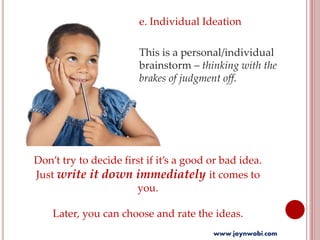
e. Individual Ideation
This is a personal/individual
brainstorm – thinking with the
brakes of judgment off.
Don’t try to decide first if it’s a good or bad idea.
Just write it down immediately it comes to
you.
Later, you can choose and rate the ideas.
www.joynwobi.com
4 BASIC RULES FOR BRAINSTORMING
• No Negative Thinking
• The wilder the Ideas, the better.
• A large number of ideas is essential. Have as many
as possible
• Combination and improvement of ideas is your
goal.
www.joynwobi.com
 Most times, one idea leads to a better idea. E.g
when we first started out with Calcon (Quality Mgt
developed to ISO Cert.)…
 Some ideas may seem far fetched and impractical
but focus on that. You are looking for all the ideas
you can possibly find.
Don’t reject any, write them all down.
www.joynwobi.com
RATE FOR EFFECTIVENESS AND FACILITY
 Rate Effectiveness by:
- Very effective
- Probably Effective
- Doubtful
 Rate Facility by:
The Idea being:
- Easy
- Not so Easy
- Difficult
www.joynwobi.com
 Rating ideas with these parameters will indicate the
likely success of any possible solution.
 It’s best to consider the ideas that are rated both
very effective and easy.
www.joynwobi.com
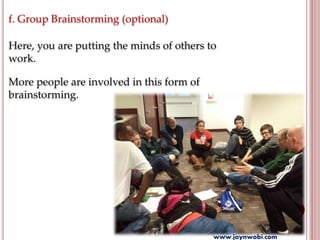
f. Group Brainstorming (optional)
Here, you are putting the minds of others to
work.
More people are involved in this form of
brainstorming.
www.joynwobi.com
• No Negative Thinking
• The wilder the Ideas, the better.
• A large number of ideas is essential. Have as
many as possible
• Combination and improvement of ideas is your
goal.
The same rules for getting ideas apply here
www.joynwobi.com
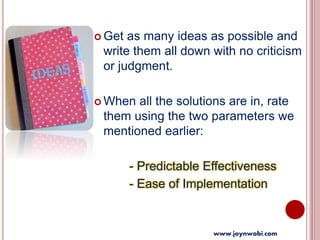
 Get as many ideas as possible and
write them all down with no criticism
or judgment.
 When all the solutions are in, rate
them using the two parameters we
mentioned earlier:
- Predictable Effectiveness
- Ease of Implementation
www.joynwobi.com
WARNING!!!
Rating the ideas must come last.
If you pass judgment on any idea while the
brainstorm is in progress, you kill the brainstorming
process.
This step is optional. You may not want group brainstorming on
every problem.
www.joynwobi.com
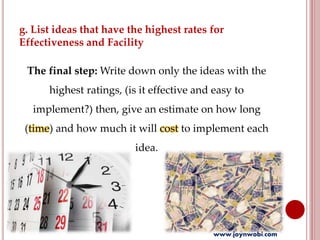
g. List ideas that have the highest rates for
Effectiveness and Facility
The final step: Write down only the ideas with the
highest ratings, (is it effective and easy to
implement?) then, give an estimate on how long
(time) and how much it will cost to implement each
idea.
www.joynwobi.com
THIS BECOMES YOUR ACTION PLAN – YOUR
SCHEDULE FOR PUTTING THE BEST IDEAS TO WORK
You now have the ideas that check out
best for:
 Effectiveness – how effective the idea is
 Facility – ease of implementation
 Time – how long it will take to implement the idea
and
 Cost – how much it will cost to implement
www.joynwobi.com
 After you review an idea in your ACTION PLAN,
you decide on 4 things:
• Who might do it;
• When it might be done
• Where it will start
• How to do it.
www.joynwobi.com
 Give yourself a deadline.
Most people work hardest and efficiently
when there is a definite time element
involved.
 You complete project or achieve goals
when you put a time element to it.
It’s advisable that you even write down a second
date just incase you don’t meet up with the first one
you set. www.joynwobi.com
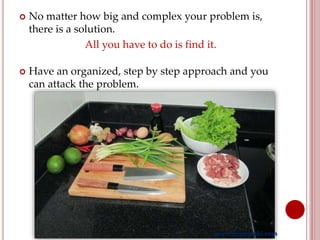
 No matter how big and complex your problem is,
there is a solution.
All you have to do is find it.
 Have an organized, step by step approach and you
can attack the problem.
www.joynwobi.com
CHAPTER 9
THE BRAINSTORM
www.joynwobi.com
2 KINDS OF BRAINSTORM
 INDIVIDUAL IDEATION
… an individual thinking up solutions to a problem
on his own
 GROUP BRAINSTORMING
… a number of people working together on solving a
problem
www.joynwobi.com
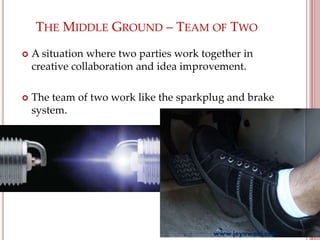
THE MIDDLE GROUND – TEAM OF TWO
 A situation where two parties work together in
creative collaboration and idea improvement.
 The team of two work like the sparkplug and brake
system.
www.joynwobi.com
THE SPARKPLUG AND BRAKE SYSTEM
 One half (the sparkplug), are the thinker uppers –
they are the thinkers.
 The other half (the brake), are the toner downers –
they are the judge. They put the thoughts in the
right perspective.
www.joynwobi.com
This model is very productive and can be done with
business associates or friends and family.
But this isn’t Brainstorming.
www.joynwobi.com
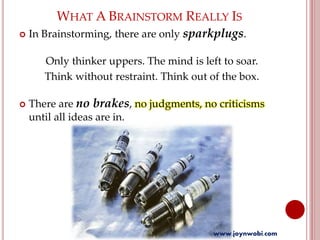
WHAT A BRAINSTORM REALLY IS
 In Brainstorming, there are only sparkplugs.
Only thinker uppers. The mind is left to soar.
Think without restraint. Think out of the box.
 There are no brakes, no judgments, no criticisms
until all ideas are in.
www.joynwobi.com
INDIVIDUAL IDEATION
 … an individual thinking up solutions to a problem on
his own
Same process as I mentioned earlier.
Define the problem clearly.
Think about it’s nature and it’s limits, till it is
clear in your mind and you can easily write down the
complete problem in one statement.
A good working definition, gives you a clear target.
www.joynwobi.com
 Now the individual brainstorm starts.
Come up with as many ideas and as many
possible solutions you can think of and write
them down.
It may not be easy at first, but it can be done.
You are looking for quantity now, quality will
come later.
www.joynwobi.com
It needs concentration, determination and perseverance to
find the best ideas to solve a problem.
The more you write, the more ideas you’ll keep getting.
www.joynwobi.com
 Don’t limit yourself, because many times, your
problems pick their own best solutions if you give
them enough choices.
Have a large quantity and variety
of ideas.
www.joynwobi.com
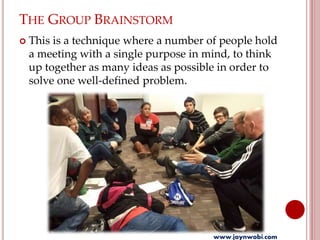
THE GROUP BRAINSTORM
 This is a technique where a number of people hold
a meeting with a single purpose in mind, to think
up together as many ideas as possible in order to
solve one well-defined problem.
www.joynwobi.com
WHAT THE GROUP BRAINSTORM IS.
 Have a gathering of 5 to 10 people in the group.
 Each member should know about the brainstorm session in
advance.
 They should each have a clear written statement of the
problem.
 Each member should spend some time on personal research
and brainstorm before the group brainstorm meeting.
 At the meeting, each member should have a pad and a pencil
so he can write down new ideas before he presents them to
the group.
 There should be a minute-taker in the group.
www.joynwobi.com
 After the brainstorm session, the minutes
should be collated and transcribed and
passed to all members in the group for
further improvement and combination of the
ideas.
Always have a leader but keep the
brainstorm as informal as possible.
Encourage everyone to contribute.
www.joynwobi.com
4 BASIC RULES FOR BRAINSTORMING
• No Negative Thinking allowed - The wilder the
Ideas, the better.
• Suspend any judgment, ideas will be judged after.
• A large number of ideas is essential. Have as many
as possible
• Combination and improvement of ideas is your
goal.
www.joynwobi.com
NOW THE BRAINSTORMING BEGINS.
 Attack the problem from all sides.
 Once the ideas start flowing, there’s a chain reaction
that takes place and firecrackers go off.
 In a short time, there are a lot of ideas generated.
Studies show that this brainstorm technique is 50%
more effective than working individually to think up
ideas to solve a problem.
www.joynwobi.com
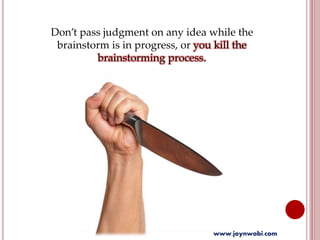
Don’t pass judgment on any idea while the
brainstorm is in progress, or you kill the
brainstorming process.
www.joynwobi.com
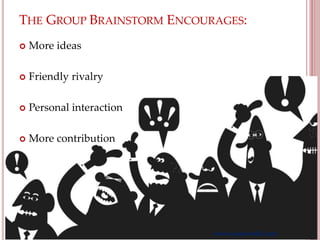
THE GROUP BRAINSTORM ENCOURAGES:
 More ideas
 Friendly rivalry
 Personal interaction
 More contribution
www.joynwobi.com
SOLVING PROBLEMS CREATIVELY
 Both are based on the same principles:
 Thinking things up
 Writing them down
 Improving them
 Judging ideas after they have all come in.
Try anything, everything, and write it all down.
www.joynwobi.com
Thanks
www.joynwobi.com

Solving problems creatively

  • 1.
    SOLVING PROBLEMS CREATIVELY How ToCreate Million Dollar Ideas
  • 2.
     In tryingto make a decision, it’s like a simple problem that we trying to solve. Most times, in making decisions, we have very few alternatives to pick from. But in solving problems, we are faced with an endless list of possibilities. www.joynwobi.com
  • 3.
     With goalachievement, it’s a point we want to reach…  So the problem to be solved here is, moving from where we are now to where we want to be. www.joynwobi.com
  • 4.
    SO…  PROBLEM SOLVING DECISION-MAKING  GOAL ACHIEVEMENT …are closely related functions of Creative Thinking. www.joynwobi.com
  • 5.
  • 6.
    a. Define theProblem Clearly A problem well stated is half-solved. Be sure to understand the problem before working on the solution. www.joynwobi.com
  • 7.
    b. Write DownEverything You Know About The Problem Many times, this information may come from books that have statistical data, your past experiences, experiences from friends and families, business associates who know something about the problem or are authorities in that area. www.joynwobi.com
  • 8.
    c. List ofPeople or Organisations That Are Authorities On The Problem This is your opportunity to go all out for facts. Call them up, ask questions that will give ideas on how to solve the problems. www.joynwobi.com
  • 9.
    d. Write downadditional information. Make notes on each information that is critical to solving the problem. Don’t risk forgetting anything or think it’s unimportant that could help you find the best solution. www.joynwobi.com
  • 10.
    e. Individual Ideation Thisis a personal/individual brainstorm – thinking with the brakes of judgment off. Don’t try to decide first if it’s a good or bad idea. Just write it down immediately it comes to you. Later, you can choose and rate the ideas. www.joynwobi.com
  • 11.
    4 BASIC RULESFOR BRAINSTORMING • No Negative Thinking • The wilder the Ideas, the better. • A large number of ideas is essential. Have as many as possible • Combination and improvement of ideas is your goal. www.joynwobi.com
  • 12.
     Most times,one idea leads to a better idea. E.g when we first started out with Calcon (Quality Mgt developed to ISO Cert.)…  Some ideas may seem far fetched and impractical but focus on that. You are looking for all the ideas you can possibly find. Don’t reject any, write them all down. www.joynwobi.com
  • 13.
    RATE FOR EFFECTIVENESSAND FACILITY  Rate Effectiveness by: - Very effective - Probably Effective - Doubtful  Rate Facility by: The Idea being: - Easy - Not so Easy - Difficult www.joynwobi.com
  • 14.
     Rating ideaswith these parameters will indicate the likely success of any possible solution.  It’s best to consider the ideas that are rated both very effective and easy. www.joynwobi.com
  • 15.
    f. Group Brainstorming(optional) Here, you are putting the minds of others to work. More people are involved in this form of brainstorming. www.joynwobi.com
  • 16.
    • No NegativeThinking • The wilder the Ideas, the better. • A large number of ideas is essential. Have as many as possible • Combination and improvement of ideas is your goal. The same rules for getting ideas apply here www.joynwobi.com
  • 17.
     Get asmany ideas as possible and write them all down with no criticism or judgment.  When all the solutions are in, rate them using the two parameters we mentioned earlier: - Predictable Effectiveness - Ease of Implementation www.joynwobi.com
  • 18.
    WARNING!!! Rating the ideasmust come last. If you pass judgment on any idea while the brainstorm is in progress, you kill the brainstorming process. This step is optional. You may not want group brainstorming on every problem. www.joynwobi.com
  • 19.
    g. List ideasthat have the highest rates for Effectiveness and Facility The final step: Write down only the ideas with the highest ratings, (is it effective and easy to implement?) then, give an estimate on how long (time) and how much it will cost to implement each idea. www.joynwobi.com
  • 20.
    THIS BECOMES YOURACTION PLAN – YOUR SCHEDULE FOR PUTTING THE BEST IDEAS TO WORK You now have the ideas that check out best for:  Effectiveness – how effective the idea is  Facility – ease of implementation  Time – how long it will take to implement the idea and  Cost – how much it will cost to implement www.joynwobi.com
  • 21.
     After youreview an idea in your ACTION PLAN, you decide on 4 things: • Who might do it; • When it might be done • Where it will start • How to do it. www.joynwobi.com
  • 22.
     Give yourselfa deadline. Most people work hardest and efficiently when there is a definite time element involved.  You complete project or achieve goals when you put a time element to it. It’s advisable that you even write down a second date just incase you don’t meet up with the first one you set. www.joynwobi.com
  • 23.
     No matterhow big and complex your problem is, there is a solution. All you have to do is find it.  Have an organized, step by step approach and you can attack the problem. www.joynwobi.com
  • 24.
  • 25.
    2 KINDS OFBRAINSTORM  INDIVIDUAL IDEATION … an individual thinking up solutions to a problem on his own  GROUP BRAINSTORMING … a number of people working together on solving a problem www.joynwobi.com
  • 26.
    THE MIDDLE GROUND– TEAM OF TWO  A situation where two parties work together in creative collaboration and idea improvement.  The team of two work like the sparkplug and brake system. www.joynwobi.com
  • 27.
    THE SPARKPLUG ANDBRAKE SYSTEM  One half (the sparkplug), are the thinker uppers – they are the thinkers.  The other half (the brake), are the toner downers – they are the judge. They put the thoughts in the right perspective. www.joynwobi.com
  • 28.
    This model isvery productive and can be done with business associates or friends and family. But this isn’t Brainstorming. www.joynwobi.com
  • 29.
    WHAT A BRAINSTORMREALLY IS  In Brainstorming, there are only sparkplugs. Only thinker uppers. The mind is left to soar. Think without restraint. Think out of the box.  There are no brakes, no judgments, no criticisms until all ideas are in. www.joynwobi.com
  • 30.
    INDIVIDUAL IDEATION  …an individual thinking up solutions to a problem on his own Same process as I mentioned earlier. Define the problem clearly. Think about it’s nature and it’s limits, till it is clear in your mind and you can easily write down the complete problem in one statement. A good working definition, gives you a clear target. www.joynwobi.com
  • 31.
     Now theindividual brainstorm starts. Come up with as many ideas and as many possible solutions you can think of and write them down. It may not be easy at first, but it can be done. You are looking for quantity now, quality will come later. www.joynwobi.com
  • 32.
    It needs concentration,determination and perseverance to find the best ideas to solve a problem. The more you write, the more ideas you’ll keep getting. www.joynwobi.com
  • 33.
     Don’t limityourself, because many times, your problems pick their own best solutions if you give them enough choices. Have a large quantity and variety of ideas. www.joynwobi.com
  • 34.
    THE GROUP BRAINSTORM This is a technique where a number of people hold a meeting with a single purpose in mind, to think up together as many ideas as possible in order to solve one well-defined problem. www.joynwobi.com
  • 35.
    WHAT THE GROUPBRAINSTORM IS.  Have a gathering of 5 to 10 people in the group.  Each member should know about the brainstorm session in advance.  They should each have a clear written statement of the problem.  Each member should spend some time on personal research and brainstorm before the group brainstorm meeting.  At the meeting, each member should have a pad and a pencil so he can write down new ideas before he presents them to the group.  There should be a minute-taker in the group. www.joynwobi.com
  • 36.
     After thebrainstorm session, the minutes should be collated and transcribed and passed to all members in the group for further improvement and combination of the ideas. Always have a leader but keep the brainstorm as informal as possible. Encourage everyone to contribute. www.joynwobi.com
  • 37.
    4 BASIC RULESFOR BRAINSTORMING • No Negative Thinking allowed - The wilder the Ideas, the better. • Suspend any judgment, ideas will be judged after. • A large number of ideas is essential. Have as many as possible • Combination and improvement of ideas is your goal. www.joynwobi.com
  • 38.
    NOW THE BRAINSTORMINGBEGINS.  Attack the problem from all sides.  Once the ideas start flowing, there’s a chain reaction that takes place and firecrackers go off.  In a short time, there are a lot of ideas generated. Studies show that this brainstorm technique is 50% more effective than working individually to think up ideas to solve a problem. www.joynwobi.com
  • 39.
    Don’t pass judgmenton any idea while the brainstorm is in progress, or you kill the brainstorming process. www.joynwobi.com
  • 40.
    THE GROUP BRAINSTORMENCOURAGES:  More ideas  Friendly rivalry  Personal interaction  More contribution www.joynwobi.com
  • 41.
    SOLVING PROBLEMS CREATIVELY Both are based on the same principles:  Thinking things up  Writing them down  Improving them  Judging ideas after they have all come in. Try anything, everything, and write it all down. www.joynwobi.com
  • 42.