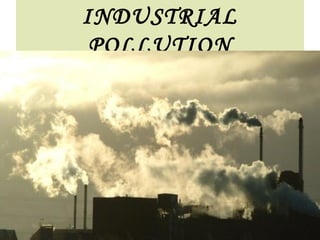
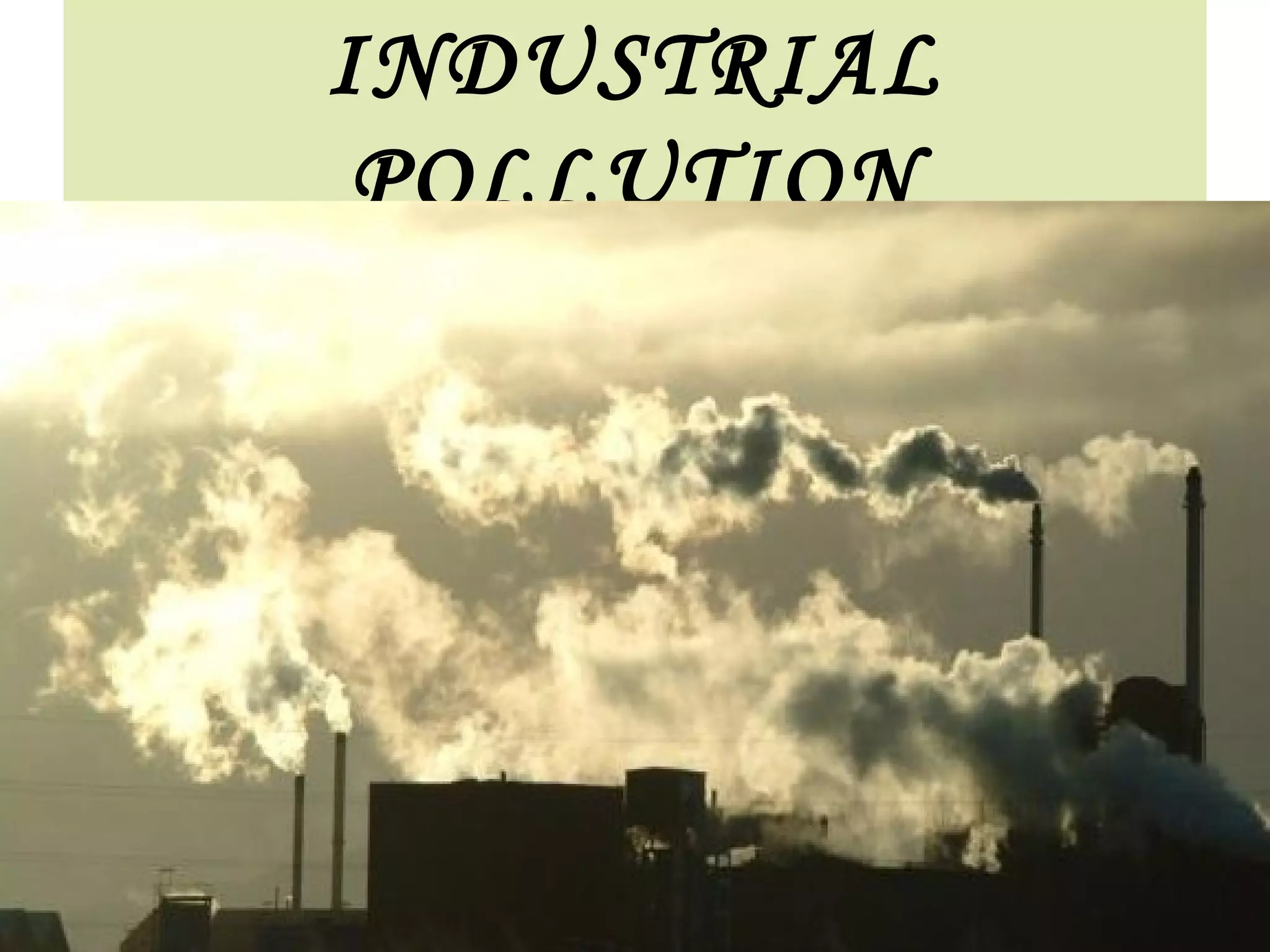
INDUSTRIAL
POLLUTION
CONTENTS
 Introduction
 Industrial pollution
 Industrial pollutant
 Forms of industrial pollution
 -Water pollution
 -Air pollution
 -soil pollution
 Global warming
 Government measures
 Pollution control
 Suggestion
INTRODUCTION
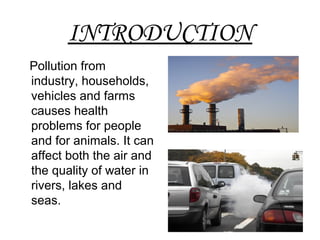
Pollution from
industry, households,
vehicles and farms
causes health
problems for people
and for animals. It can
affect both the air and
the quality of water in
rivers, lakes and
seas.
INDUSTRIAL POLLUTION
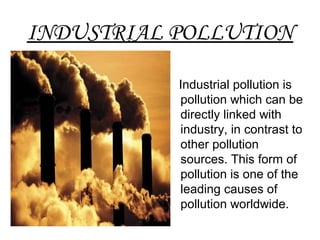
Industrial pollution is
pollution which can be
directly linked with
industry, in contrast to
other pollution
sources. This form of
pollution is one of the
leading causes of
pollution worldwide.
Where do industrial pollutants
come from ?
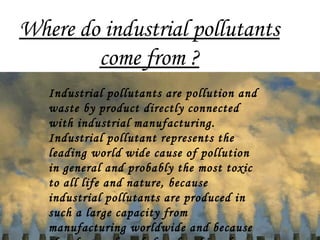
Industrial pollutants are pollution and
waste by product directly connected
with industrial manufacturing.
Industrial pollutant represents the
leading world wide cause of pollution
in general and probably the most toxic
to all life and nature, because
industrial pollutants are produced in
such a large capacity from
manufacturing worldwide and because
Industrial pollution
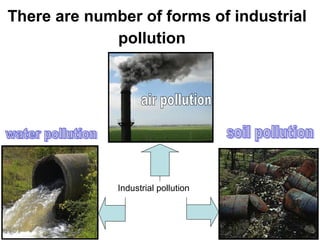
There are number of forms of industrial
pollution
Water pollution
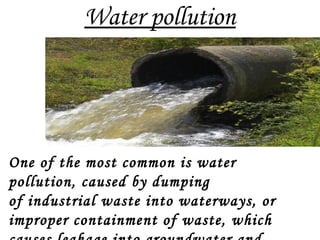
One of the most common is water
pollution, caused by dumping
of industrial waste into waterways, or
improper containment of waste, which
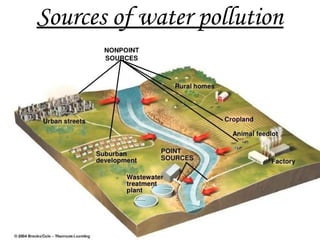
Sources of water pollution
Effects of water pollution
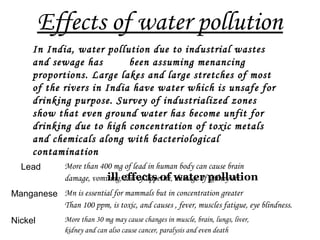
In India, water pollution due to industrial wastes
and sewage has been assuming menancing
proportions. Large lakes and large stretches of most
of the rivers in India have water which is unsafe for
drinking purpose. Survey of industrialized zones
show that even ground water has become unfit for
drinking due to high concentration of toxic metals
and chemicals along with bacteriological
contamination
ill effects of water pollution
Lead More than 400 mg of lead in human body can cause brain
damage, vomiting, loss of appetite, damage of kidney etc.
Manganese Mn is essential for mammals but in concentration greater
Than 100 ppm, is toxic, and causes , fever, muscles fatigue, eye blindness.
Nickel More than 30 mg may cause changes in muscle, brain, lungs, liver,
kidney and can also cause cancer, paralysis and even death
Air pollution
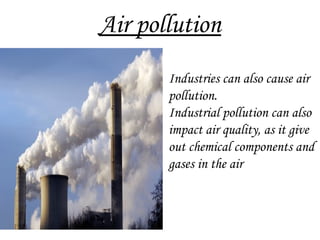
Industries can also cause air
pollution.
Industrial pollution can also
impact air quality, as it give
out chemical components and
gases in the air
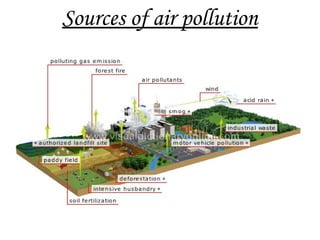
Sources of air pollution
Effects of air pollution
• Acid rain is an effect of air pollution. Acid rain can poisen
drinkwater, ruin the harvest from farmers, damage aquatic
life and erode buildings.
• Air pollution can cause cancer, headache, decreased muscle
coordination,
worse sight etc.
• Childrens have more problems with air pollution than adults.
• Smoke come out from the factories is very dangerous for those
who lives on this
earth. It contains lots of harmful chemicals which effects the
body badly.
• Different diseases are caused with this smoke like asthma,
lung disease, heart
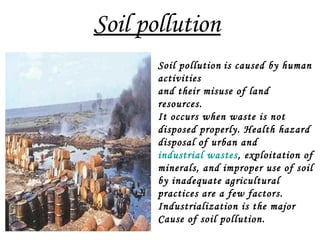
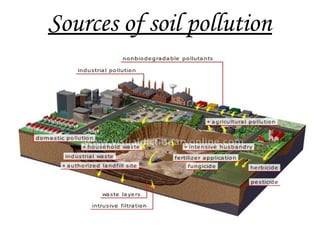
Soil pollution
Soil pollution is caused by human
activities
and their misuse of land
resources.
It occurs when waste is not
disposed properly. Health hazard
disposal of urban and
industrial wastes, exploitation of
minerals, and improper use of soil
by inadequate agricultural
practices are a few factors.
Industrialization is the major
Cause of soil pollution.
Sources of soil pollution
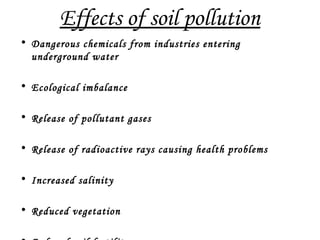
Effects of soil pollution
• Dangerous chemicals from industries entering
underground water
• Ecological imbalance
• Release of pollutant gases
• Release of radioactive rays causing health problems
• Increased salinity
• Reduced vegetation
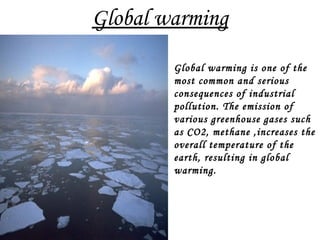
Global warming
Global warming is one of the
most common and serious
consequences of industrial
pollution. The emission of
various greenhouse gases such
as CO2, methane ,increases the
overall temperature of the
earth, resulting in global
warming.
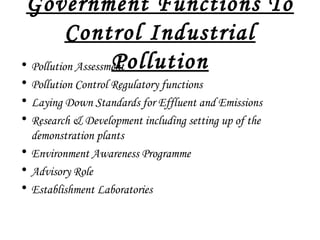
Government Functions To
Control Industrial
Pollution• Pollution Assessment
• Pollution Control Regulatory functions
• Laying Down Standards for Effluent and Emissions
• Research & Development including setting up of the
demonstration plants
• Environment Awareness Programme
• Advisory Role
• Establishment Laboratories
Government Strategies
To Control Industrial
Pollution• Take up highly polluting large and medium industries, most grossly
polluted areas of the State and grossly polluted river stretches to be
dealt with on priority basis for control of pollution.
• Promotional measures and assistance through incentives, guidelines,
development of cost effective technologies and putting up of
demonstration plants.
• Persuasion of industry / local bodies to take preventive measures for the
control of pollution.
• Strengthening of capacities for pollution control through training and
laboratory development and strengthening of man power and
infrastructure.
Government Activities
To Control Industrial
Pollution• It carries out the monitoring of the Water quality of all the four rivers of
the State viz. Satluj, Beas, Ravi & Ghaggar through 37 monitoring
stations
• It monitors  the groundwater quality in the major industrial towns of
Ludhiana, Jalandhar, Amritsar, Nangal etc.
• It carries out the monitoring of the quality of ambient air of Ludhiana,
Jalandhar, Amritsar, Patiala, Mandi Gobindgarh & Nangal through 22
permanent air monitoring stations.
• The Board advices, guides, encourages, persuades & helps the industry in
putting up effluent treatment plants and air pollution control devices to
control pollution and in taking other measures to prevent or reduce
pollution.
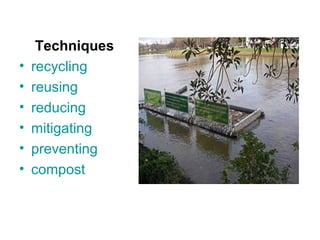
Techniques
• recycling
• reusing
• reducing
• mitigating
• preventing
• compost
Pollution control
• Pollution control is a term used in 
environmental management. It means the control of emissions
 and effluents into air, water or soil. Without pollution
control, the waste products from consumption, heating,
agriculture, mining, manufacturing, transportation and other
human activities, whether they accumulate or disperse, will
degrade the environment. In the hierarchy of controls, 
pollution prevention and waste minimization are more
desirable than pollution control. In the field of 
land development, low impact development is a similar
technique for the prevention of urban runoff.
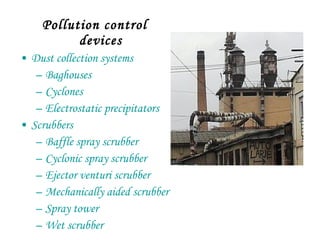
Pollution control
devices
• Dust collection systems
– Baghouses
– Cyclones
– Electrostatic precipitators
• Scrubbers
– Baffle spray scrubber
– Cyclonic spray scrubber
– Ejector venturi scrubber
– Mechanically aided scrubber
– Spray tower
– Wet scrubber
• Sewage treatment
– Sedimentation (Primary treatment)
– Activated sludge biotreaters (Secondary treatment; also used for
industrial wastewater)
– Aerated lagoons
– Constructed wetlands (also used for urban runoff)
• Industrial wastewater treatment
– API oil-water separators[15][35]
– Biofilters
– Dissolved air flotation (DAF)
– Powdered activated carbon treatment
– Ultrafiltration
• Vapor recovery systems
• Phytoremediation
SUGGESTIONS
• Stop smoking or at least follow the “No Smoking” sign.
• Never use open fires to dispose of wastes.
• Industries should use fuel with lower sulphur content.
• Industries should monitor their air emissions regularly
and take measures to ensure compliance with the
prescribed emission standards.
• Industries should strictly follow applicable government
regulations on pollution control.
• Take very good care of your pets and their wastes.
• Do not cause loud noises and unwanted sounds to avoid
noise pollution.
• Have a proper waste disposal system especially for toxic
wastes
Industrial pollution.

Industrial pollution.

  • 1.
  • 2.
    CONTENTS  Introduction  Industrialpollution  Industrial pollutant  Forms of industrial pollution  -Water pollution  -Air pollution  -soil pollution  Global warming  Government measures  Pollution control  Suggestion
  • 3.
    INTRODUCTION Pollution from industry, households, vehiclesand farms causes health problems for people and for animals. It can affect both the air and the quality of water in rivers, lakes and seas.
  • 4.
    INDUSTRIAL POLLUTION Industrial pollutionis pollution which can be directly linked with industry, in contrast to other pollution sources. This form of pollution is one of the leading causes of pollution worldwide.
  • 5.
    Where do industrialpollutants come from ? Industrial pollutants are pollution and waste by product directly connected with industrial manufacturing. Industrial pollutant represents the leading world wide cause of pollution in general and probably the most toxic to all life and nature, because industrial pollutants are produced in such a large capacity from manufacturing worldwide and because
  • 6.
    Industrial pollution There arenumber of forms of industrial pollution
  • 7.
    Water pollution One ofthe most common is water pollution, caused by dumping of industrial waste into waterways, or improper containment of waste, which
  • 8.
  • 9.
    Effects of waterpollution In India, water pollution due to industrial wastes and sewage has been assuming menancing proportions. Large lakes and large stretches of most of the rivers in India have water which is unsafe for drinking purpose. Survey of industrialized zones show that even ground water has become unfit for drinking due to high concentration of toxic metals and chemicals along with bacteriological contamination ill effects of water pollution Lead More than 400 mg of lead in human body can cause brain damage, vomiting, loss of appetite, damage of kidney etc. Manganese Mn is essential for mammals but in concentration greater Than 100 ppm, is toxic, and causes , fever, muscles fatigue, eye blindness. Nickel More than 30 mg may cause changes in muscle, brain, lungs, liver, kidney and can also cause cancer, paralysis and even death
  • 10.
    Air pollution Industries canalso cause air pollution. Industrial pollution can also impact air quality, as it give out chemical components and gases in the air
  • 11.
    Sources of airpollution
  • 12.
    Effects of airpollution • Acid rain is an effect of air pollution. Acid rain can poisen drinkwater, ruin the harvest from farmers, damage aquatic life and erode buildings. • Air pollution can cause cancer, headache, decreased muscle coordination, worse sight etc. • Childrens have more problems with air pollution than adults. • Smoke come out from the factories is very dangerous for those who lives on this earth. It contains lots of harmful chemicals which effects the body badly. • Different diseases are caused with this smoke like asthma, lung disease, heart
  • 13.
    Soil pollution Soil pollutionis caused by human activities and their misuse of land resources. It occurs when waste is not disposed properly. Health hazard disposal of urban and industrial wastes, exploitation of minerals, and improper use of soil by inadequate agricultural practices are a few factors. Industrialization is the major Cause of soil pollution.
  • 14.
    Sources of soilpollution
  • 15.
    Effects of soilpollution • Dangerous chemicals from industries entering underground water • Ecological imbalance • Release of pollutant gases • Release of radioactive rays causing health problems • Increased salinity • Reduced vegetation
  • 16.
    Global warming Global warmingis one of the most common and serious consequences of industrial pollution. The emission of various greenhouse gases such as CO2, methane ,increases the overall temperature of the earth, resulting in global warming.
  • 17.
    Government Functions To ControlIndustrial Pollution• Pollution Assessment • Pollution Control Regulatory functions • Laying Down Standards for Effluent and Emissions • Research & Development including setting up of the demonstration plants • Environment Awareness Programme • Advisory Role • Establishment Laboratories
  • 18.
    Government Strategies To ControlIndustrial Pollution• Take up highly polluting large and medium industries, most grossly polluted areas of the State and grossly polluted river stretches to be dealt with on priority basis for control of pollution. • Promotional measures and assistance through incentives, guidelines, development of cost effective technologies and putting up of demonstration plants. • Persuasion of industry / local bodies to take preventive measures for the control of pollution. • Strengthening of capacities for pollution control through training and laboratory development and strengthening of man power and infrastructure.
  • 19.
    Government Activities To ControlIndustrial Pollution• It carries out the monitoring of the Water quality of all the four rivers of the State viz. Satluj, Beas, Ravi & Ghaggar through 37 monitoring stations • It monitors  the groundwater quality in the major industrial towns of Ludhiana, Jalandhar, Amritsar, Nangal etc. • It carries out the monitoring of the quality of ambient air of Ludhiana, Jalandhar, Amritsar, Patiala, Mandi Gobindgarh & Nangal through 22 permanent air monitoring stations. • The Board advices, guides, encourages, persuades & helps the industry in putting up effluent treatment plants and air pollution control devices to control pollution and in taking other measures to prevent or reduce pollution.
  • 20.
    Techniques • recycling • reusing •reducing • mitigating • preventing • compost
  • 21.
    Pollution control • Pollutioncontrol is a term used in  environmental management. It means the control of emissions  and effluents into air, water or soil. Without pollution control, the waste products from consumption, heating, agriculture, mining, manufacturing, transportation and other human activities, whether they accumulate or disperse, will degrade the environment. In the hierarchy of controls,  pollution prevention and waste minimization are more desirable than pollution control. In the field of  land development, low impact development is a similar technique for the prevention of urban runoff.
  • 22.
    Pollution control devices • Dustcollection systems – Baghouses – Cyclones – Electrostatic precipitators • Scrubbers – Baffle spray scrubber – Cyclonic spray scrubber – Ejector venturi scrubber – Mechanically aided scrubber – Spray tower – Wet scrubber
  • 23.
    • Sewage treatment –Sedimentation (Primary treatment) – Activated sludge biotreaters (Secondary treatment; also used for industrial wastewater) – Aerated lagoons – Constructed wetlands (also used for urban runoff) • Industrial wastewater treatment – API oil-water separators[15][35] – Biofilters – Dissolved air flotation (DAF) – Powdered activated carbon treatment – Ultrafiltration • Vapor recovery systems • Phytoremediation
  • 24.
    SUGGESTIONS • Stop smokingor at least follow the “No Smoking” sign. • Never use open fires to dispose of wastes. • Industries should use fuel with lower sulphur content. • Industries should monitor their air emissions regularly and take measures to ensure compliance with the prescribed emission standards. • Industries should strictly follow applicable government regulations on pollution control. • Take very good care of your pets and their wastes. • Do not cause loud noises and unwanted sounds to avoid noise pollution. • Have a proper waste disposal system especially for toxic wastes