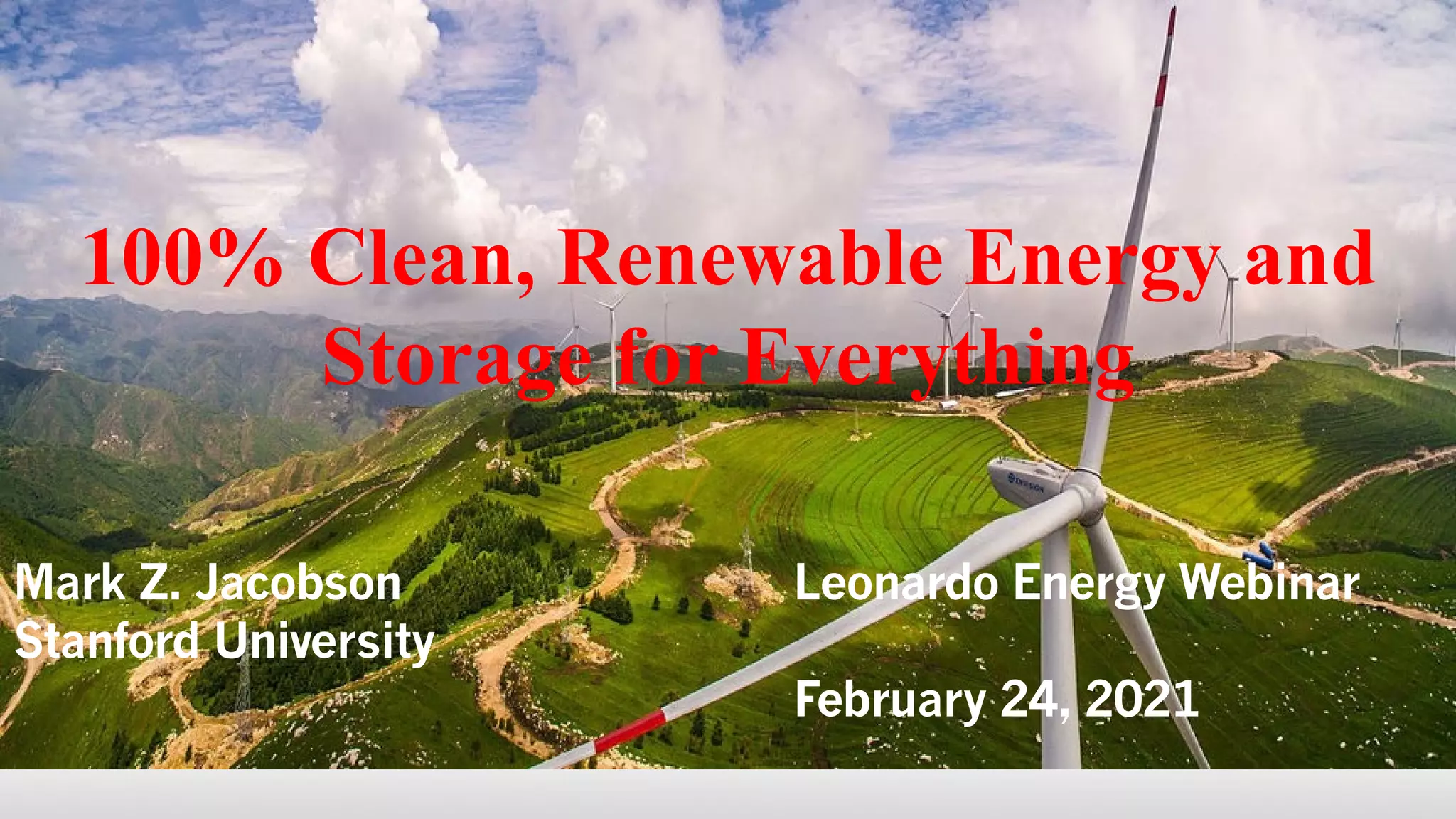
100% Clean, Renewable Energy and
Storage for Everything
Mark Z. Jacobson Leonardo Energy Webinar
Stanford University
February 24, 2021
What are the Problems? Why act Quickly?
Fossil-fuel and biofuel air pollution cause ~7 million air pollution deaths per
year worldwide costing ~$30 trillion/year
Global warming will cost the world ~$25-30 trillion per year by 2050.
Fossil fuels will become scarce over time, increasing energy prices and
economic, political, and social instability
Drastic problems require immediate solutions
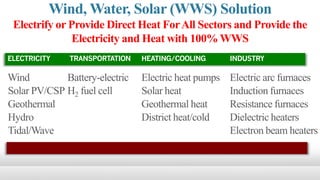
ELECTRICITY TRANSPORTATION HEATING/COOLING INDUSTRY
Wind Battery-electric Electric heat pumps Electric arc furnaces
Solar PV/CSP H2 fuel cell Solar heat Induction furnaces
Geothermal Geothermal heat Resistance furnaces
Hydro District heat/cold Dielectric heaters
Tidal/Wave Electron beam heaters
Wind, Water, Solar (WWS) Solution
Electrify or Provide Direct Heat ForAll Sectors and Provide the
Electricity and Heat with 100% WWS
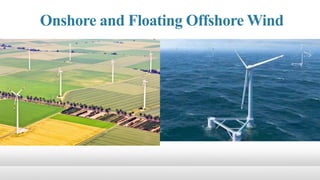
Onshore and Floating Offshore Wind
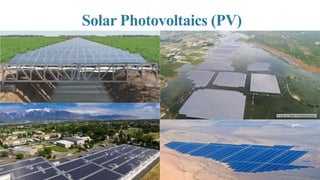
Solar Photovoltaics (PV)
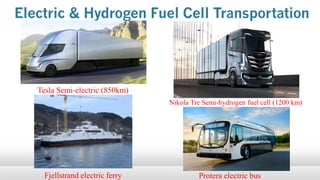
Tesla Semi-electric (850km)
Fjellstrand electric ferry Protera electric bus
Nikola Tre Semi-hydrogen fuel cell (1200 km)
Electric & Hydrogen Fuel Cell Transportation
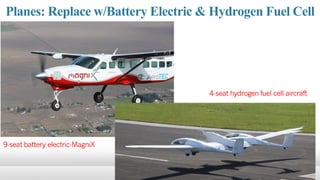
Planes: Replace w/Battery Electric & Hydrogen Fuel Cell
4-seat hydrogen fuel cell aircraft
9-seat battery electric-MagniX
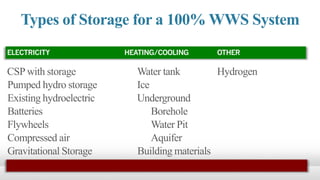
ELECTRICITY HEATING/COOLING OTHER
CSP with storage Water tank Hydrogen
Pumped hydro storage Ice
Existing hydroelectric Underground
Batteries Borehole
Flywheels Water Pit
Compressed air Aquifer
Gravitational Storage Building materials
Types of Storage for a 100% WWS System
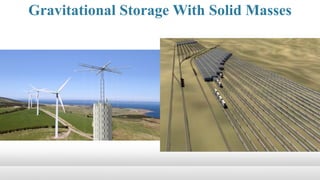
Gravitational Storage With Solid Masses
Stanford University 4th Generation District Heating System
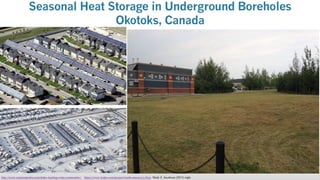
Seasonal Heat Storage in Underground Boreholes
Okotoks, Canada
http://www.sustainapedia.com/drake-landing-solar-community/ https://www.leidos.com/project/north-america’s-first- Mark Z. Jacobson (2015) right
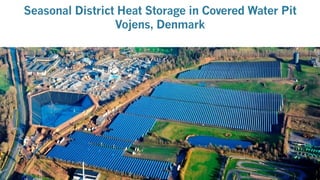
Seasonal District Heat Storage in Covered Water Pit
Vojens, Denmark
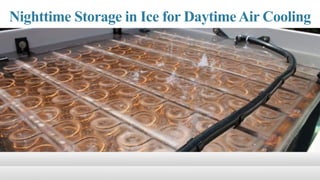
Nighttime Storage in Ice for DaytimeAir Cooling
Transitioning an Individual Home to Run
on WWS Electricity/Storage and No Gas
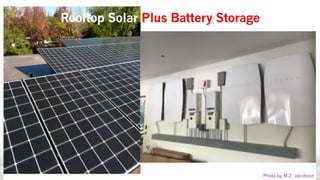
Rooftop Solar Plus Battery Storage
Photo by M.Z. Jacobson
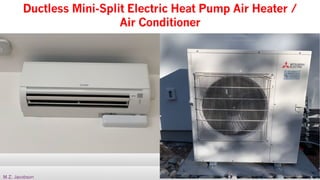
Ductless Mini-Split Electric Heat Pump Air Heater /
Air Conditioner
M.Z. Jacobson
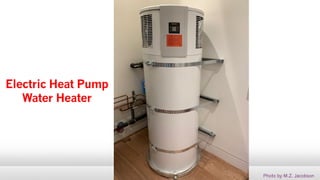
Electric Heat Pump
Water Heater
Photo by M.Z. Jacobson
Electric Induction Cooktop
Photo by M.Z. Jacobson
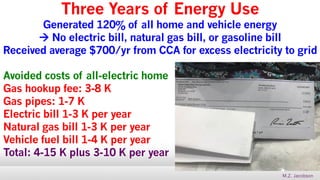
Three Years of Energy Use
Generated 120% of all home and vehicle energy
 No electric bill, natural gas bill, or gasoline bill
Received average $700/yr from CCA for excess electricity to grid
M.Z. Jacobson
Avoided costs of all-electric home
Gas hookup fee: 3-8 K
Gas pipes: 1-7 K
Electric bill 1-3 K per year
Natural gas bill 1-3 K per year
Vehicle fuel bill 1-4 K per year
Total: 4-15 K plus 3-10 K per year
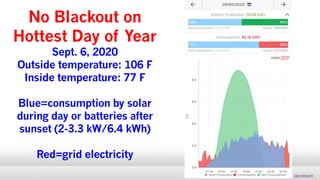
No Blackout on
Hottest Day of Year
Sept. 6, 2020
Outside temperature: 106 F
Inside temperature: 77 F
Blue=consumption by solar
during day or batteries after
sunset (2-3.3 kW/6.4 kWh)
Red=grid electricity
M.Z. Jacobson
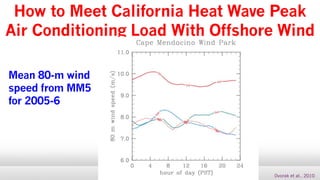
How to Meet California Heat Wave Peak
Air Conditioning Load With Offshore Wind
Dvorak et al., 2010
Mean 80-m wind
speed from MM5
for 2005-6
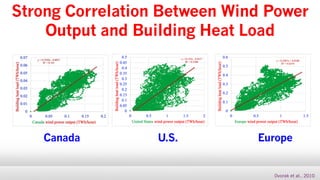
Strong Correlation Between Wind Power
Output and Building Heat Load
Dvorak et al., 2010
Canada U.S. Europe
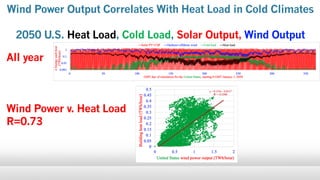
All year
Wind Power v. Heat Load
R=0.73
Wind Power Output Correlates With Heat Load in Cold Climates
2050 U.S. Heat Load, Cold Load, Solar Output, Wind Output
Can the World Transition to 100%, Clean,
Renewable Energy for all Purposes?
Roadmaps for 143 Countries
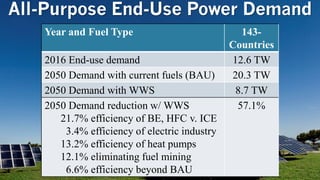
All-Purpose End-Use Power Demand
Year and Fuel Type 143-
Countries
2016 End-use demand 12.6 TW
2050 Demand with current fuels (BAU) 20.3 TW
2050 Demand with WWS 8.7 TW
2050 Demand reduction w/ WWS
21.7% efficiency of BE, HFC v. ICE
3.4% efficiency of electric industry
13.2% efficiency of heat pumps
12.1% eliminating fuel mining
6.6% efficiency beyond BAU
57.1%
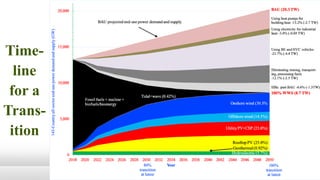
Time-
line
for a
Trans-
ition
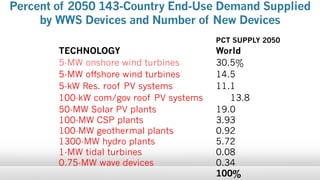
PCT SUPPLY 2050
TECHNOLOGY World
5-MW onshore wind turbines 30.5%
5-MW offshore wind turbines 14.5
5-kW Res. roof PV systems 11.1
100-kW com/gov roof PV systems 13.8
50-MW Solar PV plants 19.0
100-MW CSP plants 3.93
100-MW geothermal plants 0.92
1300-MW hydro plants 5.72
1-MW tidal turbines 0.08
0.75-MW wave devices 0.34
100%
Percent of 2050 143-Country End-Use Demand Supplied
by WWS Devices and Number of New Devices
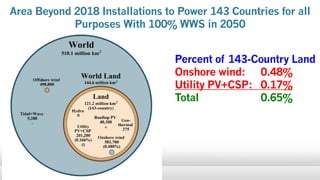
Area Beyond 2018 Installations to Power 143 Countries for all
Purposes With 100% WWS in 2050
Percent of 143-Country Land
Onshore wind: 0.48%
Utility PV+CSP: 0.17%
Total 0.65%
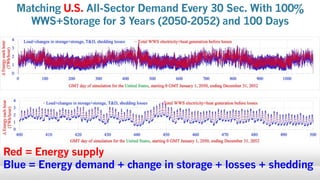
Red = Energy supply
Blue = Energy demand + change in storage + losses + shedding
Matching U.S. All-Sector Demand Every 30 Sec. With 100%
WWS+Storage for 3 Years (2050-2052) and 100 Days
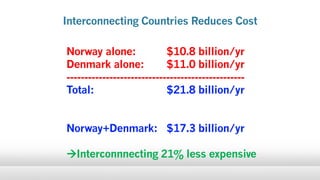
Norway alone: $10.8 billion/yr
Denmark alone: $11.0 billion/yr
--------------------------------------------------
Total: $21.8 billion/yr
Norway+Denmark: $17.3 billion/yr
Interconnnecting 21% less expensive
Interconnecting Countries Reduces Cost
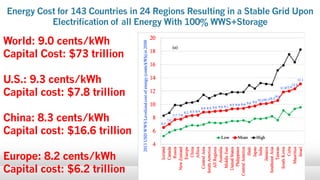
Energy Cost for 143 Countries in 24 Regions Resulting in a Stable Grid Upon
Electrification of all Energy With 100% WWS+Storage
World: 9.0 cents/kWh
Capital Cost: $73 trillion
U.S.: 9.3 cents/kWh
Capital cost: $7.8 trillion
China: 8.3 cents/kWh
Capital cost: $16.6 trillion
Europe: 8.2 cents/kWh
Capital cost: $6.2 trillion
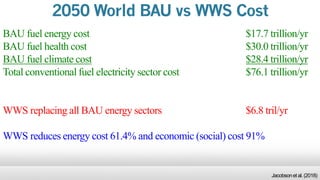
BAU fuel energy cost $17.7 trillion/yr
BAU fuel health cost $30.0 trillion/yr
BAU fuel climate cost $28.4 trillion/yr
Total conventional fuel electricity sector cost $76.1 trillion/yr
WWS replacing all BAU energy sectors $6.8 tril/yr
WWS reduces energy cost 61.4% and economic (social) cost 91%
2050 World BAU vs WWS Cost
Jacobsonet al.(2018)
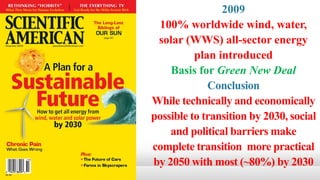
2009
100% worldwide wind, water,
solar (WWS) all-sector energy
plan introduced
Basis for Green New Deal
Conclusion
While technically and economically
possible to transition by 2030, social
and political barriers make
complete transition more practical
by 2050 with most (~80%) by 2030
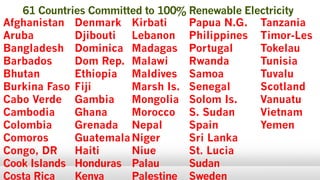
61 Countries Committed to 100% Renewable Electricity
Afghanistan Denmark Kirbati Papua N.G. Tanzania
Aruba Djibouti Lebanon Philippines Timor-Les
Bangladesh Dominica Madagas Portugal Tokelau
Barbados Dom Rep. Malawi Rwanda Tunisia
Bhutan Ethiopia Maldives Samoa Tuvalu
Burkina Faso Fiji Marsh Is. Senegal Scotland
Cabo Verde Gambia Mongolia Solom Is. Vanuatu
Cambodia Ghana Morocco S. Sudan Vietnam
Colombia Grenada Nepal Spain Yemen
Comoros GuatemalaNiger Sri Lanka
Congo, DR Haiti Niue St. Lucia
Cook Islands Honduras Palau Sudan
Costa Rica Kenya Palestine Sweden
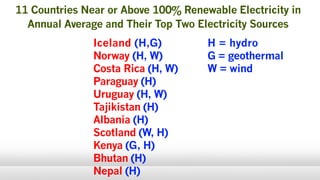
11 Countries Near or Above 100% Renewable Electricity in
Annual Average and Their Top Two Electricity Sources
Iceland (H,G) H = hydro
Norway (H, W) G = geothermal
Costa Rica (H, W) W = wind
Paraguay (H)
Uruguay (H, W)
Tajikistan (H)
Albania (H)
Scotland (W, H)
Kenya (G, H)
Bhutan (H)
Nepal (H)
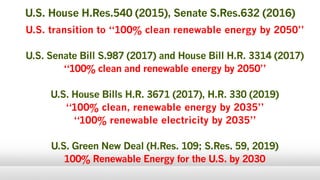
U.S. transition to “100% clean renewable energy by 2050”
U.S. Senate Bill S.987 (2017) and House Bill H.R. 3314 (2017)
“100% clean and renewable energy by 2050”
U.S. House Bills H.R. 3671 (2017), H.R. 330 (2019)
“100% clean, renewable energy by 2035”
“100% renewable electricity by 2035”
U.S. Green New Deal (H.Res. 109; S.Res. 59, 2019)
100% Renewable Energy for the U.S. by 2030
U.S. House H.Res.540 (2015), Senate S.Res.632 (2016)
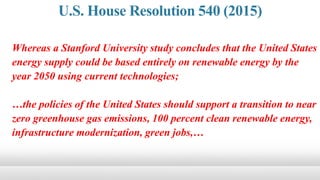
Whereas a Stanford University study concludes that the United States
energy supply could be based entirely on renewable energy by the
year 2050 using current technologies;
…the policies of the United States should support a transition to near
zero greenhouse gas emissions, 100 percent clean renewable energy,
infrastructure modernization, green jobs,…
U.S. House Resolution 540 (2015)
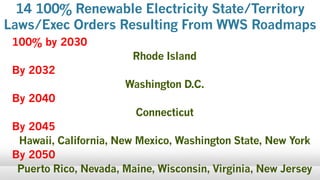
100% by 2030
Rhode Island
By 2032
Washington D.C.
By 2040
Connecticut
By 2045
Hawaii, California, New Mexico, Washington State, New York
By 2050
Puerto Rico, Nevada, Maine, Wisconsin, Virginia, New Jersey
14 100% Renewable Electricity State/Territory
Laws/Exec Orders Resulting From WWS Roadmaps
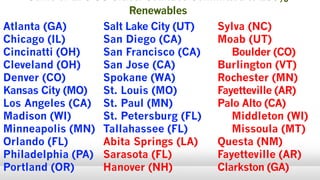
Some of 176 US Cities/Counties Committed to 100%
Renewables
Atlanta (GA) Salt Lake City (UT) Sylva (NC)
Chicago (IL) San Diego (CA) Moab (UT)
Cincinatti (OH) San Francisco (CA) Boulder (CO)
Cleveland (OH) San Jose (CA) Burlington (VT)
Denver (CO) Spokane (WA) Rochester (MN)
Kansas City (MO) St. Louis (MO) Fayetteville (AR)
Los Angeles (CA) St. Paul (MN) Palo Alto (CA)
Madison (WI) St. Petersburg (FL) Middleton (WI)
Minneapolis (MN) Tallahassee (FL) Missoula (MT)
Orlando (FL) Abita Springs (LA) Questa (NM)
Philadelphia (PA) Sarasota (FL) Fayetteville (AR)
Portland (OR) Hanover (NH) Clarkston (GA)
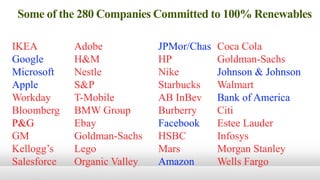
Some of the 280 Companies Committed to 100% Renewables
IKEA Adobe JPMor/Chas Coca Cola
Google H&M HP Goldman-Sachs
Microsoft Nestle Nike Johnson & Johnson
Apple S&P Starbucks Walmart
Workday T-Mobile AB InBev Bank of America
Bloomberg BMW Group Burberry Citi
P&G Ebay Facebook Estee Lauder
GM Goldman-Sachs HSBC Infosys
Kellogg’s Lego Mars Morgan Stanley
Salesforce Organic Valley Amazon Wells Fargo
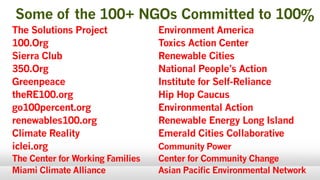
Some of the 100+ NGOs Committed to 100%
The Solutions Project Environment America
100.Org Toxics Action Center
Sierra Club Renewable Cities
350.Org National People’s Action
Greenpeace Institute for Self-Reliance
theRE100.org Hip Hop Caucus
go100percent.org Environmental Action
renewables100.org Renewable Energy Long Island
Climate Reality Emerald Cities Collaborative
iclei.org Community Power
The Center for Working Families Center for Community Change
Miami Climate Alliance Asian Pacific Environmental Network
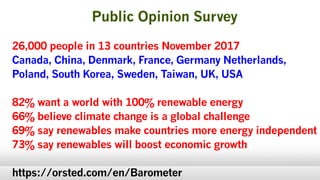
Public Opinion Survey
26,000 people in 13 countries November 2017
Canada, China, Denmark, France, Germany Netherlands,
Poland, South Korea, Sweden, Taiwan, UK, USA
82% want a world with 100% renewable energy
66% believe climate change is a global challenge
69% say renewables make countries more energy independent
73% say renewables will boost economic growth
https://orsted.com/en/Barometer
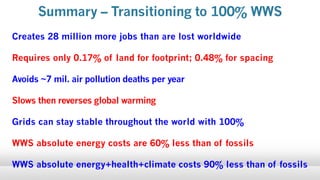
Creates 28 million more jobs than are lost worldwide
Requires only 0.17% of land for footprint; 0.48% for spacing
Avoids ~7 mil. air pollution deaths per year
Slows then reverses global warming
Grids can stay stable throughout the world with 100%
WWS absolute energy costs are 60% less than of fossils
WWS absolute energy+health+climate costs 90% less than of fossils
Summary – Transitioning to 100% WWS
Online Course on 100% WWS
http://stanford.io/windwatersolar
Roadmaps
web.stanford.edu/group/efmh/jacobson/Articles/I/WWS
-50-USState-plans.html
Infographic maps
www.thesolutionsproject.org/why-clean-energy/
Textbook on 100% WWS
https://web.stanford.edu/group/efmh/jacobson/WWSBo
ok/WWSBook.html
Twitter: @mzjacobson

100% Clean, Renewable Energy and Storage for Everything

  • 1.
    100% Clean, RenewableEnergy and Storage for Everything Mark Z. Jacobson Leonardo Energy Webinar Stanford University February 24, 2021
  • 2.
    What are theProblems? Why act Quickly? Fossil-fuel and biofuel air pollution cause ~7 million air pollution deaths per year worldwide costing ~$30 trillion/year Global warming will cost the world ~$25-30 trillion per year by 2050. Fossil fuels will become scarce over time, increasing energy prices and economic, political, and social instability Drastic problems require immediate solutions
  • 3.
    ELECTRICITY TRANSPORTATION HEATING/COOLINGINDUSTRY Wind Battery-electric Electric heat pumps Electric arc furnaces Solar PV/CSP H2 fuel cell Solar heat Induction furnaces Geothermal Geothermal heat Resistance furnaces Hydro District heat/cold Dielectric heaters Tidal/Wave Electron beam heaters Wind, Water, Solar (WWS) Solution Electrify or Provide Direct Heat ForAll Sectors and Provide the Electricity and Heat with 100% WWS
  • 4.
    Onshore and FloatingOffshore Wind
  • 5.
  • 6.
    Tesla Semi-electric (850km) Fjellstrandelectric ferry Protera electric bus Nikola Tre Semi-hydrogen fuel cell (1200 km) Electric & Hydrogen Fuel Cell Transportation
  • 7.
    Planes: Replace w/BatteryElectric & Hydrogen Fuel Cell 4-seat hydrogen fuel cell aircraft 9-seat battery electric-MagniX
  • 8.
    ELECTRICITY HEATING/COOLING OTHER CSPwith storage Water tank Hydrogen Pumped hydro storage Ice Existing hydroelectric Underground Batteries Borehole Flywheels Water Pit Compressed air Aquifer Gravitational Storage Building materials Types of Storage for a 100% WWS System
  • 9.
  • 10.
    Stanford University 4thGeneration District Heating System
  • 11.
    Seasonal Heat Storagein Underground Boreholes Okotoks, Canada http://www.sustainapedia.com/drake-landing-solar-community/ https://www.leidos.com/project/north-america’s-first- Mark Z. Jacobson (2015) right
  • 12.
    Seasonal District HeatStorage in Covered Water Pit Vojens, Denmark
  • 13.
    Nighttime Storage inIce for DaytimeAir Cooling
  • 14.
    Transitioning an IndividualHome to Run on WWS Electricity/Storage and No Gas
  • 15.
    Rooftop Solar PlusBattery Storage Photo by M.Z. Jacobson
  • 16.
    Ductless Mini-Split ElectricHeat Pump Air Heater / Air Conditioner M.Z. Jacobson
  • 17.
    Electric Heat Pump WaterHeater Photo by M.Z. Jacobson
  • 18.
  • 19.
    Three Years ofEnergy Use Generated 120% of all home and vehicle energy  No electric bill, natural gas bill, or gasoline bill Received average $700/yr from CCA for excess electricity to grid M.Z. Jacobson Avoided costs of all-electric home Gas hookup fee: 3-8 K Gas pipes: 1-7 K Electric bill 1-3 K per year Natural gas bill 1-3 K per year Vehicle fuel bill 1-4 K per year Total: 4-15 K plus 3-10 K per year
  • 20.
    No Blackout on HottestDay of Year Sept. 6, 2020 Outside temperature: 106 F Inside temperature: 77 F Blue=consumption by solar during day or batteries after sunset (2-3.3 kW/6.4 kWh) Red=grid electricity M.Z. Jacobson
  • 21.
    How to MeetCalifornia Heat Wave Peak Air Conditioning Load With Offshore Wind Dvorak et al., 2010 Mean 80-m wind speed from MM5 for 2005-6
  • 22.
    Strong Correlation BetweenWind Power Output and Building Heat Load Dvorak et al., 2010 Canada U.S. Europe
  • 23.
    All year Wind Powerv. Heat Load R=0.73 Wind Power Output Correlates With Heat Load in Cold Climates 2050 U.S. Heat Load, Cold Load, Solar Output, Wind Output
  • 24.
    Can the WorldTransition to 100%, Clean, Renewable Energy for all Purposes? Roadmaps for 143 Countries
  • 25.
    All-Purpose End-Use PowerDemand Year and Fuel Type 143- Countries 2016 End-use demand 12.6 TW 2050 Demand with current fuels (BAU) 20.3 TW 2050 Demand with WWS 8.7 TW 2050 Demand reduction w/ WWS 21.7% efficiency of BE, HFC v. ICE 3.4% efficiency of electric industry 13.2% efficiency of heat pumps 12.1% eliminating fuel mining 6.6% efficiency beyond BAU 57.1%
  • 26.
  • 27.
    PCT SUPPLY 2050 TECHNOLOGYWorld 5-MW onshore wind turbines 30.5% 5-MW offshore wind turbines 14.5 5-kW Res. roof PV systems 11.1 100-kW com/gov roof PV systems 13.8 50-MW Solar PV plants 19.0 100-MW CSP plants 3.93 100-MW geothermal plants 0.92 1300-MW hydro plants 5.72 1-MW tidal turbines 0.08 0.75-MW wave devices 0.34 100% Percent of 2050 143-Country End-Use Demand Supplied by WWS Devices and Number of New Devices
  • 28.
    Area Beyond 2018Installations to Power 143 Countries for all Purposes With 100% WWS in 2050 Percent of 143-Country Land Onshore wind: 0.48% Utility PV+CSP: 0.17% Total 0.65%
  • 29.
    Red = Energysupply Blue = Energy demand + change in storage + losses + shedding Matching U.S. All-Sector Demand Every 30 Sec. With 100% WWS+Storage for 3 Years (2050-2052) and 100 Days
  • 30.
    Norway alone: $10.8billion/yr Denmark alone: $11.0 billion/yr -------------------------------------------------- Total: $21.8 billion/yr Norway+Denmark: $17.3 billion/yr Interconnnecting 21% less expensive Interconnecting Countries Reduces Cost
  • 31.
    Energy Cost for143 Countries in 24 Regions Resulting in a Stable Grid Upon Electrification of all Energy With 100% WWS+Storage World: 9.0 cents/kWh Capital Cost: $73 trillion U.S.: 9.3 cents/kWh Capital cost: $7.8 trillion China: 8.3 cents/kWh Capital cost: $16.6 trillion Europe: 8.2 cents/kWh Capital cost: $6.2 trillion
  • 32.
    BAU fuel energycost $17.7 trillion/yr BAU fuel health cost $30.0 trillion/yr BAU fuel climate cost $28.4 trillion/yr Total conventional fuel electricity sector cost $76.1 trillion/yr WWS replacing all BAU energy sectors $6.8 tril/yr WWS reduces energy cost 61.4% and economic (social) cost 91% 2050 World BAU vs WWS Cost Jacobsonet al.(2018)
  • 33.
    2009 100% worldwide wind,water, solar (WWS) all-sector energy plan introduced Basis for Green New Deal Conclusion While technically and economically possible to transition by 2030, social and political barriers make complete transition more practical by 2050 with most (~80%) by 2030
  • 34.
    61 Countries Committedto 100% Renewable Electricity Afghanistan Denmark Kirbati Papua N.G. Tanzania Aruba Djibouti Lebanon Philippines Timor-Les Bangladesh Dominica Madagas Portugal Tokelau Barbados Dom Rep. Malawi Rwanda Tunisia Bhutan Ethiopia Maldives Samoa Tuvalu Burkina Faso Fiji Marsh Is. Senegal Scotland Cabo Verde Gambia Mongolia Solom Is. Vanuatu Cambodia Ghana Morocco S. Sudan Vietnam Colombia Grenada Nepal Spain Yemen Comoros GuatemalaNiger Sri Lanka Congo, DR Haiti Niue St. Lucia Cook Islands Honduras Palau Sudan Costa Rica Kenya Palestine Sweden
  • 35.
    11 Countries Nearor Above 100% Renewable Electricity in Annual Average and Their Top Two Electricity Sources Iceland (H,G) H = hydro Norway (H, W) G = geothermal Costa Rica (H, W) W = wind Paraguay (H) Uruguay (H, W) Tajikistan (H) Albania (H) Scotland (W, H) Kenya (G, H) Bhutan (H) Nepal (H)
  • 36.
    U.S. transition to“100% clean renewable energy by 2050” U.S. Senate Bill S.987 (2017) and House Bill H.R. 3314 (2017) “100% clean and renewable energy by 2050” U.S. House Bills H.R. 3671 (2017), H.R. 330 (2019) “100% clean, renewable energy by 2035” “100% renewable electricity by 2035” U.S. Green New Deal (H.Res. 109; S.Res. 59, 2019) 100% Renewable Energy for the U.S. by 2030 U.S. House H.Res.540 (2015), Senate S.Res.632 (2016)
  • 37.
    Whereas a StanfordUniversity study concludes that the United States energy supply could be based entirely on renewable energy by the year 2050 using current technologies; …the policies of the United States should support a transition to near zero greenhouse gas emissions, 100 percent clean renewable energy, infrastructure modernization, green jobs,… U.S. House Resolution 540 (2015)
  • 38.
    100% by 2030 RhodeIsland By 2032 Washington D.C. By 2040 Connecticut By 2045 Hawaii, California, New Mexico, Washington State, New York By 2050 Puerto Rico, Nevada, Maine, Wisconsin, Virginia, New Jersey 14 100% Renewable Electricity State/Territory Laws/Exec Orders Resulting From WWS Roadmaps
  • 39.
    Some of 176US Cities/Counties Committed to 100% Renewables Atlanta (GA) Salt Lake City (UT) Sylva (NC) Chicago (IL) San Diego (CA) Moab (UT) Cincinatti (OH) San Francisco (CA) Boulder (CO) Cleveland (OH) San Jose (CA) Burlington (VT) Denver (CO) Spokane (WA) Rochester (MN) Kansas City (MO) St. Louis (MO) Fayetteville (AR) Los Angeles (CA) St. Paul (MN) Palo Alto (CA) Madison (WI) St. Petersburg (FL) Middleton (WI) Minneapolis (MN) Tallahassee (FL) Missoula (MT) Orlando (FL) Abita Springs (LA) Questa (NM) Philadelphia (PA) Sarasota (FL) Fayetteville (AR) Portland (OR) Hanover (NH) Clarkston (GA)
  • 40.
    Some of the280 Companies Committed to 100% Renewables IKEA Adobe JPMor/Chas Coca Cola Google H&M HP Goldman-Sachs Microsoft Nestle Nike Johnson & Johnson Apple S&P Starbucks Walmart Workday T-Mobile AB InBev Bank of America Bloomberg BMW Group Burberry Citi P&G Ebay Facebook Estee Lauder GM Goldman-Sachs HSBC Infosys Kellogg’s Lego Mars Morgan Stanley Salesforce Organic Valley Amazon Wells Fargo
  • 41.
    Some of the100+ NGOs Committed to 100% The Solutions Project Environment America 100.Org Toxics Action Center Sierra Club Renewable Cities 350.Org National People’s Action Greenpeace Institute for Self-Reliance theRE100.org Hip Hop Caucus go100percent.org Environmental Action renewables100.org Renewable Energy Long Island Climate Reality Emerald Cities Collaborative iclei.org Community Power The Center for Working Families Center for Community Change Miami Climate Alliance Asian Pacific Environmental Network
  • 42.
    Public Opinion Survey 26,000people in 13 countries November 2017 Canada, China, Denmark, France, Germany Netherlands, Poland, South Korea, Sweden, Taiwan, UK, USA 82% want a world with 100% renewable energy 66% believe climate change is a global challenge 69% say renewables make countries more energy independent 73% say renewables will boost economic growth https://orsted.com/en/Barometer
  • 43.
    Creates 28 millionmore jobs than are lost worldwide Requires only 0.17% of land for footprint; 0.48% for spacing Avoids ~7 mil. air pollution deaths per year Slows then reverses global warming Grids can stay stable throughout the world with 100% WWS absolute energy costs are 60% less than of fossils WWS absolute energy+health+climate costs 90% less than of fossils Summary – Transitioning to 100% WWS
  • 44.
    Online Course on100% WWS http://stanford.io/windwatersolar Roadmaps web.stanford.edu/group/efmh/jacobson/Articles/I/WWS -50-USState-plans.html Infographic maps www.thesolutionsproject.org/why-clean-energy/ Textbook on 100% WWS https://web.stanford.edu/group/efmh/jacobson/WWSBo ok/WWSBook.html Twitter: @mzjacobson