

Creating Dramatic Change while Supporting Local Jobs/Economies and America’s Dominance in Solar Energy Jigar Shah President and CEO SunEdison
Attacking Conventional Wisdom Path to Changing the Electricity Mix Business Model Implications for Energy Providers Political Will as the Necessary Catalyst
Scenarios Way beyond conventional expectations Requiring truly breakthrough innovation Almost always surfacing significant opportunities Evaluation of Accelerated Change Scenarios
Attacking Conventional Wisdom Finally making a distinction between Central and Distributed Generation Path to Changing the Electricity Mix Reduce #1 pollution source of Asthma and other health problems American Lung Association – 70,000 deaths per year Improve energy security, by reducing Oil & Natural Gas Demand Finance/Risk balance is the big challenge: volatility vs. stability Business Model Implications for Energy Providers BP, Shell, Sharp, Sanyo, & others find a large new market that more create local jobs/local benefits -- $12B and growing Energy Providers have largely been outmaneuvered by their manufacturing customers on political issues, i.e. auto vs. oil Political Will: Converting consistent positive public opinion into a potent political force
Challenge Scenario Weak global economy, need  growth engine Energy price inflation and expectations of more inflation shave 1-2% off G8 GDP growth Geopolitical concerns lead to growing view of fossil fuel  supplies – “Unacceptable Risk” Political Will for Structural Resolution Set up Scenario:
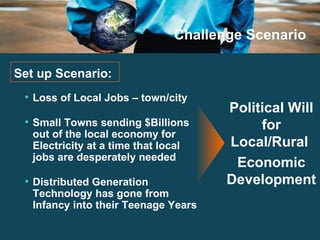
Challenge Scenario Loss of Local Jobs – town/city Small Towns sending $Billions out of the local economy for Electricity at a time that local jobs are desperately needed Distributed Generation Technology has gone from Infancy into their Teenage Years Political Will for Local/Rural  Economic Development Set up Scenario:
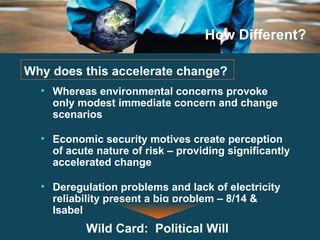
How Different? Whereas environmental concerns provoke only modest immediate concern and change scenarios Economic security motives create perception of acute nature of risk – providing significantly accelerated change Deregulation problems and lack of electricity reliability present a big problem – 8/14 & Isabel  Why does this accelerate change?   Wild Card:  Political Will
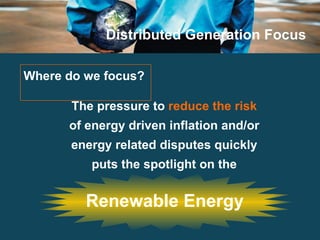
Distributed Generation Focus Where do we focus?  The pressure to  reduce the risk  of energy driven inflation and/or energy related disputes quickly puts the spotlight on the Renewable Energy
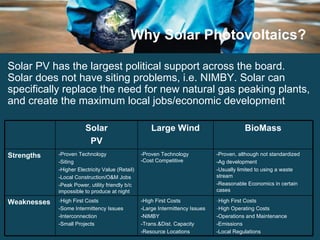
Why Solar Photovoltaics? Solar PV has the largest political support across the board.  Solar does not have siting problems, i.e. NIMBY. Solar can specifically replace the need for new natural gas peaking plants, and create the maximum local jobs/economic development High First Costs High Operating Costs -Operations and Maintenance -Emissions -Local Regulations -High First Costs -Large Intermittency Issues -NIMBY -Trans.&Dist. Capacity -Resource Locations High First Costs -Some Intermittency Issues -Interconnection -Small Projects Weaknesses -Proven, although not standardized -Ag development -Usually limited to using a waste stream  -Reasonable Economics in certain cases -Proven Technology  -Cost Competitive -Proven Technology -Siting -Higher Electricity Value (Retail) -Local Construction/O&M Jobs -Peak Power, utility friendly b/c impossible to produce at night Strengths BioMass Large Wind Solar PV
Why worry about Natural Gas? 75%+ of planned new electricity generation has been natural gas fueled Natural Gas is used by many manufacturing and fertilizer industries as a primary feedstock.  Most of these industries cannot afford prices above $5/mmBTU Many on-site generation technologies are based on natural gas (hydrogen for fuel cells, micro-turbines, NG recip. engines, etc.)
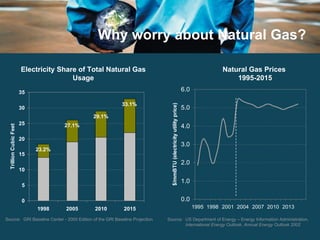
Why worry about Natural Gas? Electricity Share of Total Natural Gas Usage Natural Gas Prices  1995-2015 Source: GRI Baseline Center - 2000 Edition of the GRI Baseline Projection Source: US Department of Energy – Energy Information Administration, International Energy Outlook ,  Annual Energy Outlook 2002
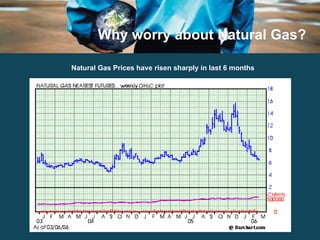
Why worry about Natural Gas? Natural Gas Prices have risen sharply in last 6 months
New Mandates Renewables So… New Mandates are Created   Pick a date – 2012 . . . 2014 . . . 2016 For Mass Adoption of
Attacking Conventional Wisdom Path to Changing the Electricity Mix Business Model Implications for Energy Providers Political Will as the Necessary Catalyst
Solar Achieve material displacement of Natural Gas in Electricity Greater energy supply diversity = greater economic/national security No NIMBY problems Local Jobs, Local Fuels Why Solar?
Theory of the Possible What would it take to significantly advance the take up of  Solar Electricity to have a major impact on reducing Natural Gas Prices?
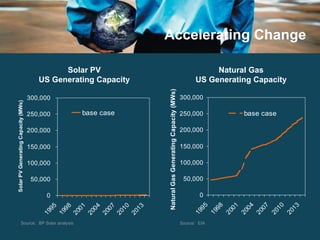
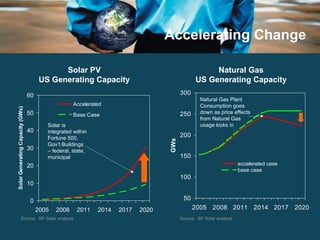
Accelerating Change Natural Gas US Generating Capacity Source: EIA Solar PV US Generating Capacity Source: BP Solar analysis
Accelerating Change Solar PV US Generating Capacity Source: BP Solar analysis Natural Gas US Generating Capacity Source: BP Solar analysis Natural Gas Plant Consumption goes down as price effects from Natural Gas usage kicks in Solar is integrated within Fortune 500, Gov’t Buildings – federal, state, municipal
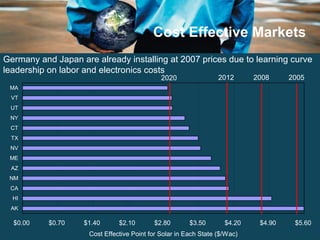
Cost Effective Markets Germany and Japan are already installing at 2007 prices due to learning curve leadership on labor and electronics costs 2005 2008 2012 2020
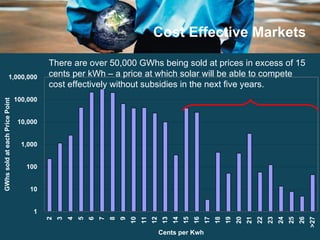
Cost Effective Markets There are over 50,000 GWhs being sold at prices in excess of 15 cents per kWh – a price at which solar will be able to compete cost effectively without subsidies in the next five years.
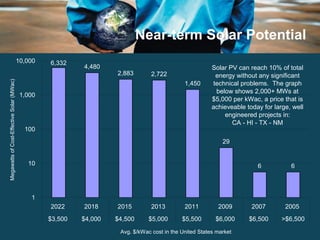
Near-term Solar Potential
Cost Challenge Large Multinational Manufacturers developing novel solutions to drive down costs Manufacturing costs Channel Efficiency Government Willing to Pay for Public Benefits US benefiting from Japanese and European Commitment to drive economies of scale on solar modules, but falling behind on labor and electronics cost efficiencies Biggest Challenge – Cost and Political Will
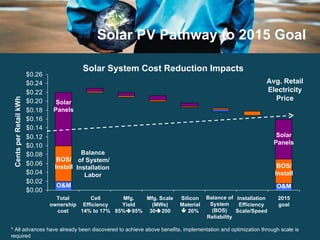
Solar PV Pathway to 2015 Goal * All advances have already been discovered to achieve above benefits, implementation and optimization through scale is required  Cents per Retail kWh Total ownership cost Balance of System (BOS) Reliability 2015 goal O&M Solar Panels Balance of System/ Installation Labor Avg. Retail Electricity Price Cell Efficiency 14% to 17% Mfg. Yield 85%  95% Mfg. Scale (MWs) 30  200 Silicon Material    20% Installation Efficiency Scale/Speed Solar System Cost Reduction Impacts O&M Solar Panels BOS/ Install BOS/ Install
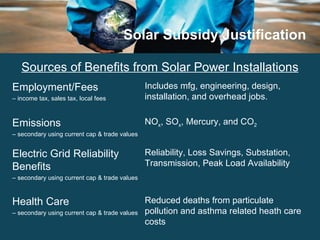
Solar Subsidy Justification Reduced deaths from particulate pollution and asthma related heath care costs Health Care –  secondary using current cap & trade values Reliability, Loss Savings, Substation, Transmission, Peak Load Availability Electric Grid Reliability Benefits –  secondary using current cap & trade values NO x , SO x , Mercury, and CO 2 Emissions –  secondary using current cap & trade values Includes mfg, engineering, design, installation, and overhead jobs. Employment/Fees –  income tax, sales tax, local fees Sources of Benefits from Solar Power Installations
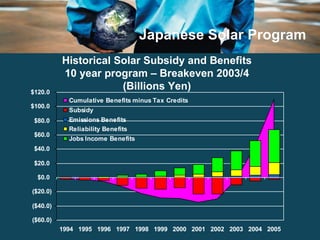
Japanese Solar Program Historical Solar Subsidy and Benefits 10 year program – Breakeven 2003/4 (Billions Yen)
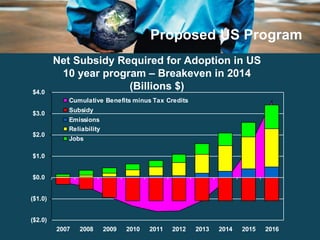
Proposed US Program  Net Subsidy Required for Adoption in US 10 year program – Breakeven in 2014 (Billions $)
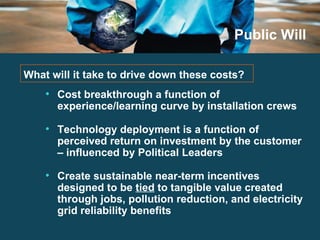
Public Will Cost breakthrough a function of experience/learning curve by installation crews Technology deployment is a function of perceived return on investment by the customer – influenced by Political Leaders Create sustainable near-term incentives designed to be  tied  to tangible value created through jobs, pollution reduction, and electricity grid reliability benefits What will it take to drive down these costs?
Advantaged Cost How do we Deliver Customers Cost Advantage? We can get to parity in electricity costs…
Attacking Conventional Wisdom Path to Changing the Energy Mix Business Model Implications for Energy Providers Political Will as the Necessary Catalyst
How large is the Industry Today? Solar cell and modules manufacturing 15% of worldwide production (100 MWs), doubling every 5 years Close to $1,000m in annual revenue, majority exported Balance of System (BOS) manufacturers 15% of worldwide production, doubling every 3 years Close to $200m in annual business, some exports Engineering, Distributors, Installers Over 500 firms with close to $950MM in 2005 revenues Research and Academic Institutions Existing US Industry
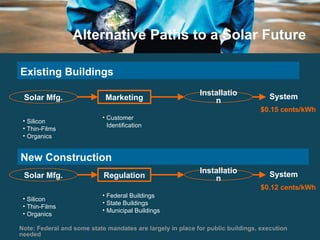
Alternative Paths to a Solar Future Existing Buildings Solar Mfg. Silicon Thin-Films Organics Marketing Installation System New Construction Customer Identification $0.15 cents/kWh Note: Federal and some state mandates are largely in place for public buildings, execution needed Solar Mfg. Silicon Thin-Films Organics Regulation Installation System Federal Buildings State Buildings Municipal Buildings $0.12 cents/kWh
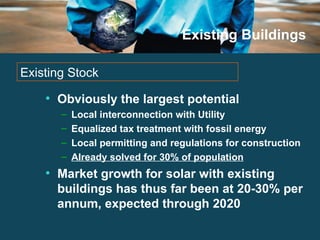
Existing Buildings Obviously the largest potential Local interconnection with Utility Equalized tax treatment with fossil energy Local permitting and regulations for construction Already solved for 30% of population Market growth for solar with existing buildings has thus far been at 20-30% per annum, expected through 2020 Existing Stock
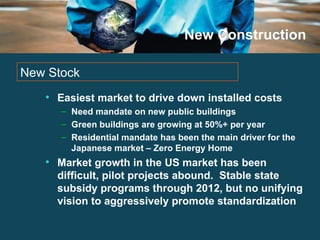
New Construction Easiest market to drive down installed costs Need mandate on new public buildings  Green buildings are growing at 50%+ per year Residential mandate has been the main driver for the Japanese market – Zero Energy Home Market growth in the US market has been difficult, pilot projects abound.  Stable state subsidy programs through 2012, but no unifying vision to aggressively promote standardization New Stock
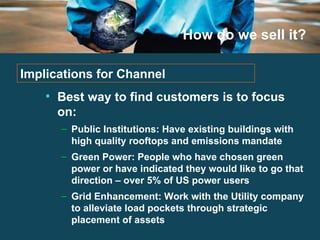
How do we sell it? Best way to find customers is to focus on: Public Institutions: Have existing buildings with high quality rooftops and emissions mandate Green Power: People who have chosen green power or have indicated they would like to go that direction – over 5% of US power users Grid Enhancement: Work with the Utility company to alleviate load pockets through strategic placement of assets Implications for Channel
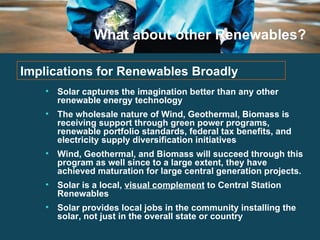
What about other Renewables? Solar captures the imagination better than any other renewable energy technology The wholesale nature of Wind, Geothermal, Biomass is receiving support through green power programs, renewable portfolio standards, federal tax benefits, and electricity supply diversification initiatives Wind, Geothermal, and Biomass will succeed through this program as well since to a large extent, they have achieved maturation for large central generation projects. Solar is a local,  visual complement  to Central Station Renewables Solar provides local jobs in the community installing the solar, not just in the overall state or country Implications for Renewables Broadly
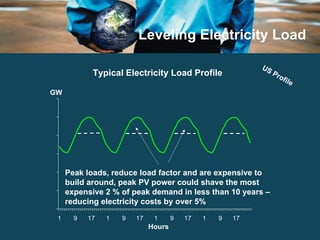
Leveling Electricity Load Typical Electricity Load Profile Hours GW Peak loads, reduce load factor and are expensive to build around, peak PV power could shave the most expensive 2 % of peak demand in less than 10 years – reducing electricity costs by over 5% US Profile
Electric Power Business Non-threatening: small % of total supply Viewed more like Demand Side Management, delaying or eliminating required utility investment in increased generation, T&D expansion/maintenance Provides the impetus to move to time-of-day pricing essential to improving utility profitability and consumer energy efficiency Switch from building and operating peaking plants to connecting and managing distributed “Power Parks” Implications for Power Business
Solar Suppliers Large well-capitalized companies have already entered into this new space (BP, Shell, Sharp, Sanyo, Kyocera,etc) Huge opportunity to create local jobs/local economic development for Rural America and Electrical Unions Summary
Review Kick-start subsidies and then quickly levelize solar subsidies to the same amount on a $/BTU basis as fossil fuels.  Peg subsidies to: Job Creation Health Care/Emissions Value National Security/Economic Security Electricity Grid Reliability Free up Natural Gas to meet higher value needs such as fertilizer, manufacturing, and hydrogen  Re-establish US dominance as the leader of the clean energy sector Scenario Review:
Risks Ability to structure the subsidies to reduce profit taking by the channel partners Quality in the systems deployed, i.e. wind in 1980s Reduction of Installed Cost Improving labor productivity Sustaining the current cost reduction curve on equipment of 5% per annum through R&D support Fighting between the Renewable Technologies to receive a share of a perceived “fixed pie” instead of supporting “grow the pie” Biggest Risks to Scenario:
Attacking Conventional Wisdom Path to Changing the Energy Mix Business Model Implications for Energy Providers Political Will as the Necessary Catalyst
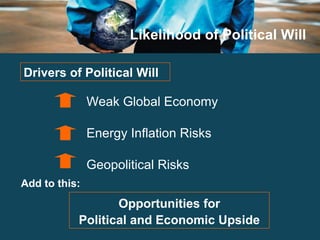
Likelihood of Political Will Weak Global Economy Energy Inflation Risks Geopolitical Risks Drivers of Political Will  Add to this: Opportunities for Political and Economic Upside
Upside What investment could achieve this level of impact? America invented solar power, they now perfect solar power Large capital investment in our Service Economy Union support for this program (IBEW)  [30 jobs per MW] Predictable productivity enhancement matching the gains Germany and Japan have already made Potential for significant emissions reductions Opportunities for Upside  If you were a US Political Leader Trying to Inspire your Electorate…
Subsidy & Spending Examples $30 Billion  Tax breaks in the House and Senate version of the 2005 Energy Bill, including $12 billion for Nuclear Industry $9.0 billion for Coal Industry  $6.0 billion in Oil and Gas subsidies $1.7 billion for Electric Transmission Companies $1.5 Billion  Renewable Energy Budget in the Department of Energy expected over next 5 yrs $1.5 Billion  Cumulative Solar PV Subsidies being funded by over 14 U.S. States through 2012 The  $10 Billion  incentive this requires over  10 years  is small relative to the  size  of other programs Source: Public Citizen
Barriers Public/private sector unintentional miscues Stated Solar PV enthusiasm Less than 1.0 Billion spending over 5 years 2020 before things get interesting Private sector does not drive to action Biggest Barrier to Political Will
Requirements Spending ramp-up over next 3-4 years  e.g.: $0.3 – 1 Billion/year Design of significant incentives to attract customer to the market ($3B over first 4 years) Subsidies per unit reduced over 10 year to a sustainable level commensurate with oil, natural gas, nuclear, and coal subsidies to match annual government economic benefits What would it take?
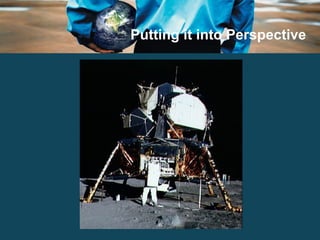
Putting it into Perspective

Big Bet on Solar Power

  • 1.
    Creating Dramatic Changewhile Supporting Local Jobs/Economies and America’s Dominance in Solar Energy Jigar Shah President and CEO SunEdison
  • 2.
    Attacking Conventional WisdomPath to Changing the Electricity Mix Business Model Implications for Energy Providers Political Will as the Necessary Catalyst
  • 3.
    Scenarios Way beyondconventional expectations Requiring truly breakthrough innovation Almost always surfacing significant opportunities Evaluation of Accelerated Change Scenarios
  • 4.
    Attacking Conventional WisdomFinally making a distinction between Central and Distributed Generation Path to Changing the Electricity Mix Reduce #1 pollution source of Asthma and other health problems American Lung Association – 70,000 deaths per year Improve energy security, by reducing Oil & Natural Gas Demand Finance/Risk balance is the big challenge: volatility vs. stability Business Model Implications for Energy Providers BP, Shell, Sharp, Sanyo, & others find a large new market that more create local jobs/local benefits -- $12B and growing Energy Providers have largely been outmaneuvered by their manufacturing customers on political issues, i.e. auto vs. oil Political Will: Converting consistent positive public opinion into a potent political force
  • 5.
    Challenge Scenario Weakglobal economy, need growth engine Energy price inflation and expectations of more inflation shave 1-2% off G8 GDP growth Geopolitical concerns lead to growing view of fossil fuel supplies – “Unacceptable Risk” Political Will for Structural Resolution Set up Scenario:
  • 6.
    Challenge Scenario Lossof Local Jobs – town/city Small Towns sending $Billions out of the local economy for Electricity at a time that local jobs are desperately needed Distributed Generation Technology has gone from Infancy into their Teenage Years Political Will for Local/Rural Economic Development Set up Scenario:
  • 7.
    How Different? Whereasenvironmental concerns provoke only modest immediate concern and change scenarios Economic security motives create perception of acute nature of risk – providing significantly accelerated change Deregulation problems and lack of electricity reliability present a big problem – 8/14 & Isabel Why does this accelerate change? Wild Card: Political Will
  • 8.
    Distributed Generation FocusWhere do we focus? The pressure to reduce the risk of energy driven inflation and/or energy related disputes quickly puts the spotlight on the Renewable Energy
  • 9.
    Why Solar Photovoltaics?Solar PV has the largest political support across the board. Solar does not have siting problems, i.e. NIMBY. Solar can specifically replace the need for new natural gas peaking plants, and create the maximum local jobs/economic development High First Costs High Operating Costs -Operations and Maintenance -Emissions -Local Regulations -High First Costs -Large Intermittency Issues -NIMBY -Trans.&Dist. Capacity -Resource Locations High First Costs -Some Intermittency Issues -Interconnection -Small Projects Weaknesses -Proven, although not standardized -Ag development -Usually limited to using a waste stream -Reasonable Economics in certain cases -Proven Technology -Cost Competitive -Proven Technology -Siting -Higher Electricity Value (Retail) -Local Construction/O&M Jobs -Peak Power, utility friendly b/c impossible to produce at night Strengths BioMass Large Wind Solar PV
  • 10.
    Why worry aboutNatural Gas? 75%+ of planned new electricity generation has been natural gas fueled Natural Gas is used by many manufacturing and fertilizer industries as a primary feedstock. Most of these industries cannot afford prices above $5/mmBTU Many on-site generation technologies are based on natural gas (hydrogen for fuel cells, micro-turbines, NG recip. engines, etc.)
  • 11.
    Why worry aboutNatural Gas? Electricity Share of Total Natural Gas Usage Natural Gas Prices 1995-2015 Source: GRI Baseline Center - 2000 Edition of the GRI Baseline Projection Source: US Department of Energy – Energy Information Administration, International Energy Outlook , Annual Energy Outlook 2002
  • 12.
    Why worry aboutNatural Gas? Natural Gas Prices have risen sharply in last 6 months
  • 13.
    New Mandates RenewablesSo… New Mandates are Created Pick a date – 2012 . . . 2014 . . . 2016 For Mass Adoption of
  • 14.
    Attacking Conventional WisdomPath to Changing the Electricity Mix Business Model Implications for Energy Providers Political Will as the Necessary Catalyst
  • 15.
    Solar Achieve materialdisplacement of Natural Gas in Electricity Greater energy supply diversity = greater economic/national security No NIMBY problems Local Jobs, Local Fuels Why Solar?
  • 16.
    Theory of thePossible What would it take to significantly advance the take up of Solar Electricity to have a major impact on reducing Natural Gas Prices?
  • 17.
    Accelerating Change NaturalGas US Generating Capacity Source: EIA Solar PV US Generating Capacity Source: BP Solar analysis
  • 18.
    Accelerating Change SolarPV US Generating Capacity Source: BP Solar analysis Natural Gas US Generating Capacity Source: BP Solar analysis Natural Gas Plant Consumption goes down as price effects from Natural Gas usage kicks in Solar is integrated within Fortune 500, Gov’t Buildings – federal, state, municipal
  • 19.
    Cost Effective MarketsGermany and Japan are already installing at 2007 prices due to learning curve leadership on labor and electronics costs 2005 2008 2012 2020
  • 20.
    Cost Effective MarketsThere are over 50,000 GWhs being sold at prices in excess of 15 cents per kWh – a price at which solar will be able to compete cost effectively without subsidies in the next five years.
  • 21.
  • 22.
    Cost Challenge LargeMultinational Manufacturers developing novel solutions to drive down costs Manufacturing costs Channel Efficiency Government Willing to Pay for Public Benefits US benefiting from Japanese and European Commitment to drive economies of scale on solar modules, but falling behind on labor and electronics cost efficiencies Biggest Challenge – Cost and Political Will
  • 23.
    Solar PV Pathwayto 2015 Goal * All advances have already been discovered to achieve above benefits, implementation and optimization through scale is required Cents per Retail kWh Total ownership cost Balance of System (BOS) Reliability 2015 goal O&M Solar Panels Balance of System/ Installation Labor Avg. Retail Electricity Price Cell Efficiency 14% to 17% Mfg. Yield 85%  95% Mfg. Scale (MWs) 30  200 Silicon Material  20% Installation Efficiency Scale/Speed Solar System Cost Reduction Impacts O&M Solar Panels BOS/ Install BOS/ Install
  • 24.
    Solar Subsidy JustificationReduced deaths from particulate pollution and asthma related heath care costs Health Care – secondary using current cap & trade values Reliability, Loss Savings, Substation, Transmission, Peak Load Availability Electric Grid Reliability Benefits – secondary using current cap & trade values NO x , SO x , Mercury, and CO 2 Emissions – secondary using current cap & trade values Includes mfg, engineering, design, installation, and overhead jobs. Employment/Fees – income tax, sales tax, local fees Sources of Benefits from Solar Power Installations
  • 25.
    Japanese Solar ProgramHistorical Solar Subsidy and Benefits 10 year program – Breakeven 2003/4 (Billions Yen)
  • 26.
    Proposed US Program Net Subsidy Required for Adoption in US 10 year program – Breakeven in 2014 (Billions $)
  • 27.
    Public Will Costbreakthrough a function of experience/learning curve by installation crews Technology deployment is a function of perceived return on investment by the customer – influenced by Political Leaders Create sustainable near-term incentives designed to be tied to tangible value created through jobs, pollution reduction, and electricity grid reliability benefits What will it take to drive down these costs?
  • 28.
    Advantaged Cost Howdo we Deliver Customers Cost Advantage? We can get to parity in electricity costs…
  • 29.
    Attacking Conventional WisdomPath to Changing the Energy Mix Business Model Implications for Energy Providers Political Will as the Necessary Catalyst
  • 30.
    How large isthe Industry Today? Solar cell and modules manufacturing 15% of worldwide production (100 MWs), doubling every 5 years Close to $1,000m in annual revenue, majority exported Balance of System (BOS) manufacturers 15% of worldwide production, doubling every 3 years Close to $200m in annual business, some exports Engineering, Distributors, Installers Over 500 firms with close to $950MM in 2005 revenues Research and Academic Institutions Existing US Industry
  • 31.
    Alternative Paths toa Solar Future Existing Buildings Solar Mfg. Silicon Thin-Films Organics Marketing Installation System New Construction Customer Identification $0.15 cents/kWh Note: Federal and some state mandates are largely in place for public buildings, execution needed Solar Mfg. Silicon Thin-Films Organics Regulation Installation System Federal Buildings State Buildings Municipal Buildings $0.12 cents/kWh
  • 32.
    Existing Buildings Obviouslythe largest potential Local interconnection with Utility Equalized tax treatment with fossil energy Local permitting and regulations for construction Already solved for 30% of population Market growth for solar with existing buildings has thus far been at 20-30% per annum, expected through 2020 Existing Stock
  • 33.
    New Construction Easiestmarket to drive down installed costs Need mandate on new public buildings Green buildings are growing at 50%+ per year Residential mandate has been the main driver for the Japanese market – Zero Energy Home Market growth in the US market has been difficult, pilot projects abound. Stable state subsidy programs through 2012, but no unifying vision to aggressively promote standardization New Stock
  • 34.
    How do wesell it? Best way to find customers is to focus on: Public Institutions: Have existing buildings with high quality rooftops and emissions mandate Green Power: People who have chosen green power or have indicated they would like to go that direction – over 5% of US power users Grid Enhancement: Work with the Utility company to alleviate load pockets through strategic placement of assets Implications for Channel
  • 35.
    What about otherRenewables? Solar captures the imagination better than any other renewable energy technology The wholesale nature of Wind, Geothermal, Biomass is receiving support through green power programs, renewable portfolio standards, federal tax benefits, and electricity supply diversification initiatives Wind, Geothermal, and Biomass will succeed through this program as well since to a large extent, they have achieved maturation for large central generation projects. Solar is a local, visual complement to Central Station Renewables Solar provides local jobs in the community installing the solar, not just in the overall state or country Implications for Renewables Broadly
  • 36.
    Leveling Electricity LoadTypical Electricity Load Profile Hours GW Peak loads, reduce load factor and are expensive to build around, peak PV power could shave the most expensive 2 % of peak demand in less than 10 years – reducing electricity costs by over 5% US Profile
  • 37.
    Electric Power BusinessNon-threatening: small % of total supply Viewed more like Demand Side Management, delaying or eliminating required utility investment in increased generation, T&D expansion/maintenance Provides the impetus to move to time-of-day pricing essential to improving utility profitability and consumer energy efficiency Switch from building and operating peaking plants to connecting and managing distributed “Power Parks” Implications for Power Business
  • 38.
    Solar Suppliers Largewell-capitalized companies have already entered into this new space (BP, Shell, Sharp, Sanyo, Kyocera,etc) Huge opportunity to create local jobs/local economic development for Rural America and Electrical Unions Summary
  • 39.
    Review Kick-start subsidiesand then quickly levelize solar subsidies to the same amount on a $/BTU basis as fossil fuels. Peg subsidies to: Job Creation Health Care/Emissions Value National Security/Economic Security Electricity Grid Reliability Free up Natural Gas to meet higher value needs such as fertilizer, manufacturing, and hydrogen Re-establish US dominance as the leader of the clean energy sector Scenario Review:
  • 40.
    Risks Ability tostructure the subsidies to reduce profit taking by the channel partners Quality in the systems deployed, i.e. wind in 1980s Reduction of Installed Cost Improving labor productivity Sustaining the current cost reduction curve on equipment of 5% per annum through R&D support Fighting between the Renewable Technologies to receive a share of a perceived “fixed pie” instead of supporting “grow the pie” Biggest Risks to Scenario:
  • 41.
    Attacking Conventional WisdomPath to Changing the Energy Mix Business Model Implications for Energy Providers Political Will as the Necessary Catalyst
  • 42.
    Likelihood of PoliticalWill Weak Global Economy Energy Inflation Risks Geopolitical Risks Drivers of Political Will Add to this: Opportunities for Political and Economic Upside
  • 43.
    Upside What investmentcould achieve this level of impact? America invented solar power, they now perfect solar power Large capital investment in our Service Economy Union support for this program (IBEW) [30 jobs per MW] Predictable productivity enhancement matching the gains Germany and Japan have already made Potential for significant emissions reductions Opportunities for Upside If you were a US Political Leader Trying to Inspire your Electorate…
  • 44.
    Subsidy & SpendingExamples $30 Billion Tax breaks in the House and Senate version of the 2005 Energy Bill, including $12 billion for Nuclear Industry $9.0 billion for Coal Industry $6.0 billion in Oil and Gas subsidies $1.7 billion for Electric Transmission Companies $1.5 Billion Renewable Energy Budget in the Department of Energy expected over next 5 yrs $1.5 Billion Cumulative Solar PV Subsidies being funded by over 14 U.S. States through 2012 The $10 Billion incentive this requires over 10 years is small relative to the size of other programs Source: Public Citizen
  • 45.
    Barriers Public/private sectorunintentional miscues Stated Solar PV enthusiasm Less than 1.0 Billion spending over 5 years 2020 before things get interesting Private sector does not drive to action Biggest Barrier to Political Will
  • 46.
    Requirements Spending ramp-upover next 3-4 years e.g.: $0.3 – 1 Billion/year Design of significant incentives to attract customer to the market ($3B over first 4 years) Subsidies per unit reduced over 10 year to a sustainable level commensurate with oil, natural gas, nuclear, and coal subsidies to match annual government economic benefits What would it take?
  • 47.
    Putting it intoPerspective