By
Amita Vadlamudi
 Having been formed approximately 4.6 billion
years ago this almost magical solar system
comprises of the Sun (a star at the heart of the
solar system), the planets, their moons, and
other astronomical objects.
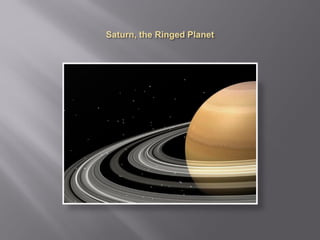
 Being the second largest planet in the solar
system, Saturn is widely known for the
mystical rings that surround it. It is 839 million
miles (1.4 billion km) from the Sun and takes
approximately 30 Earth Years to make one
orbit around the Sun, making the days short
(approximately 10 hours and 34 minutes) and
the years longer (1 Saturn year equals to 29.5
Earth years).
 Being 755 times larger in volume than the
Earth, the planet’s diameter is 74,897 miles
(120,536 km) while the distance between its
north and south pole is 67,560 miles (108,728
km). Unlike the Earth, Saturn has no solid
ground; instead it is mostly gaseous made up
of helium and hydrogen in the outer
atmosphere. Internally the planet is enveloped
by powerful winds that move 10 times faster
than the most violent hurricanes of the Earth.
 Saturn’s ring system is the fastest and most
complicated of the entire solar system. These rings
which orbit the planet are made up of billions of
particles of water, ice, and hints of rocky material.
The rocks are thought to have come from asteroids
and moons that broke apart before they even
reached the planet. The rings have thrown
researchers and scientists into a conundrum ever
since they were discovered by Galileo in 1610, as
no one has been able to discover why they are
there. Despite the rings’ incredible width they are
known to be very thin, being just 33 feet thick.
 Saturn has 53 identified moons and an additional 9
which are being studied. Majority of the moons are
very small, however, the largest of them is named
Titan. Titan is known to be larger than Mercury
and is also the second largest moon in the solar
system after Jupiter’s Ganymede. Titan is thought
to possibly be able to sustain life since its seasonal
and surface characters are similar to that of Earth’s.
Extensive astronomical research has been launched
ever since it came under the telescope, and it can
be said with certainty that this research will go on
for years to come.
 Amita Vadlamudi, a computer professional
finds the study of astronomy to be a fascinating
subject. In her spare time Amita Vadlamudi
likes to read and write about the astronomical
objects, particularly the ones in the very
neighborhood of the planet earth.

Solar System’s Most Enigmatic Planet: Saturn

  • 1.
  • 2.
     Having beenformed approximately 4.6 billion years ago this almost magical solar system comprises of the Sun (a star at the heart of the solar system), the planets, their moons, and other astronomical objects.
  • 4.
     Being thesecond largest planet in the solar system, Saturn is widely known for the mystical rings that surround it. It is 839 million miles (1.4 billion km) from the Sun and takes approximately 30 Earth Years to make one orbit around the Sun, making the days short (approximately 10 hours and 34 minutes) and the years longer (1 Saturn year equals to 29.5 Earth years).
  • 5.
     Being 755times larger in volume than the Earth, the planet’s diameter is 74,897 miles (120,536 km) while the distance between its north and south pole is 67,560 miles (108,728 km). Unlike the Earth, Saturn has no solid ground; instead it is mostly gaseous made up of helium and hydrogen in the outer atmosphere. Internally the planet is enveloped by powerful winds that move 10 times faster than the most violent hurricanes of the Earth.
  • 6.
     Saturn’s ringsystem is the fastest and most complicated of the entire solar system. These rings which orbit the planet are made up of billions of particles of water, ice, and hints of rocky material. The rocks are thought to have come from asteroids and moons that broke apart before they even reached the planet. The rings have thrown researchers and scientists into a conundrum ever since they were discovered by Galileo in 1610, as no one has been able to discover why they are there. Despite the rings’ incredible width they are known to be very thin, being just 33 feet thick.
  • 7.
     Saturn has53 identified moons and an additional 9 which are being studied. Majority of the moons are very small, however, the largest of them is named Titan. Titan is known to be larger than Mercury and is also the second largest moon in the solar system after Jupiter’s Ganymede. Titan is thought to possibly be able to sustain life since its seasonal and surface characters are similar to that of Earth’s. Extensive astronomical research has been launched ever since it came under the telescope, and it can be said with certainty that this research will go on for years to come.
  • 8.
     Amita Vadlamudi,a computer professional finds the study of astronomy to be a fascinating subject. In her spare time Amita Vadlamudi likes to read and write about the astronomical objects, particularly the ones in the very neighborhood of the planet earth.