Solar Systems 1_ New Definitions... By: Christian Hassler_ Next Slide
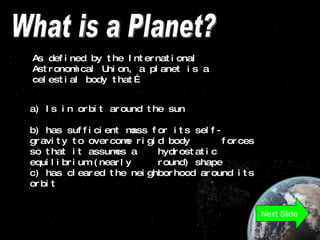
What is a Planet? As defined by the International Astronomical Union, a planet is a celestial body that… a) Is in orbit around the sun b) has sufficient mass for its self- gravity to overcome rigid body  forces so that it assumes a  hydrostatic equilibrium (nearly  round) shape  c) has cleared the neighborhood around its orbit Next Slide
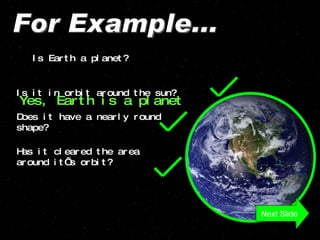
For Example... Is Earth a planet? Is it in orbit around the sun? Does it have a nearly round shape? Has it cleared the area around it’s orbit? Yes, Earth is a planet Next Slide
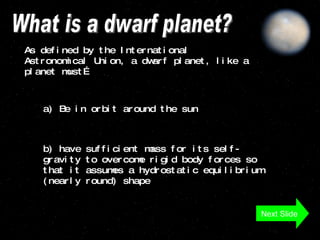
What is a dwarf planet? As defined by the International Astronomical Union, a dwarf planet, like a planet must…  a) Be in orbit around the sun b) have sufficient mass for its self-gravity to overcome rigid body forces so that it assumes a hydrostatic equilibrium (nearly round) shape  Next Slide
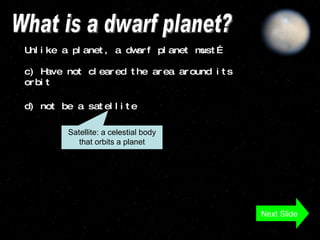
What is a dwarf planet? Unlike a planet, a dwarf planet must…  c) Have not cleared the area around its orbit d) not be a satellite Satellite: a celestial body that orbits a planet Next Slide
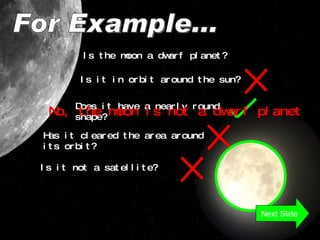
For Example... Is the moon a dwarf planet? Is it in orbit around the sun? Does it have a nearly round shape? Has it cleared the area around its orbit? Is it not a satellite? No, the moon is not a dwarf planet Next Slide
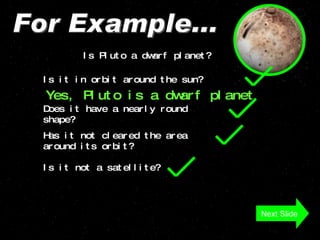
For Example... Is Pluto a dwarf planet? Is it in orbit around the sun? Does it have a nearly round shape? Has it not cleared the area around its orbit? Is it not a satellite? Yes, Pluto is a dwarf planet Next Slide
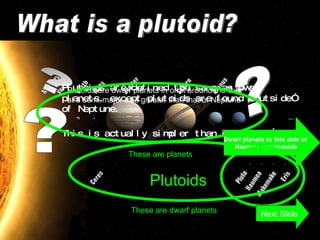
What is a plutoid? Plutoids are dwarf planets in orbit around the Sun at a semi-major axis greater than that of Neptune ? ? ? This is actually simpler than it sounds…  Plutoids are defined the same as dwarf planets, except plutoids are found “outside” of Neptune. These are planets These are dwarf planets Dwarf planets to this side of  Neptune are plutoids Plutoids Next Slide
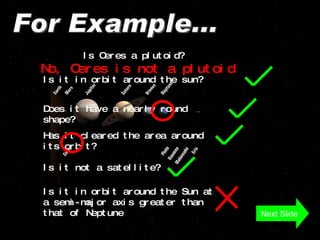
For Example... Is Ceres a plutoid? Is it in orbit around the sun? Does it have a nearly round shape? Has it cleared the area around its orbit? Is it not a satellite? No, Ceres is not a plutoid Next Slide Is it in orbit around the Sun at a semi-major axis greater than that of Neptune
Review What do planets, dwarf planets and plutoids have in common? They all have not cleared  the area around their orbit. They all must orbit the sun Sorry, Try Again Correct! Next Slide Planets, dwarf planets, and plutoids all must orbit the sun, otherwise they would be moons.  Select the Correct  Answer
Review Where must plutoids be located? In the asteroid belt Beyond Neptune Sorry, Try Again Correct! Next Slide Plutoids are dwarf planets in orbit around the Sun at a semi-major axis greater than that of Neptune  Select the Correct  Answer
http://solarsystem.nasa.gov/planets/profile.cfm?Object=Dwarf http://solarsystem.jpl.nasa.gov/planets/index.cfm Credits Thank You for Watching!

Solar System 1

  • 1.
    Solar Systems 1_New Definitions... By: Christian Hassler_ Next Slide
  • 2.
    What is aPlanet? As defined by the International Astronomical Union, a planet is a celestial body that… a) Is in orbit around the sun b) has sufficient mass for its self- gravity to overcome rigid body forces so that it assumes a hydrostatic equilibrium (nearly round) shape c) has cleared the neighborhood around its orbit Next Slide
  • 3.
    For Example... IsEarth a planet? Is it in orbit around the sun? Does it have a nearly round shape? Has it cleared the area around it’s orbit? Yes, Earth is a planet Next Slide
  • 4.
    What is adwarf planet? As defined by the International Astronomical Union, a dwarf planet, like a planet must… a) Be in orbit around the sun b) have sufficient mass for its self-gravity to overcome rigid body forces so that it assumes a hydrostatic equilibrium (nearly round) shape Next Slide
  • 5.
    What is adwarf planet? Unlike a planet, a dwarf planet must… c) Have not cleared the area around its orbit d) not be a satellite Satellite: a celestial body that orbits a planet Next Slide
  • 6.
    For Example... Isthe moon a dwarf planet? Is it in orbit around the sun? Does it have a nearly round shape? Has it cleared the area around its orbit? Is it not a satellite? No, the moon is not a dwarf planet Next Slide
  • 7.
    For Example... IsPluto a dwarf planet? Is it in orbit around the sun? Does it have a nearly round shape? Has it not cleared the area around its orbit? Is it not a satellite? Yes, Pluto is a dwarf planet Next Slide
  • 8.
    What is aplutoid? Plutoids are dwarf planets in orbit around the Sun at a semi-major axis greater than that of Neptune ? ? ? This is actually simpler than it sounds… Plutoids are defined the same as dwarf planets, except plutoids are found “outside” of Neptune. These are planets These are dwarf planets Dwarf planets to this side of Neptune are plutoids Plutoids Next Slide
  • 9.
    For Example... IsCeres a plutoid? Is it in orbit around the sun? Does it have a nearly round shape? Has it cleared the area around its orbit? Is it not a satellite? No, Ceres is not a plutoid Next Slide Is it in orbit around the Sun at a semi-major axis greater than that of Neptune
  • 10.
    Review What doplanets, dwarf planets and plutoids have in common? They all have not cleared the area around their orbit. They all must orbit the sun Sorry, Try Again Correct! Next Slide Planets, dwarf planets, and plutoids all must orbit the sun, otherwise they would be moons. Select the Correct Answer
  • 11.
    Review Where mustplutoids be located? In the asteroid belt Beyond Neptune Sorry, Try Again Correct! Next Slide Plutoids are dwarf planets in orbit around the Sun at a semi-major axis greater than that of Neptune Select the Correct Answer
  • 12.