


Introduction to Solar Resource Assessments

Carsten Hoyer-Klick
German Aerospace Center
Institute of Technical Thermodynamics

                                             Folie 1
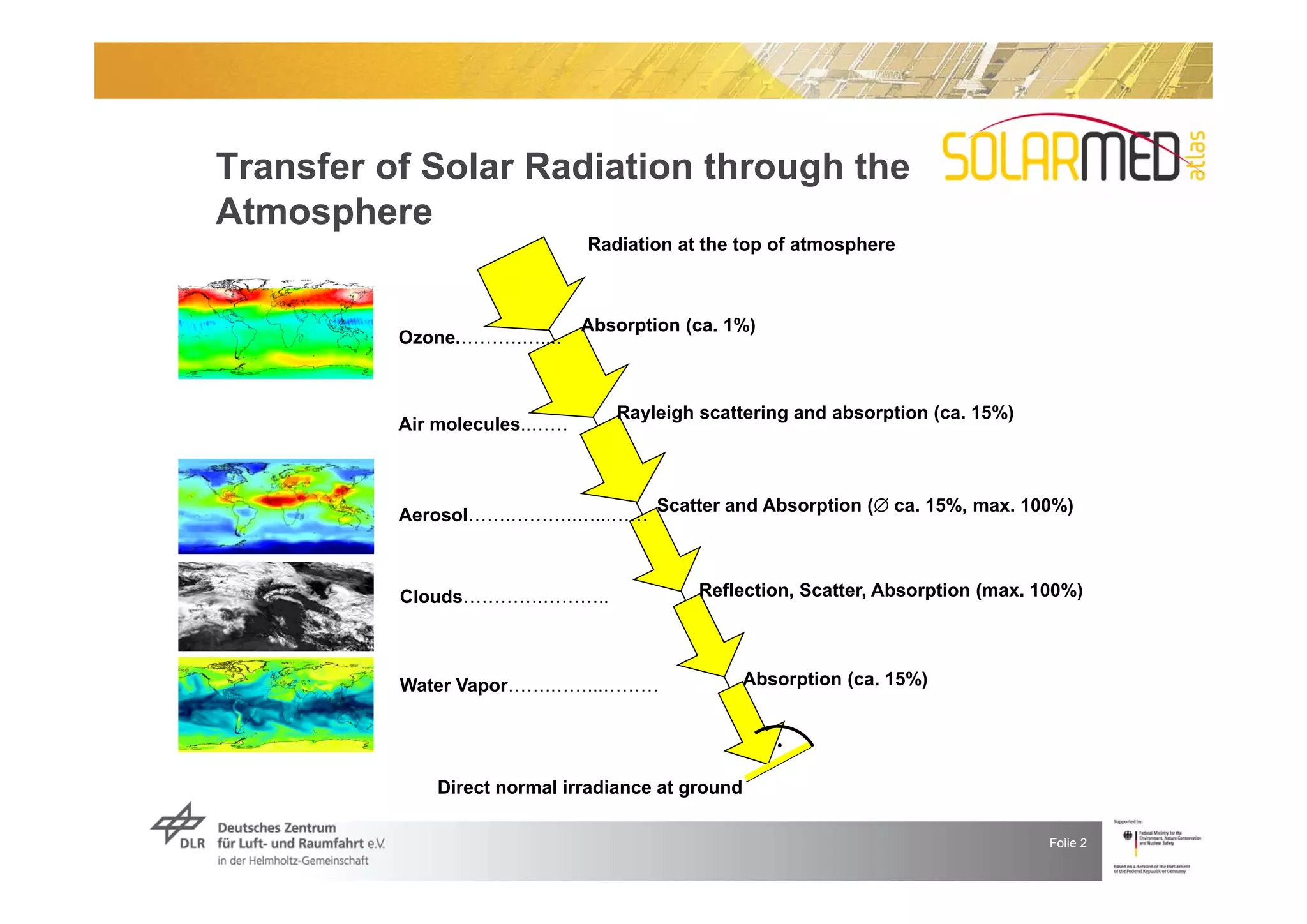
Transfer of Solar Radiation through the
Atmosphere
                              Radiation at the top of atmosphere


                              Absorption (ca. 1%)
          Ozone.……….…....


                                 Rayleigh scattering and absorption (ca. 15%)
          Air molecules..……


                                      Scatter and Absorption ( ca. 15%, max. 100%)
          Aerosol…….………..…...……


          Clouds………….………..                Reflection, Scatter, Absorption (max. 100%)


          Water Vapor…….……...………                  Absorption (ca. 15%)


             Direct normal irradiance at ground

                                                                                 Folie 2
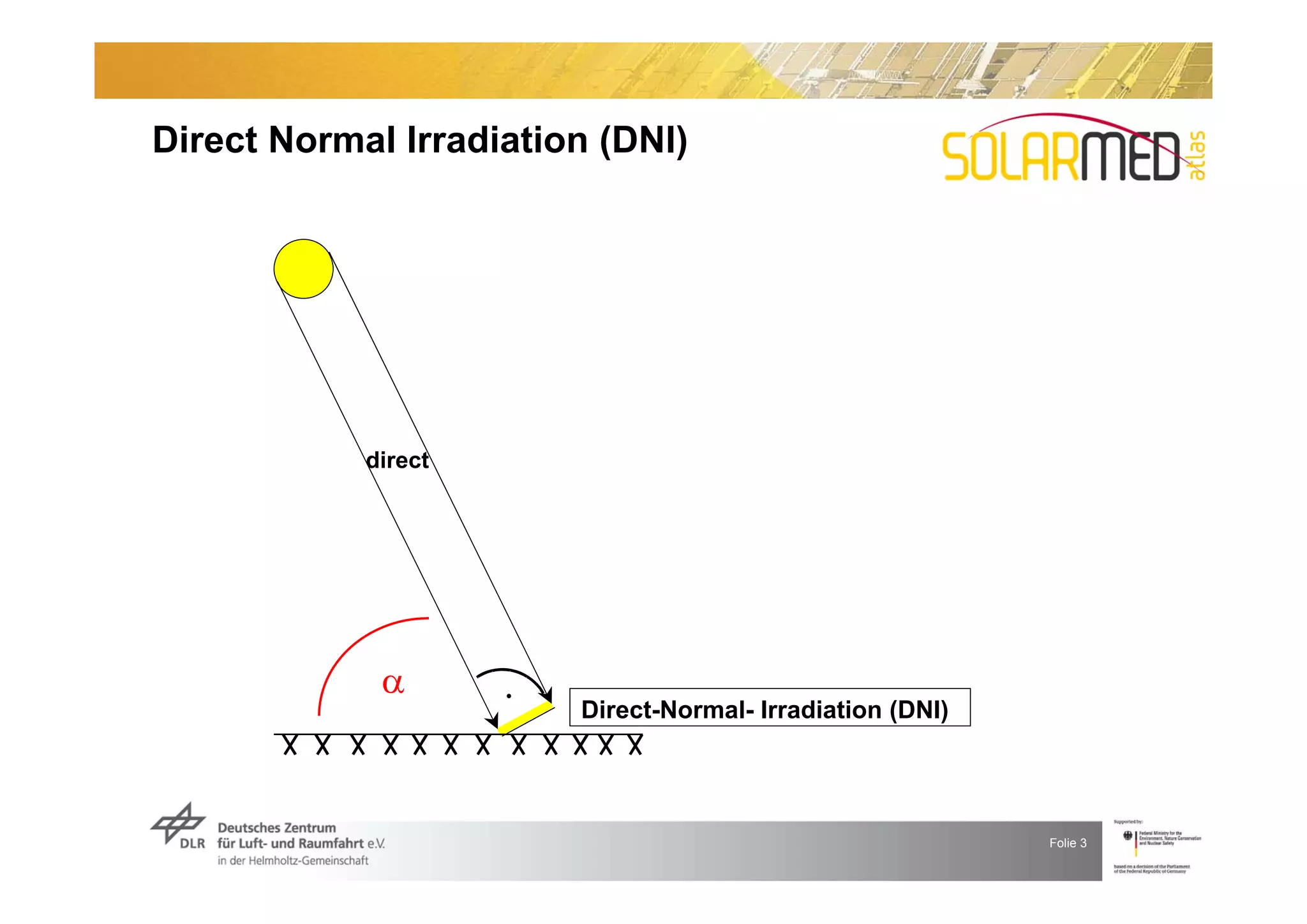
Direct Normal Irradiation (DNI)


            direct


             
                        Direct-Normal- Irradiation (DNI)


                                                           Folie 3
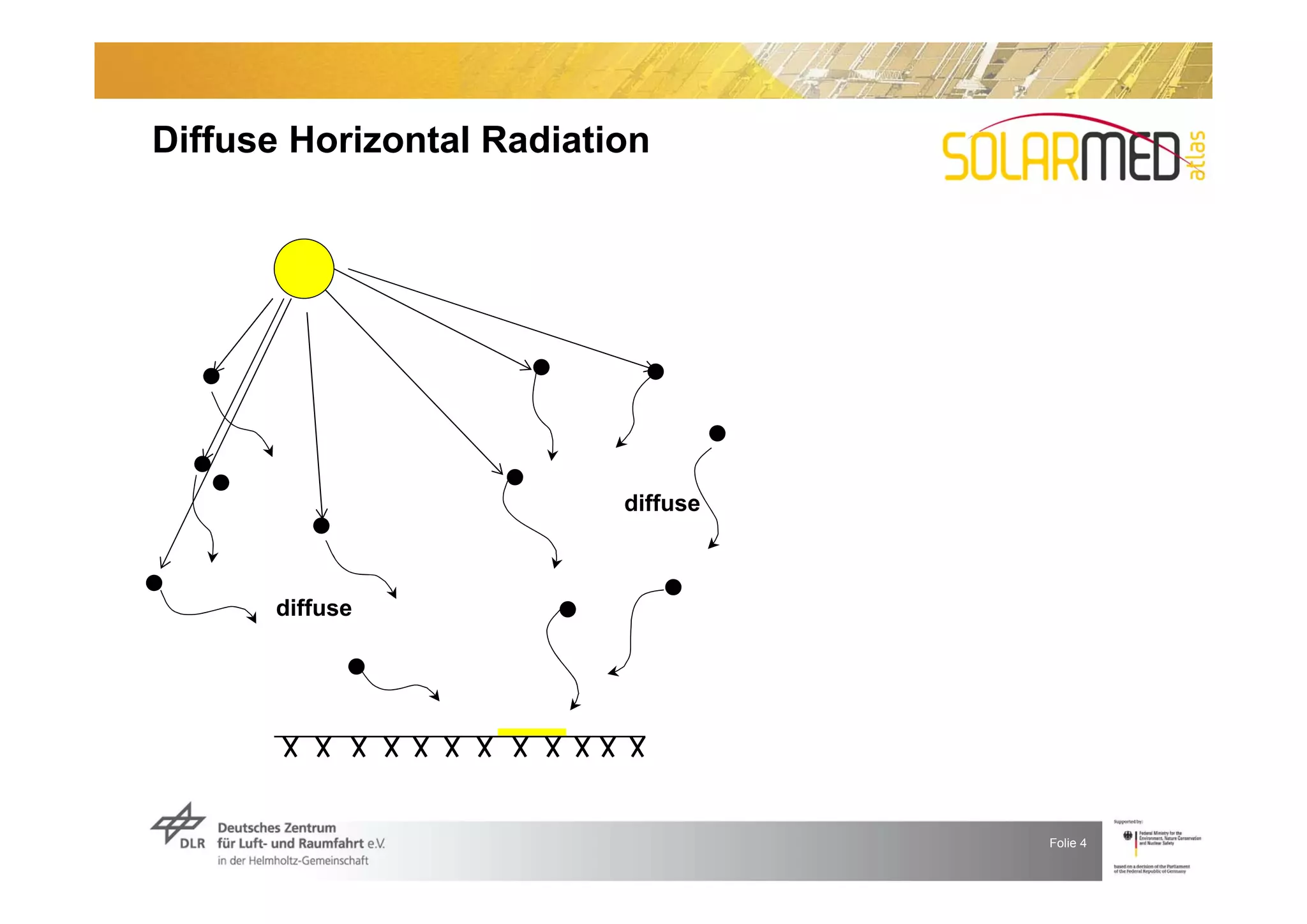
Diffuse Horizontal Radiation


                          diffuse


      diffuse


                                    Folie 4
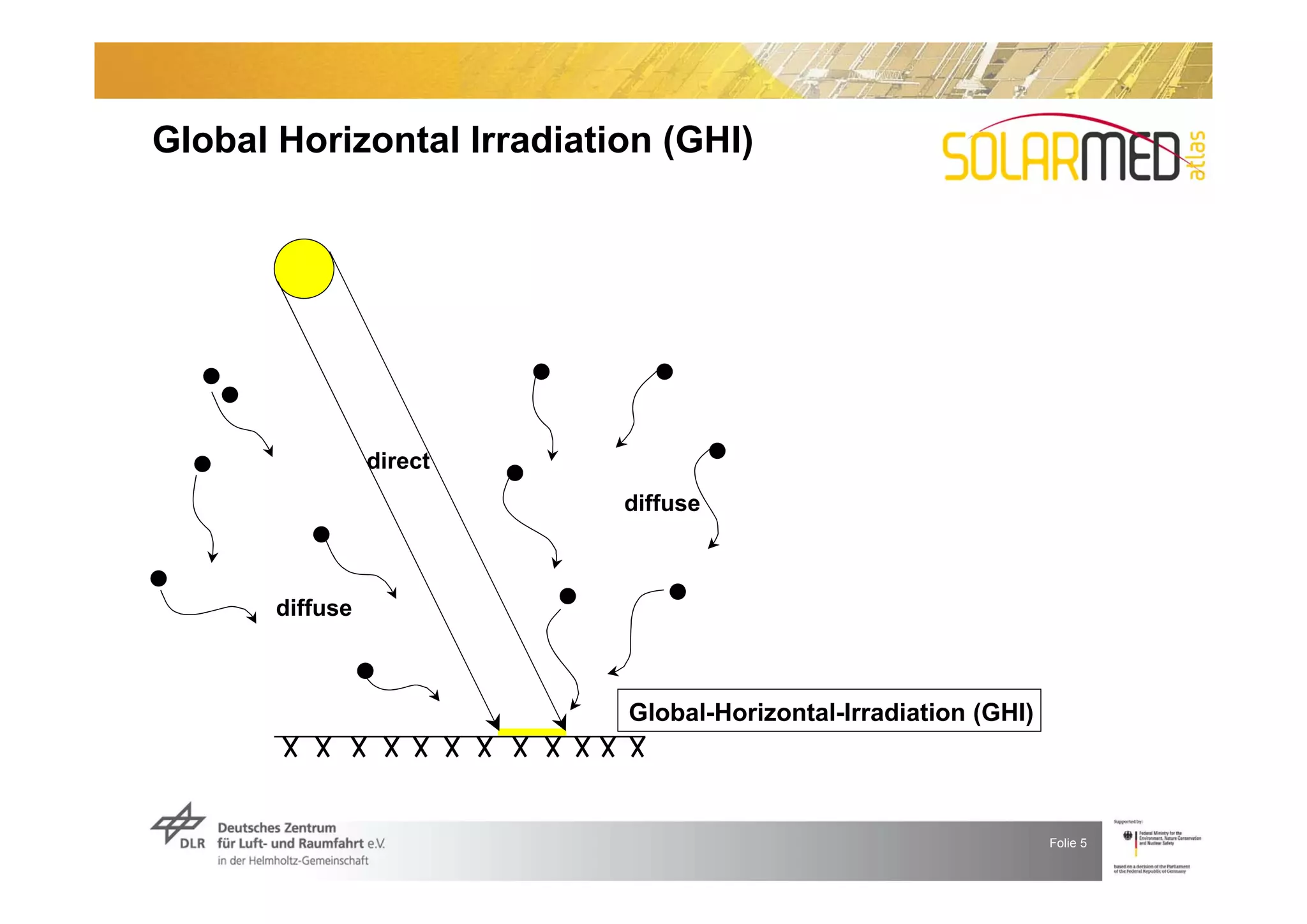
Global Horizontal Irradiation (GHI)


                 direct
                           diffuse


       diffuse


                           Global-Horizontal-Irradiation (GHI)


                                                                 Folie 5
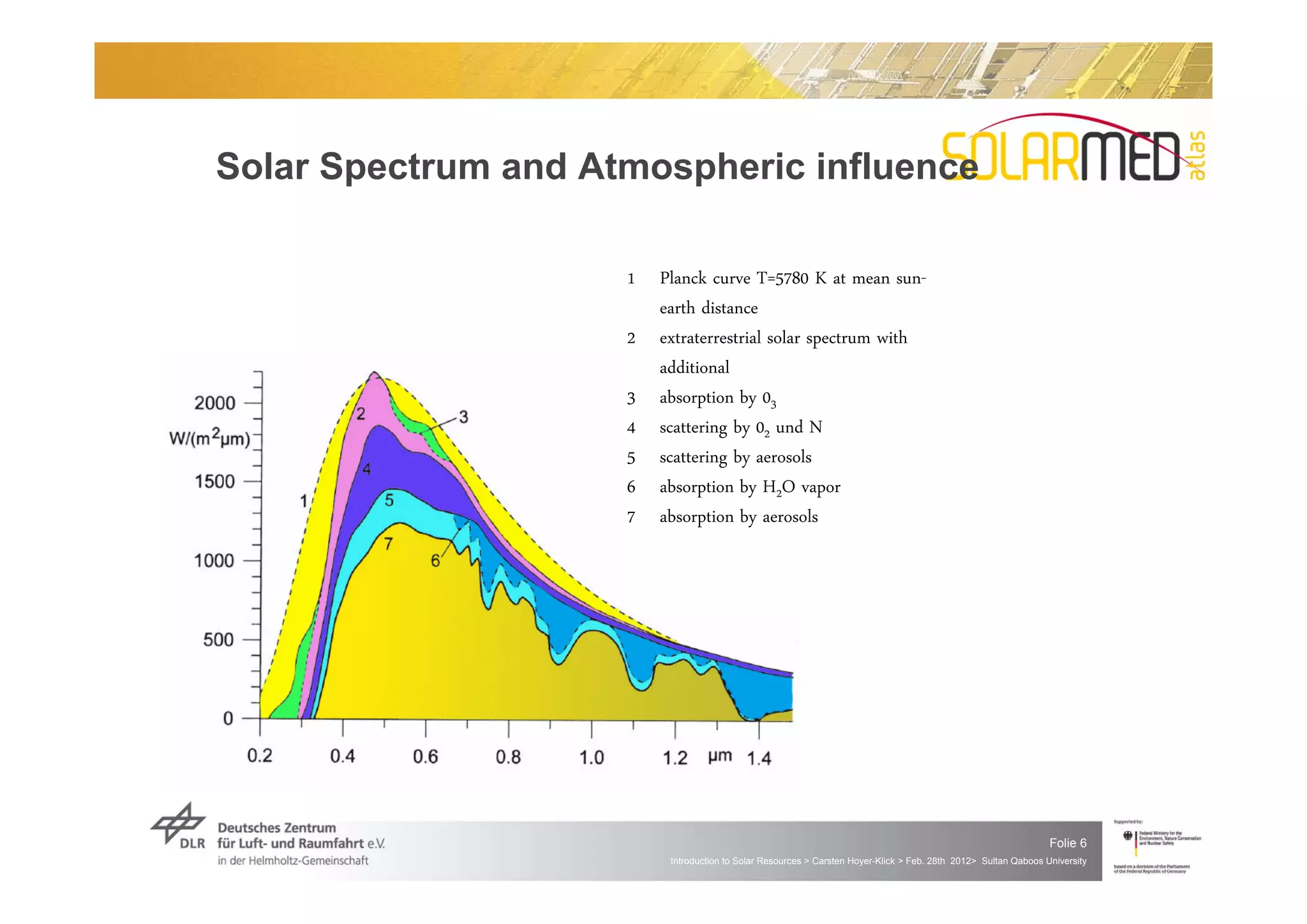
Solar Spectrum and Atmospheric influence

                     1 Planck curve T=5780 K at mean sun-
                       earth distance
                     2 extraterrestrial solar spectrum with
                       additional
                     3 absorption by 03
                     4 scattering by 02 und N
                     5 scattering by aerosols
                     6 absorption by H2O vapor
                     7 absorption by aerosols


                                                                                                                 Folie 6
                          Introduction to Solar Resources > Carsten Hoyer-Klick > Feb. 28th 2012> Sultan Qaboos University
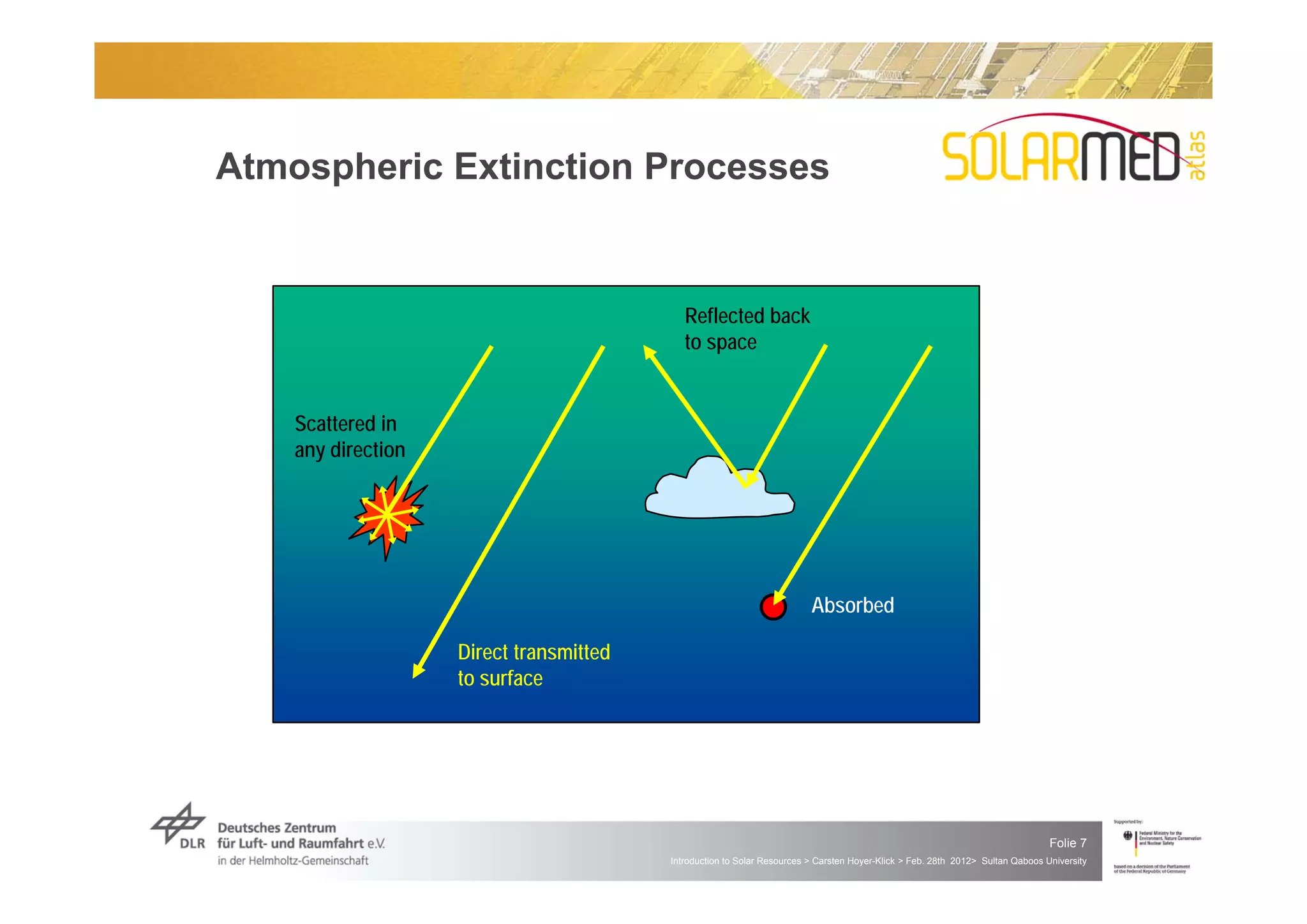
Atmospheric Extinction Processes


                                            Reflected back
                                            to space


    Scattered in
    any direction


                                                                         Absorbed

                    Direct transmitted
                    to surface


                                                                                                                                Folie 7
                                         Introduction to Solar Resources > Carsten Hoyer-Klick > Feb. 28th 2012> Sultan Qaboos University
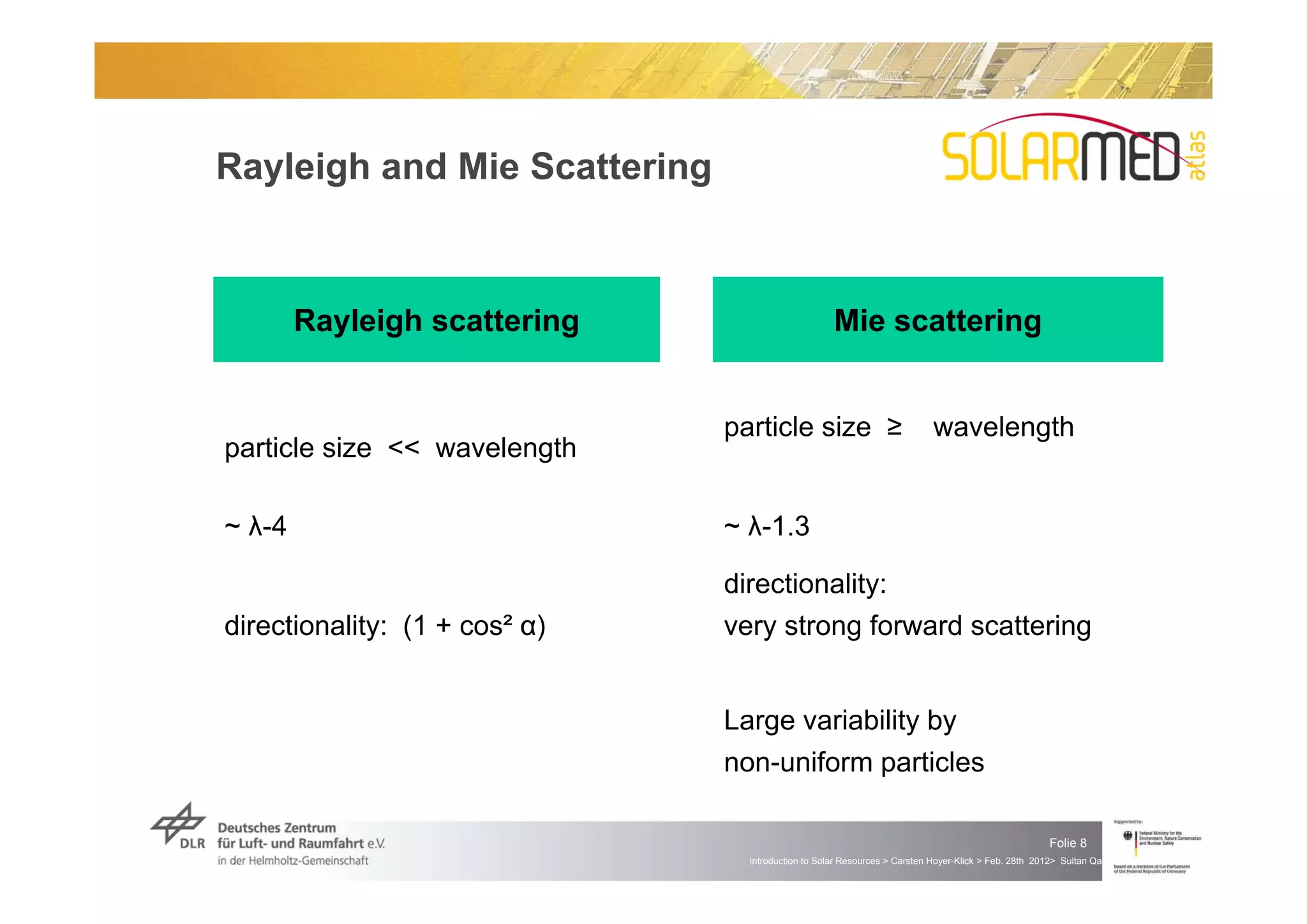
Rayleigh and Mie Scattering


        Rayleigh scattering                         Mie scattering


                               particle size ≥                             wavelength
particle size << wavelength

~ λ-4                          ~ λ-1.3

                               directionality:
directionality: (1 + cos² α)   very strong forward scattering


                               Large variability by
                               non-uniform particles

                                                                                                      Folie 8
                                 Introduction to Solar Resources > Carsten Hoyer-Klick > Feb. 28th 2012> Sultan Qaboos University
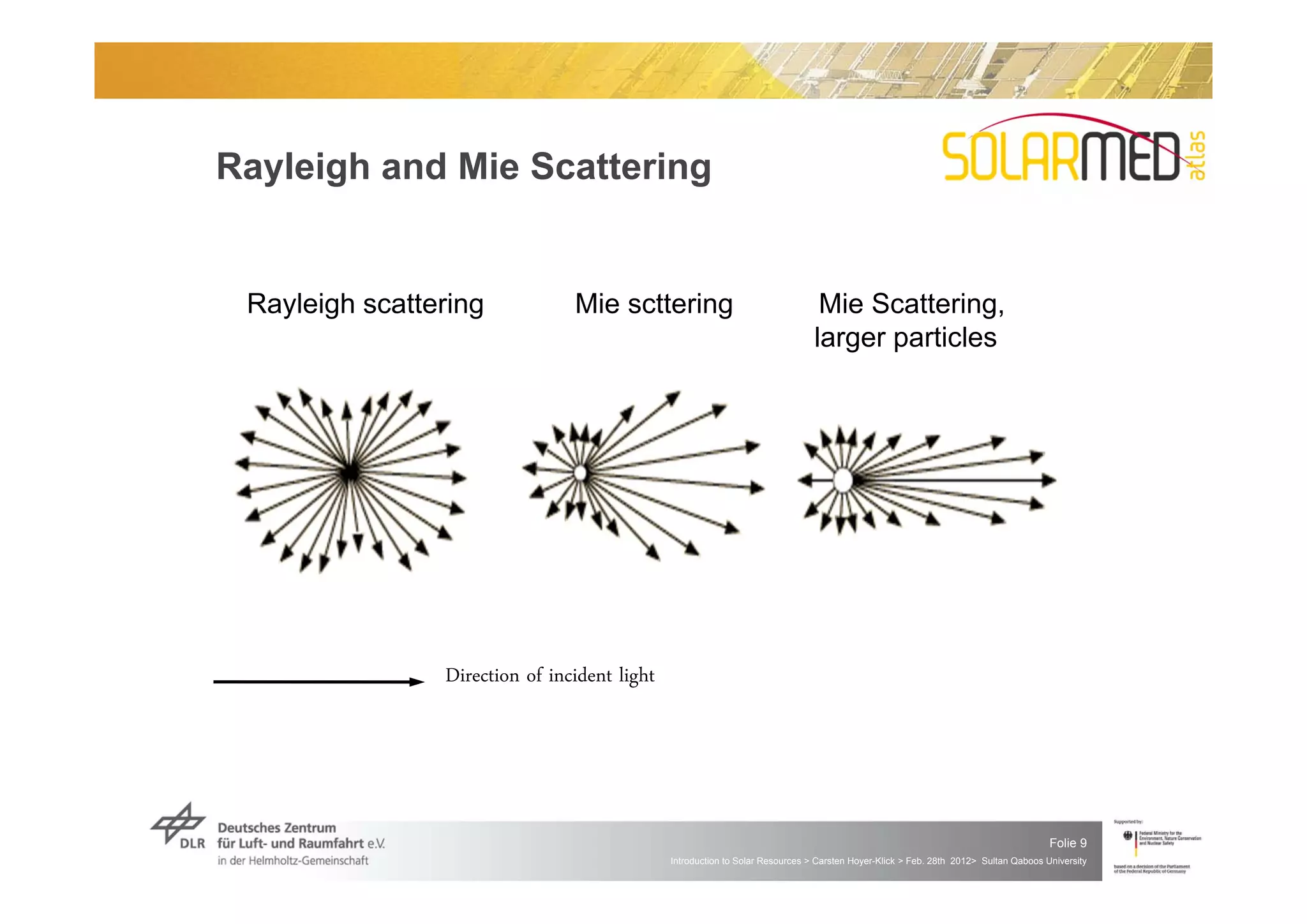
Rayleigh and Mie Scattering


 Rayleigh scattering            Mie scttering                                   Mie Scattering,
                                                                               larger particles


                Direction of incident light


                                                                                                                                     Folie 9
                                              Introduction to Solar Resources > Carsten Hoyer-Klick > Feb. 28th 2012> Sultan Qaboos University
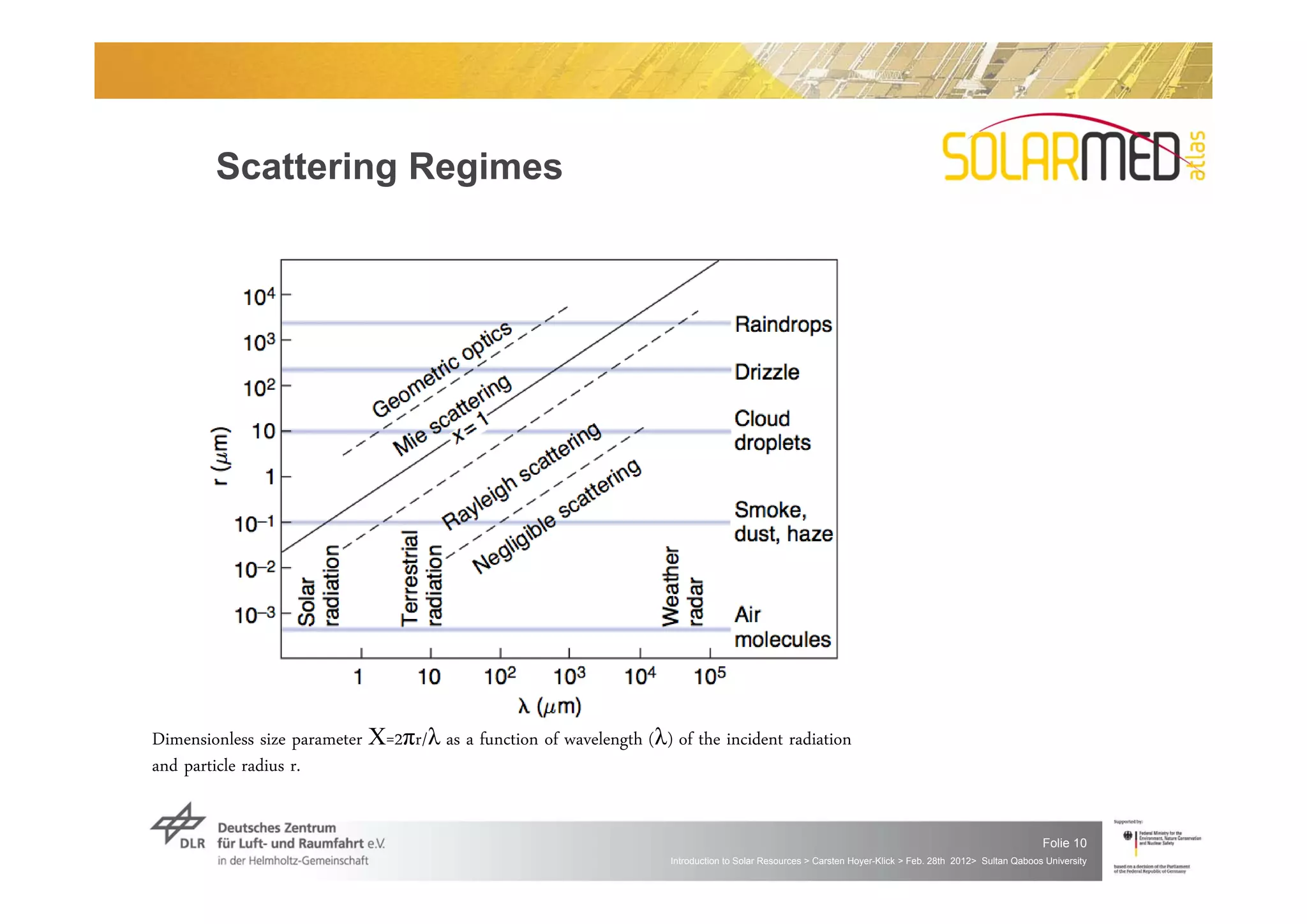
Scattering Regimes


Dimensionless size parameter Χ=2πr/λ as a function of wavelength (λ) of the incident radiation
and particle radius r.


                                                                                                                                                          Folie 10
                                                                     Introduction to Solar Resources > Carsten Hoyer-Klick > Feb. 28th 2012> Sultan Qaboos University
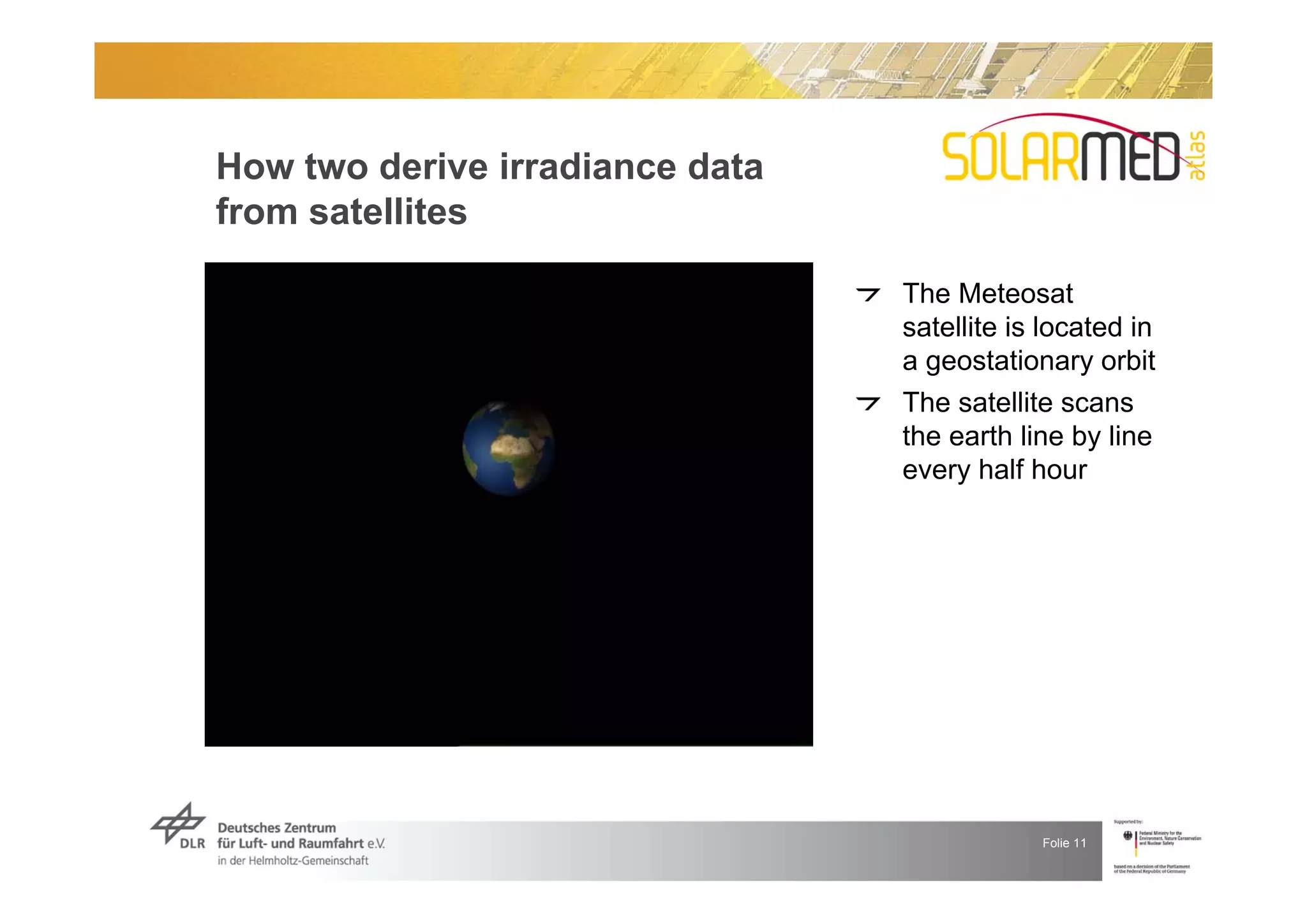
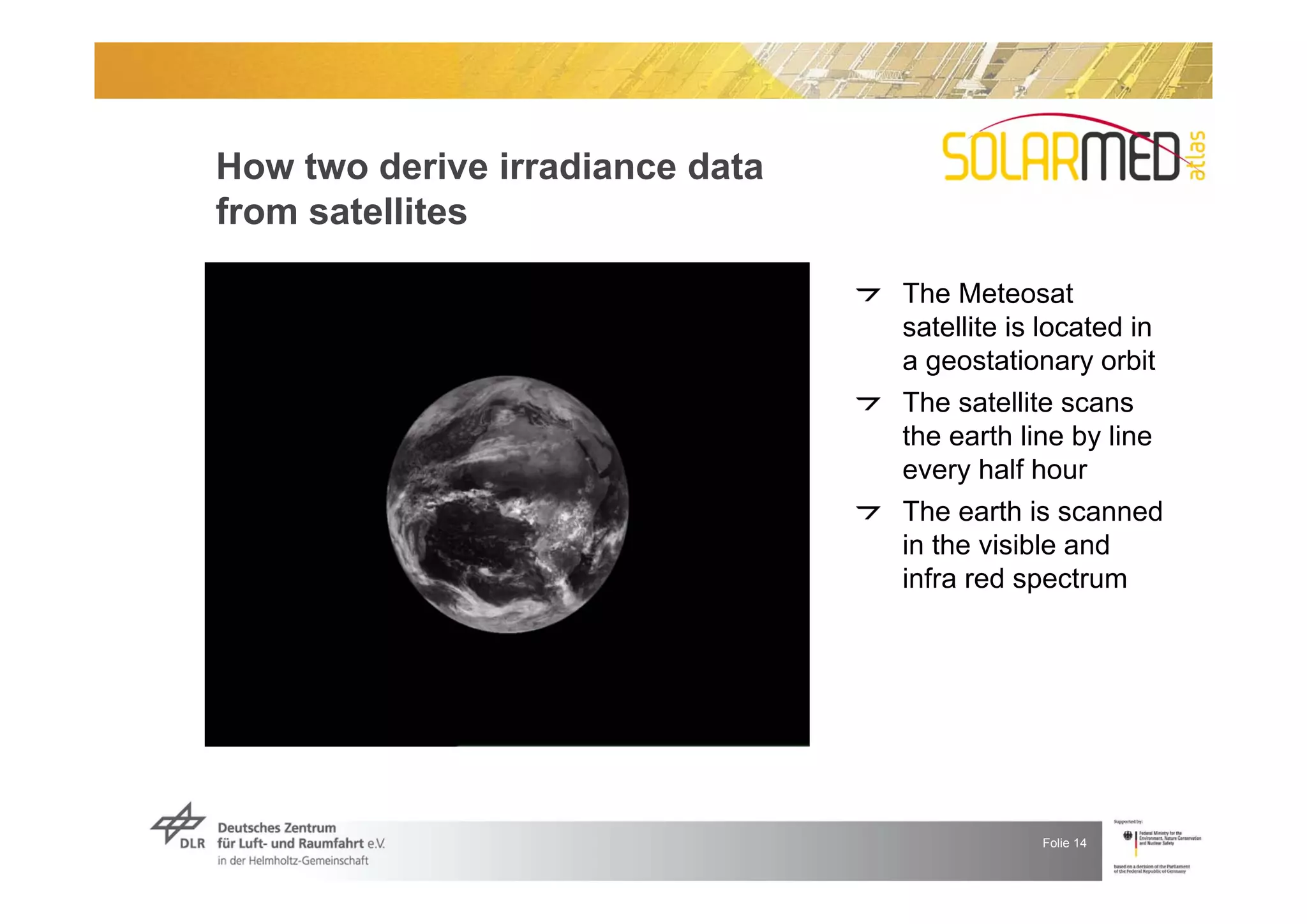
How two derive irradiance data
from satellites

                                 The Meteosat
                                 satellite is located in
                                 a geostationary orbit
                                 The satellite scans
                                 the earth line by line
                                 every half hour


                                             Folie 11
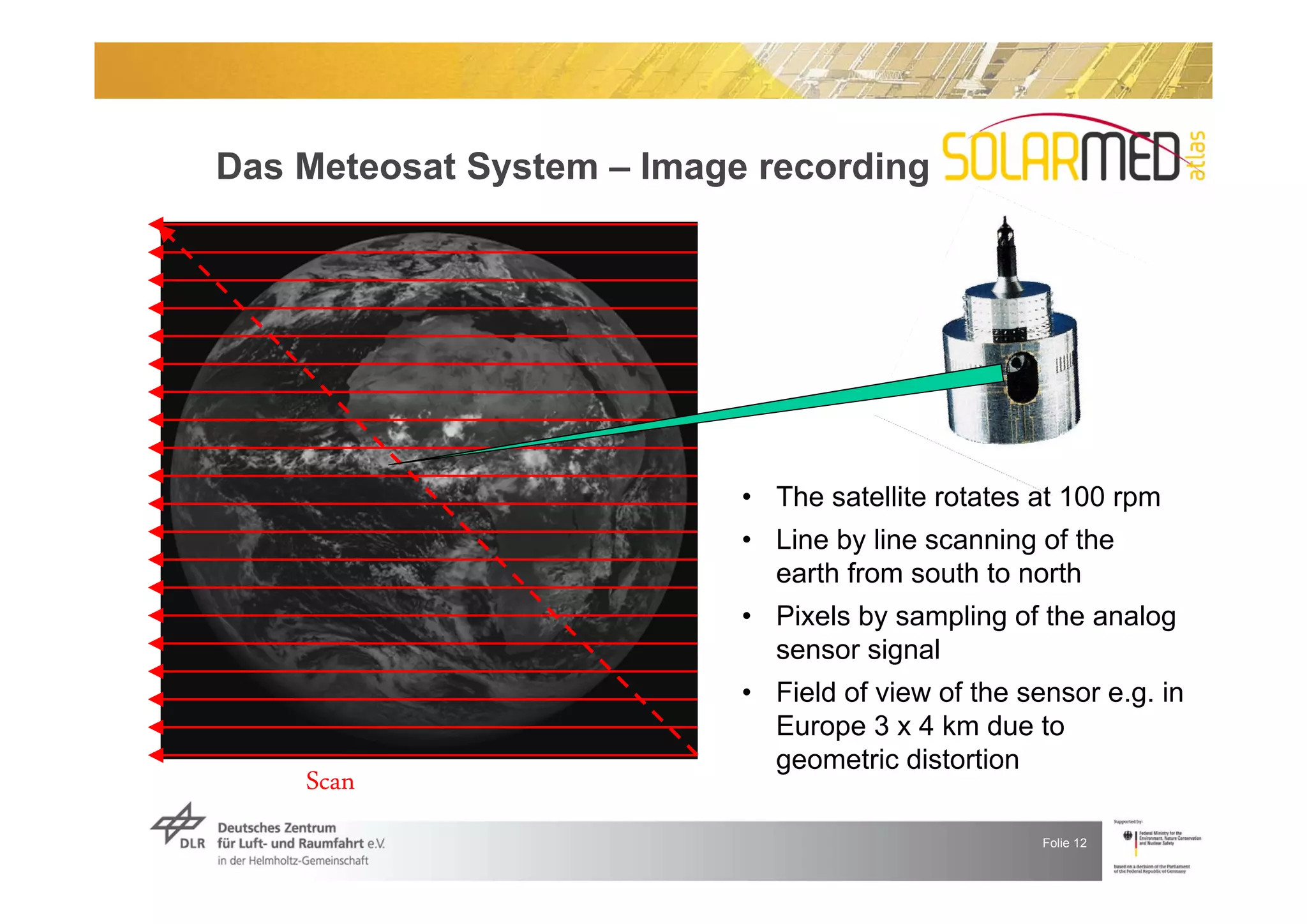
Das Meteosat System – Image recording


                           • The satellite rotates at 100 rpm
                           • Line by line scanning of the
                             earth from south to north
                           • Pixels by sampling of the analog
                             sensor signal
                           • Field of view of the sensor e.g. in
                             Europe 3 x 4 km due to
                             geometric distortion
    Scan
                                                    Folie 12
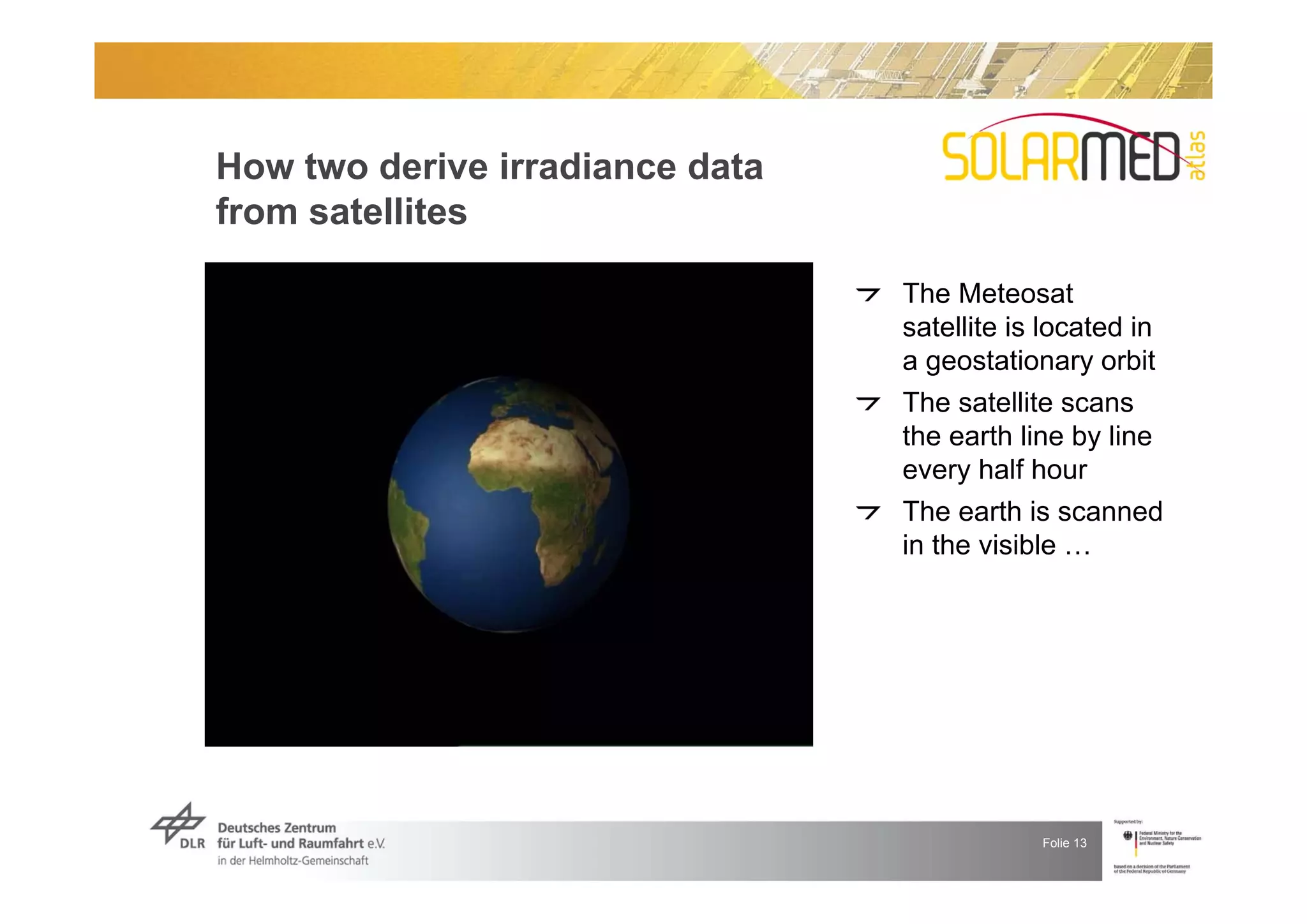
How two derive irradiance data
from satellites

                                 The Meteosat
                                 satellite is located in
                                 a geostationary orbit
                                 The satellite scans
                                 the earth line by line
                                 every half hour
                                 The earth is scanned
                                 in the visible …


                                             Folie 13
How two derive irradiance data
from satellites

                                 The Meteosat
                                 satellite is located in
                                 a geostationary orbit
                                 The satellite scans
                                 the earth line by line
                                 every half hour
                                 The earth is scanned
                                 in the visible and
                                 infra red spectrum


                                             Folie 14
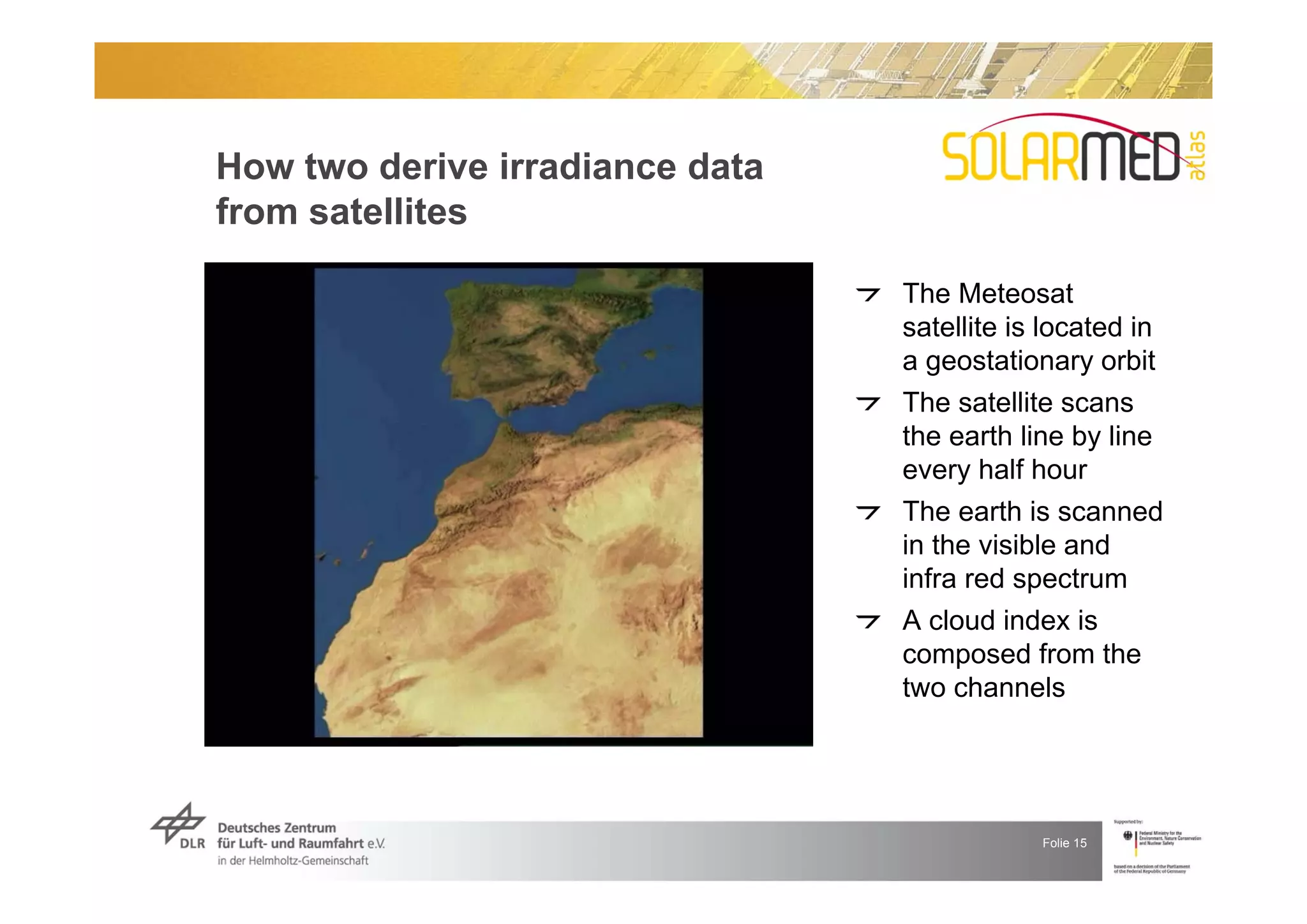
How two derive irradiance data
from satellites

                                 The Meteosat
                                 satellite is located in
                                 a geostationary orbit
                                 The satellite scans
                                 the earth line by line
                                 every half hour
                                 The earth is scanned
                                 in the visible and
                                 infra red spectrum
                                 A cloud index is
                                 composed from the
                                 two channels


                                             Folie 15
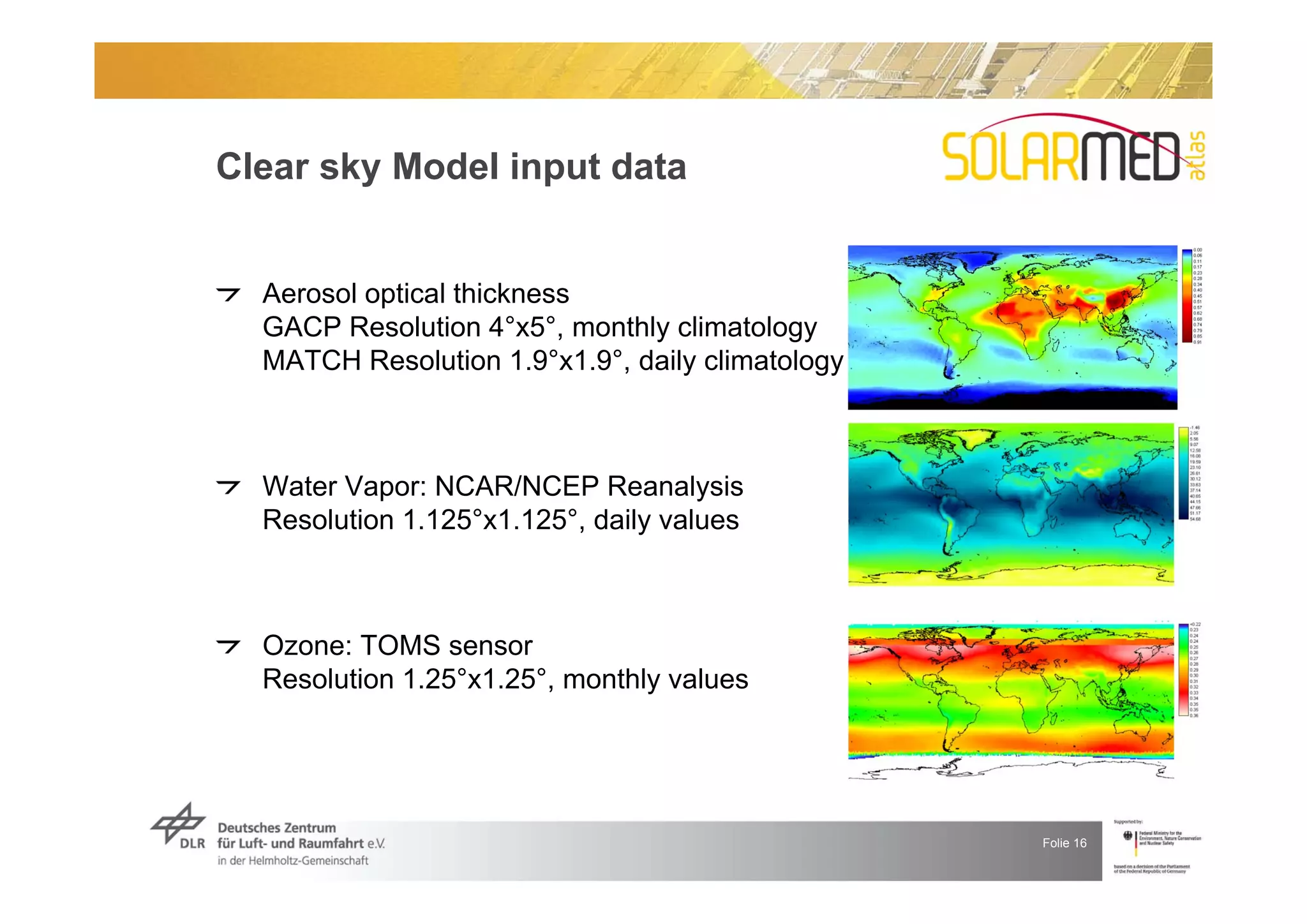
Clear sky Model input data


  Aerosol optical thickness
  GACP Resolution 4°x5°, monthly climatology
  MATCH Resolution 1.9°x1.9°, daily climatology


  Water Vapor: NCAR/NCEP Reanalysis
  Resolution 1.125°x1.125°, daily values


  Ozone: TOMS sensor
  Resolution 1.25°x1.25°, monthly values


                                                  Folie 16
Remote Sensing of Aerosols


  Usually split channel / dark target approach:
       A dark target is searched in a long-wave channel
       The reflectivity is observed in a short wave channel (usually
       aerosol backscatter increases with frequency)
       The difference is translated into a AOD


  Problems:
       Dark targets a land: Forrests, lakes – only a very few available
       almost none in deserts


                                                                  Folie 17
Chemistry Transport Models for
   Aerosol Data

Modeling of aerosol uptake, transport, chemical change and deposition in a numerical model
   Input:
          Surface properties
          Emission data bases
          Numerical weather models (especially wind fields, rain).
   Modeling:
          Aerosol uptake
          Aerosol transport with wind
          Aerosol outfall
          Aerosol chemistry, change in properties with time
   Output:
          Mass concentrations
                converted to optical properties


                                                                            Folie 18
Chemistry Transport Models –
Emission data bases

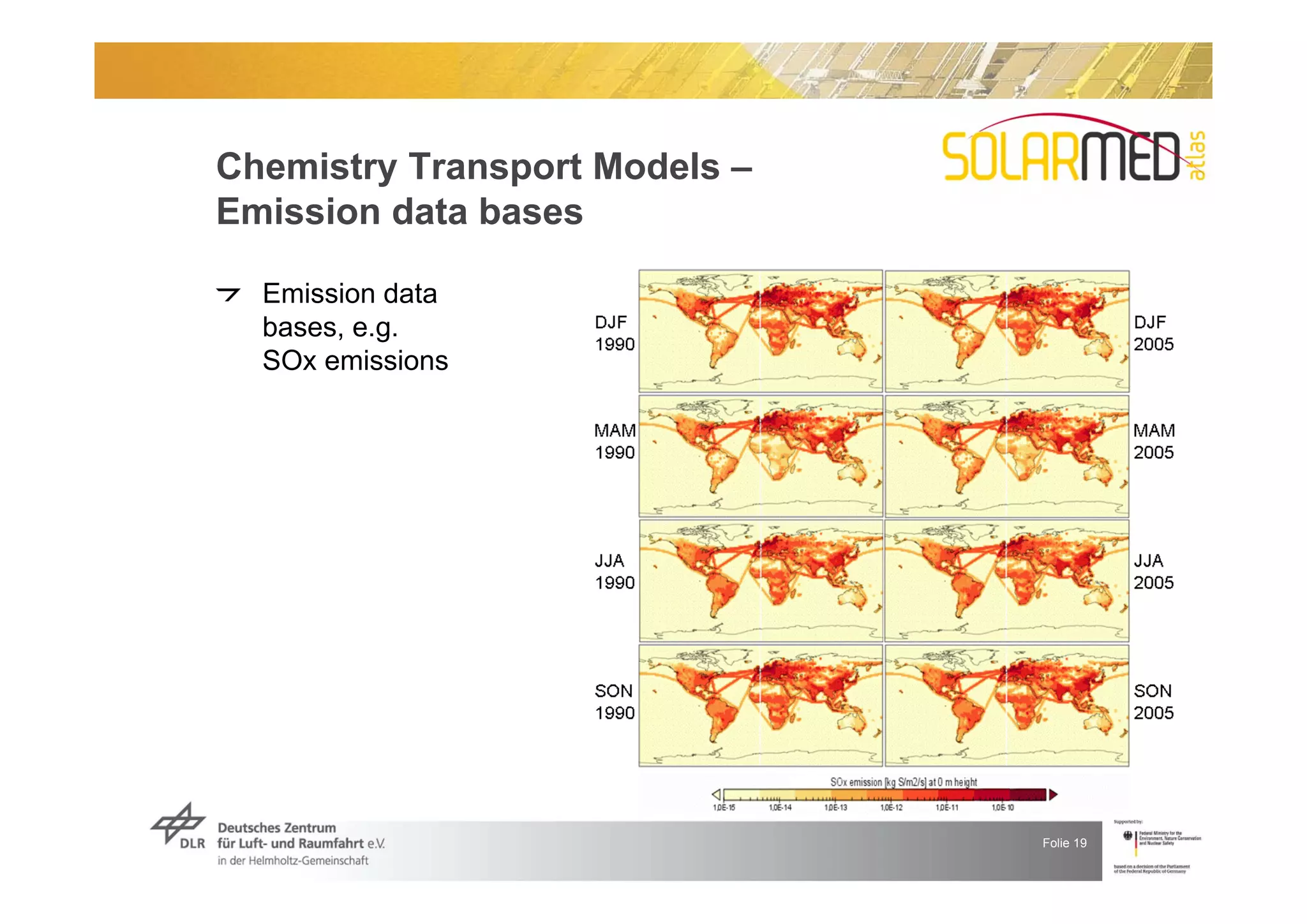
  Emission data
  bases, e.g.
  SOx emissions


                               Folie 19
Chemistry Transport Models - Dust


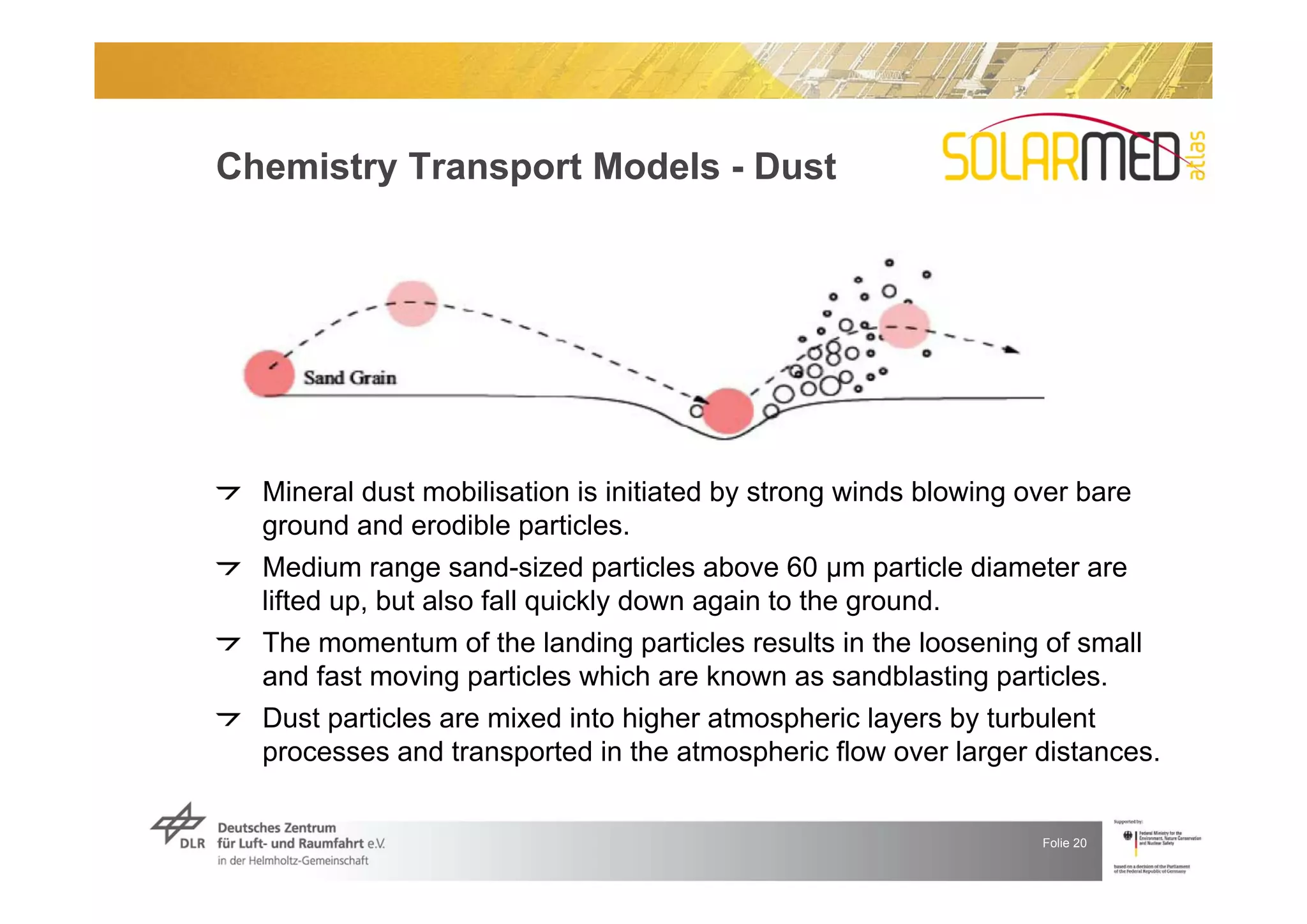
  Mineral dust mobilisation is initiated by strong winds blowing over bare
  ground and erodible particles.
  Medium range sand-sized particles above 60 μm particle diameter are
  lifted up, but also fall quickly down again to the ground.
  The momentum of the landing particles results in the loosening of small
  and fast moving particles which are known as sandblasting particles.
  Dust particles are mixed into higher atmospheric layers by turbulent
  processes and transported in the atmospheric flow over larger distances.


                                                                Folie 20
Uncertainty in Aerosols
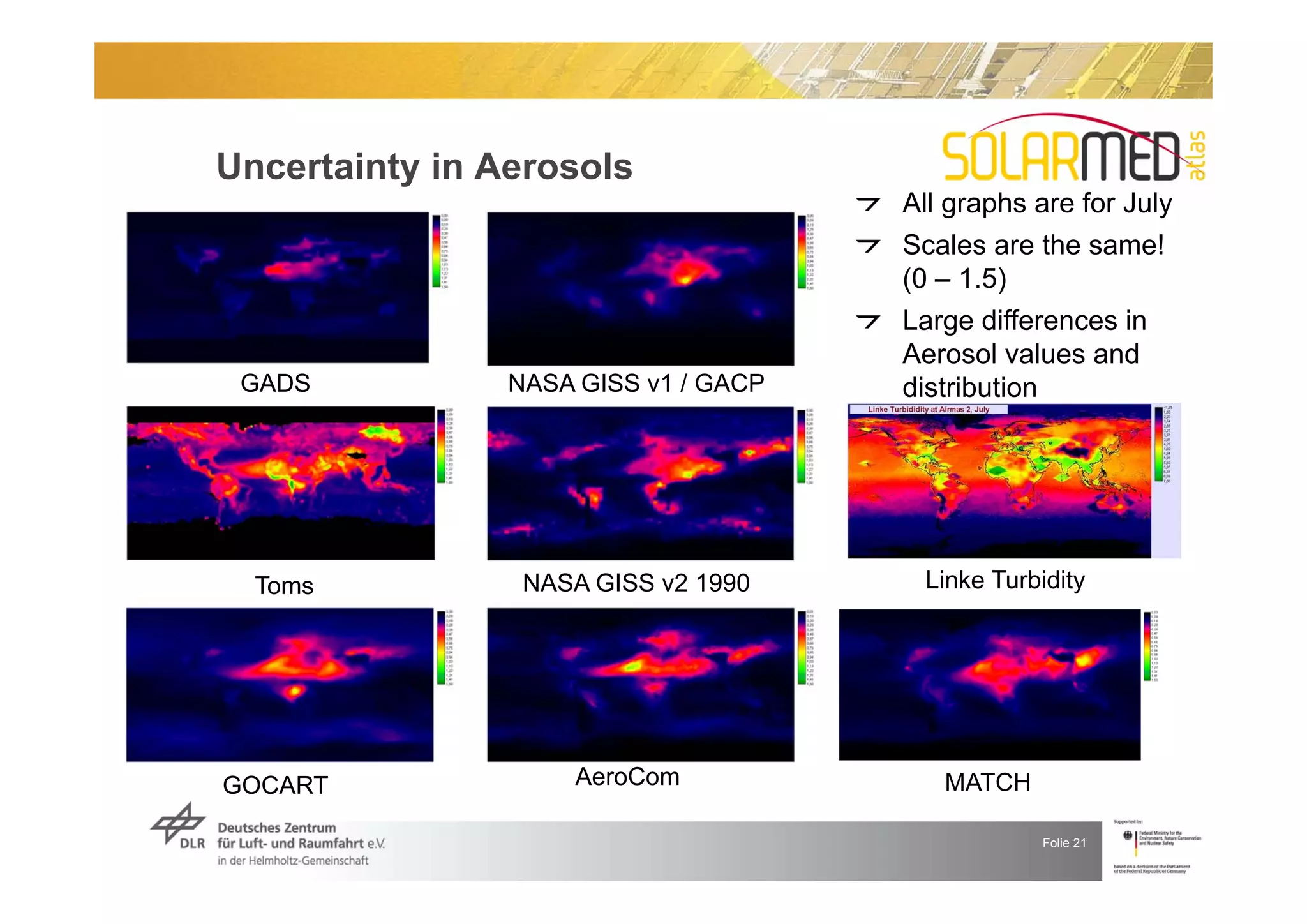
                                      All graphs are for July
                                      Scales are the same!
                                      (0 – 1.5)
                                      Large differences in
                                      Aerosol values and
 GADS           NASA GISS v1 / GACP   distribution


  Toms           NASA GISS v2 1990     Linke Turbidity


GOCART              AeroCom              MATCH

                                                 Folie 21
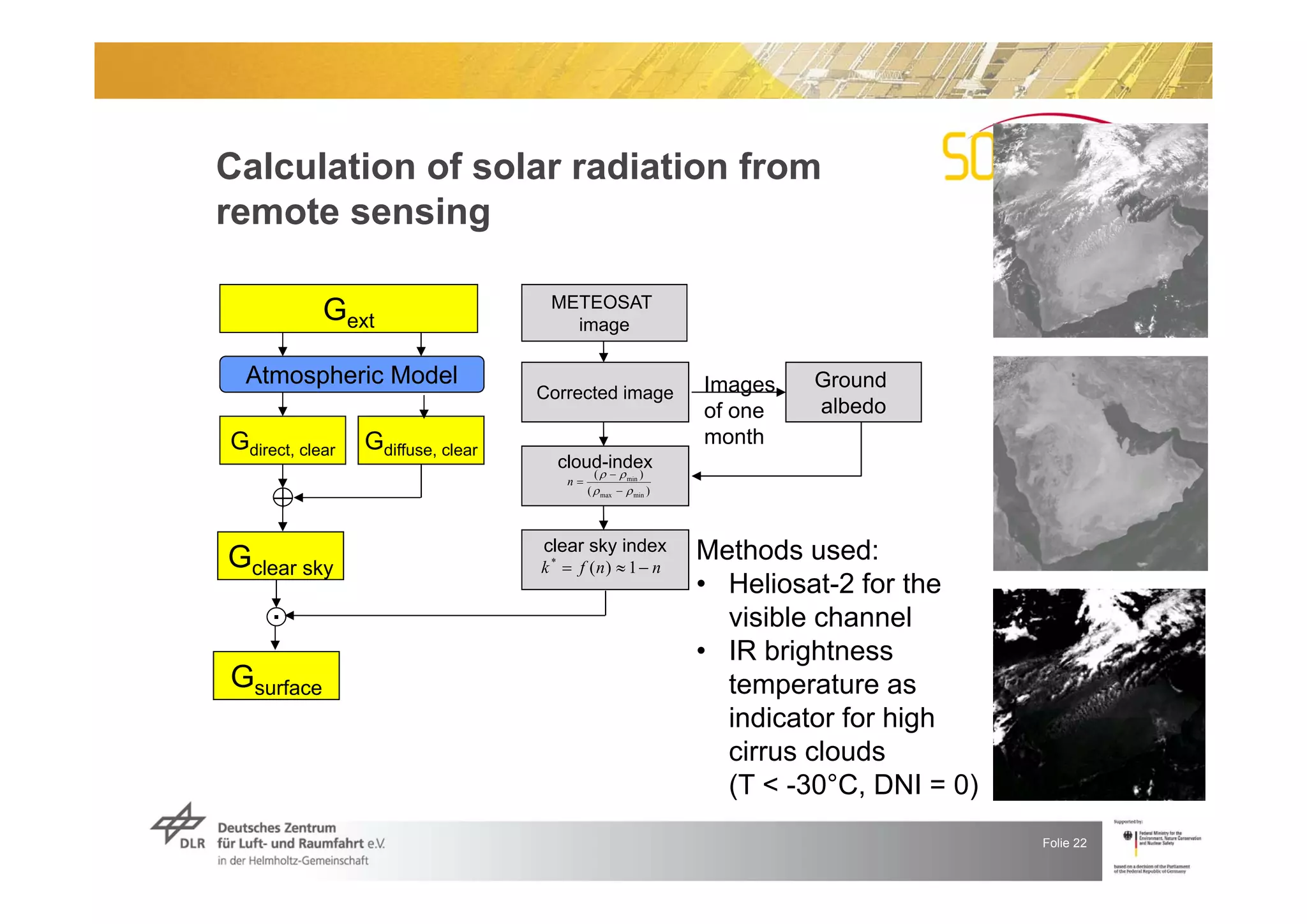
Calculation of solar radiation from
remote sensing

                                    METEOSAT
            Gext                      image

  Atmospheric Model                                             Images   Ground
                                   Corrected image
                                                                of one   albedo
Gdirect, clear   Gdiffuse, clear                                month
                                     cloud-index
                                              (    min )
                                       n

     +                                      (  max   min )


Gclear sky
                                   clear sky index
                                   k *  f (n)  1  n
                                                                Methods used:
                                                                • Heliosat-2 for the
     ·                                                            visible channel
                                                                • IR brightness
Gsurface                                                          temperature as
                                                                  indicator for high
                                                                  cirrus clouds
                                                                  (T < -30°C, DNI = 0)
                                                                                         Folie 22
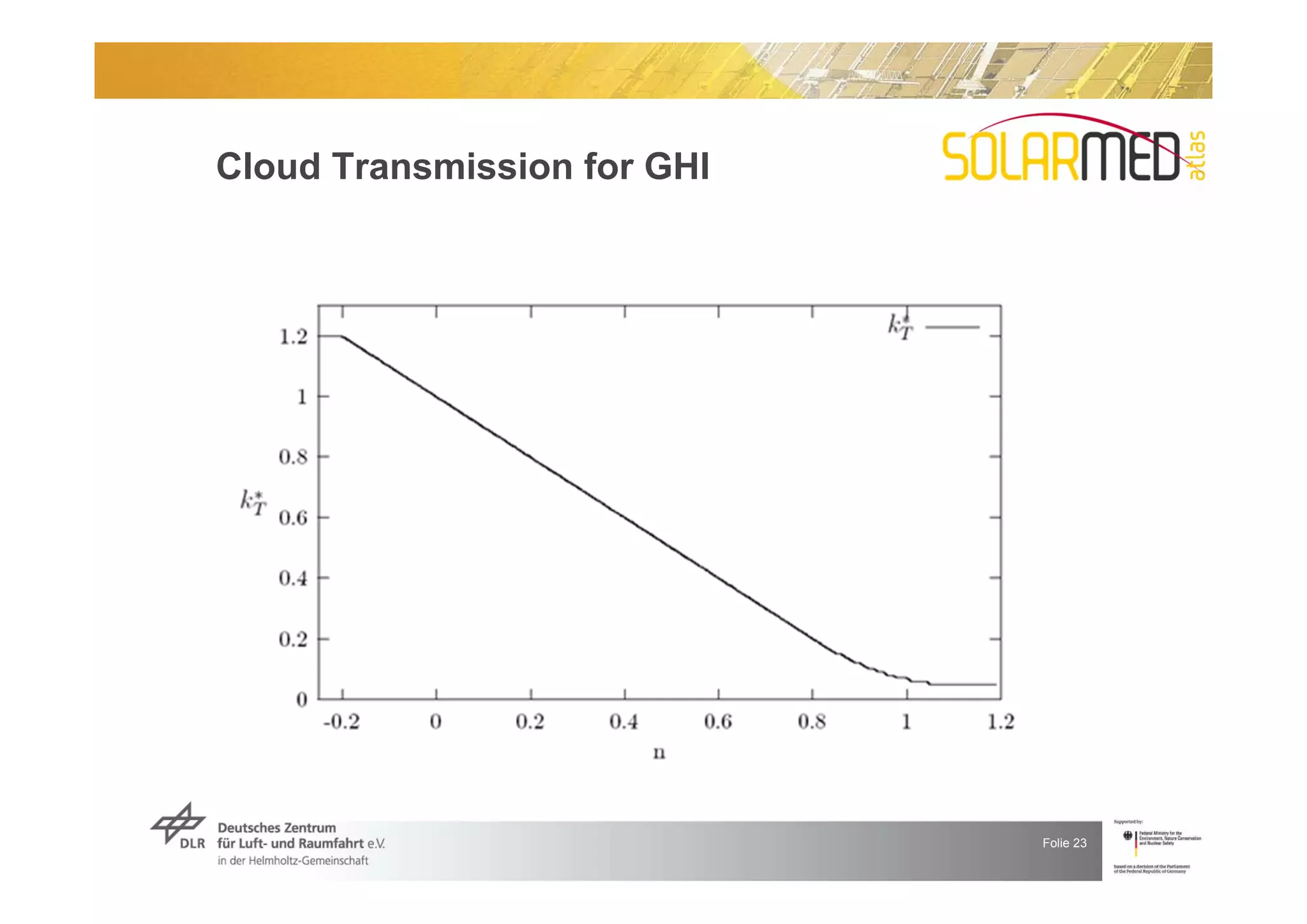
Cloud Transmission for GHI


                             Folie 23
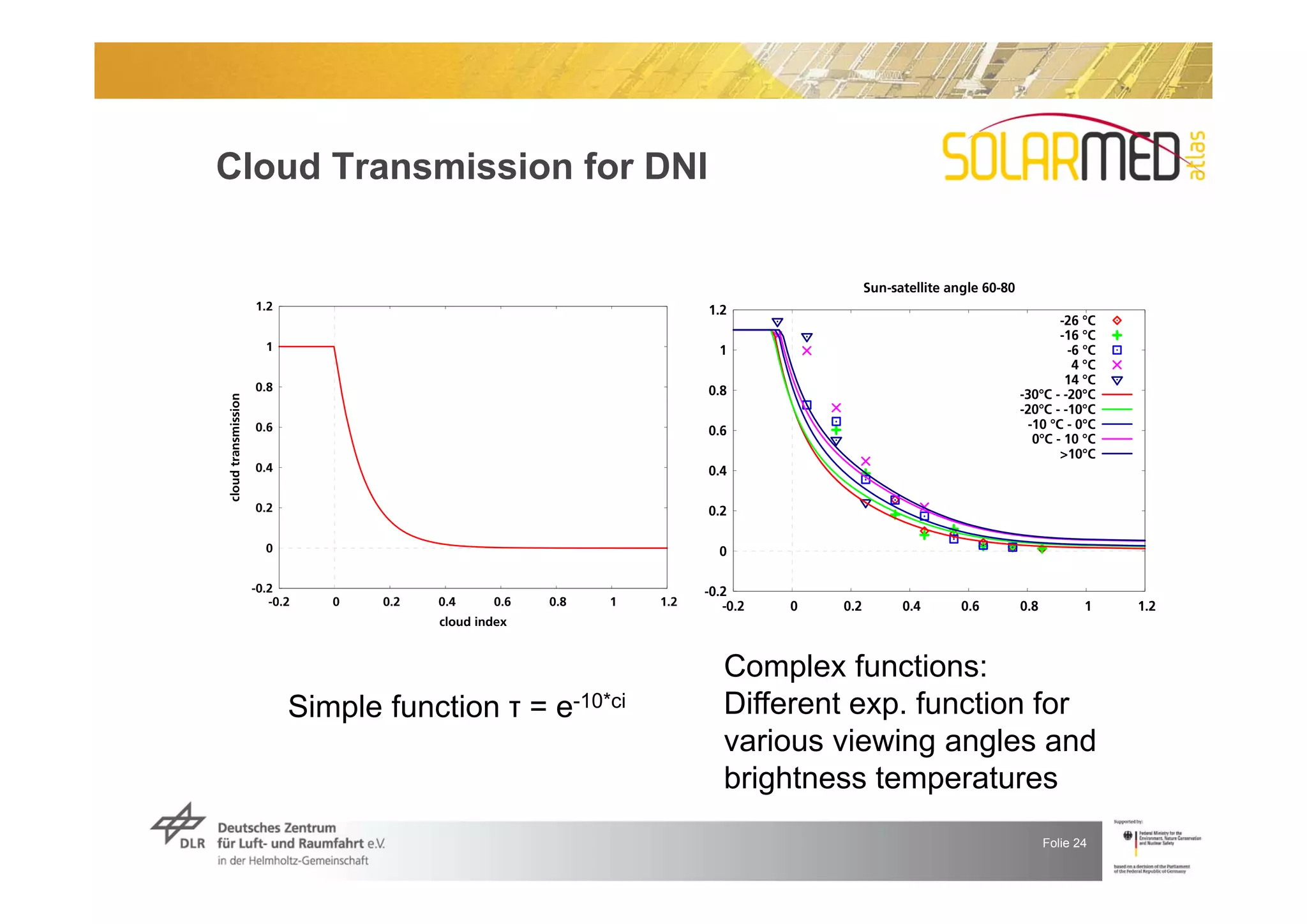
Cloud Transmission for DNI


                                                                                           Sun-satellite angle 60-80
                     1.2                                               1.2
                                                                                                                               -26 °C
                                                                                                                               -16 °C
                       1                                                 1                                                      -6 °C
                                                                                                                                 4 °C
                                                                                                                                14 °C
                     0.8                                               0.8                                             -30°C - -20°C
cloud transmission


                                                                                                                       -20°C - -10°C
                     0.6                                               0.6                                               -10 °C - 0°C
                                                                                                                          0°C - 10 °C
                                                                                                                               >10°C
                     0.4                                               0.4

                     0.2                                               0.2

                       0                                                 0

                     -0.2                                              -0.2
                        -0.2   0   0.2   0.4     0.6   0.8   1   1.2      -0.2   0   0.2         0.4       0.6         0.8          1   1.2
                                         cloud index


                                                                          Complex functions:
                           Simple function τ = e-10*ci                    Different exp. function for
                                                                          various viewing angles and
                                                                          brightness temperatures
                                                                                                                             Folie 24
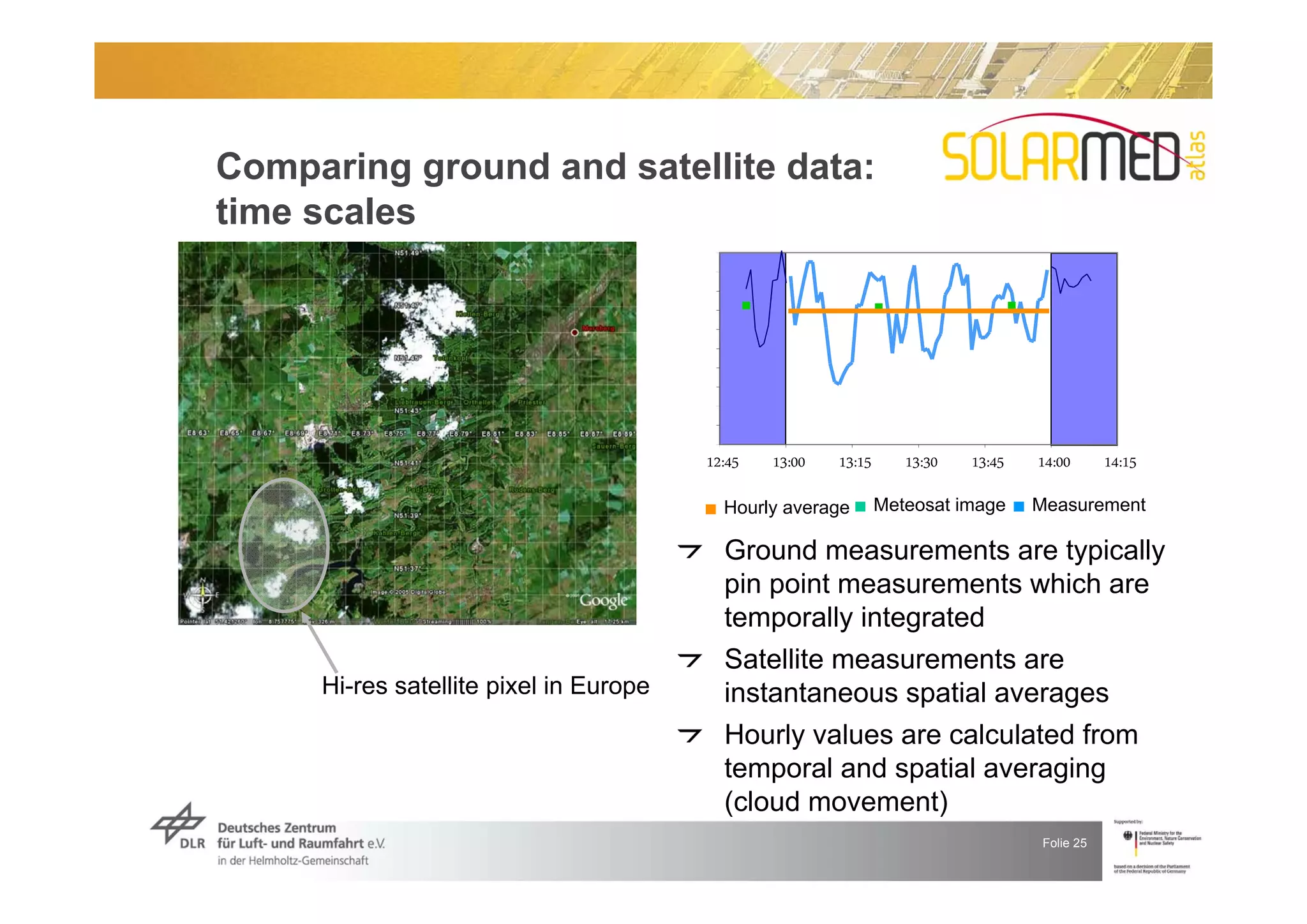
Comparing ground and satellite data:
time scales


                                        12:45   13:00   13:15      13:30   13:45   14:00       14:15

                                          Hourly average        Meteosat image     Measurement

                                          Ground measurements are typically
                                          pin point measurements which are
                                          temporally integrated
                                          Satellite measurements are
     Hi-res satellite pixel in Europe     instantaneous spatial averages
                                          Hourly values are calculated from
                                          temporal and spatial averaging
                                          (cloud movement)
                                                                                    Folie 25
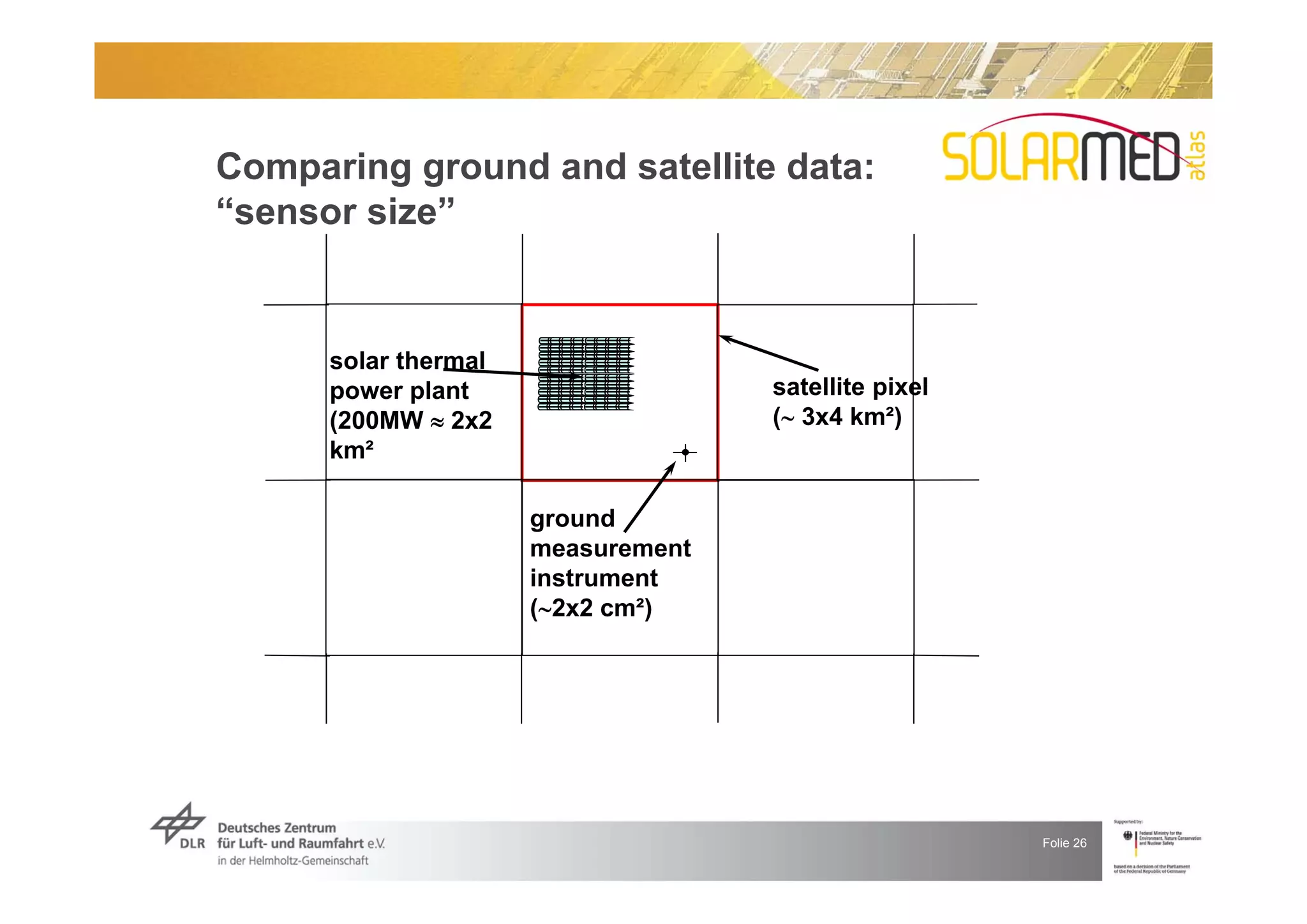
Comparing ground and satellite data:
“sensor size”


      solar thermal
      power plant                   satellite pixel
      (200MW  2x2                  ( 3x4 km²)
      km²

                      ground
                      measurement
                      instrument
                      (2x2 cm²)


                                                      Folie 26
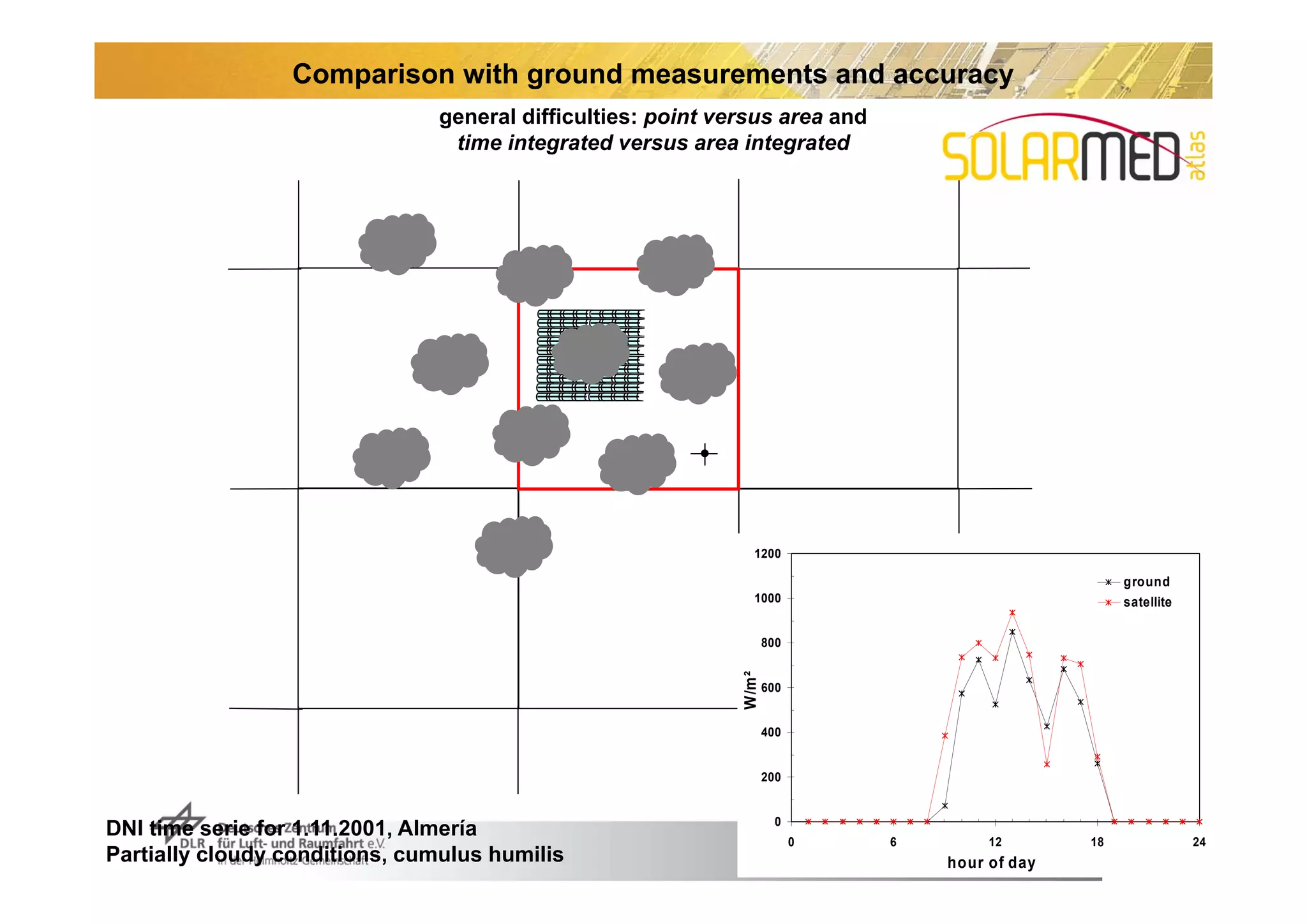
Comparison with ground measurements and accuracy
                               general difficulties: point versus area and
                                time integrated versus area integrated


                                                               1200

                                                                                                              ground
                                                               1000                                           satellite


                                                                    800


                                                             W/m²
                                                                    600


                                                                    400


                                                                    200


                                                                      0
DNI time serie for 1.11.2001, Almería                                     0   6        12       Folie 27 18               24
Partially cloudy conditions, cumulus humilis                                      hour of day
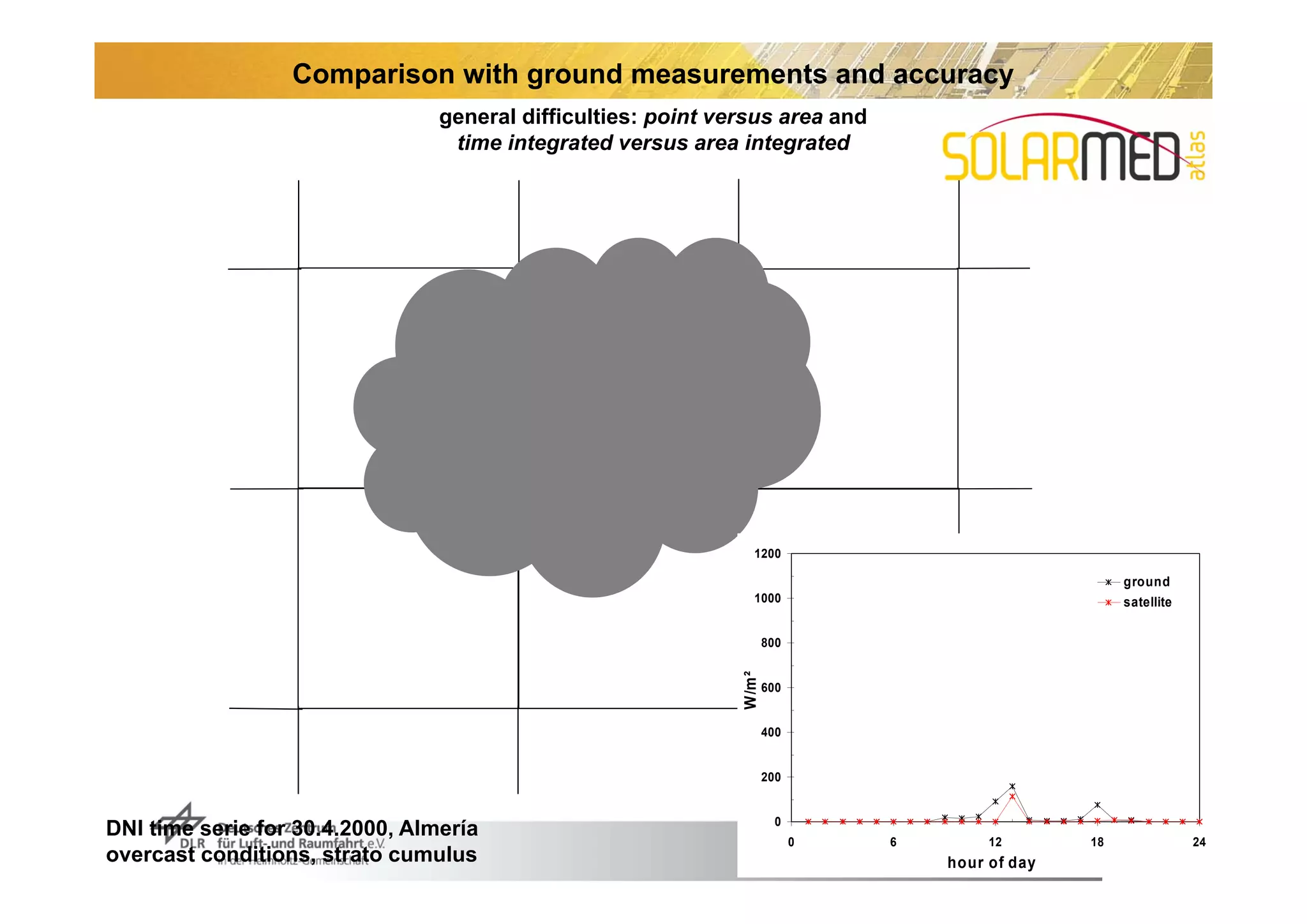
Comparison with ground measurements and accuracy
                                 general difficulties: point versus area and
                                  time integrated versus area integrated


                                                                 1200

                                                                                                                ground
                                                                 1000                                           satellite


                                                                      800


                                                               W/m²
                                                                      600


                                                                      400


                                                                      200


                                                                        0
DNI time serie for 30.4.2000, Almería                                       0   6        12       Folie 28 18               24
overcast conditions, strato cumulus                                                 hour of day
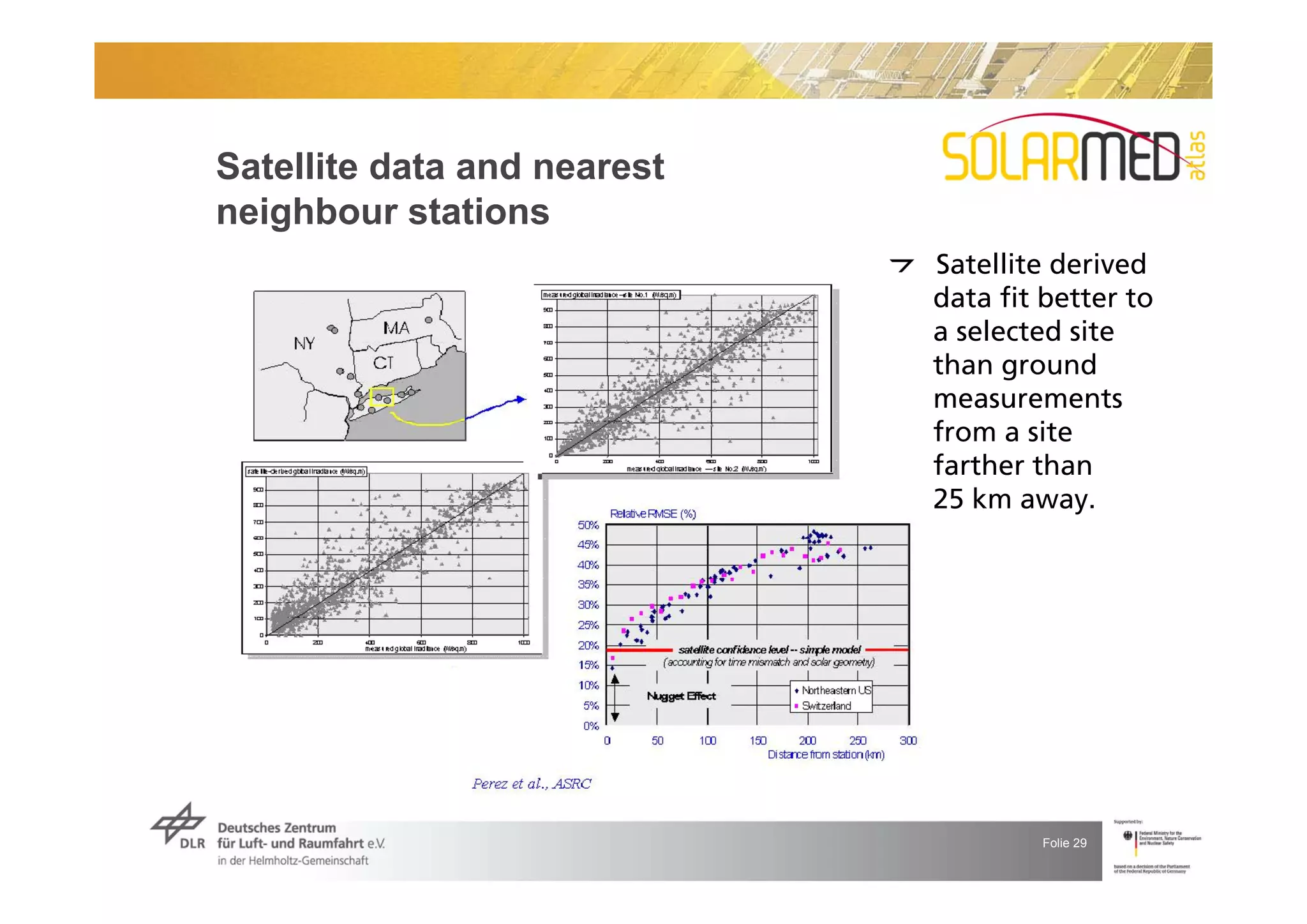
Satellite data and nearest
neighbour stations
                             Satellite derived
                             data fit better to
                             a selected site
                             than ground
                             measurements
                             from a site
                             farther than
                             25 km away.


                                     Folie 29
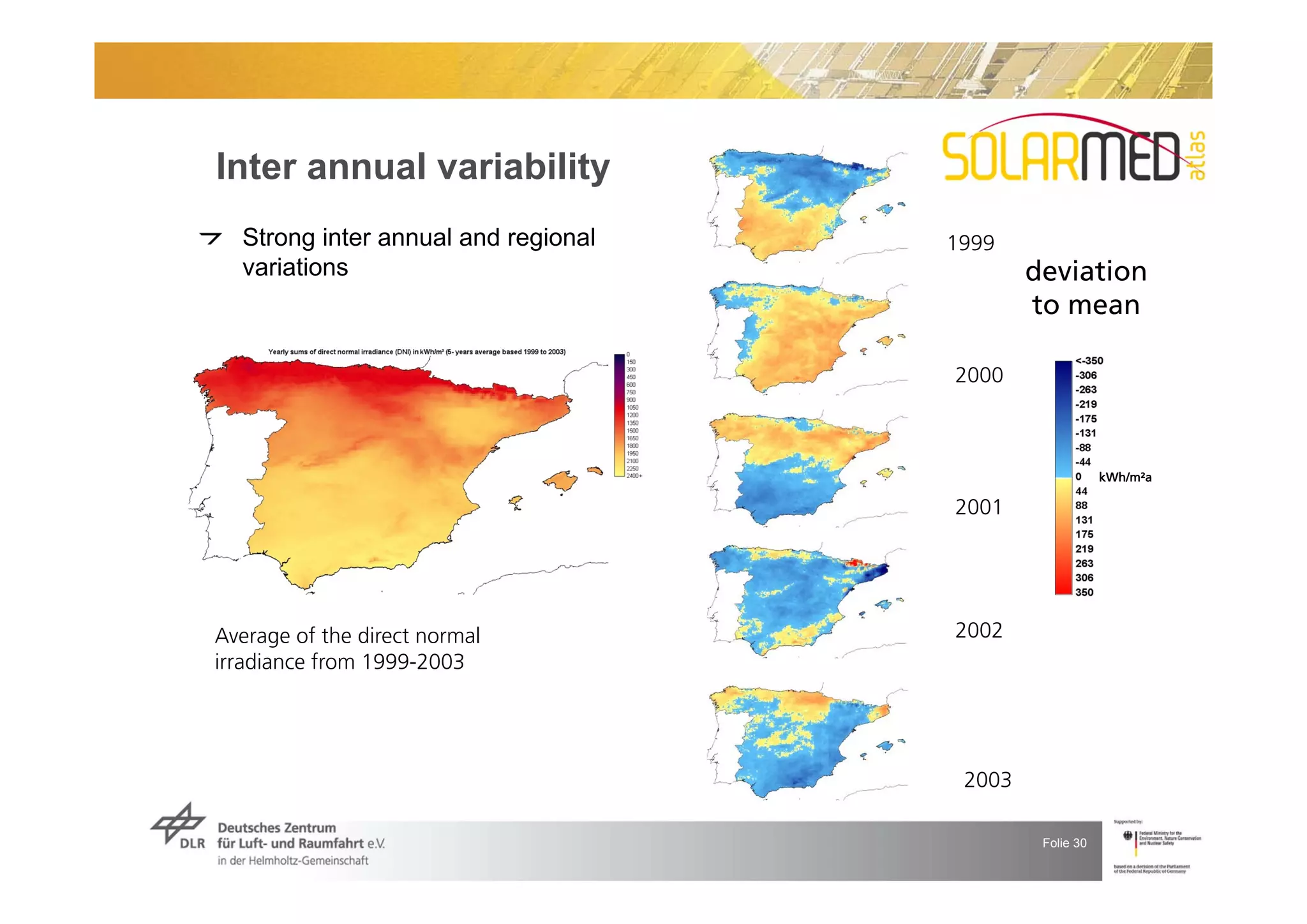
Inter annual variability
  Strong inter annual and regional   1999
  variations                                 deviation
                                             to mean

                                     2000


                                                         kWh/m²a

                                     2001


Average of the direct normal         2002
irradiance from 1999-2003


                                      2003

                                              Folie 30
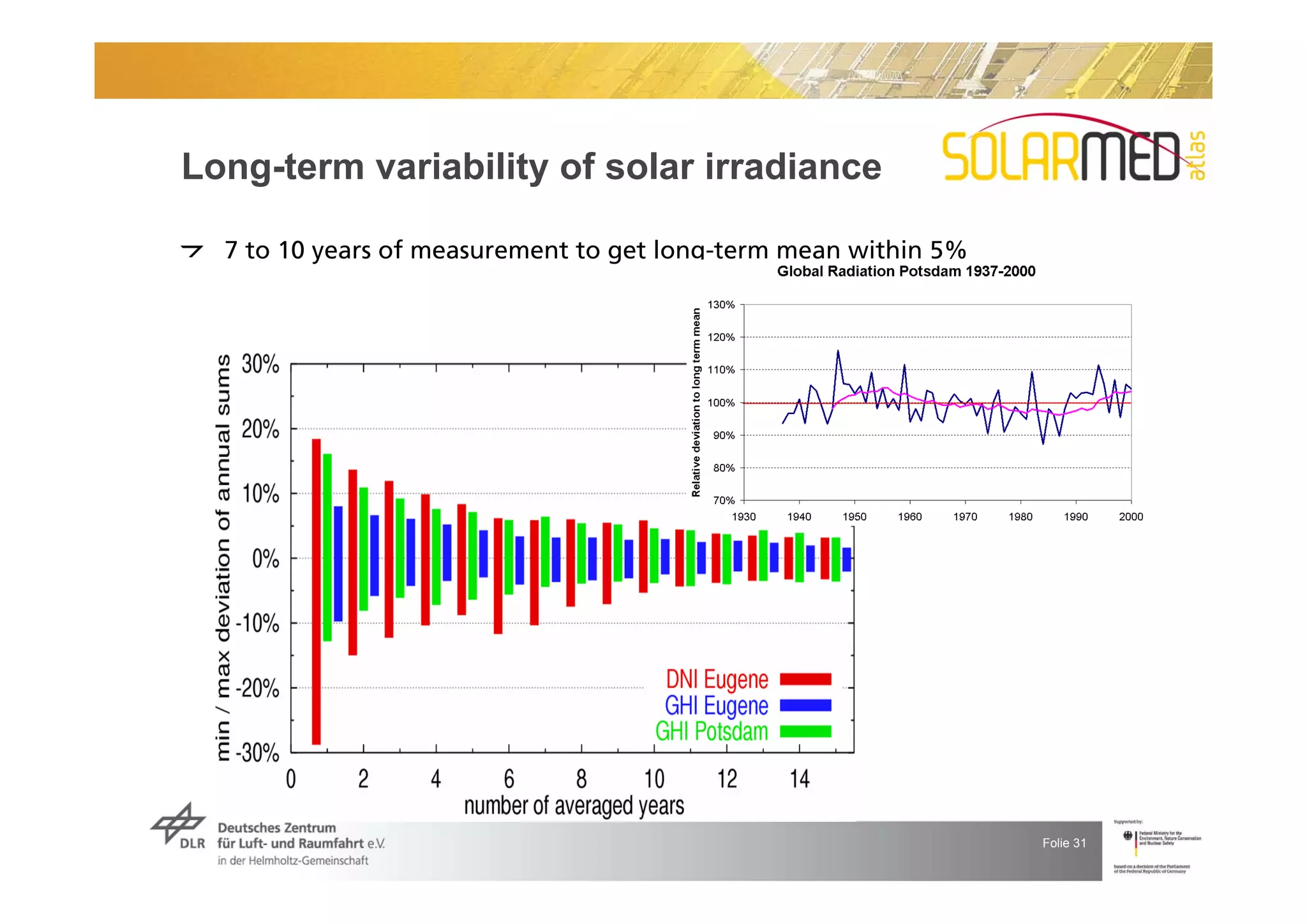
Long-term variability of solar irradiance

  7 to 10 years of measurement to get long-term mean within 5%


                                                                 Folie 31
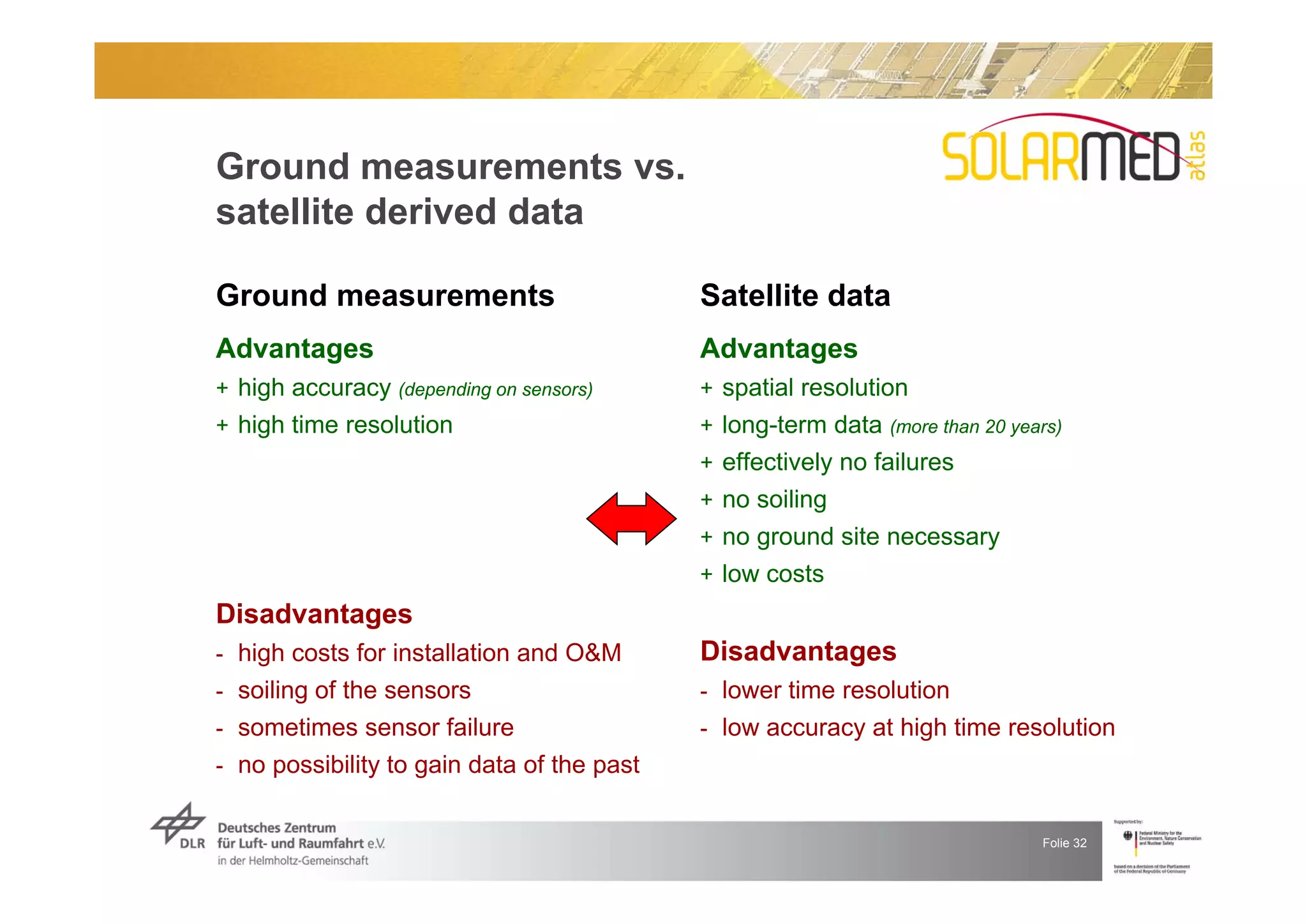
Ground measurements vs.
satellite derived data

Ground measurements                         Satellite data
Advantages                                  Advantages
+ high accuracy (depending on sensors)      + spatial resolution
+ high time resolution                      + long-term data (more than 20 years)
                                            + effectively no failures
                                            + no soiling
                                            + no ground site necessary
                                            + low costs
Disadvantages
- high costs for installation and O&M       Disadvantages
- soiling of the sensors                    - lower time resolution
- sometimes sensor failure                  - low accuracy at high time resolution
- no possibility to gain data of the past


                                                                               Folie 32
Combining Ground and
Satellite Assessments

  Satellite data
        Long term average
        Year to year variability
        Regional assessment


  Ground data
      Site specific
      High temporal resolution possible
      (up to 1 min to model transient effects)
      Good distribution function


                                                 Folie 33
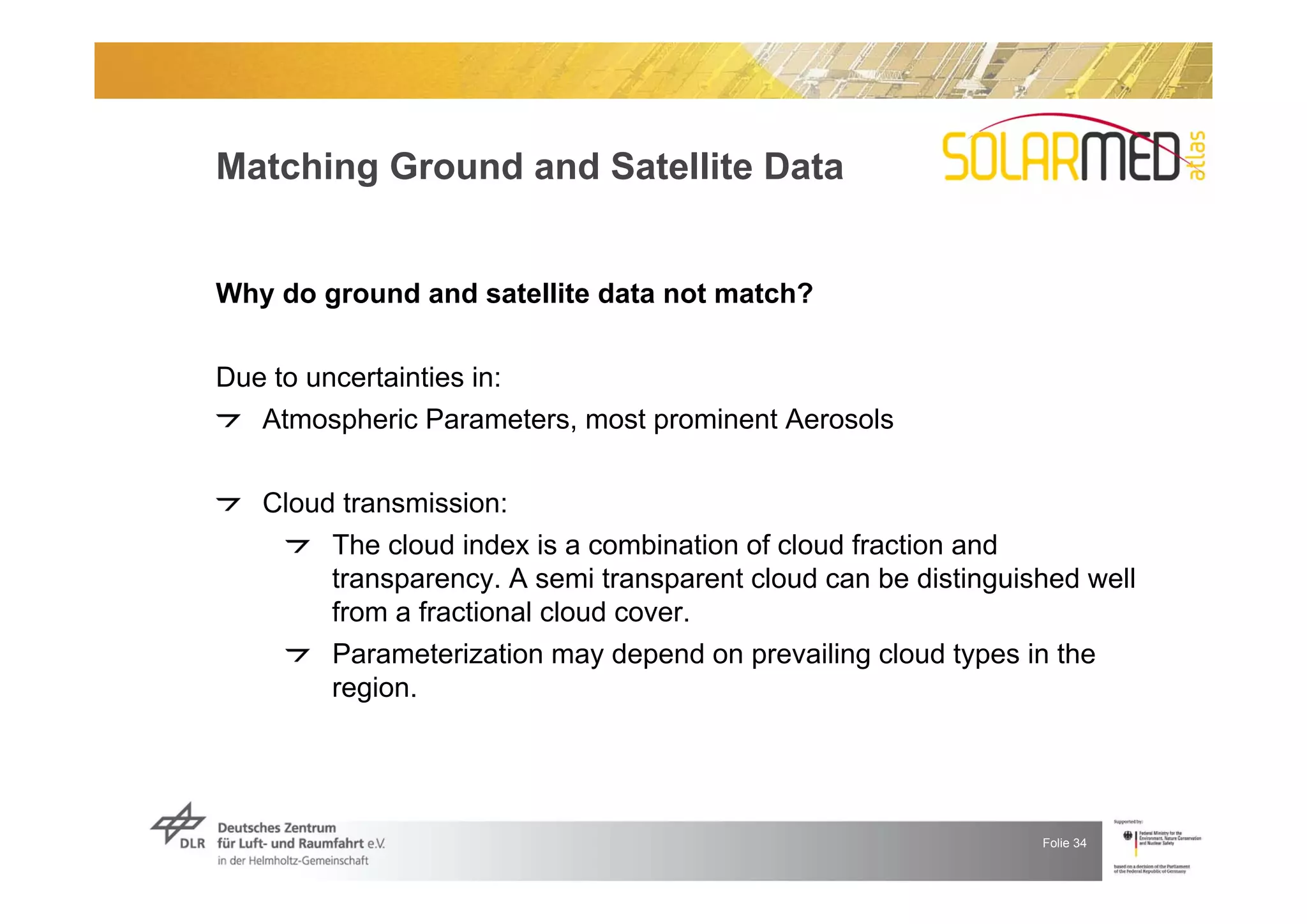
Matching Ground and Satellite Data


Why do ground and satellite data not match?


Due to uncertainties in:
   Atmospheric Parameters, most prominent Aerosols


   Cloud transmission:
        The cloud index is a combination of cloud fraction and
        transparency. A semi transparent cloud can be distinguished well
        from a fractional cloud cover.
        Parameterization may depend on prevailing cloud types in the
        region.


                                                                Folie 34
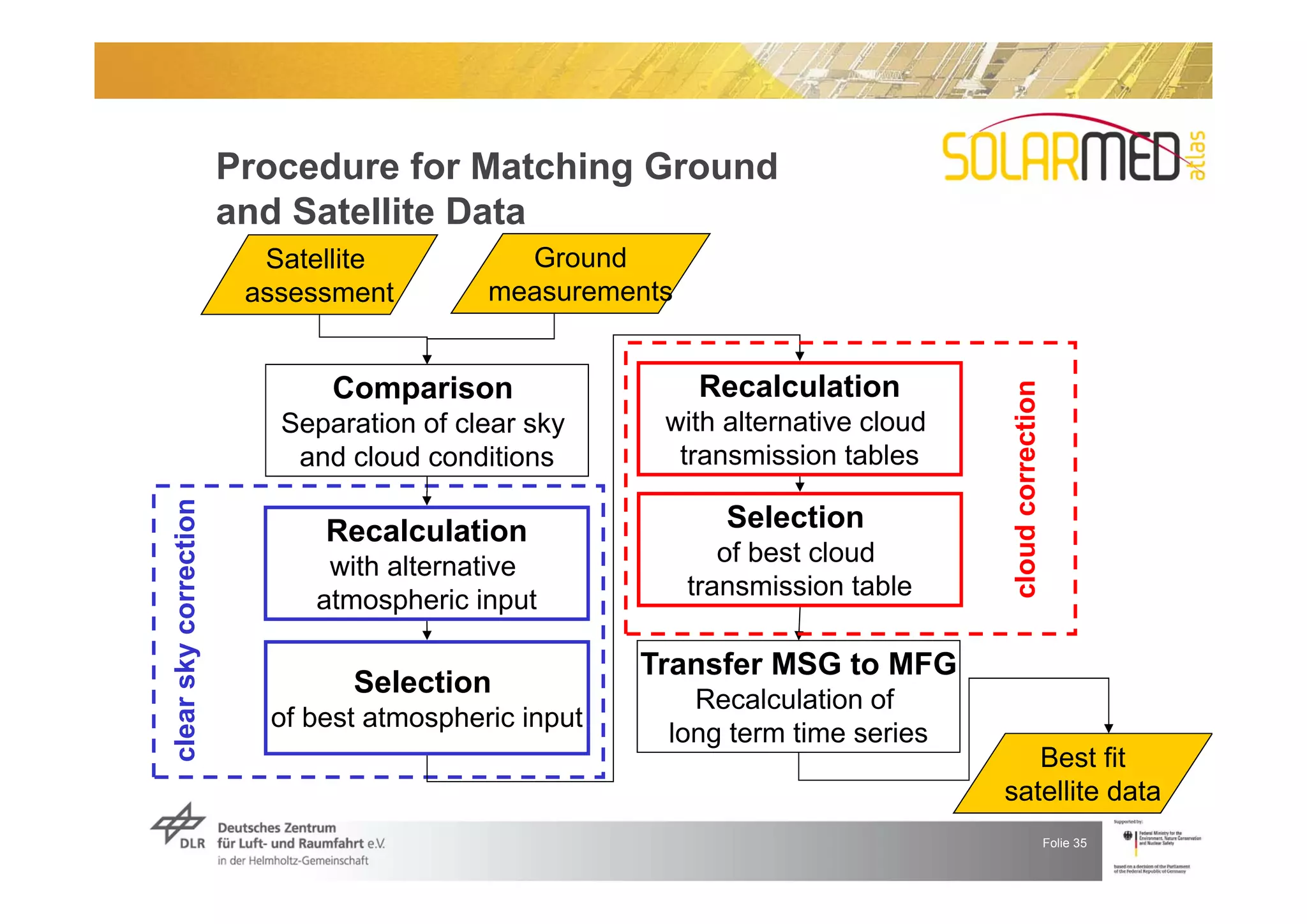
Procedure for Matching Ground
                       and Satellite Data
                         Satellite          Ground
                        assessment        measurements


                              Comparison                 Recalculation


                                                                               cloud correction
                          Separation of clear sky     with alternative cloud
                           and cloud conditions        transmission tables
clear sky correction


                             Recalculation                  Selection
                             with alternative               of best cloud
                            atmospheric input            transmission table

                                                     Transfer MSG to MFG
                               Selection
                                                        Recalculation of
                         of best atmospheric input
                                                      long term time series
                                                                                  Best fit
                                                                               satellite data
                                                                                                  Folie 35
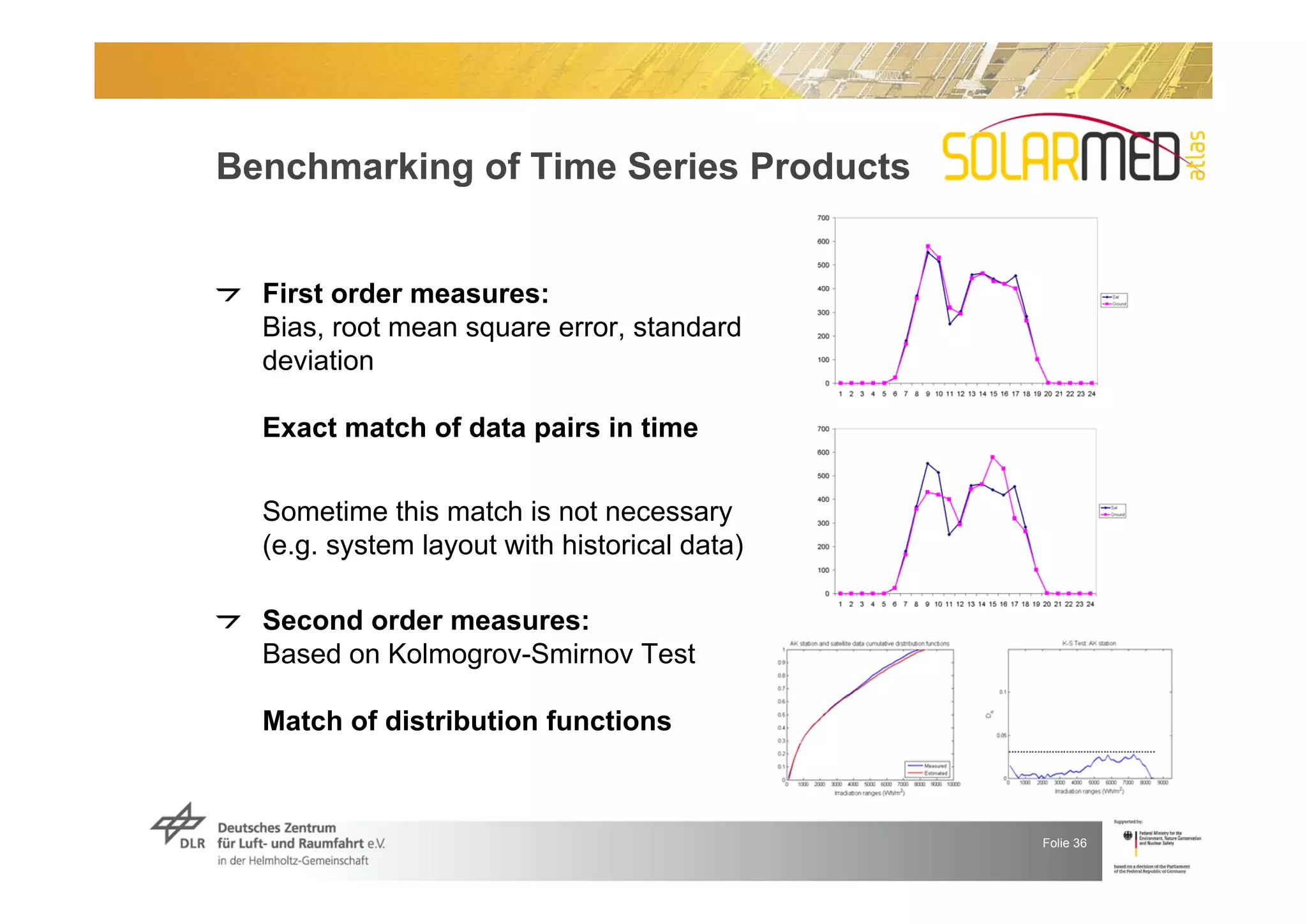
Benchmarking of Time Series Products


  First order measures:
  Bias, root mean square error, standard
  deviation

  Exact match of data pairs in time


  Sometime this match is not necessary
  (e.g. system layout with historical data)

  Second order measures:
  Based on Kolmogrov-Smirnov Test

  Match of distribution functions


                                              Folie 36
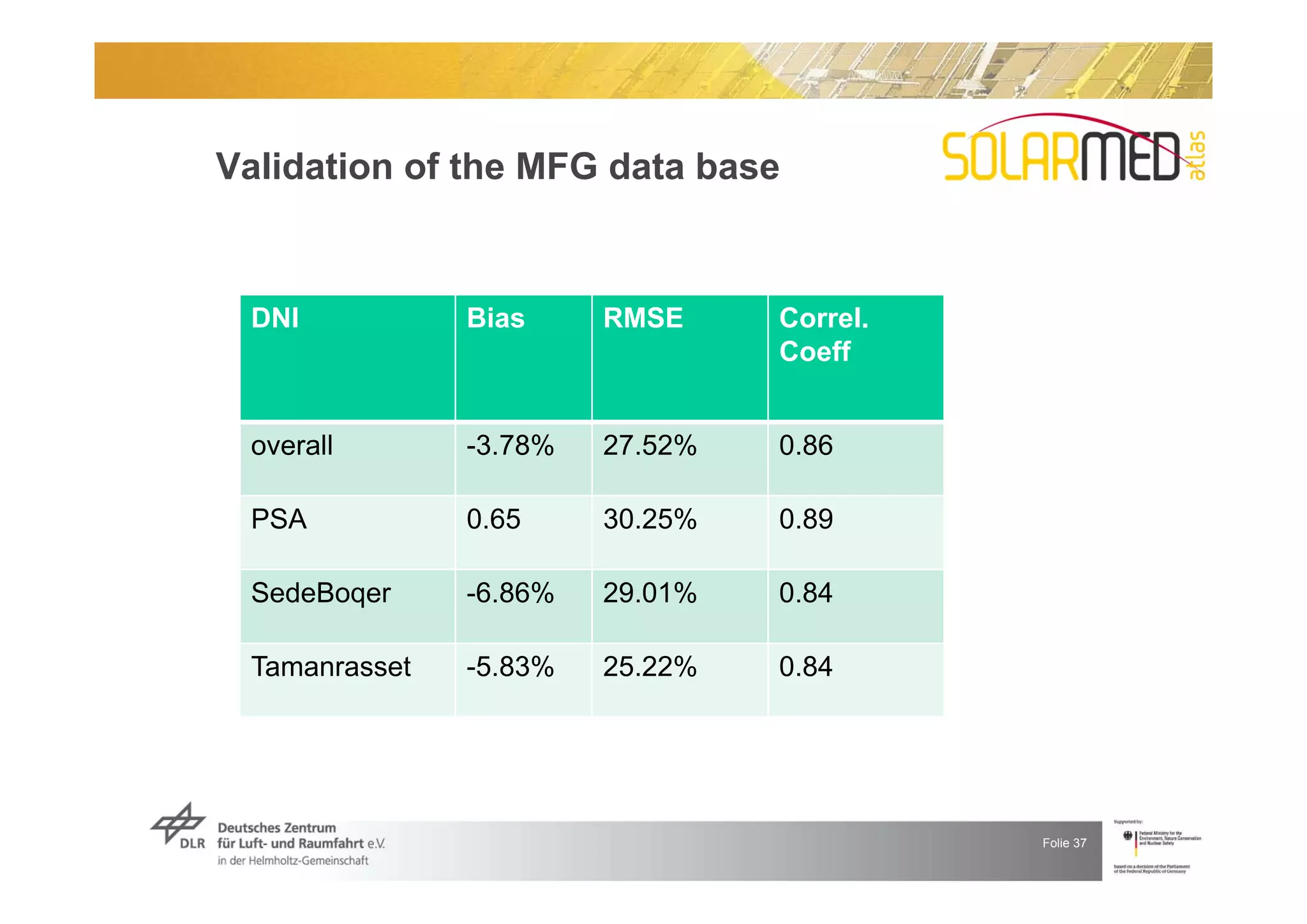
Validation of the MFG data base


 DNI           Bias     RMSE     Correl.
                                 Coeff


 overall       -3.78%   27.52%   0.86

 PSA           0.65     30.25%   0.89

 SedeBoqer     -6.86%   29.01%   0.84

 Tamanrasset   -5.83%   25.22%   0.84


                                           Folie 37
Using Solar Resource Data for Policy Analysis


                                           Folie 38
Policy questions


  How potential is there for a certain technology?


  Are there prime areas to develop a technology?


                                                     Folie 39
1st Question: How much Potential?


  Is the technology feasible, are there enough resources?


  Is there sufficient area to depoly the technology?


  To which share of the (national) demand can they contribute?


                                                                 Folie 40
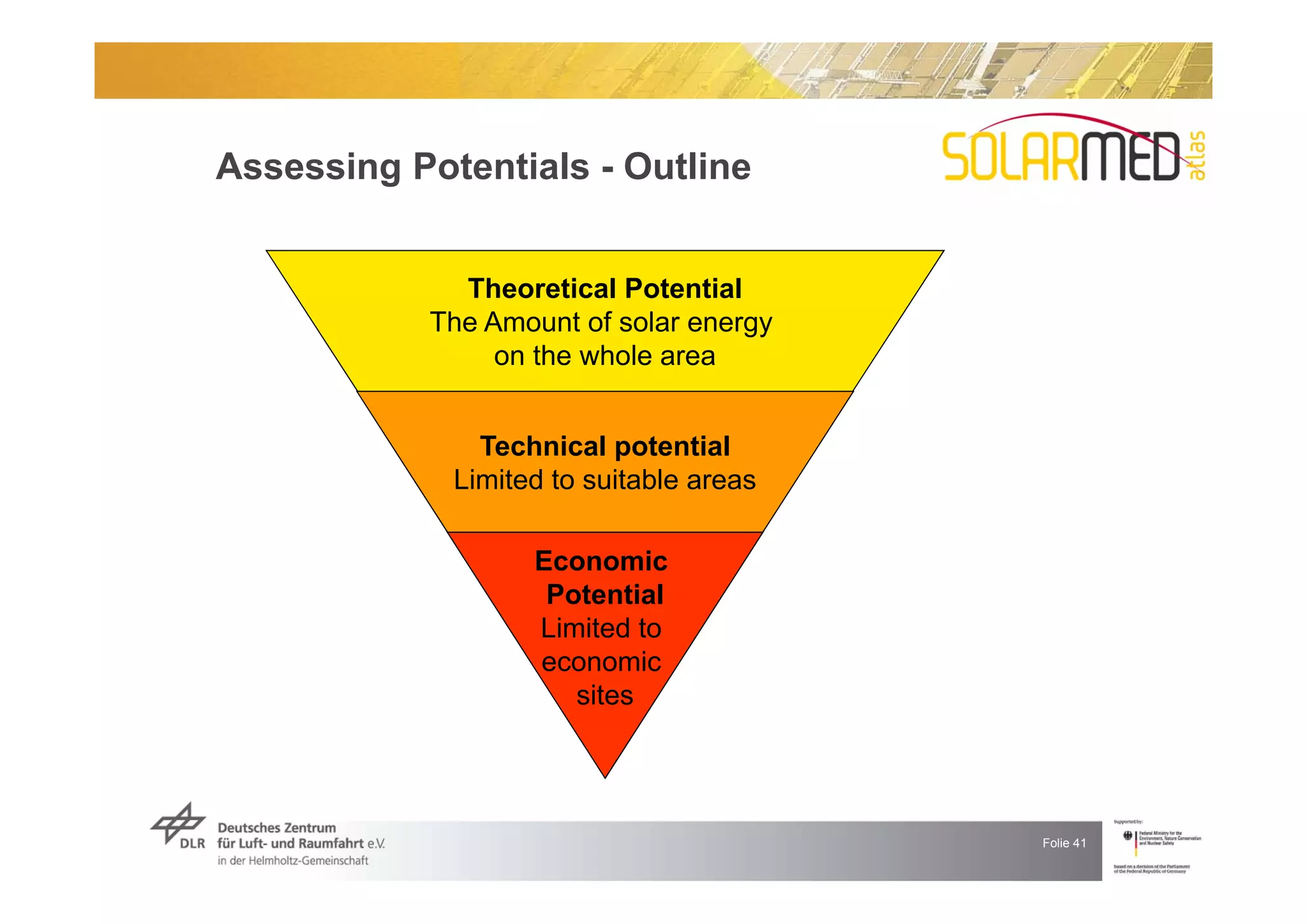
Assessing Potentials - Outline


             Theoretical Potential
           The Amount of solar energy
                on the whole area


               Technical potential
             Limited to suitable areas

                   Economic
                    Potential
                   Limited to
                   economic
                      sites


                                         Folie 41
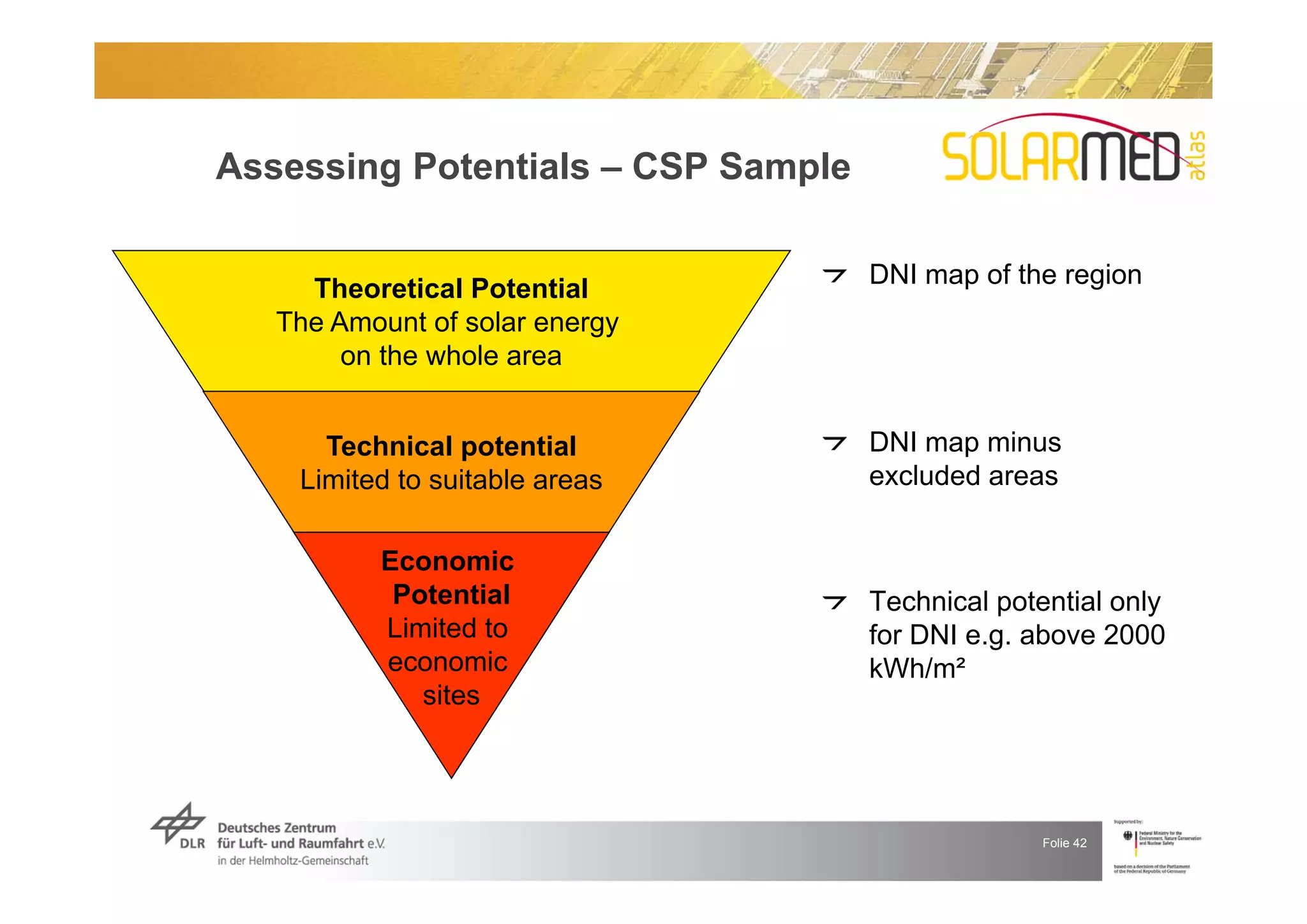
Assessing Potentials – CSP Sample

                                    DNI map of the region
     Theoretical Potential
   The Amount of solar energy
        on the whole area


      Technical potential           DNI map minus
    Limited to suitable areas       excluded areas


          Economic
           Potential                Technical potential only
          Limited to                for DNI e.g. above 2000
          economic                  kWh/m²
             sites


                                                  Folie 42
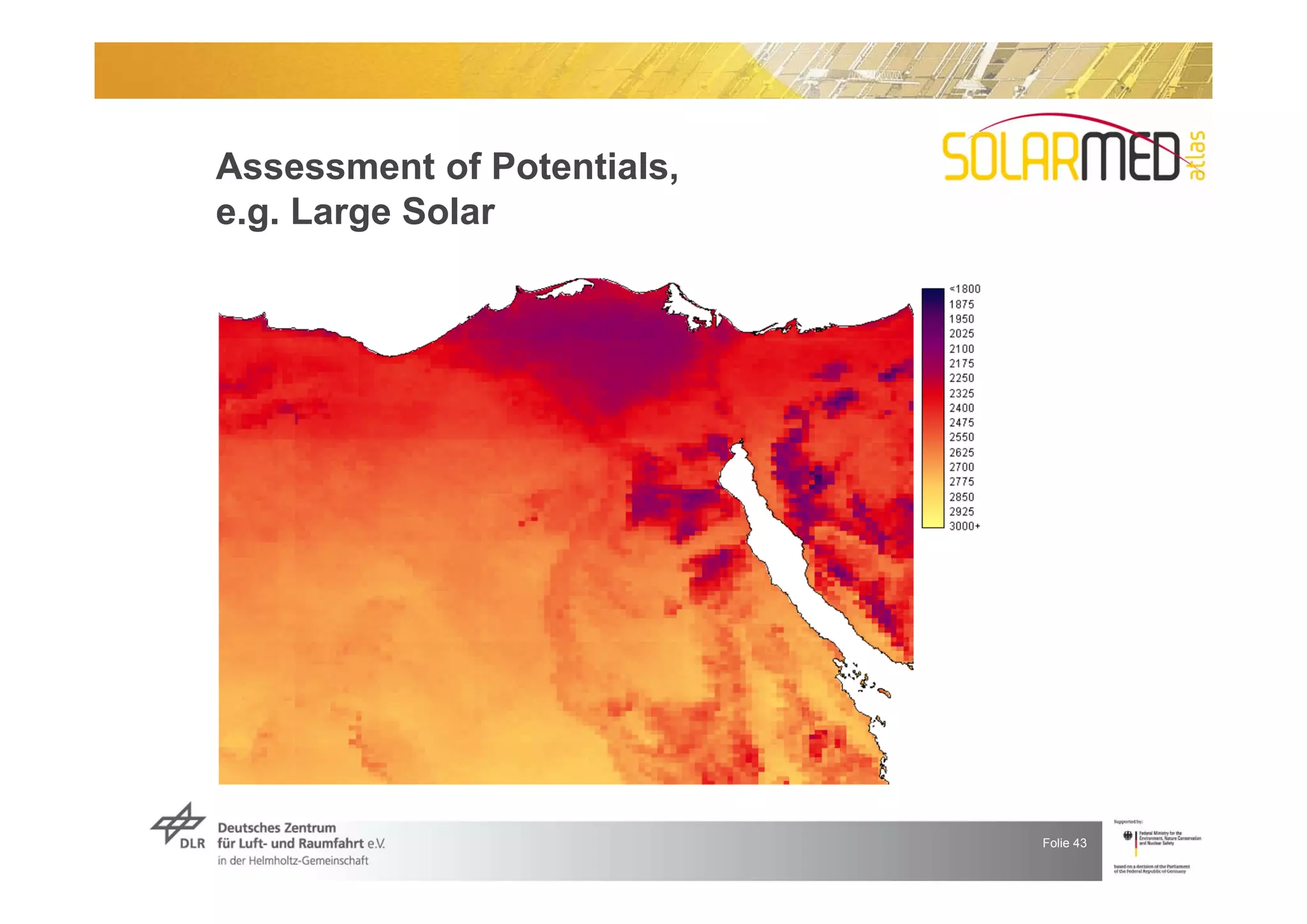
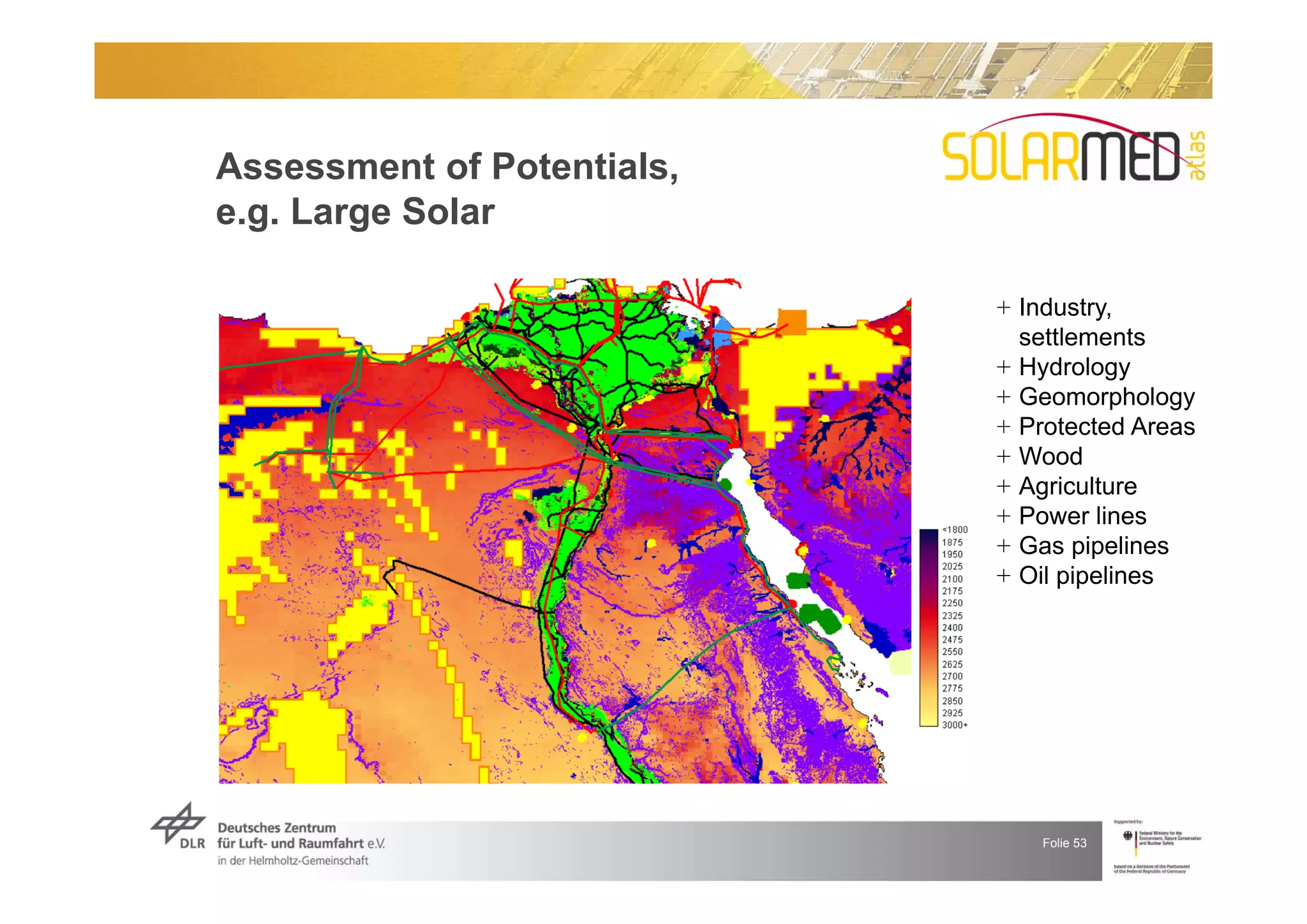
Assessment of Potentials,
e.g. Large Solar


                            Folie 43
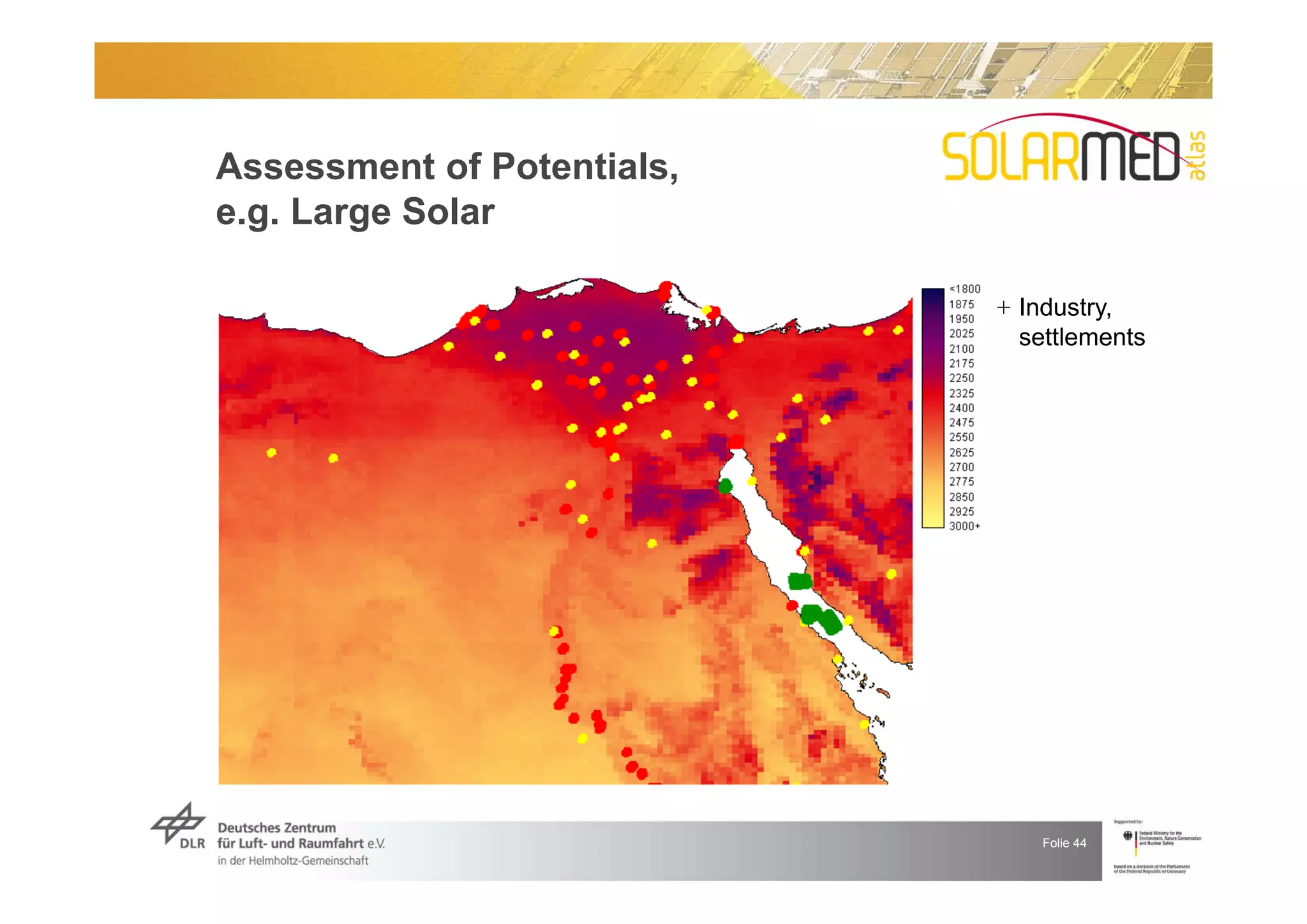
Assessment of Potentials,
e.g. Large Solar

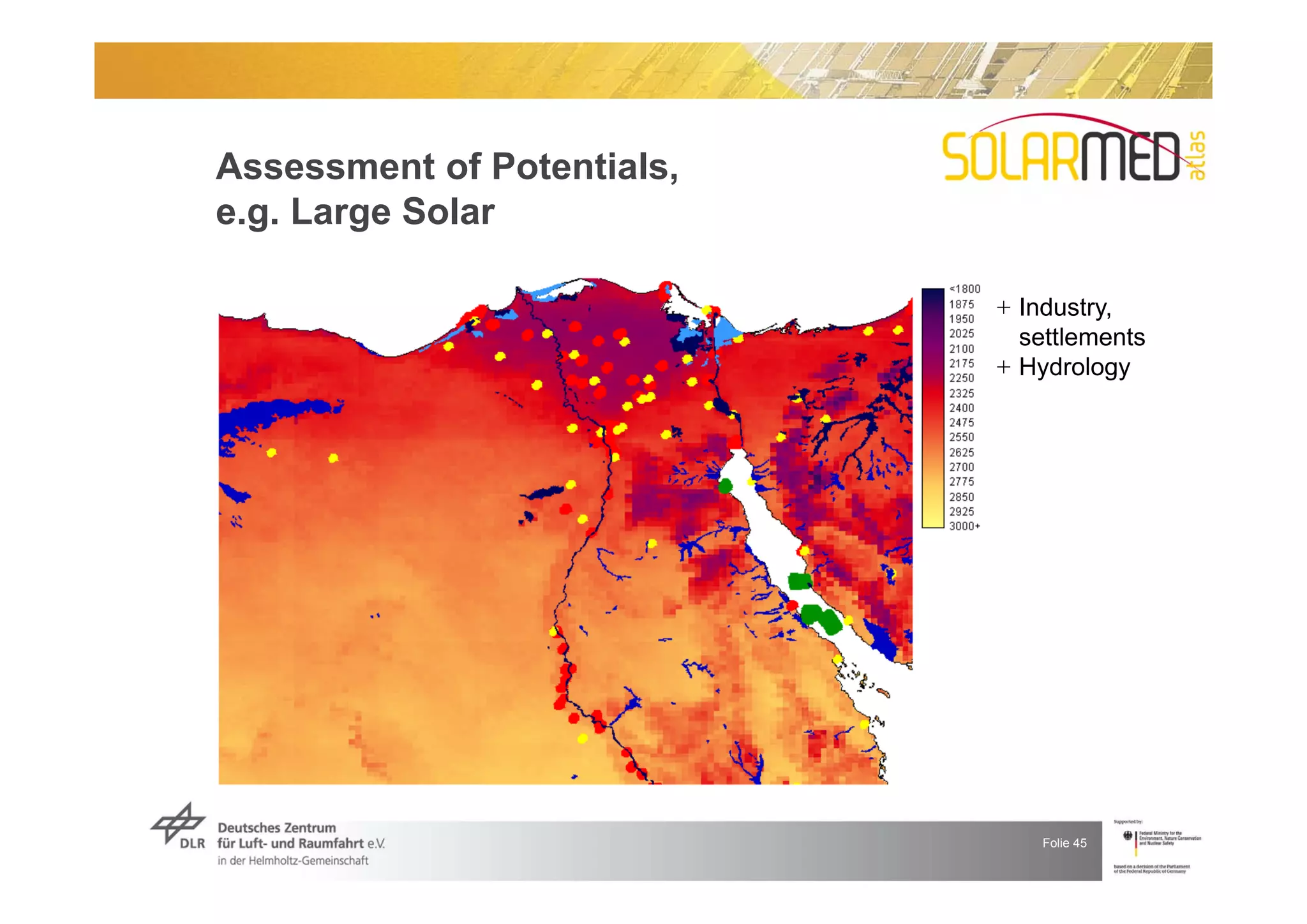
                            + Industry,
                              settlements


                                Folie 44
Assessment of Potentials,
e.g. Large Solar

                            + Industry,
                              settlements
                            + Hydrology


                                Folie 45
Assessment of Potentials,
e.g. Large Solar

                            + Industry,
                              settlements
                            + Hydrology
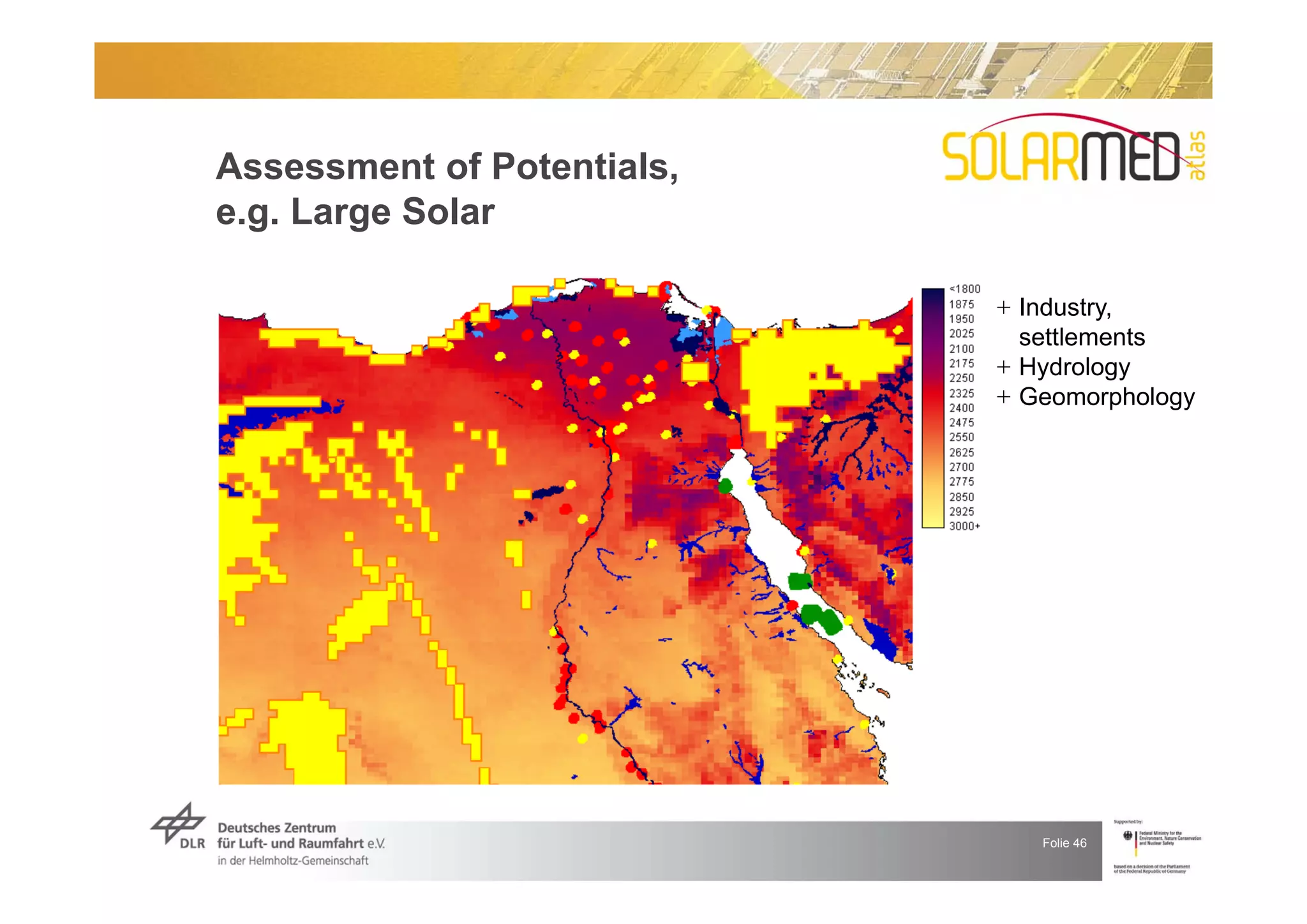
                            + Geomorphology


                               Folie 46
Assessment of Potentials,
e.g. Large Solar

                            + Industry,
                              settlements
                            + Hydrology
                            + Geomorphology
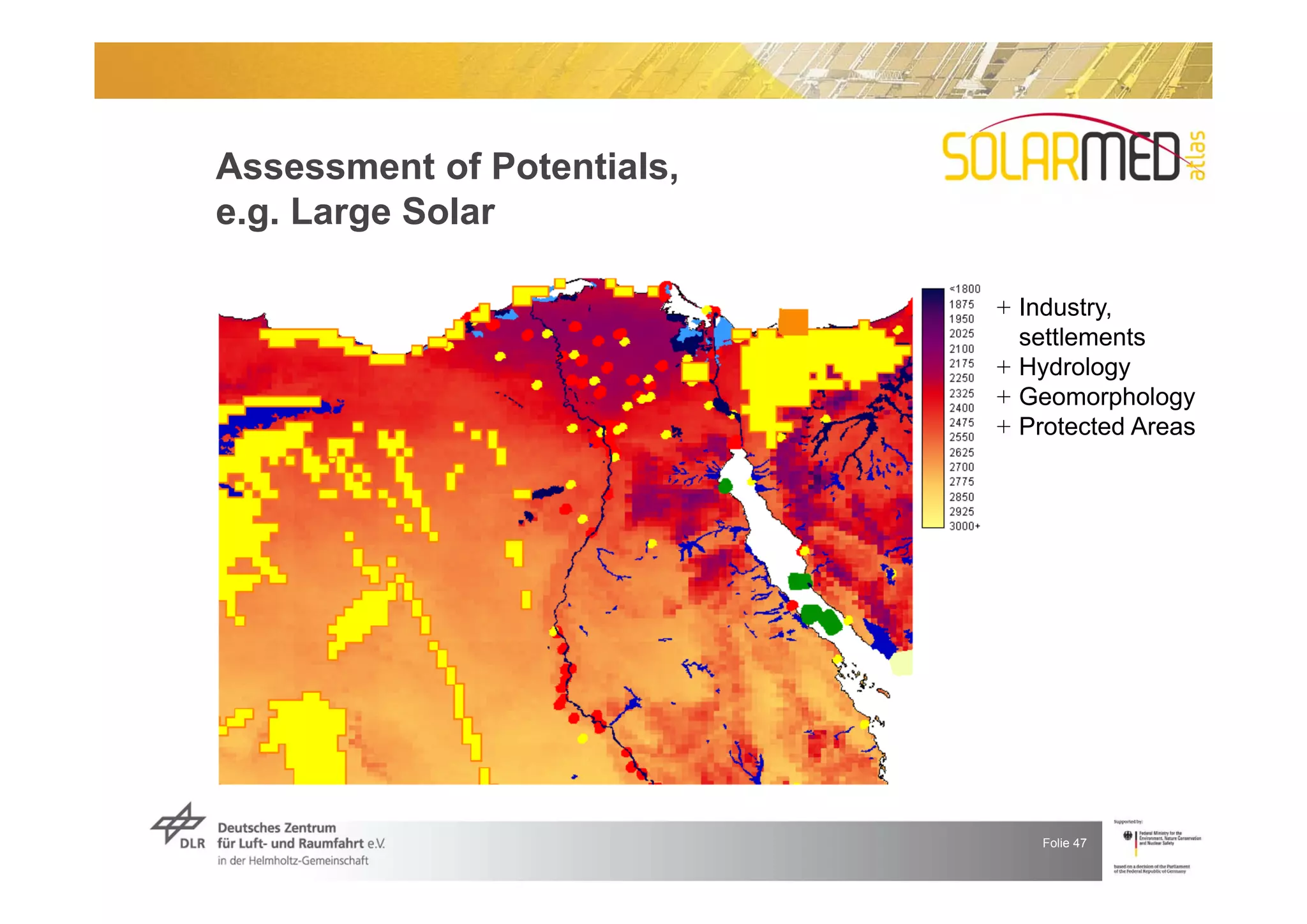
                            + Protected Areas


                               Folie 47
Assessment of Potentials,
e.g. Large Solar

                            + Industry,
                              settlements
                            + Hydrology
                            + Geomorphology
                            + Protected Areas
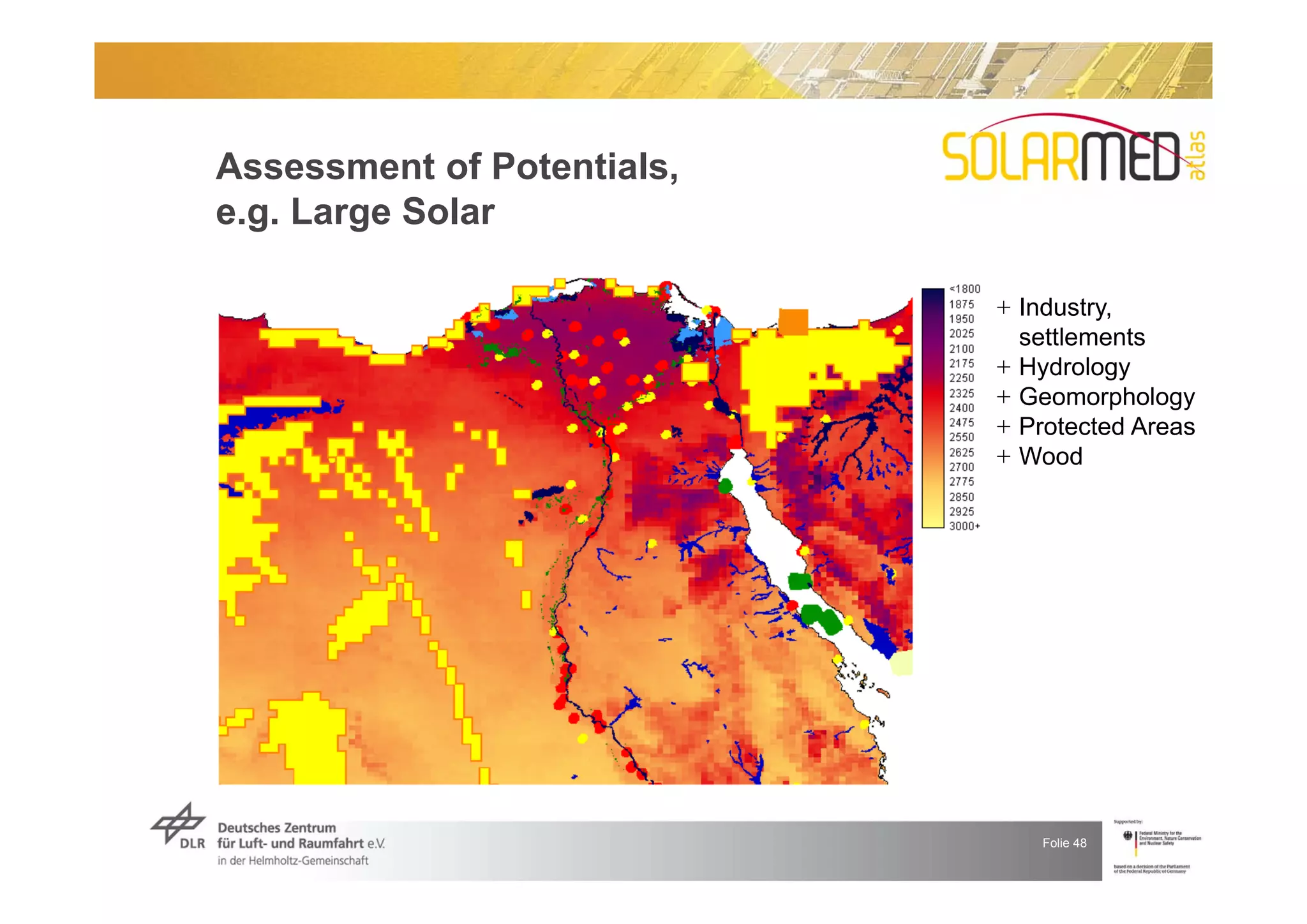
                            + Wood


                               Folie 48
Assessment of Potentials,
e.g. Large Solar

                            + Industry,
                              settlements
                            + Hydrology
                            + Geomorphology
                            + Protected Areas
                            + Wood
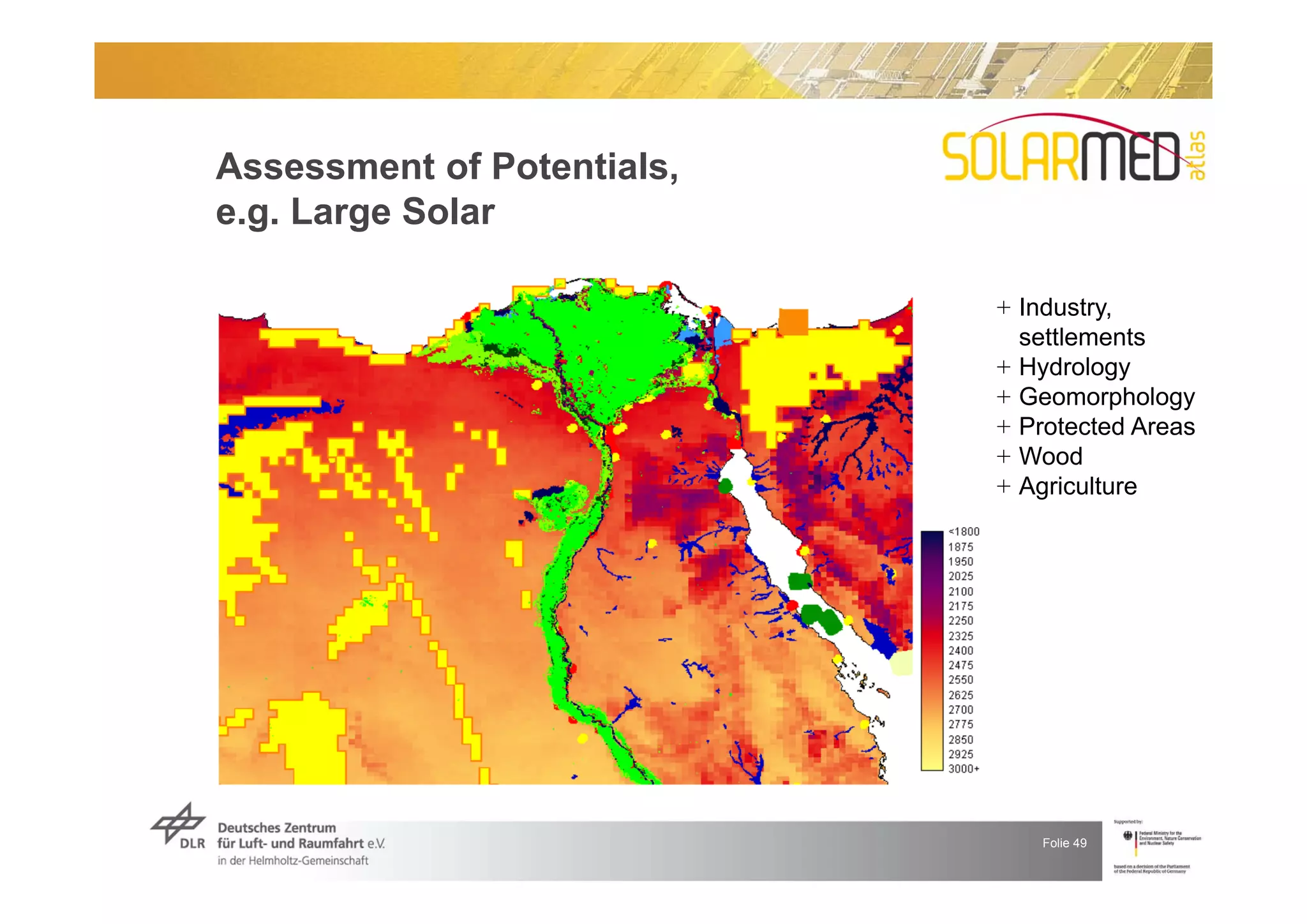
                            + Agriculture


                               Folie 49
Assessment of Potentials,
e.g. Large Solar

                            + Industry,
                              settlements
                            + Hydrology
                            + Geomorphology
                            + Protected Areas
                            + Wood
                            + Agriculture
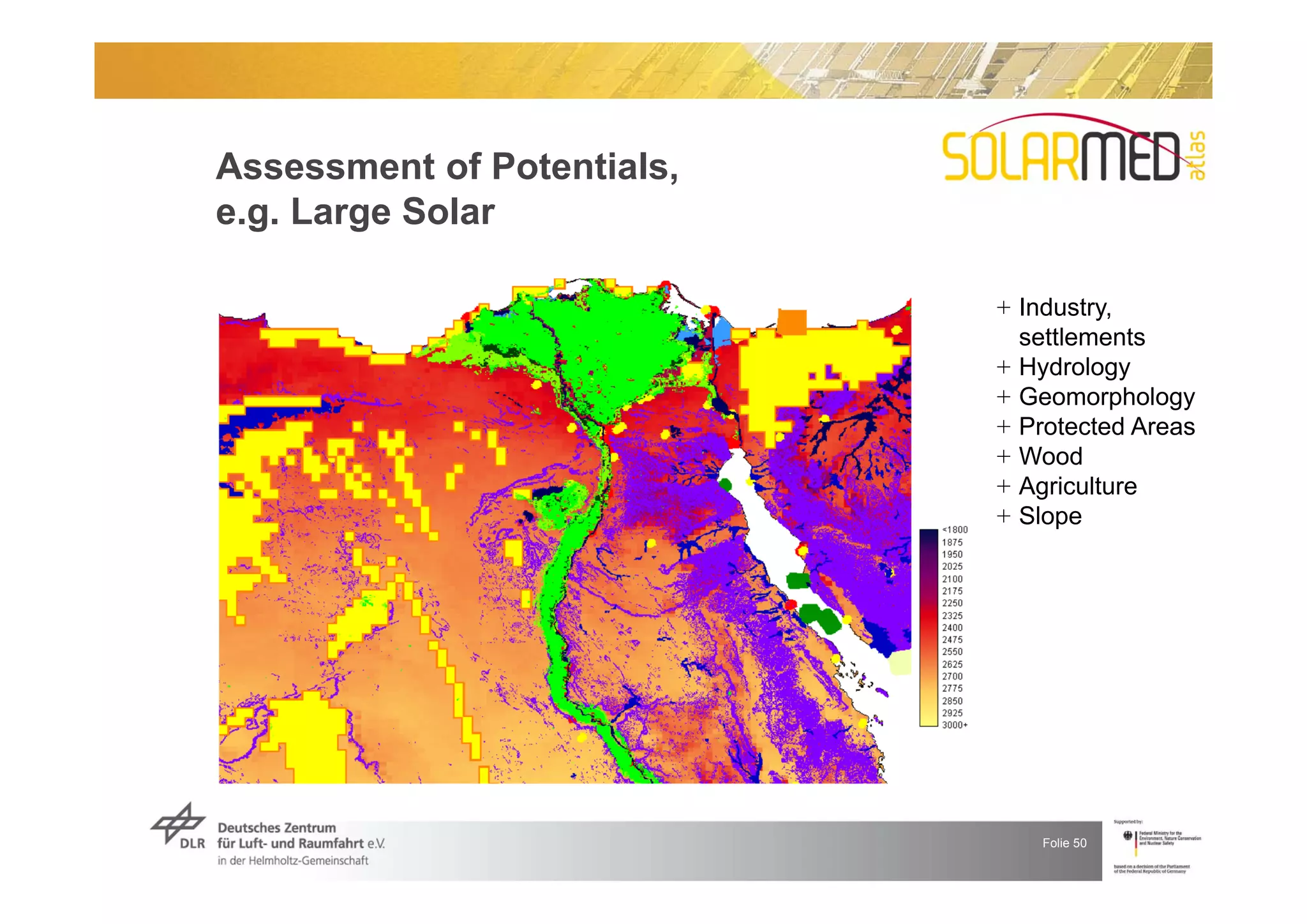
                            + Slope


                               Folie 50
Assessment of Potentials,
e.g. Large Solar

                            + Industry,
                              settlements
                            + Hydrology
                            + Geomorphology
                            + Protected Areas
                            + Wood
                            + Agriculture
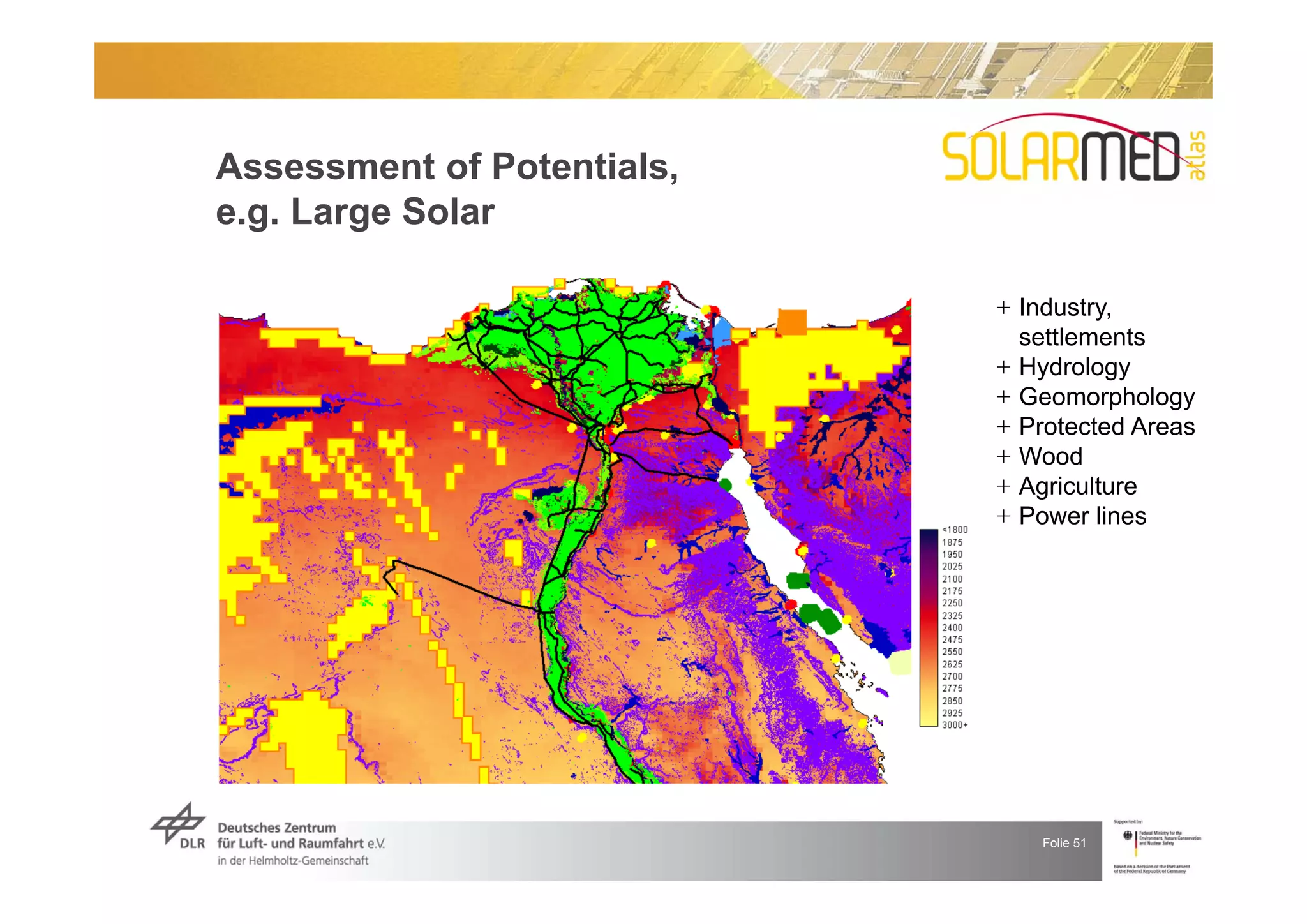
                            + Power lines


                               Folie 51
Assessment of Potentials,
e.g. Large Solar

                            + Industry,
                              settlements
                            + Hydrology
                            + Geomorphology
                            + Protected Areas
                            + Wood
                            + Agriculture
                            + Power lines
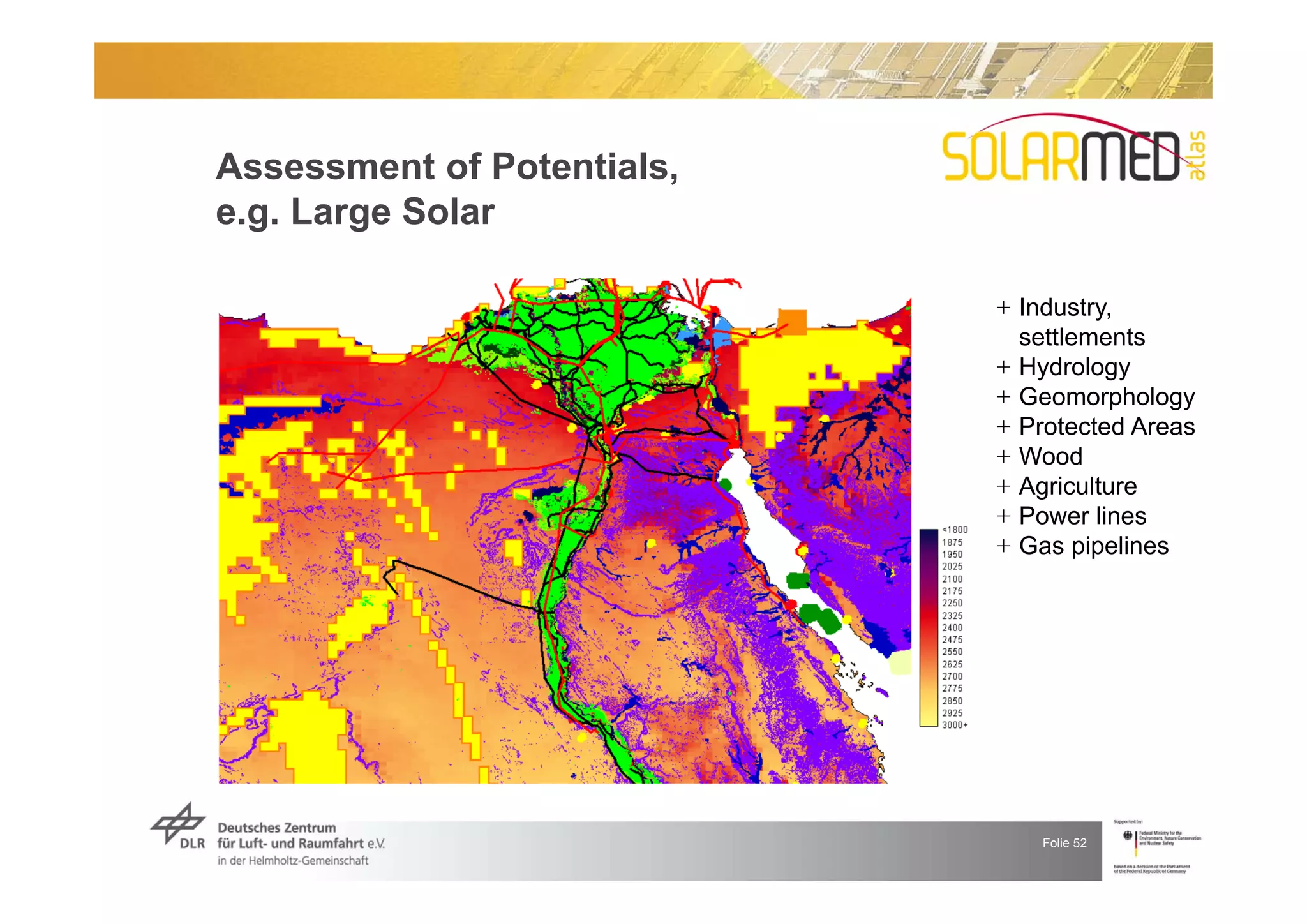
                            + Gas pipelines


                               Folie 52
Assessment of Potentials,
e.g. Large Solar

                            + Industry,
                              settlements
                            + Hydrology
                            + Geomorphology
                            + Protected Areas
                            + Wood
                            + Agriculture
                            + Power lines
                            + Gas pipelines
                            + Oil pipelines


                               Folie 53
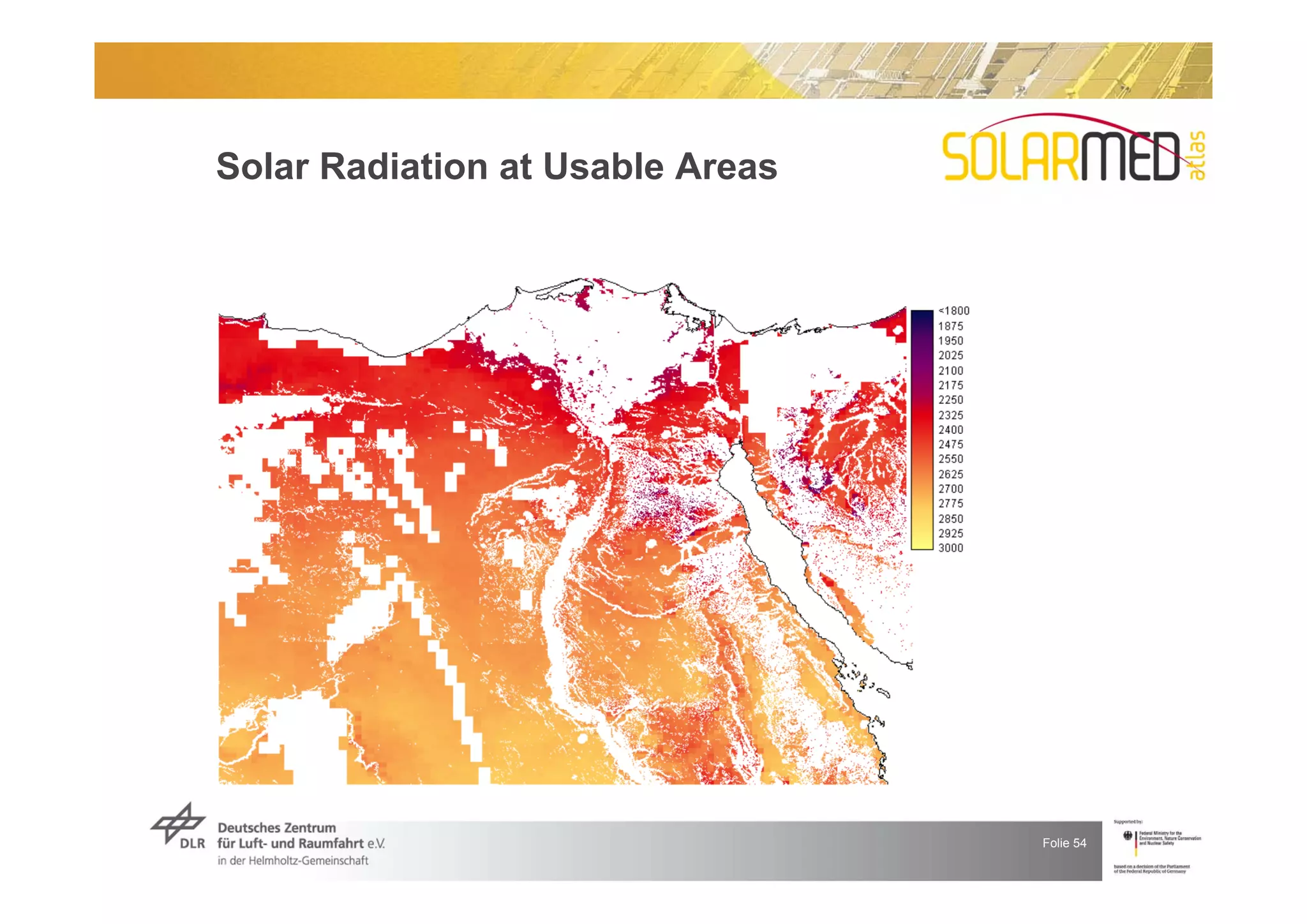
Solar Radiation at Usable Areas


                                  Folie 54
CSP Potential
                  200000

                  175000

                  150000
     Area [km²]


                  125000
                                                                                                                                            Area with certain
                  100000

                  75000
                                                                                                                                         level of solar radiation
                  50000

                  25000

                      0
                           1800   1900   2000   2100   2200   2300   2400   2500                             2600   2700   2800    >
                                                                                                                                  2800


                                                                             Electricity Potential [TWh/y]
                                                       DNI [kWh/m²a]                                         25000

                                                                                                             20000

                                                                                                             15000

                                                                                                             10000
     Technical potential
                                                                                                              5000
calc. with power plant model
                                                                                                                    0


                                                                                                                         00
                                                                                                                         00

                                                                                                                         00

                                                                                                                         00

                                                                                                                         00

                                                                                                                         00

                                                                                                                         00

                                                                                                                         00

                                                                                                                         00

                                                                                                                         00

                                                                                                                         00

                                                                                                                         00
                                                                                                                      28
                                                                                                                      18

                                                                                                                      19

                                                                                                                      20

                                                                                                                      21

                                                                                                                      22

                                                                                                                      23

                                                                                                                      24

                                                                                                                      25

                                                                                                                      26

                                                                                                                      27

                                                                                                                      28
                                                                                                                    >
                                                                                                                                                      Folie 55
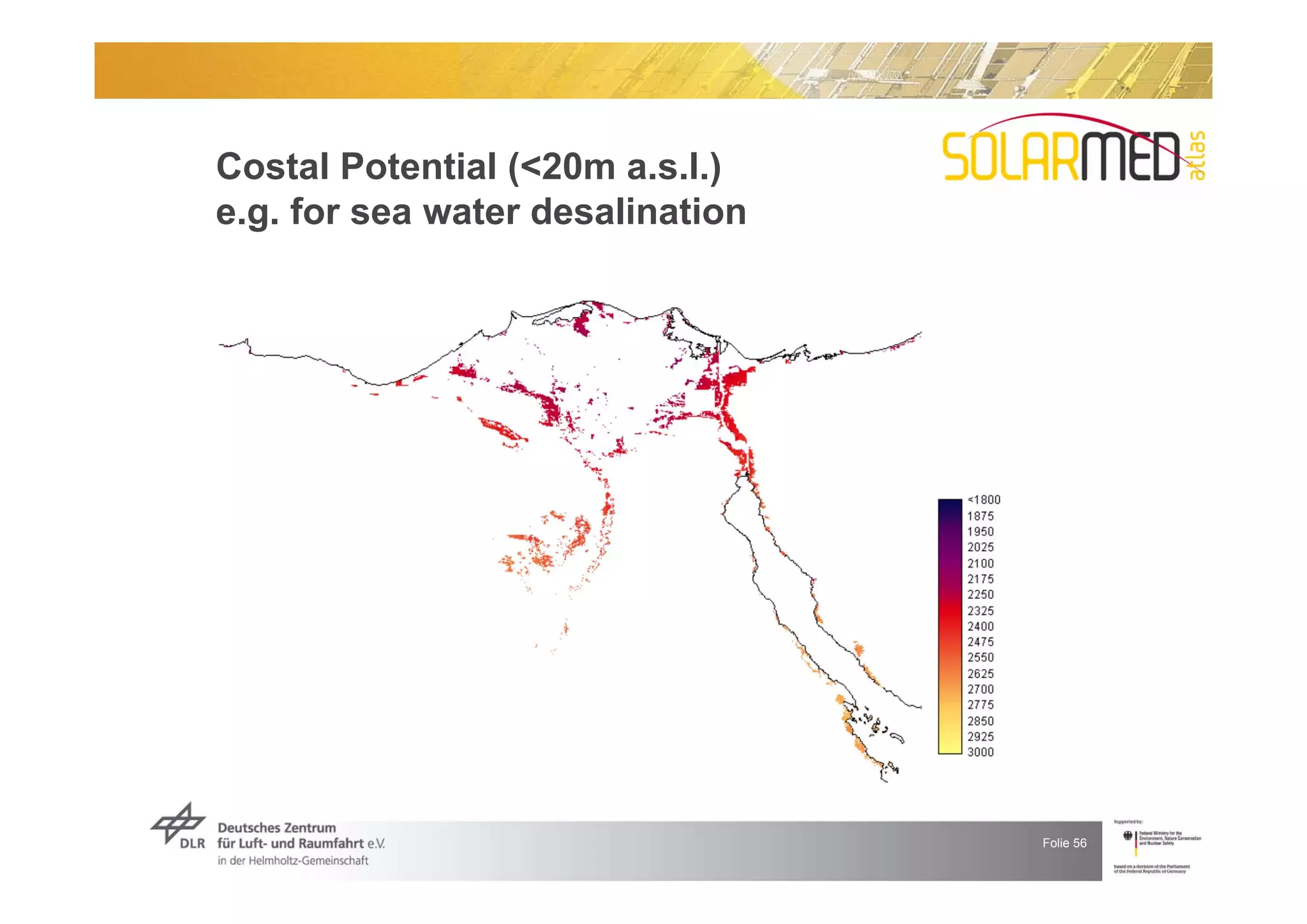
Costal Potential (<20m a.s.l.)
e.g. for sea water desalination


                                  Folie 56
Coastal Potential in Egypt

                                       Coastal Potential - Egypt (20 m a. s. l.)

                                 180
 Electricity Potential [TWh/y]


                                 160
                                 140
                                 120
                                 100
                                                                                   2008 power demand
                                  80
                                  60
                                  40
                                  20
                                   0
                                      00

                                      00

                                      00

                                      00

                                      00

                                      00

                                      00

                                      00

                                      00

                                      00


                                  > 0
                                      00
                                      0
                                   18

                                   19

                                   20

                                   21

                                   22

                                   23

                                   24

                                   25

                                   26

                                   27

                                   28

                                   28
                                                        DNI [kWh/m²a]


                                                                                                       Folie 57
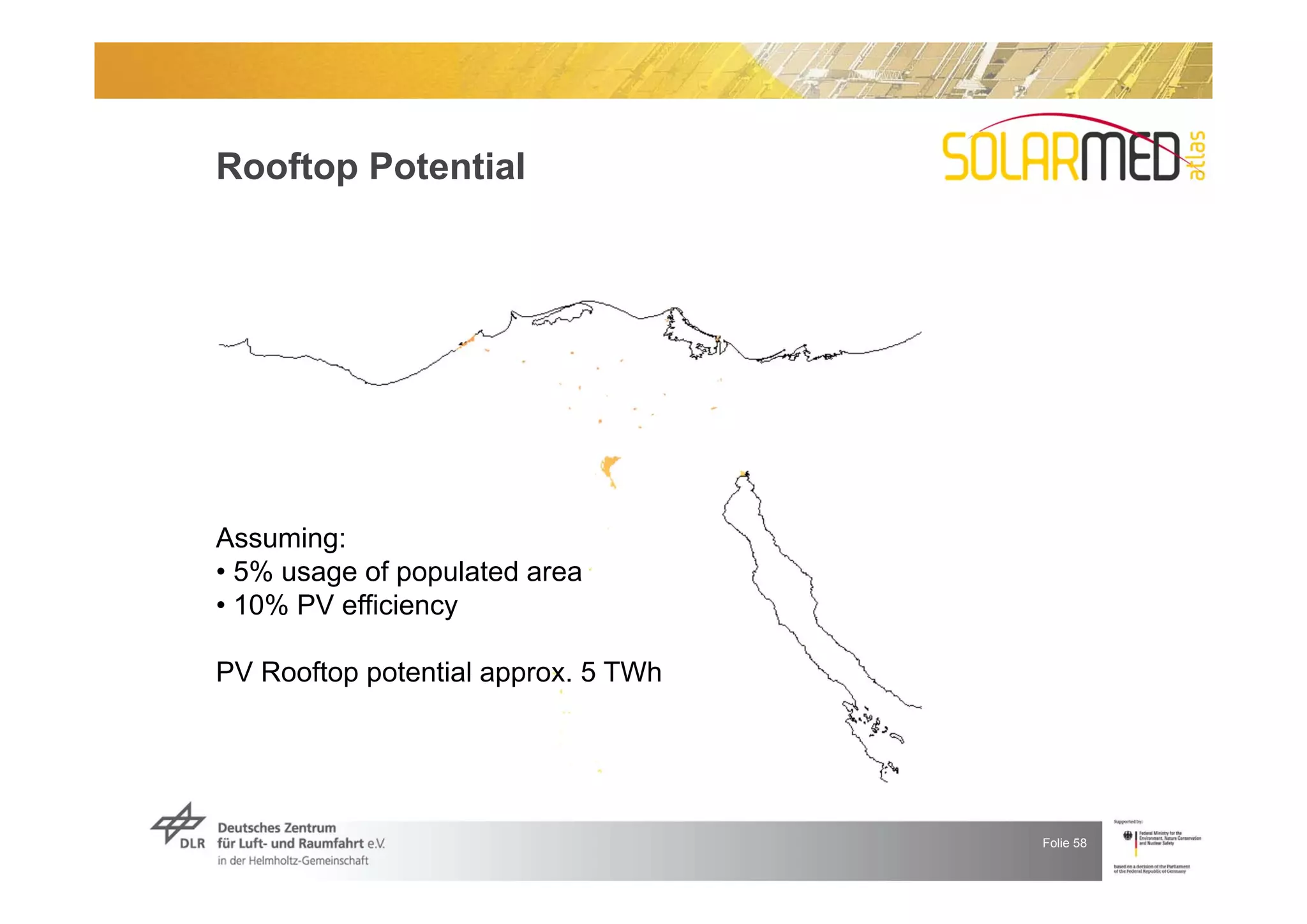
Rooftop Potential


Assuming:
• 5% usage of populated area
• 10% PV efficiency

PV Rooftop potential approx. 5 TWh


                                     Folie 58
Potential of Concentrating Solar Power
in Jordan                                DNI Classes
• Demand 2050: 53 TWh/y                  [kWh/m²/y]

• Potential CSP: 5884 TWh/y                   < 1900
                                              1,900
                                              2,000
                                              2,100
                                              2,200
                                              2,300
                                              2,400
                                              2,500
                                              2,600
                                              2,700


                                         Exclusion Criteria
                                               Urban areas
                                               Population density
                                               Hydrography
                                               Land cover
                                               Protected areas
                                               Topography
                                                Folie 59
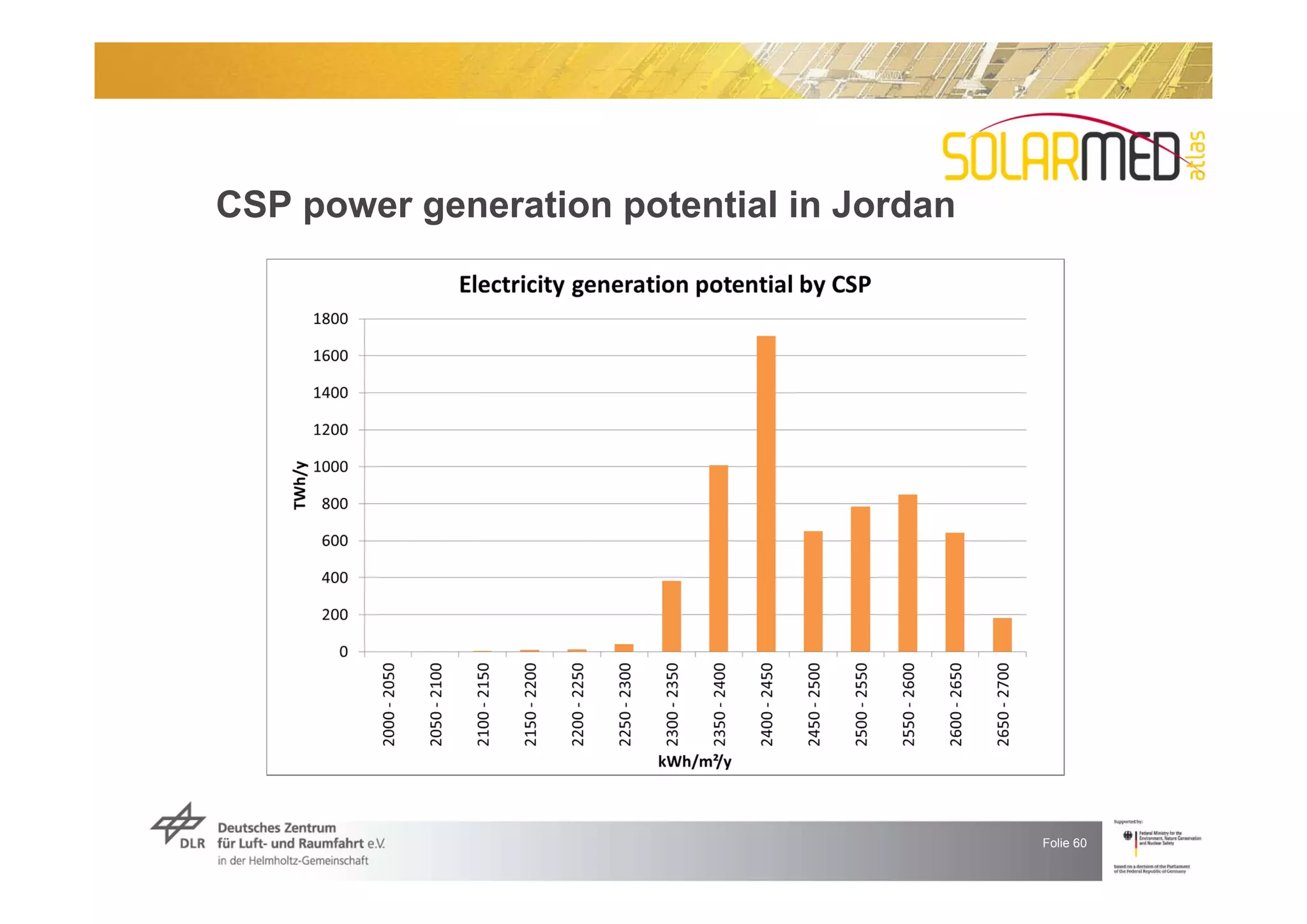
CSP power generation potential in Jordan


                                           Folie 60
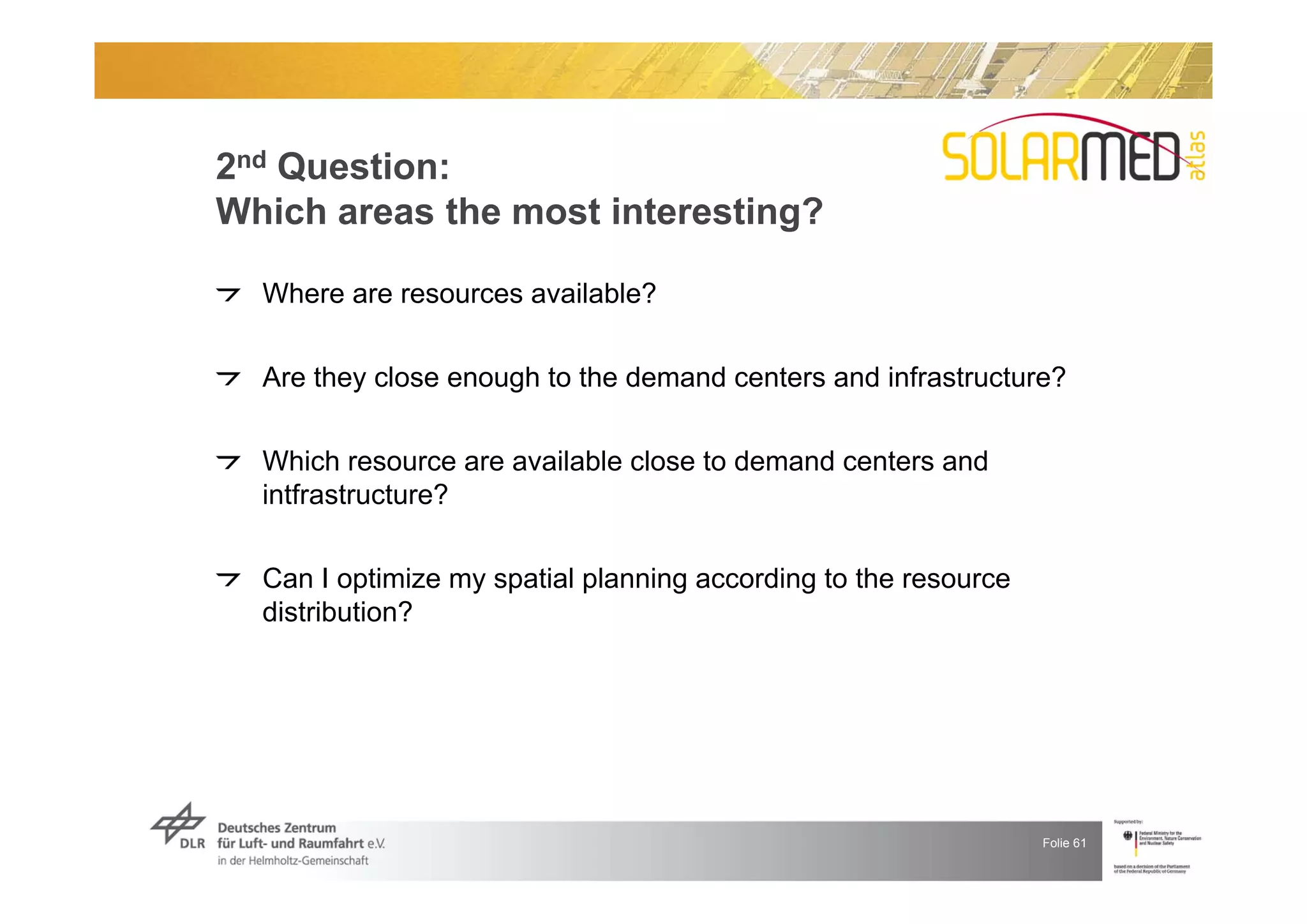
2nd Question:
Which areas the most interesting?

  Where are resources available?


  Are they close enough to the demand centers and infrastructure?


  Which resource are available close to demand centers and
  intfrastructure?


  Can I optimize my spatial planning according to the resource
  distribution?


                                                                 Folie 61
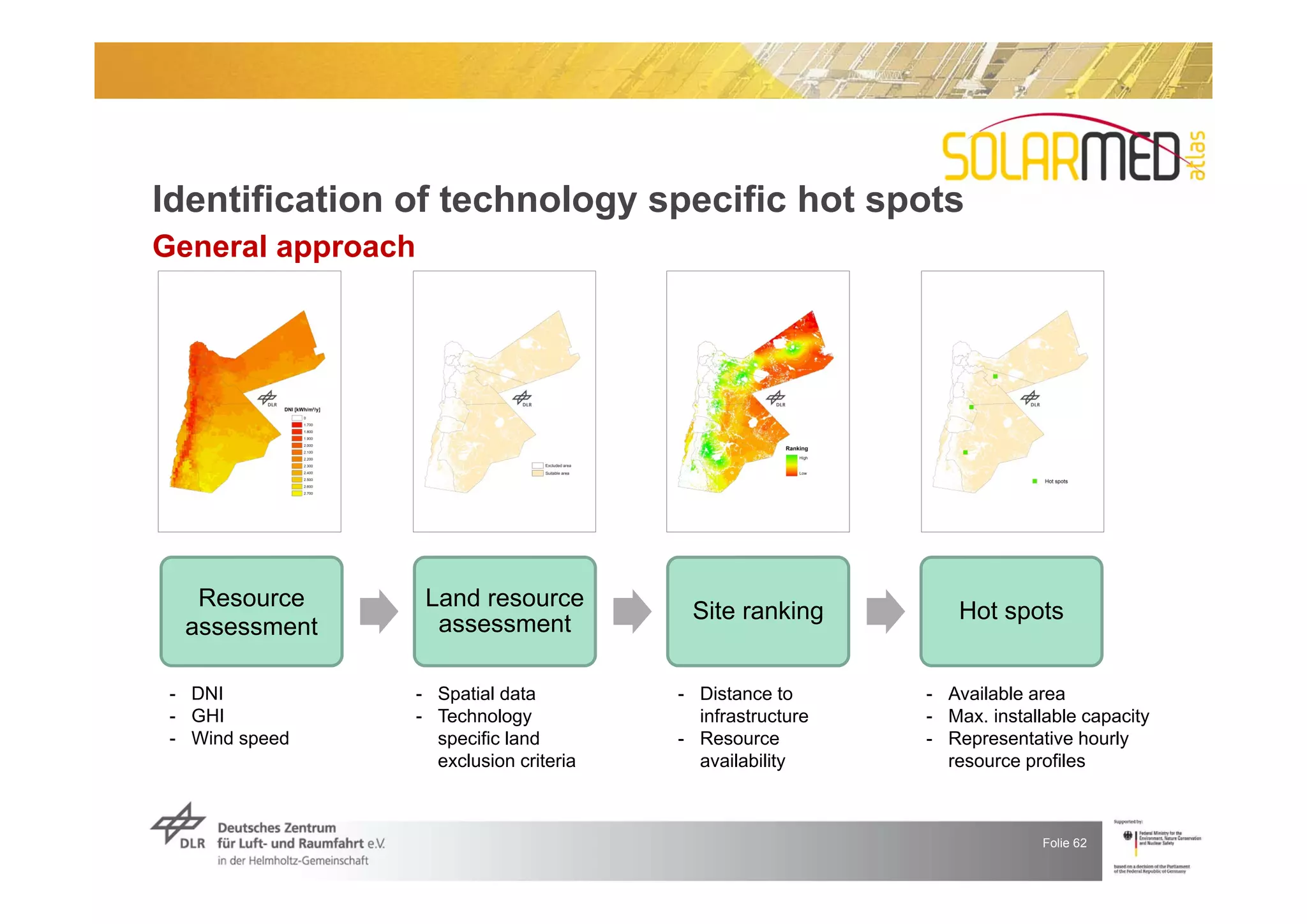
Identification of technology specific hot spots
General approach


   Resource         Land resource
                                           Site ranking         Hot spots
  assessment         assessment

 - DNI             - Spatial data         - Distance to      - Available area
 - GHI             - Technology             infrastructure   - Max. installable capacity
 - Wind speed        specific land        - Resource         - Representative hourly
                     exclusion criteria     availability       resource profiles


                                                                           Folie 62
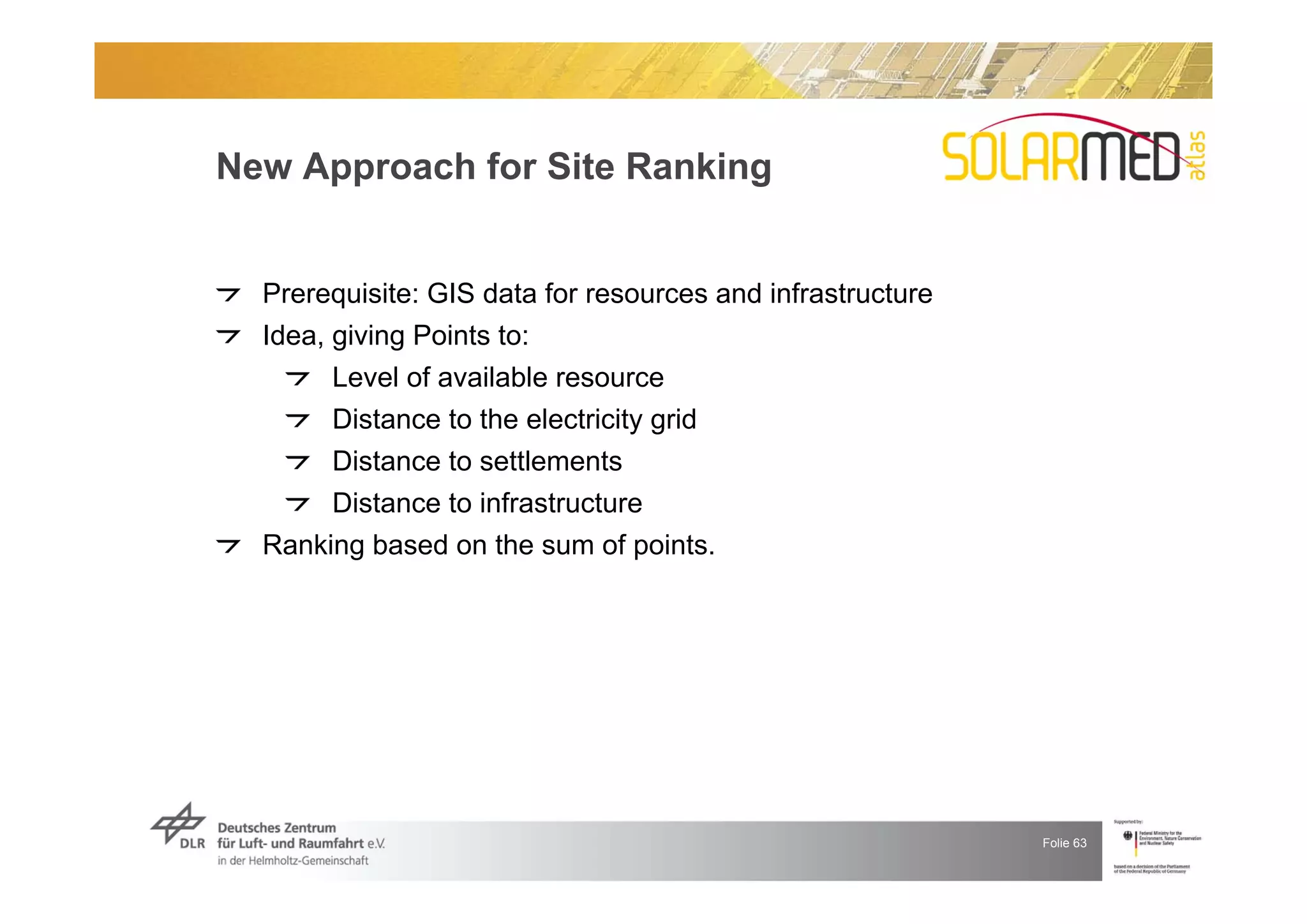
New Approach for Site Ranking


  Prerequisite: GIS data for resources and infrastructure
  Idea, giving Points to:
        Level of available resource
        Distance to the electricity grid
        Distance to settlements
        Distance to infrastructure
  Ranking based on the sum of points.


                                                            Folie 63
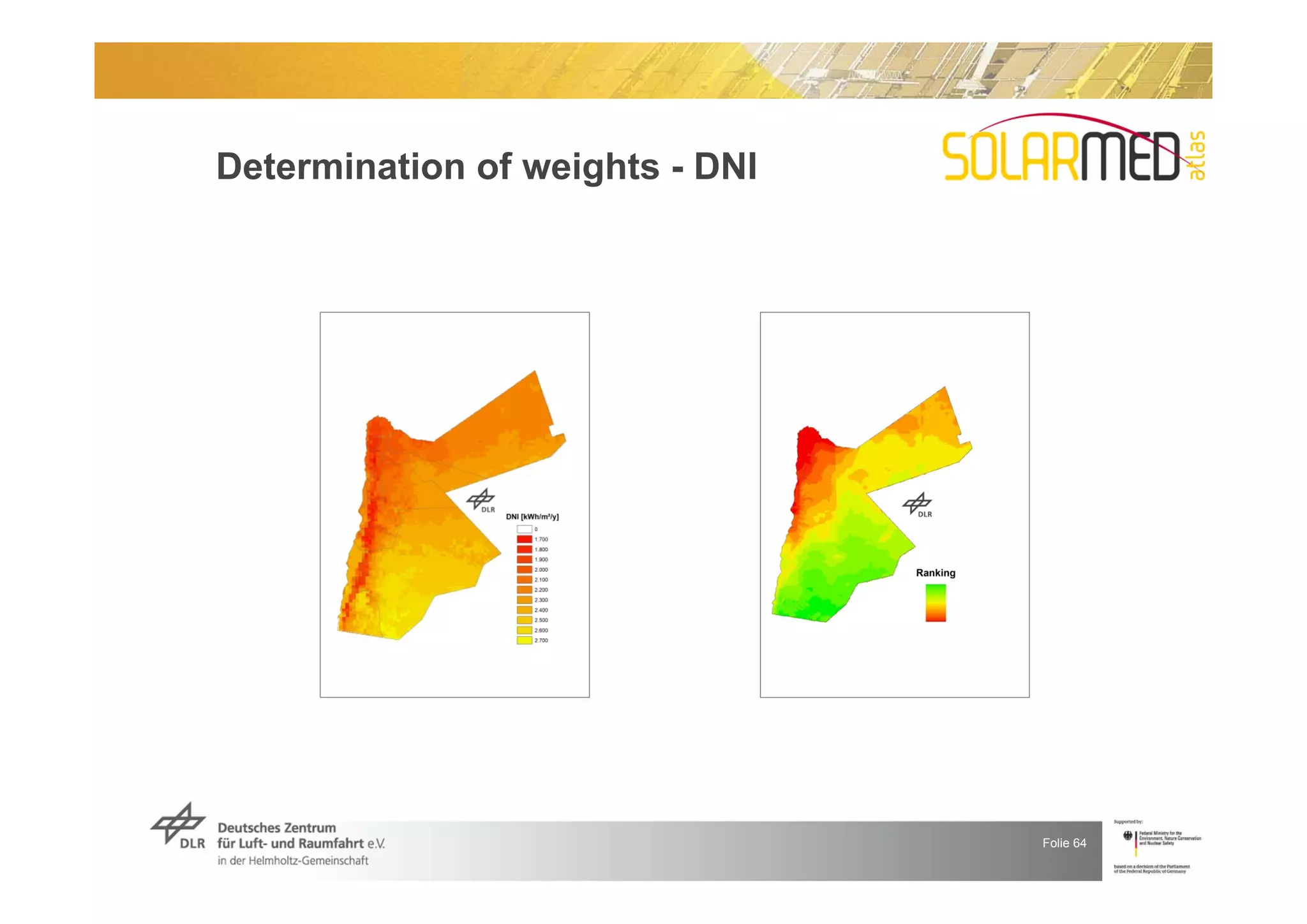
Determination of weights - DNI


                                 Folie 64
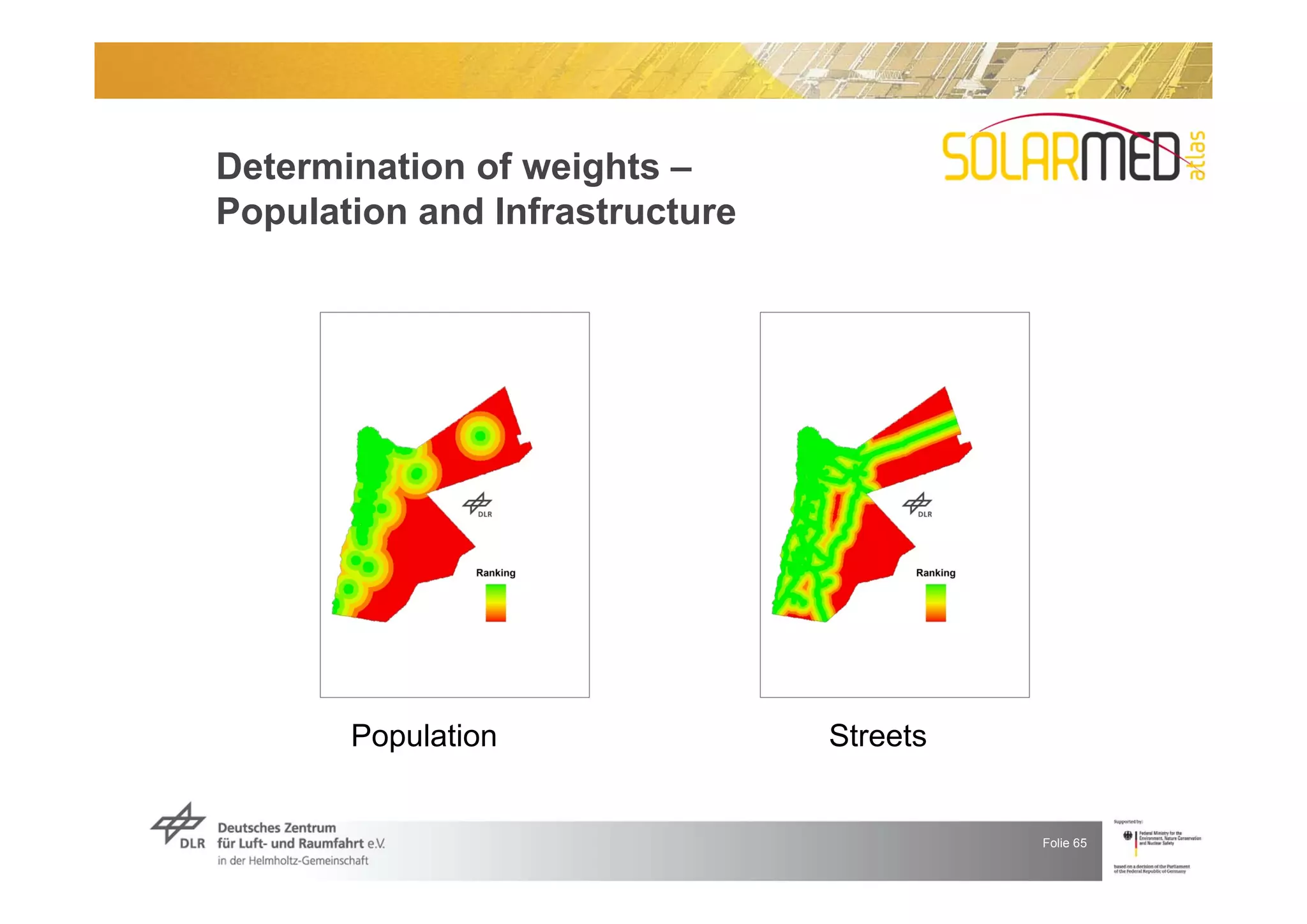
Determination of weights –
Population and Infrastructure


       Population               Streets


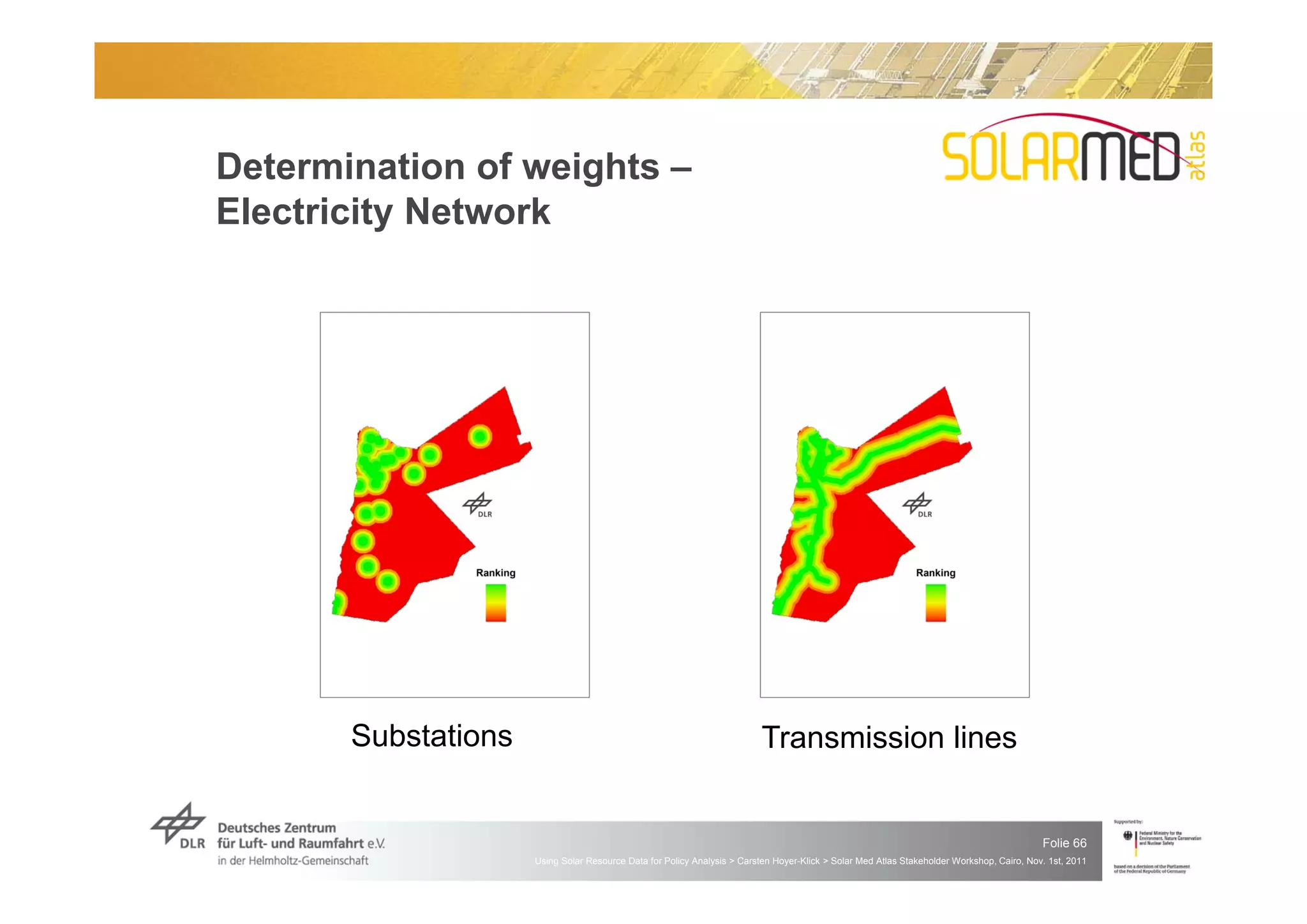
                                          Folie 65
Determination of weights –
Electricity Network


       Substations                                                       Transmission lines


                                                                                                                                           Folie 66
                     Using Solar Resource Data for Policy Analysis > Carsten Hoyer-Klick > Solar Med Atlas Stakeholder Workshop, Cairo, Nov. 1st, 2011
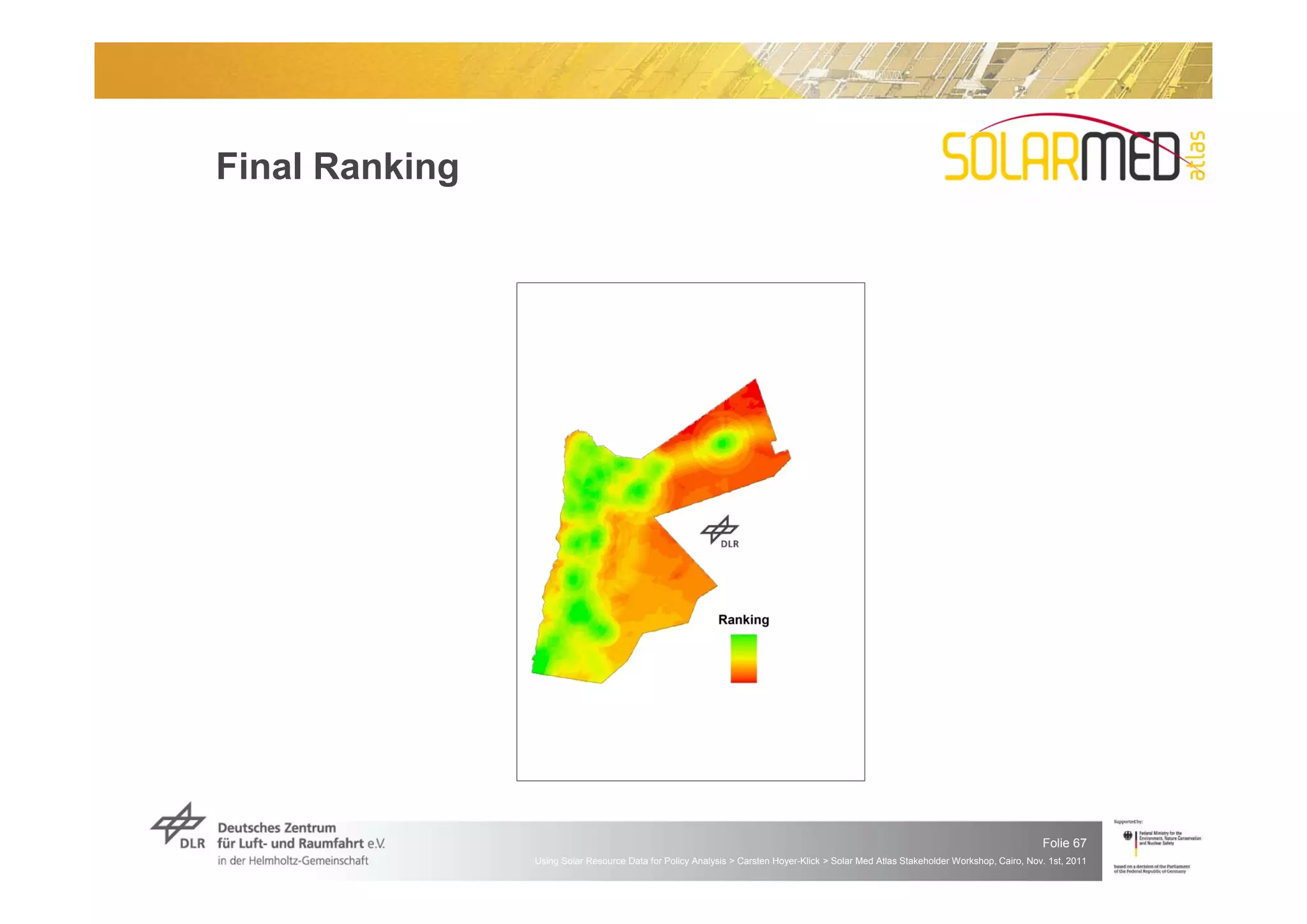
Final Ranking


                                                                                                                                      Folie 67
                Using Solar Resource Data for Policy Analysis > Carsten Hoyer-Klick > Solar Med Atlas Stakeholder Workshop, Cairo, Nov. 1st, 2011
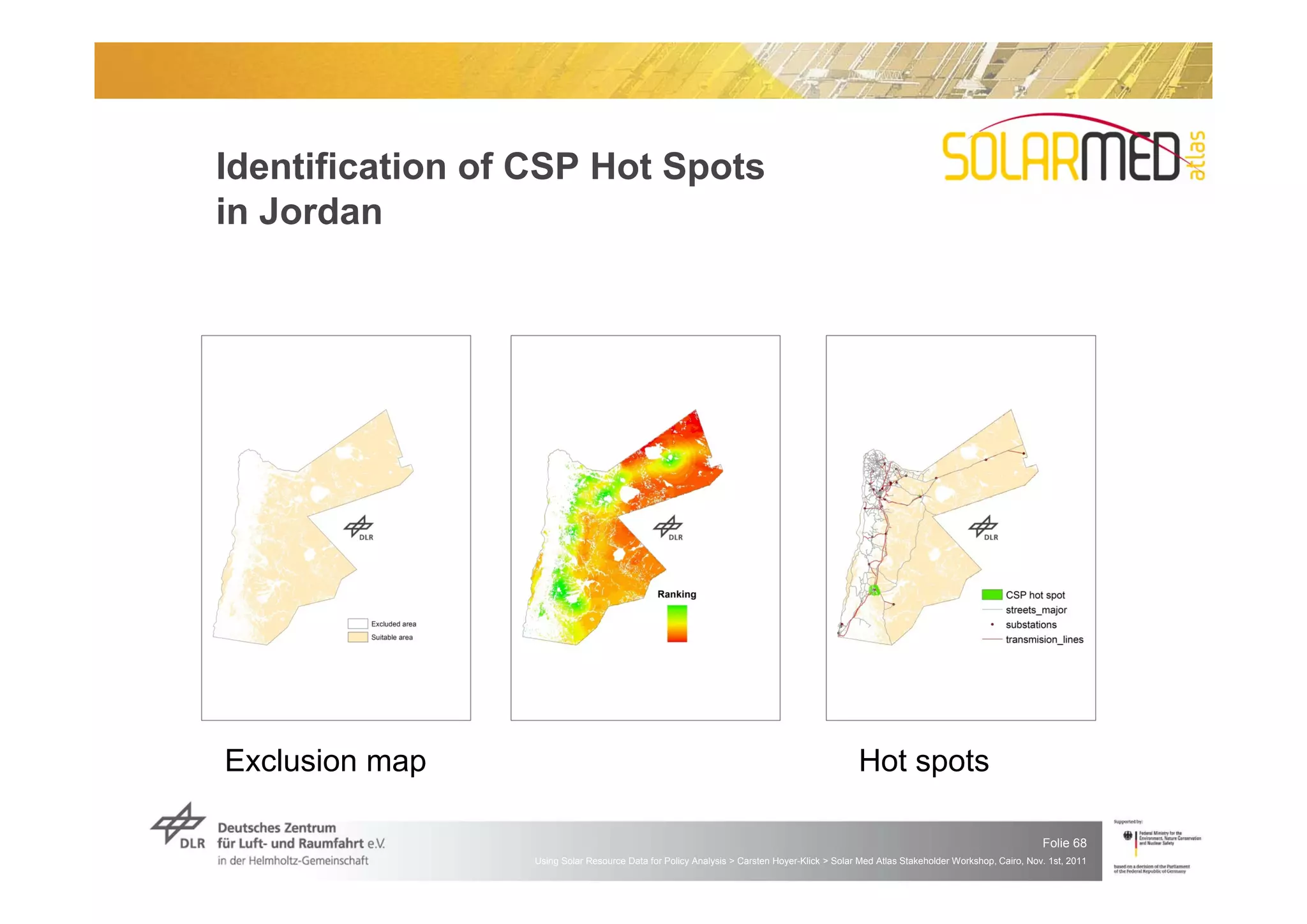
Identification of CSP Hot Spots
in Jordan


Exclusion map                                                                               Hot spots

                                                                                                                                       Folie 68
                 Using Solar Resource Data for Policy Analysis > Carsten Hoyer-Klick > Solar Med Atlas Stakeholder Workshop, Cairo, Nov. 1st, 2011
Thank you for your attention!

         Questions & Answers

Either now or carsten.hoyer-klick@dlr.de


                                       Folie 69

Introduction to solar resouce assessments

  • 1.
    Introduction to SolarResource Assessments Carsten Hoyer-Klick German Aerospace Center Institute of Technical Thermodynamics Folie 1
  • 2.
    Transfer of SolarRadiation through the Atmosphere Radiation at the top of atmosphere Absorption (ca. 1%) Ozone.……….….... Rayleigh scattering and absorption (ca. 15%) Air molecules..…… Scatter and Absorption ( ca. 15%, max. 100%) Aerosol…….………..…...…… Clouds………….……….. Reflection, Scatter, Absorption (max. 100%) Water Vapor…….……...……… Absorption (ca. 15%) Direct normal irradiance at ground Folie 2
  • 3.
    Direct Normal Irradiation(DNI) direct  Direct-Normal- Irradiation (DNI) Folie 3
  • 4.
    Diffuse Horizontal Radiation diffuse diffuse Folie 4
  • 5.
    Global Horizontal Irradiation(GHI) direct diffuse diffuse Global-Horizontal-Irradiation (GHI) Folie 5
  • 6.
    Solar Spectrum andAtmospheric influence 1 Planck curve T=5780 K at mean sun- earth distance 2 extraterrestrial solar spectrum with additional 3 absorption by 03 4 scattering by 02 und N 5 scattering by aerosols 6 absorption by H2O vapor 7 absorption by aerosols Folie 6 Introduction to Solar Resources > Carsten Hoyer-Klick > Feb. 28th 2012> Sultan Qaboos University
  • 7.
    Atmospheric Extinction Processes Reflected back to space Scattered in any direction Absorbed Direct transmitted to surface Folie 7 Introduction to Solar Resources > Carsten Hoyer-Klick > Feb. 28th 2012> Sultan Qaboos University
  • 8.
    Rayleigh and MieScattering Rayleigh scattering Mie scattering particle size ≥ wavelength particle size << wavelength ~ λ-4 ~ λ-1.3 directionality: directionality: (1 + cos² α) very strong forward scattering Large variability by non-uniform particles Folie 8 Introduction to Solar Resources > Carsten Hoyer-Klick > Feb. 28th 2012> Sultan Qaboos University
  • 9.
    Rayleigh and MieScattering Rayleigh scattering Mie scttering Mie Scattering, larger particles Direction of incident light Folie 9 Introduction to Solar Resources > Carsten Hoyer-Klick > Feb. 28th 2012> Sultan Qaboos University
  • 10.
    Scattering Regimes Dimensionless sizeparameter Χ=2πr/λ as a function of wavelength (λ) of the incident radiation and particle radius r. Folie 10 Introduction to Solar Resources > Carsten Hoyer-Klick > Feb. 28th 2012> Sultan Qaboos University
  • 11.
    How two deriveirradiance data from satellites The Meteosat satellite is located in a geostationary orbit The satellite scans the earth line by line every half hour Folie 11
  • 12.
    Das Meteosat System– Image recording • The satellite rotates at 100 rpm • Line by line scanning of the earth from south to north • Pixels by sampling of the analog sensor signal • Field of view of the sensor e.g. in Europe 3 x 4 km due to geometric distortion Scan Folie 12
  • 13.
    How two deriveirradiance data from satellites The Meteosat satellite is located in a geostationary orbit The satellite scans the earth line by line every half hour The earth is scanned in the visible … Folie 13
  • 14.
    How two deriveirradiance data from satellites The Meteosat satellite is located in a geostationary orbit The satellite scans the earth line by line every half hour The earth is scanned in the visible and infra red spectrum Folie 14
  • 15.
    How two deriveirradiance data from satellites The Meteosat satellite is located in a geostationary orbit The satellite scans the earth line by line every half hour The earth is scanned in the visible and infra red spectrum A cloud index is composed from the two channels Folie 15
  • 16.
    Clear sky Modelinput data Aerosol optical thickness GACP Resolution 4°x5°, monthly climatology MATCH Resolution 1.9°x1.9°, daily climatology Water Vapor: NCAR/NCEP Reanalysis Resolution 1.125°x1.125°, daily values Ozone: TOMS sensor Resolution 1.25°x1.25°, monthly values Folie 16
  • 17.
    Remote Sensing ofAerosols Usually split channel / dark target approach: A dark target is searched in a long-wave channel The reflectivity is observed in a short wave channel (usually aerosol backscatter increases with frequency) The difference is translated into a AOD Problems: Dark targets a land: Forrests, lakes – only a very few available almost none in deserts Folie 17
  • 18.
    Chemistry Transport Modelsfor Aerosol Data Modeling of aerosol uptake, transport, chemical change and deposition in a numerical model Input: Surface properties Emission data bases Numerical weather models (especially wind fields, rain). Modeling: Aerosol uptake Aerosol transport with wind Aerosol outfall Aerosol chemistry, change in properties with time Output: Mass concentrations converted to optical properties Folie 18
  • 19.
    Chemistry Transport Models– Emission data bases Emission data bases, e.g. SOx emissions Folie 19
  • 20.
    Chemistry Transport Models- Dust Mineral dust mobilisation is initiated by strong winds blowing over bare ground and erodible particles. Medium range sand-sized particles above 60 μm particle diameter are lifted up, but also fall quickly down again to the ground. The momentum of the landing particles results in the loosening of small and fast moving particles which are known as sandblasting particles. Dust particles are mixed into higher atmospheric layers by turbulent processes and transported in the atmospheric flow over larger distances. Folie 20
  • 21.
    Uncertainty in Aerosols All graphs are for July Scales are the same! (0 – 1.5) Large differences in Aerosol values and GADS NASA GISS v1 / GACP distribution Toms NASA GISS v2 1990 Linke Turbidity GOCART AeroCom MATCH Folie 21
  • 22.
    Calculation of solarradiation from remote sensing METEOSAT Gext image Atmospheric Model Images Ground Corrected image of one albedo Gdirect, clear Gdiffuse, clear month cloud-index (    min ) n + (  max   min ) Gclear sky clear sky index k *  f (n)  1  n Methods used: • Heliosat-2 for the · visible channel • IR brightness Gsurface temperature as indicator for high cirrus clouds (T < -30°C, DNI = 0) Folie 22
  • 23.
  • 24.
    Cloud Transmission forDNI Sun-satellite angle 60-80 1.2 1.2 -26 °C -16 °C 1 1 -6 °C 4 °C 14 °C 0.8 0.8 -30°C - -20°C cloud transmission -20°C - -10°C 0.6 0.6 -10 °C - 0°C 0°C - 10 °C >10°C 0.4 0.4 0.2 0.2 0 0 -0.2 -0.2 -0.2 0 0.2 0.4 0.6 0.8 1 1.2 -0.2 0 0.2 0.4 0.6 0.8 1 1.2 cloud index Complex functions: Simple function τ = e-10*ci Different exp. function for various viewing angles and brightness temperatures Folie 24
  • 25.
    Comparing ground andsatellite data: time scales 12:45 13:00 13:15 13:30 13:45 14:00 14:15 Hourly average Meteosat image Measurement Ground measurements are typically pin point measurements which are temporally integrated Satellite measurements are Hi-res satellite pixel in Europe instantaneous spatial averages Hourly values are calculated from temporal and spatial averaging (cloud movement) Folie 25
  • 26.
    Comparing ground andsatellite data: “sensor size” solar thermal power plant satellite pixel (200MW  2x2 ( 3x4 km²) km² ground measurement instrument (2x2 cm²) Folie 26
  • 27.
    Comparison with groundmeasurements and accuracy general difficulties: point versus area and time integrated versus area integrated 1200 ground 1000 satellite 800 W/m² 600 400 200 0 DNI time serie for 1.11.2001, Almería 0 6 12 Folie 27 18 24 Partially cloudy conditions, cumulus humilis hour of day
  • 28.
    Comparison with groundmeasurements and accuracy general difficulties: point versus area and time integrated versus area integrated 1200 ground 1000 satellite 800 W/m² 600 400 200 0 DNI time serie for 30.4.2000, Almería 0 6 12 Folie 28 18 24 overcast conditions, strato cumulus hour of day
  • 29.
    Satellite data andnearest neighbour stations Satellite derived data fit better to a selected site than ground measurements from a site farther than 25 km away. Folie 29
  • 30.
    Inter annual variability Strong inter annual and regional 1999 variations deviation to mean 2000 kWh/m²a 2001 Average of the direct normal 2002 irradiance from 1999-2003 2003 Folie 30
  • 31.
    Long-term variability ofsolar irradiance 7 to 10 years of measurement to get long-term mean within 5% Folie 31
  • 32.
    Ground measurements vs. satellitederived data Ground measurements Satellite data Advantages Advantages + high accuracy (depending on sensors) + spatial resolution + high time resolution + long-term data (more than 20 years) + effectively no failures + no soiling + no ground site necessary + low costs Disadvantages - high costs for installation and O&M Disadvantages - soiling of the sensors - lower time resolution - sometimes sensor failure - low accuracy at high time resolution - no possibility to gain data of the past Folie 32
  • 33.
    Combining Ground and SatelliteAssessments Satellite data Long term average Year to year variability Regional assessment Ground data Site specific High temporal resolution possible (up to 1 min to model transient effects) Good distribution function Folie 33
  • 34.
    Matching Ground andSatellite Data Why do ground and satellite data not match? Due to uncertainties in: Atmospheric Parameters, most prominent Aerosols Cloud transmission: The cloud index is a combination of cloud fraction and transparency. A semi transparent cloud can be distinguished well from a fractional cloud cover. Parameterization may depend on prevailing cloud types in the region. Folie 34
  • 35.
    Procedure for MatchingGround and Satellite Data Satellite Ground assessment measurements Comparison Recalculation cloud correction Separation of clear sky with alternative cloud and cloud conditions transmission tables clear sky correction Recalculation Selection with alternative of best cloud atmospheric input transmission table Transfer MSG to MFG Selection Recalculation of of best atmospheric input long term time series Best fit satellite data Folie 35
  • 36.
    Benchmarking of TimeSeries Products First order measures: Bias, root mean square error, standard deviation Exact match of data pairs in time Sometime this match is not necessary (e.g. system layout with historical data) Second order measures: Based on Kolmogrov-Smirnov Test Match of distribution functions Folie 36
  • 37.
    Validation of theMFG data base DNI Bias RMSE Correl. Coeff overall -3.78% 27.52% 0.86 PSA 0.65 30.25% 0.89 SedeBoqer -6.86% 29.01% 0.84 Tamanrasset -5.83% 25.22% 0.84 Folie 37
  • 38.
    Using Solar ResourceData for Policy Analysis Folie 38
  • 39.
    Policy questions How potential is there for a certain technology? Are there prime areas to develop a technology? Folie 39
  • 40.
    1st Question: Howmuch Potential? Is the technology feasible, are there enough resources? Is there sufficient area to depoly the technology? To which share of the (national) demand can they contribute? Folie 40
  • 41.
    Assessing Potentials -Outline Theoretical Potential The Amount of solar energy on the whole area Technical potential Limited to suitable areas Economic Potential Limited to economic sites Folie 41
  • 42.
    Assessing Potentials –CSP Sample DNI map of the region Theoretical Potential The Amount of solar energy on the whole area Technical potential DNI map minus Limited to suitable areas excluded areas Economic Potential Technical potential only Limited to for DNI e.g. above 2000 economic kWh/m² sites Folie 42
  • 43.
    Assessment of Potentials, e.g.Large Solar Folie 43
  • 44.
    Assessment of Potentials, e.g.Large Solar + Industry, settlements Folie 44
  • 45.
    Assessment of Potentials, e.g.Large Solar + Industry, settlements + Hydrology Folie 45
  • 46.
    Assessment of Potentials, e.g.Large Solar + Industry, settlements + Hydrology + Geomorphology Folie 46
  • 47.
    Assessment of Potentials, e.g.Large Solar + Industry, settlements + Hydrology + Geomorphology + Protected Areas Folie 47
  • 48.
    Assessment of Potentials, e.g.Large Solar + Industry, settlements + Hydrology + Geomorphology + Protected Areas + Wood Folie 48
  • 49.
    Assessment of Potentials, e.g.Large Solar + Industry, settlements + Hydrology + Geomorphology + Protected Areas + Wood + Agriculture Folie 49
  • 50.
    Assessment of Potentials, e.g.Large Solar + Industry, settlements + Hydrology + Geomorphology + Protected Areas + Wood + Agriculture + Slope Folie 50
  • 51.
    Assessment of Potentials, e.g.Large Solar + Industry, settlements + Hydrology + Geomorphology + Protected Areas + Wood + Agriculture + Power lines Folie 51
  • 52.
    Assessment of Potentials, e.g.Large Solar + Industry, settlements + Hydrology + Geomorphology + Protected Areas + Wood + Agriculture + Power lines + Gas pipelines Folie 52
  • 53.
    Assessment of Potentials, e.g.Large Solar + Industry, settlements + Hydrology + Geomorphology + Protected Areas + Wood + Agriculture + Power lines + Gas pipelines + Oil pipelines Folie 53
  • 54.
    Solar Radiation atUsable Areas Folie 54
  • 55.
    CSP Potential 200000 175000 150000 Area [km²] 125000 Area with certain 100000 75000 level of solar radiation 50000 25000 0 1800 1900 2000 2100 2200 2300 2400 2500 2600 2700 2800 > 2800 Electricity Potential [TWh/y] DNI [kWh/m²a] 25000 20000 15000 10000 Technical potential 5000 calc. with power plant model 0 00 00 00 00 00 00 00 00 00 00 00 00 28 18 19 20 21 22 23 24 25 26 27 28 > Folie 55
  • 56.
    Costal Potential (<20ma.s.l.) e.g. for sea water desalination Folie 56
  • 57.
    Coastal Potential inEgypt Coastal Potential - Egypt (20 m a. s. l.) 180 Electricity Potential [TWh/y] 160 140 120 100 2008 power demand 80 60 40 20 0 00 00 00 00 00 00 00 00 00 00 > 0 00 0 18 19 20 21 22 23 24 25 26 27 28 28 DNI [kWh/m²a] Folie 57
  • 58.
    Rooftop Potential Assuming: • 5%usage of populated area • 10% PV efficiency PV Rooftop potential approx. 5 TWh Folie 58
  • 59.
    Potential of ConcentratingSolar Power in Jordan DNI Classes • Demand 2050: 53 TWh/y [kWh/m²/y] • Potential CSP: 5884 TWh/y < 1900 1,900 2,000 2,100 2,200 2,300 2,400 2,500 2,600 2,700 Exclusion Criteria Urban areas Population density Hydrography Land cover Protected areas Topography Folie 59
  • 60.
    CSP power generationpotential in Jordan Folie 60
  • 61.
    2nd Question: Which areasthe most interesting? Where are resources available? Are they close enough to the demand centers and infrastructure? Which resource are available close to demand centers and intfrastructure? Can I optimize my spatial planning according to the resource distribution? Folie 61
  • 62.
    Identification of technologyspecific hot spots General approach Resource Land resource Site ranking Hot spots assessment assessment - DNI - Spatial data - Distance to - Available area - GHI - Technology infrastructure - Max. installable capacity - Wind speed specific land - Resource - Representative hourly exclusion criteria availability resource profiles Folie 62
  • 63.
    New Approach forSite Ranking Prerequisite: GIS data for resources and infrastructure Idea, giving Points to: Level of available resource Distance to the electricity grid Distance to settlements Distance to infrastructure Ranking based on the sum of points. Folie 63
  • 64.
  • 65.
    Determination of weights– Population and Infrastructure Population Streets Folie 65
  • 66.
    Determination of weights– Electricity Network Substations Transmission lines Folie 66 Using Solar Resource Data for Policy Analysis > Carsten Hoyer-Klick > Solar Med Atlas Stakeholder Workshop, Cairo, Nov. 1st, 2011
  • 67.
    Final Ranking Folie 67 Using Solar Resource Data for Policy Analysis > Carsten Hoyer-Klick > Solar Med Atlas Stakeholder Workshop, Cairo, Nov. 1st, 2011
  • 68.
    Identification of CSPHot Spots in Jordan Exclusion map Hot spots Folie 68 Using Solar Resource Data for Policy Analysis > Carsten Hoyer-Klick > Solar Med Atlas Stakeholder Workshop, Cairo, Nov. 1st, 2011
  • 69.
    Thank you foryour attention! Questions & Answers Either now or carsten.hoyer-klick@dlr.de Folie 69