
Summary
A solar car is a solar vehicle used for land transport.
Solar cars combine technology typically used in the
aerospace, bicycle , alternative energy and automotive
industries. The design of a solar vehicle is severely
limited by the amount of energy input into the car.
Solar cars depend on photovoltaic cells to convert
sunlight into electricity. Unlike solar thermal energy
which converts solar energy to heat for either household
purposes, industrial purposes or to be converted to
electricity.
Introduction
In today's climate of growing energy needs and increasing environmental
concern, alternatives to the use of non-renewable and polluting fossil fuels
have to be investigated. One such alternative is solar energy.
Solar energy is quite simply the energy produced directly by the sun and
collected elsewhere, normally the Earth. Only a very small fraction of the
total radiation produced reaches the Earth. Much of the world's required
energy can be supplied directly by solar power.
Methods of collecting and storing solar energy vary depending on the
uses planned for the solar generator. In general, there are three types of
collectors and many forms of storage units.
The three types of collectors are flat-plate collectors, focusing collectors,
and passive collectors.
We are using hear flat-plate collector which are commonly known
as solar array.
Background of solar
energy
The history of photovoltaic energy (solar cells) started way back in 1876.
William Grylls Adams along with a student of his, Richard Day, discovered
that when selenium was exposed to light, it produced electricity. An
electricity expert, Werner von Siemens, stated that the discovery was
"scientifically of the most far-reaching importance". The selenium cells were
not efficient, but it was proved that light, without heat or moving parts, could
be converted into electricity.
In 1953, Calvin Fuller, Gerald Pearson, and Daryl Chapin, discovered the
silicon solar cell. This cell actually produced enough electricity and was
efficient enough to run small electrical devices. The New York Times stated
that this discovery was "the beginning of a new era, leading eventually to the
realization of harnessing the almost limitless energy of the sun for the uses
of civilization."
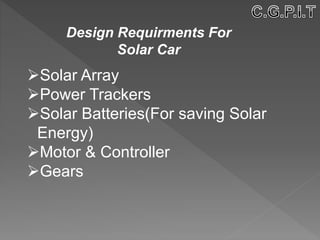
Design Requirments For
Solar Car
Solar Array
Power Trackers
Solar Batteries(For saving Solar
Energy)
Motor & Controller
Gears
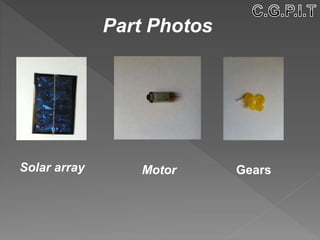
Part Photos
Solar array Motor Gears
Rechargeable
battery wire Tires
Design
Explanation
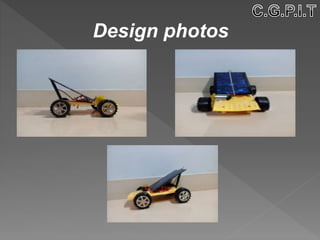
At first we made a normal car.
After that we attach a gear in the motor
and in the tyres too.
After that we connect a solar array to the
motor.
Solar array catch the sun light & transfer it
into electricity which runs the motor as
well as the car.
If you want to save energy you can attach
rechargeable battery to the solar array and
then after connect motor to the battery.
Design photos
Development & construction
Solar cars are powered by the sun's energy. The main
component of a solar car is its solar array, which collect
the energy from the sun and converts it into usable
electrical energy. The solar cells collect a portion of the
sun's energy and stores it into the batteries of the solar
car. Before that happens, power trackers converts the
energy collected from the solar array to the proper
system voltage, so that the batteries and the motor can
use it. After the energy is stored in the batteries, it is
available for use by the motor & motor controller to drive
the car. The motor controller adjusts the amount of
energy that flows to the motor to correspond to the
throttle. The motor uses that energy to drive the wheels.
How it Works.
Conclusion
Solar energy and more specifically
solar cars would be an amazing
advancement in future car technology.
They would allow for free travel and
nearly unlimited accessibility. But solar
cars are not suceessful at all places
like Antarctica which see the sun
rarely. If the hurdles can be passed
then for sure solar cars will be the
Solar Car Working Model

Solar Car Working Model

  • 2.
    Summary A solar caris a solar vehicle used for land transport. Solar cars combine technology typically used in the aerospace, bicycle , alternative energy and automotive industries. The design of a solar vehicle is severely limited by the amount of energy input into the car. Solar cars depend on photovoltaic cells to convert sunlight into electricity. Unlike solar thermal energy which converts solar energy to heat for either household purposes, industrial purposes or to be converted to electricity.
  • 3.
    Introduction In today's climateof growing energy needs and increasing environmental concern, alternatives to the use of non-renewable and polluting fossil fuels have to be investigated. One such alternative is solar energy. Solar energy is quite simply the energy produced directly by the sun and collected elsewhere, normally the Earth. Only a very small fraction of the total radiation produced reaches the Earth. Much of the world's required energy can be supplied directly by solar power. Methods of collecting and storing solar energy vary depending on the uses planned for the solar generator. In general, there are three types of collectors and many forms of storage units. The three types of collectors are flat-plate collectors, focusing collectors, and passive collectors. We are using hear flat-plate collector which are commonly known as solar array.
  • 4.
    Background of solar energy Thehistory of photovoltaic energy (solar cells) started way back in 1876. William Grylls Adams along with a student of his, Richard Day, discovered that when selenium was exposed to light, it produced electricity. An electricity expert, Werner von Siemens, stated that the discovery was "scientifically of the most far-reaching importance". The selenium cells were not efficient, but it was proved that light, without heat or moving parts, could be converted into electricity. In 1953, Calvin Fuller, Gerald Pearson, and Daryl Chapin, discovered the silicon solar cell. This cell actually produced enough electricity and was efficient enough to run small electrical devices. The New York Times stated that this discovery was "the beginning of a new era, leading eventually to the realization of harnessing the almost limitless energy of the sun for the uses of civilization."
  • 5.
    Design Requirments For SolarCar Solar Array Power Trackers Solar Batteries(For saving Solar Energy) Motor & Controller Gears
  • 6.
  • 7.
  • 8.
    Design Explanation At first wemade a normal car. After that we attach a gear in the motor and in the tyres too. After that we connect a solar array to the motor. Solar array catch the sun light & transfer it into electricity which runs the motor as well as the car. If you want to save energy you can attach rechargeable battery to the solar array and then after connect motor to the battery.
  • 9.
  • 10.
  • 11.
    Solar cars arepowered by the sun's energy. The main component of a solar car is its solar array, which collect the energy from the sun and converts it into usable electrical energy. The solar cells collect a portion of the sun's energy and stores it into the batteries of the solar car. Before that happens, power trackers converts the energy collected from the solar array to the proper system voltage, so that the batteries and the motor can use it. After the energy is stored in the batteries, it is available for use by the motor & motor controller to drive the car. The motor controller adjusts the amount of energy that flows to the motor to correspond to the throttle. The motor uses that energy to drive the wheels. How it Works.
  • 12.
    Conclusion Solar energy andmore specifically solar cars would be an amazing advancement in future car technology. They would allow for free travel and nearly unlimited accessibility. But solar cars are not suceessful at all places like Antarctica which see the sun rarely. If the hurdles can be passed then for sure solar cars will be the