Foundations for Dynamic and
Sensitive Equipment
University of Minnesota - Structures Seminar
October 30, 2015
Carl Nelson, Ph.D., P.E.
Tony Baxter, P.E.
2
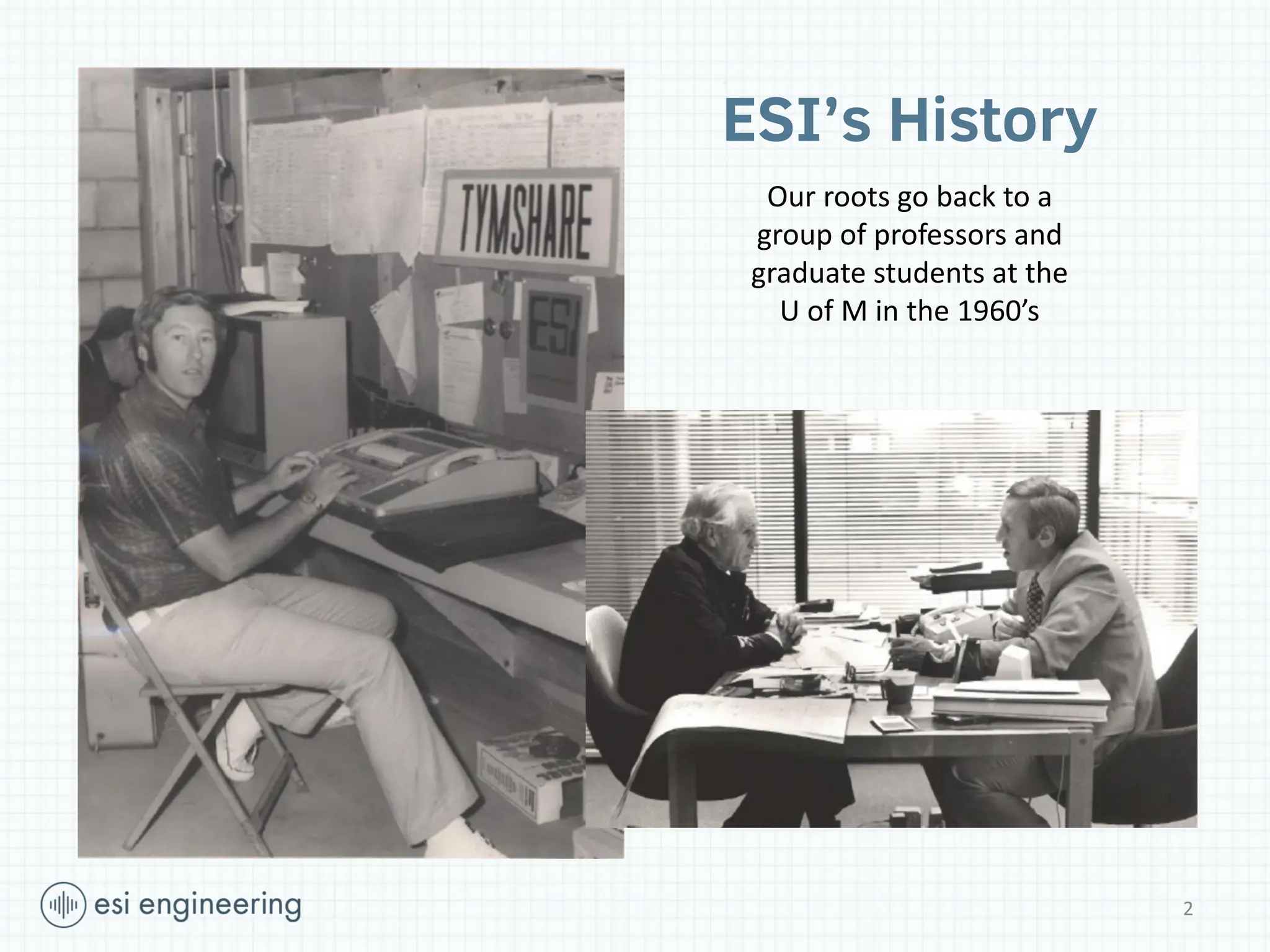
ESI’s History
Our roots go back to a
group of professors and
graduate students at the
U of M in the 1960’s
3
Who We Are Today!
 Minnesota based consulting engineering firm since 1970
 Provide specialized engineering services
 Specialists in high force/shock, vibration and noise control
From small medical devices and consumer products to sensitive buildings and large
industrial facilities, ESI helps clients with advanced analysis and design. Our professional
engineering services are focused in the areas of structural dynamics and design,
vibration control, noise and acoustics, and monitoring.
4
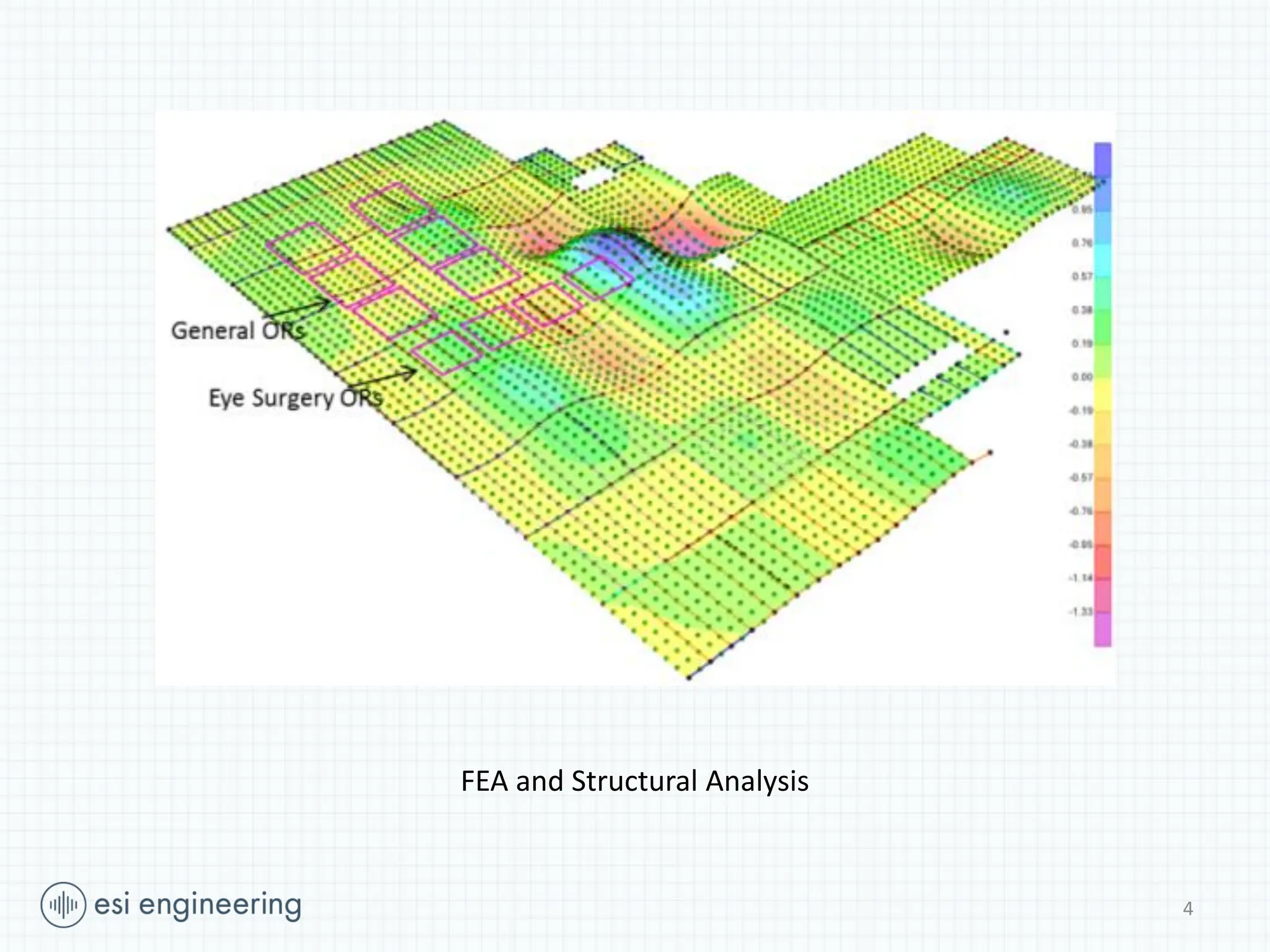
FEA and Structural Analysis
5
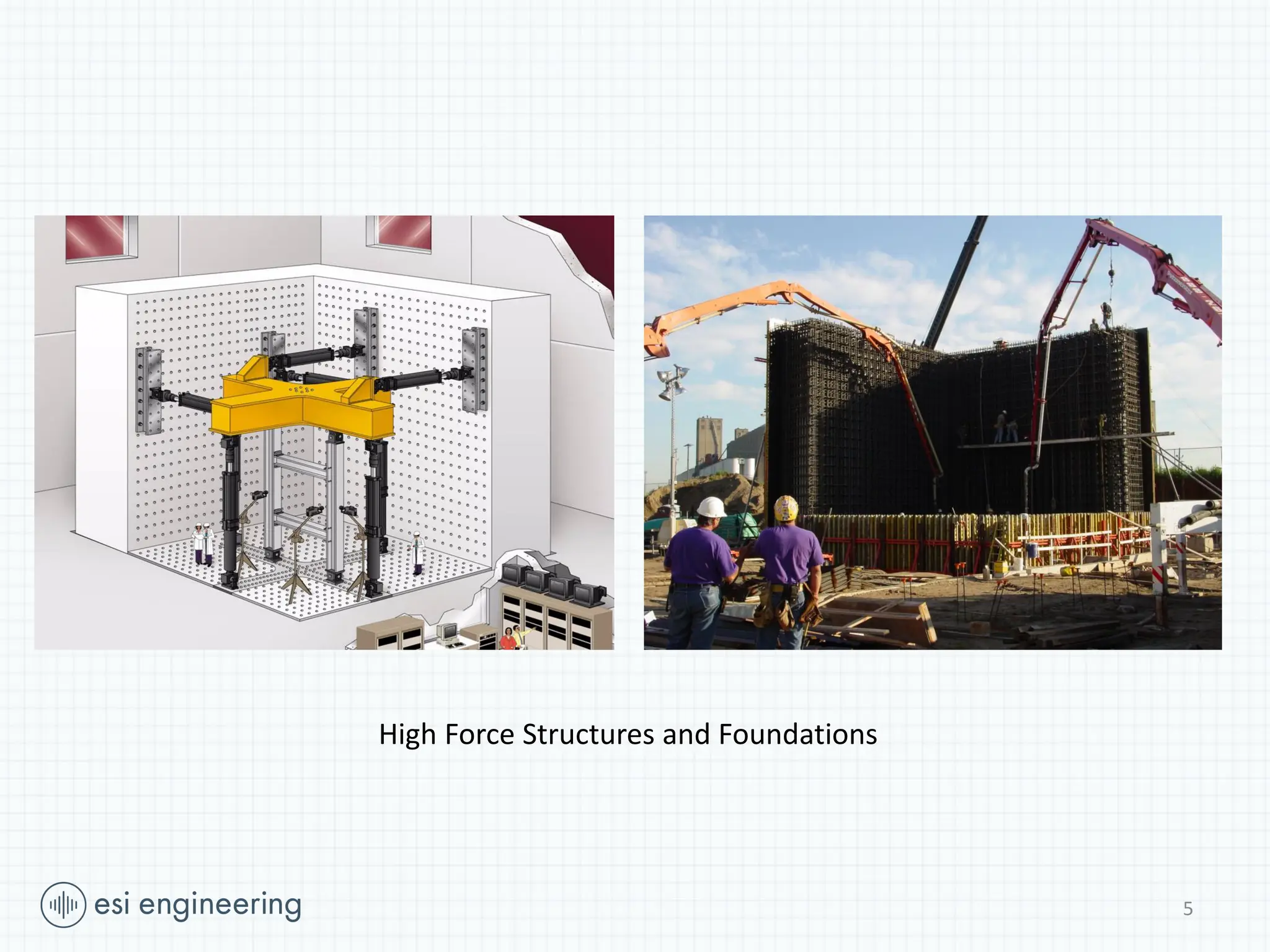
High Force Structures and Foundations
6
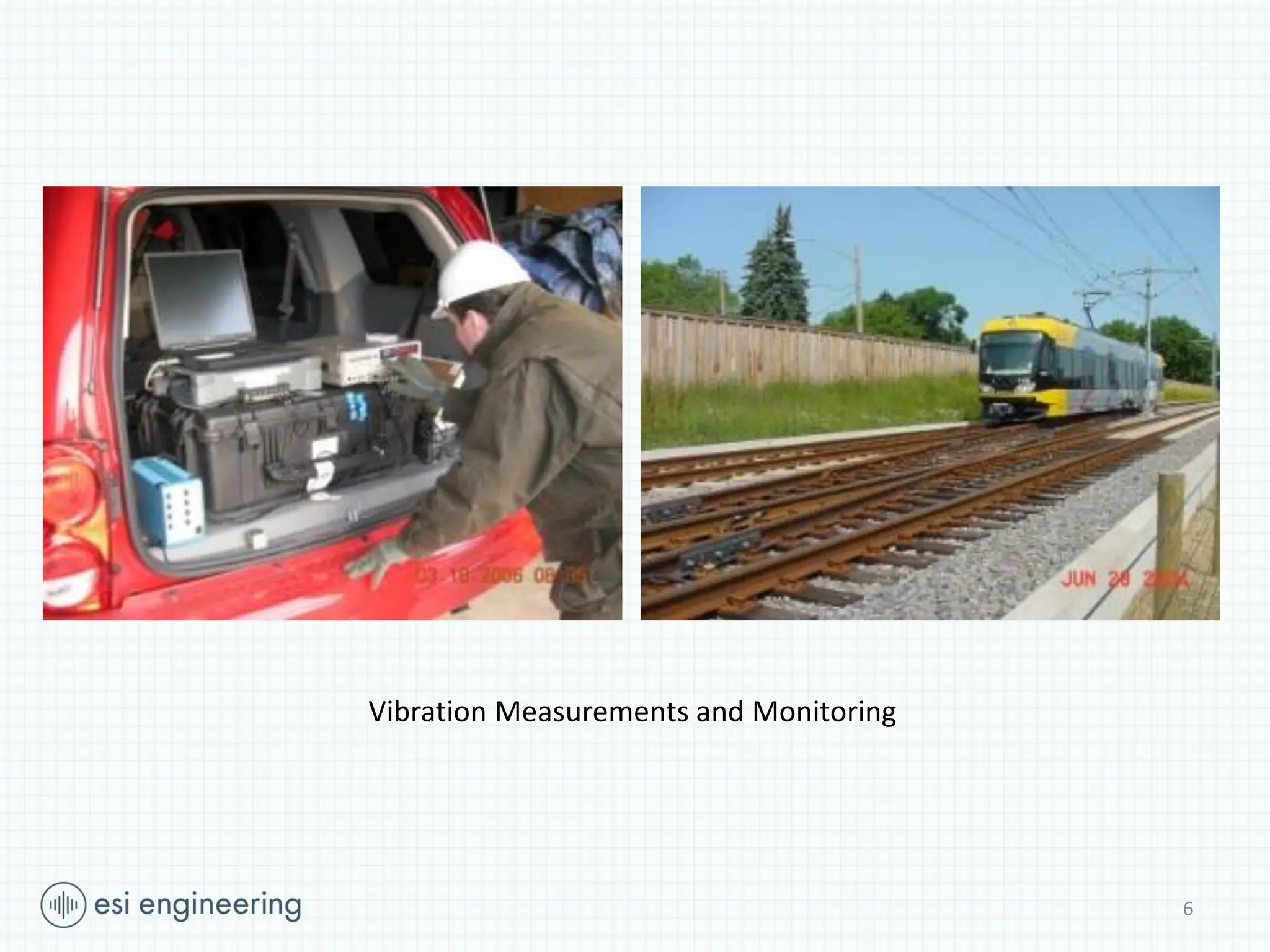
Vibration Measurements and Monitoring
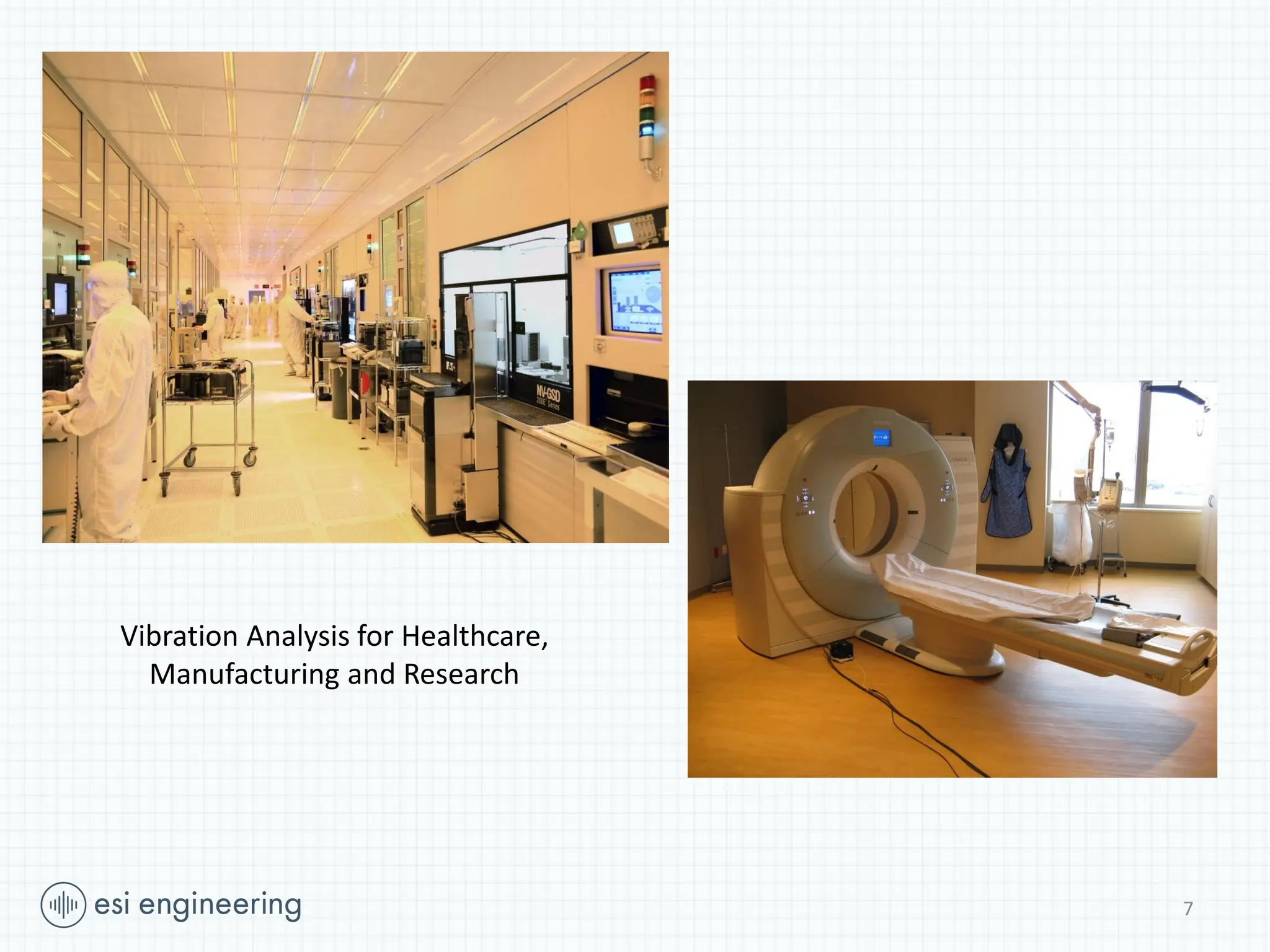
Vibration Analysis for Healthcare,
Manufacturing and Research
7
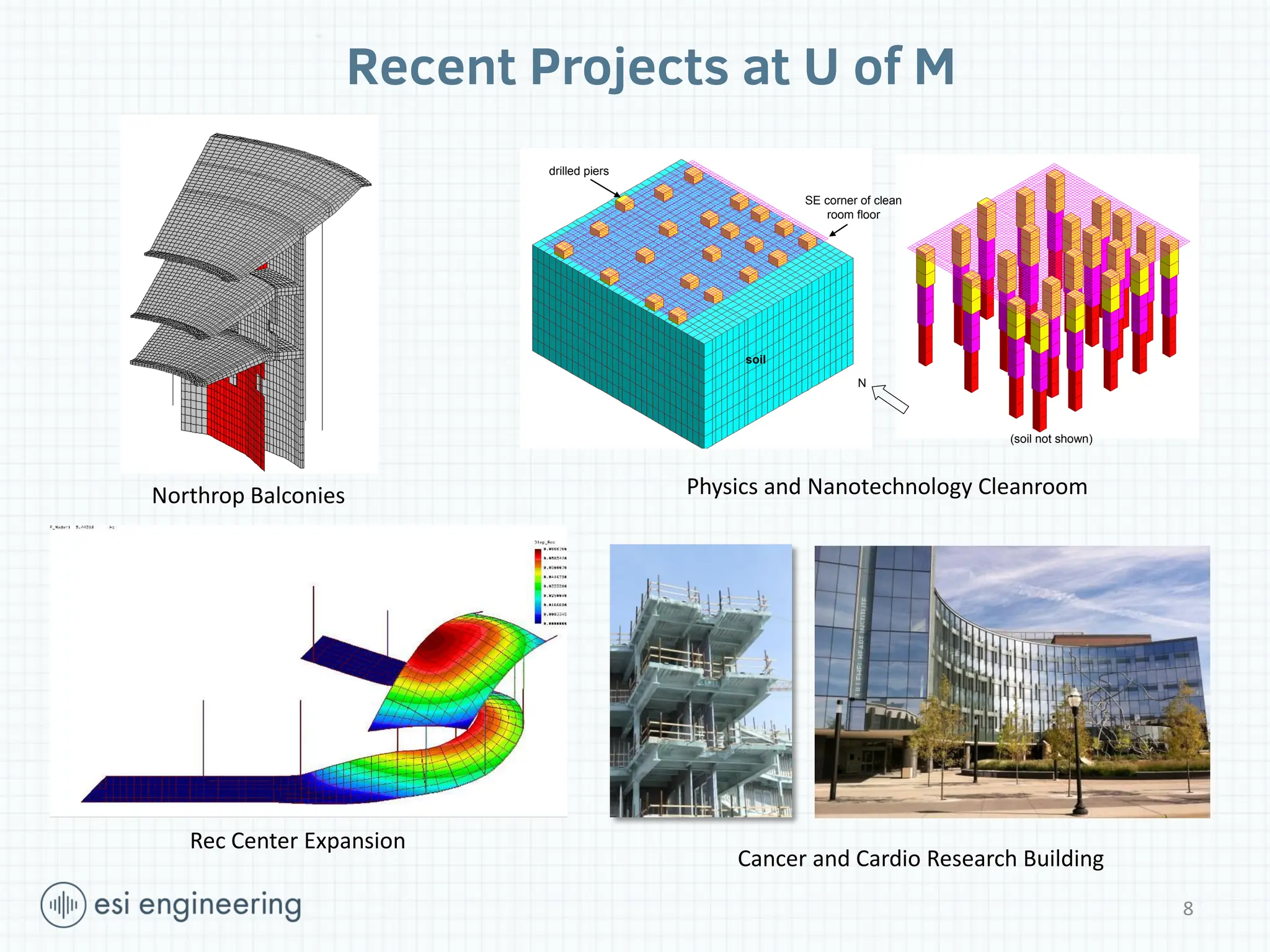
Recent Projects at U of M
Rec Center Expansion
Cancer and Cardio Research Building
Physics and Nanotechnology Cleanroom
Northrop Balconies
SE corner of clean
room floor
soil
drilled piers
(soil not shown)
N
8
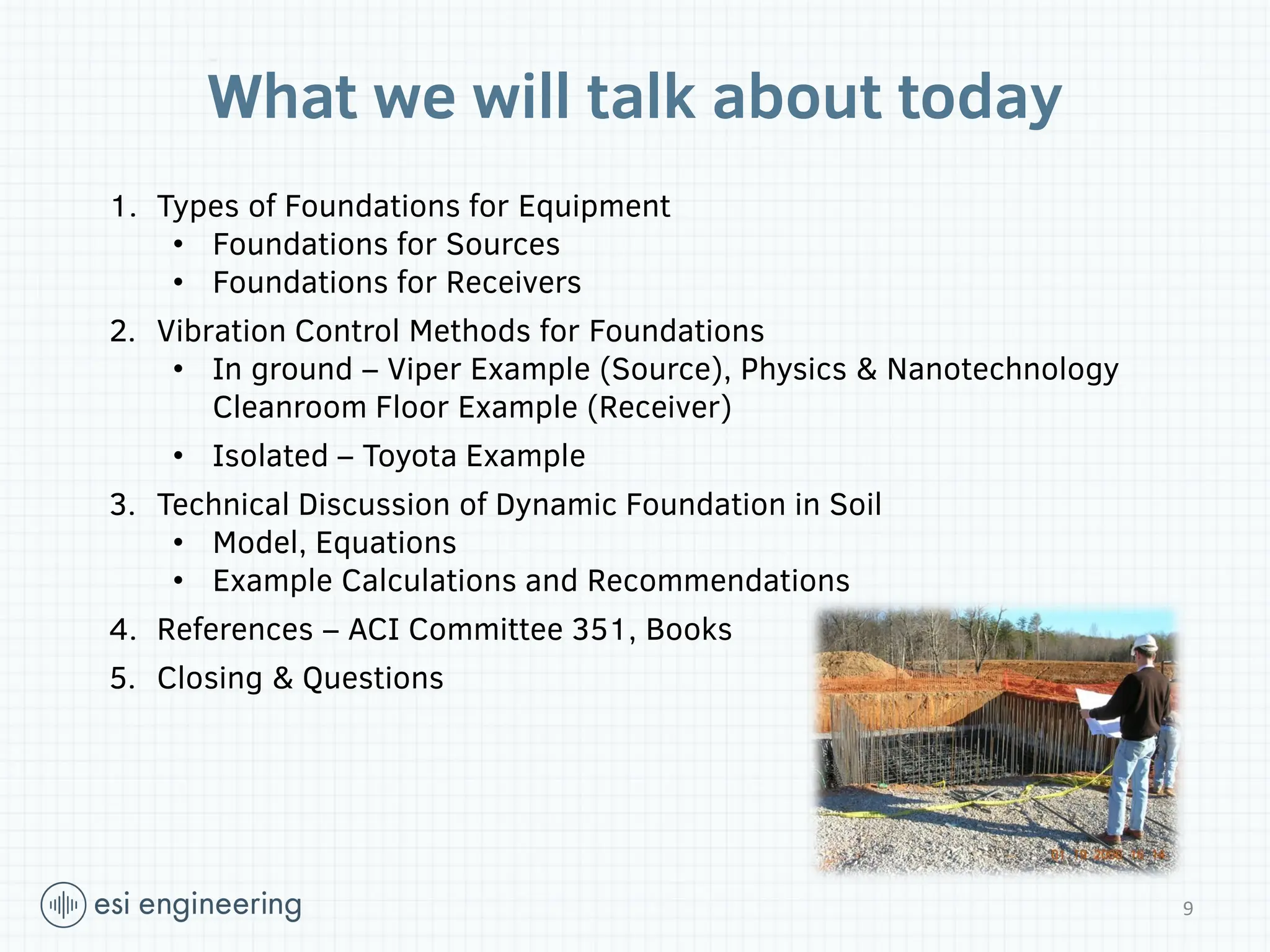
What we will talk about today
1. Types of Foundations for Equipment
• Foundations for Sources
• Foundations for Receivers
2. Vibration Control Methods for Foundations
• In ground – Viper Example (Source), Physics & Nanotechnology
Cleanroom Floor Example (Receiver)
• Isolated – Toyota Example
3. Technical Discussion of Dynamic Foundation in Soil
• Model, Equations
• Example Calculations and Recommendations
4. References – ACI Committee 351, Books
5. Closing & Questions
9
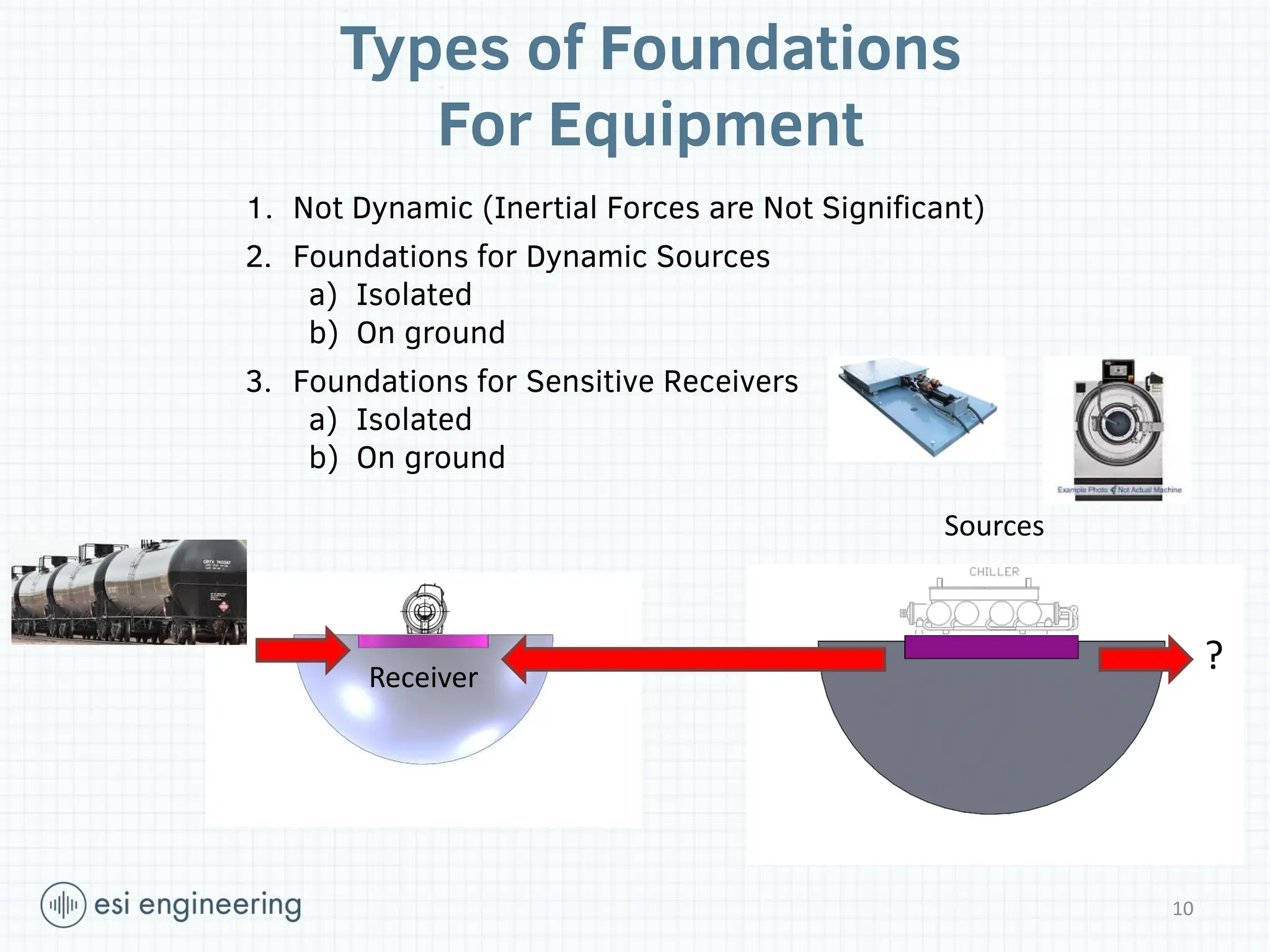
Types of Foundations
For Equipment
1. Not Dynamic (Inertial Forces are Not Significant)
2. Foundations for Dynamic Sources
a) Isolated
b) On ground
3. Foundations for Sensitive Receivers
a) Isolated
b) On ground
Sources
Receiver
10
?
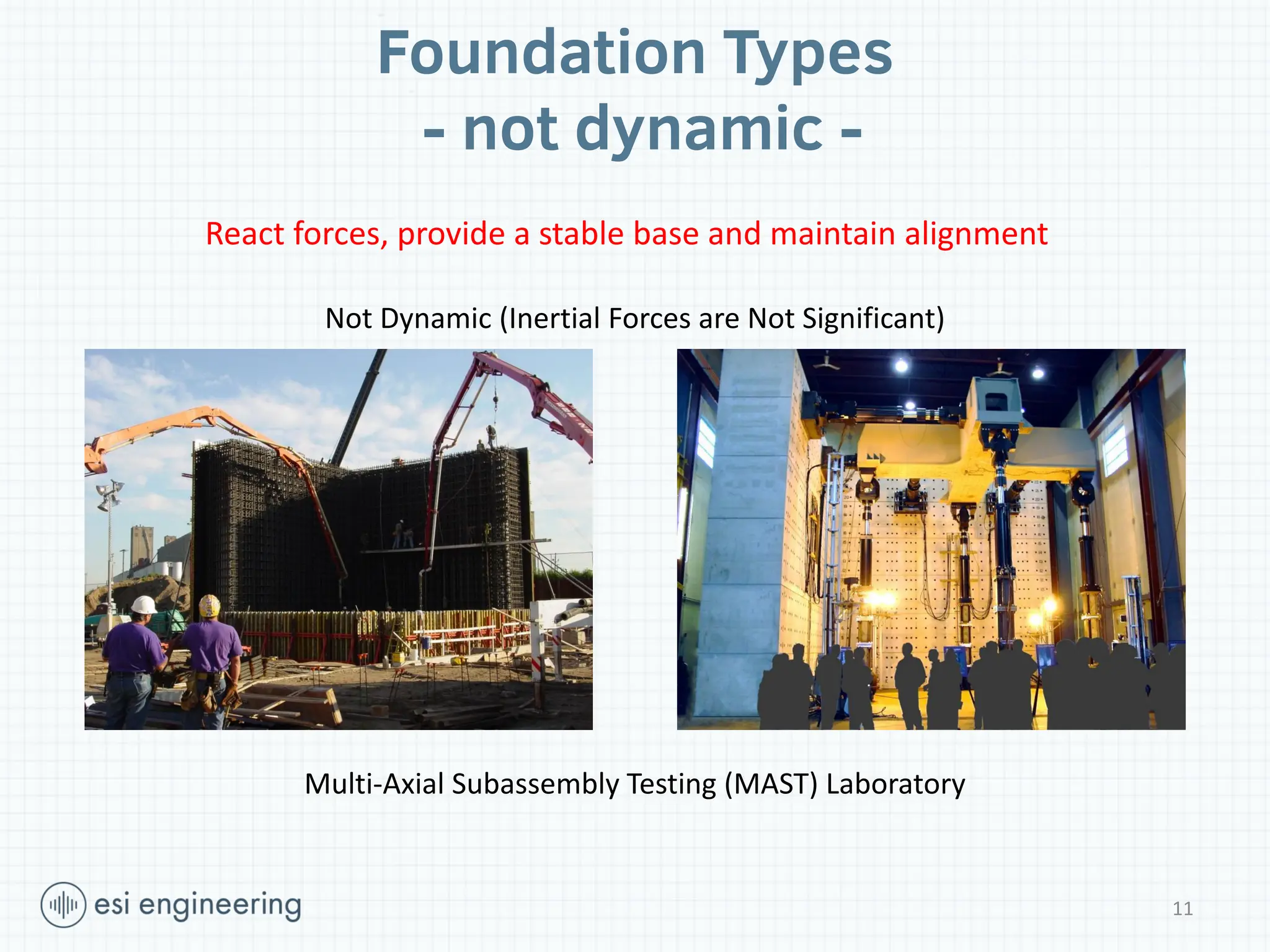
Foundation Types
- not dynamic -
Not Dynamic (Inertial Forces are Not Significant)
Multi-Axial Subassembly Testing (MAST) Laboratory
11
React forces, provide a stable base and maintain alignment
Foundations For Dynamic Sources
12
• React forces
• Provide a stable base and maintain alignment
• Minimize motion, on and off foundation
13
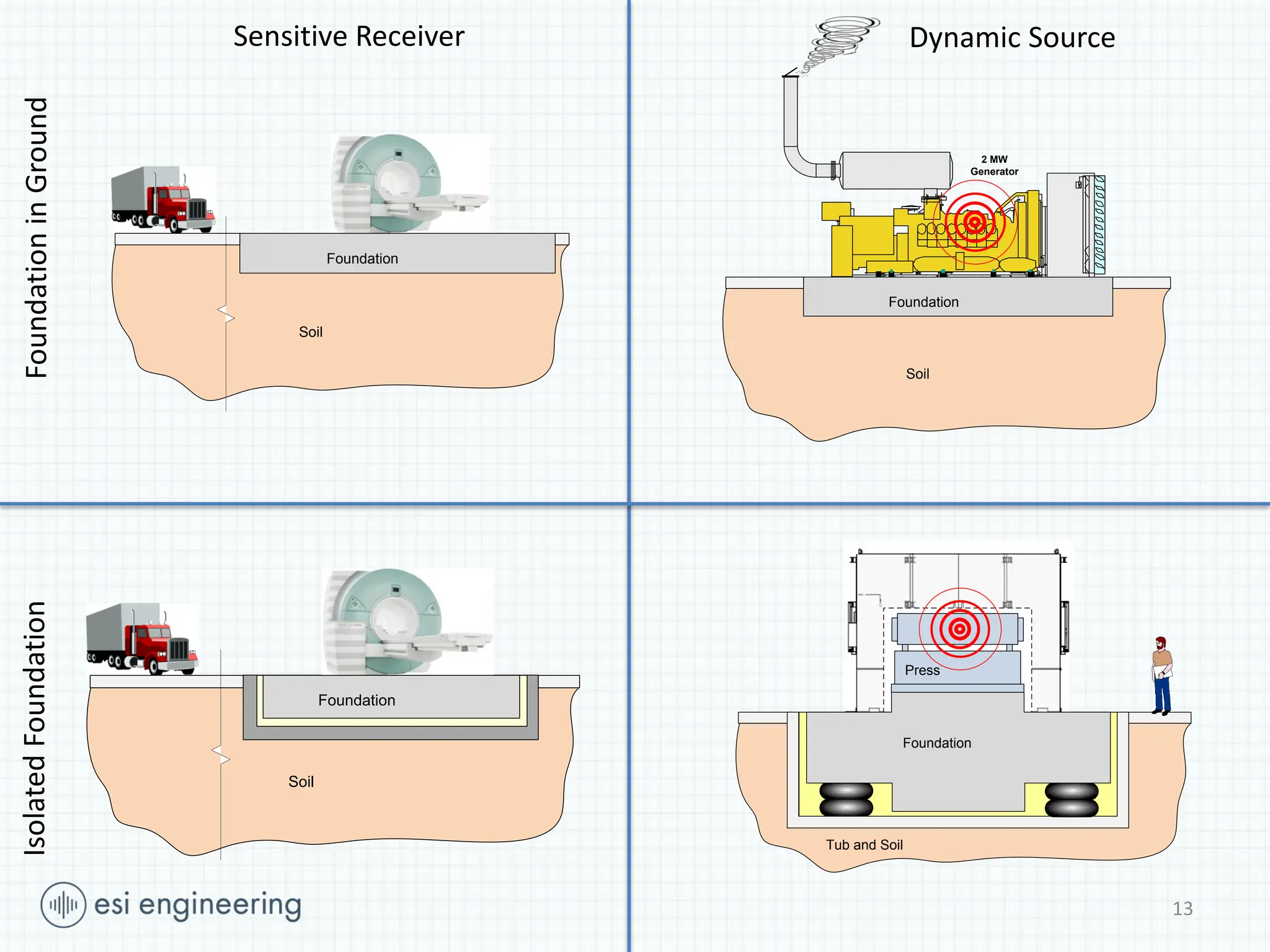
Sensitive Receiver
K1 C1
M1
X1
Xg
Foundation
Soil
Foundation in Soil
2 MW
Generator
Foundation
Soil
K1 C1
M1
X1
Xg
Foundation
Soil
K2
M2
C2
X2
F2(
Press
Tub and Soil
Press and
foundation
Tub and soil
Foundation
Dynamic Source
Foundation
in
Ground
Isolated
Foundation
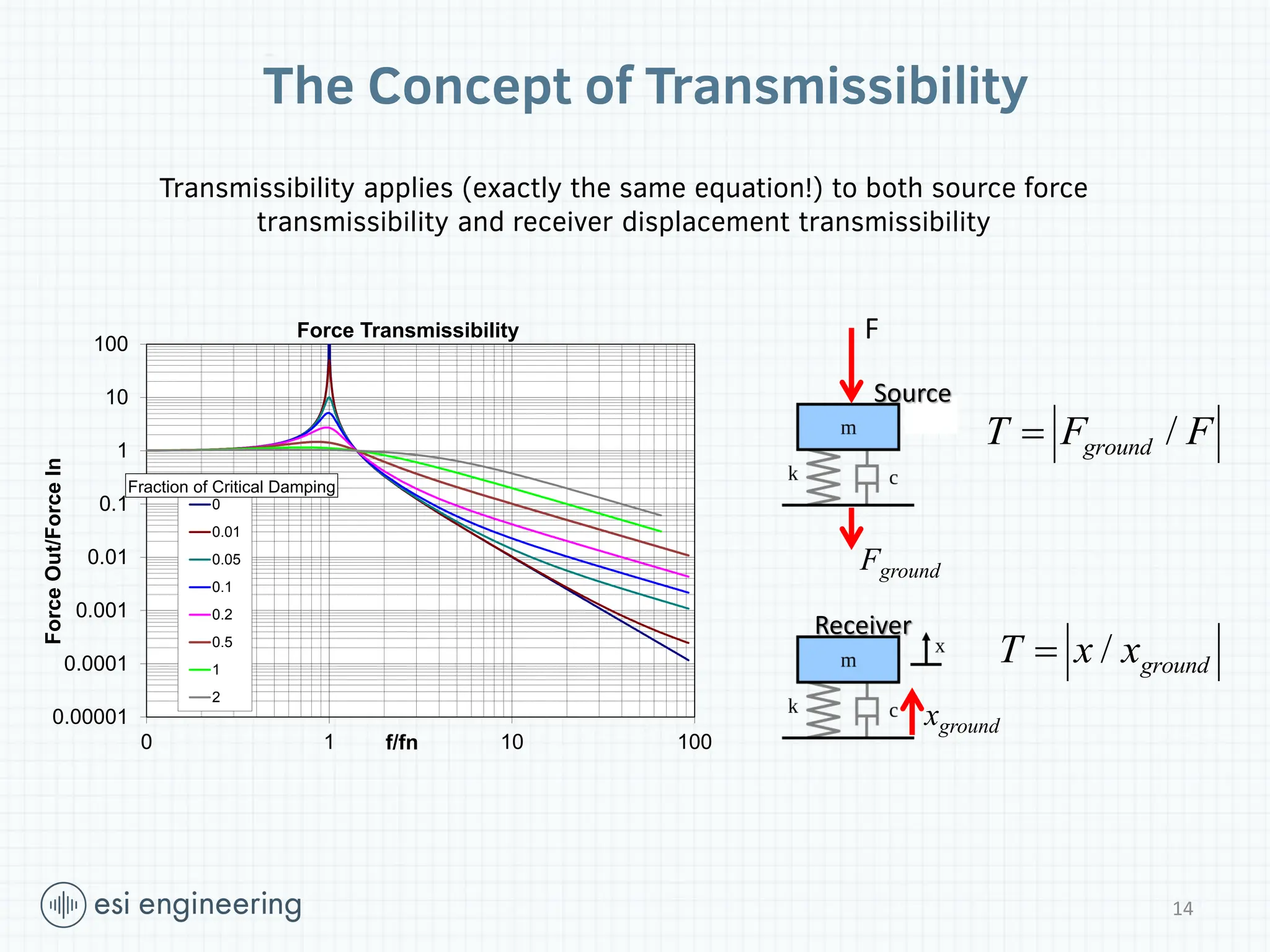
The Concept of Transmissibility
0.00001
0.0001
0.001
0.01
0.1
1
10
100
0 1 10 100
Force
Out/Force
In
f/fn
Force Transmissibility
0
0.01
0.05
0.1
0.2
0.5
1
2
Fraction of Critical Damping
F
Fground
xground
/
ground
T F F

/ ground
T x x

Transmissibility applies (exactly the same equation!) to both source force
transmissibility and receiver displacement transmissibility
Receiver
Source
14
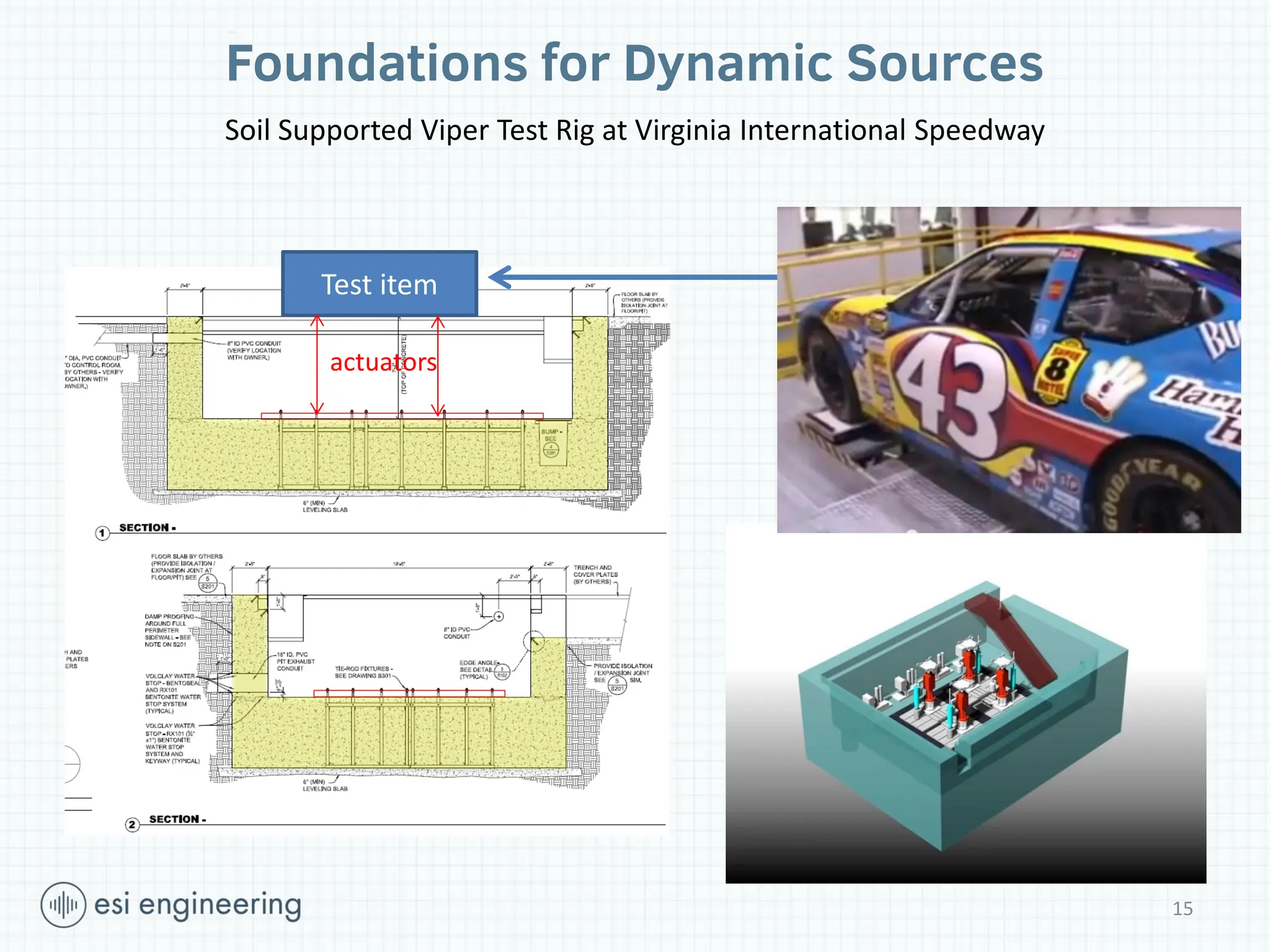
Foundations for Dynamic Sources
actuators
Test item
Soil Supported Viper Test Rig at Virginia International Speedway
15
16
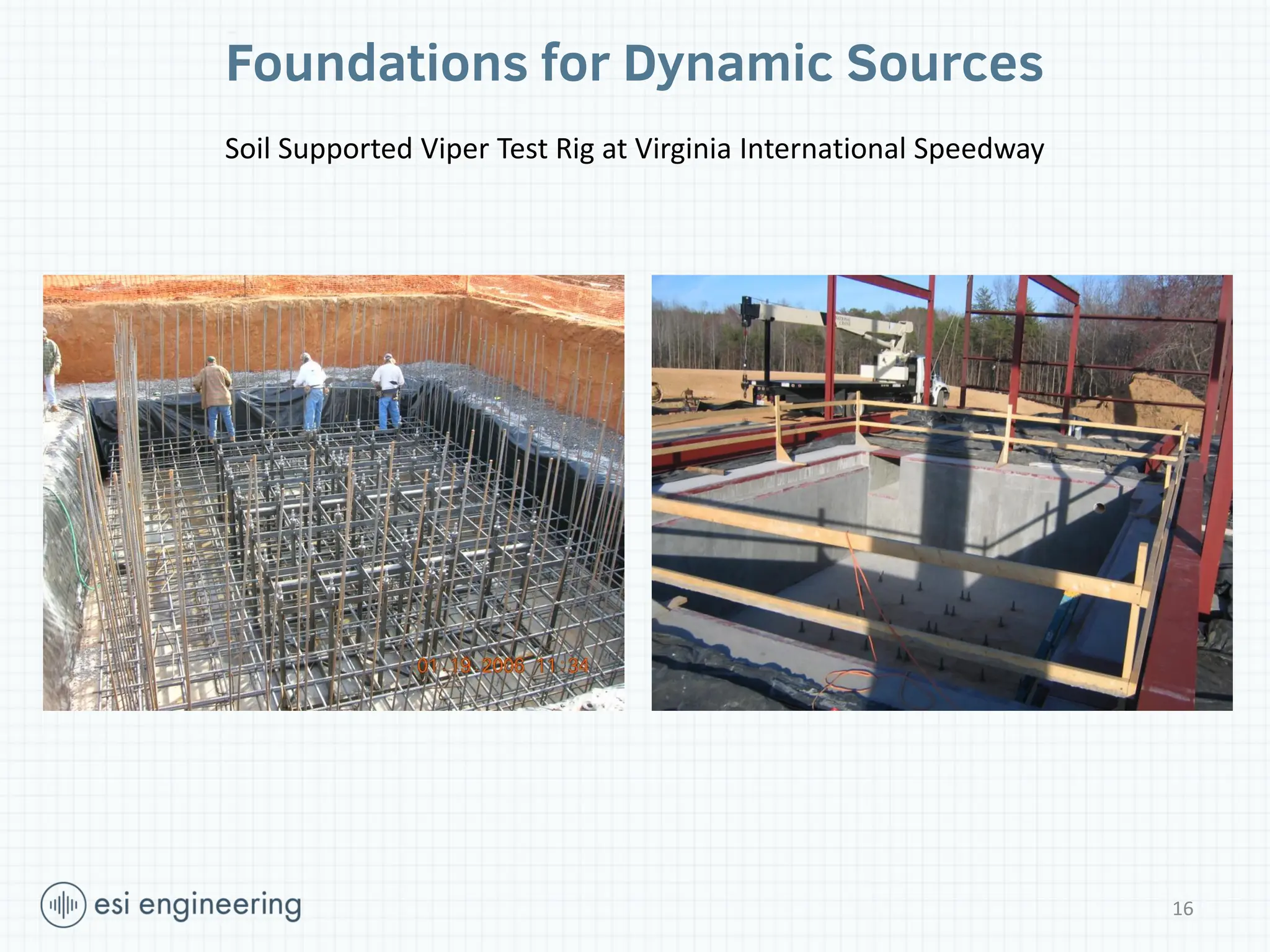
Foundations for Dynamic Sources
Soil Supported Viper Test Rig at Virginia International Speedway
17
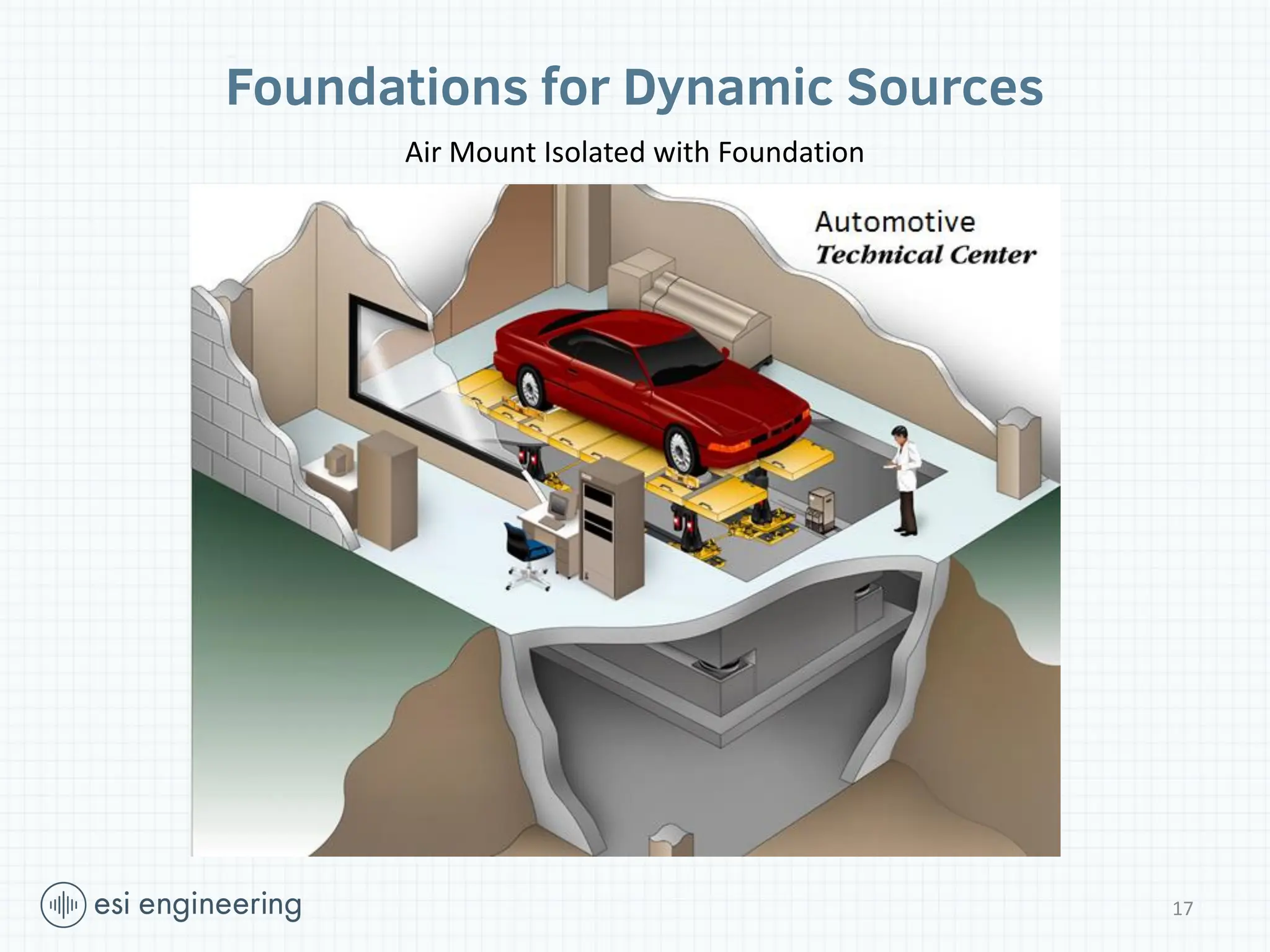
Foundations for Dynamic Sources
Air Mount Isolated with Foundation
18
19
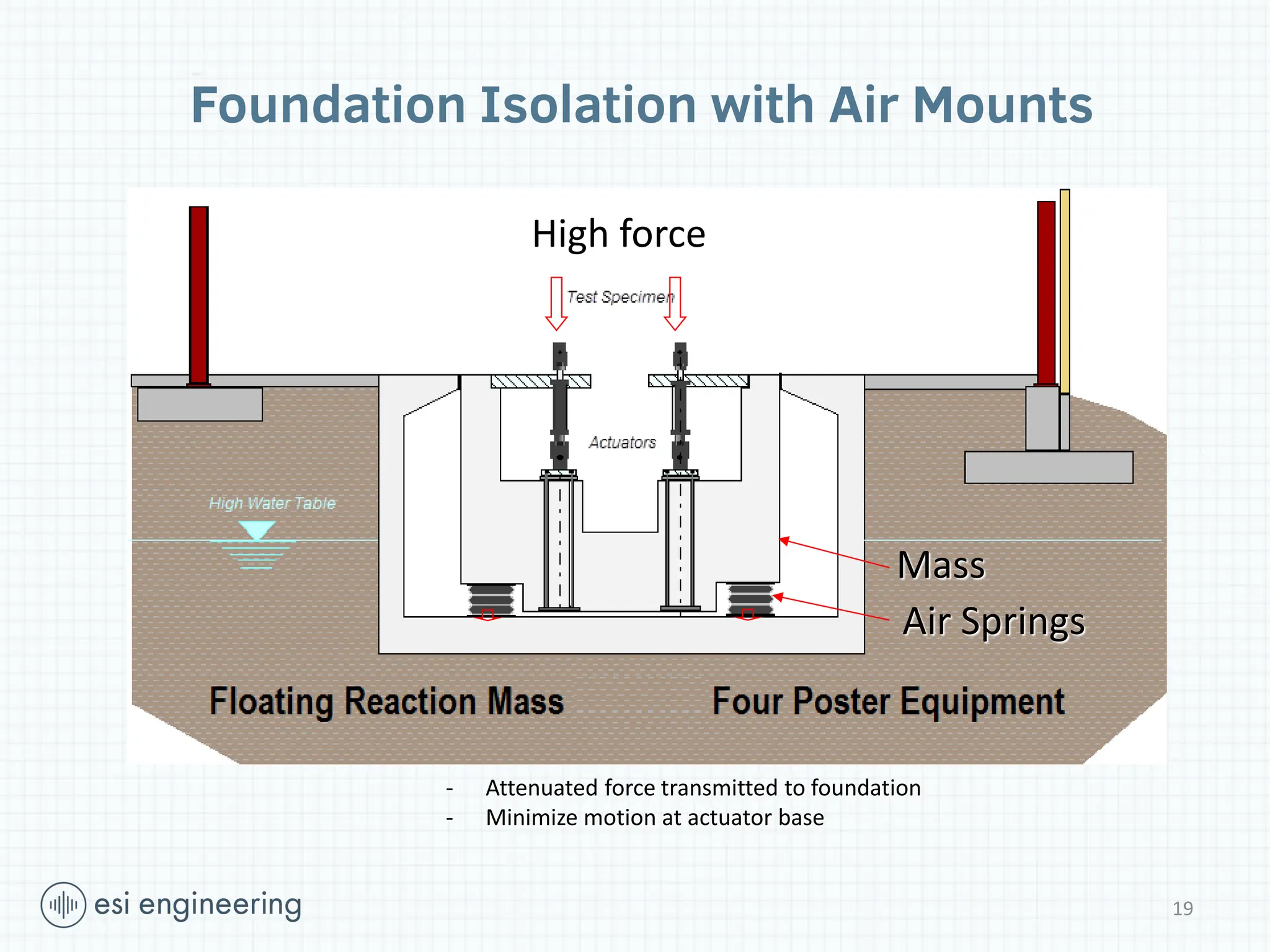
High force
Mass
Air Springs
- Attenuated force transmitted to foundation
- Minimize motion at actuator base
Foundation Isolation with Air Mounts
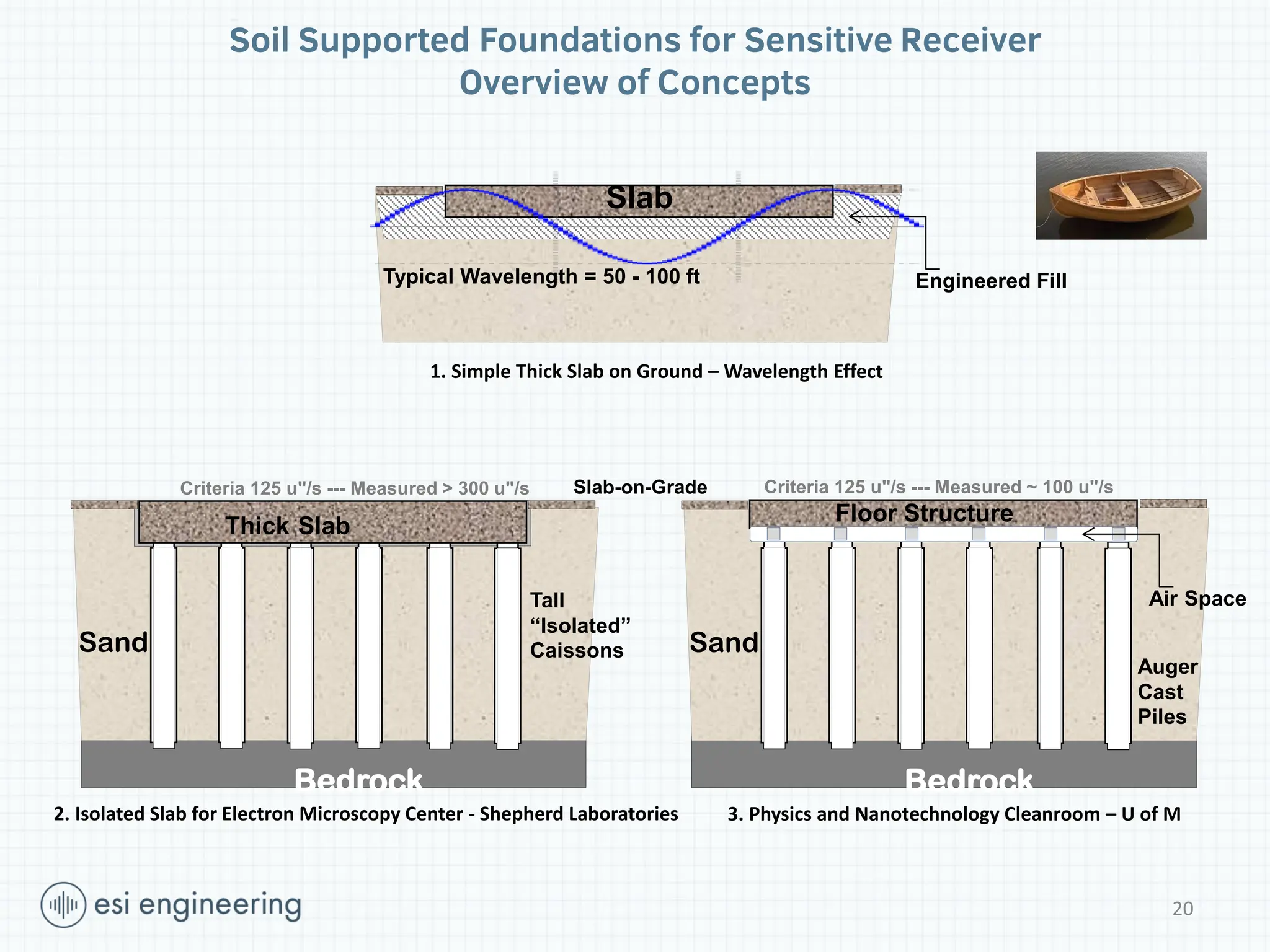
Soil Supported Foundations for Sensitive Receiver
Overview of Concepts
20
Engineered Fill
Slab
1. Simple Thick Slab on Ground – Wavelength Effect
2. Isolated Slab for Electron Microscopy Center - Shepherd Laboratories
Bedrock
Sand
Thick Slab
Criteria 125 u"/s --- Measured > 300 u"/s
Tall
“Isolated”
Caissons
Slab-on-Grade
Typical Wavelength = 50 - 100 ft
Bedrock
Sand
Auger
Cast
Piles
3. Physics and Nanotechnology Cleanroom – U of M
Air Space
Floor Structure
Criteria 125 u"/s --- Measured ~ 100 u"/s
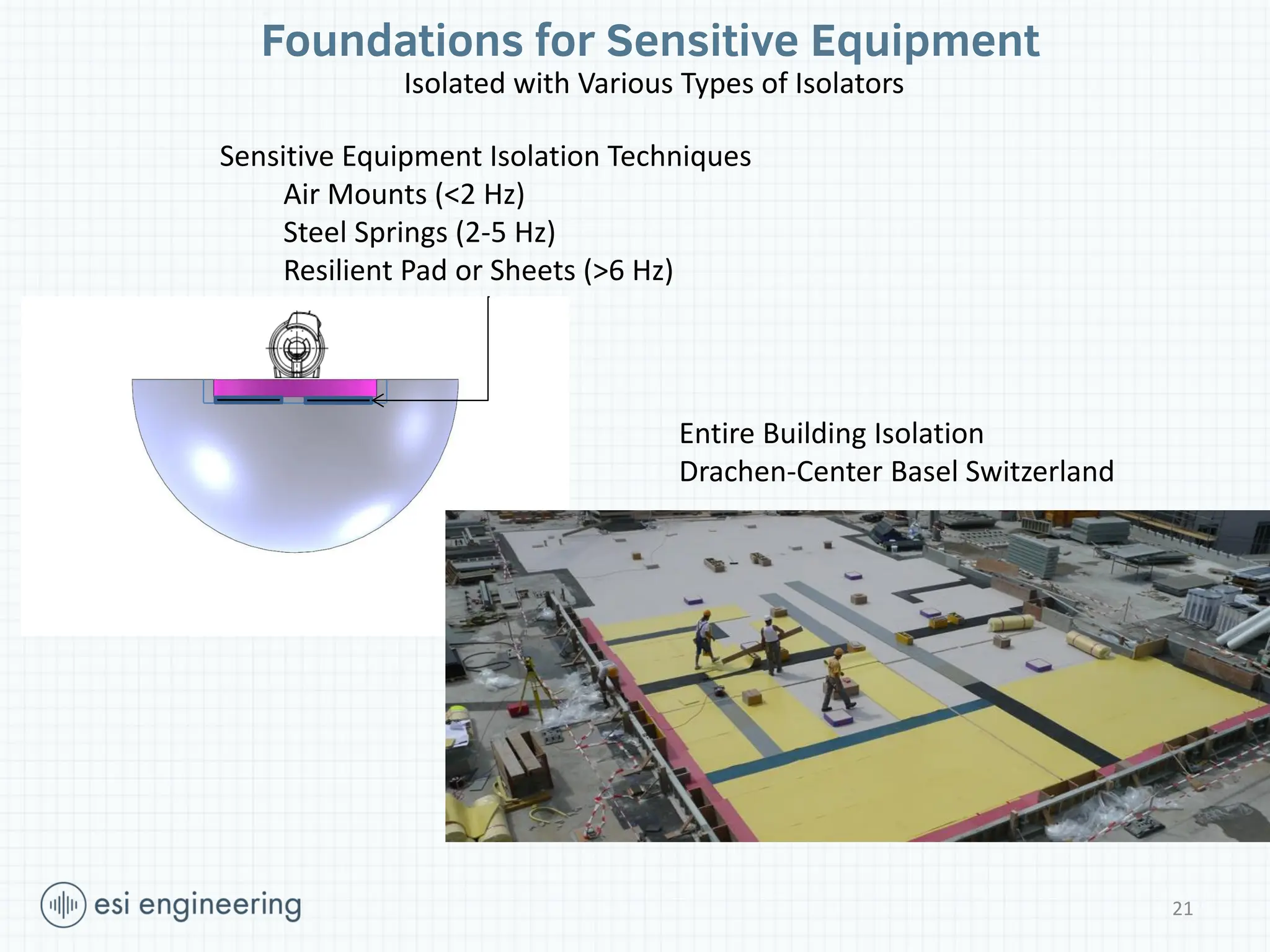
Foundations for Sensitive Equipment
Isolated with Various Types of Isolators
Sensitive Equipment Isolation Techniques
Air Mounts (<2 Hz)
Steel Springs (2-5 Hz)
Resilient Pad or Sheets (>6 Hz)
Entire Building Isolation
Drachen-Center Basel Switzerland
21
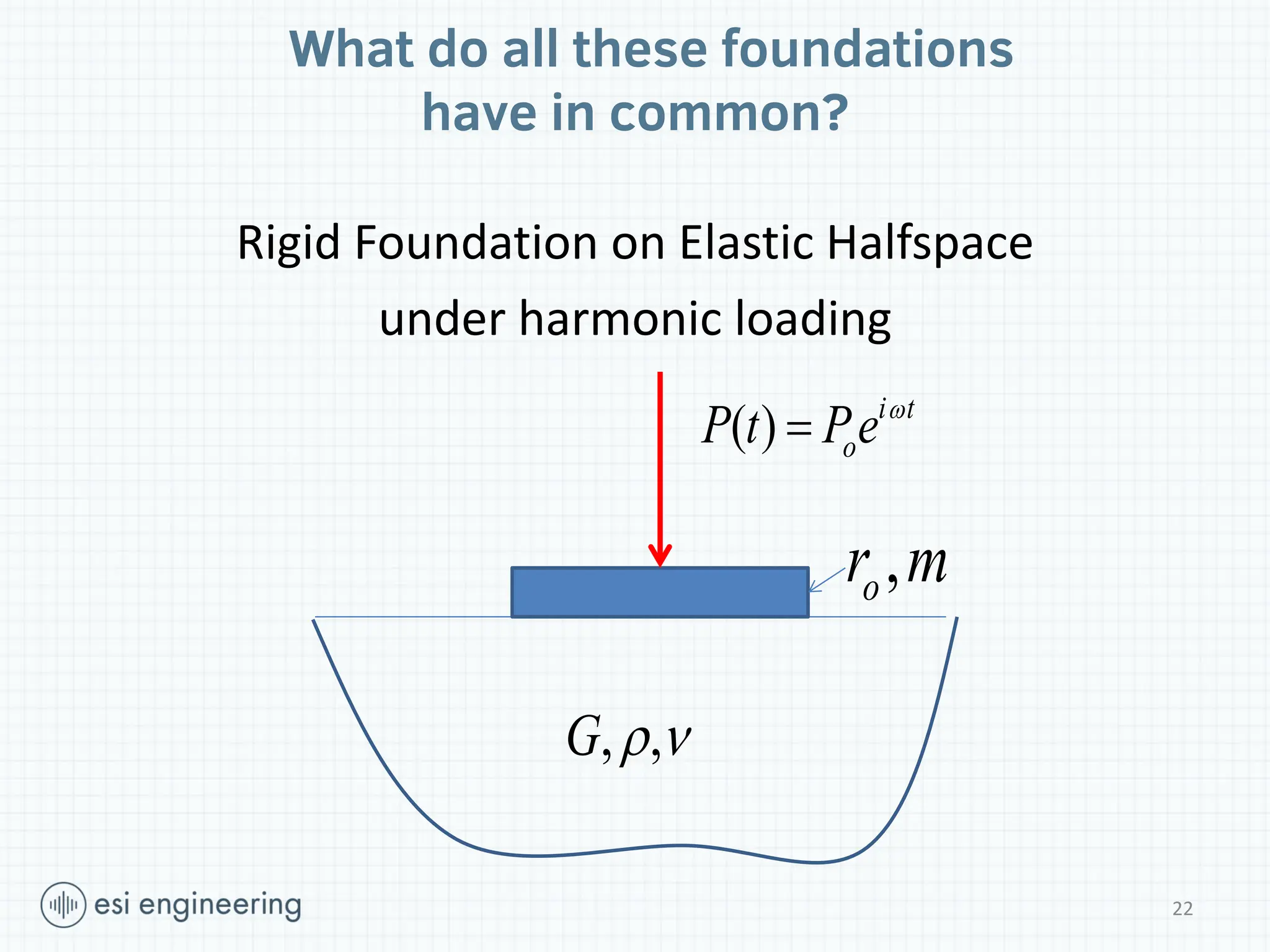
22
Rigid Foundation on Elastic Halfspace
under harmonic loading
, ,
G  
,
o
r m
( ) i t
o
P t Pe 

What do all these foundations
have in common?
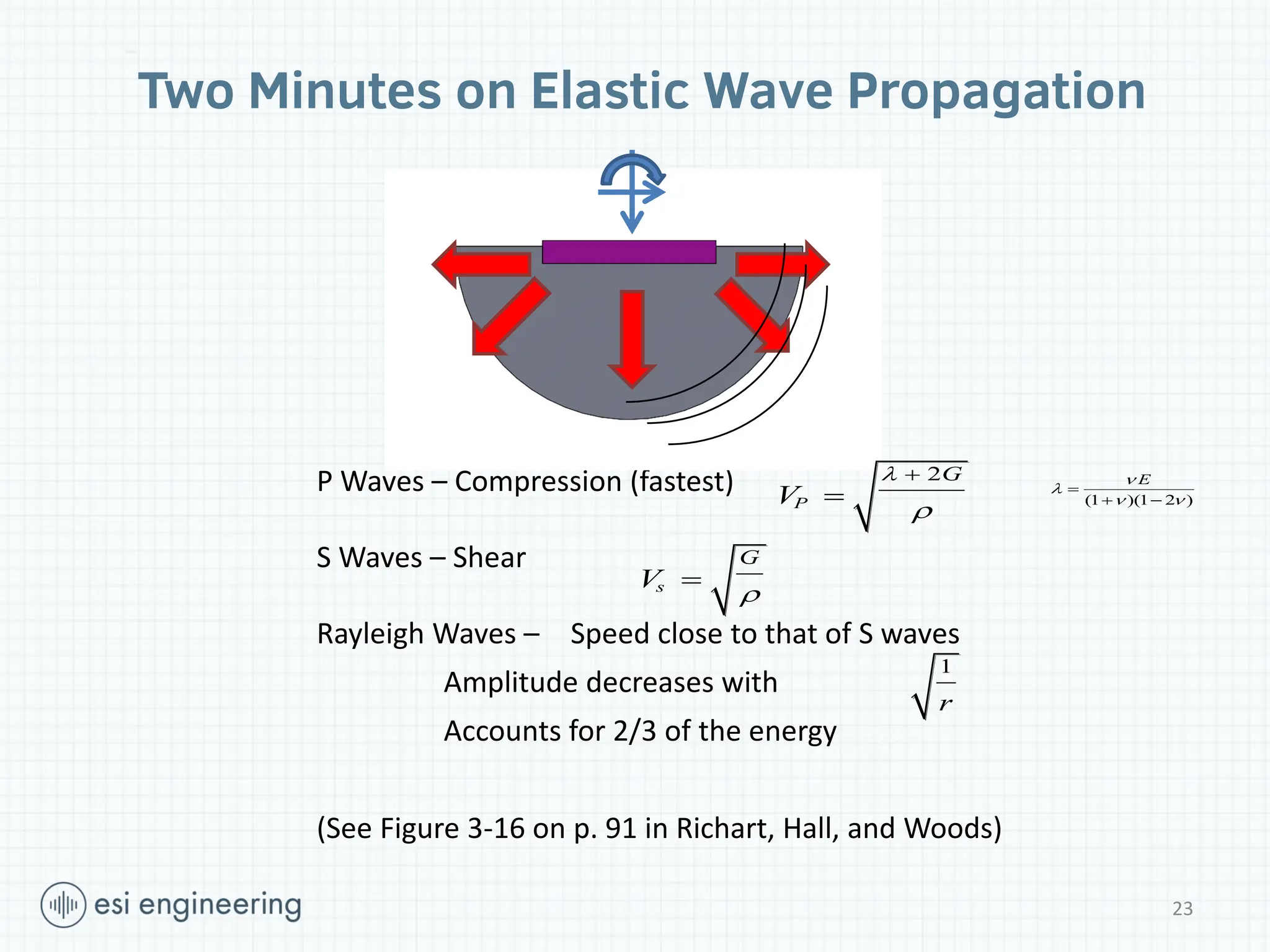
Two Minutes on Elastic Wave Propagation
P Waves – Compression (fastest)
S Waves – Shear
Rayleigh Waves – Speed close to that of S waves
Amplitude decreases with
Accounts for 2/3 of the energy
(See Figure 3-16 on p. 91 in Richart, Hall, and Woods)
s
G
V


2
P
G
V




1
r
(1 )(1 2 )
E


 

 
23
24
24
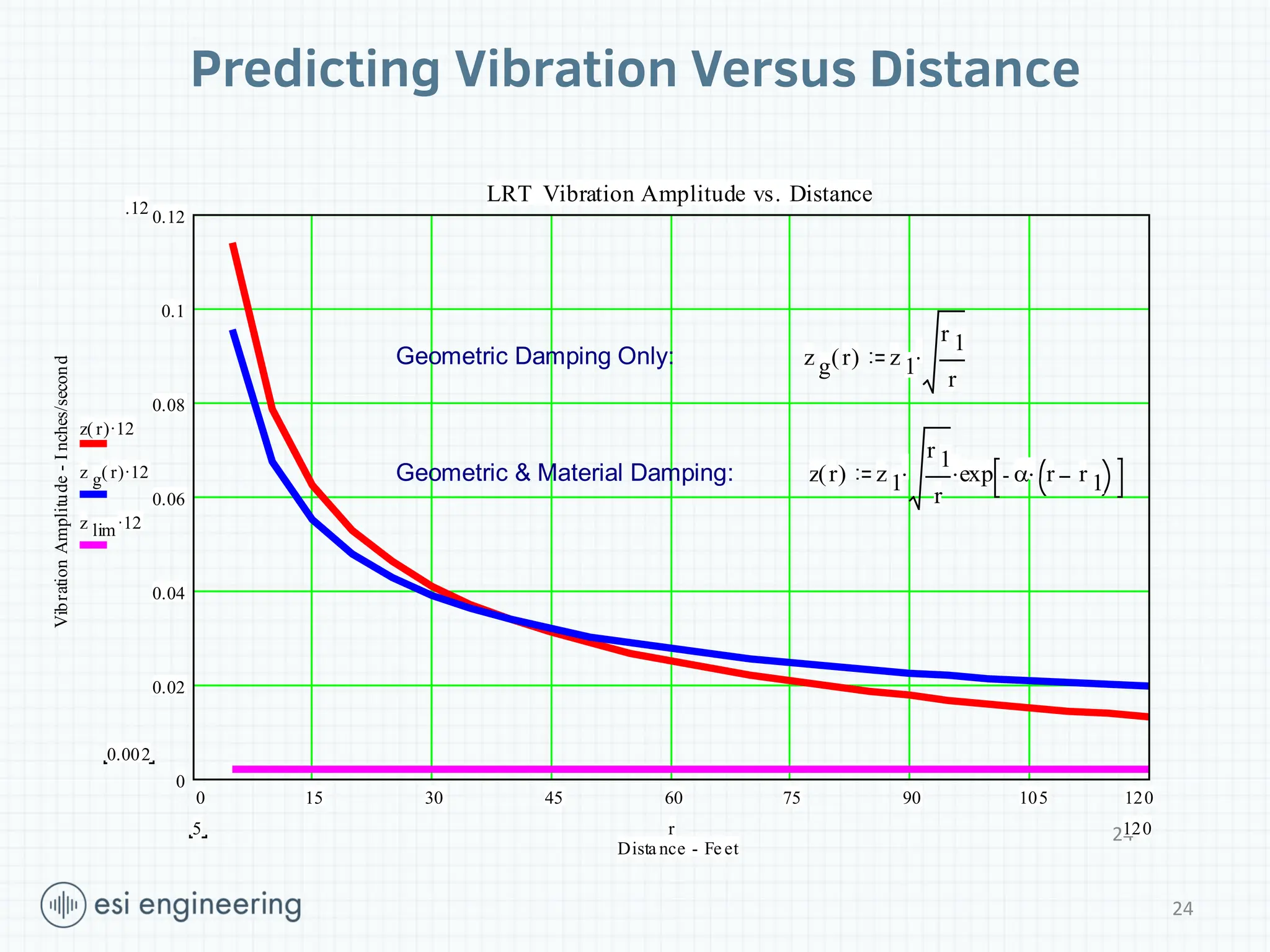
Predicting Vibration Versus Distance
0 15 30 45 60 75 90 105 120
0
0.02
0.04
0.06
0.08
0.1
0.12
LRT Vibration Amplitude vs. Distance
Dista nce - Fe et
Vibration
Amplitude
-
I
nches/second
.12
0.002
.
z( )
r 12
.
z g( )
r 12
.
z lim 12
120
5 r
Geometric Damping Only: z g( )
r .
z 1
r 1
r
Geometric & Material Damping: z( )
r .
.
z 1
r 1
r
exp .
 r r 1
Early
Boussinesq (1885), Lamb (1904) – static, dynamic load on the surface of elastic halfspace
Riessner (1936) – Dynamically loaded, rigid circular foundation on elastic halfspace
Lysmer and Richart – “Dynamic Response of Footings to Vertical Loading,” ASCE Journal
of the Soil Mechanics and Foundations Division, January 1966.
“Lysmer’s Analog”
Numerical Methods
Many Contributors – FEA, Boundary Element Method
Beskos and Co-Workers and the University of Minnesota (1970s-80s)
Some History
Development of Techniques
25
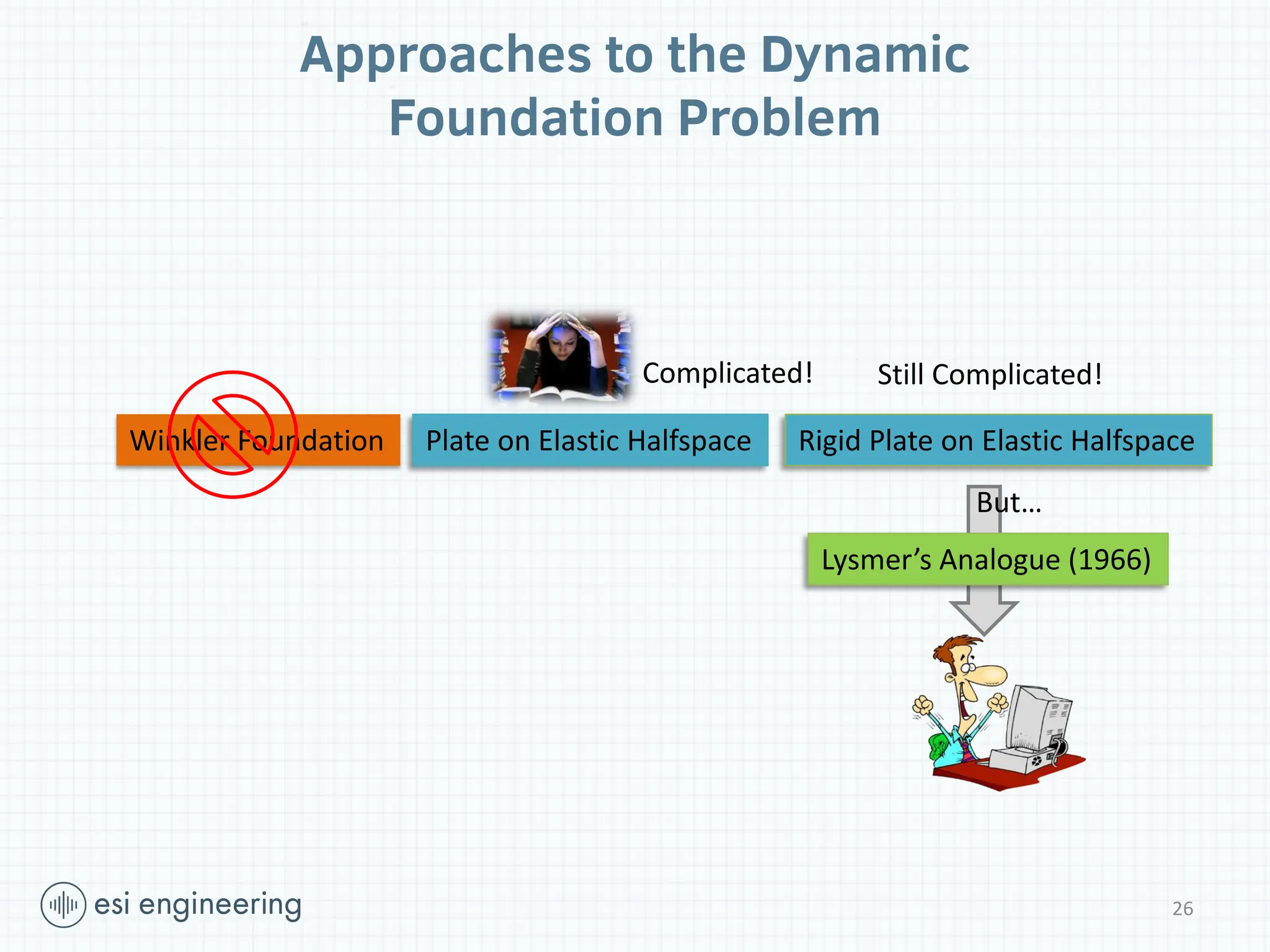
Winkler Foundation Plate on Elastic Halfspace Rigid Plate on Elastic Halfspace
Lysmer’s Analogue (1966)
Complicated! Still Complicated!
But…
Approaches to the Dynamic
Foundation Problem
26
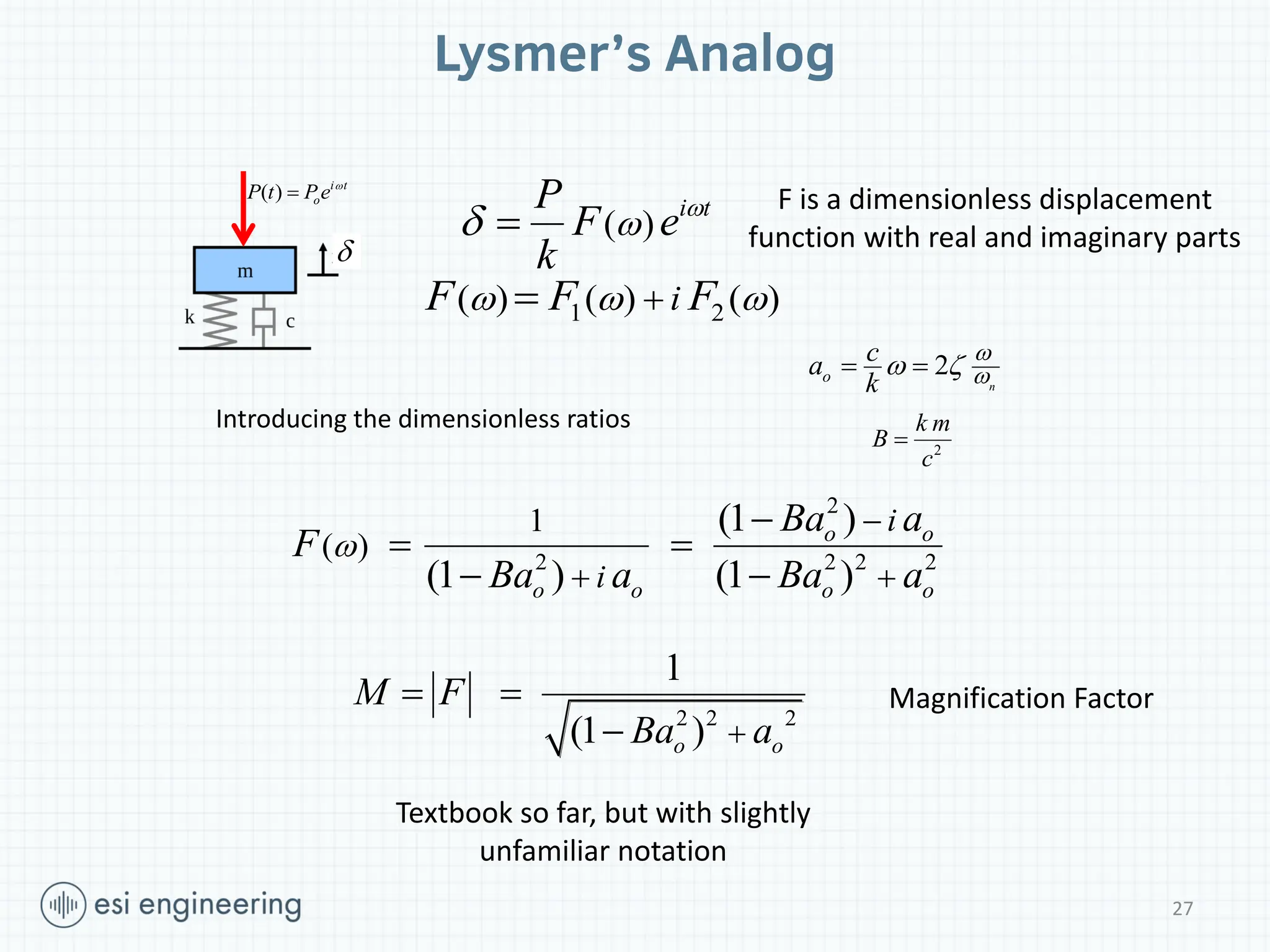
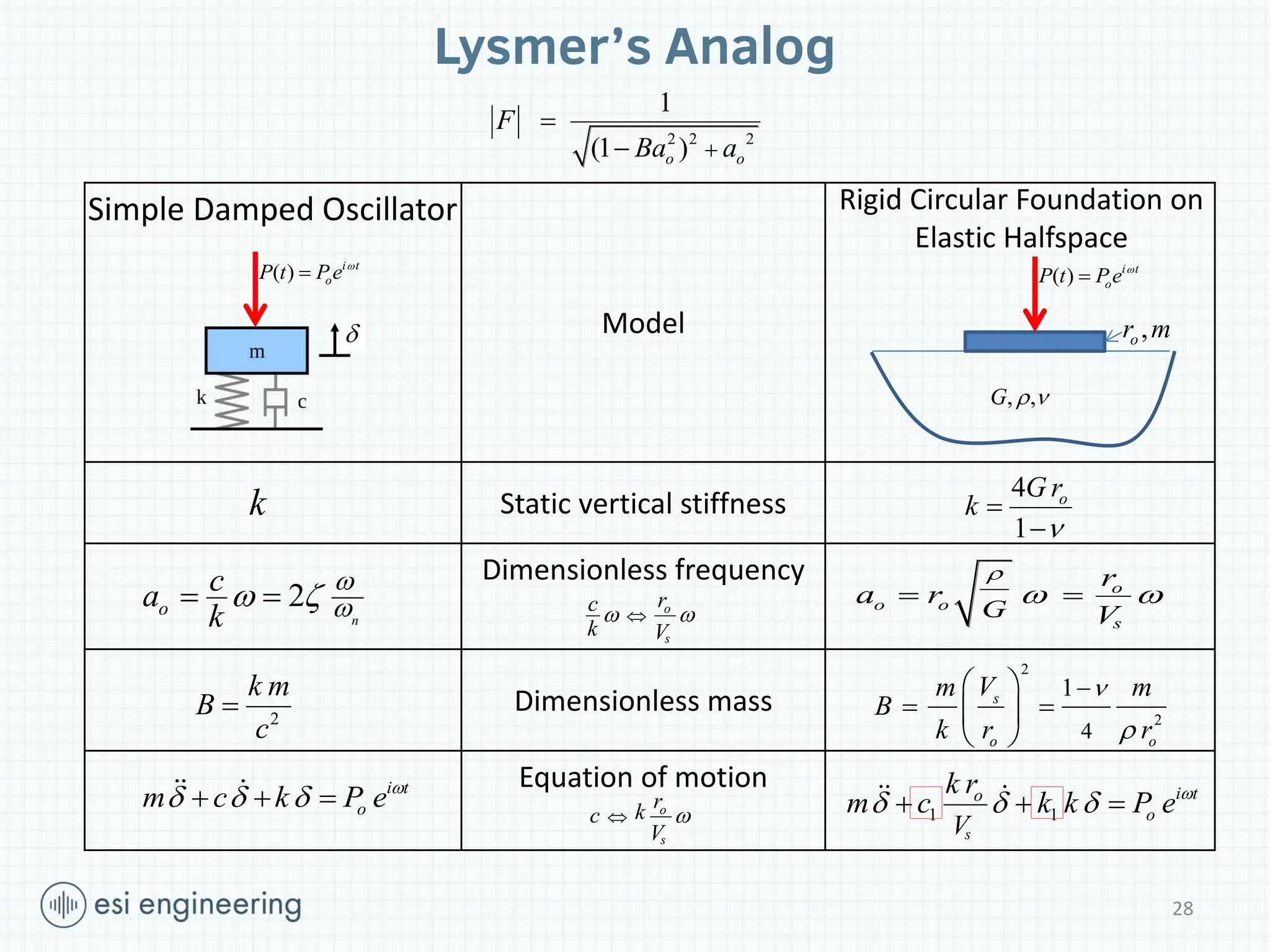
Lysmer’s Analog
( )
i t
P
F e
k


 
1 2
( ) ( ) ( )
i
F F F
  


F is a dimensionless displacement
function with real and imaginary parts
2
2 2 2 2
1
( )
(1 )
(1 ) (1 )
o o
o o o o
i
i
Ba a
F
Ba a Ba a


 

 
 
2 2 2
1
(1 )
o o
M F
Ba a

 

Textbook so far, but with slightly
unfamiliar notation
( ) i t
o
P t Pe 


Magnification Factor
2
n
o
c
a
k


 
 
2
k m
B
c

Introducing the dimensionless ratios
27
Model
Static vertical stiffness
Dimensionless frequency
Dimensionless mass
Equation of motion
Lysmer’s Analog
Simple Damped Oscillator
2
n
o
c
a
k


 
 
2 2 2
1
(1 )
o o
F
Ba a



2
k m
B
c

4
1
o
G r
k



, ,
G  
,
o
r m
Rigid Circular Foundation on
Elastic Halfspace
o
o o
s
G
r
a r
V

 
 
2
2
4
1
s
o o
V
m m
B
k r r



 
 
 
 
k
( ) i t
o
P t Pe 

( ) i t
o
P t Pe 

1 1
s
i t
o
o
V
k r
m c k k P e
  
  
i t
o
m c k P e
  
  
o
s
r
c
k V
 

o
s
r
k
c
V


28

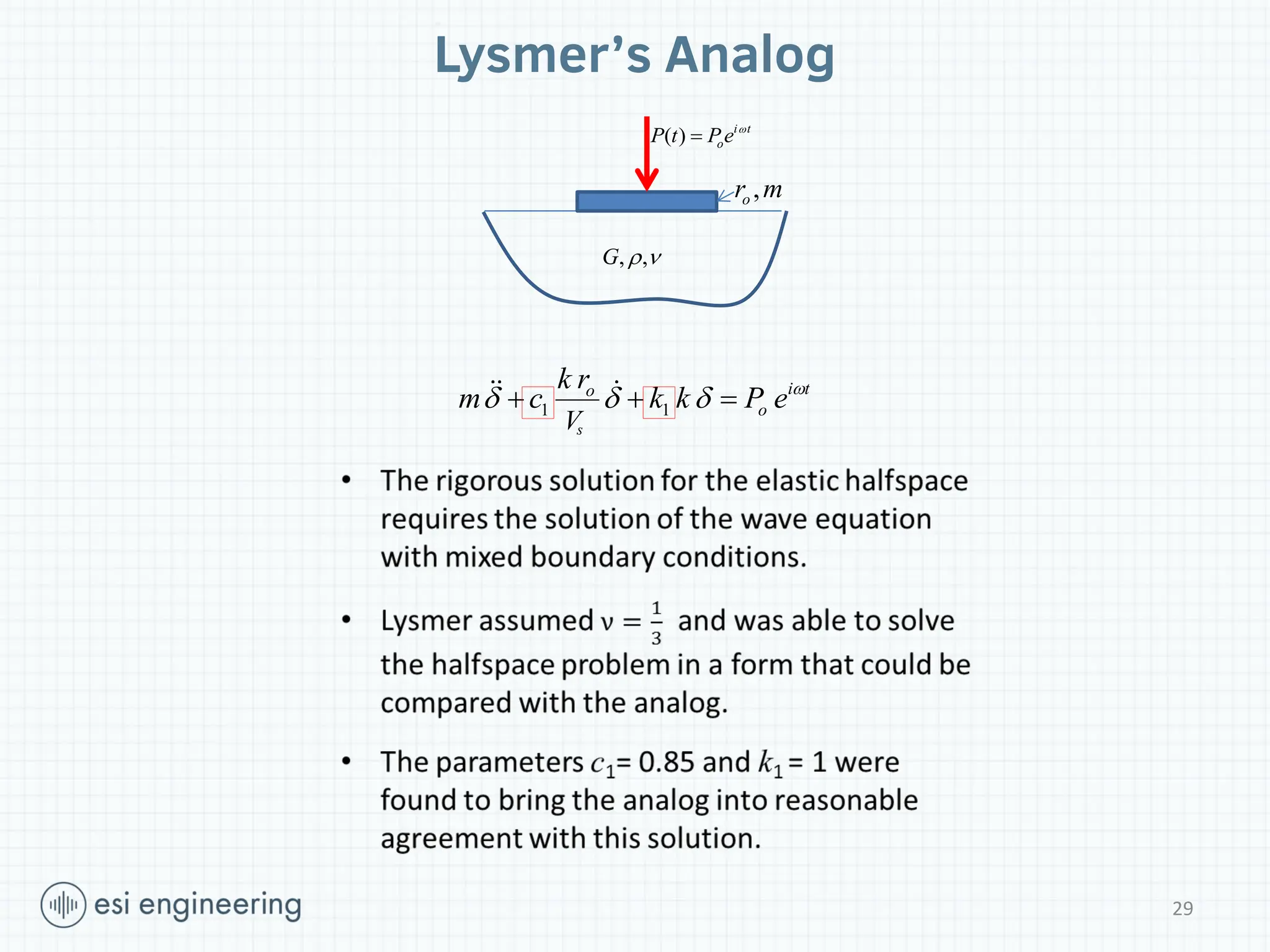
Lysmer’s Analog
, ,
G  
,
o
r m
( ) i t
o
P t Pe 

1 1
s
i t
o
o
V
k r
m c k k P e
  
  
29
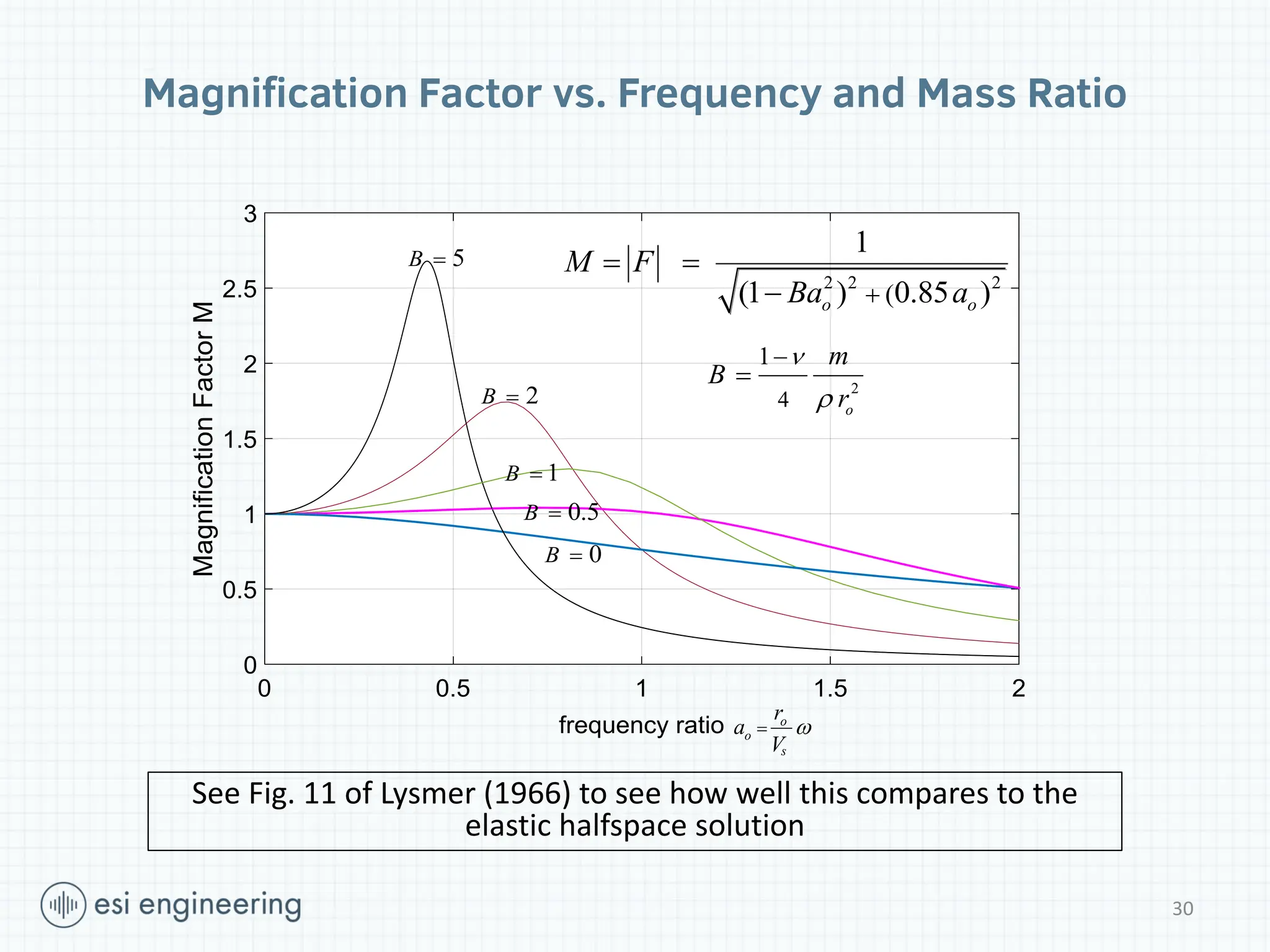
Magnification Factor vs. Frequency and Mass Ratio
2 2 2
(
1
(1 ) 0.85 )
o o
M F
Ba a

 

o
o
s
r
a
V


2
4
1
o
m
B
r




0.5
B 
0
B 
1
B 
5
B 
2
B 
See Fig. 11 of Lysmer (1966) to see how well this compares to the
elastic halfspace solution
30
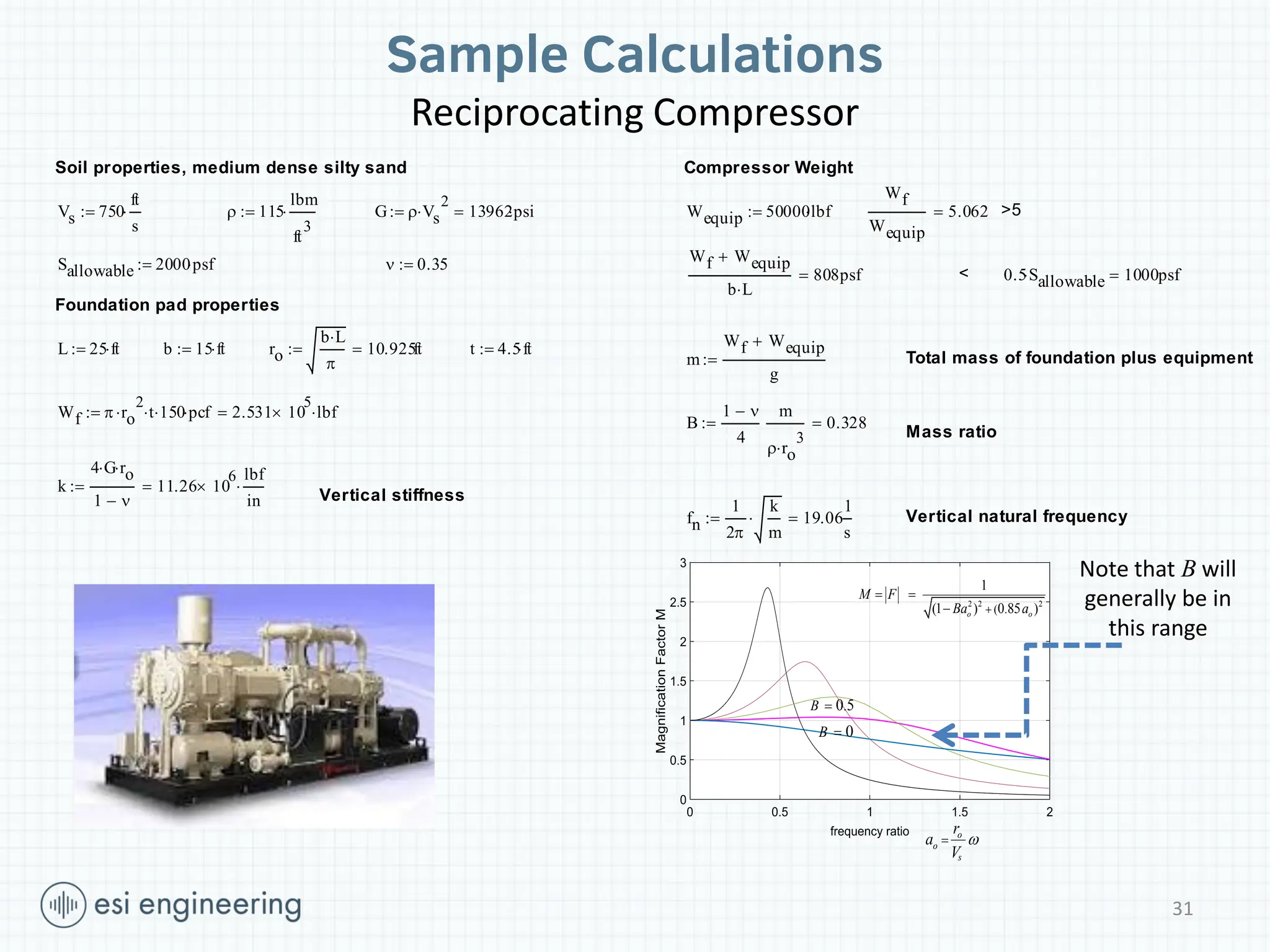
Sample Calculations
Reciprocating Compressor
o
o
s
r
a
V


2 2 2
(
1
(1 ) 0.85 )
o o
M F
Ba a

 

0.5
B 
0
B 
Note that B will
generally be in
this range
Soil properties, medium dense silty sand
Vs 750
ft
s

  115
lbm
ft
3

 G  Vs
2
 13962psi



Sallowable 2000psf

  0.35

Foundation pad properties
L 25 ft

 b 15 ft

 ro
b L


10.925ft

 t 4.5ft


Wf  ro
2
 t
 150
 pcf
 2.531 10
5
 lbf



k
4 G
 ro

1 

11.26 10
6

lbf
in



Vertical stiffness
Compressor Weight
Wequip 50000lbf


Wf
Wequip
5.062
 >5
Wf Wequip

b L

808psf
 < 0.5Sallowable
 1000psf

m
Wf Wequip

g
 Total mass of foundation plus equipment
B
1 

4
m
 ro
3

0.328


Mass ratio
fn
1
2
k
m
 19.06
1
s

 Vertical natural frequency
31
Sample Calculations
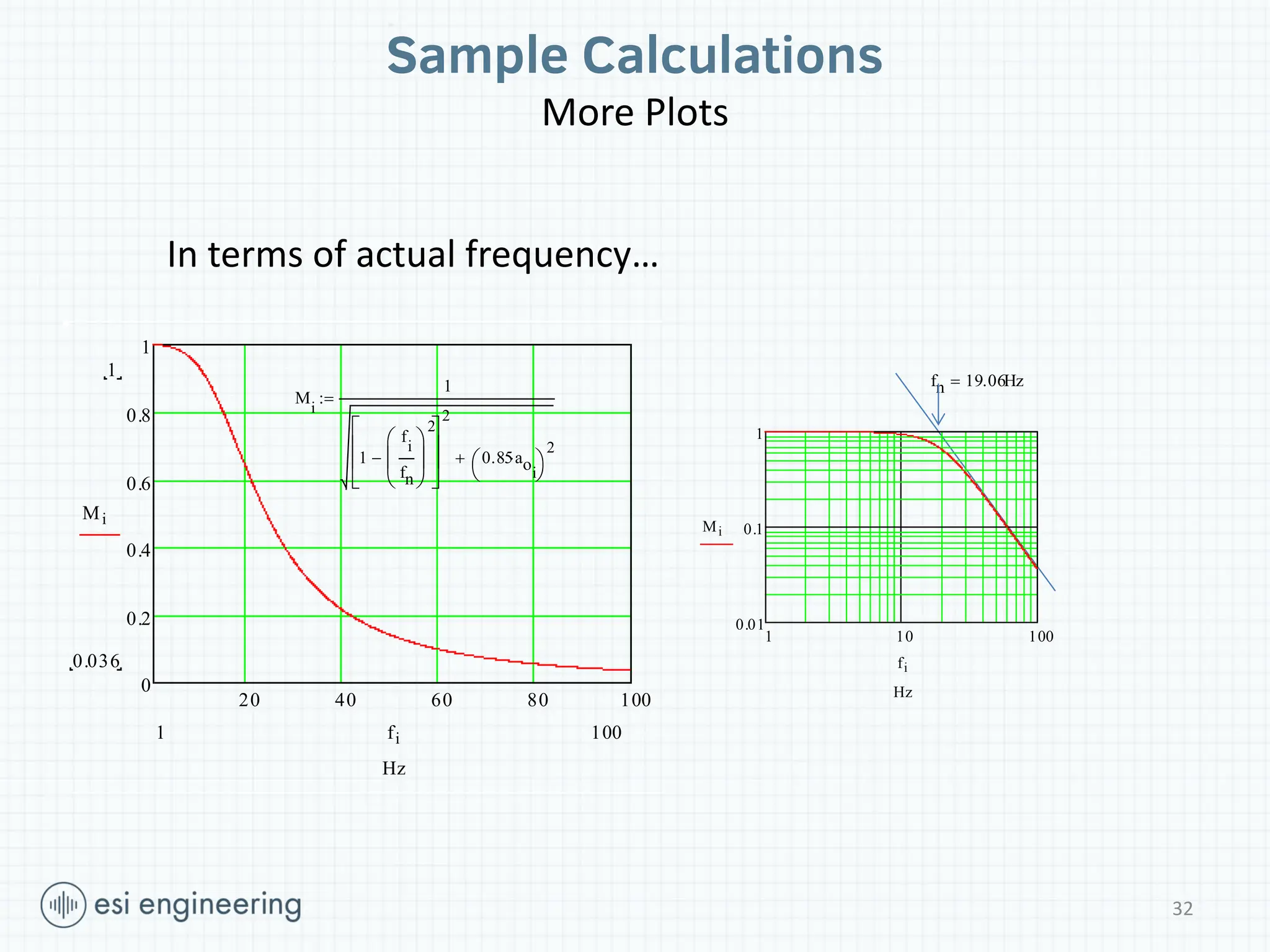
More Plots
20 40 60 80 100
0
0.2
0.4
0.6
0.8
1
1
0.036
Mi
100
1 fi
Hz
1 10 100
0.01
0.1
1
Mi
fi
Hz
M
i
1
1
f
i
fn








2









2
0.85aoi





2


fn 19.06Hz

In terms of actual frequency…
32
Sample Calculations
o
P
M
k
 
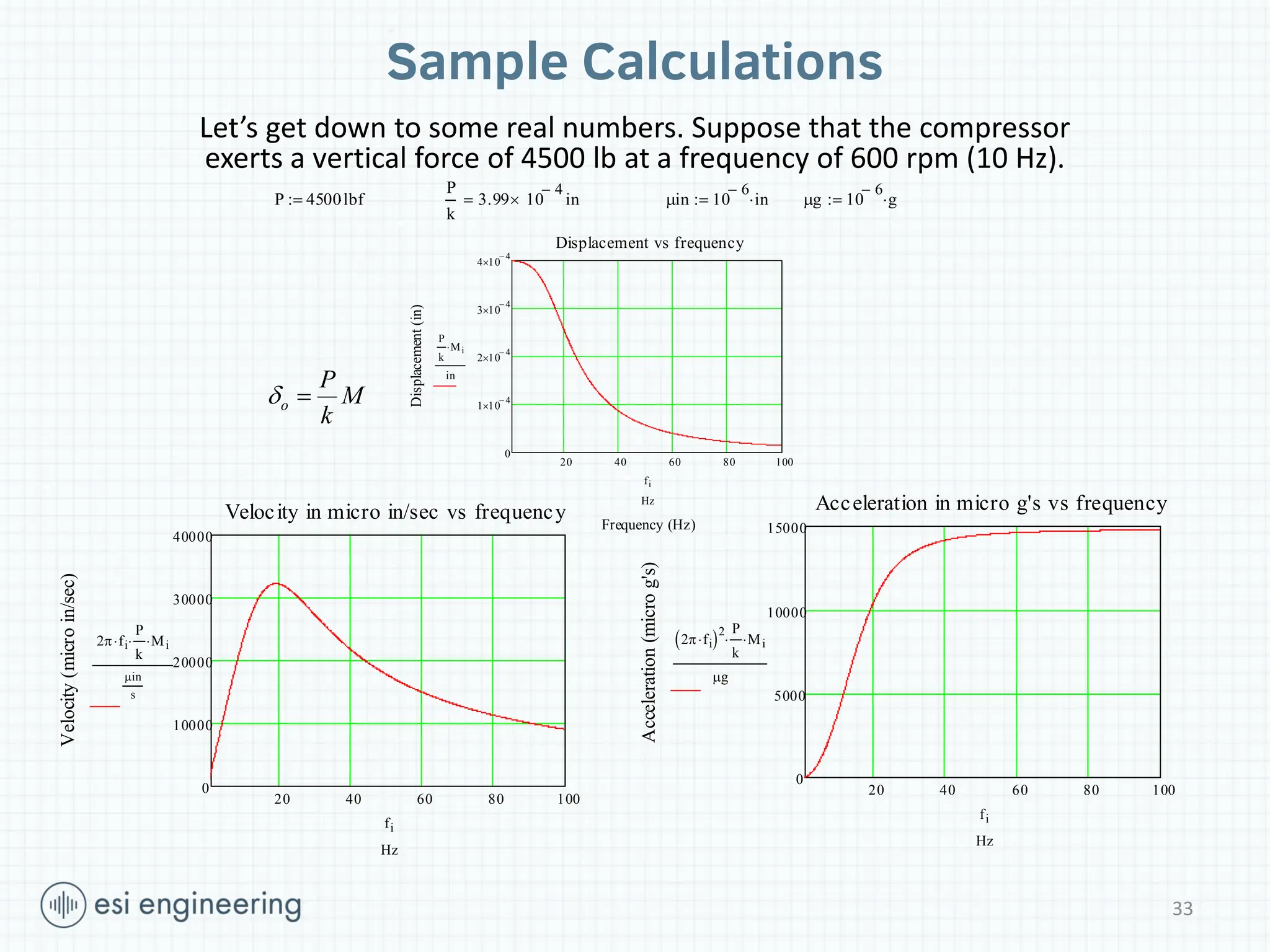
Let’s get down to some real numbers. Suppose that the compressor
exerts a vertical force of 4500 lb at a frequency of 600 rpm (10 Hz).
P 4500lbf


P
k
3.99 10
4

 in
 in 10
6

in

 g 10
6

g


20 40 60 80 100
0
1 10
4


2 10
4


3 10
4


4 10
4


Displacement vs frequency
Frequency (Hz)
Displacement
(in)
P
k
Mi

in
fi
Hz
20 40 60 80 100
0
10000
20000
30000
40000
Velocity in micro in/sec vs frequency
Velocity
(micro
in/sec)
2 fi

P
k
 Mi

in
s
fi
Hz
20 40 60 80 100
0
5000
10000
15000
Acceleration in micro g's vs frequency
Acceleration
(micro
g's)
2 fi

 2 P
k
 Mi

g
fi
Hz
33
Sample Calculations
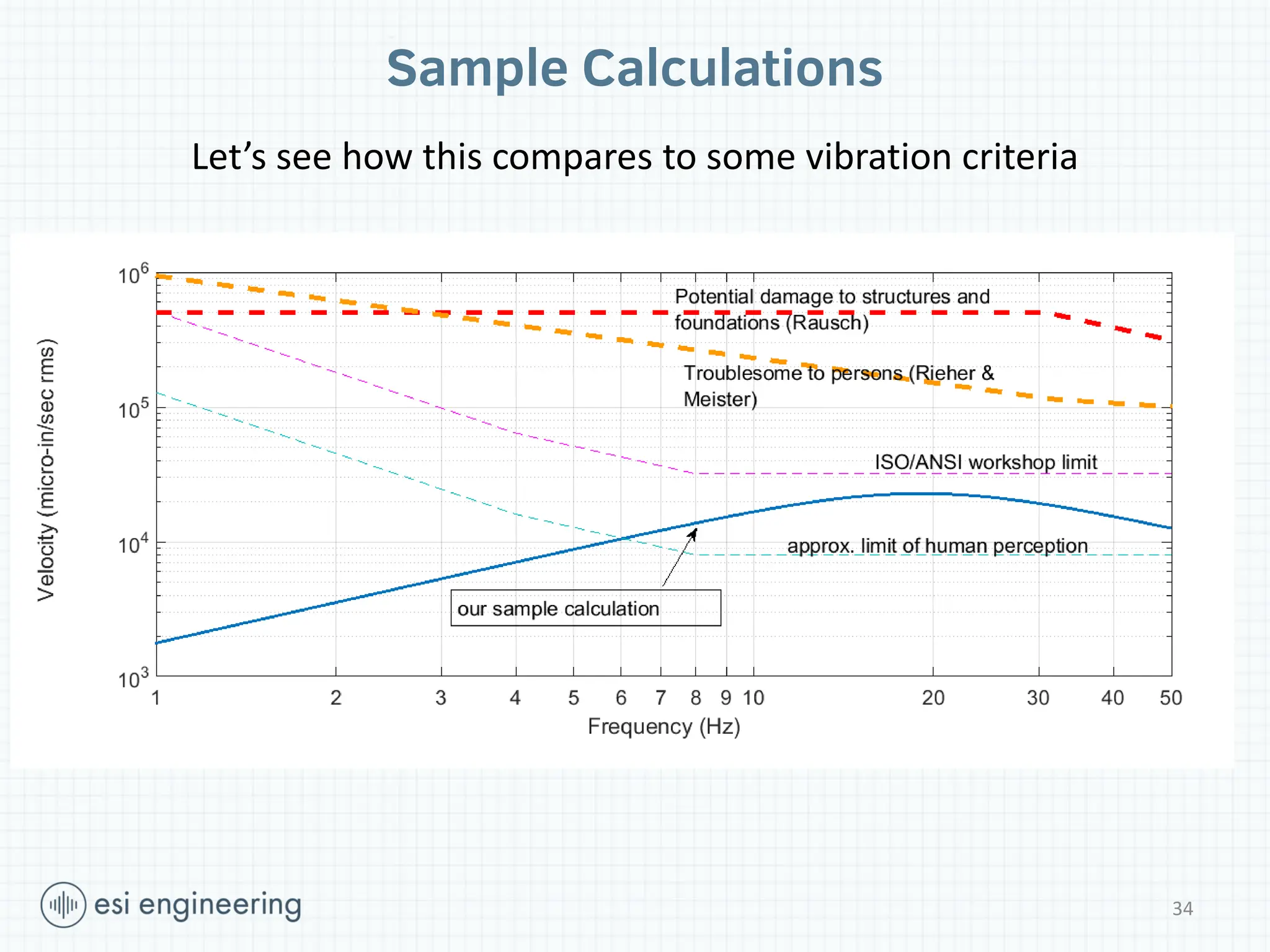
Let’s see how this compares to some vibration criteria
34
Sample Calculations
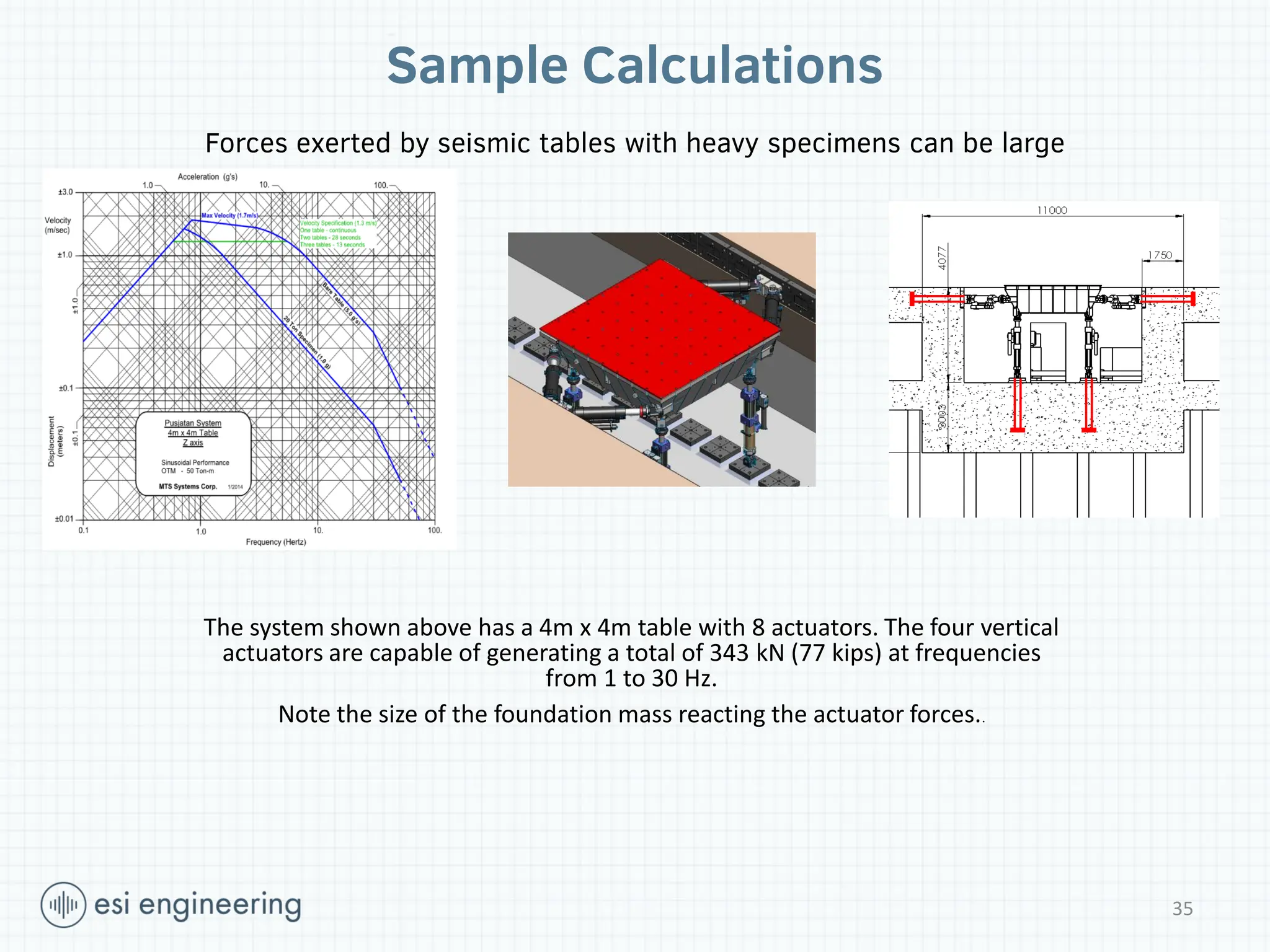
Forces exerted by seismic tables with heavy specimens can be large
The system shown above has a 4m x 4m table with 8 actuators. The four vertical
actuators are capable of generating a total of 343 kN (77 kips) at frequencies
from 1 to 30 Hz.
Note the size of the foundation mass reacting the actuator forces..
35
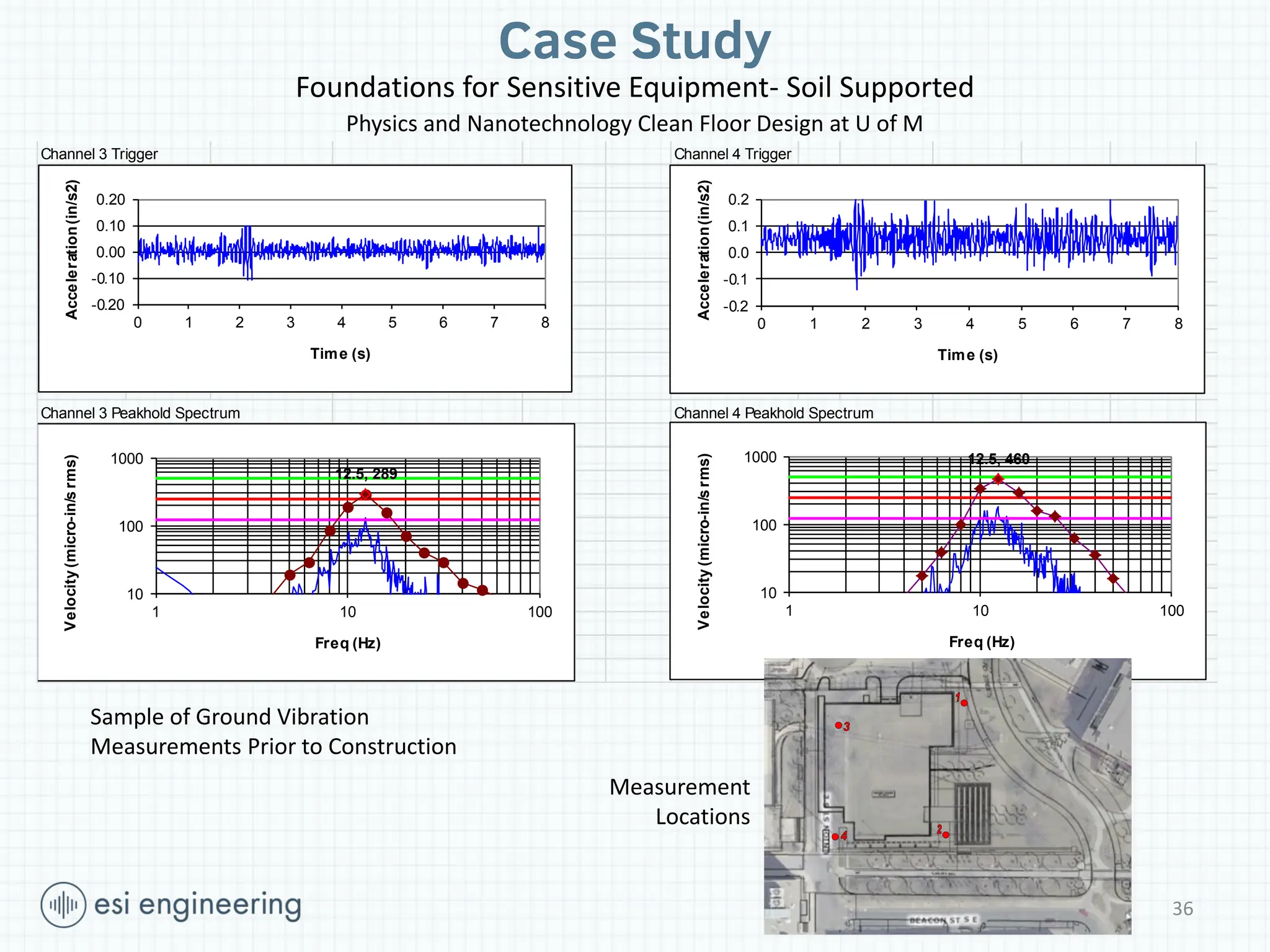
Case Study
Foundations for Sensitive Equipment- Soil Supported
Physics and Nanotechnology Clean Floor Design at U of M
Project / Location: P1721- U of M Physics & Nanotech Building Measurement ID: File: TEST004.AE2 Record Date and Time :12/20/2010 1:35:53 PM
Date: 20-Dec-10 Channel 3: Sidewalk NW corner
Conditions: Delivery truck leaving by CH 4 Channel 4: Asphalt SW corner
Setup: 90%overlap, hanning window, delta f = 0.125 Hz Vibration Criteria VC-C (green), VC-D, VC-E
Channel 3 Trigger Channel 4 Trigger
Channel 3 Peakhold Spectrum Channel 4 Peakhold Spectrum
-0.20
-0.10
0.00
0.10
0.20
0 1 2 3 4 5 6 7 8
Acceleration
(in/s2)
Time (s)
-0.2
-0.1
0.0
0.1
0.2
0 1 2 3 4 5 6 7 8
Acceleration
(in/s2)
Time (s)
12.5, 289
10
100
1000
1 10 100
Velocity
(micro-in/s
rms)
Freq (Hz)
12.5, 460
10
100
1000
1 10 100
Velocity
(micro-in/s
rms)
Freq (Hz)
36
Measurement
Locations
Sample of Ground Vibration
Measurements Prior to Construction
N
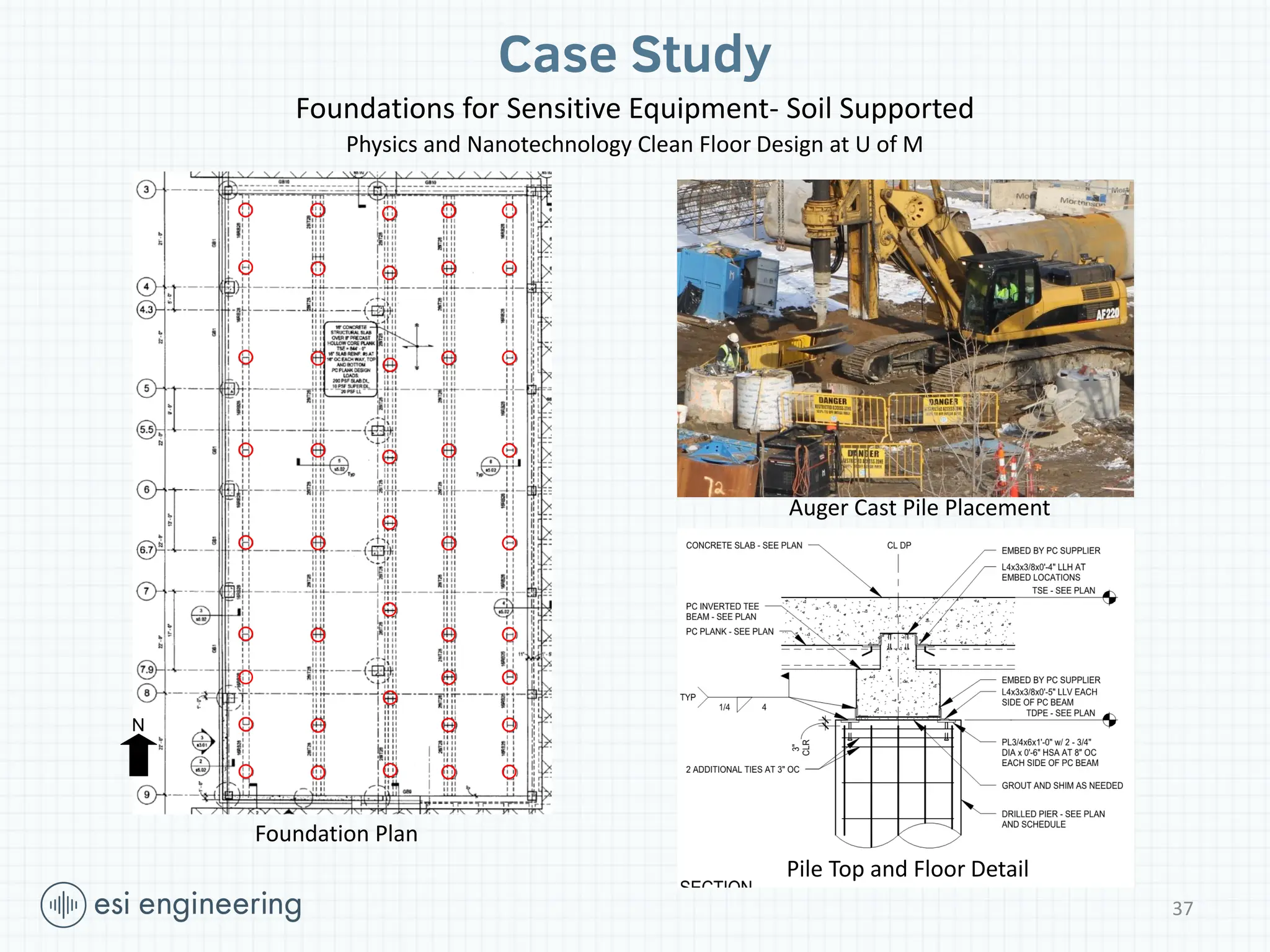
37
Case Study
Foundations for Sensitive Equipment- Soil Supported
Physics and Nanotechnology Clean Floor Design at U of M
Auger Cast Pile Placement
Pile Top and Floor Detail
Foundation Plan
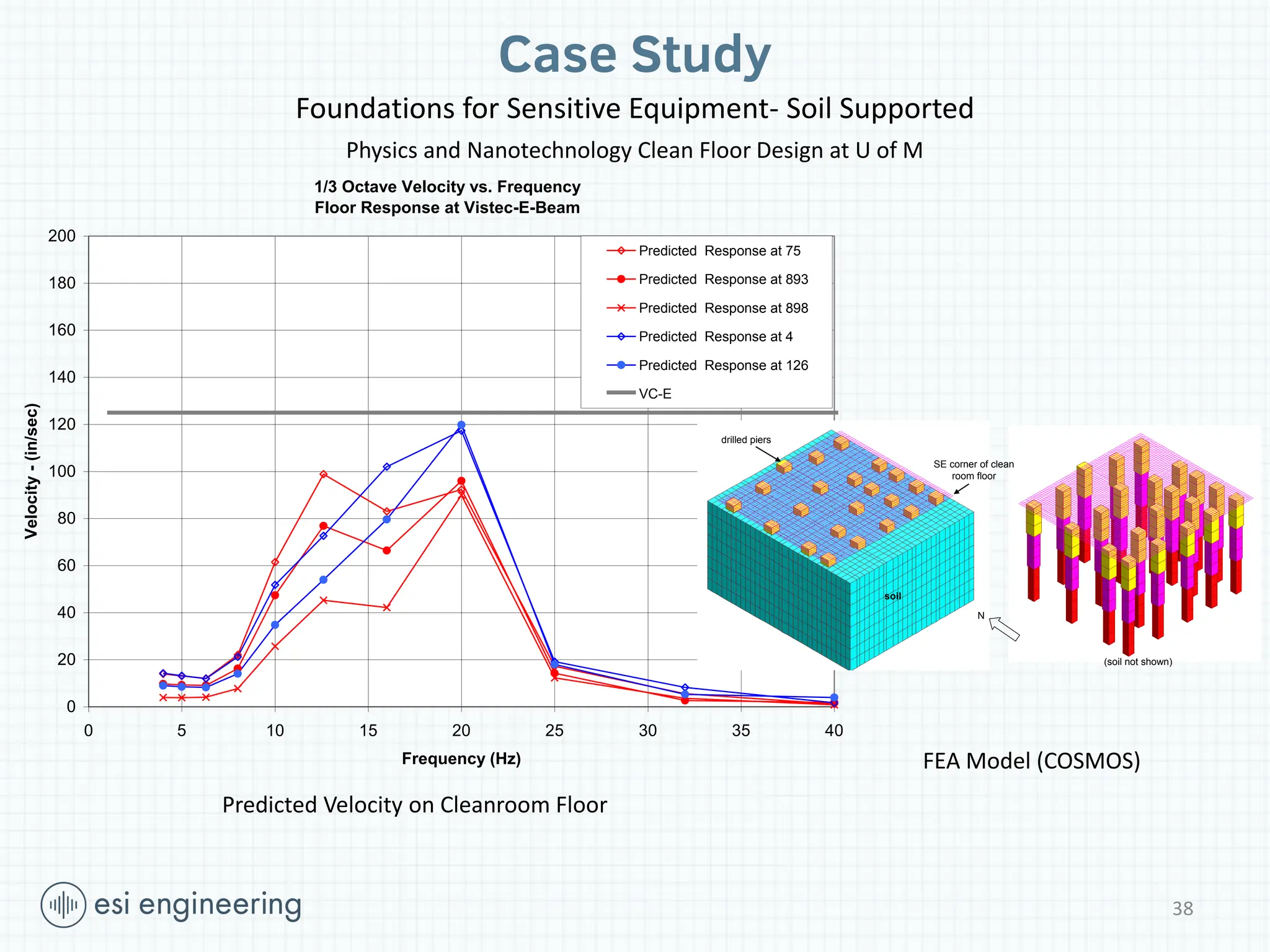
1/3 Octave Velocity vs. Frequency
Floor Response at Vistec-E-Beam
0
20
40
60
80
100
120
140
160
180
200
0 5 10 15 20 25 30 35 40
Frequency (Hz)
Velocity
-
(in/sec)
Predicted Response at 75
Predicted Response at 893
Predicted Response at 898
Predicted Response at 4
Predicted Response at 126
VC-E
38
SE corner of clean
room floor
soil
drilled piers
(soil not shown)
N
Case Study
Foundations for Sensitive Equipment- Soil Supported
Physics and Nanotechnology Clean Floor Design at U of M
Predicted Velocity on Cleanroom Floor
FEA Model (COSMOS)
ACI Committee 351 –
Foundations for Equipment and Machinery
Active Committee Documents:
• 351.1R-12: Report on Grouting between Foundations and Bases for Support of Equipment and
Machinery
• 351.2R-10: Report on Foundations for Static Equipment
• 351.3R-04: Foundations for Dynamic Equipment
• 351.4-14: Specification for Installation of Cementitious Grouting between Foundations and
Equipment Bases
• 351.5-15 Specification for Installation of Epoxy Grout between Foundations and Equipment Bases
Documents Under Development:
• 351.3R: Foundations for Dynamic Equipment
• 351.4M-14: Specification for Installation of Cementitious Grouting between Foundations and
Equipment Bases
• 351.5M-15: Specification for Installation of Epoxy Grouting between Foundations and Equipment
Bases
39
Wrap Up
Important Topics We Have Not Talked About Today
Rotational and Horizontal Modes
Embedment Effects
Strength Requirements
Anchorage
Numerical Methods/Software
Questions?
Thank you for inviting us!
40
UMN_Dynamic_Foundations dynamic and sensitive equipments.pdf

  • 1.
    Foundations for Dynamicand Sensitive Equipment University of Minnesota - Structures Seminar October 30, 2015 Carl Nelson, Ph.D., P.E. Tony Baxter, P.E.
  • 2.
    2 ESI’s History Our rootsgo back to a group of professors and graduate students at the U of M in the 1960’s
  • 3.
    3 Who We AreToday!  Minnesota based consulting engineering firm since 1970  Provide specialized engineering services  Specialists in high force/shock, vibration and noise control From small medical devices and consumer products to sensitive buildings and large industrial facilities, ESI helps clients with advanced analysis and design. Our professional engineering services are focused in the areas of structural dynamics and design, vibration control, noise and acoustics, and monitoring.
  • 4.
  • 5.
    5 High Force Structuresand Foundations
  • 6.
  • 7.
    Vibration Analysis forHealthcare, Manufacturing and Research 7
  • 8.
    Recent Projects atU of M Rec Center Expansion Cancer and Cardio Research Building Physics and Nanotechnology Cleanroom Northrop Balconies SE corner of clean room floor soil drilled piers (soil not shown) N 8
  • 9.
    What we willtalk about today 1. Types of Foundations for Equipment • Foundations for Sources • Foundations for Receivers 2. Vibration Control Methods for Foundations • In ground – Viper Example (Source), Physics & Nanotechnology Cleanroom Floor Example (Receiver) • Isolated – Toyota Example 3. Technical Discussion of Dynamic Foundation in Soil • Model, Equations • Example Calculations and Recommendations 4. References – ACI Committee 351, Books 5. Closing & Questions 9
  • 10.
    Types of Foundations ForEquipment 1. Not Dynamic (Inertial Forces are Not Significant) 2. Foundations for Dynamic Sources a) Isolated b) On ground 3. Foundations for Sensitive Receivers a) Isolated b) On ground Sources Receiver 10 ?
  • 11.
    Foundation Types - notdynamic - Not Dynamic (Inertial Forces are Not Significant) Multi-Axial Subassembly Testing (MAST) Laboratory 11 React forces, provide a stable base and maintain alignment
  • 12.
    Foundations For DynamicSources 12 • React forces • Provide a stable base and maintain alignment • Minimize motion, on and off foundation
  • 13.
    13 Sensitive Receiver K1 C1 M1 X1 Xg Foundation Soil Foundationin Soil 2 MW Generator Foundation Soil K1 C1 M1 X1 Xg Foundation Soil K2 M2 C2 X2 F2( Press Tub and Soil Press and foundation Tub and soil Foundation Dynamic Source Foundation in Ground Isolated Foundation
  • 14.
    The Concept ofTransmissibility 0.00001 0.0001 0.001 0.01 0.1 1 10 100 0 1 10 100 Force Out/Force In f/fn Force Transmissibility 0 0.01 0.05 0.1 0.2 0.5 1 2 Fraction of Critical Damping F Fground xground / ground T F F  / ground T x x  Transmissibility applies (exactly the same equation!) to both source force transmissibility and receiver displacement transmissibility Receiver Source 14
  • 15.
    Foundations for DynamicSources actuators Test item Soil Supported Viper Test Rig at Virginia International Speedway 15
  • 16.
    16 Foundations for DynamicSources Soil Supported Viper Test Rig at Virginia International Speedway
  • 17.
    17 Foundations for DynamicSources Air Mount Isolated with Foundation
  • 18.
  • 19.
    19 High force Mass Air Springs -Attenuated force transmitted to foundation - Minimize motion at actuator base Foundation Isolation with Air Mounts
  • 20.
    Soil Supported Foundationsfor Sensitive Receiver Overview of Concepts 20 Engineered Fill Slab 1. Simple Thick Slab on Ground – Wavelength Effect 2. Isolated Slab for Electron Microscopy Center - Shepherd Laboratories Bedrock Sand Thick Slab Criteria 125 u"/s --- Measured > 300 u"/s Tall “Isolated” Caissons Slab-on-Grade Typical Wavelength = 50 - 100 ft Bedrock Sand Auger Cast Piles 3. Physics and Nanotechnology Cleanroom – U of M Air Space Floor Structure Criteria 125 u"/s --- Measured ~ 100 u"/s
  • 21.
    Foundations for SensitiveEquipment Isolated with Various Types of Isolators Sensitive Equipment Isolation Techniques Air Mounts (<2 Hz) Steel Springs (2-5 Hz) Resilient Pad or Sheets (>6 Hz) Entire Building Isolation Drachen-Center Basel Switzerland 21
  • 22.
    22 Rigid Foundation onElastic Halfspace under harmonic loading , , G   , o r m ( ) i t o P t Pe   What do all these foundations have in common?
  • 23.
    Two Minutes onElastic Wave Propagation P Waves – Compression (fastest) S Waves – Shear Rayleigh Waves – Speed close to that of S waves Amplitude decreases with Accounts for 2/3 of the energy (See Figure 3-16 on p. 91 in Richart, Hall, and Woods) s G V   2 P G V     1 r (1 )(1 2 ) E        23
  • 24.
    24 24 Predicting Vibration VersusDistance 0 15 30 45 60 75 90 105 120 0 0.02 0.04 0.06 0.08 0.1 0.12 LRT Vibration Amplitude vs. Distance Dista nce - Fe et Vibration Amplitude - I nches/second .12 0.002 . z( ) r 12 . z g( ) r 12 . z lim 12 120 5 r Geometric Damping Only: z g( ) r . z 1 r 1 r Geometric & Material Damping: z( ) r . . z 1 r 1 r exp .  r r 1
  • 25.
    Early Boussinesq (1885), Lamb(1904) – static, dynamic load on the surface of elastic halfspace Riessner (1936) – Dynamically loaded, rigid circular foundation on elastic halfspace Lysmer and Richart – “Dynamic Response of Footings to Vertical Loading,” ASCE Journal of the Soil Mechanics and Foundations Division, January 1966. “Lysmer’s Analog” Numerical Methods Many Contributors – FEA, Boundary Element Method Beskos and Co-Workers and the University of Minnesota (1970s-80s) Some History Development of Techniques 25
  • 26.
    Winkler Foundation Plateon Elastic Halfspace Rigid Plate on Elastic Halfspace Lysmer’s Analogue (1966) Complicated! Still Complicated! But… Approaches to the Dynamic Foundation Problem 26
  • 27.
    Lysmer’s Analog ( ) it P F e k     1 2 ( ) ( ) ( ) i F F F      F is a dimensionless displacement function with real and imaginary parts 2 2 2 2 2 1 ( ) (1 ) (1 ) (1 ) o o o o o o i i Ba a F Ba a Ba a          2 2 2 1 (1 ) o o M F Ba a     Textbook so far, but with slightly unfamiliar notation ( ) i t o P t Pe    Magnification Factor 2 n o c a k       2 k m B c  Introducing the dimensionless ratios 27
  • 28.
    Model Static vertical stiffness Dimensionlessfrequency Dimensionless mass Equation of motion Lysmer’s Analog Simple Damped Oscillator 2 n o c a k       2 2 2 1 (1 ) o o F Ba a    2 k m B c  4 1 o G r k    , , G   , o r m Rigid Circular Foundation on Elastic Halfspace o o o s G r a r V      2 2 4 1 s o o V m m B k r r            k ( ) i t o P t Pe   ( ) i t o P t Pe   1 1 s i t o o V k r m c k k P e       i t o m c k P e       o s r c k V    o s r k c V   28 
  • 29.
    Lysmer’s Analog , , G  , o r m ( ) i t o P t Pe   1 1 s i t o o V k r m c k k P e       29
  • 30.
    Magnification Factor vs.Frequency and Mass Ratio 2 2 2 ( 1 (1 ) 0.85 ) o o M F Ba a     o o s r a V   2 4 1 o m B r     0.5 B  0 B  1 B  5 B  2 B  See Fig. 11 of Lysmer (1966) to see how well this compares to the elastic halfspace solution 30
  • 31.
    Sample Calculations Reciprocating Compressor o o s r a V   22 2 ( 1 (1 ) 0.85 ) o o M F Ba a     0.5 B  0 B  Note that B will generally be in this range Soil properties, medium dense silty sand Vs 750 ft s    115 lbm ft 3   G  Vs 2  13962psi    Sallowable 2000psf    0.35  Foundation pad properties L 25 ft   b 15 ft   ro b L   10.925ft   t 4.5ft   Wf  ro 2  t  150  pcf  2.531 10 5  lbf    k 4 G  ro  1   11.26 10 6  lbf in    Vertical stiffness Compressor Weight Wequip 50000lbf   Wf Wequip 5.062  >5 Wf Wequip  b L  808psf  < 0.5Sallowable  1000psf  m Wf Wequip  g  Total mass of foundation plus equipment B 1   4 m  ro 3  0.328   Mass ratio fn 1 2 k m  19.06 1 s   Vertical natural frequency 31
  • 32.
    Sample Calculations More Plots 2040 60 80 100 0 0.2 0.4 0.6 0.8 1 1 0.036 Mi 100 1 fi Hz 1 10 100 0.01 0.1 1 Mi fi Hz M i 1 1 f i fn         2          2 0.85aoi      2   fn 19.06Hz  In terms of actual frequency… 32
  • 33.
    Sample Calculations o P M k   Let’sget down to some real numbers. Suppose that the compressor exerts a vertical force of 4500 lb at a frequency of 600 rpm (10 Hz). P 4500lbf   P k 3.99 10 4   in  in 10 6  in   g 10 6  g   20 40 60 80 100 0 1 10 4   2 10 4   3 10 4   4 10 4   Displacement vs frequency Frequency (Hz) Displacement (in) P k Mi  in fi Hz 20 40 60 80 100 0 10000 20000 30000 40000 Velocity in micro in/sec vs frequency Velocity (micro in/sec) 2 fi  P k  Mi  in s fi Hz 20 40 60 80 100 0 5000 10000 15000 Acceleration in micro g's vs frequency Acceleration (micro g's) 2 fi   2 P k  Mi  g fi Hz 33
  • 34.
    Sample Calculations Let’s seehow this compares to some vibration criteria 34
  • 35.
    Sample Calculations Forces exertedby seismic tables with heavy specimens can be large The system shown above has a 4m x 4m table with 8 actuators. The four vertical actuators are capable of generating a total of 343 kN (77 kips) at frequencies from 1 to 30 Hz. Note the size of the foundation mass reacting the actuator forces.. 35
  • 36.
    Case Study Foundations forSensitive Equipment- Soil Supported Physics and Nanotechnology Clean Floor Design at U of M Project / Location: P1721- U of M Physics & Nanotech Building Measurement ID: File: TEST004.AE2 Record Date and Time :12/20/2010 1:35:53 PM Date: 20-Dec-10 Channel 3: Sidewalk NW corner Conditions: Delivery truck leaving by CH 4 Channel 4: Asphalt SW corner Setup: 90%overlap, hanning window, delta f = 0.125 Hz Vibration Criteria VC-C (green), VC-D, VC-E Channel 3 Trigger Channel 4 Trigger Channel 3 Peakhold Spectrum Channel 4 Peakhold Spectrum -0.20 -0.10 0.00 0.10 0.20 0 1 2 3 4 5 6 7 8 Acceleration (in/s2) Time (s) -0.2 -0.1 0.0 0.1 0.2 0 1 2 3 4 5 6 7 8 Acceleration (in/s2) Time (s) 12.5, 289 10 100 1000 1 10 100 Velocity (micro-in/s rms) Freq (Hz) 12.5, 460 10 100 1000 1 10 100 Velocity (micro-in/s rms) Freq (Hz) 36 Measurement Locations Sample of Ground Vibration Measurements Prior to Construction
  • 37.
    N 37 Case Study Foundations forSensitive Equipment- Soil Supported Physics and Nanotechnology Clean Floor Design at U of M Auger Cast Pile Placement Pile Top and Floor Detail Foundation Plan
  • 38.
    1/3 Octave Velocityvs. Frequency Floor Response at Vistec-E-Beam 0 20 40 60 80 100 120 140 160 180 200 0 5 10 15 20 25 30 35 40 Frequency (Hz) Velocity - (in/sec) Predicted Response at 75 Predicted Response at 893 Predicted Response at 898 Predicted Response at 4 Predicted Response at 126 VC-E 38 SE corner of clean room floor soil drilled piers (soil not shown) N Case Study Foundations for Sensitive Equipment- Soil Supported Physics and Nanotechnology Clean Floor Design at U of M Predicted Velocity on Cleanroom Floor FEA Model (COSMOS)
  • 39.
    ACI Committee 351– Foundations for Equipment and Machinery Active Committee Documents: • 351.1R-12: Report on Grouting between Foundations and Bases for Support of Equipment and Machinery • 351.2R-10: Report on Foundations for Static Equipment • 351.3R-04: Foundations for Dynamic Equipment • 351.4-14: Specification for Installation of Cementitious Grouting between Foundations and Equipment Bases • 351.5-15 Specification for Installation of Epoxy Grout between Foundations and Equipment Bases Documents Under Development: • 351.3R: Foundations for Dynamic Equipment • 351.4M-14: Specification for Installation of Cementitious Grouting between Foundations and Equipment Bases • 351.5M-15: Specification for Installation of Epoxy Grouting between Foundations and Equipment Bases 39
  • 40.
    Wrap Up Important TopicsWe Have Not Talked About Today Rotational and Horizontal Modes Embedment Effects Strength Requirements Anchorage Numerical Methods/Software Questions? Thank you for inviting us! 40