Software Testing
Inam Ul Haq
OOA/D, BSIT
Inam.bth@gmail.com
Guest Lecture
OOA/D, BSIT-5th, Univesity of
Education Okara
1
Observations about Testing
 “Testing is the process of executing a
program with the intention of finding
errors.” – Myers
 “Testing can show the presence of bugs
but never their absence.” - Dijkstra
OOA/D, BSIT-5th, Univesity of
Education Okara
2
Good Testing Practices
 A good test case is one that has a high
probability of detecting an undiscovered
defect, not one that shows that the
program works correctly
 It is impossible to test your own program
 A necessary part of every test case is a
description of the expected result
OOA/D, BSIT-5th, Univesity of
Education Okara
3
Good Testing Practices (cont’d)
 Avoid nonreproducible or on-the-fly testing
 Write test cases for valid as well as invalid input
conditions.
 Thoroughly inspect the results of each test case
 As the number of detected defects in a piece of
software increases, the probability of the
existence of more undetected defects also
increases
OOA/D, BSIT-5th, Univesity of
Education Okara
4
Good Testing Practices (cont’d)
 Assign your best people to testing
 Ensure that testability is a key objective
in your software design
 Never alter the program to make testing
easier
 Testing, like almost every other activity,
must start with objectives
OOA/D, BSIT-5th, Univesity of
Education Okara
5
Levels of Testing
 Unit Testing
 Integration Testing
 Validation Testing
 Regression Testing
 Alpha Testing
 Beta Testing
 Acceptance Testing
OOA/D, BSIT-5th, Univesity of
Education Okara
6
Unit Testing
 Algorithms and logic
 Data structures (global and local)
 Interfaces
 Independent paths
 Boundary conditions
 Error handling
OOA/D, BSIT-5th, Univesity of
Education Okara
7
Why Integration Testing Is Necessary
 One module can have an adverse effect
on another
 Subfunctions, when combined, may not
produce the desired major function
 Individually acceptable imprecision in
calculations may be magnified to
unacceptable levels
OOA/D, BSIT-5th, Univesity of
Education Okara
8
Why Integration Testing Is Necessary (cont’d)
 Interfacing errors not detected in unit
testing may appear
 Timing problems (in real-time systems)
are not detectable by unit testing
 Resource contention problems are not
detectable by unit testing
OOA/D, BSIT-5th, Univesity of
Education Okara
9
Validation Testing
 Determine if the software meets all of the
requirements defined in the SRS
 Having written requirements is essential
 Regression testing is performed to determine if
the software still meets all of its requirements in
light of changes and modifications to the
software
 Regression testing involves selectively
repeating existing validation tests, not
developing new tests
OOA/D, BSIT-5th, Univesity of
Education Okara
10
Alpha and Beta Testing
 It’s best to provide customers with an
outline of the things that you would like
them to focus on and specific test
scenarios for them to execute.
 Provide with customers who are actively
involved with a commitment to fix defects
that they discover.
OOA/D, BSIT-5th, Univesity of
Education Okara
11
Acceptance Testing
 Similar to validation testing except that
customers are present or directly
involved.
 Usually the tests are developed by the
customer
OOA/D, BSIT-5th, Univesity of
Education Okara
12
Test Methods
 White box or glass box testing
 Black box testing
 Top-down and bottom-up for performing
incremental integration
 ALAC (Act-like-a-customer)
OOA/D, BSIT-5th, Univesity of
Education Okara
13
Test Types
 Functional tests
 Algorithmic tests
 Positive tests
 Negative tests
 Usability tests
 Boundary tests
 Startup/shutdown tests
 Platform tests
 Load/stress tests
OOA/D, BSIT-5th, Univesity of
Education Okara
14
Test Planning
 The Test Plan – defines the scope of the
work to be performed
 The Test Procedure – a container
document that holds all of the individual
tests (test scripts) that are to be
executed
 The Test Report – documents what
occurred when the test scripts were run
OOA/D, BSIT-5th, Univesity of
Education Okara
15
Test Plan
 Questions to be answered:
 How many tests are needed?
 How long will it take to develop those tests?
 How long will it take to execute those tests?
 Topics to be addressed:
 Test estimation
 Test development and informal validation
 Validation readiness review and formal validation
 Test completion criteria
OOA/D, BSIT-5th, Univesity of
Education Okara
16
Entrance Criteria for Formal
Validation Testing
 Software development is completed (a
precise definition of “completed” is required.
 The test plan has been reviewed, approved
and is under document control.
 A requirements inspection has been
performed on the SRS.
 Design inspections have been performed on
the SDDs (Software Design Descriptions).
OOA/D, BSIT-5th, Univesity of
Education Okara
17
Entrance Criteria for Formal
Validation Testing (cont’d)
 Code inspections have been performed on all
“critical modules”.
 All test scripts are completed and the
software validation test procedure document
has been reviewed, approved, and placed
under document control.
 Selected test scripts have been reviewed,
approved and placed under document
control.
OOA/D, BSIT-5th, Univesity of
Education Okara
18
Entrance Criteria for Formal
Validation Testing (cont’d)
 All test scripts have been executed at least
once.
 CM tools are in place and all source code is
under configuration control.
 Software problem reporting procedures are in
place.
 Validation testing completion criteria have
been developed, reviewed, and approved.
OOA/D, BSIT-5th, Univesity of
Education Okara
19
Exit Criteria for Validation
Testing
 All test scripts have been executed.
 All SPRs have been satisfactorily resolved.
(Resolution could include bugs being fixed,
deferred to a later release, determined not to
be bugs, etc.) All parties must agree to the
resolution. This criterion could be further
defined to state that all high-priority bugs
must be fixed while lower-priority bugs can be
handled on a case-by-case basis.
OOA/D, BSIT-5th, Univesity of
Education Okara
20
Exit Criteria for Validation
Testing (cont’d)
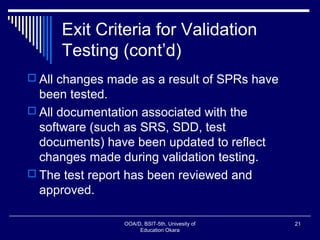
 All changes made as a result of SPRs have
been tested.
 All documentation associated with the
software (such as SRS, SDD, test
documents) have been updated to reflect
changes made during validation testing.
 The test report has been reviewed and
approved.
OOA/D, BSIT-5th, Univesity of
Education Okara
21
Test Estimation
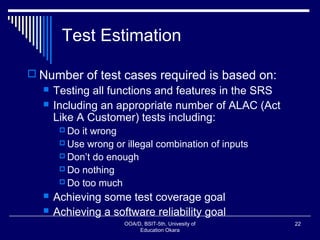
 Number of test cases required is based on:
 Testing all functions and features in the SRS
 Including an appropriate number of ALAC (Act
Like A Customer) tests including:
 Do it wrong
 Use wrong or illegal combination of inputs
 Don’t do enough
 Do nothing
 Do too much
 Achieving some test coverage goal
 Achieving a software reliability goal
OOA/D, BSIT-5th, Univesity of
Education Okara
22
Considerations in
Test Estimation
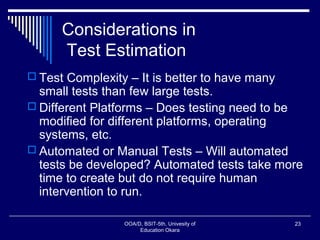
 Test Complexity – It is better to have many
small tests than few large tests.
 Different Platforms – Does testing need to be
modified for different platforms, operating
systems, etc.
 Automated or Manual Tests – Will automated
tests be developed? Automated tests take more
time to create but do not require human
intervention to run.
OOA/D, BSIT-5th, Univesity of
Education Okara
23
Estimating Tests Required
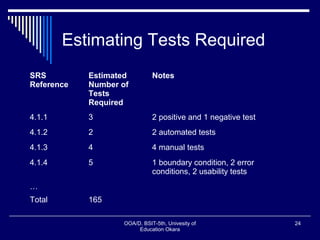
SRS
Reference
Estimated
Number of
Tests
Required
Notes
4.1.1 3 2 positive and 1 negative test
4.1.2 2 2 automated tests
4.1.3 4 4 manual tests
4.1.4 5 1 boundary condition, 2 error
conditions, 2 usability tests
…
Total 165
OOA/D, BSIT-5th, Univesity of
Education Okara
24
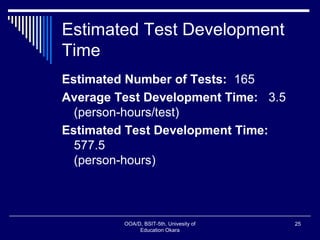
Estimated Test Development
Time
Estimated Number of Tests: 165
Average Test Development Time: 3.5
(person-hours/test)
Estimated Test Development Time:
577.5
(person-hours)
OOA/D, BSIT-5th, Univesity of
Education Okara
25
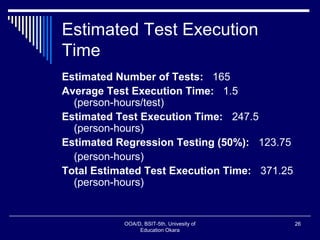
Estimated Test Execution
Time
Estimated Number of Tests: 165
Average Test Execution Time: 1.5
(person-hours/test)
Estimated Test Execution Time: 247.5
(person-hours)
Estimated Regression Testing (50%): 123.75
(person-hours)
Total Estimated Test Execution Time: 371.25
(person-hours)
OOA/D, BSIT-5th, Univesity of
Education Okara
26
Test Procedure
 Collection of test scripts
 An integral part of each test script is the
expected results
 The Test Procedure document should
contain an unexecuted, clean copy of
every test so that the tests may be more
easily reused
OOA/D, BSIT-5th, Univesity of
Education Okara
27
Test Report
 Completed copy of each test script with evidence
that it was executed (i.e., dated with the
signature of the person who ran the test)
 Copy of each SPR showing resolution
 List of open or unresolved SPRs
 Identification of SPRs found in each baseline
along with total number of SPRs in each baseline
 Regression tests executed for each software
baseline
OOA/D, BSIT-5th, Univesity of
Education Okara
28
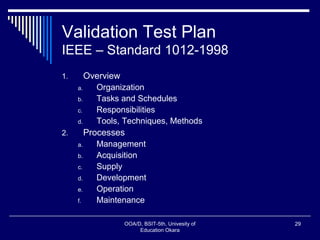
Validation Test Plan
IEEE – Standard 1012-1998
1. Overview
a. Organization
b. Tasks and Schedules
c. Responsibilities
d. Tools, Techniques, Methods
2. Processes
a. Management
b. Acquisition
c. Supply
d. Development
e. Operation
f. Maintenance
OOA/D, BSIT-5th, Univesity of
Education Okara
29
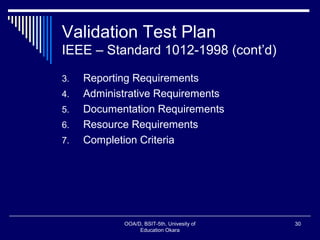
Validation Test Plan
IEEE – Standard 1012-1998 (cont’d)
3. Reporting Requirements
4. Administrative Requirements
5. Documentation Requirements
6. Resource Requirements
7. Completion Criteria
OOA/D, BSIT-5th, Univesity of
Education Okara
30
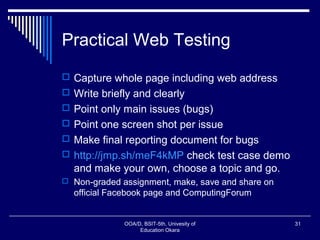
Practical Web Testing
 Capture whole page including web address
 Write briefly and clearly
 Point only main issues (bugs)
 Point one screen shot per issue
 Make final reporting document for bugs
 http://jmp.sh/meF4kMP check test case demo
and make your own, choose a topic and go.
 Non-graded assignment, make, save and share on
official Facebook page and ComputingForum
OOA/D, BSIT-5th, Univesity of
Education Okara
31

Software Testing

  • 1.
    Software Testing Inam UlHaq OOA/D, BSIT Inam.bth@gmail.com Guest Lecture OOA/D, BSIT-5th, Univesity of Education Okara 1
  • 2.
    Observations about Testing “Testing is the process of executing a program with the intention of finding errors.” – Myers  “Testing can show the presence of bugs but never their absence.” - Dijkstra OOA/D, BSIT-5th, Univesity of Education Okara 2
  • 3.
    Good Testing Practices A good test case is one that has a high probability of detecting an undiscovered defect, not one that shows that the program works correctly  It is impossible to test your own program  A necessary part of every test case is a description of the expected result OOA/D, BSIT-5th, Univesity of Education Okara 3
  • 4.
    Good Testing Practices(cont’d)  Avoid nonreproducible or on-the-fly testing  Write test cases for valid as well as invalid input conditions.  Thoroughly inspect the results of each test case  As the number of detected defects in a piece of software increases, the probability of the existence of more undetected defects also increases OOA/D, BSIT-5th, Univesity of Education Okara 4
  • 5.
    Good Testing Practices(cont’d)  Assign your best people to testing  Ensure that testability is a key objective in your software design  Never alter the program to make testing easier  Testing, like almost every other activity, must start with objectives OOA/D, BSIT-5th, Univesity of Education Okara 5
  • 6.
    Levels of Testing Unit Testing  Integration Testing  Validation Testing  Regression Testing  Alpha Testing  Beta Testing  Acceptance Testing OOA/D, BSIT-5th, Univesity of Education Okara 6
  • 7.
    Unit Testing  Algorithmsand logic  Data structures (global and local)  Interfaces  Independent paths  Boundary conditions  Error handling OOA/D, BSIT-5th, Univesity of Education Okara 7
  • 8.
    Why Integration TestingIs Necessary  One module can have an adverse effect on another  Subfunctions, when combined, may not produce the desired major function  Individually acceptable imprecision in calculations may be magnified to unacceptable levels OOA/D, BSIT-5th, Univesity of Education Okara 8
  • 9.
    Why Integration TestingIs Necessary (cont’d)  Interfacing errors not detected in unit testing may appear  Timing problems (in real-time systems) are not detectable by unit testing  Resource contention problems are not detectable by unit testing OOA/D, BSIT-5th, Univesity of Education Okara 9
  • 10.
    Validation Testing  Determineif the software meets all of the requirements defined in the SRS  Having written requirements is essential  Regression testing is performed to determine if the software still meets all of its requirements in light of changes and modifications to the software  Regression testing involves selectively repeating existing validation tests, not developing new tests OOA/D, BSIT-5th, Univesity of Education Okara 10
  • 11.
    Alpha and BetaTesting  It’s best to provide customers with an outline of the things that you would like them to focus on and specific test scenarios for them to execute.  Provide with customers who are actively involved with a commitment to fix defects that they discover. OOA/D, BSIT-5th, Univesity of Education Okara 11
  • 12.
    Acceptance Testing  Similarto validation testing except that customers are present or directly involved.  Usually the tests are developed by the customer OOA/D, BSIT-5th, Univesity of Education Okara 12
  • 13.
    Test Methods  Whitebox or glass box testing  Black box testing  Top-down and bottom-up for performing incremental integration  ALAC (Act-like-a-customer) OOA/D, BSIT-5th, Univesity of Education Okara 13
  • 14.
    Test Types  Functionaltests  Algorithmic tests  Positive tests  Negative tests  Usability tests  Boundary tests  Startup/shutdown tests  Platform tests  Load/stress tests OOA/D, BSIT-5th, Univesity of Education Okara 14
  • 15.
    Test Planning  TheTest Plan – defines the scope of the work to be performed  The Test Procedure – a container document that holds all of the individual tests (test scripts) that are to be executed  The Test Report – documents what occurred when the test scripts were run OOA/D, BSIT-5th, Univesity of Education Okara 15
  • 16.
    Test Plan  Questionsto be answered:  How many tests are needed?  How long will it take to develop those tests?  How long will it take to execute those tests?  Topics to be addressed:  Test estimation  Test development and informal validation  Validation readiness review and formal validation  Test completion criteria OOA/D, BSIT-5th, Univesity of Education Okara 16
  • 17.
    Entrance Criteria forFormal Validation Testing  Software development is completed (a precise definition of “completed” is required.  The test plan has been reviewed, approved and is under document control.  A requirements inspection has been performed on the SRS.  Design inspections have been performed on the SDDs (Software Design Descriptions). OOA/D, BSIT-5th, Univesity of Education Okara 17
  • 18.
    Entrance Criteria forFormal Validation Testing (cont’d)  Code inspections have been performed on all “critical modules”.  All test scripts are completed and the software validation test procedure document has been reviewed, approved, and placed under document control.  Selected test scripts have been reviewed, approved and placed under document control. OOA/D, BSIT-5th, Univesity of Education Okara 18
  • 19.
    Entrance Criteria forFormal Validation Testing (cont’d)  All test scripts have been executed at least once.  CM tools are in place and all source code is under configuration control.  Software problem reporting procedures are in place.  Validation testing completion criteria have been developed, reviewed, and approved. OOA/D, BSIT-5th, Univesity of Education Okara 19
  • 20.
    Exit Criteria forValidation Testing  All test scripts have been executed.  All SPRs have been satisfactorily resolved. (Resolution could include bugs being fixed, deferred to a later release, determined not to be bugs, etc.) All parties must agree to the resolution. This criterion could be further defined to state that all high-priority bugs must be fixed while lower-priority bugs can be handled on a case-by-case basis. OOA/D, BSIT-5th, Univesity of Education Okara 20
  • 21.
    Exit Criteria forValidation Testing (cont’d)  All changes made as a result of SPRs have been tested.  All documentation associated with the software (such as SRS, SDD, test documents) have been updated to reflect changes made during validation testing.  The test report has been reviewed and approved. OOA/D, BSIT-5th, Univesity of Education Okara 21
  • 22.
    Test Estimation  Numberof test cases required is based on:  Testing all functions and features in the SRS  Including an appropriate number of ALAC (Act Like A Customer) tests including:  Do it wrong  Use wrong or illegal combination of inputs  Don’t do enough  Do nothing  Do too much  Achieving some test coverage goal  Achieving a software reliability goal OOA/D, BSIT-5th, Univesity of Education Okara 22
  • 23.
    Considerations in Test Estimation Test Complexity – It is better to have many small tests than few large tests.  Different Platforms – Does testing need to be modified for different platforms, operating systems, etc.  Automated or Manual Tests – Will automated tests be developed? Automated tests take more time to create but do not require human intervention to run. OOA/D, BSIT-5th, Univesity of Education Okara 23
  • 24.
    Estimating Tests Required SRS Reference Estimated Numberof Tests Required Notes 4.1.1 3 2 positive and 1 negative test 4.1.2 2 2 automated tests 4.1.3 4 4 manual tests 4.1.4 5 1 boundary condition, 2 error conditions, 2 usability tests … Total 165 OOA/D, BSIT-5th, Univesity of Education Okara 24
  • 25.
    Estimated Test Development Time EstimatedNumber of Tests: 165 Average Test Development Time: 3.5 (person-hours/test) Estimated Test Development Time: 577.5 (person-hours) OOA/D, BSIT-5th, Univesity of Education Okara 25
  • 26.
    Estimated Test Execution Time EstimatedNumber of Tests: 165 Average Test Execution Time: 1.5 (person-hours/test) Estimated Test Execution Time: 247.5 (person-hours) Estimated Regression Testing (50%): 123.75 (person-hours) Total Estimated Test Execution Time: 371.25 (person-hours) OOA/D, BSIT-5th, Univesity of Education Okara 26
  • 27.
    Test Procedure  Collectionof test scripts  An integral part of each test script is the expected results  The Test Procedure document should contain an unexecuted, clean copy of every test so that the tests may be more easily reused OOA/D, BSIT-5th, Univesity of Education Okara 27
  • 28.
    Test Report  Completedcopy of each test script with evidence that it was executed (i.e., dated with the signature of the person who ran the test)  Copy of each SPR showing resolution  List of open or unresolved SPRs  Identification of SPRs found in each baseline along with total number of SPRs in each baseline  Regression tests executed for each software baseline OOA/D, BSIT-5th, Univesity of Education Okara 28
  • 29.
    Validation Test Plan IEEE– Standard 1012-1998 1. Overview a. Organization b. Tasks and Schedules c. Responsibilities d. Tools, Techniques, Methods 2. Processes a. Management b. Acquisition c. Supply d. Development e. Operation f. Maintenance OOA/D, BSIT-5th, Univesity of Education Okara 29
  • 30.
    Validation Test Plan IEEE– Standard 1012-1998 (cont’d) 3. Reporting Requirements 4. Administrative Requirements 5. Documentation Requirements 6. Resource Requirements 7. Completion Criteria OOA/D, BSIT-5th, Univesity of Education Okara 30
  • 31.
    Practical Web Testing Capture whole page including web address  Write briefly and clearly  Point only main issues (bugs)  Point one screen shot per issue  Make final reporting document for bugs  http://jmp.sh/meF4kMP check test case demo and make your own, choose a topic and go.  Non-graded assignment, make, save and share on official Facebook page and ComputingForum OOA/D, BSIT-5th, Univesity of Education Okara 31