Software Quality Assurance
For
Software Engineering
&&
Architecture and Design
Software Quality Assurance
• What is “quality”?
Software Quality Assurance
• What is “quality”?
• IEEE Glossary: Degree to which a system,
component, or process meets (1) specified
requirements, and (2) customer or user needs
or expectations
Software Quality Assurance
• What is “quality”?
• IEEE Glossary: Degree to which a system,
component, or process meets (1) specified
requirements, and (2) customer or user needs
or expectations
• ISO: the totality of features and
characteristics of a product or service that
bear on its ability to satisfy specified or
implied needs
Software Quality Assurance
• An alternate view of Quality:
– is not absolute
– is multidimensional, can be difficult to quantify
– has aspects that are not easy to measure
– assessment is subject to constraints (e.g., cost)
– is about acceptable compromises
– criteria are not independent, can conflict
Software Quality Assurance
• Quality Criteria include:
– correctness
– efficiency
– flexibility
– integrity
– interoperability
– maintainability
– portability
– reliability
– reusability
– testability
– usability
What is Software Quality Assurance
(SQA)?
• “Set of systematic activities providing
evidence of the ability of the software
process to produce a software product that
is fit to use”
– G. Schulmeyer and J. McManus, Software
Quality Handbook, Prentice Hall, 1998.
What is SQA?
• Monitoring processes and products throughout
the software development lifecycle to ensure
the quality of the delivered product(s)
• Monitoring the processes
– Provides management with objective feedback
regarding process compliance to approved plans,
procedures, standards, and analyses
• Monitoring the products
– Focus on the quality of product within each phase
of the SDLC
• e.g., requirements, test plan, architecture, etc.
– Objective: identify and remove defects throughout
the lifecycle, as early as possible
Quality of Software developed in-house
& COTS components
• SQA processes apply when integrating
purchased or customer-supplied software
products into the developed product
• Question. How do you determine the
“quality” of COTS components?
– Current research problem
Process Assessment
• Use of standards and process models has a positive
impact on the quality of the software product
– Disciplined, controlled development process
• Examples include:
– ISO 9001
– CMM
• CMU SEI, 5 levels
– SPICE
• Developing a standard for software process assessment
• ISO joint committee, Europe, Australia
– IEEE 1074, IEEE 12207, …
Product Assessment
• Reviews, inspections, walkthroughs
– Specialized techniques available:
• How to review/assess requirements, architecture,
detailed designs, code
• …
• Testing
• Simulation
• Protoyping
• Formal verification
– Model checking, theorem proving
Product Assessment
• Reviews, inspections, walkthroughs of
Plans, reports, models, standards
– Project management, quality assurance,
training, test plan(s)
– Requirements, analysis, architecture, detailed
design model, test cases
– Issue or problem reports
– Metric reports
– Traceability reports
– Documentation, coding standards
– …
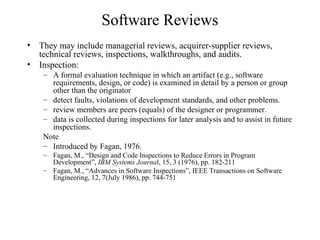
Software Reviews
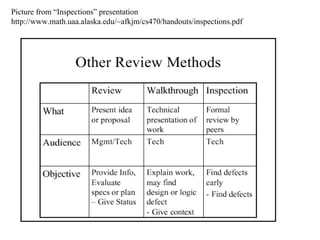
• They may include managerial reviews, acquirer-supplier reviews,
technical reviews, inspections, walkthroughs, and audits.
• Inspection:
– A formal evaluation technique in which an artifact (e.g., software
requirements, design, or code) is examined in detail by a person or group
other than the originator
– detect faults, violations of development standards, and other problems.
– review members are peers (equals) of the designer or programmer.
– data is collected during inspections for later analysis and to assist in future
inspections.
Note
– Introduced by Fagan, 1976.
– Fagan, M., “Design and Code Inspections to Reduce Errors in Program
Development”, IBM Systems Journal, 15, 3 (1976), pp. 182-211
– Fagan, M., “Advances in Software Inspections”, IEEE Transactions on Software
Engineering, 12, 7(July 1986), pp. 744-751
Picture from “Inspections” presentation
http://www.math.uaa.alaska.edu/~afkjm/cs470/handouts/inspections.pdf
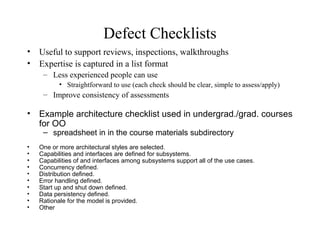
Defect Checklists
• Useful to support reviews, inspections, walkthroughs
• Expertise is captured in a list format
– Less experienced people can use
• Straightforward to use (each check should be clear, simple to assess/apply)
– Improve consistency of assessments
• Example architecture checklist used in undergrad./grad. courses
for OO
– spreadsheet in in the course materials subdirectory
• One or more architectural styles are selected.
• Capabilities and interfaces are defined for subsystems.
• Capabilities of and interfaces among subsystems support all of the use cases.
• Concurrency defined.
• Distribution defined.
• Error handling defined.
• Start up and shut down defined.
• Data persistency defined.
• Rationale for the model is provided.
• Other
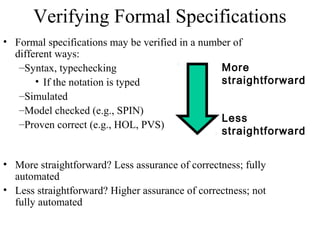
Verifying Formal Specifications
• Formal specifications may be verified in a number of
different ways:
–Syntax, typechecking
• If the notation is typed
–Simulated
–Model checked (e.g., SPIN)
–Proven correct (e.g., HOL, PVS)
• More straightforward? Less assurance of correctness; fully
automated
• Less straightforward? Higher assurance of correctness; not
fully automated
More
straightforward
Less
straightforward
Problem Reporting, Tracking, and Resolving
• Describe the practices and procedures to be followed
for reporting, tracking, and resolving problems
– Who can report a problem?
– How is it reported?
– How is is tracked?
– Who determines if it is a problem that going to be resolved?
– How is it assigned for resolution?
– How does the person indicate it has been corrected?
– Who reviews it to determine if it can be closed?
• Problems can be product or process related
– e.g. incorrect requirement, incomplete class definition, code
defect, ambiguous description in user documentation,
process to review detailed design is not clearly defined, etc.
Metrics
• Metrics for each artifact
• e.g., Requirements
– Number of requirements
– Number of changes per requirement
• Called “churn” rate
– Characterization of defects
• Not testable, ambiguous, inconsistent, incorrect,
incomplete redundant, infeasible, …
• Major or minor defect
• Phase defect detected
• Cost to fix
Tools, techniques, training
• What tools?
– e.g., CVS for CM, excel spreadsheet for
problem reporting/tracking, ...
• What techniques?
– e.g., formal peer review for deliverables,
checklists for defect detection, ...
• What training is needed on tools,
techniques?
Media Control
• Identify the media for each intermediate and
deliverable artifact
• Documentation required to store the media, including
the backup and restore process
• Protect computer program physical media from:
– unauthorized access
– inadvertent damage
– degradation
Architecture Analysis Methods
• Why evaluate an architecture?
http://www.slideshare.net/kevinjew/evaluating-software-
architectures-presentation
• Specialized techniques available:
http://www.slideshare.net/timmenzies/architecture-
tradeoff-analysis-method-presentation
SEI presentation and technical report on ATAM are in the
course subdirectory

Sqa

  • 1.
    Software Quality Assurance For SoftwareEngineering && Architecture and Design
  • 2.
    Software Quality Assurance •What is “quality”?
  • 3.
    Software Quality Assurance •What is “quality”? • IEEE Glossary: Degree to which a system, component, or process meets (1) specified requirements, and (2) customer or user needs or expectations
  • 4.
    Software Quality Assurance •What is “quality”? • IEEE Glossary: Degree to which a system, component, or process meets (1) specified requirements, and (2) customer or user needs or expectations • ISO: the totality of features and characteristics of a product or service that bear on its ability to satisfy specified or implied needs
  • 5.
    Software Quality Assurance •An alternate view of Quality: – is not absolute – is multidimensional, can be difficult to quantify – has aspects that are not easy to measure – assessment is subject to constraints (e.g., cost) – is about acceptable compromises – criteria are not independent, can conflict
  • 6.
    Software Quality Assurance •Quality Criteria include: – correctness – efficiency – flexibility – integrity – interoperability – maintainability – portability – reliability – reusability – testability – usability
  • 7.
    What is SoftwareQuality Assurance (SQA)? • “Set of systematic activities providing evidence of the ability of the software process to produce a software product that is fit to use” – G. Schulmeyer and J. McManus, Software Quality Handbook, Prentice Hall, 1998.
  • 8.
    What is SQA? •Monitoring processes and products throughout the software development lifecycle to ensure the quality of the delivered product(s) • Monitoring the processes – Provides management with objective feedback regarding process compliance to approved plans, procedures, standards, and analyses • Monitoring the products – Focus on the quality of product within each phase of the SDLC • e.g., requirements, test plan, architecture, etc. – Objective: identify and remove defects throughout the lifecycle, as early as possible
  • 9.
    Quality of Softwaredeveloped in-house & COTS components • SQA processes apply when integrating purchased or customer-supplied software products into the developed product • Question. How do you determine the “quality” of COTS components? – Current research problem
  • 10.
    Process Assessment • Useof standards and process models has a positive impact on the quality of the software product – Disciplined, controlled development process • Examples include: – ISO 9001 – CMM • CMU SEI, 5 levels – SPICE • Developing a standard for software process assessment • ISO joint committee, Europe, Australia – IEEE 1074, IEEE 12207, …
  • 11.
    Product Assessment • Reviews,inspections, walkthroughs – Specialized techniques available: • How to review/assess requirements, architecture, detailed designs, code • … • Testing • Simulation • Protoyping • Formal verification – Model checking, theorem proving
  • 12.
    Product Assessment • Reviews,inspections, walkthroughs of Plans, reports, models, standards – Project management, quality assurance, training, test plan(s) – Requirements, analysis, architecture, detailed design model, test cases – Issue or problem reports – Metric reports – Traceability reports – Documentation, coding standards – …
  • 13.
    Software Reviews • Theymay include managerial reviews, acquirer-supplier reviews, technical reviews, inspections, walkthroughs, and audits. • Inspection: – A formal evaluation technique in which an artifact (e.g., software requirements, design, or code) is examined in detail by a person or group other than the originator – detect faults, violations of development standards, and other problems. – review members are peers (equals) of the designer or programmer. – data is collected during inspections for later analysis and to assist in future inspections. Note – Introduced by Fagan, 1976. – Fagan, M., “Design and Code Inspections to Reduce Errors in Program Development”, IBM Systems Journal, 15, 3 (1976), pp. 182-211 – Fagan, M., “Advances in Software Inspections”, IEEE Transactions on Software Engineering, 12, 7(July 1986), pp. 744-751
  • 14.
    Picture from “Inspections”presentation http://www.math.uaa.alaska.edu/~afkjm/cs470/handouts/inspections.pdf
  • 15.
    Defect Checklists • Usefulto support reviews, inspections, walkthroughs • Expertise is captured in a list format – Less experienced people can use • Straightforward to use (each check should be clear, simple to assess/apply) – Improve consistency of assessments • Example architecture checklist used in undergrad./grad. courses for OO – spreadsheet in in the course materials subdirectory • One or more architectural styles are selected. • Capabilities and interfaces are defined for subsystems. • Capabilities of and interfaces among subsystems support all of the use cases. • Concurrency defined. • Distribution defined. • Error handling defined. • Start up and shut down defined. • Data persistency defined. • Rationale for the model is provided. • Other
  • 16.
    Verifying Formal Specifications •Formal specifications may be verified in a number of different ways: –Syntax, typechecking • If the notation is typed –Simulated –Model checked (e.g., SPIN) –Proven correct (e.g., HOL, PVS) • More straightforward? Less assurance of correctness; fully automated • Less straightforward? Higher assurance of correctness; not fully automated More straightforward Less straightforward
  • 17.
    Problem Reporting, Tracking,and Resolving • Describe the practices and procedures to be followed for reporting, tracking, and resolving problems – Who can report a problem? – How is it reported? – How is is tracked? – Who determines if it is a problem that going to be resolved? – How is it assigned for resolution? – How does the person indicate it has been corrected? – Who reviews it to determine if it can be closed? • Problems can be product or process related – e.g. incorrect requirement, incomplete class definition, code defect, ambiguous description in user documentation, process to review detailed design is not clearly defined, etc.
  • 18.
    Metrics • Metrics foreach artifact • e.g., Requirements – Number of requirements – Number of changes per requirement • Called “churn” rate – Characterization of defects • Not testable, ambiguous, inconsistent, incorrect, incomplete redundant, infeasible, … • Major or minor defect • Phase defect detected • Cost to fix
  • 19.
    Tools, techniques, training •What tools? – e.g., CVS for CM, excel spreadsheet for problem reporting/tracking, ... • What techniques? – e.g., formal peer review for deliverables, checklists for defect detection, ... • What training is needed on tools, techniques?
  • 20.
    Media Control • Identifythe media for each intermediate and deliverable artifact • Documentation required to store the media, including the backup and restore process • Protect computer program physical media from: – unauthorized access – inadvertent damage – degradation
  • 21.
    Architecture Analysis Methods •Why evaluate an architecture? http://www.slideshare.net/kevinjew/evaluating-software- architectures-presentation • Specialized techniques available: http://www.slideshare.net/timmenzies/architecture- tradeoff-analysis-method-presentation SEI presentation and technical report on ATAM are in the course subdirectory