PRODUCT DEVELOPMENT
(for a Software Machine)
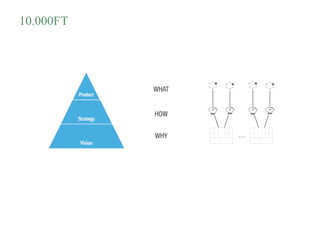
10.000FT
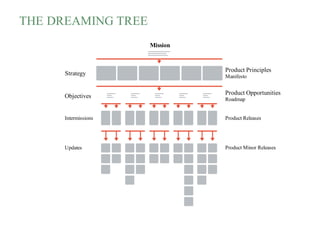
THE DREAMING TREE
Product Releases
Product Principles
Manifesto
Product Opportunities
Roadmap
Product Minor Releases
Mission
Strategy
Objectives
Intermissions
Updates
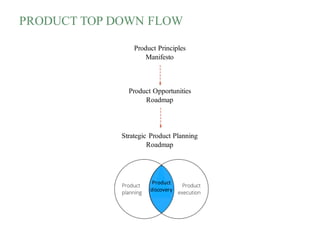
PRODUCT TOP DOWN FLOW
Product Opportunities
Roadmap
Product Principles
Manifesto
Strategic Product Planning
Roadmap
Product	
discovery
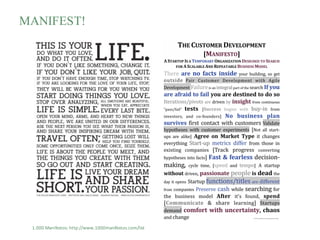
MANIFEST!
1.000	Manifestos:	http://www.1000manifestos.com/list
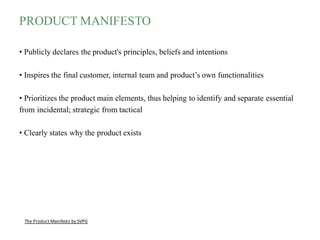
PRODUCT MANIFESTO
• Publicly declares the product's principles, beliefs and intentions
• Inspires the final customer, internal team and product’s own functionalities
• Prioritizes the product main elements, thus helping to identify and separate essential
from incidental; strategic from tactical
• Clearly states why the product exists
The	Product	Manifesto	by	SVPG
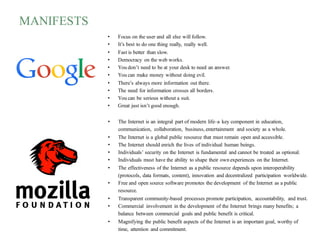
MANIFESTS
• The Internet is an integral part of modern life–a key component in education,
communication, collaboration, business, entertainment and society as a whole.
• The Internet is a global public resource that must remain open and accessible.
• The Internet should enrich the lives of individual human beings.
• Individuals’ security on the Internet is fundamental and cannot be treated as optional.
• Individuals must have the ability to shape their own experiences on the Internet.
• The effectiveness of the Internet as a public resource depends upon interoperability
(protocols, data formats, content), innovation and decentralized participation worldwide.
• Free and open source software promotes the development of the Internet as a public
resource.
• Transparent community-based processes promote participation, accountability, and trust.
• Commercial involvement in the development of the Internet brings many benefits; a
balance between commercial goals and public benefit is critical.
• Magnifying the public benefit aspects of the Internet is an important goal, worthy of
time, attention and commitment.
• Focus on the user and all else will follow.
• It’s best to do one thing really, really well.
• Fast is better than slow.
• Democracy on the web works.
• You don’t need to be at your desk to need an answer.
• You can make money without doing evil.
• There’s always more information out there.
• The need for information crosses all borders.
• You can be serious without a suit.
• Great just isn’t good enough.
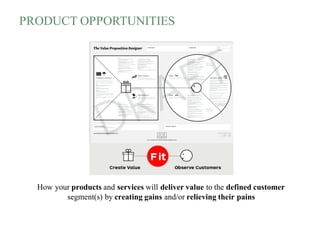
PRODUCT OPPORTUNITIES
How your products and services will deliver value to the defined customer
segment(s) by creating gains and/or relieving their pains
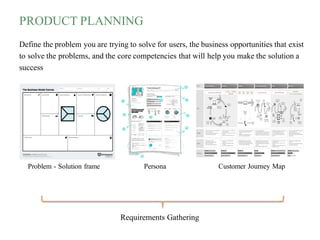
PRODUCT PLANNING
Define the problem you are trying to solve for users, the business opportunities that exist
to solve the problems, and the core competencies that will help you make the solution a
success
Problem - Solution frame Persona Customer Journey Map
Requirements Gathering
PRODUCT PLANNING – REQUIREMENTS GATHERING
A requirement is simply a short statement of the problem
Suggested format:
[Persona] has [problem] with [frequency]
Product Requirements
Product managers explore the problem, not the solution at this stage. Design
team understands the context of the problem.
PRODUCT PLANNING – REQUIREMENTS GATHERING
Benchmark for well-written requirements:
• Is there a clear definition of the user(s)?
• Do I understand their problem / what they are trying to achieve?
• Do I have supporting documentation that provides the context about the persona
and their problems so that I clearly understand how to design a solution to their
problem?
PRODUCT PLANNING – REQUIREMENTS GATHERING
Requirements	vs.	Specifications
Requirement:	short	statement	of	the	problem
Specification:	how	to	solve	the	problem
PRODUCT OPPORTUNITIES – ROADMAP
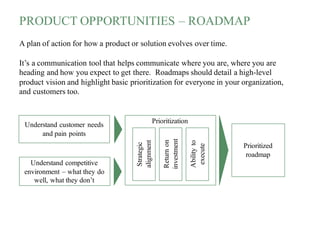
A plan of action for how a product or solution evolves over time.
It’s a communication tool that helps communicate where you are, where you are
heading and how you expect to get there. Roadmaps should detail a high-level
product vision and highlight basic prioritization for everyone in your organization,
and customers too.
Understand customer needs
and pain points
Understand competitive
environment – what they do
well, what they don’t
Prioritization
Strategic
alignment
Returnon
investment
Abilityto
execute
Prioritized
roadmap
PRODUCT OPPORTUNITIES – ROADMAP
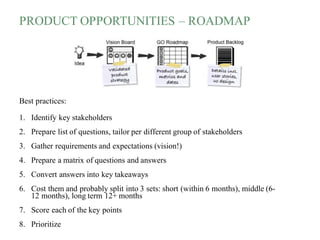
Best practices:
1. Identify key stakeholders
2. Prepare list of questions, tailor per different group of stakeholders
3. Gather requirements and expectations (vision!)
4. Prepare a matrix of questions and answers
5. Convert answers into key takeaways
6. Cost them and probably split into 3 sets: short (within 6 months), middle (6-
12 months), long term 12+ months
7. Score each of the key points
8. Prioritize
PRODUCT PLANNING – REQUIREMENTS GATHERING
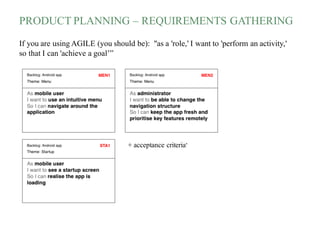
If you are using AGILE (you should be): "as a 'role,' I want to 'perform an activity,'
so that I can 'achieve a goal’”
+ acceptance criteria*
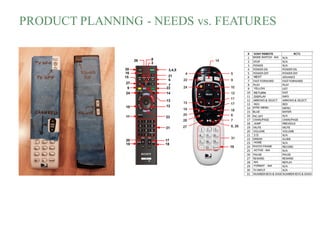
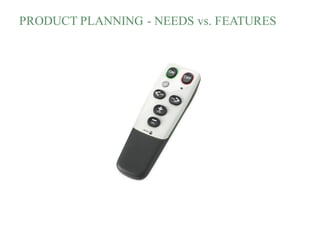
PRODUCT PLANNING - NEEDS vs. FEATURES
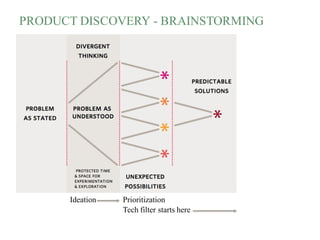
PRODUCT DISCOVERY - BRAINSTORMING
Tech filter starts here
Ideation Prioritization
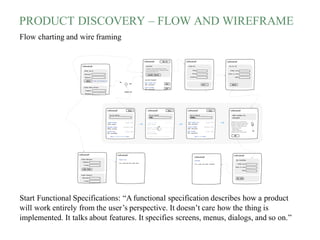
PRODUCT DISCOVERY – FLOW AND WIREFRAME
Flow charting and wire framing
Start Functional Specifications: “A functional specification describes how a product
will work entirely from the user’s perspective. It doesn’t care how the thing is
implemented. It talks about features. It specifies screens, menus, dialogs, and so on.”
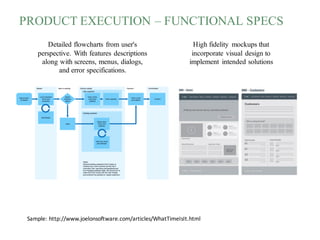
PRODUCT EXECUTION – FUNCTIONAL SPECS
High fidelity mockups that
incorporate visual design to
implement intended solutions
Sample:	http://www.joelonsoftware.com/articles/WhatTimeIsIt.html
Detailed flowcharts from user's
perspective. With features descriptions
along with screens, menus, dialogs,
and error specifications.
PRODUCT EXECUTION – TECHNICAL SPECS
Must	read:	http://c2.com/cgi/wiki?TechnicalSpecification
A technical specification describe the internal implementation of the program.
It talks about software architecture, data structures, relational database models, choice
of programming languages and tools, algorithms, etc.
Good technical specification can be as simples as Functional Specifications that
follow a particular SoftwareArchitecture that has been chosen to guide the solution.
Generally you have to decide things like:
• Communication protocols, availability, SLAs etc.
• Management structure, reporting structure, budgets, conflict resolution
• Source code control, bug tracking, builds, testing, release policies, etc.
• Software methodology, coding standards, languages, OSs, etc.
• Frameworks, message passing, logging, which libraries to use, etc.
• Resource management, memory management, etc.
• System startup, configuration, monitoring, licensing, contingency, backup, etc.
• Application architecture
• …..
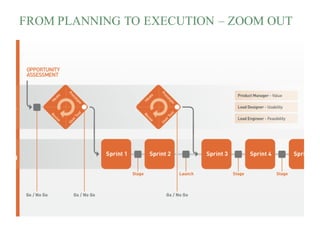
FROM PLANNING TO EXECUTION – ZOOM OUT
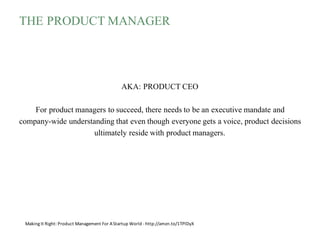
THE PRODUCT MANAGER
AKA: PRODUCT CEO
For product managers to succeed, there needs to be an executive mandate and
company-wide understanding that even though everyone gets a voice, product decisions
ultimately reside with product managers.
Making	It	Right:	Product	Management	For	A	Startup	World	-http://amzn.to/1TPlDyX
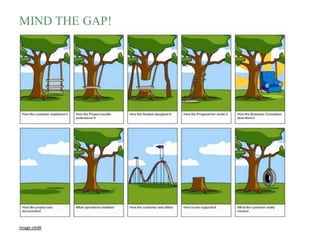
MIND THE GAP!
Image	credit
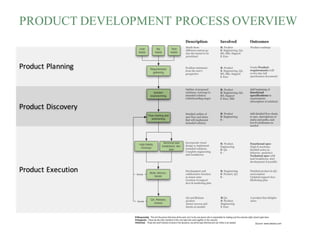
PRODUCT DEVELOPMENT PROCESS OVERVIEW
Product	Planning
Product	Execution
Product	Discovery
Astella is a Latin root that originated the words atelier
and estaleiro (shipyard); a place where great heroes are
made, through science and art.

Software product development basics

  • 1.
    PRODUCT DEVELOPMENT (for aSoftware Machine)
  • 2.
  • 3.
    THE DREAMING TREE ProductReleases Product Principles Manifesto Product Opportunities Roadmap Product Minor Releases Mission Strategy Objectives Intermissions Updates
  • 4.
    PRODUCT TOP DOWNFLOW Product Opportunities Roadmap Product Principles Manifesto Strategic Product Planning Roadmap Product discovery
  • 5.
  • 6.
    PRODUCT MANIFESTO • Publiclydeclares the product's principles, beliefs and intentions • Inspires the final customer, internal team and product’s own functionalities • Prioritizes the product main elements, thus helping to identify and separate essential from incidental; strategic from tactical • Clearly states why the product exists The Product Manifesto by SVPG
  • 7.
    MANIFESTS • The Internetis an integral part of modern life–a key component in education, communication, collaboration, business, entertainment and society as a whole. • The Internet is a global public resource that must remain open and accessible. • The Internet should enrich the lives of individual human beings. • Individuals’ security on the Internet is fundamental and cannot be treated as optional. • Individuals must have the ability to shape their own experiences on the Internet. • The effectiveness of the Internet as a public resource depends upon interoperability (protocols, data formats, content), innovation and decentralized participation worldwide. • Free and open source software promotes the development of the Internet as a public resource. • Transparent community-based processes promote participation, accountability, and trust. • Commercial involvement in the development of the Internet brings many benefits; a balance between commercial goals and public benefit is critical. • Magnifying the public benefit aspects of the Internet is an important goal, worthy of time, attention and commitment. • Focus on the user and all else will follow. • It’s best to do one thing really, really well. • Fast is better than slow. • Democracy on the web works. • You don’t need to be at your desk to need an answer. • You can make money without doing evil. • There’s always more information out there. • The need for information crosses all borders. • You can be serious without a suit. • Great just isn’t good enough.
  • 8.
    PRODUCT OPPORTUNITIES How yourproducts and services will deliver value to the defined customer segment(s) by creating gains and/or relieving their pains
  • 9.
    PRODUCT PLANNING Define theproblem you are trying to solve for users, the business opportunities that exist to solve the problems, and the core competencies that will help you make the solution a success Problem - Solution frame Persona Customer Journey Map Requirements Gathering
  • 10.
    PRODUCT PLANNING –REQUIREMENTS GATHERING A requirement is simply a short statement of the problem Suggested format: [Persona] has [problem] with [frequency] Product Requirements Product managers explore the problem, not the solution at this stage. Design team understands the context of the problem.
  • 11.
    PRODUCT PLANNING –REQUIREMENTS GATHERING Benchmark for well-written requirements: • Is there a clear definition of the user(s)? • Do I understand their problem / what they are trying to achieve? • Do I have supporting documentation that provides the context about the persona and their problems so that I clearly understand how to design a solution to their problem?
  • 12.
    PRODUCT PLANNING –REQUIREMENTS GATHERING Requirements vs. Specifications Requirement: short statement of the problem Specification: how to solve the problem
  • 13.
    PRODUCT OPPORTUNITIES –ROADMAP A plan of action for how a product or solution evolves over time. It’s a communication tool that helps communicate where you are, where you are heading and how you expect to get there. Roadmaps should detail a high-level product vision and highlight basic prioritization for everyone in your organization, and customers too. Understand customer needs and pain points Understand competitive environment – what they do well, what they don’t Prioritization Strategic alignment Returnon investment Abilityto execute Prioritized roadmap
  • 14.
    PRODUCT OPPORTUNITIES –ROADMAP Best practices: 1. Identify key stakeholders 2. Prepare list of questions, tailor per different group of stakeholders 3. Gather requirements and expectations (vision!) 4. Prepare a matrix of questions and answers 5. Convert answers into key takeaways 6. Cost them and probably split into 3 sets: short (within 6 months), middle (6- 12 months), long term 12+ months 7. Score each of the key points 8. Prioritize
  • 15.
    PRODUCT PLANNING –REQUIREMENTS GATHERING If you are using AGILE (you should be): "as a 'role,' I want to 'perform an activity,' so that I can 'achieve a goal’” + acceptance criteria*
  • 16.
    PRODUCT PLANNING -NEEDS vs. FEATURES
  • 17.
    PRODUCT PLANNING -NEEDS vs. FEATURES
  • 18.
    PRODUCT DISCOVERY -BRAINSTORMING Tech filter starts here Ideation Prioritization
  • 19.
    PRODUCT DISCOVERY –FLOW AND WIREFRAME Flow charting and wire framing Start Functional Specifications: “A functional specification describes how a product will work entirely from the user’s perspective. It doesn’t care how the thing is implemented. It talks about features. It specifies screens, menus, dialogs, and so on.”
  • 20.
    PRODUCT EXECUTION –FUNCTIONAL SPECS High fidelity mockups that incorporate visual design to implement intended solutions Sample: http://www.joelonsoftware.com/articles/WhatTimeIsIt.html Detailed flowcharts from user's perspective. With features descriptions along with screens, menus, dialogs, and error specifications.
  • 21.
    PRODUCT EXECUTION –TECHNICAL SPECS Must read: http://c2.com/cgi/wiki?TechnicalSpecification A technical specification describe the internal implementation of the program. It talks about software architecture, data structures, relational database models, choice of programming languages and tools, algorithms, etc. Good technical specification can be as simples as Functional Specifications that follow a particular SoftwareArchitecture that has been chosen to guide the solution. Generally you have to decide things like: • Communication protocols, availability, SLAs etc. • Management structure, reporting structure, budgets, conflict resolution • Source code control, bug tracking, builds, testing, release policies, etc. • Software methodology, coding standards, languages, OSs, etc. • Frameworks, message passing, logging, which libraries to use, etc. • Resource management, memory management, etc. • System startup, configuration, monitoring, licensing, contingency, backup, etc. • Application architecture • …..
  • 22.
    FROM PLANNING TOEXECUTION – ZOOM OUT
  • 23.
    THE PRODUCT MANAGER AKA:PRODUCT CEO For product managers to succeed, there needs to be an executive mandate and company-wide understanding that even though everyone gets a voice, product decisions ultimately reside with product managers. Making It Right: Product Management For A Startup World -http://amzn.to/1TPlDyX
  • 24.
  • 25.
    PRODUCT DEVELOPMENT PROCESSOVERVIEW Product Planning Product Execution Product Discovery
  • 26.
    Astella is aLatin root that originated the words atelier and estaleiro (shipyard); a place where great heroes are made, through science and art.