



THE FUTURE OF HUMAN
POTENTIAL
IN A NUTSHELL
• Fasten your seatbelts! HUMAN POTENTIAL is in for a ride
• The next TWO DECADES will bring unprecedented economic opportunities
• Soon, EVERY COMPANY will be a ‘technology company’
• ENTREPRENEURS are leading the knowledge storm
HUMAN POTENTIAL IS IN FOR A RIDE
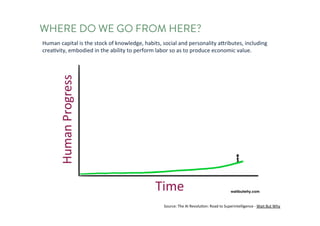
WHERE DO WE GO FROM HERE?
Human	capital	is	the	stock	of	knowledge,	habits,	social	and	personality	attributes,	including	
creativity,	embodied	in	the	ability	to	perform	labor	so	as	to	produce	economic	value.
Source:	The	AI	Revolution:	Road	to	Superintelligence-Wait	But	Why
THIS IS THE REAL “J” CURVE
We	are	on	the	edge	of	change	comparable	to	the	rise	of	human	life	on	Earth.	— Vernor Vinge
Source:	The	AI	Revolution:	Road	to	Superintelligence-Wait	But	Why
LAW OF ACCELERATINGRETURNS
Source:	The	Law	of	Accelerating	Returns
It	states	that	"fundamental	measures	of	information	technology	follow	predictable	and	
exponential	trajectories."
AI IS AROUND THE CORNER
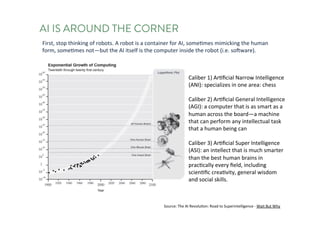
Caliber	1)	Artificial	Narrow	Intelligence	
(ANI):	specializes	in	one	area:	chess
Caliber	2)	Artificial	General	Intelligence	
(AGI):	a	computer	that	is	as	smart	as	a	
human	across	the	board—a	machine	
that	can	perform	any	intellectual	task	
that	a	human	being	can
Caliber	3)	Artificial	Super	Intelligence	
(ASI):	an	intellect	that	is	much	smarter	
than	the	best	human	brains	in	
practically	every	field,	including	
scientific	creativity,	general	wisdom	
and	social	skills.
First,	stop	thinking	of	robots.	A	robot	is	a	container	for	AI,	sometimes	mimicking	the	human	
form,	sometimes	not—but	 the	AI	itself	is	the	computer	inside	the	robot	(i.e.	software).
Source:	The	AI	Revolution:	Road	to	Superintelligence-Wait	But	Why
RUNNING WITH THE MACHINE
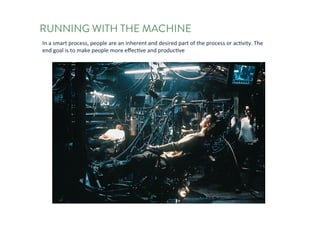
In	a	smart	process,	people	are	an	inherent	and	desired	part	of	the	process	or	activity.	The	end	
goal	is	to	make	people	more	effective	and	productive
A HISTORICAL PERSPECTIVE
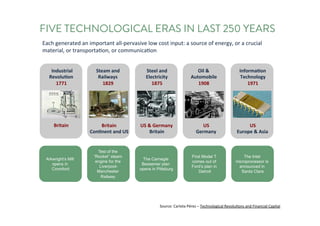
FIVE TECHNOLOGICAL ERASIN LAST 250 YEARS
Industrial
Revolution
1771
Steam	and
Railways
1829
Steel	and
Electricity
1875
Oil	&
Automobile
1908
Information
Technology
1971
Britain Britain
Continent	and	US
US	&	Germany
Britain
US
Germany
US
Europe	&	Asia
Each	generated	an	important	all-pervasive	low	cost	input:	a	source	of	energy,	or	a	crucial	
material,	or	transportation,	or	communication
Arkwright’s Mill
opens in
Cromford
Test of the
“Rocket” steam
engine for the
Liverpool-
Manchester
Railway
The Carnegie
Bessemer plan
opens in Pittsburg
First Model T
comes out of
Ford’s plan in
Detroit
The Intel
microprocessor is
announced in
Santa Clara
Source:	Carlota	Pérez	– Technological	Revolutions	and	Financial	Capital
PATTER OF DIFFUSION
Cluster	of	new	
products,	
industries	and	
infrastructure
New	generic	
technologies	and	
management	
principles
Higher	level	of	
potential	
productivity	for	
the	whole	system
Increased	
consumer	surplus	
and	human	
development
Source:	Carlota	Pérez	– Technological	Revolutions	and	Financial	Capital
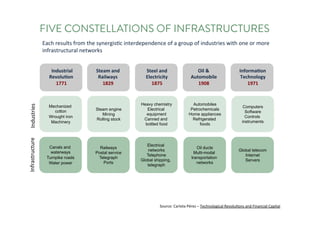
FIVE CONSTELLATIONS OF INFRASTRUCTURES
Each	results	from	the	synergistic	interdependence	of	a	group	of	industries	with	one	or	more	
infrastructural	networks
Industrial
Revolution
1771
Steam	and
Railways
1829
Steel	and
Electricity
1875
Oil	&
Automobile
1908
Information
Technology
1971
Canals and
waterways
Turnpike roads
Water power
Railways
Postal service
Telegraph
Ports
Electrical
networks
Telephone
Global shipping,
telegraph
Oil ducts
Multi-modal
transportation
networks
Global telecom
Internet
Servers
Mechanized
cotton
Wrought iron
Machinery
Steam engine
Mining
Rolling stock
Heavy chemistry
Electrical
equipment
Canned and
bottled food
Automobiles
Petrochemicals
Home appliances
Refrigerated
foods
Computers
Software
Controls
instruments
IndustriesInfrastructure
Source:	Carlota	Pérez	– Technological	Revolutions	and	Financial	Capital
FIVE ECONOMIC PARADIGM SHIFTS'
Each	unleashed	a	profound	transformation	in	‘the	way	of	doing	things’	across	the	whole	
economy
Resulting	in	a	best-practice	model	made	up	of	a	set	of	all-pervasive	technological	and	
organizational	principles,	thus	a	new	way	of	‘management’
Industrial
Revolution
1771
Steam	and
Railways
1829
Steel	and
Electricity
1875
Oil	&
Automobile
1908
Information
Technology
1971
Mechanization
Productivity/time
keeping
Fluidity of
movement
Economies of
agglomeration
Economies of
scale
Standard parts
Vertical
integration
Cartels
Cost accounting
Mass production
Standardization
of products
Functional
specialization
Segmentation
Economies of
scope
Globalization
Source:	Carlota	Pérez	– Technological	Revolutions	and	Financial	Capital
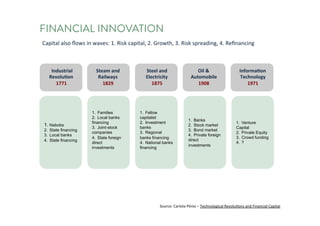
FINANCIAL INNOVATION
Capital	also	flows	in	waves:	1.	Risk	capital,	2.	Growth,	3.	Risk	spreading,	4.	Refinancing
Industrial
Revolution
1771
Steam	and
Railways
1829
Steel	and
Electricity
1875
Oil	&
Automobile
1908
Information
Technology
1971
1. Nabobs
2. State financing
3. Local banks
4. State financing
1. Families
2. Local banks
financing
3. Joint-stock
companies
4. State foreign
direct
investments
1. Fellow
capitalist
2. Investment
banks
3. Regional
banks financing
4. National banks
financing
1. Banks
2. Stock market
3. Bond market
4. Private foreign
direct
investments
1. Venture
Capital
2. Private Equity
3. Crowd funding
4. ?
Source:	Carlota	Pérez	– Technological	Revolutions	and	Financial	Capital
TWO DECADES OF UNPRECEDENTED
OPPORTUNITIES
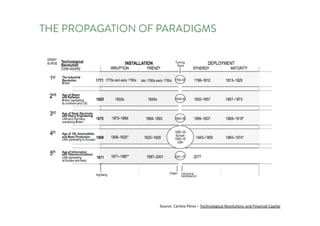
THE PROPAGATION OF PARADIGMS
Source:	Carlota	Pérez	– Technological	Revolutions	and	Financial	Capital
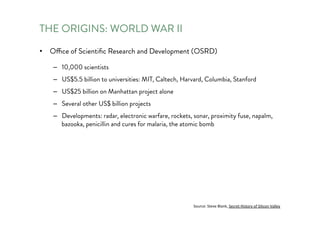
THE ORIGINS: WORLD WAR II
• Office of Scientific Research and Development (OSRD)
– 10,000 scientists
– US$5.5 billion to universities: MIT, Caltech, Harvard, Columbia, Stanford
– US$25 billion on Manhattan project alone
– Several other US$ billion projects
– Developments: radar, electronic warfare, rockets, sonar, proximityfuse, napalm,
bazooka, penicillin and curesfor malaria, the atomic bomb
Source:	Steve	Blank,	Secret	History	of	Silicon	Valley
Mainframe
Computing
1960
Mini	
Computing
1970
Personal
Computing
1980
Desktop
Computing
1990
Mobile
Computing
2000
1MM+
units
10MM+
units
100MM+
units
1B+
units
10B?
units
Source: Morgan Stanley, IBM, Nokia
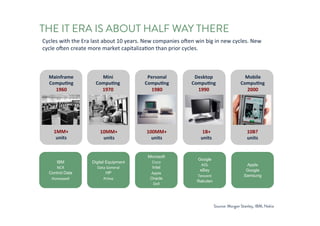
THE IT ERA IS ABOUT HALF WAY THERE
Cycles	with	the	Era	last	about	10	years.	New	companies	often	win	big	in	new	cycles.	New	
cycle	often	create	more	market	capitalization	than	prior	cycles.
IBM
NCR
Control Data
Honeywell
Digital Equipment
Data	General
HP
Prime
Microsoft
Cisco
Intel
Apple
Oracle
Dell
Google
AOL
eBay
Tencent
Rakuten
Apple
Google
Samsung
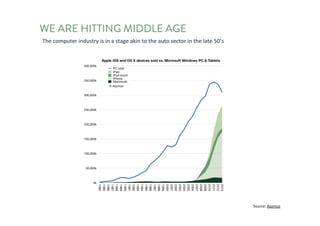
WE ARE HITTING MIDDLE AGE
The	computer	industry	is	in	a	stage	akin	to	the	auto	sector	in	the	late	50’s
Source:	Asymco
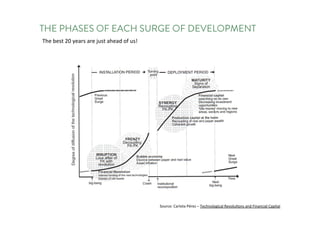
THE PHASES OF EACH SURGE OF DEVELOPMENT
The	best	20	years	are	just	ahead	of	us!
Source:	Carlota	Pérez	– Technological	Revolutions	and	Financial	Capital
EVERY COMPANY WILL BE A
‘TECHNOLOGY COMPANY’
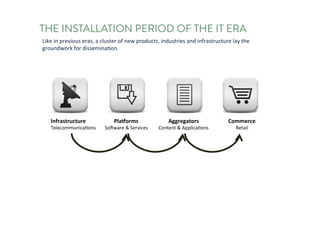
THE INSTALLATION PERIOD OF THE IT ERA
Infrastructure
Telecommunications
Platforms
Software	&	Services
Aggregators
Content	&	Applications
Commerce
Retail
Like	in	previous	eras,	a	cluster	of	new	products,	industries	and	infrastructure	lay	the	
groundwork	for	dissemination.
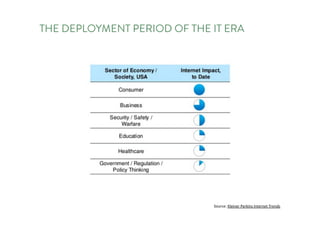
THE DEPLOYMENT PERIODOF THE IT ERA
Source:	Kleiner Perkins	Internet	Trends
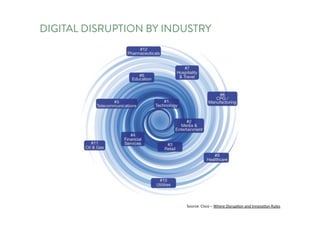
DIGITAL DISRUPTION BY INDUSTRY
Source:	Cisco	– Where	Disruption	and	Innovation	Rules
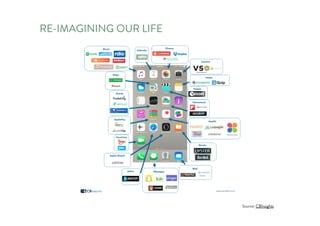
RE-IMAGINING OUR LIFE
Source: CBInsights
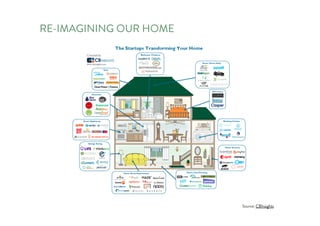
RE-IMAGINING OUR HOME
Source: CBInsights
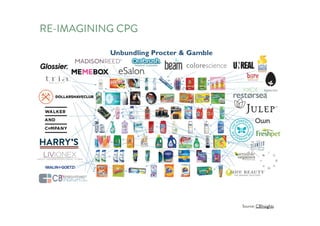
RE-IMAGINING CPG
Source: CBInsights
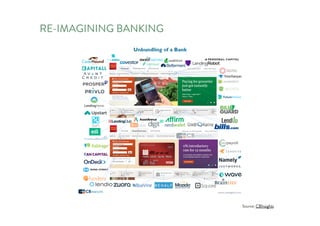
RE-IMAGINING BANKING
Source: CBInsights
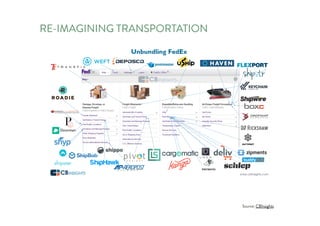
RE-IMAGINING TRANSPORTATION
Source: CBInsights
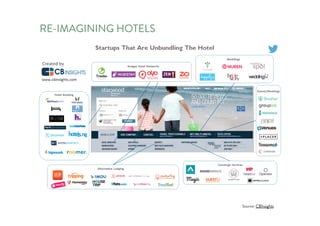
RE-IMAGINING HOTELS
Source: CBInsights
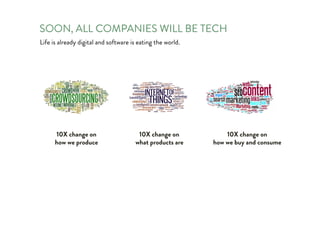
SOON, ALL COMPANIESWILL BE TECH
Life is alreadydigital and software is eating the world.
10X change on
how we produce
10X change on
what products are
10X change on
how we buyand consume
ENTREPRENEURS ARE LEADING
THE KNOWLEDGE STORM
THE IT ERA ORGANIZATIONAL LEGACY
• Customer Development
• Growth Hacking
• Halocracy
• Crowdsourcing
• Technology Product Management
• Agile Development
• Design Thinking
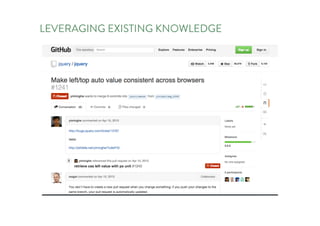
LEVERAGING EXISTING KNOWLEDGE
CONNECTING KNOWLEDGE
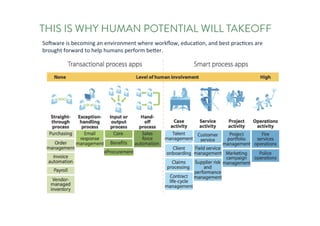
THIS IS WHY HUMAN POTENTIAL WILL TAKEOFF
Software	is	becoming	an	environment	where	workflow,	education,	and	best	practices	are	
brought	forward	to	help	humans	perform	better.
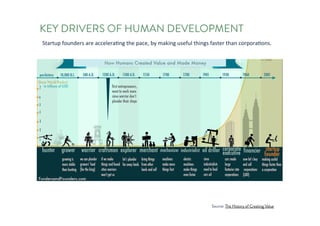
KEY DRIVERSOF HUMAN DEVELOPMENT
Source: The History of Creating Value
Startup	founders	are	accelerating	the	pace,	by	making	useful	things	faster	than	corporations.
IN SUMMARY
• HUMAN POTENTIAL is being leveraged by software
• We have TWO DECADES of strong potential ahead of us
• EVERY COMPANY should be working on its ‘technology’ path
• FOUNDERS and it’s management ideas are the greatest productsof our era
www.astellainvest.com

The Future of Human Potential

  • 1.
    THE FUTURE OFHUMAN POTENTIAL
  • 2.
    IN A NUTSHELL •Fasten your seatbelts! HUMAN POTENTIAL is in for a ride • The next TWO DECADES will bring unprecedented economic opportunities • Soon, EVERY COMPANY will be a ‘technology company’ • ENTREPRENEURS are leading the knowledge storm
  • 3.
    HUMAN POTENTIAL ISIN FOR A RIDE
  • 4.
    WHERE DO WEGO FROM HERE? Human capital is the stock of knowledge, habits, social and personality attributes, including creativity, embodied in the ability to perform labor so as to produce economic value. Source: The AI Revolution: Road to Superintelligence-Wait But Why
  • 5.
    THIS IS THEREAL “J” CURVE We are on the edge of change comparable to the rise of human life on Earth. — Vernor Vinge Source: The AI Revolution: Road to Superintelligence-Wait But Why
  • 6.
  • 7.
    AI IS AROUNDTHE CORNER Caliber 1) Artificial Narrow Intelligence (ANI): specializes in one area: chess Caliber 2) Artificial General Intelligence (AGI): a computer that is as smart as a human across the board—a machine that can perform any intellectual task that a human being can Caliber 3) Artificial Super Intelligence (ASI): an intellect that is much smarter than the best human brains in practically every field, including scientific creativity, general wisdom and social skills. First, stop thinking of robots. A robot is a container for AI, sometimes mimicking the human form, sometimes not—but the AI itself is the computer inside the robot (i.e. software). Source: The AI Revolution: Road to Superintelligence-Wait But Why
  • 8.
    RUNNING WITH THEMACHINE In a smart process, people are an inherent and desired part of the process or activity. The end goal is to make people more effective and productive
  • 9.
  • 10.
    FIVE TECHNOLOGICAL ERASINLAST 250 YEARS Industrial Revolution 1771 Steam and Railways 1829 Steel and Electricity 1875 Oil & Automobile 1908 Information Technology 1971 Britain Britain Continent and US US & Germany Britain US Germany US Europe & Asia Each generated an important all-pervasive low cost input: a source of energy, or a crucial material, or transportation, or communication Arkwright’s Mill opens in Cromford Test of the “Rocket” steam engine for the Liverpool- Manchester Railway The Carnegie Bessemer plan opens in Pittsburg First Model T comes out of Ford’s plan in Detroit The Intel microprocessor is announced in Santa Clara Source: Carlota Pérez – Technological Revolutions and Financial Capital
  • 11.
  • 12.
    FIVE CONSTELLATIONS OFINFRASTRUCTURES Each results from the synergistic interdependence of a group of industries with one or more infrastructural networks Industrial Revolution 1771 Steam and Railways 1829 Steel and Electricity 1875 Oil & Automobile 1908 Information Technology 1971 Canals and waterways Turnpike roads Water power Railways Postal service Telegraph Ports Electrical networks Telephone Global shipping, telegraph Oil ducts Multi-modal transportation networks Global telecom Internet Servers Mechanized cotton Wrought iron Machinery Steam engine Mining Rolling stock Heavy chemistry Electrical equipment Canned and bottled food Automobiles Petrochemicals Home appliances Refrigerated foods Computers Software Controls instruments IndustriesInfrastructure Source: Carlota Pérez – Technological Revolutions and Financial Capital
  • 13.
    FIVE ECONOMIC PARADIGMSHIFTS' Each unleashed a profound transformation in ‘the way of doing things’ across the whole economy Resulting in a best-practice model made up of a set of all-pervasive technological and organizational principles, thus a new way of ‘management’ Industrial Revolution 1771 Steam and Railways 1829 Steel and Electricity 1875 Oil & Automobile 1908 Information Technology 1971 Mechanization Productivity/time keeping Fluidity of movement Economies of agglomeration Economies of scale Standard parts Vertical integration Cartels Cost accounting Mass production Standardization of products Functional specialization Segmentation Economies of scope Globalization Source: Carlota Pérez – Technological Revolutions and Financial Capital
  • 14.
    FINANCIAL INNOVATION Capital also flows in waves: 1. Risk capital, 2. Growth, 3. Risk spreading, 4. Refinancing Industrial Revolution 1771 Steam and Railways 1829 Steel and Electricity 1875 Oil & Automobile 1908 Information Technology 1971 1. Nabobs 2.State financing 3. Local banks 4. State financing 1. Families 2. Local banks financing 3. Joint-stock companies 4. State foreign direct investments 1. Fellow capitalist 2. Investment banks 3. Regional banks financing 4. National banks financing 1. Banks 2. Stock market 3. Bond market 4. Private foreign direct investments 1. Venture Capital 2. Private Equity 3. Crowd funding 4. ? Source: Carlota Pérez – Technological Revolutions and Financial Capital
  • 15.
    TWO DECADES OFUNPRECEDENTED OPPORTUNITIES
  • 16.
    THE PROPAGATION OFPARADIGMS Source: Carlota Pérez – Technological Revolutions and Financial Capital
  • 17.
    THE ORIGINS: WORLDWAR II • Office of Scientific Research and Development (OSRD) – 10,000 scientists – US$5.5 billion to universities: MIT, Caltech, Harvard, Columbia, Stanford – US$25 billion on Manhattan project alone – Several other US$ billion projects – Developments: radar, electronic warfare, rockets, sonar, proximityfuse, napalm, bazooka, penicillin and curesfor malaria, the atomic bomb Source: Steve Blank, Secret History of Silicon Valley
  • 18.
    Mainframe Computing 1960 Mini Computing 1970 Personal Computing 1980 Desktop Computing 1990 Mobile Computing 2000 1MM+ units 10MM+ units 100MM+ units 1B+ units 10B? units Source: Morgan Stanley,IBM, Nokia THE IT ERA IS ABOUT HALF WAY THERE Cycles with the Era last about 10 years. New companies often win big in new cycles. New cycle often create more market capitalization than prior cycles. IBM NCR Control Data Honeywell Digital Equipment Data General HP Prime Microsoft Cisco Intel Apple Oracle Dell Google AOL eBay Tencent Rakuten Apple Google Samsung
  • 19.
    WE ARE HITTINGMIDDLE AGE The computer industry is in a stage akin to the auto sector in the late 50’s Source: Asymco
  • 20.
    THE PHASES OFEACH SURGE OF DEVELOPMENT The best 20 years are just ahead of us! Source: Carlota Pérez – Technological Revolutions and Financial Capital
  • 21.
    EVERY COMPANY WILLBE A ‘TECHNOLOGY COMPANY’
  • 22.
    THE INSTALLATION PERIODOF THE IT ERA Infrastructure Telecommunications Platforms Software & Services Aggregators Content & Applications Commerce Retail Like in previous eras, a cluster of new products, industries and infrastructure lay the groundwork for dissemination.
  • 23.
    THE DEPLOYMENT PERIODOFTHE IT ERA Source: Kleiner Perkins Internet Trends
  • 24.
    DIGITAL DISRUPTION BYINDUSTRY Source: Cisco – Where Disruption and Innovation Rules
  • 25.
  • 26.
  • 27.
  • 28.
  • 29.
  • 30.
  • 31.
    SOON, ALL COMPANIESWILLBE TECH Life is alreadydigital and software is eating the world. 10X change on how we produce 10X change on what products are 10X change on how we buyand consume
  • 32.
  • 33.
    THE IT ERAORGANIZATIONAL LEGACY • Customer Development • Growth Hacking • Halocracy • Crowdsourcing • Technology Product Management • Agile Development • Design Thinking
  • 34.
  • 35.
  • 36.
    THIS IS WHYHUMAN POTENTIAL WILL TAKEOFF Software is becoming an environment where workflow, education, and best practices are brought forward to help humans perform better.
  • 37.
    KEY DRIVERSOF HUMANDEVELOPMENT Source: The History of Creating Value Startup founders are accelerating the pace, by making useful things faster than corporations.
  • 38.
    IN SUMMARY • HUMANPOTENTIAL is being leveraged by software • We have TWO DECADES of strong potential ahead of us • EVERY COMPANY should be working on its ‘technology’ path • FOUNDERS and it’s management ideas are the greatest productsof our era
  • 39.