




APIS FOR HEROES
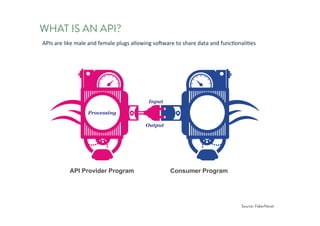
WHAT IS AN API?
faberNovel 2012 ••• 6
•••
In other words, APIs are like male and female plugs allowing software to
share data and functionalities.
Processing
Input
Output
API Provider Program Consumer Program
APIs	are	like	male	and	female	plugs	allowing	software	to	share	data	and	functionalities	
Source: FaberNovel
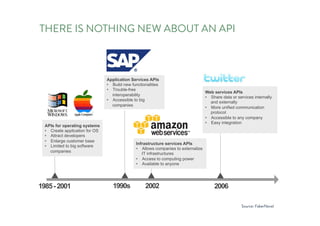
THERE IS NOTHING NEW ABOUT AN API
faberNovel 2012 ••• 11
•••
Historically, APIs were used by big software companies but their usage is
becoming more democratic today
1985-2001 2002 2006
APIs for operating systems
•  Create application for OS
•  Attract developers
•  Enlarge customer base
•  Limited to big software
companies
Application Services APIs
•  Build new functionalities
•  Trouble-free
interoperability
•  Accessible to big
companies
Infrastructure services APIs
•  Allows companies to externalize
IT infrastructures
•  Access to computing power
•  Available to anyone
Web services APIs
•  Share data or services internally
and externally
•  More unified communication
protocol
•  Accessible to any company
•  Easy integration
1990s
Source: 3Scale, What is an API?
Source: FaberNovel
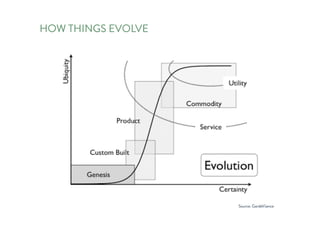
HOW THINGS EVOLVE
Source: GardeViiance
A HISTORICAL PERSPECTIVE
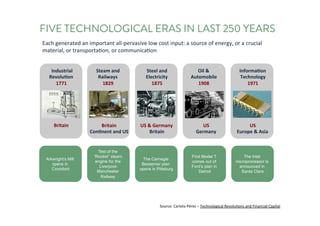
FIVE TECHNOLOGICAL ERASIN LAST 250 YEARS
Industrial
Revolution
1771
Steam	and
Railways
1829
Steel	and
Electricity
1875
Oil	&
Automobile
1908
Information
Technology
1971
Britain Britain
Continent	and	US
US	&	Germany
Britain
US
Germany
US
Europe	&	Asia
Each	generated	an	important	all-pervasive	low	cost	input:	a	source	of	energy,	or	a	crucial	
material,	or	transportation,	or	communication
Arkwright’s Mill
opens in
Cromford
Test of the
“Rocket” steam
engine for the
Liverpool-
Manchester
Railway
The Carnegie
Bessemer plan
opens in Pittsburg
First Model T
comes out of
Ford’s plan in
Detroit
The Intel
microprocessor is
announced in
Santa Clara
Source:	Carlota	Pérez	– Technological	Revolutions	and	Financial	Capital
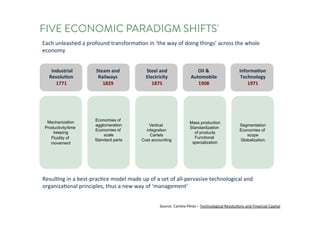
FIVE ECONOMIC PARADIGM SHIFTS'
Each	unleashed	a	profound	transformation	in	‘the	way	of	doing	things’	across	the	whole	
economy
Resulting	in	a	best-practice	model	made	up	of	a	set	of	all-pervasive	technological	and	
organizational	principles,	thus	a	new	way	of	‘management’
Industrial
Revolution
1771
Steam	and
Railways
1829
Steel	and
Electricity
1875
Oil	&
Automobile
1908
Information
Technology
1971
Mechanization
Productivity/time
keeping
Fluidity of
movement
Economies of
agglomeration
Economies of
scale
Standard parts
Vertical
integration
Cartels
Cost accounting
Mass production
Standardization
of products
Functional
specialization
Segmentation
Economies of
scope
Globalization
Source:	Carlota	Pérez	– Technological	Revolutions	and	Financial	Capital
Mainframe
Computing
1960
Mini	
Computing
1970
Personal
Computing
1980
Desktop
Computing
1990
Mobile
Computing
2000
1MM+
units
10MM+
units
100MM+
units
1B+
units
10B?
units
Source: Morgan Stanley, IBM, Nokia
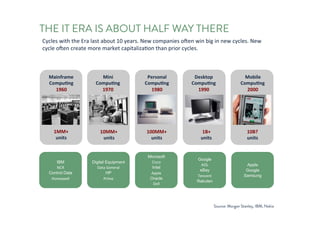
THE IT ERA IS ABOUT HALF WAY THERE
Cycles	with	the	Era	last	about	10	years.	New	companies	often	win	big	in	new	cycles.	New	
cycle	often	create	more	market	capitalization	than	prior	cycles.
IBM
NCR
Control Data
Honeywell
Digital Equipment
Data	General
HP
Prime
Microsoft
Cisco
Intel
Apple
Oracle
Dell
Google
AOL
eBay
Tencent
Rakuten
Apple
Google
Samsung
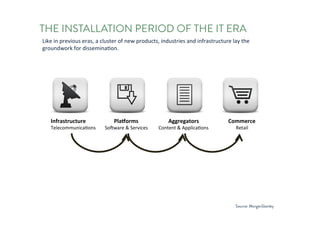
THE INSTALLATION PERIOD OF THE IT ERA
Infrastructure
Telecommunications
Platforms
Software	&	Services
Aggregators
Content	&	Applications
Commerce
Retail
Like	in	previous	eras,	a	cluster	of	new	products,	industries	and	infrastructure	lay	the	
groundwork	for	dissemination.
Source: MorganStanley
ENABLINGTHE DIGITAL TRANSFORMATION
faberNovel 2012 ••• 7
•••
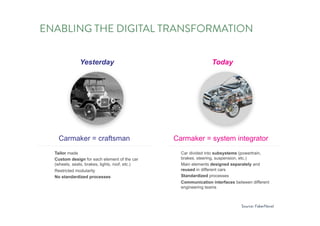
An analogy: The evolution of the car industry follows the logic of APIs
Yesterday Today
Tailor made
Custom design for each element of the car
(wheels, seats, brakes, lights, roof, etc.)
Restricted modularity
No standardized processes
Car divided into subsystems (powertrain,
brakes, steering, suspension, etc.)
Main elements designed separately and
reused in different cars
Standardized processes
Communication interfaces between different
engineering teams
Carmaker = craftsman Carmaker = system integrator
Source: 3Scale, What is an API?
Source: FaberNovel
A PATH TO NEW OPPORTUNITIES
Source: IBM
THREE TECTONIC SHIFTS
ConsumptionProduction Product
Source: Business Model Generation
EXAMPLES
faberNovel 2012 ••• 44
•••
APIs allow companies to effectively pursue the classical triptych of business
goals
Business
Development
#1
Product
Development
#2
SupplyChain
Management
#3
Source: FaberNovel
WHAT ARE THE REAL POSSIBILITIES?
SIX WAYS AN API CAN CHANGE YOUR LIFE
faberNovel 2012 ••• 47
•••
An API is more than the sum of its parts, it combines many advantages
Newbusinessmodel
andrevenuestreams
Newdistributionchannels
andextendedreach
Partnershipdevelopment
ExternalizedR&D
andfosteredinnovation
Rationalizationandcontrolover
whoaccessesyourresources
Organizationflexibility
withinternalAPIs
Source: FaberNovel
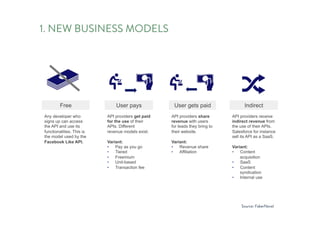
1. NEW BUSINESSMODELS
faberNovel 2012 ••• 49
•••
An API represents a shift in traditional business models
Free User pays User gets paid Indirect
Any developer who
signs up can access
the API and use its
functionalities. This is
the model used by the
Facebook Like API.
API providers get paid
for the use of their
APIs. Different
revenue models exist.
Variant:
•  Pay as you go
•  Tiered
•  Freemium
•  Unit-based
•  Transaction fee
API providers share
revenue with users
for leads they bring to
their website.
Variant:
•  Revenue share
•  Affiliation
API providers receive
indirect revenue from
the use of their APIs.
Salesforce for instance
sell its API as a SaaS.
Variant:
•  Content
acquisition
•  SaaS
•  Content
syndication
•  Internal use
Source: John Musser, ProgrammableWeb.com
Source: FaberNovel
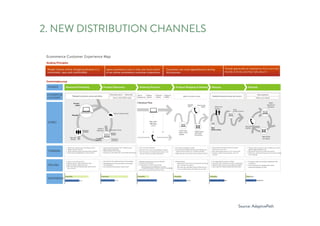
2. NEW DISTRIBUTION CHANNELS
Source: AdaptivePath
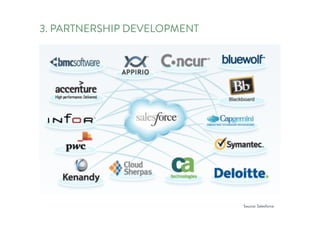
3. PARTNERSHIP DEVELOPMENT
Source: Salesforce
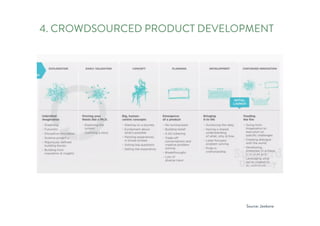
4. CROWDSOURCEDPRODUCT DEVELOPMENT
Source: Jawbone
APIs revolutionize the way
products and services are
delivered
www.astellainvest.com

Astella API Experience

  • 1.
  • 2.
    WHAT IS ANAPI? faberNovel 2012 ••• 6 ••• In other words, APIs are like male and female plugs allowing software to share data and functionalities. Processing Input Output API Provider Program Consumer Program APIs are like male and female plugs allowing software to share data and functionalities Source: FaberNovel
  • 3.
    THERE IS NOTHINGNEW ABOUT AN API faberNovel 2012 ••• 11 ••• Historically, APIs were used by big software companies but their usage is becoming more democratic today 1985-2001 2002 2006 APIs for operating systems •  Create application for OS •  Attract developers •  Enlarge customer base •  Limited to big software companies Application Services APIs •  Build new functionalities •  Trouble-free interoperability •  Accessible to big companies Infrastructure services APIs •  Allows companies to externalize IT infrastructures •  Access to computing power •  Available to anyone Web services APIs •  Share data or services internally and externally •  More unified communication protocol •  Accessible to any company •  Easy integration 1990s Source: 3Scale, What is an API? Source: FaberNovel
  • 4.
  • 5.
  • 6.
    FIVE TECHNOLOGICAL ERASINLAST 250 YEARS Industrial Revolution 1771 Steam and Railways 1829 Steel and Electricity 1875 Oil & Automobile 1908 Information Technology 1971 Britain Britain Continent and US US & Germany Britain US Germany US Europe & Asia Each generated an important all-pervasive low cost input: a source of energy, or a crucial material, or transportation, or communication Arkwright’s Mill opens in Cromford Test of the “Rocket” steam engine for the Liverpool- Manchester Railway The Carnegie Bessemer plan opens in Pittsburg First Model T comes out of Ford’s plan in Detroit The Intel microprocessor is announced in Santa Clara Source: Carlota Pérez – Technological Revolutions and Financial Capital
  • 7.
    FIVE ECONOMIC PARADIGMSHIFTS' Each unleashed a profound transformation in ‘the way of doing things’ across the whole economy Resulting in a best-practice model made up of a set of all-pervasive technological and organizational principles, thus a new way of ‘management’ Industrial Revolution 1771 Steam and Railways 1829 Steel and Electricity 1875 Oil & Automobile 1908 Information Technology 1971 Mechanization Productivity/time keeping Fluidity of movement Economies of agglomeration Economies of scale Standard parts Vertical integration Cartels Cost accounting Mass production Standardization of products Functional specialization Segmentation Economies of scope Globalization Source: Carlota Pérez – Technological Revolutions and Financial Capital
  • 8.
    Mainframe Computing 1960 Mini Computing 1970 Personal Computing 1980 Desktop Computing 1990 Mobile Computing 2000 1MM+ units 10MM+ units 100MM+ units 1B+ units 10B? units Source: Morgan Stanley,IBM, Nokia THE IT ERA IS ABOUT HALF WAY THERE Cycles with the Era last about 10 years. New companies often win big in new cycles. New cycle often create more market capitalization than prior cycles. IBM NCR Control Data Honeywell Digital Equipment Data General HP Prime Microsoft Cisco Intel Apple Oracle Dell Google AOL eBay Tencent Rakuten Apple Google Samsung
  • 9.
    THE INSTALLATION PERIODOF THE IT ERA Infrastructure Telecommunications Platforms Software & Services Aggregators Content & Applications Commerce Retail Like in previous eras, a cluster of new products, industries and infrastructure lay the groundwork for dissemination. Source: MorganStanley
  • 10.
    ENABLINGTHE DIGITAL TRANSFORMATION faberNovel2012 ••• 7 ••• An analogy: The evolution of the car industry follows the logic of APIs Yesterday Today Tailor made Custom design for each element of the car (wheels, seats, brakes, lights, roof, etc.) Restricted modularity No standardized processes Car divided into subsystems (powertrain, brakes, steering, suspension, etc.) Main elements designed separately and reused in different cars Standardized processes Communication interfaces between different engineering teams Carmaker = craftsman Carmaker = system integrator Source: 3Scale, What is an API? Source: FaberNovel
  • 11.
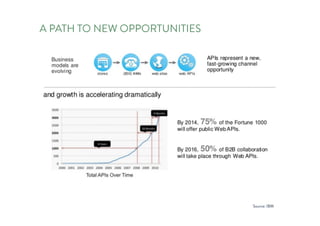
    A PATH TONEW OPPORTUNITIES Source: IBM
  • 12.
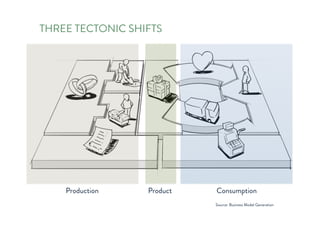
    THREE TECTONIC SHIFTS ConsumptionProductionProduct Source: Business Model Generation
  • 13.
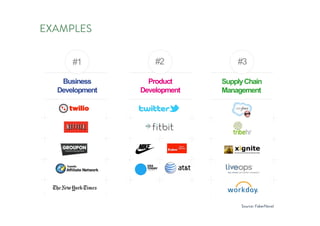
    EXAMPLES faberNovel 2012 •••44 ••• APIs allow companies to effectively pursue the classical triptych of business goals Business Development #1 Product Development #2 SupplyChain Management #3 Source: FaberNovel
  • 14.
    WHAT ARE THEREAL POSSIBILITIES?
  • 15.
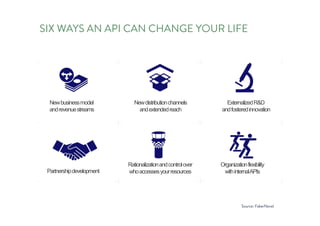
    SIX WAYS ANAPI CAN CHANGE YOUR LIFE faberNovel 2012 ••• 47 ••• An API is more than the sum of its parts, it combines many advantages Newbusinessmodel andrevenuestreams Newdistributionchannels andextendedreach Partnershipdevelopment ExternalizedR&D andfosteredinnovation Rationalizationandcontrolover whoaccessesyourresources Organizationflexibility withinternalAPIs Source: FaberNovel
  • 16.
    1. NEW BUSINESSMODELS faberNovel2012 ••• 49 ••• An API represents a shift in traditional business models Free User pays User gets paid Indirect Any developer who signs up can access the API and use its functionalities. This is the model used by the Facebook Like API. API providers get paid for the use of their APIs. Different revenue models exist. Variant: •  Pay as you go •  Tiered •  Freemium •  Unit-based •  Transaction fee API providers share revenue with users for leads they bring to their website. Variant: •  Revenue share •  Affiliation API providers receive indirect revenue from the use of their APIs. Salesforce for instance sell its API as a SaaS. Variant: •  Content acquisition •  SaaS •  Content syndication •  Internal use Source: John Musser, ProgrammableWeb.com Source: FaberNovel
  • 17.
    2. NEW DISTRIBUTIONCHANNELS Source: AdaptivePath
  • 18.
  • 19.
  • 20.
    APIs revolutionize theway products and services are delivered
  • 21.