Software Estimation
André Pitombeira
Agenda
● Overview
● Estimation
● Challenges with Estimation
● Story points
● Estimation techniques
● Sprint velocity
● Challenges with Sprint velocity
● Brainstorm
● Final considerations
Overview
—John Maynard Keynes. It is better to be roughly right
than precisely wrong.
Overview
● The problem with estimation is people
● We’re bad at making absolute estimates
○ Ideal time (hours, days, weeks)
● We’re good at making relative estimates
○ Size and complexity
● Exercise: Packing for a weekend trip
Estimation
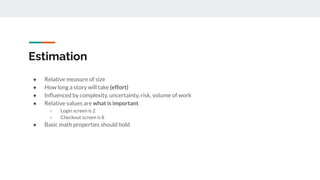
● Relative measure of size
● How long a story will take (effort)
● Influenced by complexity, uncertainty, risk, volume of work
● Relative values are what is important
○ Login screen is 2
○ Checkout screen is 8
● Basic math properties should hold
Challenges with Estimation
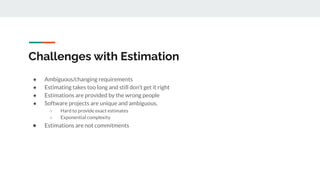
● Ambiguous/changing requirements
● Estimating takes too long and still don’t get it right
● Estimations are provided by the wrong people
● Software projects are unique and ambiguous.
○ Hard to provide exact estimates
○ Exponential complexity
● Estimations are not commitments
Story Points
● Abstract unit of time
○ Depending on the person it can be hours, days, weeks
● The goal is to take us away from thinking in terms of absolute estimates
● Start doing estimations relatively
Story Points
● Fibonacci sequence
○ 1, 2, 3, 5, 8, 13, 21
● Why does it work?
○ Weber’s Law states that the difference we can identify between objects is given by a percentage
○ Each Fibonacci number is about 60% larger than the preceding value
○ According to Weber’s Law, if we can distinguish a 60% difference in effort between two estimates, we can
distinguish that same percentage difference between other estimates
Estimation techniques
● Poker planning
○ Each team member gives an estimation using a card
○ Create consensus
● Affinity sizing
○ Draw a vertical line on a board
○ Review stories and add them to the board
○ Determine points in the end
● Complexity buckets
○ Agree on the bucket criteria
○ Review stories and add them to the buckets
○ Combine points from the buckets and define the final story point value
Sprint Velocity
● Velocity it is a measure of team rate of progress used to estimate future commitments
● How to calculate a team velocity?
○ Look at the historical data from the previous sprints
○ Calculate a confidence interval (usually ~ 90%)
● How to use them?
○ Size -> Calculation -> Duration
■ 300 points is the size
■ 20 points is the velocity
■ The duration is 300/20 = 15
○ It helps the team to do a rough estimation of when something is gonna be released
● Practice: Velocity chart on Jira
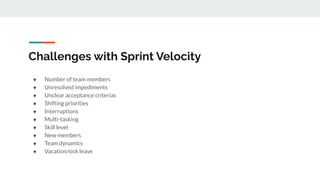
Challenges with Sprint Velocity
● Number of team members
● Unresolved impediments
● Unclear acceptance criterias
● Shifting priorities
● Interruptions
● Multi-tasking
● Skill level
● New members
● Team dynamics
● Vacation/sick leave
Brainstorm
Hands on
Questions?
Thank you!

Software estimation techniques

  • 1.
  • 2.
    Agenda ● Overview ● Estimation ●Challenges with Estimation ● Story points ● Estimation techniques ● Sprint velocity ● Challenges with Sprint velocity ● Brainstorm ● Final considerations
  • 3.
    Overview —John Maynard Keynes.It is better to be roughly right than precisely wrong.
  • 4.
    Overview ● The problemwith estimation is people ● We’re bad at making absolute estimates ○ Ideal time (hours, days, weeks) ● We’re good at making relative estimates ○ Size and complexity ● Exercise: Packing for a weekend trip
  • 5.
    Estimation ● Relative measureof size ● How long a story will take (effort) ● Influenced by complexity, uncertainty, risk, volume of work ● Relative values are what is important ○ Login screen is 2 ○ Checkout screen is 8 ● Basic math properties should hold
  • 6.
    Challenges with Estimation ●Ambiguous/changing requirements ● Estimating takes too long and still don’t get it right ● Estimations are provided by the wrong people ● Software projects are unique and ambiguous. ○ Hard to provide exact estimates ○ Exponential complexity ● Estimations are not commitments
  • 7.
    Story Points ● Abstractunit of time ○ Depending on the person it can be hours, days, weeks ● The goal is to take us away from thinking in terms of absolute estimates ● Start doing estimations relatively
  • 8.
    Story Points ● Fibonaccisequence ○ 1, 2, 3, 5, 8, 13, 21 ● Why does it work? ○ Weber’s Law states that the difference we can identify between objects is given by a percentage ○ Each Fibonacci number is about 60% larger than the preceding value ○ According to Weber’s Law, if we can distinguish a 60% difference in effort between two estimates, we can distinguish that same percentage difference between other estimates
  • 9.
    Estimation techniques ● Pokerplanning ○ Each team member gives an estimation using a card ○ Create consensus ● Affinity sizing ○ Draw a vertical line on a board ○ Review stories and add them to the board ○ Determine points in the end ● Complexity buckets ○ Agree on the bucket criteria ○ Review stories and add them to the buckets ○ Combine points from the buckets and define the final story point value
  • 10.
    Sprint Velocity ● Velocityit is a measure of team rate of progress used to estimate future commitments ● How to calculate a team velocity? ○ Look at the historical data from the previous sprints ○ Calculate a confidence interval (usually ~ 90%) ● How to use them? ○ Size -> Calculation -> Duration ■ 300 points is the size ■ 20 points is the velocity ■ The duration is 300/20 = 15 ○ It helps the team to do a rough estimation of when something is gonna be released ● Practice: Velocity chart on Jira
  • 11.
    Challenges with SprintVelocity ● Number of team members ● Unresolved impediments ● Unclear acceptance criterias ● Shifting priorities ● Interruptions ● Multi-tasking ● Skill level ● New members ● Team dynamics ● Vacation/sick leave
  • 12.
  • 13.
  • 14.