ESTIMATION 
PROTIPS 
JONATHON HILL 
NCDEVCON, SEPT. 2014
BACKGROUND 
• Self-taught 
• 5+ years of full-time development 
• Former CTO for a small web startup 
• Former Director of Development for 
a digital marketing agency 
• AtlantaPHP Steering Committee
I DID IT WRONG
PROTIP #1: 
ESTIMATES ARE 
NOT PROMISES
(N) ES-TIM-ATE: 
An attempt to quantify something in 
the face of the unknown. 
By definition, estimates are imprecise 
and tentative, versus
“GOOD” ESTIMATE 
A good estimation approach should 
provide estimates that are within 25% 
of the actual results 75% of the time. 
Conte, Dunsmore, and Shen (1986)
CERTAINTY 
Sadly, people asking for control or 
visibility really want certainty. 
Which doesn’t exist. 
Dan North 
https://twitter.com/tastapod/status/116271851767992320
DISTINCTIONS 
Target: a stated desirable business 
objective 
Commitment: a promise to deliver a 
specific product within a specific 
timeframe
DEFINITION 
A good estimate is an estimate that 
provides a clear enough view of the 
project reality to allow the project 
leadership to make good decisions 
about how to control the project to hit 
targets. 
Steve McConnell, Software Estimation
PROTIP #2: 
YOUR GUT LIES
HEAVIEST BLUE WHALE EVER RECORDED 
380,000 LBS
REALISTIC?
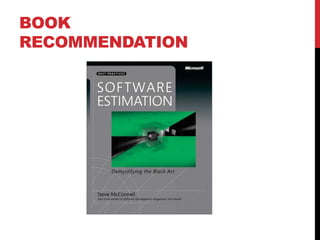
BOOK 
RECOMMENDATION
HOFSTADTER’S LAW 
“It always takes longer than you 
expect, even when you take into 
account Hofstadter’s Law.” 
Douglas Hofstadter 
Gödel, Escher, Bach: An Eternal Golden Braid
WHY?
IT’LL BE DIFFERENT 
THIS TIME!
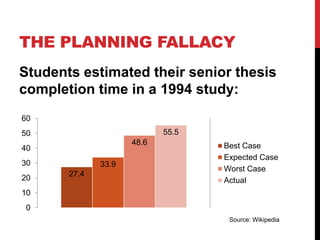
THE PLANNING FALLACY 
Students estimated their senior thesis 
completion time in a 1994 study: 
27.4 
33.9 
48.6 
55.5 
60 
50 
40 
30 
20 
10 
0 
Best Case 
Expected Case 
Worst Case 
Actual 
Source: Wikipedia
TIME FRAMES 
“With software estimation you've only 
realistically got a choice of 5 mins, 1 
hour, 1-2 days, about a week, and then 
all bets are off.” 
Rob Bowley 
https://twitter.com/robbowley/status/115430969825181696
TIME FRAMES 
Can it be done in… 
• 5 minutes? 
• 1 hour? 
• 1-2 days? 
• 1 week?
PROTIP #3: 
PREMATURE 
ESTIMATION IS 
SABOTAGE
DEFINITION 
A good estimate is an estimate that 
provides a clear enough view of the 
project reality to allow the project 
leadership to make good decisions 
about how to control the project to hit 
targets. 
Steve McConnell, Software Estimation
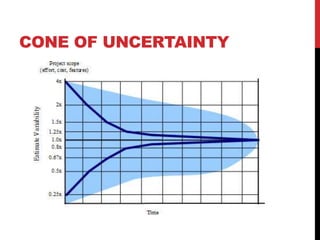
CONE OF UNCERTAINTY
OVERESTIMATION 
• Inflated prices – might lose the job 
• Lack of urgency – project time fills 
up the estimate when it could have 
been done faster 
• Procrastination
UNDERESTIMATION 
• Inadequate planning 
• Missed deadlines 
• Overwork, burnout 
• More bugs 
• Technical debt 
• Damage control 
• Unplanned interim releases 
• Meetings proliferate
IS IT USEFUL? 
If there’s as much chance of you 
coming up with something meaningful 
by rolling some dice or rubbing the 
estimate goat then what purpose are 
you satisfying by doing so? 
Rob Bowley
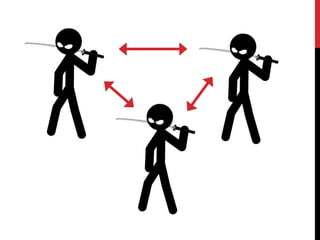
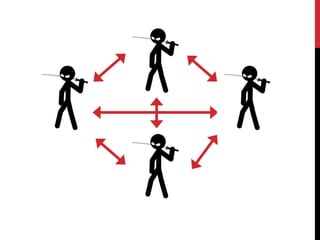
PROTIP #4: 
BIG TEAMS ARE 
SLOWER THAN 
SMALL ONES
TIME 
= 
ESTIMATE 
÷ 
AVAILABILITY
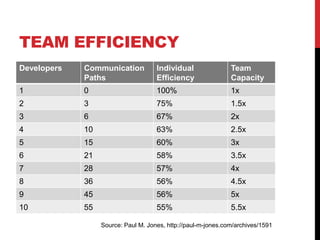
TEAM EFFICIENCY 
Developers Communication 
Paths 
Individual 
Efficiency 
Team 
Capacity 
1 0 100% 1x 
2 3 75% 1.5x 
3 6 67% 2x 
4 10 63% 2.5x 
5 15 60% 3x 
6 21 58% 3.5x 
7 28 57% 4x 
8 36 56% 4.5x 
9 45 56% 5x 
10 55 55% 5.5x 
Source: Paul M. Jones, http://paul-m-jones.com/archives/1591
PROTIP #5: 
BEWARE 
UNWARRANTED 
PRECISION
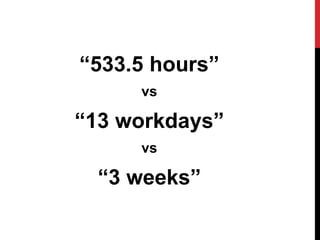
“533.5 hours” 
vs 
“13 workdays” 
vs 
“3 weeks”
PROTIP #6: 
COUNT ALL THE 
THINGS!
TIME FRAMES 
Can it be done in… 
• 5 minutes? 
• 1 hour? 
• 1-2 days? 
• 1 week?
DECOMPOSITION AND 
RECOMPOSITION 
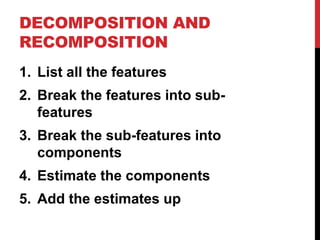
1. List all the features 
2. Break the features into sub-features 
3. Break the sub-features into 
components 
4. Estimate the components 
5. Add the estimates up
LAW OF LARGE NUMBERS 
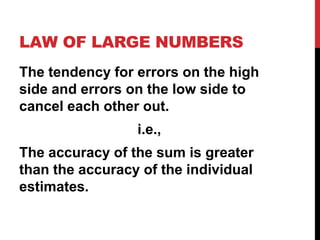
The tendency for errors on the high 
side and errors on the low side to 
cancel each other out. 
i.e., 
The accuracy of the sum is greater 
than the accuracy of the individual 
estimates.
PAUL JONES’ METHOD 
1. List all the controllers required for 
each feature 
2. List all the methods required for 
each controller 
3. Estimate 1 dev-pair day per 
controller method
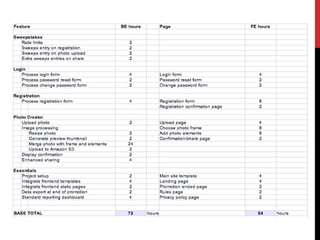
BRANDMOVERS 
METHOD 
1. List all the logical features required 
2. Break down each feature into small 
logical components 
3. List all the pages and modals required for 
each feature 
4. Estimate the back-end time required for 
each logical component 
5. Estimate the front-end time required for 
each page 
6. Sum up the back-end and front-end totals
PROTIP #7: 
WHEN IN A 
PINCH, USE A 
PROXY
PROXY ESTIMATION 
1. Assign a size classification to each 
feature 
2. Compute the average time required 
for similarly-sized features from 
actual past projects 
3. Create estimate ranges for each 
feature based on past performance 
4. Sum the result
PROS 
• Easier 
• Faster
CONS 
• Less accurate 
• Requires collection and archival of 
project historical data on a per-feature 
basis
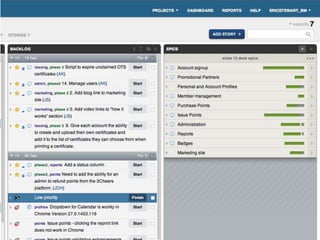
STORY POINTS 
• Uses a point scale: 1, 2, 4, 8, 16 
• Break down the project into epics and 
stories 
• Assign a point value to each story 
• Schedule releases at regular intervals 
• The number of points completed per 
release is known as “velocity” 
• Use the velocity to plan and estimate 
the delivery dates for future releases
EXAMPLE 
Iteration 1 
• 27 story points delivered 
• 12 staff weeks expended over 3 calendar weeks 
• Effort = 27 points / 12 weeks = 2.25 points/week 
• Schedule = 27 points / 3 weeks = 9 points/week 
Iteration 2 projection 
• 33 story points scheduled 
• Effort = 33 points / 2.25 points/week = 15 staff weeks 
• Schedule = 33 points / 9 points/week = 4 calendar weeks
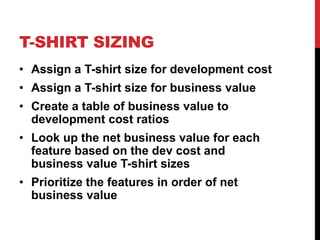
T-SHIRT SIZING 
• Assign a T-shirt size for development cost 
• Assign a T-shirt size for business value 
• Create a table of business value to 
development cost ratios 
• Look up the net business value for each 
feature based on the dev cost and 
business value T-shirt sizes 
• Prioritize the features in order of net 
business value
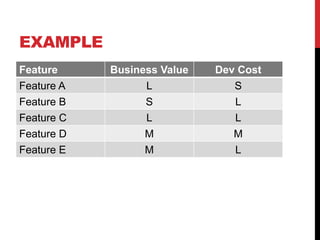
EXAMPLE 
Feature Business Value Dev Cost 
Feature A L S 
Feature B S L 
Feature C L L 
Feature D M M 
Feature E M L
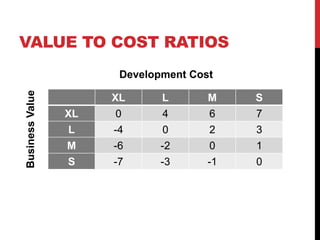
VALUE TO COST RATIOS 
Development Cost 
XL L M S 
XL 0 4 6 7 
L -4 0 2 3 
M -6 -2 0 1 
S -7 -3 -1 0 
Business Value
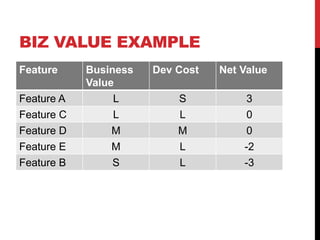
BIZ VALUE EXAMPLE 
Feature Business 
Value 
Dev Cost Net Value 
Feature A L S 3 
Feature C L L 0 
Feature D M M 0 
Feature E M L -2 
Feature B S L -3
PROTIP #8: 
YOU CAN’T 
NEGOTIATE MATH
PROBLEM SOLVING 
When the estimate and target conflict: 
• Negotiate features 
• Negotiate time 
• Negotiate price
ATTITUDE 
• Try to be helpful, offer solutions 
• Be creative 
• Examine what can be done in 
parallel to save time 
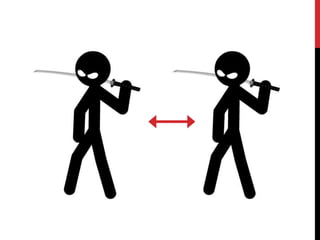
• Be firm – you can’t change the laws 
of physics
QUESTIONS?
ONE FINAL WORD 
A HORROR STORY
THE SETTING 
• Former employer of mine 
• Start-up, naïve and inexperienced 
• Needed cash bad
THE CLIENT 
• Small company in Atlanta 
• Four separate disconnected 
systems 
• Wanted web-based workflow 
consolidation 
• Wanted online ordering and 

payments
THE ESTIMATE 
• Estimated at 1,039 man-hours 
• Normal hourly rate was $120/hr 
• We did a fixed-bid for $50k, at an 
effective hourly rate of $48/hr
THE FALLOUT 
• 18 months later… 
• 2,500 man-hours 
• 1,500+ Subversion commits 
• Lots of “unknown unknowns”, 
hidden complexities, and scope 
creep
THE MORAL 
• Don’t succumb to optimism or 
planning bias 
• Use a good estimation methodology 
• Try not to do fixed bidding 
• Always have a thorough scope 
before starting
ESTIMATION PROTIPS 
1. Estimates are not promises 
2. Your gut lies 
3. Premature estimation is sabotage 
4. Big teams are slower than small ones 
5. Beware unwarranted precision 
6. Count all the things! 
7. When in a pinch, use a proxy 
8. You can’t negotiate math
JonathonHill.net 
@compwright 
Book Recommendation: 
Software Estimation: 
Demystifying the Black Art 
by Steve McConnell

Estimation Protips - NCDevCon 2014

  • 1.
    ESTIMATION PROTIPS JONATHONHILL NCDEVCON, SEPT. 2014
  • 2.
    BACKGROUND • Self-taught • 5+ years of full-time development • Former CTO for a small web startup • Former Director of Development for a digital marketing agency • AtlantaPHP Steering Committee
  • 6.
    I DID ITWRONG
  • 7.
    PROTIP #1: ESTIMATESARE NOT PROMISES
  • 8.
    (N) ES-TIM-ATE: Anattempt to quantify something in the face of the unknown. By definition, estimates are imprecise and tentative, versus
  • 9.
    “GOOD” ESTIMATE Agood estimation approach should provide estimates that are within 25% of the actual results 75% of the time. Conte, Dunsmore, and Shen (1986)
  • 10.
    CERTAINTY Sadly, peopleasking for control or visibility really want certainty. Which doesn’t exist. Dan North https://twitter.com/tastapod/status/116271851767992320
  • 11.
    DISTINCTIONS Target: astated desirable business objective Commitment: a promise to deliver a specific product within a specific timeframe
  • 13.
    DEFINITION A goodestimate is an estimate that provides a clear enough view of the project reality to allow the project leadership to make good decisions about how to control the project to hit targets. Steve McConnell, Software Estimation
  • 14.
  • 16.
    HEAVIEST BLUE WHALEEVER RECORDED 380,000 LBS
  • 17.
  • 18.
  • 19.
    HOFSTADTER’S LAW “Italways takes longer than you expect, even when you take into account Hofstadter’s Law.” Douglas Hofstadter Gödel, Escher, Bach: An Eternal Golden Braid
  • 20.
  • 22.
  • 23.
    THE PLANNING FALLACY Students estimated their senior thesis completion time in a 1994 study: 27.4 33.9 48.6 55.5 60 50 40 30 20 10 0 Best Case Expected Case Worst Case Actual Source: Wikipedia
  • 25.
    TIME FRAMES “Withsoftware estimation you've only realistically got a choice of 5 mins, 1 hour, 1-2 days, about a week, and then all bets are off.” Rob Bowley https://twitter.com/robbowley/status/115430969825181696
  • 26.
    TIME FRAMES Canit be done in… • 5 minutes? • 1 hour? • 1-2 days? • 1 week?
  • 27.
    PROTIP #3: PREMATURE ESTIMATION IS SABOTAGE
  • 28.
    DEFINITION A goodestimate is an estimate that provides a clear enough view of the project reality to allow the project leadership to make good decisions about how to control the project to hit targets. Steve McConnell, Software Estimation
  • 29.
  • 30.
    OVERESTIMATION • Inflatedprices – might lose the job • Lack of urgency – project time fills up the estimate when it could have been done faster • Procrastination
  • 31.
    UNDERESTIMATION • Inadequateplanning • Missed deadlines • Overwork, burnout • More bugs • Technical debt • Damage control • Unplanned interim releases • Meetings proliferate
  • 33.
    IS IT USEFUL? If there’s as much chance of you coming up with something meaningful by rolling some dice or rubbing the estimate goat then what purpose are you satisfying by doing so? Rob Bowley
  • 34.
    PROTIP #4: BIGTEAMS ARE SLOWER THAN SMALL ONES
  • 36.
    TIME = ESTIMATE ÷ AVAILABILITY
  • 41.
    TEAM EFFICIENCY DevelopersCommunication Paths Individual Efficiency Team Capacity 1 0 100% 1x 2 3 75% 1.5x 3 6 67% 2x 4 10 63% 2.5x 5 15 60% 3x 6 21 58% 3.5x 7 28 57% 4x 8 36 56% 4.5x 9 45 56% 5x 10 55 55% 5.5x Source: Paul M. Jones, http://paul-m-jones.com/archives/1591
  • 42.
    PROTIP #5: BEWARE UNWARRANTED PRECISION
  • 43.
    “533.5 hours” vs “13 workdays” vs “3 weeks”
  • 45.
    PROTIP #6: COUNTALL THE THINGS!
  • 46.
    TIME FRAMES Canit be done in… • 5 minutes? • 1 hour? • 1-2 days? • 1 week?
  • 47.
    DECOMPOSITION AND RECOMPOSITION 1. List all the features 2. Break the features into sub-features 3. Break the sub-features into components 4. Estimate the components 5. Add the estimates up
  • 48.
    LAW OF LARGENUMBERS The tendency for errors on the high side and errors on the low side to cancel each other out. i.e., The accuracy of the sum is greater than the accuracy of the individual estimates.
  • 49.
    PAUL JONES’ METHOD 1. List all the controllers required for each feature 2. List all the methods required for each controller 3. Estimate 1 dev-pair day per controller method
  • 50.
    BRANDMOVERS METHOD 1.List all the logical features required 2. Break down each feature into small logical components 3. List all the pages and modals required for each feature 4. Estimate the back-end time required for each logical component 5. Estimate the front-end time required for each page 6. Sum up the back-end and front-end totals
  • 52.
    PROTIP #7: WHENIN A PINCH, USE A PROXY
  • 53.
    PROXY ESTIMATION 1.Assign a size classification to each feature 2. Compute the average time required for similarly-sized features from actual past projects 3. Create estimate ranges for each feature based on past performance 4. Sum the result
  • 54.
    PROS • Easier • Faster
  • 55.
    CONS • Lessaccurate • Requires collection and archival of project historical data on a per-feature basis
  • 56.
    STORY POINTS •Uses a point scale: 1, 2, 4, 8, 16 • Break down the project into epics and stories • Assign a point value to each story • Schedule releases at regular intervals • The number of points completed per release is known as “velocity” • Use the velocity to plan and estimate the delivery dates for future releases
  • 57.
    EXAMPLE Iteration 1 • 27 story points delivered • 12 staff weeks expended over 3 calendar weeks • Effort = 27 points / 12 weeks = 2.25 points/week • Schedule = 27 points / 3 weeks = 9 points/week Iteration 2 projection • 33 story points scheduled • Effort = 33 points / 2.25 points/week = 15 staff weeks • Schedule = 33 points / 9 points/week = 4 calendar weeks
  • 59.
    T-SHIRT SIZING •Assign a T-shirt size for development cost • Assign a T-shirt size for business value • Create a table of business value to development cost ratios • Look up the net business value for each feature based on the dev cost and business value T-shirt sizes • Prioritize the features in order of net business value
  • 60.
    EXAMPLE Feature BusinessValue Dev Cost Feature A L S Feature B S L Feature C L L Feature D M M Feature E M L
  • 61.
    VALUE TO COSTRATIOS Development Cost XL L M S XL 0 4 6 7 L -4 0 2 3 M -6 -2 0 1 S -7 -3 -1 0 Business Value
  • 62.
    BIZ VALUE EXAMPLE Feature Business Value Dev Cost Net Value Feature A L S 3 Feature C L L 0 Feature D M M 0 Feature E M L -2 Feature B S L -3
  • 63.
    PROTIP #8: YOUCAN’T NEGOTIATE MATH
  • 65.
    PROBLEM SOLVING Whenthe estimate and target conflict: • Negotiate features • Negotiate time • Negotiate price
  • 66.
    ATTITUDE • Tryto be helpful, offer solutions • Be creative • Examine what can be done in parallel to save time • Be firm – you can’t change the laws of physics

  • 67.
  • 68.
    ONE FINAL WORD A HORROR STORY
  • 69.
    THE SETTING •Former employer of mine • Start-up, naïve and inexperienced • Needed cash bad
  • 70.
    THE CLIENT •Small company in Atlanta • Four separate disconnected systems • Wanted web-based workflow consolidation • Wanted online ordering and payments
  • 71.
    THE ESTIMATE •Estimated at 1,039 man-hours • Normal hourly rate was $120/hr • We did a fixed-bid for $50k, at an effective hourly rate of $48/hr
  • 72.
    THE FALLOUT •18 months later… • 2,500 man-hours • 1,500+ Subversion commits • Lots of “unknown unknowns”, hidden complexities, and scope creep
  • 73.
    THE MORAL •Don’t succumb to optimism or planning bias • Use a good estimation methodology • Try not to do fixed bidding • Always have a thorough scope before starting
  • 74.
    ESTIMATION PROTIPS 1.Estimates are not promises 2. Your gut lies 3. Premature estimation is sabotage 4. Big teams are slower than small ones 5. Beware unwarranted precision 6. Count all the things! 7. When in a pinch, use a proxy 8. You can’t negotiate math
  • 75.
    JonathonHill.net @compwright BookRecommendation: Software Estimation: Demystifying the Black Art by Steve McConnell

Editor's Notes

  • #11 Dan North sez…
  • #12 Targets: “We need v2.1 ready to demo at a trade show in May.” “Our budget is $2mm, we must limit the cost of the next release to that budget.”
  • #13 Here’s the problem: estimates and targets often collide. Good estimates are probability statements based on what is known about the project and available resources, and targets are specific business objects that are sometimes quite solid. At Brandmovers, if we’re building a promotion to help generate buzz and excitement for the next Avengers movie, and that movie launches on a particular date, it isn’t really an option to delay launching the promotion if the project runs over. So if an estimate isn’t a promise, what is a good estimate?
  • #15 Ever been asked for a “gut estimate?” It’s not at all uncommon to be asked to estimate something about which you have next to no knowledge. To illustrate the point, I’d like to do a little exercise.
  • #16 I’d like you to estimate the weight, in pounds, of the heaviest blue whale ever recorded. No cheating, don’t Google it. Give a high and a low estimate. Here’s the catch: I want you to estimate this with a wide enough range so that you are 90% confident that the correct answer is in the range that you set. You’ve got one minute. Go.
  • #17 Now, I’d like to get a show of hands of how many of you captured the correct answer in your range. Almost everyone gets this wrong.
  • #18 You might be thinking, “c’mon, this is not a realistic exercise.” Folks, estimating in the face of this kind of uncertainty is business as usual for software estimators. Fortunately, there are techniques that will help you get within 25% of the actual number 75% of the time. The other takeaway here is unless you are into statistics and you have have a mathematical reason for saying so, don’t use terms like “90% confident” or “75% confident.”
  • #19 Before we go any further, I’d like to share a book recommendation. The exercise we just did comes from chapter 2 of the book Software Estimation, by Steve McConnell. Steve is a former Microsoft employee and also authored the book Code Complete. Software Estimation is pretty much required reading for anyone who is responsible for estimating software projects. This book really helped me to understand why good estimation practices work, and what I had been doing wrong for years before.
  • #20 Hofstadter’s Law illustrates why estimation is so hard, and why so many people get it wrong. In fact, the difficulties with producing even a ballpark estimate and the the tendency to misunderstand and abuse estimation have led some to seek workflows which eliminate estimation altogether. Some agile methodologies do this. Sadly, the dynamics and business models of many companies do not allow such a luxury.
  • #46 We’ve talked about a lot of theory, what estimates are, what they’re good for. Now let’s talk about some practical methodology.
  • #47 Remember Rob Bowley’s timeframes?
  • #48 This is the underlying idea behind estimation by decomposition. Essentially, you break down the project features, and then you break down those sub-features down even further to the individual components that must be built. Estimate each component, and sum the individual estimates to produce the overall estimate.
  • #50 There are a few different ways to do this. The first way was pretty hard for me to swallow at first. I learned it from Paul Jones and in practice it works very well. This method includes front-end, back-end, and QA time built in and was created based on his personal observations from working on many different projects. Notice the large unit of measure (1 day), and the fact that it assumes two people will be pair programming. I never understood why this method worked so well until I learned about the law of large numbers. Simple methods are often quite effective! It doesn’t take complex mathematics or estimation modeling software to produce a useful estimate. A spreadsheet and a good method are all you need.
  • #71 Had four separate systems in place for managing customer data, billing, inventory, and fulfillment
  • #72 Did I mention we needed the money?
  • #73 $25-30/hr effectively