Software Te$ting
                    E 'HSHQGDEOH (PEHGGHG 6VWHPV
                                -LDQWDR 3DQ
                               )HE  
Required Reading:      Towards Target-Level Testing and Debugging Tools for Embedded Software
Fun Reading:           http://www.cnet.com/Content/Features/Dlife/Bugs/?dd
Best Tutorial:         Software-reliability-engineered testing practice; John D.Musa; Proceedings
                       of the 1997 ICSE, Pages 628 - 629
Authoritative Books:   The Art of Software Testing, Glenford J. Myers, 1979
                        Black-box Testing, Boris Beizer, 1995
                       The Complete Guide to Software Testing, Hetzel, William C., 1988
You Are Here
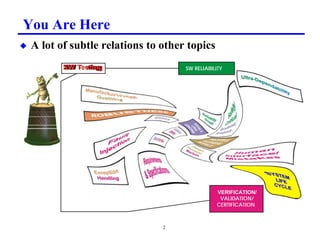
x   A lot of subtle relations to other topics
                                      SW RELIABILITY


                                                 VERIFICATION/
                                                  VALIDATION/
                                                 CERTIFICATION


                                 2
Introduction
x   Definitions of Software Testing
    • [1]: Testing is the process of executing a program or system with
      the intent of finding errors.
    • [3]: Testing is any activity aimed at evaluating an attribute or
      capability of a program or system and determining that it meets its
      required results.
x   Vocabulary  Concepts
    • Defects, bugs, faults[ANSI], errata[Intel]
    • Testing is more than debugging[BEIZER90]
x   Software testing is an        ……               $57
    • because we still can not make it a science
x   Software testing is everywhere
    • in every phase of software life cycle, whenever software changes
    • 50%+ time in debugging/testing
x   Software testing is not mature
                                     3
Why testing?
x   For Quality

    •bugs kill
        – in a computerized embedded world
    • Defect detection (find problems and get them fixed
      [KANER93])
        – Better early than late
           » Difficult to upgrade field software in embedded systems
    • To make quality visible [HETZEL88]
x   For Verification  Validation(VV):
    • show it works:
        – clean test/positive test
    • or it can handle exceptional situations:
        – dirty test/negative test
x   For Reliability Estimation [KANER93]
    • E.g. reliability growth testing
                                                 4
Why software testing is difficult -- principles
x   Software fails in different ways with physical systems
x   Imperfection of human nature(to handle complexity)
x   Cannot exterminate bugs
    • We cannot test a typical program completely
    • The Pesticide Paradox[BEIZER90]
        – Every method you use to prevent or find bugs leaves a residue of subtler bugs
          against which those methods are ineffectual.
        – Fixing the previous(easy) bugs will tend to increase software complexity --
          introducing new subtler bugs
    • The Complexity Barrier[BEIZER90]
        – Software complexity(and therefore that of bugs) grows to the limits of our ability to
          manage that complexity.


                                                5
Software Testing: Taxonomy
x   By purposes                           x   By scope
    • Correctness testing                     • implied in [BEIZER95]
        – Black-box                              –   Unit testing
        – White-box                              –   Component testing
    • Performance testing                        –   Integration testing
    • Reliability testing                        –   System testing
        – Robustness testing                  • or in [PERRY90]
           » Exception handling testing          –   Unit testing
           » Stress/load testing
                                                 –   String testing
    • Security testing                           –   System testing (α test)
x   By life cycle phase[PERRY95]                 –   Acceptance testing (β test)
    •   Requirements phase testing
    •   Design phase testing
    •   Program phase testing
    •   Evaluating test results
    •   Installation phase testing
    •   Acceptance testing
    •   Testing changes: maintenance
                                          6
Correctness Testing
x   Needs some type of oracles
x   Black-box testing/behavioral testing
    •   also: data-driven; input/output driven[1]; requirements-based[3]
    •   Test data are derived solely from the program structure[9]
    •   “Exhaustive input testing”[1]
    •   But, what about omissions/extras in spec?
x   White-box testing/structural testing
    • also: logic-driven[1]; design-based[3]
    • Application of test data derived from the specified functional
      requirements without regard to the final program structure[9]
    • “Exhaustive path testing”[1]
    • But, what about omissions/extras in code?
x   Other than bugs, we may find:
    • Features
    • Specification problems
    • Design philosophy (e.g. core dumps v.s. error return code)
                                      7
Correctness Testing Methods/Tools
x   Control-flow testing
    • Trace control-flow using control-flow graph; coverage
x   Loop testing
    • A heuristic technique; should be combined with other methods    Flow-
    • Applied when there is a loop in graph                           coverage
x   Data-flow testing                                                 testing
    • Trace data-flow using data-flow graph; coverage
x   Transaction-flow testing
    • Testing of on-line applications and batch-processing software
    • Has both control-flow and data-flow attributes
x   Domain testing
    • Software dominated by numerical processing
x   Syntax testing
    • Command-driven software and similar applications
x   Finite-state testing
    • Using finite-state machine model
    • motivated from hardware logic design
    • Excellent for testing menu-driven applications
                                          8
When to stop testing?


x   Trade-off between budget+time and quality
    • Part of acceptance testing
x   Stopping rules:
    • When reliability meets requirement
       – Statistical models
          » E.g. reliability growth models
       – Data gathering -- modeling --prediction
       – Not possible to calculate for ultra-dependable system
          » Because failure data is hard to accumulate
    • When out of resources: test case, money and/or time
                                             9
Testing is Controversial
x   Alternatives to testing
    • “human testing[MYERS79]”
        – inspections, walkthroughs, reviews
    • Engineering methods
        – Clean-room v.s. testing
    • Formal Verification v.s. Testing

x   Flames
    •   Traditional coverage-based testing is flawed.
    •   Testing can only prove the software is flawed.
    •   Inspection/review more effective than testing?
    •   “If we have good process, good quality, we don't need much
        testing”


                                          10
Conclusions
x   Complete testing is infeasible
    • Complexity problem
    • Equivalent to Turing halting problem
x   Software testing is immature
    • Crucial to software quality
x   Testing is more than debugging
    • For quality assurance, validation and reliability measurement
x   Rules of thumb
    • Efficiency  effectiveness
    • Automation
x   When to stop: need good metrics
    • Reliability
    • Time  budget


                                           11
List of References
x   [1][MYERS79] The art of software testing
x   [2][BEIZER95] Black-box Testing
x   [3][HETZEL88] The Complete Guide to Software Testing
x   [4][PHAM95] Software Reliability and Testing, pp29
x   [5][KANER93] Testing Computer Software
x   [6][PERRY95] Effective Methods for Software Testing, William
    Perry, 1995 QA76.76.T48P47X
x   [7][BEIZER90] Software Testing Techniques
x   [8]http://www.cs.jmu.edu/users/foxcj/cs555/Unit12/Testing/index.
    htm
x   [9][PERRY90] A standard for testing application software,
    William E. Perry, 1990


                                   12

Presentation

  • 1.
    Software Te$ting E 'HSHQGDEOH (PEHGGHG 6VWHPV -LDQWDR 3DQ )HE Required Reading: Towards Target-Level Testing and Debugging Tools for Embedded Software Fun Reading: http://www.cnet.com/Content/Features/Dlife/Bugs/?dd Best Tutorial: Software-reliability-engineered testing practice; John D.Musa; Proceedings of the 1997 ICSE, Pages 628 - 629 Authoritative Books: The Art of Software Testing, Glenford J. Myers, 1979 Black-box Testing, Boris Beizer, 1995 The Complete Guide to Software Testing, Hetzel, William C., 1988
  • 2.
    You Are Here x A lot of subtle relations to other topics SW RELIABILITY VERIFICATION/ VALIDATION/ CERTIFICATION 2
  • 3.
    Introduction x Definitions of Software Testing • [1]: Testing is the process of executing a program or system with the intent of finding errors. • [3]: Testing is any activity aimed at evaluating an attribute or capability of a program or system and determining that it meets its required results. x Vocabulary Concepts • Defects, bugs, faults[ANSI], errata[Intel] • Testing is more than debugging[BEIZER90] x Software testing is an …… $57 • because we still can not make it a science x Software testing is everywhere • in every phase of software life cycle, whenever software changes • 50%+ time in debugging/testing x Software testing is not mature 3
  • 4.
    Why testing? x For Quality •bugs kill – in a computerized embedded world • Defect detection (find problems and get them fixed [KANER93]) – Better early than late » Difficult to upgrade field software in embedded systems • To make quality visible [HETZEL88] x For Verification Validation(VV): • show it works: – clean test/positive test • or it can handle exceptional situations: – dirty test/negative test x For Reliability Estimation [KANER93] • E.g. reliability growth testing 4
  • 5.
    Why software testingis difficult -- principles x Software fails in different ways with physical systems x Imperfection of human nature(to handle complexity) x Cannot exterminate bugs • We cannot test a typical program completely • The Pesticide Paradox[BEIZER90] – Every method you use to prevent or find bugs leaves a residue of subtler bugs against which those methods are ineffectual. – Fixing the previous(easy) bugs will tend to increase software complexity -- introducing new subtler bugs • The Complexity Barrier[BEIZER90] – Software complexity(and therefore that of bugs) grows to the limits of our ability to manage that complexity. 5
  • 6.
    Software Testing: Taxonomy x By purposes x By scope • Correctness testing • implied in [BEIZER95] – Black-box – Unit testing – White-box – Component testing • Performance testing – Integration testing • Reliability testing – System testing – Robustness testing • or in [PERRY90] » Exception handling testing – Unit testing » Stress/load testing – String testing • Security testing – System testing (α test) x By life cycle phase[PERRY95] – Acceptance testing (β test) • Requirements phase testing • Design phase testing • Program phase testing • Evaluating test results • Installation phase testing • Acceptance testing • Testing changes: maintenance 6
  • 7.
    Correctness Testing x Needs some type of oracles x Black-box testing/behavioral testing • also: data-driven; input/output driven[1]; requirements-based[3] • Test data are derived solely from the program structure[9] • “Exhaustive input testing”[1] • But, what about omissions/extras in spec? x White-box testing/structural testing • also: logic-driven[1]; design-based[3] • Application of test data derived from the specified functional requirements without regard to the final program structure[9] • “Exhaustive path testing”[1] • But, what about omissions/extras in code? x Other than bugs, we may find: • Features • Specification problems • Design philosophy (e.g. core dumps v.s. error return code) 7
  • 8.
    Correctness Testing Methods/Tools x Control-flow testing • Trace control-flow using control-flow graph; coverage x Loop testing • A heuristic technique; should be combined with other methods Flow- • Applied when there is a loop in graph coverage x Data-flow testing testing • Trace data-flow using data-flow graph; coverage x Transaction-flow testing • Testing of on-line applications and batch-processing software • Has both control-flow and data-flow attributes x Domain testing • Software dominated by numerical processing x Syntax testing • Command-driven software and similar applications x Finite-state testing • Using finite-state machine model • motivated from hardware logic design • Excellent for testing menu-driven applications 8
  • 9.
    When to stoptesting? x Trade-off between budget+time and quality • Part of acceptance testing x Stopping rules: • When reliability meets requirement – Statistical models » E.g. reliability growth models – Data gathering -- modeling --prediction – Not possible to calculate for ultra-dependable system » Because failure data is hard to accumulate • When out of resources: test case, money and/or time 9
  • 10.
    Testing is Controversial x Alternatives to testing • “human testing[MYERS79]” – inspections, walkthroughs, reviews • Engineering methods – Clean-room v.s. testing • Formal Verification v.s. Testing x Flames • Traditional coverage-based testing is flawed. • Testing can only prove the software is flawed. • Inspection/review more effective than testing? • “If we have good process, good quality, we don't need much testing” 10
  • 11.
    Conclusions x Complete testing is infeasible • Complexity problem • Equivalent to Turing halting problem x Software testing is immature • Crucial to software quality x Testing is more than debugging • For quality assurance, validation and reliability measurement x Rules of thumb • Efficiency effectiveness • Automation x When to stop: need good metrics • Reliability • Time budget 11
  • 12.
    List of References x [1][MYERS79] The art of software testing x [2][BEIZER95] Black-box Testing x [3][HETZEL88] The Complete Guide to Software Testing x [4][PHAM95] Software Reliability and Testing, pp29 x [5][KANER93] Testing Computer Software x [6][PERRY95] Effective Methods for Software Testing, William Perry, 1995 QA76.76.T48P47X x [7][BEIZER90] Software Testing Techniques x [8]http://www.cs.jmu.edu/users/foxcj/cs555/Unit12/Testing/index. htm x [9][PERRY90] A standard for testing application software, William E. Perry, 1990 12