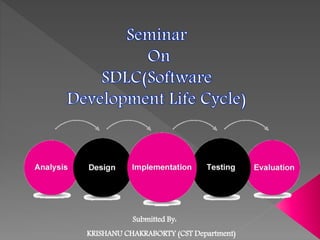
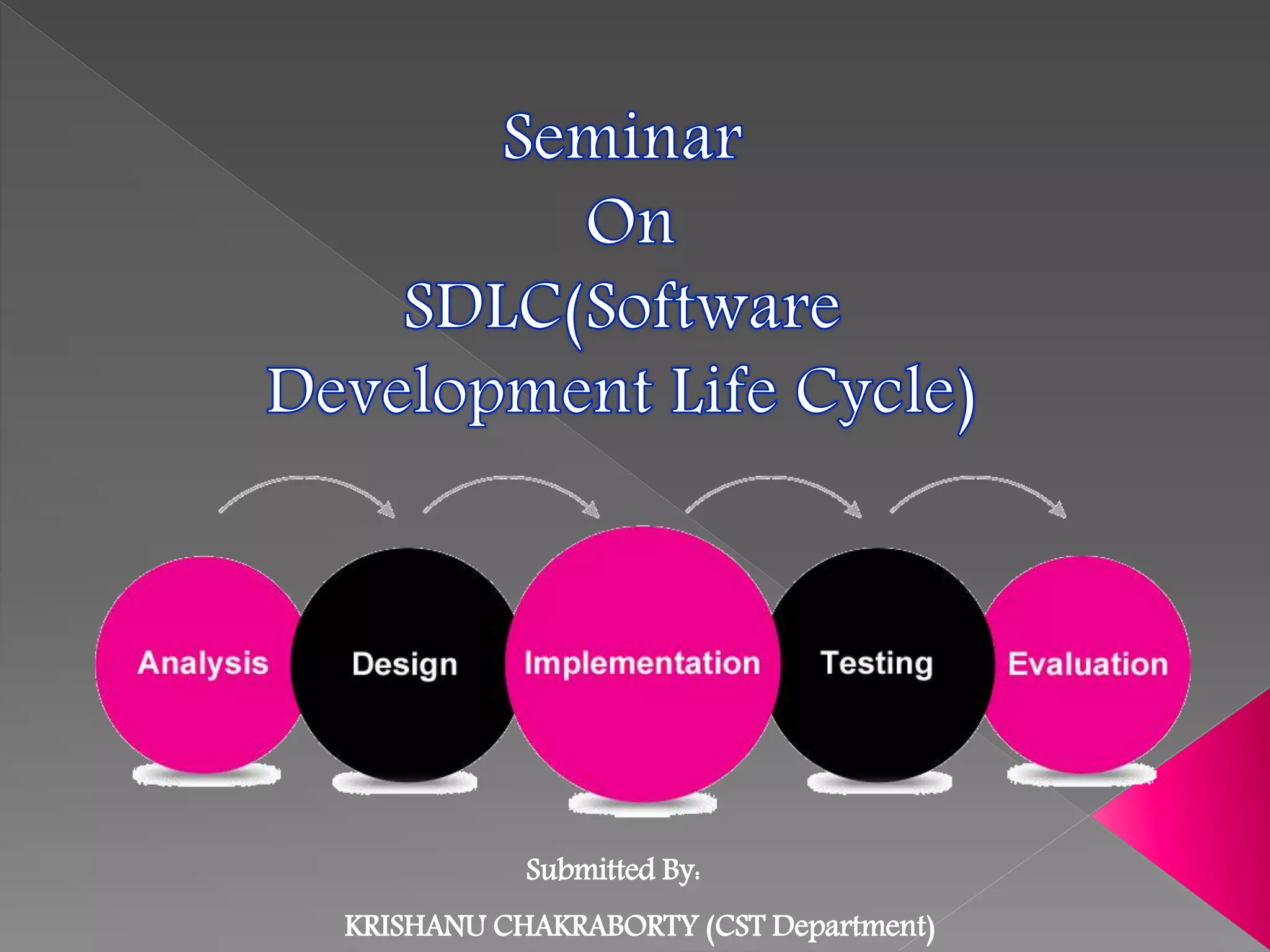
Submitted By:
KRISHANU CHAKRABORTY (CST Department)
 Introduction
 History
 What is SDLC
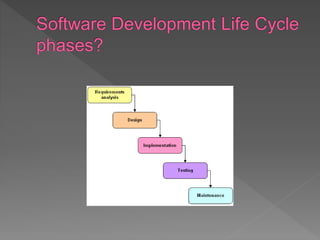
 SDLC Phases
 Model of SDLC
 Conclusion
 SDLC, Software Development Life Cycle is a process used
by software industry to design, develop and test high quality
software’s.
 The SDLC aims to produce a high quality software that meets
or exceeds customer expectations, reaches completion within
times and cost estimates.
 SDLC is a process followed for a software project, within a
software organization.
 It consists of a detailed plan describing how to develop,
maintain, replace and alter or enhance specific software.
 The life cycle defines a methodology for improving the
quality of software and the overall development process.
 Business requirements are gathered in this phase.
 This phase is the main focus of the project managers and
stake holders.
 Meetings with managers, stake holders and users are held in
order to determine the requirements like; who is going to use
the system.
 In this phase the system and software design is prepared from
the requirement specifications which were studied in the first
phase.
 System Design helps in specifying hardware and system
requirements and also helps in defining overall system
architecture.
 The system design specifications serve as input for the next
phase of the model.
 On receiving system design
documents, the work is divided in
modules/units and actual coding is
started.
 Since, in this phase the code is
produced so it is the main focus
for the developer. This is the
longest phase of the software
development life cycle.
 After the code is developed it is tested against the
requirements to make sure that the product is actually solving
the needs addressed and gathered during the requirements
phase.
 During this phase unit testing, integration testing, system
testing, acceptance testing are done.
 Once when the customers starts using the developed system
then the actual problems comes up and needs to be solved
from time to time.
 This process where the care is taken for the developed
product is known as maintenance.
Waterfall
Advantages
 Simple goal.
 Simple to understand and use.
 Clearly defined stages.
 Well understood milestones.
Disadvantages
 It is difficult to measure progress within stages.
 Cannot accommodate changing requirements.
 No working software is produced until late in the life cycle.
 Risk and uncertainty is high with this process model.
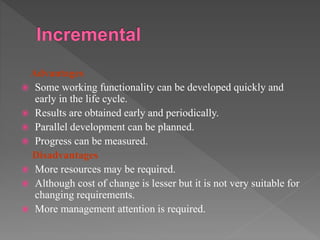
Advantages
 Some working functionality can be developed quickly and
early in the life cycle.
 Results are obtained early and periodically.
 Parallel development can be planned.
 Progress can be measured.
Disadvantages
 More resources may be required.
 Although cost of change is lesser but it is not very suitable for
changing requirements.
 More management attention is required.
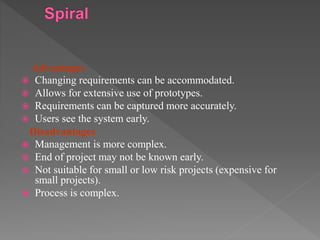
Advantages
 Changing requirements can be accommodated.
 Allows for extensive use of prototypes.
 Requirements can be captured more accurately.
 Users see the system early.
Disadvantages
 Management is more complex.
 End of project may not be known early.
 Not suitable for small or low risk projects (expensive for
small projects).
 Process is complex.
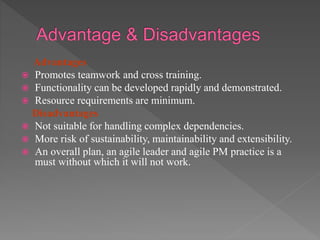
Advantages
 Promotes teamwork and cross training.
 Functionality can be developed rapidly and demonstrated.
 Resource requirements are minimum.
Disadvantages
 Not suitable for handling complex dependencies.
 More risk of sustainability, maintainability and extensibility.
 An overall plan, an agile leader and agile PM practice is a
must without which it will not work.
Software developement life cycle ppt

Software developement life cycle ppt

  • 1.
  • 2.
     Introduction  History What is SDLC  SDLC Phases  Model of SDLC  Conclusion
  • 3.
     SDLC, SoftwareDevelopment Life Cycle is a process used by software industry to design, develop and test high quality software’s.  The SDLC aims to produce a high quality software that meets or exceeds customer expectations, reaches completion within times and cost estimates.
  • 4.
     SDLC isa process followed for a software project, within a software organization.  It consists of a detailed plan describing how to develop, maintain, replace and alter or enhance specific software.  The life cycle defines a methodology for improving the quality of software and the overall development process.
  • 6.
     Business requirementsare gathered in this phase.  This phase is the main focus of the project managers and stake holders.  Meetings with managers, stake holders and users are held in order to determine the requirements like; who is going to use the system.
  • 7.
     In thisphase the system and software design is prepared from the requirement specifications which were studied in the first phase.  System Design helps in specifying hardware and system requirements and also helps in defining overall system architecture.  The system design specifications serve as input for the next phase of the model.
  • 8.
     On receivingsystem design documents, the work is divided in modules/units and actual coding is started.  Since, in this phase the code is produced so it is the main focus for the developer. This is the longest phase of the software development life cycle.
  • 9.
     After thecode is developed it is tested against the requirements to make sure that the product is actually solving the needs addressed and gathered during the requirements phase.  During this phase unit testing, integration testing, system testing, acceptance testing are done.
  • 10.
     Once whenthe customers starts using the developed system then the actual problems comes up and needs to be solved from time to time.  This process where the care is taken for the developed product is known as maintenance.
  • 11.
    Waterfall Advantages  Simple goal. Simple to understand and use.  Clearly defined stages.  Well understood milestones. Disadvantages  It is difficult to measure progress within stages.  Cannot accommodate changing requirements.  No working software is produced until late in the life cycle.  Risk and uncertainty is high with this process model.
  • 12.
    Advantages  Some workingfunctionality can be developed quickly and early in the life cycle.  Results are obtained early and periodically.  Parallel development can be planned.  Progress can be measured. Disadvantages  More resources may be required.  Although cost of change is lesser but it is not very suitable for changing requirements.  More management attention is required.
  • 13.
    Advantages  Changing requirementscan be accommodated.  Allows for extensive use of prototypes.  Requirements can be captured more accurately.  Users see the system early. Disadvantages  Management is more complex.  End of project may not be known early.  Not suitable for small or low risk projects (expensive for small projects).  Process is complex.
  • 14.
    Advantages  Promotes teamworkand cross training.  Functionality can be developed rapidly and demonstrated.  Resource requirements are minimum. Disadvantages  Not suitable for handling complex dependencies.  More risk of sustainability, maintainability and extensibility.  An overall plan, an agile leader and agile PM practice is a must without which it will not work.