Deploying Software at
       Scale
      Kris Buytaert
      @krisbuytaert
Kris Buytaert
●   I used to be a Dev,
●   Then Became an Op
●   Chief Trolling Officer and Open Source
    Consultant @inuits.eu
●   Everything is an effing DNS Problem
●   Building Clouds since before the bookstore
●   Some books, some papers, some blogs
●   Evangelizing devops
Todays Goals
●   A reproducable way to deploy and upgrade
    software
●   Automatically
●   Fast
●   Consistent
What's this devops thing
       anyhow ?
What's the problem ?
The community of developers whose work you
see on the Web, who probably don’t know what
ADO or UML or JPA even stand for, deploy better
systems at less cost in less time at lower risk
than we see in the Enterprise. This is true even
when you factor in the greater flexibility and
velocity of startups.


Tim Bray , on his blog January 2010
The Old Days
●   “Put this Code Live, here's a tarball” NOW!
●   What dependencies ?
●   No machines available ?
●   What database ?
●   Security ?
●   High Availability ?
●   Scalability ?
●   My computer can't install this ?
devops
●   Culture
●   (Lean)
●   Automation
●   Measurement
●   Sharing
              Damon Edwards and John Willis
                                  Gene Kim
devops (<)> continuous delilvery
Nirvana
An “ecosystem” that supports continuous delivery, from
infrastructure, data and configuration management to
business.
Through automation of the build, deployment, and testing
process, and improved collaboration between developers,
testers, and operations, delivery teams can get changes
released in a matter of hours — sometimes even minutes–no
matter what the size of a project or the complexity of its code
base.
                            Continuous Delivery , Jez Humble
How many times a day ?
●   10 @ Flickr
●   Deployments used to be pain
●   Nobody dared to deploy a site
●   Practice makes perfect
●   Knowing you can vs constantly doing it
" Our job as engineers (and ops, dev-ops, QA,
support, everyone in the company actually) is to
enable the business goals. We strongly feel that
in order to do that you must have the ability to
deploy code quickly and safely. Even if the
business goals are to deploy strongly QA’d code
once a month at 3am (it’s not for us, we push all
the time), having a reliable and easy
deployment should be non-negotiable."
Etsy Blog upon releasing Deployinator

http://codeascraft.etsy.com/2010/05/20/quantum-of-deployment/
How do we get there ?
OS Baseline
●   Automated Deployments
●   Reproducable
●   Kickstart, FAI, Preseeding,
●   JeOS
Infrastructure as Code
●   Treat configuration automation as code
●   Development best practices
      •   Model your infrastructure
      •   Version your cookbooks / manifests
      •   Test your cookbooks/ manifests
      •   Dev/ test /uat / prod for your infra
●   Model your infrastructure
●   A working service = automated ( Application Code +
    Infrastructure Code + Security + Monitoring )
●   Think Puppet, Chef, Cfengine, Ansible , ....
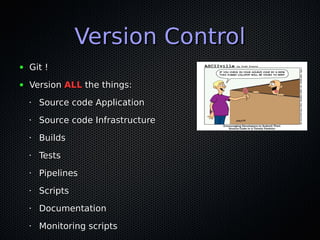
Version Control
●   Git !
●   Version ALL the things:
    •   Source code Application
    •   Source code Infrastructure
    •   Builds
    •   Tests
    •   Pipelines
    •   Scripts
    •   Documentation
    •   Monitoring scripts
Continuous Integration
●   Builds

●   Nightly Builds

●   Builds with tests

●   Nightly Builds with tests

●   Frequent integration

●   Continuous Integration
Jenkins
●   Open Source Continuous Integration Server
●   A zillion plugins (400)


●   Have developers build stable and deployable
    code
●   Test Infra code
Jenkins Pipeline
What's in your Pipeline ?
A pipeline
●   Checkout code
●   Syntax
●   Style
●   Code Coverage
●   Tests
●   Build
●   More Tests
●   Package
App Requirements
●   Testable
●   Configuration isolated
●   Automated Deployments
●   “If my computer can't install it , the installer is
    borken”   Luke Kanies at Fosdem (2007)


●   Bulk provisioning of data
●   http://www.krisbuytaert.be/blog/how-i-my-java
Why ops like to package
●   Packages give you features

•Consistency, security, dependencies
●   Uniquely identify where files come from

•Package or cfg-mgmt
●   Source repo not always available

•Firewall / Cloud etc ..
●   Weird deployment locations , no easy access
●   Little overhead when you automate
●   CONFIG does not belong in a package
#packagingsucks
• Really ..

              ●   Missing upstream

              ●   Ancient upstream

              ●   Unneeded dependencies

              ●   Broken upstream

              ●   Distro Policies

●   “Maximum RPM” ?

●   Packaging is needed

              ●   Dependencies, tooling, repositories

●   Anger driven development
Not all packages are equal
#packaginlove
fpm
fpm -t rpm -s dir -n hornetq -v 2.2.5 hornetq
Executing(%prep): /bin/sh -e /var/tmp/rpm-tmp.nNkVwh
+ umask 022
+ cd /usr/local/build-rpm-hornetq-2.2.5.x86_64.rpm/BUILD
+ exit 0
Executing(%build): /bin/sh -e /var/tmp/rpm-tmp.yUd4MV
+ umask 022
+ cd /usr/local/build-rpm-hornetq-2.2.5.x86_64.rpm/BUILD
+ tar -zxf /usr/local/build-rpm-hornetq-2.2.5.x86_64.rpm/data.tar.gz
+ exit 0
Executing(%install): /bin/sh -e /var/tmp/rpm-tmp.jkpqeA
+ umask 022
+ cd /usr/local/build-rpm-hornetq-2.2.5.x86_64.rpm/BUILD
+ /usr/lib/rpm/brp-compress
+ /usr/lib/rpm/brp-strip
+ /usr/lib/rpm/brp-strip-static-archive
+ /usr/lib/rpm/brp-strip-comment-note
Processing files: hornetq-2.2.5-1.x86_64
Checking for unpackaged file(s): /usr/lib/rpm/check-files /usr/local/build-rpm-hornetq-2.2.5.x86_64.rpm/BUILD
Wrote: /usr/local/build-rpm-hornetq-2.2.5.x86_64.rpm/SRPMS/hornetq-2.2.5-1.src.rpm
Wrote: /usr/local/build-rpm-hornetq-2.2.5.x86_64.rpm/RPMS/x86_64/hornetq-2.2.5-1.x86_64.rpm
Executing(%clean): /bin/sh -e /var/tmp/rpm-tmp.z2UL3B
+ umask 022
+ cd /usr/local/build-rpm-hornetq-2.2.5.x86_64.rpm/BUILD
+ rm -rf /usr/local/build-rpm-hornetq-2.2.5.x86_64.rpm/BUILD
+ exit 0
Created /usr/local/hornetq-2.2.5.x86_64.rpm
fpm in action
●   https://github.com/Inuits/build-gems
●   Fork, pull
●   Jenkins pulls , builds , pushes to repo
●   (variants for Nagios Plugins / Jenkins Plugins
    available)
A pipeline
●   Checkout code     ●   Upload to Repo
●   Syntax
●   Style
●   Code Coverage
●   Tests
●   Build
●   More Tests
●   Package
Pulp
Pulp is a Python application for managing
software repositories and their associated
content, such as packages, errata, and
distributions. It can replicate software
repositories from a variety of supported sources,
such as http/https, file system, ISO, and RHN, to
a local on-site repository. It provides mechanisms
for systems to gain access to these repositories,
providing centralized software installation.
Pulp
●   Redhat Community
●   Redhat Emerging Technology
●   Part of Katello
Pulp
●   “manages” its own apache instance

●   Symlinks , no copies

●   Queues

•Syncing in the background

•No more screens ;)

●   Actions are not instantly

•e.g. Add / sync / delete

●   Hello mongodb :(

●   v1 vs v2

●   Only use repo functionality , cfgmgmt is in charge of packages
Repository Management
Version vs Latest
●   Version your repos ?
     ensure => latests
●   Latest your environments ?
●   Strict versioning in config ?
     ensure => '0.98.4'
A pipeline
●   Checkout code     ●   Upload to Repo
●   Syntax            ●   Deploy on Test
●   Style
●   Code Coverage
●   Tests
●   Build
●   More Tests
●   Package
The Marionette Collective
●   Distributed ssh ++
●   What version of ssh do I have installed on my
    servers ?
●   On what servers is XYZ running ?
●   Clean all my ssl certs ?
●   Restart apache on all servers with fact X
mc-package
mc-package -W /dev/ status jdk
 * [ ============================================================> ] 33 / 33

servicesdb01.dev.com             version = -absent
services.dev.google.com          version = jdk-1.6.0_13-fcs
drbdtest02.dev.google.com          version = -absent
services3.dev.google.com          version = jdk-1.6.0_20-fcs
um.dev.google.com               version = jdk-1.5.0_19-fcs
devtools03.uat.com              version = jdk-1.6.0_29-fcs
alexandria02.dev.google.com         version = -absent
weblink01.dev.com               version = -absent
wikitest.dev.google.com          version = jdk-1.6.0_24-fcs
payment.dev.google.com             version = jdk-1.5.0_17-fcs
tiff2pdf01.dev.com             version = -absent
devdoos.dev.com                version = jdk-1.6.0_30-fcs
wiki.dev.google.com             version = jdk-1.6.0_24-fcs
reporting01.dev.com             version = -absent
devtools01-dev.uat.com            version = jdk-1.6.0_23-fcs
devtools02.uat.com              version = jdk-1.6.0_29-fcs
drbdtest01.dev.google.com          version = -absent

---- package agent summary ----
        Nodes: 33/33
            Versions: 1 * 1.5.0_17-fcs, 1 * 1.5.0_19-fcs, 1 * 1.6.0_13-fcs, 1 * 1.6.0_20-fcs, 1 * 1.6.0_23-fcs, 2 * 1.6.0_24-fcs, 2 * 1.6.0
               Elapsed Time: 1.73 s
What to Trigger ?
●   Update Package
     •   Only updates package
●   Trigger Puppet Run
     •   Updates config + package
A pipeline
●   Checkout code     ●   Upload to Repo
●   Syntax            ●   Deploy on Test
●   Style             ●   More Tests
●   Code Coverage     ●   Promote
●   Tests             ●   Deploy on UAT
●   Build             ●   More Tests
●   More Tests        ●   Promote
●   Package           ●   Deploy on Prod
Done ?
●   Close the feedback loop,
●   Send metric on deployment


     echo "deployed.$package_name 1 `date +
     %s`" > /dev/tcp/<%= graphite_host %>/2003
Done ?


A Software project is not done until your last
enduser is in his grave !
But remember
      Everything is a Fscking DNS Problem
 No really, Everything is a Fscking DNS Problem
        If it's not a fucking DNS Problem ..
                     It's an arp problem
              If it's not an arp problem...
            It's a Full Filesystem Problem
               If your filesystem isn't full
            It's a Spanning Tree problem
      If it's not a spanning Tree problem...
                     It's a USB problem
                If it's not a USB Problem
             It might be an ntp problem
                If it's not an ntp problem
               It's a sharing IRQ Problem
          If it's not a sharing IRQ Problem
 But most often .. its a Freaking Dns Problem !
         Or someone playing tricks on you


                                                  Jan 2006
Contact
Kris Buytaert
Kris.Buytaert@inuits.be

Further Reading
@krisbuytaert
http://www.krisbuytaert.be/b
log/
http://www.inuits.be/


                               Inuits

                               Duboistraat 50
                               2060 Antwerpen
                               Belgium
                               891.514.231

                               +32 475 961221

Deploying software at Scale

  • 1.
    Deploying Software at Scale Kris Buytaert @krisbuytaert
  • 2.
    Kris Buytaert ● I used to be a Dev, ● Then Became an Op ● Chief Trolling Officer and Open Source Consultant @inuits.eu ● Everything is an effing DNS Problem ● Building Clouds since before the bookstore ● Some books, some papers, some blogs ● Evangelizing devops
  • 3.
    Todays Goals ● A reproducable way to deploy and upgrade software ● Automatically ● Fast ● Consistent
  • 4.
    What's this devopsthing anyhow ?
  • 5.
    What's the problem? The community of developers whose work you see on the Web, who probably don’t know what ADO or UML or JPA even stand for, deploy better systems at less cost in less time at lower risk than we see in the Enterprise. This is true even when you factor in the greater flexibility and velocity of startups. Tim Bray , on his blog January 2010
  • 6.
    The Old Days ● “Put this Code Live, here's a tarball” NOW! ● What dependencies ? ● No machines available ? ● What database ? ● Security ? ● High Availability ? ● Scalability ? ● My computer can't install this ?
  • 7.
    devops ● Culture ● (Lean) ● Automation ● Measurement ● Sharing Damon Edwards and John Willis Gene Kim
  • 8.
  • 9.
    Nirvana An “ecosystem” thatsupports continuous delivery, from infrastructure, data and configuration management to business. Through automation of the build, deployment, and testing process, and improved collaboration between developers, testers, and operations, delivery teams can get changes released in a matter of hours — sometimes even minutes–no matter what the size of a project or the complexity of its code base. Continuous Delivery , Jez Humble
  • 11.
    How many timesa day ? ● 10 @ Flickr ● Deployments used to be pain ● Nobody dared to deploy a site ● Practice makes perfect ● Knowing you can vs constantly doing it
  • 12.
    " Our jobas engineers (and ops, dev-ops, QA, support, everyone in the company actually) is to enable the business goals. We strongly feel that in order to do that you must have the ability to deploy code quickly and safely. Even if the business goals are to deploy strongly QA’d code once a month at 3am (it’s not for us, we push all the time), having a reliable and easy deployment should be non-negotiable." Etsy Blog upon releasing Deployinator http://codeascraft.etsy.com/2010/05/20/quantum-of-deployment/
  • 13.
    How do weget there ?
  • 14.
    OS Baseline ● Automated Deployments ● Reproducable ● Kickstart, FAI, Preseeding, ● JeOS
  • 15.
    Infrastructure as Code ● Treat configuration automation as code ● Development best practices • Model your infrastructure • Version your cookbooks / manifests • Test your cookbooks/ manifests • Dev/ test /uat / prod for your infra ● Model your infrastructure ● A working service = automated ( Application Code + Infrastructure Code + Security + Monitoring ) ● Think Puppet, Chef, Cfengine, Ansible , ....
  • 16.
    Version Control ● Git ! ● Version ALL the things: • Source code Application • Source code Infrastructure • Builds • Tests • Pipelines • Scripts • Documentation • Monitoring scripts
  • 17.
    Continuous Integration ● Builds ● Nightly Builds ● Builds with tests ● Nightly Builds with tests ● Frequent integration ● Continuous Integration
  • 18.
    Jenkins ● Open Source Continuous Integration Server ● A zillion plugins (400) ● Have developers build stable and deployable code ● Test Infra code
  • 19.
  • 20.
    What's in yourPipeline ?
  • 21.
    A pipeline ● Checkout code ● Syntax ● Style ● Code Coverage ● Tests ● Build ● More Tests ● Package
  • 22.
    App Requirements ● Testable ● Configuration isolated ● Automated Deployments ● “If my computer can't install it , the installer is borken” Luke Kanies at Fosdem (2007) ● Bulk provisioning of data ● http://www.krisbuytaert.be/blog/how-i-my-java
  • 23.
    Why ops liketo package ● Packages give you features •Consistency, security, dependencies ● Uniquely identify where files come from •Package or cfg-mgmt ● Source repo not always available •Firewall / Cloud etc .. ● Weird deployment locations , no easy access ● Little overhead when you automate ● CONFIG does not belong in a package
  • 24.
    #packagingsucks • Really .. ● Missing upstream ● Ancient upstream ● Unneeded dependencies ● Broken upstream ● Distro Policies ● “Maximum RPM” ? ● Packaging is needed ● Dependencies, tooling, repositories ● Anger driven development
  • 25.
  • 26.
  • 27.
    fpm fpm -t rpm-s dir -n hornetq -v 2.2.5 hornetq Executing(%prep): /bin/sh -e /var/tmp/rpm-tmp.nNkVwh + umask 022 + cd /usr/local/build-rpm-hornetq-2.2.5.x86_64.rpm/BUILD + exit 0 Executing(%build): /bin/sh -e /var/tmp/rpm-tmp.yUd4MV + umask 022 + cd /usr/local/build-rpm-hornetq-2.2.5.x86_64.rpm/BUILD + cd /usr/local/build-rpm-hornetq-2.2.5.x86_64.rpm/BUILD + tar -zxf /usr/local/build-rpm-hornetq-2.2.5.x86_64.rpm/data.tar.gz + exit 0 Executing(%install): /bin/sh -e /var/tmp/rpm-tmp.jkpqeA + umask 022 + cd /usr/local/build-rpm-hornetq-2.2.5.x86_64.rpm/BUILD + /usr/lib/rpm/brp-compress + /usr/lib/rpm/brp-strip + /usr/lib/rpm/brp-strip-static-archive + /usr/lib/rpm/brp-strip-comment-note Processing files: hornetq-2.2.5-1.x86_64 Checking for unpackaged file(s): /usr/lib/rpm/check-files /usr/local/build-rpm-hornetq-2.2.5.x86_64.rpm/BUILD Wrote: /usr/local/build-rpm-hornetq-2.2.5.x86_64.rpm/SRPMS/hornetq-2.2.5-1.src.rpm Wrote: /usr/local/build-rpm-hornetq-2.2.5.x86_64.rpm/RPMS/x86_64/hornetq-2.2.5-1.x86_64.rpm Executing(%clean): /bin/sh -e /var/tmp/rpm-tmp.z2UL3B + umask 022 + cd /usr/local/build-rpm-hornetq-2.2.5.x86_64.rpm/BUILD + rm -rf /usr/local/build-rpm-hornetq-2.2.5.x86_64.rpm/BUILD + exit 0 Created /usr/local/hornetq-2.2.5.x86_64.rpm
  • 28.
    fpm in action ● https://github.com/Inuits/build-gems ● Fork, pull ● Jenkins pulls , builds , pushes to repo ● (variants for Nagios Plugins / Jenkins Plugins available)
  • 29.
    A pipeline ● Checkout code ● Upload to Repo ● Syntax ● Style ● Code Coverage ● Tests ● Build ● More Tests ● Package
  • 30.
    Pulp Pulp is aPython application for managing software repositories and their associated content, such as packages, errata, and distributions. It can replicate software repositories from a variety of supported sources, such as http/https, file system, ISO, and RHN, to a local on-site repository. It provides mechanisms for systems to gain access to these repositories, providing centralized software installation.
  • 31.
    Pulp ● Redhat Community ● Redhat Emerging Technology ● Part of Katello
  • 33.
    Pulp ● “manages” its own apache instance ● Symlinks , no copies ● Queues •Syncing in the background •No more screens ;) ● Actions are not instantly •e.g. Add / sync / delete ● Hello mongodb :( ● v1 vs v2 ● Only use repo functionality , cfgmgmt is in charge of packages
  • 34.
  • 35.
    Version vs Latest ● Version your repos ? ensure => latests ● Latest your environments ? ● Strict versioning in config ? ensure => '0.98.4'
  • 36.
    A pipeline ● Checkout code ● Upload to Repo ● Syntax ● Deploy on Test ● Style ● Code Coverage ● Tests ● Build ● More Tests ● Package
  • 37.
    The Marionette Collective ● Distributed ssh ++ ● What version of ssh do I have installed on my servers ? ● On what servers is XYZ running ? ● Clean all my ssl certs ? ● Restart apache on all servers with fact X
  • 38.
    mc-package mc-package -W /dev/status jdk * [ ============================================================> ] 33 / 33 servicesdb01.dev.com version = -absent services.dev.google.com version = jdk-1.6.0_13-fcs drbdtest02.dev.google.com version = -absent services3.dev.google.com version = jdk-1.6.0_20-fcs um.dev.google.com version = jdk-1.5.0_19-fcs devtools03.uat.com version = jdk-1.6.0_29-fcs alexandria02.dev.google.com version = -absent weblink01.dev.com version = -absent wikitest.dev.google.com version = jdk-1.6.0_24-fcs payment.dev.google.com version = jdk-1.5.0_17-fcs tiff2pdf01.dev.com version = -absent devdoos.dev.com version = jdk-1.6.0_30-fcs wiki.dev.google.com version = jdk-1.6.0_24-fcs reporting01.dev.com version = -absent devtools01-dev.uat.com version = jdk-1.6.0_23-fcs devtools02.uat.com version = jdk-1.6.0_29-fcs drbdtest01.dev.google.com version = -absent ---- package agent summary ---- Nodes: 33/33 Versions: 1 * 1.5.0_17-fcs, 1 * 1.5.0_19-fcs, 1 * 1.6.0_13-fcs, 1 * 1.6.0_20-fcs, 1 * 1.6.0_23-fcs, 2 * 1.6.0_24-fcs, 2 * 1.6.0 Elapsed Time: 1.73 s
  • 39.
    What to Trigger? ● Update Package • Only updates package ● Trigger Puppet Run • Updates config + package
  • 40.
    A pipeline ● Checkout code ● Upload to Repo ● Syntax ● Deploy on Test ● Style ● More Tests ● Code Coverage ● Promote ● Tests ● Deploy on UAT ● Build ● More Tests ● More Tests ● Promote ● Package ● Deploy on Prod
  • 41.
    Done ? ● Close the feedback loop, ● Send metric on deployment echo "deployed.$package_name 1 `date + %s`" > /dev/tcp/<%= graphite_host %>/2003
  • 42.
    Done ? A Softwareproject is not done until your last enduser is in his grave !
  • 43.
    But remember Everything is a Fscking DNS Problem No really, Everything is a Fscking DNS Problem If it's not a fucking DNS Problem .. It's an arp problem If it's not an arp problem... It's a Full Filesystem Problem If your filesystem isn't full It's a Spanning Tree problem If it's not a spanning Tree problem... It's a USB problem If it's not a USB Problem It might be an ntp problem If it's not an ntp problem It's a sharing IRQ Problem If it's not a sharing IRQ Problem But most often .. its a Freaking Dns Problem ! Or someone playing tricks on you Jan 2006
  • 44.