Michael T. Shrove & Emil Jovanov
International Journal of Software Engineering (IJSE), Volume (8) : Issue (1) : 2020 1
Software Defect Trend Forecasting In Open Source Projects
using A Univariate ARIMA Model and FBProphet
Michael T. Shrove tshrove@gmail.com
Millennium Corporation
Huntsville, AL. 35806, USA
Emil Jovanov emil.jovanov@uah.edu
ECE Department
University of Alabama Huntsville
Huntsville, AL. 35899, USA
Abstract
Our objective in this research is to provide a framework that will allow project managers, business
owners, and developers an effective way to forecast the trend in software defects within a
software project in real-time. By providing these stakeholders with a mechanism for forecasting
defects, they can then provide the necessary resources at the right time in order to remove these
defects before they become too much ultimately leading to software failure. In our research, we
will not only show general trends in several open-source projects but also show trends in daily,
monthly, and yearly activity. Our research shows that we can use this forecasting method up to 6
months out with only an MSE of 0.019. In this paper, we present our technique and
methodologies for developing the inputs for the proposed model and the results of testing on
seven open source projects. Further, we discuss the prediction models, the performance, and the
implementation using the FBProphet framework and the ARIMA model.
Keywords: Software Engineering, Software Defects, Time Series Forecasting, ARIMA,
FBProphet.
1. INTRODUCTION
In today’s world, software has almost become a part of every job function in the market. From the
food industry to the medical industry to the defense industry, software is everywhere. Which in
turn, means more and more people rely on software that is of high quality and produces accurate
results. However, in 2015 a report by Standish Group showed that only 29% of software projects
are successful and 52% were “challenged”[1]. Even in the 52% that were “challenged”, do we
know they produced a quality product? A successful project does not necessarily mean, a quality
product.
In [2], the authors lay out four main high-level areas for why software projects fail, People, Tasks,
Environment, Methods. In this study, one of the main areas that we focused on was the lack of
software testing, which directing was related to software project failure. In turn, the lack of
software testing can lead to more software defects which inevitably leads to software failure.
In this research, we propose a time series model for forecasting trends and patterns in software
project defect data in order for stakeholders to reallocated resources. In our proposed solution,
we show that unlike most research in this area, our approach can be performed in real-time using
a new framework called FBProphet and show much more than just the trend in overall defect
data. We also show that we can present daily, weekly, and yearly seasonal trends. This trend
analysis can be used to effectively show where to reallocate resources up to weeks and months
in the future on the project. If stakeholders can know what their defect posture will look like in the
future, it may give software project’s a higher probability of success. In the section label, Review
of Literature, we will be reviewing papers and related research to this area. In the Overall
Michael T. Shrove & Emil Jovanov
International Journal of Software Engineering (IJSE), Volume (8) : Issue (1) : 2020 2
Approach section, we present the overall approach, data used in our research, and the models
used to forecast trends and patterns. After that, we show the results of our research in the
Results section. Lastly, in Threat to Validity, we present threats to the validity of our research and
present some mitigations against it.
2. REVIEW OF LITERATURE
In performing literature reviews for similar research, what we found was that a majority of authors
focusing in this area, more specifically with defect counts, are trying to classify if a particular code
module is or will be defect prone based on software metrics [3][4][5][6][7][8][9]. In our research,
we are focused on the more project management aspects of the project. Forecasting trends,
similar to financial market trends [10], in the total defect counts, to use for decision making
[11][12].
Our research builds on top of Raja and Hale’s research in [13]. Raja et al. showed an auspicious
method in using defects to get accurate trend analysis from technical debt items from a software
project. We followed their research and laid out the same approach as them. However, in our
research, we wanted to make it more practical and more user-friendly for the practitioner. With
the increase in data generating in these software projects, so has the need and popularity in
using machine learning and statistical-based models to be able to make sense of these data
while not adding burden to the practitioner. In [14], Manzano et al. presented an API-based
framework for using statistical models in a more manageable approach by proposing these
models to be behind an API but still using ARIMA as the model, which is the same statistical
method in research.
In [16], Chikkakrishna et al. showed a more user-friendly method by using the FBProphet
framework to get seasonal trends from the data more efficiently than from the ARIMA-based
model. Chikkakrishna et al. used both an ARIMA method along with FBProphet to supplement
getting more information from the data as we did in our research.
3. OVERALL APPROACH
In our approach, we wanted to find a method that would allow software project stakeholders to
monitor the data, present the total number of defects, forecast the trends in the data, and present
in a graphic format for the stakeholders to view for decision making. For the data, we focused on
open source software (OSS) project data, with no use of simulation. We needed to find some that
had their defect data open to the public. We used OSS to apply time series-based models to
forecast trends in the data, and lastly, we used open-source graphing libraries to present the
trends to the stakeholders.
4. THE TRAINING DATASET
Our training datasets is open-source software projects from a company called MongoDB. They
were readily available and open to the public and was acquired using MongoDB’s JIRA API.
MongoDB has been tracking a set of their software projects over the past 9 years using Atlassian
JIRA as their issue tracking system. Their projects are mostly the drivers used for connecting
various programming languages to the MongoDB platform. There was a total of 31 projects in
their JIRA instance. Out of the 31 projects, we chose 7 for our research. Out of the 7 projects, the
mean lifespan was 9.64 years ± 172 days. The shortest project currently has a lifespan of 3,286
days and the longest project having a lifespan of 3,679 days, as seen in Table 1.
In [15] the authors showed that there is a very clear correlation between testing and software
defects. Moreover, OSS does not typically have dedicated testers, testing strategies, and test
procedures in place to find defects consistently. Therefore, we chose MongoDB’s projects
because the projects themselves were made available to the public, however, the projects were
backed by a public company with development processes and testing.
Michael T. Shrove & Emil Jovanov
International Journal of Software Engineering (IJSE), Volume (8) : Issue (1) : 2020 3
Project Name Project Description Start Date
Total Defect Events
(+1 Defect Created or -1
Defect Resolved)
C Driver C driver for MongoDB 12/09/2009 2326
C# Driver C# driver for MongoDB 02/17/2010 1683
Java Driver Java driver for MongoDB 07/21/2009 1819
Node Driver Node driver for MongoDB 10/14/2012 1676
Perl Driver Perl driver for MongoDB 07/09/2009 733
Python Driver Python driver for MongoDB 04/09/2009 1422
Ruby Driver Ruby driver for MongoDB 04/13/2009 1405
C Driver C driver for MongoDB 12/09/2009 2326
C# Driver C# driver for MongoDB 02/17/2010 1683
TABLE 1: OSS Project Information used for Research.
5. DATA PREPROCESSING
For these 7 projects, their code was stored in GitHub, however, their defect repository was stored
as described above in a JIRA instance. Within the JIRA instance, contained 7 different projects,
one for each software project. For the purpose of this research, we collected only the issues with
each JIRA project labeled as a bug.
We decided to calculate the defect cost as +1 (production of defect), -1 (reduction of a defect or
resolving the defect), or 0 (no change in defects). We arranged the defects by date from the
earliest dated defect first, to the most recent dated defect last. We then created a cumulative sum
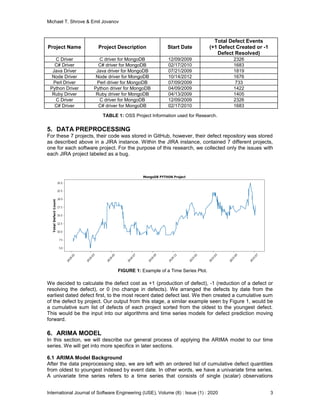
of the defect by project. Our output from this stage, a similar example seen by Figure 1, would be
a cumulative sum list of defects of each project sorted from the oldest to the youngest defect.
This would be the input into our algorithms and time series models for defect prediction moving
forward.
6. ARIMA MODEL
In this section, we will describe our general process of applying the ARIMA model to our time
series. We will get into more specifics in later sections.
6.1 ARIMA Model Background
After the data preprocessing step, we are left with an ordered list of cumulative defect quantities
from oldest to youngest indexed by event date. In other words, we have a univariate time series.
A univariate time series refers to a time series that consists of single (scalar) observations
FIGURE 1: Example of a Time Series Plot.
Michael T. Shrove & Emil Jovanov
International Journal of Software Engineering (IJSE), Volume (8) : Issue (1) : 2020 4
recorded sequentially over equal time increments [17]. There are many different techniques and
methods for time series forecasting which include: autoregressive moving average (ARMA),
autoregressive integrated moving average (ARIMA), Exponential Smoothing, and Holt-Winters. In
this research, we will be focusing on using the ARIMA model or sometimes referred to as the Box
Jenkins Model. The ARIMA model is a combination of both the autoregressive (AR) models and
the moving average (MA) models.
6.2 Stationality Testing
One assumption about using the ARIMA model is that the data is required to be stationary.
Stationary is defined as the mean, variance and autocovariance do not change over time. Later in
our research, we will show our techniques for removing nonstationarity, the most common
technique being differencing. In our research, in order to determine if our time series was
stationary or not, we used the Dickey-Fuller (DF) test [18].The DF test suggests the time series
has a unit root, meaning it is nonstationary. It has some time-dependent structure. The alternative
hypothesis is that it suggests the time series does not have a unit root, meaning it is stationary. It
does not have a time-dependent structure. Once the DF test has been run, if the time series was
stationary (p-value < alpha value) we could move on to applying the ARIMA model, if not, we
would have to apply methods for removing nonstationarity in the data.
6.3 Methods for Removing Nonstationality
Methods for removing nonstationarity are not the same each time for time series data. Different
methods must be applied each time, and the results must be manually evaluated based on the
results of the hypothesis test. The most common techniques for removing nonstationarity are
transformation, smoothing, and differencing. Of those 3 techniques, we used 8 methods shown in
Table 2.
# Name Technique Description
1 Natural Log Transformation Applying the natural logarithm to the data.
2 Log Moving Average
Transformation /
Smoothing
Applying a 7-day moving average of the
natural logarithm of the data.
3 Moving Average Smoothing
Applying a 7-day moving average of the
data.
4 Diff Natural Log
Transformation /
Differencing
Applying differencing to the natural
logarithm of the data.
5 Diff Moving Average and Data Transformation
Applying the difference between normal
data and moving average.
6 Diff Log and Moving Average
Transformation
/Differencing
Applying a difference between the natural
logarithm of the data and the natural
logarithm moving average.
7
EWMA (Exponential Weighted
Moving Average) of Log
Transformation
Applying an EWMA algorithm to the
natural logarithm of the data. We used a
half-life of 7 for all instances.
8 Log EWMA Differencing
Transformation /
Differencing
Applying a difference between the natural
logarithm of the data with the EWMA
algorithm.
TABLE 2: Non-Stationarity Removal Techniques (NRTs).
Michael T. Shrove & Emil Jovanov
International Journal of Software Engineering (IJSE), Volume (8) : Issue (1) : 2020 5
In each of our hypothesis tests (applying the DF test to each technique), we used a value of 0.05.
If the results of the hypothesis test returned a value less than 0.05, we would fail to reject the null
hypothesis (not stationary). Otherwise, if the p-value was equal to or greater than 0.05, we would
reject the null hypothesis and we could potentially use the technique for removing the
nonstationarity in the data.
6.4 Applying The ARIMA Model
In an ARIMA model as defined in earlier texts are three parts of the equation, autoregressive
(AR), integrated (I) and moving average (MA). Lags of the stationarized series in the forecasting
equation are the AR, lags of the forecast errors are the MA, and a time series which needs to be
differenced to be made stationary is said to be an "integrated (I)" version of a stationary series
[19]. Often times the ARIMA model will be shown as ARIMA (P,D,Q) where P refers to
the number of AR terms, D refers to the number of nonseasonal differences needed for
stationarity, and Q refers to the number of lagged forecast errors in the prediction equation.
In our research in order to determine the P and Q parameters in the ARIMA model, we used the
Partial Autocorrelation Function (PACF) and the Autocorrelation Function (ACF) respectively. The
ACF is the correlation between the time series and the lagged version of itself. The PACF is
explained as an additional correlation explained by each successive lagged term. Figure 2 shows
an example of the ACF and PACF functions. Lastly, we apply the ARIMA model to the data. We
use the chosen data based on the hypothesis tests from removing nonstationarity and using the
parameters shown to the correct parameters for P, D, and Q using the ACF and PACF functions.
During our results, we used more than one nonstationarity method. Our results of the ARIMA
model will be shown in the Results section.
FIGURE 2: Example of ACF and PACF Outputs.
Michael T. Shrove & Emil Jovanov
International Journal of Software Engineering (IJSE), Volume (8) : Issue (1) : 2020 6
7. FBProphet
Prophet is an open-source forecasting tool developed by Facebook’s core data science team. It is
used for forecasting time series data based on an additive model where non-linear trends are fit
with yearly, weekly, and daily seasonality, plus holiday effects. It works best with time series that
have strong seasonal effects and several seasons of historical data [20]. With FBProphet you
can either “auto” forecast or customize it using some of the configurations built-in [21].
Underneath it all, FBProphet uses ARIMA, exponential models, and other similar regressive
models. We will be
FIGURE 3: Example out of a FBProphet plot using the Mongo
Python Project Data
Michael T. Shrove & Emil Jovanov
International Journal of Software Engineering (IJSE), Volume (8) : Issue (1) : 2020 7
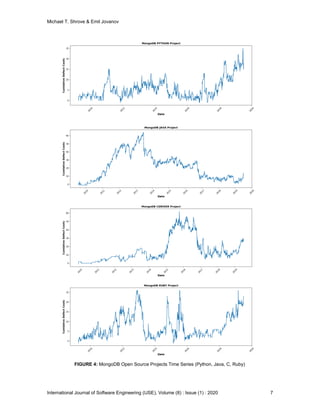
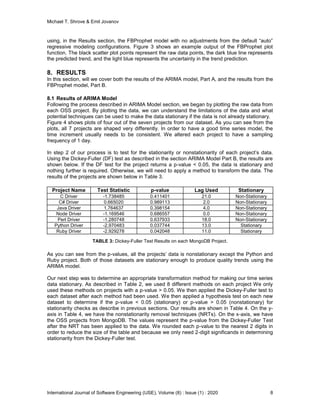
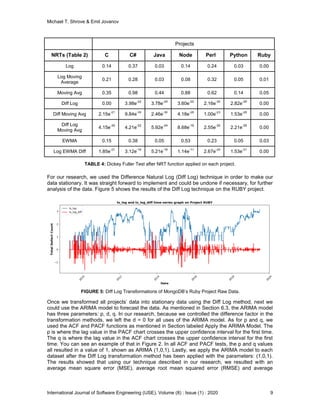
FIGURE 4: MongoDB Open Source Projects Time Series (Python, Java, C, Ruby)
Michael T. Shrove & Emil Jovanov
International Journal of Software Engineering (IJSE), Volume (8) : Issue (1) : 2020 8
using, in the Results section, the FBProphet model with no adjustments from the default “auto”
regressive modeling configurations. Figure 3 shows an example output of the FBProphet plot
function. The black scatter plot points represent the raw data points, the dark blue line represents
the predicted trend, and the light blue represents the uncertainty in the trend prediction.
8. RESULTS
In this section, will we cover both the results of the ARIMA model, Part A, and the results from the
FBProphet model, Part B.
8.1 Results of ARIMA Model
Following the process described in ARIMA Model section, we began by plotting the raw data from
each OSS project. By plotting the data, we can understand the limitations of the data and what
potential techniques can be used to make the data stationary if the data is not already stationary.
Figure 4 shows plots of four out of the seven projects from our dataset. As you can see from the
plots, all 7 projects are shaped very differently. In order to have a good time series model, the
time increment usually needs to be consistent. We altered each project to have a sampling
frequency of 1 day.
In step 2 of our process is to test for the stationarity or nonstationarity of each project’s data.
Using the Dickey-Fuller (DF) test as described in the section ARIMA Model Part B, the results are
shown below. If the DF test for the project returns a p-value < 0.05, the data is stationary and
nothing further is required. Otherwise, we will need to apply a method to transform the data. The
results of the projects are shown below in Table 3.
Project Name Test Statistic p-value Lag Used Stationary
C Driver -1.738485 0.411401 21.0 Non-Stationary
C# Driver 0.665020 0.989113 2.0 Non-Stationary
Java Driver 1.764637 0.398154 4.0 Non-Stationary
Node Driver -1.169546 0.686557 0.0 Non-Stationary
Perl Driver -1.280748 0.637933 18.0 Non-Stationary
Python Driver -2.970483 0.037744 13.0 Stationary
Ruby Driver -2.929278 0.042048 11.0 Stationary
TABLE 3: Dickey-Fuller Test Results on each MongoDB Project.
As you can see from the p-values, all the projects’ data is nonstationary except the Python and
Ruby project. Both of those datasets are stationary enough to produce quality trends using the
ARIMA model.
Our next step was to determine an appropriate transformation method for making our time series
data stationary. As described in Table 2, we used 8 different methods on each project We only
used these methods on projects with a p-value > 0.05. We then applied the Dickey-Fuller test to
each dataset after each method had been used. We then applied a hypothesis test on each new
dataset to determine if the p-value < 0.05 (stationary) or p-value > 0.05 (nonstationary) for
stationarity checks as describe in previous sections. Our results are shown in Table 4. On the y-
axis in Table 4, we have the nonstationarity removal techniques (NRTs). On the x-axis, we have
the OSS projects from MongoDB. The values represent the p-value from the Dickey-Fuller Test
after the NRT has been applied to the data. We rounded each p-value to the nearest 2 digits in
order to reduce the size of the table and because we only need 2-digit significands in determining
stationarity from the Dickey-Fuller test.
Michael T. Shrove & Emil Jovanov
International Journal of Software Engineering (IJSE), Volume (8) : Issue (1) : 2020 9
Projects
NRTs (Table 2) C C# Java Node Perl Python Ruby
Log 0.14 0.37 0.03 0.14 0.24 0.03 0.00
Log Moving
Average
0.21 0.28 0.03 0.08 0.32 0.05 0.01
Moving Avg 0.35 0.98 0.44 0.88 0.62 0.14 0.05
Diff Log 0.00 3.98e
-22
3.78e
-24
3.60e
-22
2.16e
-30
2.82e
-29
0.00
Diff Moving Avg 2.15e
-21
9.84e
-30
2.46e
-30
4.18e
-28
1.00e
-23
1.53e
-28
0.00
Diff Log
Moving Avg
4.15e
-30
4.21e
-22
5.92e
-24
8.68e
-19
2.55e
-30
2.21e
-29
0.00
EWMA 0.15 0.38 0.05 0.53 0.23 0.05 0.03
Log EWMA Diff 1.85e
-21
3.12e
-16
5.21e
-18
1.14e
-17
2.67e
-25
1.53e
-27
0.00
TABLE 4: Dickey Fuller Test after NRT function applied on each project.
For our research, we used the Difference Natural Log (Diff Log) technique in order to make our
data stationary. It was straight forward to implement and could be undone if necessary, for further
analysis of the data. Figure 5 shows the results of the Diff Log technique on the RUBY project.
Once we transformed all projects’ data into stationary data using the Diff Log method, next we
could use the ARIMA model to forecast the data. As mentioned in Section 6.3, the ARIMA model
has three parameters: p, d, q. In our research, because we controlled the difference factor in the
transformation methods, we left the d = 0 for all uses of the ARIMA model. As for p and q, we
used the ACF and PACF functions as mentioned in Section labeled Apply the ARIMA Model. The
p is where the lag value in the PACF chart crosses the upper confidence interval for the first time.
The q is where the lag value in the ACF chart crosses the upper confidence interval for the first
time. You can see an example of that in Figure 2. In all ACF and PACF tests, the p and q values
all resulted in a value of 1, shown as ARIMA (1,0,1). Lastly, we apply the ARIMA model to each
dataset after the Diff Log transformation method has been applied with the parameters: (1,0,1).
The results showed that using our technique described in our research, we resulted with an
average mean square error (MSE), average root mean squared error (RMSE) and average
FIGURE 5: Diff Log Transformations of MongoDB’s Ruby Project Raw Data.
Michael T. Shrove & Emil Jovanov
International Journal of Software Engineering (IJSE), Volume (8) : Issue (1) : 2020 10
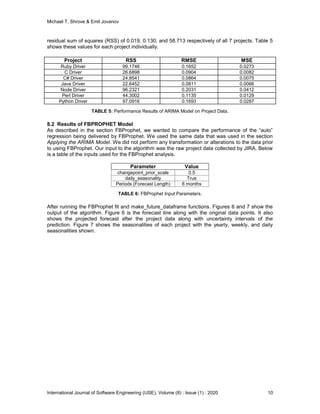
residual sum of squares (RSS) of 0.019, 0.130, and 58.713 respectively of all 7 projects. Table 5
shows these values for each project individually.
Project RSS RMSE MSE
Ruby Driver 99.1746 0.1652 0.0273
C Driver 26.6898 0.0904 0.0082
C# Driver 24.8541 0.0864 0.0075
Java Driver 22.6452 0.0811 0.0066
Node Driver 96.2321 0.2031 0.0412
Perl Driver 44.3002 0.1135 0.0129
Python Driver 97.0916 0.1693 0.0287
TABLE 5: Performance Results of ARIMA Model on Project Data.
8.2 Results of FBPROPHET Model
As described in the section FBProphet, we wanted to compare the performance of the “auto”
regression being delivered by FBProphet. We used the same data that was used in the section
Applying the ARIMA Model. We did not perform any transformation or alterations to the data prior
to using FBProphet. Our input to the algorithm was the raw project data collected by JIRA. Below
is a table of the inputs used for the FBProphet analysis.
Parameter Value
changepoint_prior_scale 0.5
daily_seasonality True
Periods (Forecast Length) 6 months
TABLE 6: FBProphet Input Parameters.
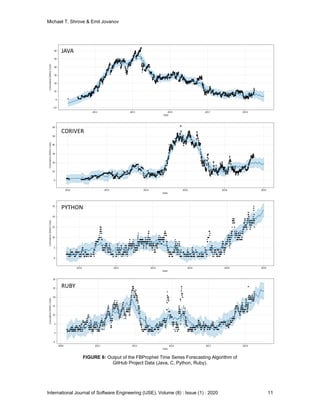
After running the FBProphet fit and make_future_dataframe functions. Figures 6 and 7 show the
output of the algorithm. Figure 6 is the forecast line along with the original data points. It also
shows the projected forecast after the project data along with uncertainty intervals of the
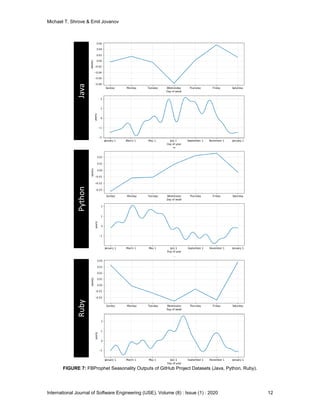
prediction. Figure 7 shows the seasonalities of each project with the yearly, weekly, and daily
seasonalities shown.
Michael T. Shrove & Emil Jovanov
International Journal of Software Engineering (IJSE), Volume (8) : Issue (1) : 2020 11
FIGURE 6: Output of the FBProphet Time Series Forecasting Algorithm of
GitHub Project Data (Java, C, Python, Ruby).
CDRIVER
JAVA
PYTHON
RUBY
Michael T. Shrove & Emil Jovanov
International Journal of Software Engineering (IJSE), Volume (8) : Issue (1) : 2020 12
FIGURE 7: FBProphet Seasonality Outputs of GitHub Project Datasets (Java, Python, Ruby).
RubyPythonJava
Michael T. Shrove & Emil Jovanov
International Journal of Software Engineering (IJSE), Volume (8) : Issue (1) : 2020 13
As you can see from the seasonalities, specifically the weekly, three projects (JAVA and RUBY)
seem to have a trend of decreasing the defects from Sunday to Wednesday then producing
defects from Wednesday to Saturday. The Python project seem to produce defects during the
week and fix them over the weekend and lastly. Similarly, you can see other trends in the data
through the yearly trends.
9. THREATS TO VALIDITY
In this section, will we cover what in the research by be a threat to producing valid research.
9.1 Data Validity
The defects collected in our data are defects reported by people in the open-source community.
These people may be amateurs to the product, or they could be internal MongoDB personnel. We
don’t really have any knowing, therefore, the reported defects may not be valid or there may be
duplicates of the same defect.
9.2 Variation of Data
The data collected during this research was all collected from one source, MongoDB. Having
different sources of data could show a broader trend in seasonality and defect reporting that is
not shown in the data. Future research will collect multiple sources and perform a similar analysis
and come to a more general and common model for the general software community.
9.3 Reporting Mechanisms
The data collected for this research was gathered on MongoDB’s JIRA repository, however,
MongoDB could have another internal reporting instance of JIRA not displayed to the public. This
would not reflect in our data or model development. In future research, we could reach to
MongoDB to confirm one instance of JIRA for defect reporting.
10.FUTURE RESEARCH
The overall goal of our research is to predict the outcome of software projects (success or failure)
using the method described in this research, along with other metrics. To identify whether a
software project is successful or unsuccessful, we need to define what success is. Traditional
waterfall approaches have a defined success and failure defined with cost, schedule, and
performance. However, agile and open-source projects do not necessarily have a defined
success. The one thing that defines success for open source projects is the use of the source of
the number of active users. For agile projects, we plan to use defect trend analysis, presented
here, along with other metrics such as # of pull requests, # active users, # followers for a GitHub
project. We then take those two inputs and define an algorithm to produce a metric that defines a
metric such as the sP2D2 metric presented in [22]. We then can use that to show a real-time
evaluation of whether an agile/open-source project is currently successful based on users and
defects.
11.CONCLUSION
By providing a trend mechanism as seen by FBProphet and the ARIMA model in our research,
these mechanisms could provide valuable insight for the stakeholders of the projects or even the
open-source community. By knowing when defects tend to arrive throughout the week and year,
the stakeholders could easily provide campaigns with the open-source community to ask for
additional help or for-profit companies could plan part-time or temporary resources throughout the
year to reduce the defects without paying for full-time employees. Saving the company money in
the long run. In this research, we have shown that using either the FBProphet or ARIMA models
along with transformation functions, one can forecast defect trends with confidence. We have
also shown that using the FBProphet model can reduce “time-to-market” on producing a model
but may not produce as accurate results as the ARIMA model. In future research, we plan to pair
this research (defect forecasting) with other machine learning models such as classifiers to
potential classify OSS projects as failing projects.
Michael T. Shrove & Emil Jovanov
International Journal of Software Engineering (IJSE), Volume (8) : Issue (1) : 2020 14
12. REFERENCES
[1] S. Wojewoda and S. Hastie, “Standish Group 2015 Chaos Report - Q&amp;A with Jennifer
Lynch,” 2015. [Online]. Available: https://www.infoq.com/articles/standish-chaos-2015/.
[Accessed: 25-Aug-2019].
[2] Lehtinen, T., Mäntylä, M., Vanhanen, J., Itkonen, J., & Lassenius, C. (2014). Perceived
causes of software project failures – An analysis of their relationships. Information and
Software Technology, 56(6), 623–643. https://doi.org/10.1016/j.infsof.2014.01.015
[3] Fenton, N., Neil, M., Marsh, W., Hearty, P., Marquez, D., Krause, P., & Mishra, R. (2007).
Predicting software defects in varying development lifecycles using Bayesian nets.
Information and Software Technology, 49(1), 32–43.
https://doi.org/10.1016/j.infsof.2006.09.001
[4] Lessmann, S., Baesens, B., Mues, C., & Pietsch, S. (2008). Benchmarking Classification
Models for Software Defect Prediction: A Proposed Framework and Novel Findings. IEEE
Transactions on Software Engineering, 34(4), 485–496. https://doi.org/10.1109/TSE.2008.35
[5] Okutan, A., & Yıldız, O. (2014). Software defect prediction using Bayesian networks.
Empirical Software Engineering, 19(1), 154–181. https://doi.org/10.1007/s10664-012-9218-8
[6] Qinbao Song, Zihan Jia, Shepperd, M., Shi Ying, & Jin Liu. (2011). A General Software
Defect-Proneness Prediction Framework. IEEE Transactions on Software Engineering,
37(3), 356–370. https://doi.org/10.1109/TSE.2010.90
[7] V. Vashisht, M. Lal, and G. S. Sureshchandar, “A Framework for Software Defect Prediction
Using Neural Networks,” J. Softw. Eng. Appl., vol. 08, no. 08, pp. 384–394, 2015.
[8] Shuo Wang, & Xin Yao. (2013). Using Class Imbalance Learning for Software Defect
Prediction. IEEE Transactions on Reliability, 62(2), 434–443.
https://doi.org/10.1109/TR.2013.2259203
[9] Nam, J., Fu, W., Kim, S., Menzies, T., & Tan, L. (2018). Heterogeneous Defect Prediction.
IEEE Transactions on Software Engineering, 44(9), 874–896.
https://doi.org/10.1109/TSE.2017.2720603
[10] Bou-Hamad, I., & Jamali, I. (2020). Forecasting financial time-series using data mining
models: A simulation study. Research in International Business and Finance, 51.
https://doi.org/10.1016/j.ribaf.2019.101072
[11] Weber, R., Waller, M., Verner, J., & Evanco, W. (2003). Predicting software development
project outcomes. Lecture Notes in Computer Science (including Subseries Lecture Notes in
Artificial Intelligence and Lecture Notes in Bioinformatics), 2689, 595–609.
https://doi.org/10.1007/3-540-45006-8_45
[12] Ramaswamy, V., Suma, V., & Pushphavathi, T. (2012). An approach to predict software
project success by cascading clustering and classification. IET Seminar Digest, 2012(4).
https://doi.org/10.1049/ic.2012.0137
[13] Raja, U., Hale, D., & Hale, J. (2009). Modeling software evolution defects: a time series
approach. Journal Of Software Maintenance And Evolution-Research And Practice, 21(1),
49–71. https://doi.org/10.1002/smr.398
[14] Manzano, M., Ayala, C., Gomez, C., & Lopez Cuesta, L. (2019). A Software Service
Supporting Software Quality Forecasting. 2019 IEEE 19th International Conference on
Software Quality, Reliability and Security Companion (QRS-C), 130–132.
https://doi.org/10.1109/QRS-C.2019.00037
Michael T. Shrove & Emil Jovanov
International Journal of Software Engineering (IJSE), Volume (8) : Issue (1) : 2020 15
[15] Fenton, N., & Neil, M. (1999). A critique of software defect prediction models. IEEE
Transactions on Software Engineering, 25(5), 675–689. https://doi.org/10.1109/32.815326
[16] N. K. Chikkakrishna, C. Hardik, K. Deepika and N. Sparsha, "Short-Term Traffic Prediction
Using Sarima and FbPROPHET," 2019 IEEE 16th India Council International Conference
(INDICON), Rajkot, India, 2019, pp. 1-4.
[17] “6.4.4. Univariate Time Series Models.” [Online]. Available:
https://www.itl.nist.gov/div898/handbook/pmc/section4/pmc44.htm. [Accessed: 30-Aug-
2019].
[18] Leybourne, S., Kim, T., & Newbold, P. (2005). Examination of Some More Powerful
Modifications of the Dickey-Fuller Test. Journal of Time Series Analysis, 26(3), 355–369.
https://doi.org/10.1111/j.1467-9892.2004.00406.x
[19] “Introduction to ARIMA models.” [Online]. Available:
https://people.duke.edu/~rnau/411arim.htm. [Accessed: 31-Aug-2019].
[20] “Prophet | Prophet is a forecasting procedure implemented in R and Python. It is fast and
provides completely automated forecasts that can be tuned by hand by data scientists and
analysts.” [Online]. Available: https://facebook.github.io/prophet/. [Accessed: 30-Jan-2020].
[21] “Prophet: forecasting at scale - Facebook Research.” [Online]. Available:
https://research.fb.com/blog/2017/02/prophet-forecasting-at-scale/. [Accessed: 01-Sep-
2019].
[22] Shrove, M. T., & Jovanov, E. (2019). sP2D2: Software Productivity and Popularity of Open
Source Projects based on Defect Technical Debt. In IEEE SoutheastCON. IEEE.

Software Defect Trend Forecasting In Open Source Projects using A Univariate ARIMA Model and FBProphet

  • 1.
    Michael T. Shrove& Emil Jovanov International Journal of Software Engineering (IJSE), Volume (8) : Issue (1) : 2020 1 Software Defect Trend Forecasting In Open Source Projects using A Univariate ARIMA Model and FBProphet Michael T. Shrove tshrove@gmail.com Millennium Corporation Huntsville, AL. 35806, USA Emil Jovanov emil.jovanov@uah.edu ECE Department University of Alabama Huntsville Huntsville, AL. 35899, USA Abstract Our objective in this research is to provide a framework that will allow project managers, business owners, and developers an effective way to forecast the trend in software defects within a software project in real-time. By providing these stakeholders with a mechanism for forecasting defects, they can then provide the necessary resources at the right time in order to remove these defects before they become too much ultimately leading to software failure. In our research, we will not only show general trends in several open-source projects but also show trends in daily, monthly, and yearly activity. Our research shows that we can use this forecasting method up to 6 months out with only an MSE of 0.019. In this paper, we present our technique and methodologies for developing the inputs for the proposed model and the results of testing on seven open source projects. Further, we discuss the prediction models, the performance, and the implementation using the FBProphet framework and the ARIMA model. Keywords: Software Engineering, Software Defects, Time Series Forecasting, ARIMA, FBProphet. 1. INTRODUCTION In today’s world, software has almost become a part of every job function in the market. From the food industry to the medical industry to the defense industry, software is everywhere. Which in turn, means more and more people rely on software that is of high quality and produces accurate results. However, in 2015 a report by Standish Group showed that only 29% of software projects are successful and 52% were “challenged”[1]. Even in the 52% that were “challenged”, do we know they produced a quality product? A successful project does not necessarily mean, a quality product. In [2], the authors lay out four main high-level areas for why software projects fail, People, Tasks, Environment, Methods. In this study, one of the main areas that we focused on was the lack of software testing, which directing was related to software project failure. In turn, the lack of software testing can lead to more software defects which inevitably leads to software failure. In this research, we propose a time series model for forecasting trends and patterns in software project defect data in order for stakeholders to reallocated resources. In our proposed solution, we show that unlike most research in this area, our approach can be performed in real-time using a new framework called FBProphet and show much more than just the trend in overall defect data. We also show that we can present daily, weekly, and yearly seasonal trends. This trend analysis can be used to effectively show where to reallocate resources up to weeks and months in the future on the project. If stakeholders can know what their defect posture will look like in the future, it may give software project’s a higher probability of success. In the section label, Review of Literature, we will be reviewing papers and related research to this area. In the Overall
  • 2.
    Michael T. Shrove& Emil Jovanov International Journal of Software Engineering (IJSE), Volume (8) : Issue (1) : 2020 2 Approach section, we present the overall approach, data used in our research, and the models used to forecast trends and patterns. After that, we show the results of our research in the Results section. Lastly, in Threat to Validity, we present threats to the validity of our research and present some mitigations against it. 2. REVIEW OF LITERATURE In performing literature reviews for similar research, what we found was that a majority of authors focusing in this area, more specifically with defect counts, are trying to classify if a particular code module is or will be defect prone based on software metrics [3][4][5][6][7][8][9]. In our research, we are focused on the more project management aspects of the project. Forecasting trends, similar to financial market trends [10], in the total defect counts, to use for decision making [11][12]. Our research builds on top of Raja and Hale’s research in [13]. Raja et al. showed an auspicious method in using defects to get accurate trend analysis from technical debt items from a software project. We followed their research and laid out the same approach as them. However, in our research, we wanted to make it more practical and more user-friendly for the practitioner. With the increase in data generating in these software projects, so has the need and popularity in using machine learning and statistical-based models to be able to make sense of these data while not adding burden to the practitioner. In [14], Manzano et al. presented an API-based framework for using statistical models in a more manageable approach by proposing these models to be behind an API but still using ARIMA as the model, which is the same statistical method in research. In [16], Chikkakrishna et al. showed a more user-friendly method by using the FBProphet framework to get seasonal trends from the data more efficiently than from the ARIMA-based model. Chikkakrishna et al. used both an ARIMA method along with FBProphet to supplement getting more information from the data as we did in our research. 3. OVERALL APPROACH In our approach, we wanted to find a method that would allow software project stakeholders to monitor the data, present the total number of defects, forecast the trends in the data, and present in a graphic format for the stakeholders to view for decision making. For the data, we focused on open source software (OSS) project data, with no use of simulation. We needed to find some that had their defect data open to the public. We used OSS to apply time series-based models to forecast trends in the data, and lastly, we used open-source graphing libraries to present the trends to the stakeholders. 4. THE TRAINING DATASET Our training datasets is open-source software projects from a company called MongoDB. They were readily available and open to the public and was acquired using MongoDB’s JIRA API. MongoDB has been tracking a set of their software projects over the past 9 years using Atlassian JIRA as their issue tracking system. Their projects are mostly the drivers used for connecting various programming languages to the MongoDB platform. There was a total of 31 projects in their JIRA instance. Out of the 31 projects, we chose 7 for our research. Out of the 7 projects, the mean lifespan was 9.64 years ± 172 days. The shortest project currently has a lifespan of 3,286 days and the longest project having a lifespan of 3,679 days, as seen in Table 1. In [15] the authors showed that there is a very clear correlation between testing and software defects. Moreover, OSS does not typically have dedicated testers, testing strategies, and test procedures in place to find defects consistently. Therefore, we chose MongoDB’s projects because the projects themselves were made available to the public, however, the projects were backed by a public company with development processes and testing.
  • 3.
    Michael T. Shrove& Emil Jovanov International Journal of Software Engineering (IJSE), Volume (8) : Issue (1) : 2020 3 Project Name Project Description Start Date Total Defect Events (+1 Defect Created or -1 Defect Resolved) C Driver C driver for MongoDB 12/09/2009 2326 C# Driver C# driver for MongoDB 02/17/2010 1683 Java Driver Java driver for MongoDB 07/21/2009 1819 Node Driver Node driver for MongoDB 10/14/2012 1676 Perl Driver Perl driver for MongoDB 07/09/2009 733 Python Driver Python driver for MongoDB 04/09/2009 1422 Ruby Driver Ruby driver for MongoDB 04/13/2009 1405 C Driver C driver for MongoDB 12/09/2009 2326 C# Driver C# driver for MongoDB 02/17/2010 1683 TABLE 1: OSS Project Information used for Research. 5. DATA PREPROCESSING For these 7 projects, their code was stored in GitHub, however, their defect repository was stored as described above in a JIRA instance. Within the JIRA instance, contained 7 different projects, one for each software project. For the purpose of this research, we collected only the issues with each JIRA project labeled as a bug. We decided to calculate the defect cost as +1 (production of defect), -1 (reduction of a defect or resolving the defect), or 0 (no change in defects). We arranged the defects by date from the earliest dated defect first, to the most recent dated defect last. We then created a cumulative sum of the defect by project. Our output from this stage, a similar example seen by Figure 1, would be a cumulative sum list of defects of each project sorted from the oldest to the youngest defect. This would be the input into our algorithms and time series models for defect prediction moving forward. 6. ARIMA MODEL In this section, we will describe our general process of applying the ARIMA model to our time series. We will get into more specifics in later sections. 6.1 ARIMA Model Background After the data preprocessing step, we are left with an ordered list of cumulative defect quantities from oldest to youngest indexed by event date. In other words, we have a univariate time series. A univariate time series refers to a time series that consists of single (scalar) observations FIGURE 1: Example of a Time Series Plot.
  • 4.
    Michael T. Shrove& Emil Jovanov International Journal of Software Engineering (IJSE), Volume (8) : Issue (1) : 2020 4 recorded sequentially over equal time increments [17]. There are many different techniques and methods for time series forecasting which include: autoregressive moving average (ARMA), autoregressive integrated moving average (ARIMA), Exponential Smoothing, and Holt-Winters. In this research, we will be focusing on using the ARIMA model or sometimes referred to as the Box Jenkins Model. The ARIMA model is a combination of both the autoregressive (AR) models and the moving average (MA) models. 6.2 Stationality Testing One assumption about using the ARIMA model is that the data is required to be stationary. Stationary is defined as the mean, variance and autocovariance do not change over time. Later in our research, we will show our techniques for removing nonstationarity, the most common technique being differencing. In our research, in order to determine if our time series was stationary or not, we used the Dickey-Fuller (DF) test [18].The DF test suggests the time series has a unit root, meaning it is nonstationary. It has some time-dependent structure. The alternative hypothesis is that it suggests the time series does not have a unit root, meaning it is stationary. It does not have a time-dependent structure. Once the DF test has been run, if the time series was stationary (p-value < alpha value) we could move on to applying the ARIMA model, if not, we would have to apply methods for removing nonstationarity in the data. 6.3 Methods for Removing Nonstationality Methods for removing nonstationarity are not the same each time for time series data. Different methods must be applied each time, and the results must be manually evaluated based on the results of the hypothesis test. The most common techniques for removing nonstationarity are transformation, smoothing, and differencing. Of those 3 techniques, we used 8 methods shown in Table 2. # Name Technique Description 1 Natural Log Transformation Applying the natural logarithm to the data. 2 Log Moving Average Transformation / Smoothing Applying a 7-day moving average of the natural logarithm of the data. 3 Moving Average Smoothing Applying a 7-day moving average of the data. 4 Diff Natural Log Transformation / Differencing Applying differencing to the natural logarithm of the data. 5 Diff Moving Average and Data Transformation Applying the difference between normal data and moving average. 6 Diff Log and Moving Average Transformation /Differencing Applying a difference between the natural logarithm of the data and the natural logarithm moving average. 7 EWMA (Exponential Weighted Moving Average) of Log Transformation Applying an EWMA algorithm to the natural logarithm of the data. We used a half-life of 7 for all instances. 8 Log EWMA Differencing Transformation / Differencing Applying a difference between the natural logarithm of the data with the EWMA algorithm. TABLE 2: Non-Stationarity Removal Techniques (NRTs).
  • 5.
    Michael T. Shrove& Emil Jovanov International Journal of Software Engineering (IJSE), Volume (8) : Issue (1) : 2020 5 In each of our hypothesis tests (applying the DF test to each technique), we used a value of 0.05. If the results of the hypothesis test returned a value less than 0.05, we would fail to reject the null hypothesis (not stationary). Otherwise, if the p-value was equal to or greater than 0.05, we would reject the null hypothesis and we could potentially use the technique for removing the nonstationarity in the data. 6.4 Applying The ARIMA Model In an ARIMA model as defined in earlier texts are three parts of the equation, autoregressive (AR), integrated (I) and moving average (MA). Lags of the stationarized series in the forecasting equation are the AR, lags of the forecast errors are the MA, and a time series which needs to be differenced to be made stationary is said to be an "integrated (I)" version of a stationary series [19]. Often times the ARIMA model will be shown as ARIMA (P,D,Q) where P refers to the number of AR terms, D refers to the number of nonseasonal differences needed for stationarity, and Q refers to the number of lagged forecast errors in the prediction equation. In our research in order to determine the P and Q parameters in the ARIMA model, we used the Partial Autocorrelation Function (PACF) and the Autocorrelation Function (ACF) respectively. The ACF is the correlation between the time series and the lagged version of itself. The PACF is explained as an additional correlation explained by each successive lagged term. Figure 2 shows an example of the ACF and PACF functions. Lastly, we apply the ARIMA model to the data. We use the chosen data based on the hypothesis tests from removing nonstationarity and using the parameters shown to the correct parameters for P, D, and Q using the ACF and PACF functions. During our results, we used more than one nonstationarity method. Our results of the ARIMA model will be shown in the Results section. FIGURE 2: Example of ACF and PACF Outputs.
  • 6.
    Michael T. Shrove& Emil Jovanov International Journal of Software Engineering (IJSE), Volume (8) : Issue (1) : 2020 6 7. FBProphet Prophet is an open-source forecasting tool developed by Facebook’s core data science team. It is used for forecasting time series data based on an additive model where non-linear trends are fit with yearly, weekly, and daily seasonality, plus holiday effects. It works best with time series that have strong seasonal effects and several seasons of historical data [20]. With FBProphet you can either “auto” forecast or customize it using some of the configurations built-in [21]. Underneath it all, FBProphet uses ARIMA, exponential models, and other similar regressive models. We will be FIGURE 3: Example out of a FBProphet plot using the Mongo Python Project Data
  • 7.
    Michael T. Shrove& Emil Jovanov International Journal of Software Engineering (IJSE), Volume (8) : Issue (1) : 2020 7 FIGURE 4: MongoDB Open Source Projects Time Series (Python, Java, C, Ruby)
  • 8.
    Michael T. Shrove& Emil Jovanov International Journal of Software Engineering (IJSE), Volume (8) : Issue (1) : 2020 8 using, in the Results section, the FBProphet model with no adjustments from the default “auto” regressive modeling configurations. Figure 3 shows an example output of the FBProphet plot function. The black scatter plot points represent the raw data points, the dark blue line represents the predicted trend, and the light blue represents the uncertainty in the trend prediction. 8. RESULTS In this section, will we cover both the results of the ARIMA model, Part A, and the results from the FBProphet model, Part B. 8.1 Results of ARIMA Model Following the process described in ARIMA Model section, we began by plotting the raw data from each OSS project. By plotting the data, we can understand the limitations of the data and what potential techniques can be used to make the data stationary if the data is not already stationary. Figure 4 shows plots of four out of the seven projects from our dataset. As you can see from the plots, all 7 projects are shaped very differently. In order to have a good time series model, the time increment usually needs to be consistent. We altered each project to have a sampling frequency of 1 day. In step 2 of our process is to test for the stationarity or nonstationarity of each project’s data. Using the Dickey-Fuller (DF) test as described in the section ARIMA Model Part B, the results are shown below. If the DF test for the project returns a p-value < 0.05, the data is stationary and nothing further is required. Otherwise, we will need to apply a method to transform the data. The results of the projects are shown below in Table 3. Project Name Test Statistic p-value Lag Used Stationary C Driver -1.738485 0.411401 21.0 Non-Stationary C# Driver 0.665020 0.989113 2.0 Non-Stationary Java Driver 1.764637 0.398154 4.0 Non-Stationary Node Driver -1.169546 0.686557 0.0 Non-Stationary Perl Driver -1.280748 0.637933 18.0 Non-Stationary Python Driver -2.970483 0.037744 13.0 Stationary Ruby Driver -2.929278 0.042048 11.0 Stationary TABLE 3: Dickey-Fuller Test Results on each MongoDB Project. As you can see from the p-values, all the projects’ data is nonstationary except the Python and Ruby project. Both of those datasets are stationary enough to produce quality trends using the ARIMA model. Our next step was to determine an appropriate transformation method for making our time series data stationary. As described in Table 2, we used 8 different methods on each project We only used these methods on projects with a p-value > 0.05. We then applied the Dickey-Fuller test to each dataset after each method had been used. We then applied a hypothesis test on each new dataset to determine if the p-value < 0.05 (stationary) or p-value > 0.05 (nonstationary) for stationarity checks as describe in previous sections. Our results are shown in Table 4. On the y- axis in Table 4, we have the nonstationarity removal techniques (NRTs). On the x-axis, we have the OSS projects from MongoDB. The values represent the p-value from the Dickey-Fuller Test after the NRT has been applied to the data. We rounded each p-value to the nearest 2 digits in order to reduce the size of the table and because we only need 2-digit significands in determining stationarity from the Dickey-Fuller test.
  • 9.
    Michael T. Shrove& Emil Jovanov International Journal of Software Engineering (IJSE), Volume (8) : Issue (1) : 2020 9 Projects NRTs (Table 2) C C# Java Node Perl Python Ruby Log 0.14 0.37 0.03 0.14 0.24 0.03 0.00 Log Moving Average 0.21 0.28 0.03 0.08 0.32 0.05 0.01 Moving Avg 0.35 0.98 0.44 0.88 0.62 0.14 0.05 Diff Log 0.00 3.98e -22 3.78e -24 3.60e -22 2.16e -30 2.82e -29 0.00 Diff Moving Avg 2.15e -21 9.84e -30 2.46e -30 4.18e -28 1.00e -23 1.53e -28 0.00 Diff Log Moving Avg 4.15e -30 4.21e -22 5.92e -24 8.68e -19 2.55e -30 2.21e -29 0.00 EWMA 0.15 0.38 0.05 0.53 0.23 0.05 0.03 Log EWMA Diff 1.85e -21 3.12e -16 5.21e -18 1.14e -17 2.67e -25 1.53e -27 0.00 TABLE 4: Dickey Fuller Test after NRT function applied on each project. For our research, we used the Difference Natural Log (Diff Log) technique in order to make our data stationary. It was straight forward to implement and could be undone if necessary, for further analysis of the data. Figure 5 shows the results of the Diff Log technique on the RUBY project. Once we transformed all projects’ data into stationary data using the Diff Log method, next we could use the ARIMA model to forecast the data. As mentioned in Section 6.3, the ARIMA model has three parameters: p, d, q. In our research, because we controlled the difference factor in the transformation methods, we left the d = 0 for all uses of the ARIMA model. As for p and q, we used the ACF and PACF functions as mentioned in Section labeled Apply the ARIMA Model. The p is where the lag value in the PACF chart crosses the upper confidence interval for the first time. The q is where the lag value in the ACF chart crosses the upper confidence interval for the first time. You can see an example of that in Figure 2. In all ACF and PACF tests, the p and q values all resulted in a value of 1, shown as ARIMA (1,0,1). Lastly, we apply the ARIMA model to each dataset after the Diff Log transformation method has been applied with the parameters: (1,0,1). The results showed that using our technique described in our research, we resulted with an average mean square error (MSE), average root mean squared error (RMSE) and average FIGURE 5: Diff Log Transformations of MongoDB’s Ruby Project Raw Data.
  • 10.
    Michael T. Shrove& Emil Jovanov International Journal of Software Engineering (IJSE), Volume (8) : Issue (1) : 2020 10 residual sum of squares (RSS) of 0.019, 0.130, and 58.713 respectively of all 7 projects. Table 5 shows these values for each project individually. Project RSS RMSE MSE Ruby Driver 99.1746 0.1652 0.0273 C Driver 26.6898 0.0904 0.0082 C# Driver 24.8541 0.0864 0.0075 Java Driver 22.6452 0.0811 0.0066 Node Driver 96.2321 0.2031 0.0412 Perl Driver 44.3002 0.1135 0.0129 Python Driver 97.0916 0.1693 0.0287 TABLE 5: Performance Results of ARIMA Model on Project Data. 8.2 Results of FBPROPHET Model As described in the section FBProphet, we wanted to compare the performance of the “auto” regression being delivered by FBProphet. We used the same data that was used in the section Applying the ARIMA Model. We did not perform any transformation or alterations to the data prior to using FBProphet. Our input to the algorithm was the raw project data collected by JIRA. Below is a table of the inputs used for the FBProphet analysis. Parameter Value changepoint_prior_scale 0.5 daily_seasonality True Periods (Forecast Length) 6 months TABLE 6: FBProphet Input Parameters. After running the FBProphet fit and make_future_dataframe functions. Figures 6 and 7 show the output of the algorithm. Figure 6 is the forecast line along with the original data points. It also shows the projected forecast after the project data along with uncertainty intervals of the prediction. Figure 7 shows the seasonalities of each project with the yearly, weekly, and daily seasonalities shown.
  • 11.
    Michael T. Shrove& Emil Jovanov International Journal of Software Engineering (IJSE), Volume (8) : Issue (1) : 2020 11 FIGURE 6: Output of the FBProphet Time Series Forecasting Algorithm of GitHub Project Data (Java, C, Python, Ruby). CDRIVER JAVA PYTHON RUBY
  • 12.
    Michael T. Shrove& Emil Jovanov International Journal of Software Engineering (IJSE), Volume (8) : Issue (1) : 2020 12 FIGURE 7: FBProphet Seasonality Outputs of GitHub Project Datasets (Java, Python, Ruby). RubyPythonJava
  • 13.
    Michael T. Shrove& Emil Jovanov International Journal of Software Engineering (IJSE), Volume (8) : Issue (1) : 2020 13 As you can see from the seasonalities, specifically the weekly, three projects (JAVA and RUBY) seem to have a trend of decreasing the defects from Sunday to Wednesday then producing defects from Wednesday to Saturday. The Python project seem to produce defects during the week and fix them over the weekend and lastly. Similarly, you can see other trends in the data through the yearly trends. 9. THREATS TO VALIDITY In this section, will we cover what in the research by be a threat to producing valid research. 9.1 Data Validity The defects collected in our data are defects reported by people in the open-source community. These people may be amateurs to the product, or they could be internal MongoDB personnel. We don’t really have any knowing, therefore, the reported defects may not be valid or there may be duplicates of the same defect. 9.2 Variation of Data The data collected during this research was all collected from one source, MongoDB. Having different sources of data could show a broader trend in seasonality and defect reporting that is not shown in the data. Future research will collect multiple sources and perform a similar analysis and come to a more general and common model for the general software community. 9.3 Reporting Mechanisms The data collected for this research was gathered on MongoDB’s JIRA repository, however, MongoDB could have another internal reporting instance of JIRA not displayed to the public. This would not reflect in our data or model development. In future research, we could reach to MongoDB to confirm one instance of JIRA for defect reporting. 10.FUTURE RESEARCH The overall goal of our research is to predict the outcome of software projects (success or failure) using the method described in this research, along with other metrics. To identify whether a software project is successful or unsuccessful, we need to define what success is. Traditional waterfall approaches have a defined success and failure defined with cost, schedule, and performance. However, agile and open-source projects do not necessarily have a defined success. The one thing that defines success for open source projects is the use of the source of the number of active users. For agile projects, we plan to use defect trend analysis, presented here, along with other metrics such as # of pull requests, # active users, # followers for a GitHub project. We then take those two inputs and define an algorithm to produce a metric that defines a metric such as the sP2D2 metric presented in [22]. We then can use that to show a real-time evaluation of whether an agile/open-source project is currently successful based on users and defects. 11.CONCLUSION By providing a trend mechanism as seen by FBProphet and the ARIMA model in our research, these mechanisms could provide valuable insight for the stakeholders of the projects or even the open-source community. By knowing when defects tend to arrive throughout the week and year, the stakeholders could easily provide campaigns with the open-source community to ask for additional help or for-profit companies could plan part-time or temporary resources throughout the year to reduce the defects without paying for full-time employees. Saving the company money in the long run. In this research, we have shown that using either the FBProphet or ARIMA models along with transformation functions, one can forecast defect trends with confidence. We have also shown that using the FBProphet model can reduce “time-to-market” on producing a model but may not produce as accurate results as the ARIMA model. In future research, we plan to pair this research (defect forecasting) with other machine learning models such as classifiers to potential classify OSS projects as failing projects.
  • 14.
    Michael T. Shrove& Emil Jovanov International Journal of Software Engineering (IJSE), Volume (8) : Issue (1) : 2020 14 12. REFERENCES [1] S. Wojewoda and S. Hastie, “Standish Group 2015 Chaos Report - Q&amp;A with Jennifer Lynch,” 2015. [Online]. Available: https://www.infoq.com/articles/standish-chaos-2015/. [Accessed: 25-Aug-2019]. [2] Lehtinen, T., Mäntylä, M., Vanhanen, J., Itkonen, J., & Lassenius, C. (2014). Perceived causes of software project failures – An analysis of their relationships. Information and Software Technology, 56(6), 623–643. https://doi.org/10.1016/j.infsof.2014.01.015 [3] Fenton, N., Neil, M., Marsh, W., Hearty, P., Marquez, D., Krause, P., & Mishra, R. (2007). Predicting software defects in varying development lifecycles using Bayesian nets. Information and Software Technology, 49(1), 32–43. https://doi.org/10.1016/j.infsof.2006.09.001 [4] Lessmann, S., Baesens, B., Mues, C., & Pietsch, S. (2008). Benchmarking Classification Models for Software Defect Prediction: A Proposed Framework and Novel Findings. IEEE Transactions on Software Engineering, 34(4), 485–496. https://doi.org/10.1109/TSE.2008.35 [5] Okutan, A., & Yıldız, O. (2014). Software defect prediction using Bayesian networks. Empirical Software Engineering, 19(1), 154–181. https://doi.org/10.1007/s10664-012-9218-8 [6] Qinbao Song, Zihan Jia, Shepperd, M., Shi Ying, & Jin Liu. (2011). A General Software Defect-Proneness Prediction Framework. IEEE Transactions on Software Engineering, 37(3), 356–370. https://doi.org/10.1109/TSE.2010.90 [7] V. Vashisht, M. Lal, and G. S. Sureshchandar, “A Framework for Software Defect Prediction Using Neural Networks,” J. Softw. Eng. Appl., vol. 08, no. 08, pp. 384–394, 2015. [8] Shuo Wang, & Xin Yao. (2013). Using Class Imbalance Learning for Software Defect Prediction. IEEE Transactions on Reliability, 62(2), 434–443. https://doi.org/10.1109/TR.2013.2259203 [9] Nam, J., Fu, W., Kim, S., Menzies, T., & Tan, L. (2018). Heterogeneous Defect Prediction. IEEE Transactions on Software Engineering, 44(9), 874–896. https://doi.org/10.1109/TSE.2017.2720603 [10] Bou-Hamad, I., & Jamali, I. (2020). Forecasting financial time-series using data mining models: A simulation study. Research in International Business and Finance, 51. https://doi.org/10.1016/j.ribaf.2019.101072 [11] Weber, R., Waller, M., Verner, J., & Evanco, W. (2003). Predicting software development project outcomes. Lecture Notes in Computer Science (including Subseries Lecture Notes in Artificial Intelligence and Lecture Notes in Bioinformatics), 2689, 595–609. https://doi.org/10.1007/3-540-45006-8_45 [12] Ramaswamy, V., Suma, V., & Pushphavathi, T. (2012). An approach to predict software project success by cascading clustering and classification. IET Seminar Digest, 2012(4). https://doi.org/10.1049/ic.2012.0137 [13] Raja, U., Hale, D., & Hale, J. (2009). Modeling software evolution defects: a time series approach. Journal Of Software Maintenance And Evolution-Research And Practice, 21(1), 49–71. https://doi.org/10.1002/smr.398 [14] Manzano, M., Ayala, C., Gomez, C., & Lopez Cuesta, L. (2019). A Software Service Supporting Software Quality Forecasting. 2019 IEEE 19th International Conference on Software Quality, Reliability and Security Companion (QRS-C), 130–132. https://doi.org/10.1109/QRS-C.2019.00037
  • 15.
    Michael T. Shrove& Emil Jovanov International Journal of Software Engineering (IJSE), Volume (8) : Issue (1) : 2020 15 [15] Fenton, N., & Neil, M. (1999). A critique of software defect prediction models. IEEE Transactions on Software Engineering, 25(5), 675–689. https://doi.org/10.1109/32.815326 [16] N. K. Chikkakrishna, C. Hardik, K. Deepika and N. Sparsha, "Short-Term Traffic Prediction Using Sarima and FbPROPHET," 2019 IEEE 16th India Council International Conference (INDICON), Rajkot, India, 2019, pp. 1-4. [17] “6.4.4. Univariate Time Series Models.” [Online]. Available: https://www.itl.nist.gov/div898/handbook/pmc/section4/pmc44.htm. [Accessed: 30-Aug- 2019]. [18] Leybourne, S., Kim, T., & Newbold, P. (2005). Examination of Some More Powerful Modifications of the Dickey-Fuller Test. Journal of Time Series Analysis, 26(3), 355–369. https://doi.org/10.1111/j.1467-9892.2004.00406.x [19] “Introduction to ARIMA models.” [Online]. Available: https://people.duke.edu/~rnau/411arim.htm. [Accessed: 31-Aug-2019]. [20] “Prophet | Prophet is a forecasting procedure implemented in R and Python. It is fast and provides completely automated forecasts that can be tuned by hand by data scientists and analysts.” [Online]. Available: https://facebook.github.io/prophet/. [Accessed: 30-Jan-2020]. [21] “Prophet: forecasting at scale - Facebook Research.” [Online]. Available: https://research.fb.com/blog/2017/02/prophet-forecasting-at-scale/. [Accessed: 01-Sep- 2019]. [22] Shrove, M. T., & Jovanov, E. (2019). sP2D2: Software Productivity and Popularity of Open Source Projects based on Defect Technical Debt. In IEEE SoutheastCON. IEEE.