_________ _____ ____ ____
                               _____


L05: Introduction to ADLs
                                  Henry Muccini
                    DISIM, University of L’Aquila
                     henry.muccini@univaq.it
The material in these slides may be freely reproduced
and distributed, partially or totally, as far as an explicit
reference or acknowledge to the material author is
preserved.


                           Henry Muccini
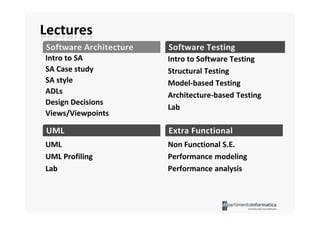
Intro to SA        Intro to Software Testing
SA Case study      Structural Testing
SA style           Model-based Testing
ADLs               Architecture-based Testing
Design Decisions
                   Lab
Views/Viewpoints


UML                Non Functional S.E.
UML Profiling      Performance modeling
Lab                Performance analysis
WEB:
www.di.univaq.it/muccini/SE+/2012/


SVN:
https://svn.di.univaq.it/seagroup/Courses/SE+2012/PROGETTI
HOW TO MODEL SA?
Which are the problems with such a notation?
There are three different options:


   component ElevatorPanel is {
     state {
       vport : ViewportType;
       sub_vports : set ViewportIDType;
     }
     invariant {
       #sub_vports eqgreater 0;
     }
     interface {
       prov ip_newvpt: createViewport() : ViewportType;
          ...
       req ir_selshp: selectShipment(port : PortID; shp : ShipmentID);
          }
     operations {
       prov op_subvpt: {
         let vpt : ViewportIDType;
         pre vpt not_in sub_vports;
         post (#~sub_vports = #sub_vports + 1) and
              (vpt in sub_vports);
       } ...
Architecture Description Languages
An architecture description language (or architecture
definition language, or ADL) is a

  •formal specification language

  •for describing the structure and behavior of a
  software architecture
ADLs Principles
Motivations: Why use Specifications
Specification is “the software lifecycle phase
concerned with precise definition of the tasks to be
performed by the system”[Meyer85]
To reveal ambiguity, incompleteness and inconsistency
   →   Rephrasing: to be sure that the product released conforms to the customer
       expectations
To prove that the system is:
   →   Consistent
   →   Complete
   →   Unambiguous
   →   Minimal
   →   Adequate
Specification: What
Specification and Formal Specification

“Formal methods provide mathematically based techniques” that have the
additional advantage of “being amenable to machine analysis and
manipulation” [Wing90]

A Formal specification is the expression, in some formal language and at
some level of abstraction, of a collection of properties some system should
satisfy [Lam00]

A formal specification language consists of
   →   syntax (the notation)
   →   semantics (the specifiable objects)
   →   satisfies relation (the semantics associated to the syntax)
Formal Specification: Why
Sometimes, systems must run reliably
for 99.9999 % of the time

semi-automated generation of test cases
 from formally specified requirements
semi-automated derivation of correctness,
 security, safety and other properties
Formal Specification: Why
For avoiding:
     »    [In]Consistency
     1.   [In]Completeness
     2.   [Non] Minimality
Types of Formal Specifications for SA modeling

Structural specifications:
  →   Structural specifications describe topological constraints
  →   Properties on the structure of the element in the
      specification


Behavioral specification
  →   Behavioral specifications describe
      constraints on behavior of the
      system
  →   functional properties
Example
Structural specification
State Transition Specifications: the FSP Process Algebra

range N = 0..1
range K = 0..1                                                       a)
range Sent = 0..1

/**UserProcess*/
USER_ALARM= (sendAlarm_To_Router -> receiveAck_From_Router -> USER_ALARM).
USER_CHECK = (sendCheck_To_Router -> USER_CHECK).                     b)
||USER = (USER_ALARM||USER_CHECK).
/**RouterProcess*/
ROUTER_RECEIVEALARM = (receiveAlarm_From_User -> sendAlarm_To_Server ->
receiveAck_From_Server -> sendAck_To_User -> ROUTER_RECEIVEALARM).
ROUTER_RECEIVECHECK = (receiveCheck_From_User -> (sendInput_To_Timer ->
ROUTER_RECEIVECHECK|pre_receiveCheck -> ROUTER_RECEIVECHECK)). c)
ROUTER_RECEIVETIME = (receiveTime_From_Timer ->(sendNoFunc_To_Server ->
ROUTER_RECEIVETIME|pre_receiveTime-> ROUTER_RECEIVETIME)).
||ROUTER = ([0..1]:ROUTER_RECEIVEALARM||[0..1]:ROUTER_RECEIVECHECK||
ROUTER_RECEIVETIME).
...                                                                   d)
/**System*/
||ALL_PROCESSES=(u[0..1]:USER||r:ROUTER||sa[0..1]:SERVER||t:TIMER)/
{
u[0].sendAlarm_To_Router/r.[0].receiveAlarm_From_User,                e)
u[1].sendAlarm_To_Router/r.[1].receiveAlarm_From_User,
...
ADL
ADL = Formal specifications for modeling SA concepts
Structural:
  →Components,  Connectors, Interfaces, Ports, Channels
  →Configurations, Constraints, Properties

Behavioral:
  →How components and connectors behave
  →How they behave in integration

  →Constraints, Properties
Practical ADLs
Existing ADLs (and many many more)
     NOME ADL
                              NOME ADL
         AADL
                                   LISA
       ABC/ADL
                                LITTLE JIL
        ACME
                                   MAE
        ADAGE
                                  MADL
       ADLARS
                                  MAFIIA
        ADML
                                 MAUDE
        AESOP
                              M(énage / xADL
       ArchJava
                                 META H
       ArchWare
                                 MIMOLA
       ArchiTRIO
                              MODE CHART
       ARTECH
                                PALANTIR
          C2
                                 PRISMA
        C2 AML
                                  RADL
       C2 SADEL
                                 RAPIDE
      CommUnity
                                RESOLVE
       DAOP ADL
                                  SADL
       DARWIN
                                 SATURN
        DICAM
                                 SKWYRL

       EAST ADL                   UDL/i

      EXPRESSION                 UNICON

      GEN VOCA                   WEAVES

        HMDES                    WRIGHT

         ISDL                     WSDL

        JACAL                  xArch / xAcme

        KOALA                  xArch / xADL

       LILEANNA                    xC2
NON PRESENZA DI BUON
      ADL NON                   ADL NON PIU’        MANCANZA DI TOOL    TOOLKIT E MANCANZA DI   ADL NON SOFTWARE
   CONVENZIONALE                 UTILIZZATO           DI SUPPORTO         MULTIPIATTAFORMA           SPECIFIC
        (V3)                        (V4)                  (V5)                  (V8.1)                 (V9)


                           OR                  OR                      OR                  OR


                                               NON ESISTENZA DI
      ADL DATATO
         (V1)
                                AND            APPLICAZIONI CHE
                                                   ESTEDONO
                                                     L’ADL
                                                      (V7)


  OFFICIAL WEB SITE                            NON ESISTENZA DI
        NON                     AND            APPLICAZIONI CHE
                                                   ESTEDONO
    AGGIORNATO
        (V2)                                         L’ADL
                                                      (V7)
                                                                                          REJECTED
SCARSE INFORMAZIONI                            NON ESISTENZA DI
 CAUSA GIOVANE ETA’
      DELL’ADL
                                AND            APPLICAZIONI CHE
                                                   ESTEDONO
        (V6)                                         L’ADL
                                                      (V7)


                                               NON ESISTENZA DI
PRESENZA DI BUON TOOLKIT                       APPLICAZIONI CHE
    MA MANCANZA DI
   MULTIPIATTAFORMA
                                AND                ESTEDONO
         (V8.2)                                      L’ADL
                                                      (V7)
ADL/Tool Support


     Mainly for            Strongly            Supports code          Oriented to
     Analysis             oriented to          generation and          dynamic
                         Architectural          architectural        architectures
                             Styles             programming             via FSP


AADL/OSATE            ACME/AcmeStudio        AcmeArchJava        DARWIN/SAA


                       Representationa           Support to         XML Schemas-
   Supports for              and                   Aspect               based
  model checking       Implementatino           Oriented and         extensibility
        SA                 of PLAs               Component
                                                   Based
                                                development


EAST-
EAST-ADL/AutoFocus2   xADL/Ménage-
                      xADL/Ménage-Palantir   Prisma/PrismaCase   xADL/ArchStudio
A Look to Some of them
Darwin & FSP
  →   Imperial College London, J. Kramer & J. Magee
Koala
  →   Philips Research
ACME
  →   Carnegie-Mellon, D. Garlan
Rapide
  → Stanford, D. Luckham

xArch/xADL
  →   University of California, Irvine
For distributed sytems
                    Darwin/FSP
                                                                             [Darwin], [DarwinWeb]


range N = 0..1
range K = 0..1                                                       a)
range Sent = 0..1

/**UserProcess*/
USER_ALARM= (sendAlarm_To_Router -> receiveAck_From_Router -> USER_ALARM).
USER_CHECK = (sendCheck_To_Router -> USER_CHECK).                     b)
||USER = (USER_ALARM||USER_CHECK).
/**RouterProcess*/
ROUTER_RECEIVEALARM = (receiveAlarm_From_User -> sendAlarm_To_Server ->
receiveAck_From_Server -> sendAck_To_User -> ROUTER_RECEIVEALARM).
ROUTER_RECEIVECHECK = (receiveCheck_From_User -> (sendInput_To_Timer ->
ROUTER_RECEIVECHECK|pre_receiveCheck -> ROUTER_RECEIVECHECK)). c)
ROUTER_RECEIVETIME = (receiveTime_From_Timer ->(sendNoFunc_To_Server ->
ROUTER_RECEIVETIME|pre_receiveTime-> ROUTER_RECEIVETIME)).
||ROUTER = ([0..1]:ROUTER_RECEIVEALARM||[0..1]:ROUTER_RECEIVECHECK||
ROUTER_RECEIVETIME).
...                                                                   d)
/**System*/
||ALL_PROCESSES=(u[0..1]:USER||r:ROUTER||sa[0..1]:SERVER||t:TIMER)/
{
u[0].sendAlarm_To_Router/r.[0].receiveAlarm_From_User,                e)
u[1].sendAlarm_To_Router/r.[1].receiveAlarm_From_User,
...
Koala [KoalaWeb][Koala]
Koala (Ommering, 2004) is an ADL specially designed for
modeling embedded software for consumer electronics.
It inherits from Darwin the main concepts and ideals, even
though it is more oriented to notations and concepts
commonly used in consumer electronics products.
Koala allows to specify hierarchical architectures, it makes
a distinction between component types and instances, it
allows to construct configurations by instantiating
components and connectors and explicitly models optional
interfaces.
For product lines
A graphical view of Koala
For modeling styles
AcmeStudio ACME tool
For formal verification
    Rapide          [Rapide, RapideWeb]
Rapide is an event-based ADL
   →component   behavior and interconnection represented by
        ─ explicit event sequences. Events are the method of
          communication
        ─ event sequencing constraints


   →Events organized in POSETs (Partially Ordered SETs)
   →Specified systems can be simulated by Rapide toolset

   →Simulations can be visualized in a graph format
POSETs
Consider events that a person might emit at a gas station:
    →   Pull up
    →   Leave
    →   Use Credit Card Machine
    →   Wash Windows
    →   Pump Gas
                                                   What are the orderings
                                                   between these events?


                  Credit Card       Pump Gas       Wash

 Pull Up                                                        Leave


                    Wash            Credit Card    Pump Gas


                      Credit Card           Pump Gas
The Result
The Result


Could this be a problem?


 Ability to specify Constraints
 (patterns that should or should
 not happen) are important in
 finding these issues.
For extensibility
xArch/xADL 2.0 [xADL_Wicsa01]
xArch is an XML-based representation for building
ADLs.
It consists of a core of basic architectural elements,
defined in an XML schema called the “instances”
schema.
The xArch instances schema provides definitions for
the following elements typically found in an ADL:
  •Component,   connector, interface, and link instances;
  •Subarchitectures, for specifying hierarchically composed component and
  connector instances; and
  •Groups, allowing the combination of basic elements
xArch XML Schema
Open the XMLinstance.html file
AADL                         Part of the material on AADL comes from
                             www.aadl.info and from Dr. Peter Feiler.
Notation for specification of runtime architecture of
real-time, embedded, fault-tolerant, secure, safety-
critical, software-intensive systems
Fields of application: Avionics, Aerospace, Automotive,
Autonomous systems, Medical devices
Based on 15 years of research & industry input
Standard approved & published Nov 2004
www.aadl.info
High level description of AADL
Developed and standardized under the auspices of the
International Society of Automotive Engineers (SAE)
Support the design and analysis of complex real-time
safety-critical systems in avionics, automotive, space,
…
AADL provides a formal mechanism to capture the
architecture specification
      ─ AADL -> mathematical analysis of real-time embedded,
       multiprocessor, safety critical, fault tolerant systems (hardware
       and software)
AADL is precise but abstract, incremental, system of
systems, extendable
Model-based Assurance

  Availability
                      Predictive Analysis
  & Reliability       Across Perspectives                   Security
  MTBF                                                      Intrusion
  FMEA                                                      Integrity
                        Architecture Model                  Confidentiality
  Hazard
  analysis


                                                      Resource
    Data                                              Consumption
    Quality
                                                      Bandwidth
    Data precision/         Real-time                 CPU time
    accuracy
                            Performance               Power
    Temporal                                          consumption
                            Execution time/
    correctness
                            Deadline
    Confidence
                            Deadlock/starvation      Reduced model
                            Latency               validation cost due to
                                                   single source model
SAE AADL Standard
                  RMA               Simplex                    MetaH
   ACME


                                                                                                Automotive
                Lehoczky       Dependable Upgrade           Error Model
   Garlan
                  Klein               Sha                   Honeywell
   EDCS

                              HOOD                Eclipse              GME
     MetaH
                                                                     VanderBilt
    Honeywell                 STOOD                EMF
                                                                      MoBIES
      DSSA


                               MBE


                                                                                                Avionics
                                                                                                Avionics
                      SAE AADL             AADL Meta
                       Standard            Model & XMI
                      Nov 2004              June 2006            OSATE
                                                                 Toolset
                                                                   SEI


                                                                                                Aerospace
                       AADL UML            AADL Error
                       Profile Std        Annex Standard
                          2007              June 2006


Embedded
 Systems                                                                   Industry
Research        Industrial           Industrial         Industrial         Standards
                Initiatives           Projects            Tools

        Unmanned
                                                                                       www.aadl.info
Medical   Vehicles                    Aerospace              Avionics Automotive
Application Components
System: hierarchical organization
of components
Process: protected virtual address
space
Thread group: organization of
threads in processes
Thread: an active unit of
concurrent execution
Data: potentially sharable data
Subprogram: Callable unit of
sequential code
Why So Many ADLs?
There are many reasons for having many ADLs:
  →Different   ADLs for different “stakeholder concerns”
      ─ Different Domains
      ─ Different Analysis
      ─ Different Viewpoints


  →Some   of them are really similar, with just small semantic or
  syntactic differences
  →Many are just prototipal languages research specific
Problems with Existing ADLs
High degree of formality
  →making   difficult their integration in industrial life-cycles

Specialized semantic basis:
  →Differentanalysis require different ADLs
  →Impossible to construct an ADL which supports every kind of analysis


Limited tool support

Lack of lifecycle-wide support

Very limited industry buy-in to date
Our study
Goal:
  →To understand which ADLs are used by industry
  →To underestand what they like and do not like

  →To understand how to plan for more practical ADLs


Plan:
  →We identified 135 ADLs!!! (see googledocs)
  →We interviewed 35 practitioners
        ─ from Volvo, IBM, ESA, Ericsson, CapGemini, SAP, Accenture Lab,
          ABB, and many others
RQ1: most popular notations
RQ1: What are the most popular notations used by
the interviewed companies?
                                      Standard notation types
                                 45
                                 40

 →UML   vs formal ADL            35
                                 30
     ─ Standard notation types   25
                                 20
                                 15
                                 10
                                 5
                                 0
RQ1: most popular notations
RQ1: What are the most popular notations used by
the interviewed companies?

 →UML   vs formal ADL
                                            AS IS (73%)
     ─ Standard notation types
     ─ Do you use UML?
          How?
                                 PROFILED
                                   (25%)
                                                          NO USAGE
                                                            (19%)
RQ1: most popular notations
RQ1: What are the most popular notations used by
the interviewed companies?
                                       Kind of UML diagrams
 →UML   vs formal ADL
     ─ Standard notation types
                                                         Structural
     ─ Do you use UML?                             38%

          How?                   57%
                                                         Behavioral
          Which UML diagrams?                 5%


                                                         Mixed(Structural/Behav
                                                         ioral)
RQ1: most popular notations
RQ1: What are the most popular notations used by
the interviewed companies?

 →UML   vs formal ADL
     ─ Standard notation types
     ─ Do you use UML?
          How?
          Which UML diagrams?
     ─ Used ADL (see next slide)
RQ1: Used ADLs

                  Used Architectural Notations
40

35

30

25

20

15

10

 5

 0
RQ1: most popular notations
RQ1: What are the most popular notations used by
the interviewed companies?
                                        Use of multiple ADLs
 →UML   vs formal ADL
                                                   21%


                                                               Yes
                                  79%                          No


     ─ About 21% of the respondents use multiple ADLs
     ─ Free sketching is advocated as useful
RQ1 - Summary
 →Summary:
    ─ UML very used (86%)
    ─ Formal ADL: only rarely and produced by industry (AADL,
      Archimate, ad hoc, Rapide)
usefulness of ADL features in past and future
projects
A Compromise: UML
UML is the de facto standard design notation of choice
 in industrial software development
Understood by many industrial software developers
Reasonably applicable to software architectures
  → UML   can be adapted for use as an ADL, but
     ─ Less formal and much more ambiguous than existing ADLs
     ─ Mature design environments, but lack of powerful analysis tools
Nowadays, many approaches to extend the UML for
 SA modeling
In general

As a matter of fact, a Software Architect needs to use
different ADLs or UML profiles to model different
aspects of his system

  →As analyzed in many papers, it is impractical to think about a
  universal ADL covering all the different users’ concerns
  →We will see our solution (DUALLY) in L17 and L18
What you shall have learned
You get the precise idea on what an ADL is
You get a precise idea on why there are many ADLs

Software Architecture: Architecture Description Languages

  • 1.
    _________ _____ ________ _____ L05: Introduction to ADLs Henry Muccini DISIM, University of L’Aquila henry.muccini@univaq.it
  • 2.
    The material inthese slides may be freely reproduced and distributed, partially or totally, as far as an explicit reference or acknowledge to the material author is preserved. Henry Muccini
  • 3.
    Intro to SA Intro to Software Testing SA Case study Structural Testing SA style Model-based Testing ADLs Architecture-based Testing Design Decisions Lab Views/Viewpoints UML Non Functional S.E. UML Profiling Performance modeling Lab Performance analysis
  • 4.
  • 5.
  • 6.
    Which are theproblems with such a notation?
  • 7.
    There are threedifferent options: component ElevatorPanel is { state { vport : ViewportType; sub_vports : set ViewportIDType; } invariant { #sub_vports eqgreater 0; } interface { prov ip_newvpt: createViewport() : ViewportType; ... req ir_selshp: selectShipment(port : PortID; shp : ShipmentID); } operations { prov op_subvpt: { let vpt : ViewportIDType; pre vpt not_in sub_vports; post (#~sub_vports = #sub_vports + 1) and (vpt in sub_vports); } ...
  • 8.
    Architecture Description Languages Anarchitecture description language (or architecture definition language, or ADL) is a •formal specification language •for describing the structure and behavior of a software architecture
  • 9.
  • 10.
    Motivations: Why useSpecifications Specification is “the software lifecycle phase concerned with precise definition of the tasks to be performed by the system”[Meyer85] To reveal ambiguity, incompleteness and inconsistency → Rephrasing: to be sure that the product released conforms to the customer expectations To prove that the system is: → Consistent → Complete → Unambiguous → Minimal → Adequate
  • 11.
  • 12.
    Specification and FormalSpecification “Formal methods provide mathematically based techniques” that have the additional advantage of “being amenable to machine analysis and manipulation” [Wing90] A Formal specification is the expression, in some formal language and at some level of abstraction, of a collection of properties some system should satisfy [Lam00] A formal specification language consists of → syntax (the notation) → semantics (the specifiable objects) → satisfies relation (the semantics associated to the syntax)
  • 13.
    Formal Specification: Why Sometimes,systems must run reliably for 99.9999 % of the time semi-automated generation of test cases from formally specified requirements semi-automated derivation of correctness, security, safety and other properties
  • 14.
    Formal Specification: Why Foravoiding: » [In]Consistency 1. [In]Completeness 2. [Non] Minimality
  • 15.
    Types of FormalSpecifications for SA modeling Structural specifications: → Structural specifications describe topological constraints → Properties on the structure of the element in the specification Behavioral specification → Behavioral specifications describe constraints on behavior of the system → functional properties
  • 16.
  • 17.
    State Transition Specifications:the FSP Process Algebra range N = 0..1 range K = 0..1 a) range Sent = 0..1 /**UserProcess*/ USER_ALARM= (sendAlarm_To_Router -> receiveAck_From_Router -> USER_ALARM). USER_CHECK = (sendCheck_To_Router -> USER_CHECK). b) ||USER = (USER_ALARM||USER_CHECK). /**RouterProcess*/ ROUTER_RECEIVEALARM = (receiveAlarm_From_User -> sendAlarm_To_Server -> receiveAck_From_Server -> sendAck_To_User -> ROUTER_RECEIVEALARM). ROUTER_RECEIVECHECK = (receiveCheck_From_User -> (sendInput_To_Timer -> ROUTER_RECEIVECHECK|pre_receiveCheck -> ROUTER_RECEIVECHECK)). c) ROUTER_RECEIVETIME = (receiveTime_From_Timer ->(sendNoFunc_To_Server -> ROUTER_RECEIVETIME|pre_receiveTime-> ROUTER_RECEIVETIME)). ||ROUTER = ([0..1]:ROUTER_RECEIVEALARM||[0..1]:ROUTER_RECEIVECHECK|| ROUTER_RECEIVETIME). ... d) /**System*/ ||ALL_PROCESSES=(u[0..1]:USER||r:ROUTER||sa[0..1]:SERVER||t:TIMER)/ { u[0].sendAlarm_To_Router/r.[0].receiveAlarm_From_User, e) u[1].sendAlarm_To_Router/r.[1].receiveAlarm_From_User, ...
  • 18.
    ADL ADL = Formalspecifications for modeling SA concepts Structural: →Components, Connectors, Interfaces, Ports, Channels →Configurations, Constraints, Properties Behavioral: →How components and connectors behave →How they behave in integration →Constraints, Properties
  • 19.
  • 20.
    Existing ADLs (andmany many more) NOME ADL NOME ADL AADL LISA ABC/ADL LITTLE JIL ACME MAE ADAGE MADL ADLARS MAFIIA ADML MAUDE AESOP M(énage / xADL ArchJava META H ArchWare MIMOLA ArchiTRIO MODE CHART ARTECH PALANTIR C2 PRISMA C2 AML RADL C2 SADEL RAPIDE CommUnity RESOLVE DAOP ADL SADL DARWIN SATURN DICAM SKWYRL EAST ADL UDL/i EXPRESSION UNICON GEN VOCA WEAVES HMDES WRIGHT ISDL WSDL JACAL xArch / xAcme KOALA xArch / xADL LILEANNA xC2
  • 21.
    NON PRESENZA DIBUON ADL NON ADL NON PIU’ MANCANZA DI TOOL TOOLKIT E MANCANZA DI ADL NON SOFTWARE CONVENZIONALE UTILIZZATO DI SUPPORTO MULTIPIATTAFORMA SPECIFIC (V3) (V4) (V5) (V8.1) (V9) OR OR OR OR NON ESISTENZA DI ADL DATATO (V1) AND APPLICAZIONI CHE ESTEDONO L’ADL (V7) OFFICIAL WEB SITE NON ESISTENZA DI NON AND APPLICAZIONI CHE ESTEDONO AGGIORNATO (V2) L’ADL (V7) REJECTED SCARSE INFORMAZIONI NON ESISTENZA DI CAUSA GIOVANE ETA’ DELL’ADL AND APPLICAZIONI CHE ESTEDONO (V6) L’ADL (V7) NON ESISTENZA DI PRESENZA DI BUON TOOLKIT APPLICAZIONI CHE MA MANCANZA DI MULTIPIATTAFORMA AND ESTEDONO (V8.2) L’ADL (V7)
  • 22.
    ADL/Tool Support Mainly for Strongly Supports code Oriented to Analysis oriented to generation and dynamic Architectural architectural architectures Styles programming via FSP AADL/OSATE ACME/AcmeStudio AcmeArchJava DARWIN/SAA Representationa Support to XML Schemas- Supports for and Aspect based model checking Implementatino Oriented and extensibility SA of PLAs Component Based development EAST- EAST-ADL/AutoFocus2 xADL/Ménage- xADL/Ménage-Palantir Prisma/PrismaCase xADL/ArchStudio
  • 23.
    A Look toSome of them Darwin & FSP → Imperial College London, J. Kramer & J. Magee Koala → Philips Research ACME → Carnegie-Mellon, D. Garlan Rapide → Stanford, D. Luckham xArch/xADL → University of California, Irvine
  • 24.
    For distributed sytems Darwin/FSP [Darwin], [DarwinWeb] range N = 0..1 range K = 0..1 a) range Sent = 0..1 /**UserProcess*/ USER_ALARM= (sendAlarm_To_Router -> receiveAck_From_Router -> USER_ALARM). USER_CHECK = (sendCheck_To_Router -> USER_CHECK). b) ||USER = (USER_ALARM||USER_CHECK). /**RouterProcess*/ ROUTER_RECEIVEALARM = (receiveAlarm_From_User -> sendAlarm_To_Server -> receiveAck_From_Server -> sendAck_To_User -> ROUTER_RECEIVEALARM). ROUTER_RECEIVECHECK = (receiveCheck_From_User -> (sendInput_To_Timer -> ROUTER_RECEIVECHECK|pre_receiveCheck -> ROUTER_RECEIVECHECK)). c) ROUTER_RECEIVETIME = (receiveTime_From_Timer ->(sendNoFunc_To_Server -> ROUTER_RECEIVETIME|pre_receiveTime-> ROUTER_RECEIVETIME)). ||ROUTER = ([0..1]:ROUTER_RECEIVEALARM||[0..1]:ROUTER_RECEIVECHECK|| ROUTER_RECEIVETIME). ... d) /**System*/ ||ALL_PROCESSES=(u[0..1]:USER||r:ROUTER||sa[0..1]:SERVER||t:TIMER)/ { u[0].sendAlarm_To_Router/r.[0].receiveAlarm_From_User, e) u[1].sendAlarm_To_Router/r.[1].receiveAlarm_From_User, ...
  • 25.
    Koala [KoalaWeb][Koala] Koala (Ommering,2004) is an ADL specially designed for modeling embedded software for consumer electronics. It inherits from Darwin the main concepts and ideals, even though it is more oriented to notations and concepts commonly used in consumer electronics products. Koala allows to specify hierarchical architectures, it makes a distinction between component types and instances, it allows to construct configurations by instantiating components and connectors and explicitly models optional interfaces.
  • 26.
    For product lines Agraphical view of Koala
  • 27.
  • 28.
    For formal verification Rapide [Rapide, RapideWeb] Rapide is an event-based ADL →component behavior and interconnection represented by ─ explicit event sequences. Events are the method of communication ─ event sequencing constraints →Events organized in POSETs (Partially Ordered SETs) →Specified systems can be simulated by Rapide toolset →Simulations can be visualized in a graph format
  • 29.
    POSETs Consider events thata person might emit at a gas station: → Pull up → Leave → Use Credit Card Machine → Wash Windows → Pump Gas What are the orderings between these events? Credit Card Pump Gas Wash Pull Up Leave Wash Credit Card Pump Gas Credit Card Pump Gas
  • 30.
  • 31.
    The Result Could thisbe a problem? Ability to specify Constraints (patterns that should or should not happen) are important in finding these issues.
  • 32.
    For extensibility xArch/xADL 2.0[xADL_Wicsa01] xArch is an XML-based representation for building ADLs. It consists of a core of basic architectural elements, defined in an XML schema called the “instances” schema. The xArch instances schema provides definitions for the following elements typically found in an ADL: •Component, connector, interface, and link instances; •Subarchitectures, for specifying hierarchically composed component and connector instances; and •Groups, allowing the combination of basic elements
  • 33.
    xArch XML Schema Openthe XMLinstance.html file
  • 34.
    AADL Part of the material on AADL comes from www.aadl.info and from Dr. Peter Feiler. Notation for specification of runtime architecture of real-time, embedded, fault-tolerant, secure, safety- critical, software-intensive systems Fields of application: Avionics, Aerospace, Automotive, Autonomous systems, Medical devices Based on 15 years of research & industry input Standard approved & published Nov 2004 www.aadl.info
  • 35.
    High level descriptionof AADL Developed and standardized under the auspices of the International Society of Automotive Engineers (SAE) Support the design and analysis of complex real-time safety-critical systems in avionics, automotive, space, … AADL provides a formal mechanism to capture the architecture specification ─ AADL -> mathematical analysis of real-time embedded, multiprocessor, safety critical, fault tolerant systems (hardware and software) AADL is precise but abstract, incremental, system of systems, extendable
  • 36.
    Model-based Assurance Availability Predictive Analysis & Reliability Across Perspectives Security MTBF Intrusion FMEA Integrity Architecture Model Confidentiality Hazard analysis Resource Data Consumption Quality Bandwidth Data precision/ Real-time CPU time accuracy Performance Power Temporal consumption Execution time/ correctness Deadline Confidence Deadlock/starvation Reduced model Latency validation cost due to single source model
  • 37.
    SAE AADL Standard RMA Simplex MetaH ACME Automotive Lehoczky Dependable Upgrade Error Model Garlan Klein Sha Honeywell EDCS HOOD Eclipse GME MetaH VanderBilt Honeywell STOOD EMF MoBIES DSSA MBE Avionics Avionics SAE AADL AADL Meta Standard Model & XMI Nov 2004 June 2006 OSATE Toolset SEI Aerospace AADL UML AADL Error Profile Std Annex Standard 2007 June 2006 Embedded Systems Industry Research Industrial Industrial Industrial Standards Initiatives Projects Tools Unmanned www.aadl.info Medical Vehicles Aerospace Avionics Automotive
  • 38.
    Application Components System: hierarchicalorganization of components Process: protected virtual address space Thread group: organization of threads in processes Thread: an active unit of concurrent execution Data: potentially sharable data Subprogram: Callable unit of sequential code
  • 39.
    Why So ManyADLs? There are many reasons for having many ADLs: →Different ADLs for different “stakeholder concerns” ─ Different Domains ─ Different Analysis ─ Different Viewpoints →Some of them are really similar, with just small semantic or syntactic differences →Many are just prototipal languages research specific
  • 40.
    Problems with ExistingADLs High degree of formality →making difficult their integration in industrial life-cycles Specialized semantic basis: →Differentanalysis require different ADLs →Impossible to construct an ADL which supports every kind of analysis Limited tool support Lack of lifecycle-wide support Very limited industry buy-in to date
  • 41.
    Our study Goal: →To understand which ADLs are used by industry →To underestand what they like and do not like →To understand how to plan for more practical ADLs Plan: →We identified 135 ADLs!!! (see googledocs) →We interviewed 35 practitioners ─ from Volvo, IBM, ESA, Ericsson, CapGemini, SAP, Accenture Lab, ABB, and many others
  • 42.
    RQ1: most popularnotations RQ1: What are the most popular notations used by the interviewed companies? Standard notation types 45 40 →UML vs formal ADL 35 30 ─ Standard notation types 25 20 15 10 5 0
  • 43.
    RQ1: most popularnotations RQ1: What are the most popular notations used by the interviewed companies? →UML vs formal ADL AS IS (73%) ─ Standard notation types ─ Do you use UML? How? PROFILED (25%) NO USAGE (19%)
  • 44.
    RQ1: most popularnotations RQ1: What are the most popular notations used by the interviewed companies? Kind of UML diagrams →UML vs formal ADL ─ Standard notation types Structural ─ Do you use UML? 38% How? 57% Behavioral Which UML diagrams? 5% Mixed(Structural/Behav ioral)
  • 45.
    RQ1: most popularnotations RQ1: What are the most popular notations used by the interviewed companies? →UML vs formal ADL ─ Standard notation types ─ Do you use UML? How? Which UML diagrams? ─ Used ADL (see next slide)
  • 46.
    RQ1: Used ADLs Used Architectural Notations 40 35 30 25 20 15 10 5 0
  • 47.
    RQ1: most popularnotations RQ1: What are the most popular notations used by the interviewed companies? Use of multiple ADLs →UML vs formal ADL 21% Yes 79% No ─ About 21% of the respondents use multiple ADLs ─ Free sketching is advocated as useful
  • 48.
    RQ1 - Summary →Summary: ─ UML very used (86%) ─ Formal ADL: only rarely and produced by industry (AADL, Archimate, ad hoc, Rapide)
  • 49.
    usefulness of ADLfeatures in past and future projects
  • 50.
    A Compromise: UML UMLis the de facto standard design notation of choice in industrial software development Understood by many industrial software developers Reasonably applicable to software architectures → UML can be adapted for use as an ADL, but ─ Less formal and much more ambiguous than existing ADLs ─ Mature design environments, but lack of powerful analysis tools Nowadays, many approaches to extend the UML for SA modeling
  • 51.
    In general As amatter of fact, a Software Architect needs to use different ADLs or UML profiles to model different aspects of his system →As analyzed in many papers, it is impractical to think about a universal ADL covering all the different users’ concerns →We will see our solution (DUALLY) in L17 and L18
  • 52.
    What you shallhave learned You get the precise idea on what an ADL is You get a precise idea on why there are many ADLs