World Hepatitis Day
Diagnosis and Management of
Hepatitis
D.R. Deeksha Singh
PG-JR-2 General Medicine
Viral hepatitis –
• primary inflammation of the liver due to infiltration of
hepatocytes with viral infected cells parenchymal
necrosis in portal and peri-portal areas.
Globally, the primary focus is to eliminate hepatitis B, C and D infections.
Unlike acute viral hepatitis, these three infections cause chronic hepatitis
that lasts for several years and culminates in more than 10 Lakhs of
deaths per year from cirrhosis and cancer of the liver.
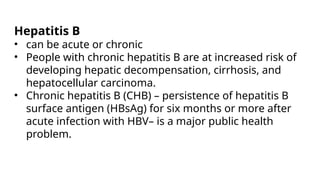
Hepatitis B
• can be acute or chronic
• People with chronic hepatitis B are at increased risk of
developing hepatic decompensation, cirrhosis, and
hepatocellular carcinoma.
• Chronic hepatitis B (CHB) – persistence of hepatitis B
surface antigen (HBsAg) for six months or more after
acute infection with HBV– is a major public health
problem.
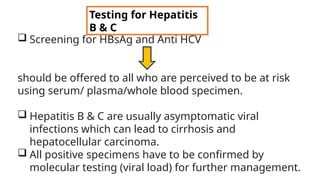
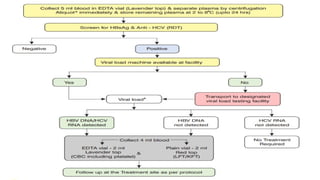
 Screening for HBsAg and Anti HCV
should be offered to all who are perceived to be at risk
using serum/ plasma/whole blood specimen.
 Hepatitis B & C are usually asymptomatic viral
infections which can lead to cirrhosis and
hepatocellular carcinoma.
 All positive specimens have to be confirmed by
molecular testing (viral load) for further management.
Testing for Hepatitis
B & C
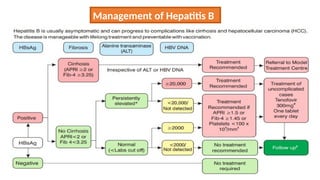
Management of Hepatitis B
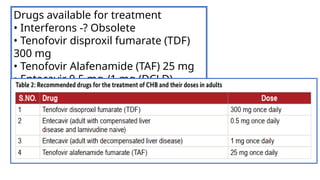
Drugs available for treatment
• Interferons -? Obsolete
• Tenofovir disproxil fumarate (TDF)
300 mg
• Tenofovir Alafenamide (TAF) 25 mg
• Entecavir 0.5 mg /1 mg (DCLD)
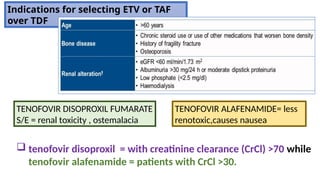
TENOFOVIR DISOPROXIL FUMARATE
S/E = renal toxicity , ostemalacia
Indications for selecting ETV or TAF
over TDF
 tenofovir disoproxil = with creatinine clearance (CrCl) >70 while
tenofovir alafenamide = patients with CrCl >30.
TENOFOVIR ALAFENAMIDE= less
renotoxic,causes nausea
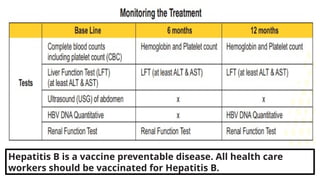
Hepatitis B is a vaccine preventable disease. All health care
workers should be vaccinated for Hepatitis B.
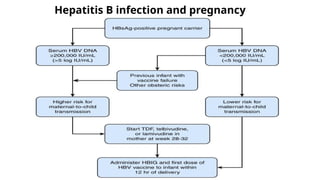
Hepatitis B infection and pregnancy
Hepatitis B immunoglobulin (HBIG) = 0.5 ml or 100 international units,
intramuscular, this should be done as soon after birth as possible (and within 12-
24 hours) and in anterolateral aspect of mid-thigh other than the one in which
hepatitis B vaccine has been administered.
Breast-feeding
A mother who has hepatitis B may breast-feed her baby, unless there is an
exuding injury or disease of the nipple or surrounding skin. The advantages of
breast-feeding far outweigh the risk, if any, of transmission of hepatitis B to a
baby who has received hepatitis B vaccine.
Timing of testing
If it is felt that the baby needs to be tested for hepatitis B, this should be done
only after 1 year of age. Any positivity before this age is difficult to interpret and
may resolve spontaneously over time.
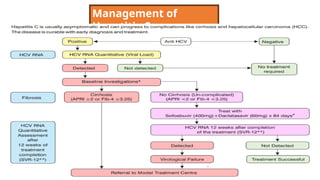
Management of
Hepatitis C
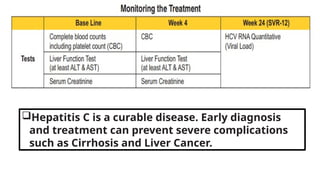
Hepatitis C is a curable disease. Early diagnosis
and treatment can prevent severe complications
such as Cirrhosis and Liver Cancer.
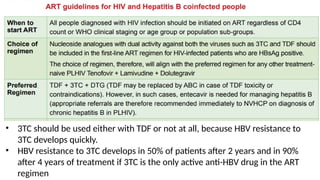
• 3TC should be used either with TDF or not at all, because HBV resistance to
3TC develops quickly.
• HBV resistance to 3TC develops in 50% of patients after 2 years and in 90%
after 4 years of treatment if 3TC is the only active anti-HBV drug in the ART
regimen
Hepatic flares
• typically present as an unexpected increase in ALT/AST levels
and symptoms of clinical hepatitis (fatigue, nausea, abdominal
pain and jaundice) within 6–12 weeks of commencing ART.
• The flares may be difficult to distinguish from ART-induced
hepatic toxicity.
• Drugs active against HBV should preferably be continued
during a suspected flare.
• If it is not possible to distinguish serious hepatitis B flare from
grade 4 drug toxicity, ART should be stopped until the patient
stabilizes.
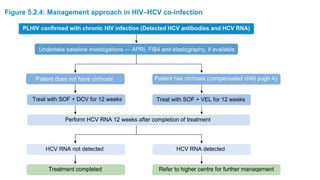
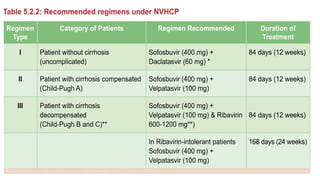
ACCORDING TO NACO GUIDELINES- stabilization of HIV disease with ART is
advisable before starting treatment for HCV, especially for people with
advanced immunosuppression (CD4 count below 200 cells/mm3 ).
ACCORDING TO AASLD GUIDELINES- treatment of both can be started.
• The decision to start ART among people coinfected with HCV
should follow the same principles as for HIV mono infection.
• The ARV regimen for new initiation remains the same, Tenofovir,
Lamivudine and Dolutegravir in single-pill FDC for adults and
adolescents.
• Potential harmful effects of ARV drugs include their hepatotoxic
effects.
• However, the highest rates of hepatotoxicity have been
observed with ARV drugs that are no longer commonly used or
recommended, including stavudine, didanosine, nevirapine or
full-dose ritonavir (600 mg twice a day).
• For most HIV–HCV coinfected people, including those with
cirrhosis, the benefits of ART outweigh the concerns regarding
drug-induced liver injury.
HBV with HCV co-infection
 It is important to check for the presence of HBV
infection before starting HCV treatment.
HBV and HCV co-infection may result in an accelerated
disease course
HCV is considered to be the main
driver of disease.
• Persons co-infected with HBV and HCV can be
treated with antiviral therapy for HCV;
SVR(sustained virological response) rates are likely
to be similar to those in HCV-mono infected
persons.
• During treatment and after HCV clearance, there is
a risk of reactivation of HBV, and this may require
treatment with concurrent anti-HBV antiviral
therapy. We must be checked before initiating
treatment.
Hepatitis A
presents with non-specific constitutional symptoms of low grade
fever, anorexia, nausea and vomiting, fatigue, malaise, arthralgia,
myalgia, headache, photophobia, pharyngitis, cough and coryza
may precede onset of jaundice by 1-2weeks.
Hepatitis E usually an acute self-limiting disease.
Acute hepatic failure- more likely in pregnancy and in malnourished state or
having pre-existing liver disease. Chronic HEV has been described almost
exclusively in immunocompromised patients.
Four genotypes (genotypes 1 to 4 [HEV1, HEV2, HEV3, and HEV4]).
Genotypes 1 and 2 more virulent, whereas genotypes 3 and 4 are
more attenuated and account for subclinical infections.
MANAGEMENT OF BOTH- USUALLY SUPPORTIVE
Hepatitis D virus (HDV or delta virus)
dependent on HBV for the production of envelope proteins.
It is an incomplete RNA particle enclosed in a shell of HBsAg.
The virus is unable to replicate on its own but is activated by the
presence of HBV.
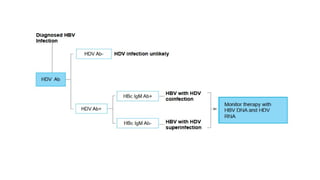
Natural HDV infections occur as either a co-infection with HBV or
a super-infection of HBV carriers.
HDV can cause severe acute and chronic liver diseases in HBV-
infected individuals; most of the HBV carriers super-infected
with HDV become carriers of both HBV and HDV.
Pretreatment evaluation —
patients should have laboratory testing for HDV ribonucleic acid (RNA)
and transaminase levels.
In patients with chronic hepatitis B virus (HBV)/HDV infection, we
consider patients with elevated serum alanine aminotransferase (ALT)
levels to have evidence of active liver disease.
Treatment of chronic HDV
Patients without advanced fibrosis or cirrhosis
-Whom to treat – pt. with active liver disease and detectable HDV RNA
• treatment is generally not needed for persons with chronic HDV who have
persistently normal ALT levels and no or very mild fibrosis
• However, close monitoring (eg, ALT levels) should be performed to assess for
signs of disease progression.
-Regimen selection – In most countries, pegylated interferon alfa-2a is the only
available treatment.
180 mcg s.c. once weekly should be administered for 48 weeks. Patients should
be treated as soon as possible, since virologic suppression with Peg-IFNa-2α is
more likely to be attained in patients with a shorter duration of infection.
Bulevirtide, an entry inhibitor, may also be an option for certain patients.
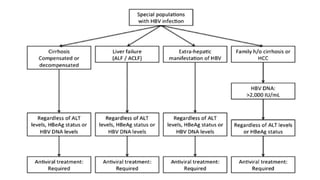
Patients with cirrhosis –
• For patients with chronic HDV/HBV cirrhosis, HBV nucleos(t)ide therapy
should be administered. In addition, surveillance for hepatocellular
carcinoma should be performed.
Prevention – The best way to prevent HDV infection is vaccination against
HBV (its helper virus).
Hepatitisssssssssssssßsssssssssssssssssss

Hepatitisssssssssssssßsssssssssssssssssss

  • 1.
    World Hepatitis Day Diagnosisand Management of Hepatitis D.R. Deeksha Singh PG-JR-2 General Medicine
  • 2.
    Viral hepatitis – •primary inflammation of the liver due to infiltration of hepatocytes with viral infected cells parenchymal necrosis in portal and peri-portal areas. Globally, the primary focus is to eliminate hepatitis B, C and D infections. Unlike acute viral hepatitis, these three infections cause chronic hepatitis that lasts for several years and culminates in more than 10 Lakhs of deaths per year from cirrhosis and cancer of the liver.
  • 8.
    Hepatitis B • canbe acute or chronic • People with chronic hepatitis B are at increased risk of developing hepatic decompensation, cirrhosis, and hepatocellular carcinoma. • Chronic hepatitis B (CHB) – persistence of hepatitis B surface antigen (HBsAg) for six months or more after acute infection with HBV– is a major public health problem.
  • 9.
     Screening forHBsAg and Anti HCV should be offered to all who are perceived to be at risk using serum/ plasma/whole blood specimen.  Hepatitis B & C are usually asymptomatic viral infections which can lead to cirrhosis and hepatocellular carcinoma.  All positive specimens have to be confirmed by molecular testing (viral load) for further management. Testing for Hepatitis B & C
  • 11.
  • 14.
    Drugs available fortreatment • Interferons -? Obsolete • Tenofovir disproxil fumarate (TDF) 300 mg • Tenofovir Alafenamide (TAF) 25 mg • Entecavir 0.5 mg /1 mg (DCLD)
  • 15.
    TENOFOVIR DISOPROXIL FUMARATE S/E= renal toxicity , ostemalacia Indications for selecting ETV or TAF over TDF  tenofovir disoproxil = with creatinine clearance (CrCl) >70 while tenofovir alafenamide = patients with CrCl >30. TENOFOVIR ALAFENAMIDE= less renotoxic,causes nausea
  • 16.
    Hepatitis B isa vaccine preventable disease. All health care workers should be vaccinated for Hepatitis B.
  • 17.
    Hepatitis B infectionand pregnancy
  • 18.
    Hepatitis B immunoglobulin(HBIG) = 0.5 ml or 100 international units, intramuscular, this should be done as soon after birth as possible (and within 12- 24 hours) and in anterolateral aspect of mid-thigh other than the one in which hepatitis B vaccine has been administered. Breast-feeding A mother who has hepatitis B may breast-feed her baby, unless there is an exuding injury or disease of the nipple or surrounding skin. The advantages of breast-feeding far outweigh the risk, if any, of transmission of hepatitis B to a baby who has received hepatitis B vaccine. Timing of testing If it is felt that the baby needs to be tested for hepatitis B, this should be done only after 1 year of age. Any positivity before this age is difficult to interpret and may resolve spontaneously over time.
  • 19.
  • 20.
    Hepatitis C isa curable disease. Early diagnosis and treatment can prevent severe complications such as Cirrhosis and Liver Cancer.
  • 21.
    • 3TC shouldbe used either with TDF or not at all, because HBV resistance to 3TC develops quickly. • HBV resistance to 3TC develops in 50% of patients after 2 years and in 90% after 4 years of treatment if 3TC is the only active anti-HBV drug in the ART regimen
  • 22.
    Hepatic flares • typicallypresent as an unexpected increase in ALT/AST levels and symptoms of clinical hepatitis (fatigue, nausea, abdominal pain and jaundice) within 6–12 weeks of commencing ART. • The flares may be difficult to distinguish from ART-induced hepatic toxicity. • Drugs active against HBV should preferably be continued during a suspected flare. • If it is not possible to distinguish serious hepatitis B flare from grade 4 drug toxicity, ART should be stopped until the patient stabilizes.
  • 23.
    ACCORDING TO NACOGUIDELINES- stabilization of HIV disease with ART is advisable before starting treatment for HCV, especially for people with advanced immunosuppression (CD4 count below 200 cells/mm3 ). ACCORDING TO AASLD GUIDELINES- treatment of both can be started. • The decision to start ART among people coinfected with HCV should follow the same principles as for HIV mono infection. • The ARV regimen for new initiation remains the same, Tenofovir, Lamivudine and Dolutegravir in single-pill FDC for adults and adolescents.
  • 24.
    • Potential harmfuleffects of ARV drugs include their hepatotoxic effects. • However, the highest rates of hepatotoxicity have been observed with ARV drugs that are no longer commonly used or recommended, including stavudine, didanosine, nevirapine or full-dose ritonavir (600 mg twice a day). • For most HIV–HCV coinfected people, including those with cirrhosis, the benefits of ART outweigh the concerns regarding drug-induced liver injury.
  • 27.
    HBV with HCVco-infection  It is important to check for the presence of HBV infection before starting HCV treatment. HBV and HCV co-infection may result in an accelerated disease course HCV is considered to be the main driver of disease.
  • 28.
    • Persons co-infectedwith HBV and HCV can be treated with antiviral therapy for HCV; SVR(sustained virological response) rates are likely to be similar to those in HCV-mono infected persons. • During treatment and after HCV clearance, there is a risk of reactivation of HBV, and this may require treatment with concurrent anti-HBV antiviral therapy. We must be checked before initiating treatment.
  • 29.
    Hepatitis A presents withnon-specific constitutional symptoms of low grade fever, anorexia, nausea and vomiting, fatigue, malaise, arthralgia, myalgia, headache, photophobia, pharyngitis, cough and coryza may precede onset of jaundice by 1-2weeks. Hepatitis E usually an acute self-limiting disease. Acute hepatic failure- more likely in pregnancy and in malnourished state or having pre-existing liver disease. Chronic HEV has been described almost exclusively in immunocompromised patients. Four genotypes (genotypes 1 to 4 [HEV1, HEV2, HEV3, and HEV4]). Genotypes 1 and 2 more virulent, whereas genotypes 3 and 4 are more attenuated and account for subclinical infections. MANAGEMENT OF BOTH- USUALLY SUPPORTIVE
  • 30.
    Hepatitis D virus(HDV or delta virus) dependent on HBV for the production of envelope proteins. It is an incomplete RNA particle enclosed in a shell of HBsAg. The virus is unable to replicate on its own but is activated by the presence of HBV. Natural HDV infections occur as either a co-infection with HBV or a super-infection of HBV carriers. HDV can cause severe acute and chronic liver diseases in HBV- infected individuals; most of the HBV carriers super-infected with HDV become carriers of both HBV and HDV.
  • 32.
    Pretreatment evaluation — patientsshould have laboratory testing for HDV ribonucleic acid (RNA) and transaminase levels. In patients with chronic hepatitis B virus (HBV)/HDV infection, we consider patients with elevated serum alanine aminotransferase (ALT) levels to have evidence of active liver disease.
  • 33.
    Treatment of chronicHDV Patients without advanced fibrosis or cirrhosis -Whom to treat – pt. with active liver disease and detectable HDV RNA • treatment is generally not needed for persons with chronic HDV who have persistently normal ALT levels and no or very mild fibrosis • However, close monitoring (eg, ALT levels) should be performed to assess for signs of disease progression. -Regimen selection – In most countries, pegylated interferon alfa-2a is the only available treatment. 180 mcg s.c. once weekly should be administered for 48 weeks. Patients should be treated as soon as possible, since virologic suppression with Peg-IFNa-2α is more likely to be attained in patients with a shorter duration of infection. Bulevirtide, an entry inhibitor, may also be an option for certain patients.
  • 34.
    Patients with cirrhosis– • For patients with chronic HDV/HBV cirrhosis, HBV nucleos(t)ide therapy should be administered. In addition, surveillance for hepatocellular carcinoma should be performed. Prevention – The best way to prevent HDV infection is vaccination against HBV (its helper virus).