SODIUM
Syed Abdul Sami
syedsami084@gmail.com
+923059761835
UNIVERSITY OF AGRICULTURE FAISALABAD PAKISTAN
SODIUM
 Sodium is one of the most abundant element on earth
 Sodium is naturally present in food
 Sodium is an important mineral and electrolyte
necessary for many functions in the body
 It has an important role in maintaining water balance
within cells, and is involved in proper functioning of
both nerve impulses and muscles within the body
SOURCES OF SODIUM
• Sodium is naturally present in most foods, but
most dietary sodium is found in processed foods
in the form of salt.
• Salt may be added for flavor enhancement and
to extend the shelf life of certain foods
• Sodium is a component of salt. Table salt, also
known as sodium chloride, is 40% sodium and
60% chloride
• The sodium portion of salt is associated with high
blood pressure
SOURCES OF SODIUM
• Grains
• Rice and Pasta
• Backed Goods
• Muscles foods
• Fresh Meats
• Kosher Meats
• Dairy Foods
• Milk
• Cheese
• Butter
• Fruits
• Vegetables
• Beans
• Legumes
SODIUM METABOLISM
Digestive absorption
Tissue Distribution
In blood
Passage of sodium between cells and extra cellular medium
Voltage-gated sodium channels
Receptor-dependent sodium channels
DISORDERS OF SODIUM METABOLISM
• The metabolism of sodium is closely linked to that of water
• One can observe hyponatremia and hypernatremia
• It is not necessarily a question of lack or excess of sodium, but often the
consequences of dissociated variations of water and sodium, a water excess, for
example, causes a hyponatremia of dilution.
• Hyponatremia can be observed in patients with a mediastinal tumor or a
neurological disease or more frequently in patients treated with certain drugs like
antidepressants, carbamazepine, and neuroleptic agents
DISORDERS OF SODIUM METABOLISM
• . A sufficient intake of water or electrolytes by oral route each time it is possible
avoids and corrects the anomalies, while reducing the risk of overloading linked
to parenteral administration
• However, when the intake by oral route is impossible or when there is an
important imbalance, they should be administered by intravenous route.
SODIUM DEFICIENCY
• Sodium deficiency is extremely rare, as most Americans over-consume sodium
• Deficiency usually only occurs with prolonged bouts of fluid loss due to diarrhea,
vomiting, or perspiration
• Those who have kidney problems may also be more likely to develop a sodium
deficiency. Symptoms of deficiency include nausea, dizziness, and muscle cramps
TOO MUCH SODIUM
• Most Americans consume too much sodium.
• The Tolerable Upper Limit Level (UL) for sodium is 2,300 milligrams daily for teens
and adults
• This value does not apply to those with high blood pressure, as this value may be
set too high
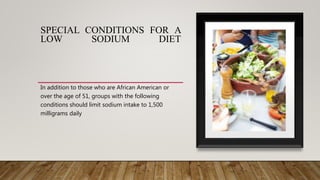
SPECIAL CONDITIONS FOR A
LOW SODIUM DIET
In addition to those who are African American or
over the age of 51, groups with the following
conditions should limit sodium intake to 1,500
milligrams daily
SPECIAL CONDITIONS FOR A LOW SODIUM DIET
KIDNEY DISEASE
• Those with kidney disease may have
trouble excreting sodium and other
minerals, leading to water retention
and swelling
CONGESTIVE HEART FAILURE
• Those with heart failure experience
swelling and fluid retention in the
lungs and throughout the body.
Since sodium promotes fluid
retention, a low sodium diet may be
helpful in relieving fluid
accumulation.
SPECIAL CONDITIONS FOR A LOW SODIUM DIET
OSTEOPOROSIS
• Women who consume excess sodium
may be at higher risk for developing
osteoporosis even if calcium intake is
adequate. Some evidence suggests that
for each teaspoon of salt (2,000
milligrams of sodium) consumed,
considerable calcium is excreted in the
urine.
HIGH BLOOD PRESSURE OR
HYPERTENSION
• High sodium consumption is one factor
involved in the development of high
blood pressure, Hypertension tends to
develop as people age, and can lead to
cardiovascular disease. Some
individuals are "salt sensitive," so
reducing intake of sodium helps to
reduce blood pressure levels.
HEALTH CLAIMS
Specific health claims can be made about sodium for food products that meet
certain requirements.
• Sodium free: Less than 5 milligrams of sodium per serving.
• Very low sodium: 35 milligrams of sodium or less per serving.
• Low sodium: 140 milligrams of sodium or less per serving.
• Reduced sodium or less sodium: At least 25% less sodium per serving than the
reference food.
• Light in sodium: At least 50% less sodium per serving than the reference food.
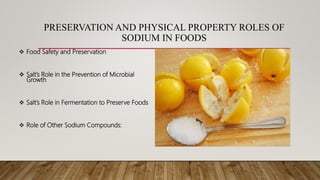
PRESERVATION AND PHYSICAL PROPERTY ROLES OF
SODIUM IN FOODS
 Food Safety and Preservation
 Salt’s Role in the Prevention of Microbial
Growth
 Salt’s Role in Fermentation to Preserve Foods
 Role of Other Sodium Compounds:
HEALTH BENEFITS OF SODIUM
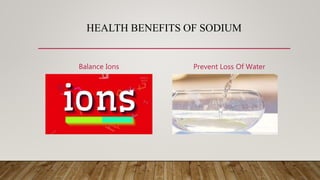
Balance Ions Prevent Loss Of Water
HEALTH BENEFITS OF SODIUM
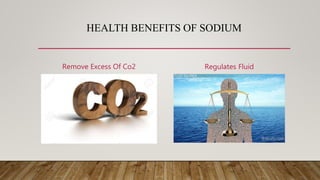
Remove Excess Of Co2 Regulates Fluid
HEALTH BENEFITS OF SODIUM
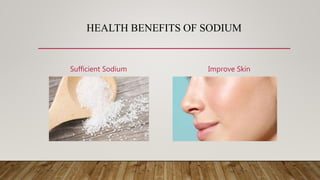
Sufficient Sodium Improve Skin
HEALTH BENEFITS OF SODIUM
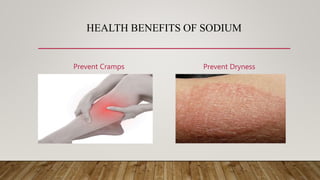
Prevent Cramps Prevent Dryness

Sodium

  • 1.
  • 2.
    SODIUM  Sodium isone of the most abundant element on earth  Sodium is naturally present in food  Sodium is an important mineral and electrolyte necessary for many functions in the body  It has an important role in maintaining water balance within cells, and is involved in proper functioning of both nerve impulses and muscles within the body
  • 3.
    SOURCES OF SODIUM •Sodium is naturally present in most foods, but most dietary sodium is found in processed foods in the form of salt. • Salt may be added for flavor enhancement and to extend the shelf life of certain foods • Sodium is a component of salt. Table salt, also known as sodium chloride, is 40% sodium and 60% chloride • The sodium portion of salt is associated with high blood pressure
  • 4.
    SOURCES OF SODIUM •Grains • Rice and Pasta • Backed Goods • Muscles foods • Fresh Meats • Kosher Meats • Dairy Foods • Milk • Cheese • Butter • Fruits • Vegetables • Beans • Legumes
  • 5.
    SODIUM METABOLISM Digestive absorption TissueDistribution In blood Passage of sodium between cells and extra cellular medium Voltage-gated sodium channels Receptor-dependent sodium channels
  • 6.
    DISORDERS OF SODIUMMETABOLISM • The metabolism of sodium is closely linked to that of water • One can observe hyponatremia and hypernatremia • It is not necessarily a question of lack or excess of sodium, but often the consequences of dissociated variations of water and sodium, a water excess, for example, causes a hyponatremia of dilution. • Hyponatremia can be observed in patients with a mediastinal tumor or a neurological disease or more frequently in patients treated with certain drugs like antidepressants, carbamazepine, and neuroleptic agents
  • 7.
    DISORDERS OF SODIUMMETABOLISM • . A sufficient intake of water or electrolytes by oral route each time it is possible avoids and corrects the anomalies, while reducing the risk of overloading linked to parenteral administration • However, when the intake by oral route is impossible or when there is an important imbalance, they should be administered by intravenous route.
  • 8.
    SODIUM DEFICIENCY • Sodiumdeficiency is extremely rare, as most Americans over-consume sodium • Deficiency usually only occurs with prolonged bouts of fluid loss due to diarrhea, vomiting, or perspiration • Those who have kidney problems may also be more likely to develop a sodium deficiency. Symptoms of deficiency include nausea, dizziness, and muscle cramps
  • 9.
    TOO MUCH SODIUM •Most Americans consume too much sodium. • The Tolerable Upper Limit Level (UL) for sodium is 2,300 milligrams daily for teens and adults • This value does not apply to those with high blood pressure, as this value may be set too high
  • 10.
    SPECIAL CONDITIONS FORA LOW SODIUM DIET In addition to those who are African American or over the age of 51, groups with the following conditions should limit sodium intake to 1,500 milligrams daily
  • 11.
    SPECIAL CONDITIONS FORA LOW SODIUM DIET KIDNEY DISEASE • Those with kidney disease may have trouble excreting sodium and other minerals, leading to water retention and swelling CONGESTIVE HEART FAILURE • Those with heart failure experience swelling and fluid retention in the lungs and throughout the body. Since sodium promotes fluid retention, a low sodium diet may be helpful in relieving fluid accumulation.
  • 12.
    SPECIAL CONDITIONS FORA LOW SODIUM DIET OSTEOPOROSIS • Women who consume excess sodium may be at higher risk for developing osteoporosis even if calcium intake is adequate. Some evidence suggests that for each teaspoon of salt (2,000 milligrams of sodium) consumed, considerable calcium is excreted in the urine. HIGH BLOOD PRESSURE OR HYPERTENSION • High sodium consumption is one factor involved in the development of high blood pressure, Hypertension tends to develop as people age, and can lead to cardiovascular disease. Some individuals are "salt sensitive," so reducing intake of sodium helps to reduce blood pressure levels.
  • 13.
    HEALTH CLAIMS Specific healthclaims can be made about sodium for food products that meet certain requirements. • Sodium free: Less than 5 milligrams of sodium per serving. • Very low sodium: 35 milligrams of sodium or less per serving. • Low sodium: 140 milligrams of sodium or less per serving. • Reduced sodium or less sodium: At least 25% less sodium per serving than the reference food. • Light in sodium: At least 50% less sodium per serving than the reference food.
  • 14.
    PRESERVATION AND PHYSICALPROPERTY ROLES OF SODIUM IN FOODS  Food Safety and Preservation  Salt’s Role in the Prevention of Microbial Growth  Salt’s Role in Fermentation to Preserve Foods  Role of Other Sodium Compounds:
  • 15.
    HEALTH BENEFITS OFSODIUM Balance Ions Prevent Loss Of Water
  • 16.
    HEALTH BENEFITS OFSODIUM Remove Excess Of Co2 Regulates Fluid
  • 17.
    HEALTH BENEFITS OFSODIUM Sufficient Sodium Improve Skin
  • 18.
    HEALTH BENEFITS OFSODIUM Prevent Cramps Prevent Dryness