SO.CL: AN INTEREST NETWORK
FOR INFORMAL LEARNING
Shelly D. Farnham, Michal Lahav, David Raskino, Lili Cheng, Steven Ickman, Tom Laird-McConnell
FUSE Labs, Microsoft Research
ICWSM, June 7, 2012
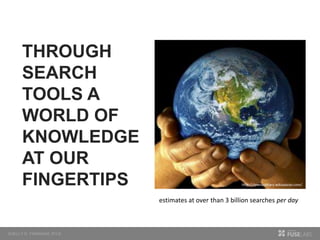
THROUGH
SEARCH
TOOLS A
WORLD OF
KNOWLEDGE
AT OUR
FINGERTIPS http://dewooddiary.wikispaces.com/
estimates at over than 3 billion searches per day
INFORMAL LEARNING AND
DEMOCRATIZATION OF
KNOWLEDGE
 Education outside of formal institutions
 Access to learning opportunities outside
immediate social circles
 Peer to peer learning
 Informal communities of practice
http://utopianist.com/2011/05/knowing-what-your-neighbor-thinks-corrupts-wisdom-of-crowds-deters-democracy/
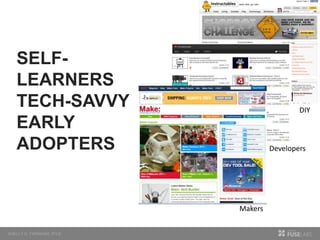
SELF-
LEARNERS
TECH-SAVVY
EARLY
ADOPTERS
DIY
Makers
Developers
WHAT IS MY MOTIVATION?
http://www.designerchaircoverstogo.com/blog/2010/07/fight-the-flab-for-the-wedding-dress/
Giving people a sense of connection
to others in their extended networks
and exposing them to their interests
will motivate them to learn new
topics not available in their
immediate social circles.
LEVERAGING SOCIAL MEDIA
BECAUSE LEARNING IS SOCIAL
RELATED WORK
 Search
 Primary information seeking
behavior online
 Social interactions important
aspect of search (e.g., Morris, 2008; Evans and Chi,
2008)
 Foraging for information
 Sense-making process
 Search tools primarily designed for
solitary experience
 Social Search Systems and
Social Tagging
 Focus primarily on improving
quality of search, not connecting
people around information
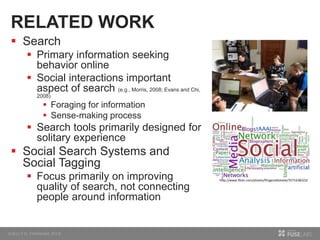
http://www.flickr.com/photos/fitzgeraldsteele/3571638323/
RELATED WORK
 Online Learning Communities
 Remix/participatory culture (Jenkins et al. 2005), with creation,
sharing, and building upon user generated content
 Scratch, Kodu, Sourceforge (opensoure), Instructables
 Walled communities often with high barriers to sharing,
members already motivated around specific topic
 Interest Networks
 Public, asymmetrical networks focused on broadcasting
information
 Blogs, Twitter, Pinterest, Tumblr
 Better for lightweight sharing and serendipitous
discovery (Ito, 2011)
 Not directly integrated with search
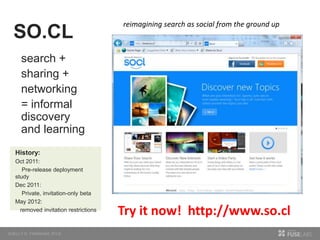
search +
sharing +
networking
= informal
discovery
and learning
SO.CL
reimagining search as social from the ground up
History:
Oct 2011:
Pre-release deployment
study
Dec 2011:
Private, invitation-only beta
May 2012:
removed invitation restrictions
Try it now! http://www.so.cl
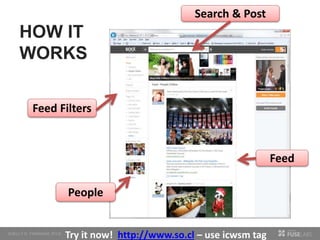
HOW IT
WORKS
Feed
Search & Post
Feed Filters
People
Try it now! http://www.so.cl – use icwsm tag
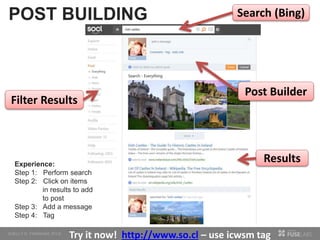
POST BUILDING
Results
Search (Bing)
Filter Results
Post Builder
Experience:
Step 1: Perform search
Step 2: Click on items
in results to add
to post
Step 3: Add a message
Step 4: Tag
Try it now! http://www.so.cl – use icwsm tag
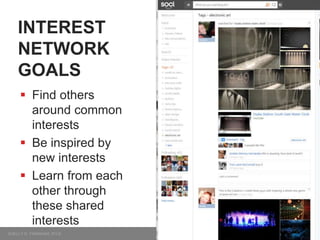
INTEREST
NETWORK
GOALS
 Find others
around common
interests
 Be inspired by
new interests
 Learn from each
other through
these shared
interests
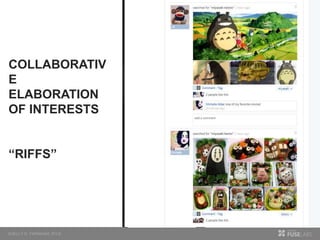
COLLABORATIV
E
ELABORATION
OF INTERESTS
“RIFFS”
SO.CL DEPLOYMENT STUDY
 33 University of Washington students
 Seed community pre-release
 Study:
 Existing learning practices
 Use of so.cl as informal learning tool
MIXED METHODS PROCEDURES
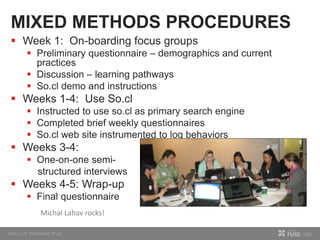
 Week 1: On-boarding focus groups
 Preliminary questionnaire – demographics and current
practices
 Discussion – learning pathways
 So.cl demo and instructions
 Weeks 1-4: Use So.cl
 Instructed to use so.cl as primary search engine
 Completed brief weekly questionnaires
 So.cl web site instrumented to log behaviors
 Weeks 3-4:
 One-on-one semi-
structured interviews
 Weeks 4-5: Wrap-up
 Final questionnaire
Michal Lahav rocks!
PARTICIPANTS
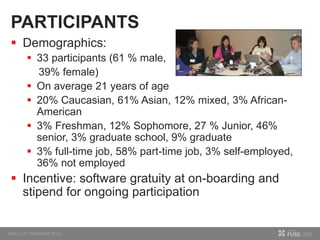
 Demographics:
 33 participants (61 % male,
39% female)
 On average 21 years of age
 20% Caucasian, 61% Asian, 12% mixed, 3% African-
American
 3% Freshman, 12% Sophomore, 27 % Junior, 46%
senior, 3% graduate school, 9% graduate
 3% full-time job, 58% part-time job, 3% self-employed,
36% not employed
 Incentive: software gratuity at on-boarding and
stipend for ongoing participation
INTERNET USE
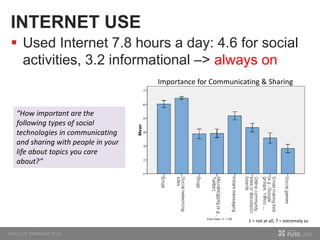
 Used Internet 7.8 hours a day: 4.6 for social
activities, 3.2 informational –> always on
Importance for Communicating & Sharing
“How important are the
following types of social
technologies in communicating
and sharing with people in your
life about topics you care
about?”
1 = not at all, 7 = extremely so
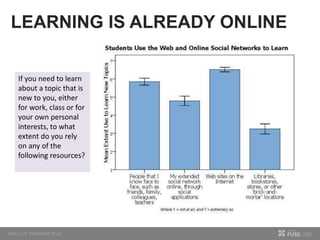
LEARNING IS ALREADY ONLINE
If you need to learn
about a topic that is
new to you, either
for work, class or for
your own personal
interests, to what
extent do you rely
on any of the
following resources?
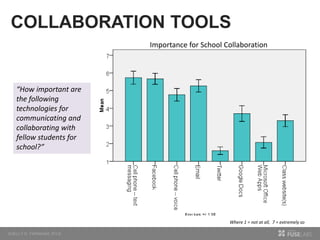
COLLABORATION TOOLS
Importance for School Collaboration
Where 1 = not at all, 7 = extremely so
“How important are
the following
technologies for
communicating and
collaborating with
fellow students for
school?”
SOCIAL LEARNING PATHWAYS
 Asked participants to describe pathways to learning
something new in past two weeks
 Coded each point along learning pathway
 Content only source (books, TV, news site) vs. social
interaction (email, face-to-face, networks)
 If a social interaction, coded as social media or face-to-face
Example:
“My friend told me in person about stabbing in home town. I
wonder if this is a big issues- I searched for it -- wasn't in the
search, but in the news tab. Clicked on different links to see if
they were the same.”
coded as:
1. My friend told me [personal interaction][face to face]
2. searched; news tab [content only source]
SOCIAL LEARNING PATHWAYS
 69% of pathways described involved social interaction
 43% from personal interaction to content only source
“I learned about Steve Job’s death from a friend on twitter and then
checked bloomberg for potential impact.”
“My friend told me in person about stabbing in home town. I wonder if
this is a big issues- I searched for it -- wasn't in the search, but in the
news tab. Clicked on different links to see if they were the same.”
 26% from content only source to more personal
interactions
“I used tumbler to keep track of news related blogs. On blogs I saw an
Occupy Wallstreat posts. Saw one about Rome. Then I was talking to
a girlfriend who is in Rome. Told her that I saw photo of car fire on
tumbler. She said ‘I saw a care on fire last night, we got trapped
indoors because of protest’”
 Observed foraging, sense-making but also initial
discovery
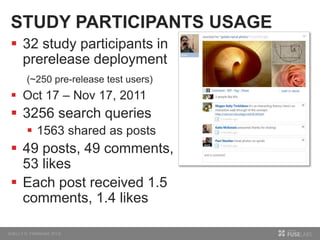
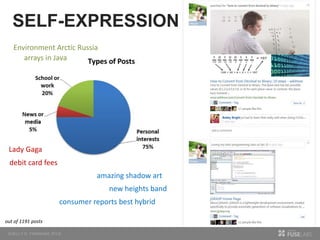
STUDY PARTICIPANTS USAGE
 32 study participants in
prerelease deployment
(~250 pre-release test users)
 Oct 17 – Nov 17, 2011
 3256 search queries
 1563 shared as posts
 49 posts, 49 comments,
53 likes
 Each post received 1.5
comments, 1.4 likes
amazing shadow art
out of 1191 posts
arrays in Java
new heights band
Environment Arctic Russia
consumer reports best hybrid
debit card fees
Lady Gaga
SELF-EXPRESSION
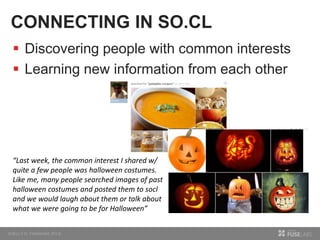
CONNECTING IN SO.CL
Josh Chau
“Last week, the common interest I shared w/
quite a few people was halloween costumes.
Like me, many people searched images of past
halloween costumes and posted them to socl
and we would laugh about them or talk about
what we were going to be for Halloween”
 Discovering people with common interests
 Learning new information from each other
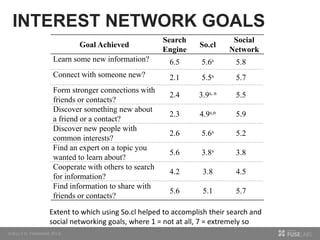
Goal Achieved
Search
Engine
So.cl
Social
Network
Learn some new information? 6.5 5.6s 5.8
Connect with someone new? 2.1 5.5s 5.7
Form stronger connections with
friends or contacts?
2.4 3.9s, n 5.5
Discover something new about
a friend or a contact?
2.3 4.9s,n 5.9
Discover new people with
common interests?
2.6 5.6s 5.2
Find an expert on a topic you
wanted to learn about?
5.6 3.8s 3.8
Cooperate with others to search
for information?
4.2 3.8 4.5
Find information to share with
friends or contacts?
5.6 5.1 5.7
INTEREST NETWORK GOALS
Extent to which using So.cl helped to accomplish their search and
social networking goals, where 1 = not at all, 7 = extremely so
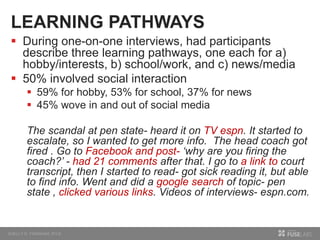
LEARNING PATHWAYS
 During one-on-one interviews, had participants
describe three learning pathways, one each for a)
hobby/interests, b) school/work, and c) news/media
 50% involved social interaction
 59% for hobby, 53% for school, 37% for news
 45% wove in and out of social media
The scandal at pen state- heard it on TV espn. It started to
escalate, so I wanted to get more info. The head coach got
fired . Go to Facebook and post- ‘why are you firing the
coach?’ - had 21 comments after that. I go to a link to court
transcript, then I started to read- got sick reading it, but able
to find info. Went and did a google search of topic- pen
state , clicked various links. Videos of interviews- espn.com.
SO.CL AND LEARNING PATHWAYS
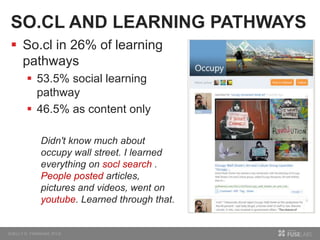
 So.cl in 26% of learning
pathways
 53.5% social learning
pathway
 46.5% as content only
Didn't know much about
occupy wall street. I learned
everything on socl search .
People posted articles,
pictures and videos, went on
youtube. Learned through that.
SO.CL AND LEARNING PATHWAYS
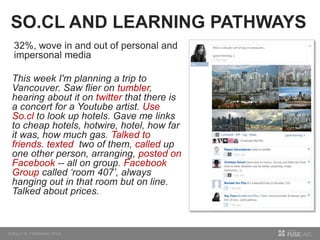
32%, wove in and out of personal and
impersonal media
This week I'm planning a trip to
Vancouver. Saw flier on tumbler,
hearing about it on twitter that there is
a concert for a Youtube artist. Use
So.cl to look up hotels. Gave me links
to cheap hotels, hotwire, hotel, how far
it was, how much gas. Talked to
friends. texted two of them, called up
one other person, arranging, posted on
Facebook -- all on group. Facebook
Group called ‘room 407’, always
hanging out in that room but on line.
Talked about prices.
WRAP UP OPEN ENDED
FEEDBACK
 Effective serendipitous discovery of people and
information
I found a ton of people with similar interests..every day.
Yogurtland, coffee, fantasy football
I think it really helped me in seeing other people’s search
results..like oh-you’re interested in skydiving, then we can into a
little conversation about it
 Deeper connection and collaboration? Privacy and groups
highly requested features.
I had no way to connect with them besides commenting, trying to
go deeper with them is basically impossible.
I want groups: research, professors, family-- not everyone that
you are following on one page.
CONCLUSIONS AND DISCUSSION
 Students are already heavily employing search and
social media tools for informal learning
 Learning online is very social and incorporates social
media
 Learning pathways weave in and out of personal
interactions, pure content sources, online and offline
 So.cl:
 Integration of sharing around search fostered
serendipitous, lightweight, informal learning around
interests
 Based on study, shifted our conceptualization of So.cl;
less emphasis on social search and more on interest-
based networking
 So.cl actively used in participants’ learning pathways
(discovery, foraging and sensemaking)
CONCLUSIONS AND DISCUSSION
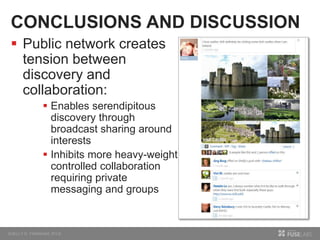
 Public network creates
tension between
discovery and
collaboration:
 Enables serendipitous
discovery through
broadcast sharing around
interests
 Inhibits more heavy-weight,
controlled collaboration
requiring private
messaging and groups
NEXT STEPS
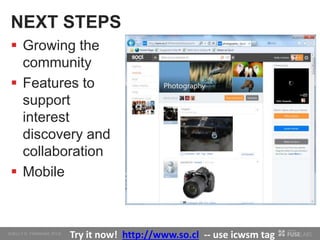
 Growing the
community
 Features to
support
interest
discovery and
collaboration
 Mobile
Try it now! http://www.so.cl -- use icwsm tag
QUESTIONS
WHERE TO FIND US ON THE WEB
http://www.so.cl
http://fuse.microsoft.com
CONTACT INFO
Shelly Farnham, Researcher
FUSE Labs, Microsoft Research
shellyfa@microsft.com
@shellyshelly

So.cl: An interest Network for Informal Learning

  • 1.
    SO.CL: AN INTERESTNETWORK FOR INFORMAL LEARNING Shelly D. Farnham, Michal Lahav, David Raskino, Lili Cheng, Steven Ickman, Tom Laird-McConnell FUSE Labs, Microsoft Research ICWSM, June 7, 2012
  • 2.
    THROUGH SEARCH TOOLS A WORLD OF KNOWLEDGE ATOUR FINGERTIPS http://dewooddiary.wikispaces.com/ estimates at over than 3 billion searches per day
  • 3.
    INFORMAL LEARNING AND DEMOCRATIZATIONOF KNOWLEDGE  Education outside of formal institutions  Access to learning opportunities outside immediate social circles  Peer to peer learning  Informal communities of practice http://utopianist.com/2011/05/knowing-what-your-neighbor-thinks-corrupts-wisdom-of-crowds-deters-democracy/
  • 4.
  • 5.
    WHAT IS MYMOTIVATION? http://www.designerchaircoverstogo.com/blog/2010/07/fight-the-flab-for-the-wedding-dress/
  • 6.
    Giving people asense of connection to others in their extended networks and exposing them to their interests will motivate them to learn new topics not available in their immediate social circles. LEVERAGING SOCIAL MEDIA BECAUSE LEARNING IS SOCIAL
  • 7.
    RELATED WORK  Search Primary information seeking behavior online  Social interactions important aspect of search (e.g., Morris, 2008; Evans and Chi, 2008)  Foraging for information  Sense-making process  Search tools primarily designed for solitary experience  Social Search Systems and Social Tagging  Focus primarily on improving quality of search, not connecting people around information http://www.flickr.com/photos/fitzgeraldsteele/3571638323/
  • 8.
    RELATED WORK  OnlineLearning Communities  Remix/participatory culture (Jenkins et al. 2005), with creation, sharing, and building upon user generated content  Scratch, Kodu, Sourceforge (opensoure), Instructables  Walled communities often with high barriers to sharing, members already motivated around specific topic  Interest Networks  Public, asymmetrical networks focused on broadcasting information  Blogs, Twitter, Pinterest, Tumblr  Better for lightweight sharing and serendipitous discovery (Ito, 2011)  Not directly integrated with search
  • 9.
    search + sharing + networking =informal discovery and learning SO.CL reimagining search as social from the ground up History: Oct 2011: Pre-release deployment study Dec 2011: Private, invitation-only beta May 2012: removed invitation restrictions Try it now! http://www.so.cl
  • 10.
    HOW IT WORKS Feed Search &Post Feed Filters People Try it now! http://www.so.cl – use icwsm tag
  • 11.
    POST BUILDING Results Search (Bing) FilterResults Post Builder Experience: Step 1: Perform search Step 2: Click on items in results to add to post Step 3: Add a message Step 4: Tag Try it now! http://www.so.cl – use icwsm tag
  • 12.
    INTEREST NETWORK GOALS  Find others aroundcommon interests  Be inspired by new interests  Learn from each other through these shared interests
  • 13.
  • 14.
    SO.CL DEPLOYMENT STUDY 33 University of Washington students  Seed community pre-release  Study:  Existing learning practices  Use of so.cl as informal learning tool
  • 15.
    MIXED METHODS PROCEDURES Week 1: On-boarding focus groups  Preliminary questionnaire – demographics and current practices  Discussion – learning pathways  So.cl demo and instructions  Weeks 1-4: Use So.cl  Instructed to use so.cl as primary search engine  Completed brief weekly questionnaires  So.cl web site instrumented to log behaviors  Weeks 3-4:  One-on-one semi- structured interviews  Weeks 4-5: Wrap-up  Final questionnaire Michal Lahav rocks!
  • 16.
    PARTICIPANTS  Demographics:  33participants (61 % male, 39% female)  On average 21 years of age  20% Caucasian, 61% Asian, 12% mixed, 3% African- American  3% Freshman, 12% Sophomore, 27 % Junior, 46% senior, 3% graduate school, 9% graduate  3% full-time job, 58% part-time job, 3% self-employed, 36% not employed  Incentive: software gratuity at on-boarding and stipend for ongoing participation
  • 17.
    INTERNET USE  UsedInternet 7.8 hours a day: 4.6 for social activities, 3.2 informational –> always on Importance for Communicating & Sharing “How important are the following types of social technologies in communicating and sharing with people in your life about topics you care about?” 1 = not at all, 7 = extremely so
  • 18.
    LEARNING IS ALREADYONLINE If you need to learn about a topic that is new to you, either for work, class or for your own personal interests, to what extent do you rely on any of the following resources?
  • 19.
    COLLABORATION TOOLS Importance forSchool Collaboration Where 1 = not at all, 7 = extremely so “How important are the following technologies for communicating and collaborating with fellow students for school?”
  • 20.
    SOCIAL LEARNING PATHWAYS Asked participants to describe pathways to learning something new in past two weeks  Coded each point along learning pathway  Content only source (books, TV, news site) vs. social interaction (email, face-to-face, networks)  If a social interaction, coded as social media or face-to-face Example: “My friend told me in person about stabbing in home town. I wonder if this is a big issues- I searched for it -- wasn't in the search, but in the news tab. Clicked on different links to see if they were the same.” coded as: 1. My friend told me [personal interaction][face to face] 2. searched; news tab [content only source]
  • 21.
    SOCIAL LEARNING PATHWAYS 69% of pathways described involved social interaction  43% from personal interaction to content only source “I learned about Steve Job’s death from a friend on twitter and then checked bloomberg for potential impact.” “My friend told me in person about stabbing in home town. I wonder if this is a big issues- I searched for it -- wasn't in the search, but in the news tab. Clicked on different links to see if they were the same.”  26% from content only source to more personal interactions “I used tumbler to keep track of news related blogs. On blogs I saw an Occupy Wallstreat posts. Saw one about Rome. Then I was talking to a girlfriend who is in Rome. Told her that I saw photo of car fire on tumbler. She said ‘I saw a care on fire last night, we got trapped indoors because of protest’”  Observed foraging, sense-making but also initial discovery
  • 22.
    STUDY PARTICIPANTS USAGE 32 study participants in prerelease deployment (~250 pre-release test users)  Oct 17 – Nov 17, 2011  3256 search queries  1563 shared as posts  49 posts, 49 comments, 53 likes  Each post received 1.5 comments, 1.4 likes
  • 23.
    amazing shadow art outof 1191 posts arrays in Java new heights band Environment Arctic Russia consumer reports best hybrid debit card fees Lady Gaga SELF-EXPRESSION
  • 24.
    CONNECTING IN SO.CL JoshChau “Last week, the common interest I shared w/ quite a few people was halloween costumes. Like me, many people searched images of past halloween costumes and posted them to socl and we would laugh about them or talk about what we were going to be for Halloween”  Discovering people with common interests  Learning new information from each other
  • 25.
    Goal Achieved Search Engine So.cl Social Network Learn somenew information? 6.5 5.6s 5.8 Connect with someone new? 2.1 5.5s 5.7 Form stronger connections with friends or contacts? 2.4 3.9s, n 5.5 Discover something new about a friend or a contact? 2.3 4.9s,n 5.9 Discover new people with common interests? 2.6 5.6s 5.2 Find an expert on a topic you wanted to learn about? 5.6 3.8s 3.8 Cooperate with others to search for information? 4.2 3.8 4.5 Find information to share with friends or contacts? 5.6 5.1 5.7 INTEREST NETWORK GOALS Extent to which using So.cl helped to accomplish their search and social networking goals, where 1 = not at all, 7 = extremely so
  • 26.
    LEARNING PATHWAYS  Duringone-on-one interviews, had participants describe three learning pathways, one each for a) hobby/interests, b) school/work, and c) news/media  50% involved social interaction  59% for hobby, 53% for school, 37% for news  45% wove in and out of social media The scandal at pen state- heard it on TV espn. It started to escalate, so I wanted to get more info. The head coach got fired . Go to Facebook and post- ‘why are you firing the coach?’ - had 21 comments after that. I go to a link to court transcript, then I started to read- got sick reading it, but able to find info. Went and did a google search of topic- pen state , clicked various links. Videos of interviews- espn.com.
  • 27.
    SO.CL AND LEARNINGPATHWAYS  So.cl in 26% of learning pathways  53.5% social learning pathway  46.5% as content only Didn't know much about occupy wall street. I learned everything on socl search . People posted articles, pictures and videos, went on youtube. Learned through that.
  • 28.
    SO.CL AND LEARNINGPATHWAYS 32%, wove in and out of personal and impersonal media This week I'm planning a trip to Vancouver. Saw flier on tumbler, hearing about it on twitter that there is a concert for a Youtube artist. Use So.cl to look up hotels. Gave me links to cheap hotels, hotwire, hotel, how far it was, how much gas. Talked to friends. texted two of them, called up one other person, arranging, posted on Facebook -- all on group. Facebook Group called ‘room 407’, always hanging out in that room but on line. Talked about prices.
  • 29.
    WRAP UP OPENENDED FEEDBACK  Effective serendipitous discovery of people and information I found a ton of people with similar interests..every day. Yogurtland, coffee, fantasy football I think it really helped me in seeing other people’s search results..like oh-you’re interested in skydiving, then we can into a little conversation about it  Deeper connection and collaboration? Privacy and groups highly requested features. I had no way to connect with them besides commenting, trying to go deeper with them is basically impossible. I want groups: research, professors, family-- not everyone that you are following on one page.
  • 30.
    CONCLUSIONS AND DISCUSSION Students are already heavily employing search and social media tools for informal learning  Learning online is very social and incorporates social media  Learning pathways weave in and out of personal interactions, pure content sources, online and offline  So.cl:  Integration of sharing around search fostered serendipitous, lightweight, informal learning around interests  Based on study, shifted our conceptualization of So.cl; less emphasis on social search and more on interest- based networking  So.cl actively used in participants’ learning pathways (discovery, foraging and sensemaking)
  • 31.
    CONCLUSIONS AND DISCUSSION Public network creates tension between discovery and collaboration:  Enables serendipitous discovery through broadcast sharing around interests  Inhibits more heavy-weight, controlled collaboration requiring private messaging and groups
  • 32.
    NEXT STEPS  Growingthe community  Features to support interest discovery and collaboration  Mobile Try it now! http://www.so.cl -- use icwsm tag
  • 33.
    QUESTIONS WHERE TO FINDUS ON THE WEB http://www.so.cl http://fuse.microsoft.com CONTACT INFO Shelly Farnham, Researcher FUSE Labs, Microsoft Research shellyfa@microsft.com @shellyshelly

Editor's Notes

  • #3 The Internet has become a powerful force in our day to day lives; With billions of searches Google every day, We are truly in the information age, where an entire world of knowledge is at our fingertips. Essentially having the entire planet as a source of information has been transforming how we think about learning.
  • #4 And as information has gone online, we’ve observed a democratization of knowledge That is, rather than learning from experts in ivory towers such as professors in universities, People are learning from sharing and conversations with their peers and communities. According to a study by Bransford in 2006, more than 80% of our waking hours consists of informal learning;
  • #5 A large part of this movement in democratized knowledge has been happening with highly motivated tech-savvy communities; Such as open source developer communities, makers, and DIY movements. One thing we are really interested in – how can we bring this kind of democratized learning to the more mainstream audience, around our day to day interests.
  • #6 The issue of motivation is extremely important, particularly for informal learning: What is going to motivate me to go online to learn; for fun, in my own time? This question gets us to why social media is a great entry point for instigating informal learning online
  • #7 Because, learning is social. I really want to emphasize what this means -- Helping people develop a sense of connection to others in their extended networks provides an opportunity to motivate them to learn and share around new topics not available in their immediate social circles.
  • #10 Which brings us to so.cl. In the past year, at FUSE Labs we’ve been working on an experimental application called so.cl to explore some of these issues; How might we combine the capacity for searching the internet, with really lightweight sharing in the context of a social network, To enable informal learning
  • #11 To give you an idea of the experience, here is what I see when I log in; The core of the experience is through this activity feed in the middle; where I see posts made by people everyone in so.cl, or just the I follow; Or posts about things I find interesting; These posts are made out of searching the internet, selecting images and web sites you want to share; Built in a very lightweight way from my searching;
  • #12 To give you an idea of the experience, here is what I see when I log in; The core of the experience is through this activity feed in the middle; where I see posts made by people everyone in so.cl, or just the I follow; Or posts about things I find interesting; These posts are made out of searching the internet, selecting images and web sites you want to share; Built in a very lightweight way from my searching;
  • #13 Through so.cl, our goal is to help users discover new interests, connect with others around common interests, and be inspired to learn more For example, on the right, you can see I have clicked on the tag electronic arts, an interest of mine, and found this post from Nathan about a water clock – which is inspiring.
  • #14 There was a real sense of play – here’s an example Super lightweight remixing, people sharing and building on each others ideas  again, an important feature with trying to faciliate learning and innovation [long screen shot from lili and animation here…?]
  • #15 We’ve already learned a lot from so.cl; Just this fall we performed a study of its use by a group college students Where we brought 33 students into our labs, had them complete a questionnaire, got them onboard And then had them use the site for the next month, prior to our release in december
  • #19 As you might expect, we found the internet was already an extremely important source for learning new topics But, so was people that they knew face-to-face in there lives, and so was their network online More important, than libraries, or books stores, which they were not using much at all
  • #20 We also found that our students were already using a broad range of tools – incuding the phone, Facebook, and email, to communicate and collaborate with their fellow students for school. It is notable, that while they are using Facebook for collaborating with their fellow students, often through Facebook groups created for specifric classes or projects – they interact with people who are *not* their peers, such as professors, or bosses, in email.
  • #24 Here’s an example with people looking for costume ideas, getting feedback and inspiration about what costumes they might want to (different example….more learning ish)
  • #25 --In the use of social, we found that our student group really enjoyed creating these lightweight posts --clearly a tendency toward more social sharing and expression around topics of interest --vs. more heavyweight learning --For example, just around halloween, people were sharing pumpkin recipes, and pumpkin cutting images --This enabled discovery of people with common interest --