Image	
  via	
  Flickr:	
  Amanda	
  Venner	
  h4ps://flic.kr/p/8wwpTx	
  
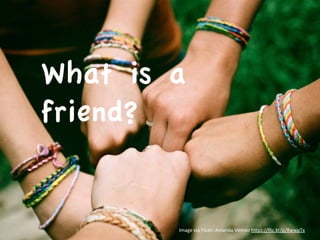
What is a
friend?
Image	
  via	
  Flickr:	
  wolfgangfoto	
  h4ps://flic.kr/p/4DYHtX	
  
friend:
(noun) a
person whom
one knows
and with
whom one has
a bond of
mutual
affection,
typically
exclusive of
sexual or
family
relations. [1]
Image	
  via	
  Flickr:	
  Michael	
  
Simmons	
  h4ps://flic.kr/p/NPC3h	
  
FRIEND:
(verb) add
(someone) to
a list of
contacts
associated
with a social
networking
website. [1]
Image	
  via	
  Flickr:	
  Garry	
  Knight	
  h4ps://flic.kr/p/bER864	


“As	
  individuals	
  
have	
  needs	
  for	
  
inUmacy	
  and	
  
companionship,	
  
the	
  use	
  of	
  the	
  
Internet	
  for	
  
communicaUon	
  
purposes	
  
provides	
  a	
  new	
  
venue	
  to	
  meet	
  
others	
  and	
  
create	
  close	
  
relaUonships.”	
  [3]	
  	
  
Image	
  via	
  Flickr:	
  Chris	
  Dlugosz	
  h4ps://flic.kr/p/4YCwnW	
  	
  
RESEARCH HAS FOUND THAT:
63.3 % OF ADOLESCENT FRIENDSHIPS BEGIN IN THE NEIGHBOURHOOD
24.1 % OF ADOLESCENT FRIENDSHIPS BEGIN AT SCHOOL
12.6 % OF ADOLESCENT FRIENDSHIPS BEGIN ONLINE [3]
Image	
  via	
  Flickr:	
  Asha	
  ten	
  Broeke	
  	
  
h4ps://flic.kr/p/7DVVRT	


People who use the internet to begin friendships typically befriend
those who resemble themselves (similar lifestyles, likes, dislikes,
etc.) [2]
Image	
  via	
  Flickr:	
  Kerry	
  Sanders	
  h4ps://flic.kr/p/obBTE	
  
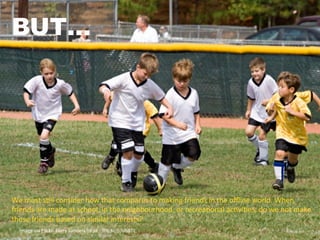
BUT…
We	
  must	
  sUll	
  consider	
  how	
  that	
  compares	
  to	
  making	
  friends	
  in	
  the	
  offline	
  world.	
  When	
  
friends	
  are	
  made	
  at	
  school,	
  in	
  the	
  neighbourhood,	
  or	
  recreaUonal	
  acUviUes,	
  do	
  we	
  not	
  make	
  
those	
  friends	
  based	
  on	
  similar	
  interests?	
  
Image	
  via	
  Flickr:	
  Joel	
  Cooper	
  h4ps://flic.kr/p/9tL5J	
  
THE ONLY DIFFERENCE IS: on the Internet, you
get to decide who you are, what your interests
are, and whether you are truthful to reality.
Image	
  via	
  Flickr:	
  Wendell	
  
h4ps://flic.kr/p/6LaB7f	
  
“Frequent	
  Internet	
  use	
  is	
  
more	
  likely	
  to	
  occur	
  among	
  
individuals	
  suffering	
  from	
  
social	
  anxiety,	
  low	
  self-­‐
esteem,	
  and	
  lack	
  of	
  
sociability.”	
  [3]	
  
Image	
  via	
  Flickr:	
  jaci	
  Lopes	
  dos	
  
Santos	
  h4ps://flic.kr/p/84ATAp	
  
The best part
about friendship
online is that, if
you want to, you
can end a
conversation, end
emotion, end the
problem, end the
relationship all at
the click of a
button!!
Image	
  via	
  Flickr:	
  Caro	
  Wallis	
  
h4ps://flic.kr/p/7stNaj	
  
Adolescents who engage in higher levels of
conflict with their parents are also more likely
to form friendships online. [3]
Image	
  via	
  Flickr:	
  Marco	
  
h4ps://flic.kr/p/dcH7rX	
  	
  
The internet has become a safe place for
adolescents to speak their minds, express
themselves, and vent frustrations with not
only their current friends but potential and
new friends.
	
  
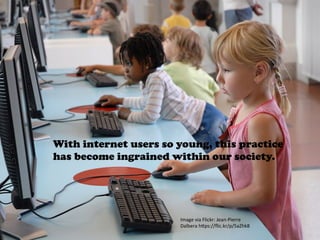
Image	
  via	
  Flickr:	
  Jean-­‐Pierre	
  
Dalbera	
  h4ps://flic.kr/p/5aZhk8	
  
With internet users so young, this practice
has become ingrained within our society.
	
  
Image	
  via	
  Flickr:	
  Royce	
  Bair	
  
h4ps://flic.kr/p/7icRw2	


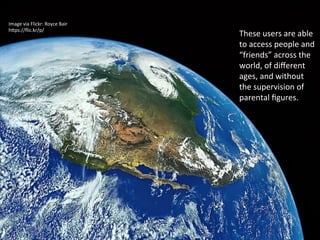
These	
  users	
  are	
  able	
  
to	
  access	
  people	
  and	
  
“friends”	
  across	
  the	
  
world,	
  of	
  different	
  
ages,	
  and	
  without	
  
the	
  supervision	
  of	
  
parental	
  figures.	


Image	
  via	
  Flickr:	
  epSos	
  .de	
  h4ps://flic.kr/p/8vVqqW	


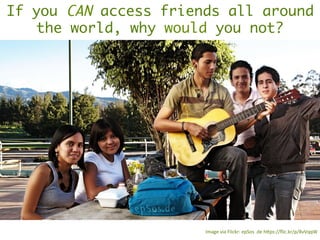
If you CAN access friends all around
the world, why would you not?
Image	
  via	
  Flickr:	
  Renato	
  Ganoza	
  
h4ps://flic.kr/p/7QYtpH	
  	
  
“Not only are
adolescents
making new
friends in the
Internet, but
also these
friends are
changing the
extent of
similarity in
gender and
age of their
social
networks.” [3]
Image	
  via	
  Flickr:	
  Stefan	
  
Baudy	
  h4ps://flic.kr/p/
wTgzo	
  
So	
  now	
  we	
  must	
  ask	
  ourselves:	
  
WHAT	
  DOES	
  IT	
  MEAN	
  TO	
  BE	
  
SOMEBODY’S	
  FRIEND?	
  
Image	
  via	
  Flickr:	
  Marco	
  
Pakoeningrat	
  h4ps://flic.kr/
p/4DmkbS	
  	
  
Ridiculously large numbers of online friends,
as seen on major social media sites or online
social networks, such as Facebook, Twitter,
and Instagram make us question the
relevance of the term “friendship”. [4]
It	
  is	
  criUcal	
  to	
  disUnguish	
  between	
  the	
  noun	
  and	
  the	
  verb.	
  
“Online friendship is an
umbrella name for real
friendship and various
degrees of
acquaintanceship… only
25% of contacts are
recognized as real
friends.” [4]
SO, how did you meet your friends?!
SOURCES:!
[1]	
  	
  "Friend."	
  Dic$onary.com.	
  N.p.,	
  2014.	
  Web.	
  22	
  May	
  2014.	
  <h4p://	
  
	
  dicUonary.reference.com/browse/friend?s=t>.	


[2]	
  Amichai-­‐Hamburger,	
  Yair,	
  Mila	
  Kingsbury,	
  and	
  Barry	
  H.	
  Schneider.	


  "Friendship:	
  An	
  Old	
  Concept	
  with	
  a	
  New	
  Meaning?"	
  Computers	
  in	


  Human	
  Behavior	
  29.2013	
  (2012):	
  33-­‐39.	
  26	
  Aug.	
  2012.	
  Web.	
  23	
  May	
  2014.	


[3]	
  Mesch,	
  Gustavo	
  S.,	
  and	
  Ilan	
  Talmud.	
  "Online	
  Friendship	
  FormaUon,	


  CommunicaUon	
  Channels,	
  and	
  Social	
  Closeness."	
  Interna$onal	


  Journal	
  of	
  Internet	
  Science	
  1.1	
  (2006):	
  29-­‐44.	
  Web.	
  23	
  May	
  2014.	


[4]	
  Zinoviev,	
  Dmitry,	
  and	
  Vy	
  Duong.	
  "Toward	
  Understanding	
  Friendship	
  in	


  Online	
  Social	
  Networks."	
  Interna$onal	
  Journal	
  of	
  Technology,	


  Knowledge,	
  and	
  Society	
  (2009):	
  n.	
  pag.	
  Web.	
  23	
  May	
  2014.	


Image	
  via	
  Flickr:	
  Paulo	
  Otavio	
  
h4ps://flic.kr/p/7qBgkT	


Flipbook assignment (moodle)

  • 1.
    Image  via  Flickr:  Amanda  Venner  h4ps://flic.kr/p/8wwpTx   What is a friend?
  • 2.
    Image  via  Flickr:  wolfgangfoto  h4ps://flic.kr/p/4DYHtX   friend: (noun) a person whom one knows and with whom one has a bond of mutual affection, typically exclusive of sexual or family relations. [1]
  • 3.
    Image  via  Flickr:  Michael   Simmons  h4ps://flic.kr/p/NPC3h   FRIEND: (verb) add (someone) to a list of contacts associated with a social networking website. [1]
  • 4.
    Image  via  Flickr:  Garry  Knight  h4ps://flic.kr/p/bER864       “As  individuals   have  needs  for   inUmacy  and   companionship,   the  use  of  the   Internet  for   communicaUon   purposes   provides  a  new   venue  to  meet   others  and   create  close   relaUonships.”  [3]    
  • 5.
    Image  via  Flickr:  Chris  Dlugosz  h4ps://flic.kr/p/4YCwnW     RESEARCH HAS FOUND THAT: 63.3 % OF ADOLESCENT FRIENDSHIPS BEGIN IN THE NEIGHBOURHOOD 24.1 % OF ADOLESCENT FRIENDSHIPS BEGIN AT SCHOOL 12.6 % OF ADOLESCENT FRIENDSHIPS BEGIN ONLINE [3]
  • 6.
    Image  via  Flickr:  Asha  ten  Broeke     h4ps://flic.kr/p/7DVVRT       People who use the internet to begin friendships typically befriend those who resemble themselves (similar lifestyles, likes, dislikes, etc.) [2]
  • 7.
    Image  via  Flickr:  Kerry  Sanders  h4ps://flic.kr/p/obBTE   BUT… We  must  sUll  consider  how  that  compares  to  making  friends  in  the  offline  world.  When   friends  are  made  at  school,  in  the  neighbourhood,  or  recreaUonal  acUviUes,  do  we  not  make   those  friends  based  on  similar  interests?  
  • 8.
    Image  via  Flickr:  Joel  Cooper  h4ps://flic.kr/p/9tL5J   THE ONLY DIFFERENCE IS: on the Internet, you get to decide who you are, what your interests are, and whether you are truthful to reality.
  • 9.
    Image  via  Flickr:  Wendell   h4ps://flic.kr/p/6LaB7f   “Frequent  Internet  use  is   more  likely  to  occur  among   individuals  suffering  from   social  anxiety,  low  self-­‐ esteem,  and  lack  of   sociability.”  [3]  
  • 10.
    Image  via  Flickr:  jaci  Lopes  dos   Santos  h4ps://flic.kr/p/84ATAp   The best part about friendship online is that, if you want to, you can end a conversation, end emotion, end the problem, end the relationship all at the click of a button!!
  • 11.
    Image  via  Flickr:  Caro  Wallis   h4ps://flic.kr/p/7stNaj   Adolescents who engage in higher levels of conflict with their parents are also more likely to form friendships online. [3]
  • 12.
    Image  via  Flickr:  Marco   h4ps://flic.kr/p/dcH7rX     The internet has become a safe place for adolescents to speak their minds, express themselves, and vent frustrations with not only their current friends but potential and new friends.  
  • 13.
    Image  via  Flickr:  Jean-­‐Pierre   Dalbera  h4ps://flic.kr/p/5aZhk8   With internet users so young, this practice has become ingrained within our society.  
  • 14.
    Image  via  Flickr:  Royce  Bair   h4ps://flic.kr/p/7icRw2       These  users  are  able   to  access  people  and   “friends”  across  the   world,  of  different   ages,  and  without   the  supervision  of   parental  figures.      
  • 15.
    Image  via  Flickr:  epSos  .de  h4ps://flic.kr/p/8vVqqW       If you CAN access friends all around the world, why would you not?
  • 16.
    Image  via  Flickr:  Renato  Ganoza   h4ps://flic.kr/p/7QYtpH     “Not only are adolescents making new friends in the Internet, but also these friends are changing the extent of similarity in gender and age of their social networks.” [3]
  • 17.
    Image  via  Flickr:  Stefan   Baudy  h4ps://flic.kr/p/ wTgzo   So  now  we  must  ask  ourselves:   WHAT  DOES  IT  MEAN  TO  BE   SOMEBODY’S  FRIEND?  
  • 18.
    Image  via  Flickr:  Marco   Pakoeningrat  h4ps://flic.kr/ p/4DmkbS     Ridiculously large numbers of online friends, as seen on major social media sites or online social networks, such as Facebook, Twitter, and Instagram make us question the relevance of the term “friendship”. [4] It  is  criUcal  to  disUnguish  between  the  noun  and  the  verb.  
  • 19.
    “Online friendship isan umbrella name for real friendship and various degrees of acquaintanceship… only 25% of contacts are recognized as real friends.” [4]
  • 20.
    SO, how didyou meet your friends?! SOURCES:! [1]    "Friend."  Dic$onary.com.  N.p.,  2014.  Web.  22  May  2014.  <h4p://    dicUonary.reference.com/browse/friend?s=t>.     [2]  Amichai-­‐Hamburger,  Yair,  Mila  Kingsbury,  and  Barry  H.  Schneider.      "Friendship:  An  Old  Concept  with  a  New  Meaning?"  Computers  in      Human  Behavior  29.2013  (2012):  33-­‐39.  26  Aug.  2012.  Web.  23  May  2014.     [3]  Mesch,  Gustavo  S.,  and  Ilan  Talmud.  "Online  Friendship  FormaUon,      CommunicaUon  Channels,  and  Social  Closeness."  Interna$onal      Journal  of  Internet  Science  1.1  (2006):  29-­‐44.  Web.  23  May  2014.     [4]  Zinoviev,  Dmitry,  and  Vy  Duong.  "Toward  Understanding  Friendship  in      Online  Social  Networks."  Interna$onal  Journal  of  Technology,      Knowledge,  and  Society  (2009):  n.  pag.  Web.  23  May  2014.         Image  via  Flickr:  Paulo  Otavio   h4ps://flic.kr/p/7qBgkT