and Your Child


         Luanda International School
Ali Shebani - Secondary Guidance Counselor
Elèni Thomaidis da Silva - Child Psychologist
      Katy Vance - Secondary Librarian
You know you're living in the 21st
             Century when...
1. You accidentally enter your password on the
microwave.
2. You haven't played solitaire with real cards in years.
3. You have a list of 15 phone numbers to reach your
family of three.
4. You e-mail your mate who works at the desk next to
you.
5. Your reason for not staying in touch with friends is
that they do not have e-mail addresses
Outline of the Morning
•   Teens, the Net & Social Networking
•   Positive Aspects of Facebook
•   Concerns with Facebook & Students
•   Understanding Facebook settings
•   Blocking, Reporting, Privacy Settings
•   Advice for Parents
“You think of technology as a tool… We think of it as a
     foundation; it underlies everything we do.”
              Mark Prensky- Our Brains Extended


               Photo by Flickr User ~C4Chaos under CC BY-NC-SA 2.0
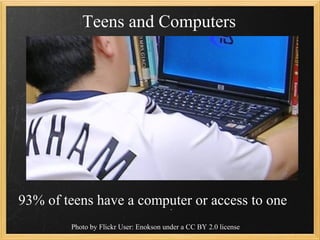
Teens and Computers


93% of teens have a computer or access to one
        Photo by Flickr User: Enokson under a CC BY 2.0 license
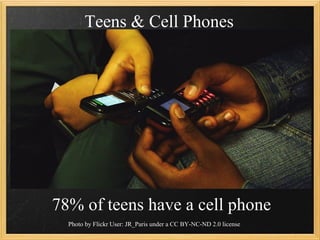
Teens & Cell Phones


78% of teens have a cell phone
  Photo by Flickr User: JR_Paris under a CC BY-NC-ND 2.0 license
Social Media Sites


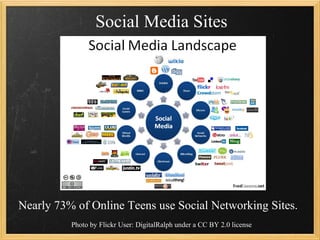
Nearly 73% of Online Teens use Social Networking Sites.
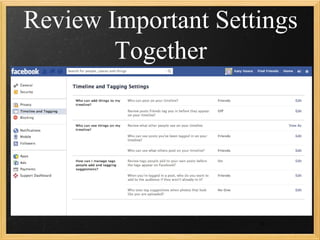
          Photo by Flickr User: DigitalRalph under a CC BY 2.0 license
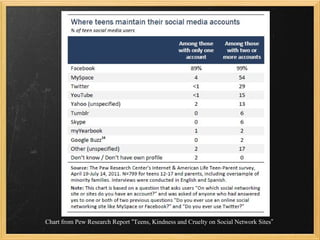
Chart from Pew Research Report “Teens, Kindness and Cruelty on Social Network Sites”
Tug Of War


Photo by Flickr User: ILRI under a CC BY-NC-SA 2.0 license
                                                             9
This can be a good thing!


Photo by Flickr User: Robert S. Donovan under a CC BY 2.0 license
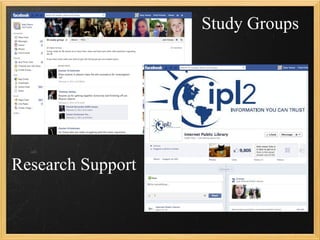
Study Groups


Research Support
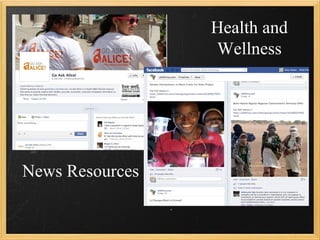
Health and
                 Wellness


News Resources
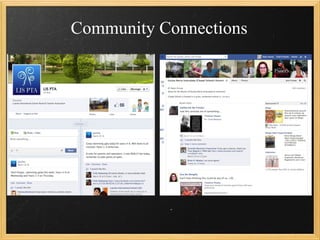
Community Connections
Concerns for Parents
• Bullying

• Safety & Privacy

                     14
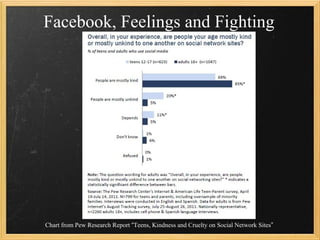
Facebook, Feelings and Fighting


Chart from Pew Research Report “Teens, Kindness and Cruelty on Social Network Sites”
What are the
  issues?
It’s not all good, all the time.


  Photo by Flickr user Amanda Gravel under CC BY-NC-SA 2.0 license
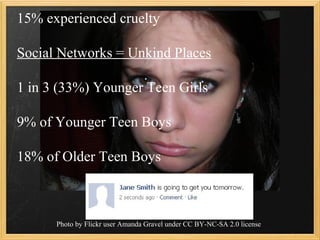
15% experienced cruelty

Social Networks = Unkind Places

1 in 3 (33%) Younger Teen Girls

9% of Younger Teen Boys

18% of Older Teen Boys


      Photo by Flickr user Amanda Gravel under CC BY-NC-SA 2.0 license
'Keyboard Heroes'


                                                    Photo used for educational purposes only. From
http://www.telegraph.co.uk/news/picturegalleries/howaboutthat/7892000/Eskil-Ronningsbakken-the-daredevil-who-balances-on-the-edge-of-1000ft-cliffs-in-Norw
Turn to Your Neighbor


                    20
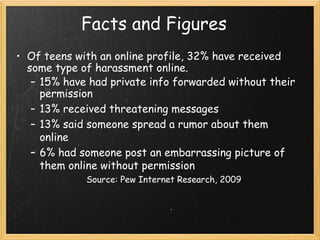
Facts and Figures
• Of teens with an online profile, 32% have received
  some type of harassment online.
   – 15% have had private info forwarded without their
     permission
   – 13% received threatening messages
   – 13% said someone spread a rumor about them
     online
   – 6% had someone post an embarrassing picture of
     them online without permission
             Source: Pew Internet Research, 2009


                                             21
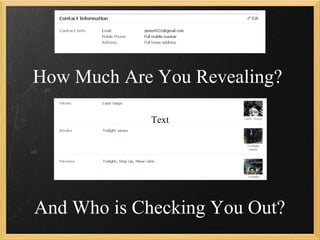
How Much Are You Revealing?

             Text


And Who is Checking You Out?
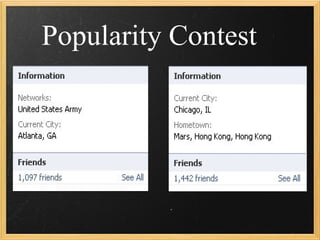
Popularity Contest
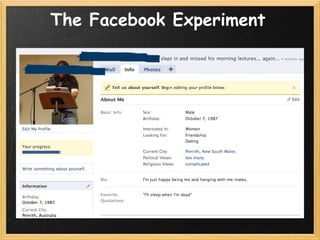
The Facebook Experiment
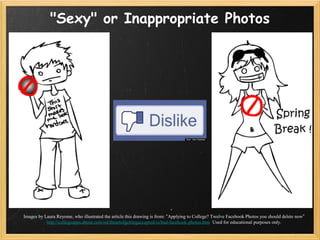
"Sexy" or Inappropriate Photos


Images by Laura Reyome, who illustrated the article this drawing is from: “Applying to College? Twelve Facebook Photos you should delete now”
           http://collegeapps.about.com/od/theartofgettingaccepted/ss/bad-facebook-photos.htm Used for educational purposes only.
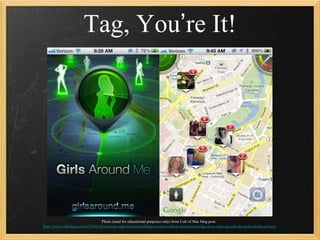
Tag, You’re It!


                                 Photo (used for educational purposes only) from Cult of Mac blog post:
                                                                                                                                 26
http://www.cultofmac.com/157641/this-creepy-app-isnt-just-stalking-women-without-their-knowledge-its-a-wake-up-call-about-facebook-privacy/
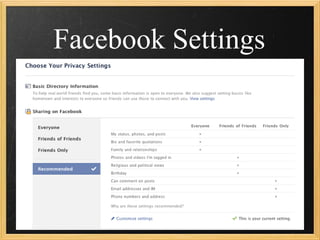
Facebook Settings
Parenting Strategies


  Photo by DeviantArt user Loor101 under a CC BY-SA 3.0 license   30
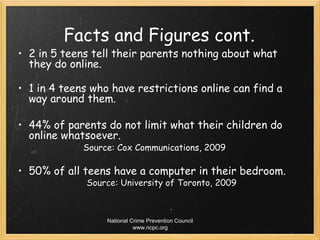
Facts and Figures cont.
• 2 in 5 teens tell their parents nothing about what
  they do online.

• 1 in 4 teens who have restrictions online can find a
  way around them.

• 44% of parents do not limit what their children do
  online whatsoever.
             Source: Cox Communications, 2009

• 50% of all teens have a computer in their bedroom.
              Source: University of Toronto, 2009


                  National Crime Prevention Council
                            www.ncpc.org
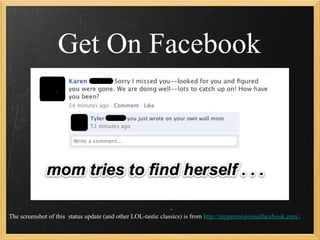
Get On Facebook


The screenshot of this status update (and other LOL-tastic classics) is from http://myparentsjoinedfacebook.com/.
                                                                                                 32
Turn to Your Neighbor


                    33
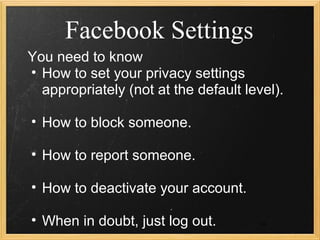
Facebook Settings
You need to know
• How to set your privacy settings
  appropriately (not at the default level).

• How to block someone.

• How to report someone.

• How to deactivate your account.

• When in doubt, just log out.         34
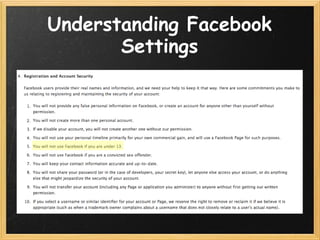
Understanding Facebook
       Settings
Review Important Settings
        Together


                     36
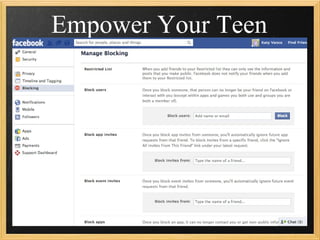
Empower Your Teen


                37
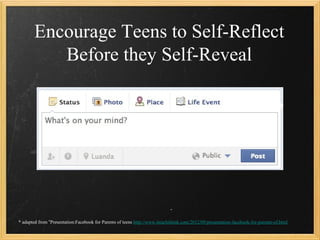
Encourage Teens to Self-Reflect
           Before they Self-Reveal


* adapted from “Presentation:Facebook for Parents of teens http://www.iteachithink.com/2012/09/presentation-facebook-for-parents-of.html
                                                                                                                          38
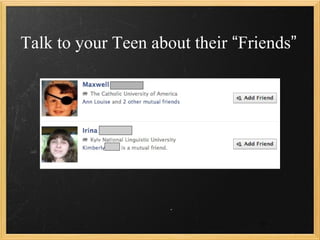
Talk to your Teen about their “Friends”


                                 39
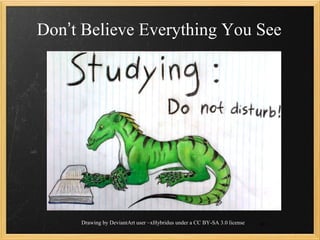
Don’t Believe Everything You See


     Drawing by DeviantArt user ~xHybridus under a CC BY-SA 3.0 license   40
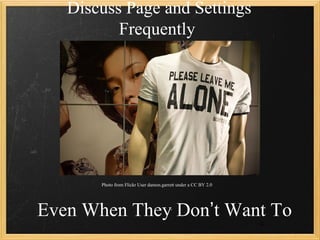
Discuss Page and Settings
          Frequently


       Photo from Flickr User damon.garrett under a CC BY 2.0


Even When They Don’t Want To
                                                                41
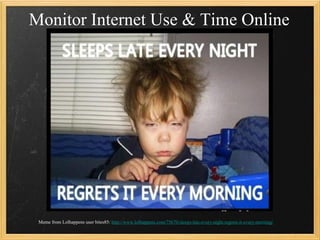
Monitor Internet Use & Time Online


 Meme from Lolhappens user bites85: http://www.lolhappens.com/75670/sleeps-late-every-night-regrets-it-every-morning/
                                                                                                              42
It’s a Balancing Act


                             CC BY-SA 3.0

Photo from Wikimedia Commons User Usien under a CC BY-SA 3.0 license
                                                                       43
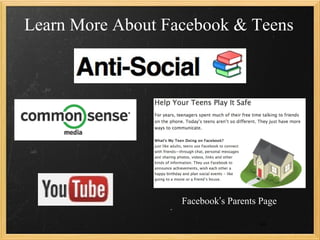
Learn More About Facebook & Teens


                   Facebook’s Parents Page

                                     44
Are you ready for this?


   Photo from Flickr User Tanzen80 under a CC BY-SA 2.0   45
Videos and Further Resources
• Facebook Privacy Shortcuts Tutorial 2013:
  http://youtu.be/NI92-AcJweA

• Very Short Facebook Settings Tutorial:
  http://youtu.be/-dJz_5pd33w

• Common Sense Media:
  http://www.commonsensemedia.org/

• Facebook Parents Page:
  http://www.facebook.com/safety/groups/parents/
Bibliography
Brookhouser, Kevin. "Presentation: Facebook for Parents of Teens." Web log post. I Teach. I Think. N.p., 19 Sept.
2012. Web. 17 Apr. 2013. <http://www.iteachithink.com/2012/09/presentation-facebook-for-parents-of.html>.

Brownlee, John. "This Creepy App Isn’t Just Stalking Women Without Their Knowledge, It’s A Wake-Up Call
About Facebook Privacy [Update]." Cult of Mac. Cultomedia Corp, 30 Mar. 2012. Web. 17 Apr. 2013.
<http://www.cultofmac.com/157641/this-creepy-app-isnt-just-stalking-women-with
out-their-knowledge-its-a-wake-up-call-about-facebook-privacy/>.

"Facebook for Parents." Common Sense Media, 3 Oct. 2011. Web. 17 Apr. 2013.
<http://www.commonsensemedia.org/advice-for-parents/facebook-parents>.

"Global Digital Communication: Texting, Social Networking Popular Worldwide." Pew Global Attitudes Project.
Pew Research, 29 Feb. 2012. Web. 15 Apr. 2013. http://www.pewglobal.org/2011/12/20/global-digital-
communication-texting-social-networking-popular-worldwide/.

Prensky, Marc. "Our Brains Extended." Educational Leadership 70.6 (2013): 22-27.Educational Leadership.
ASCD, Mar. 2013. Web. 15 Apr. 2013.

"Social Networking Tips." Common Sense Media. N.p., 17 Oct. 2011. Web. 17 Apr. 2013.
<http://www.commonsensemedia.org/advice-for-parents/social-networking-tips>.

"Teens, Kindness and Cruelty on Social Network Sites." Facebook Dominates Teen Social Media Usage. Pew
Research, 9 Nov. 2011. Web. 15 Apr. 2013. <http://pewinternet.org/Reports/2011/Teens-and-social-media/Part-
1/Facebook.aspx>.

Facebook and Your Child

  • 1.
    and Your Child Luanda International School Ali Shebani - Secondary Guidance Counselor Elèni Thomaidis da Silva - Child Psychologist Katy Vance - Secondary Librarian
  • 2.
    You know you'reliving in the 21st Century when... 1. You accidentally enter your password on the microwave. 2. You haven't played solitaire with real cards in years. 3. You have a list of 15 phone numbers to reach your family of three. 4. You e-mail your mate who works at the desk next to you. 5. Your reason for not staying in touch with friends is that they do not have e-mail addresses
  • 3.
    Outline of theMorning • Teens, the Net & Social Networking • Positive Aspects of Facebook • Concerns with Facebook & Students • Understanding Facebook settings • Blocking, Reporting, Privacy Settings • Advice for Parents
  • 4.
    “You think oftechnology as a tool… We think of it as a foundation; it underlies everything we do.” Mark Prensky- Our Brains Extended Photo by Flickr User ~C4Chaos under CC BY-NC-SA 2.0
  • 5.
    Teens and Computers 93%of teens have a computer or access to one Photo by Flickr User: Enokson under a CC BY 2.0 license
  • 6.
    Teens & CellPhones 78% of teens have a cell phone Photo by Flickr User: JR_Paris under a CC BY-NC-ND 2.0 license
  • 7.
    Social Media Sites Nearly73% of Online Teens use Social Networking Sites. Photo by Flickr User: DigitalRalph under a CC BY 2.0 license
  • 8.
    Chart from PewResearch Report “Teens, Kindness and Cruelty on Social Network Sites”
  • 9.
    Tug Of War Photoby Flickr User: ILRI under a CC BY-NC-SA 2.0 license 9
  • 10.
    This can bea good thing! Photo by Flickr User: Robert S. Donovan under a CC BY 2.0 license
  • 11.
  • 12.
    Health and Wellness News Resources
  • 13.
  • 14.
    Concerns for Parents •Bullying • Safety & Privacy 14
  • 15.
    Facebook, Feelings andFighting Chart from Pew Research Report “Teens, Kindness and Cruelty on Social Network Sites”
  • 16.
  • 17.
    It’s not allgood, all the time. Photo by Flickr user Amanda Gravel under CC BY-NC-SA 2.0 license
  • 18.
    15% experienced cruelty SocialNetworks = Unkind Places 1 in 3 (33%) Younger Teen Girls 9% of Younger Teen Boys 18% of Older Teen Boys Photo by Flickr user Amanda Gravel under CC BY-NC-SA 2.0 license
  • 19.
    'Keyboard Heroes' Photo used for educational purposes only. From http://www.telegraph.co.uk/news/picturegalleries/howaboutthat/7892000/Eskil-Ronningsbakken-the-daredevil-who-balances-on-the-edge-of-1000ft-cliffs-in-Norw
  • 20.
    Turn to YourNeighbor 20
  • 21.
    Facts and Figures •Of teens with an online profile, 32% have received some type of harassment online. – 15% have had private info forwarded without their permission – 13% received threatening messages – 13% said someone spread a rumor about them online – 6% had someone post an embarrassing picture of them online without permission Source: Pew Internet Research, 2009 21
  • 22.
    How Much AreYou Revealing? Text And Who is Checking You Out?
  • 23.
  • 24.
  • 25.
    "Sexy" or InappropriatePhotos Images by Laura Reyome, who illustrated the article this drawing is from: “Applying to College? Twelve Facebook Photos you should delete now” http://collegeapps.about.com/od/theartofgettingaccepted/ss/bad-facebook-photos.htm Used for educational purposes only.
  • 26.
    Tag, You’re It! Photo (used for educational purposes only) from Cult of Mac blog post: 26 http://www.cultofmac.com/157641/this-creepy-app-isnt-just-stalking-women-without-their-knowledge-its-a-wake-up-call-about-facebook-privacy/
  • 27.
  • 30.
    Parenting Strategies Photo by DeviantArt user Loor101 under a CC BY-SA 3.0 license 30
  • 31.
    Facts and Figurescont. • 2 in 5 teens tell their parents nothing about what they do online. • 1 in 4 teens who have restrictions online can find a way around them. • 44% of parents do not limit what their children do online whatsoever. Source: Cox Communications, 2009 • 50% of all teens have a computer in their bedroom. Source: University of Toronto, 2009 National Crime Prevention Council www.ncpc.org
  • 32.
    Get On Facebook Thescreenshot of this status update (and other LOL-tastic classics) is from http://myparentsjoinedfacebook.com/. 32
  • 33.
    Turn to YourNeighbor 33
  • 34.
    Facebook Settings You needto know • How to set your privacy settings appropriately (not at the default level). • How to block someone. • How to report someone. • How to deactivate your account. • When in doubt, just log out. 34
  • 35.
  • 36.
  • 37.
  • 38.
    Encourage Teens toSelf-Reflect Before they Self-Reveal * adapted from “Presentation:Facebook for Parents of teens http://www.iteachithink.com/2012/09/presentation-facebook-for-parents-of.html 38
  • 39.
    Talk to yourTeen about their “Friends” 39
  • 40.
    Don’t Believe EverythingYou See Drawing by DeviantArt user ~xHybridus under a CC BY-SA 3.0 license 40
  • 41.
    Discuss Page andSettings Frequently Photo from Flickr User damon.garrett under a CC BY 2.0 Even When They Don’t Want To 41
  • 42.
    Monitor Internet Use& Time Online Meme from Lolhappens user bites85: http://www.lolhappens.com/75670/sleeps-late-every-night-regrets-it-every-morning/ 42
  • 43.
    It’s a BalancingAct CC BY-SA 3.0 Photo from Wikimedia Commons User Usien under a CC BY-SA 3.0 license 43
  • 44.
    Learn More AboutFacebook & Teens Facebook’s Parents Page 44
  • 45.
    Are you readyfor this? Photo from Flickr User Tanzen80 under a CC BY-SA 2.0 45
  • 46.
    Videos and FurtherResources • Facebook Privacy Shortcuts Tutorial 2013: http://youtu.be/NI92-AcJweA • Very Short Facebook Settings Tutorial: http://youtu.be/-dJz_5pd33w • Common Sense Media: http://www.commonsensemedia.org/ • Facebook Parents Page: http://www.facebook.com/safety/groups/parents/
  • 47.
    Bibliography Brookhouser, Kevin. "Presentation:Facebook for Parents of Teens." Web log post. I Teach. I Think. N.p., 19 Sept. 2012. Web. 17 Apr. 2013. <http://www.iteachithink.com/2012/09/presentation-facebook-for-parents-of.html>. Brownlee, John. "This Creepy App Isn’t Just Stalking Women Without Their Knowledge, It’s A Wake-Up Call About Facebook Privacy [Update]." Cult of Mac. Cultomedia Corp, 30 Mar. 2012. Web. 17 Apr. 2013. <http://www.cultofmac.com/157641/this-creepy-app-isnt-just-stalking-women-with out-their-knowledge-its-a-wake-up-call-about-facebook-privacy/>. "Facebook for Parents." Common Sense Media, 3 Oct. 2011. Web. 17 Apr. 2013. <http://www.commonsensemedia.org/advice-for-parents/facebook-parents>. "Global Digital Communication: Texting, Social Networking Popular Worldwide." Pew Global Attitudes Project. Pew Research, 29 Feb. 2012. Web. 15 Apr. 2013. http://www.pewglobal.org/2011/12/20/global-digital- communication-texting-social-networking-popular-worldwide/. Prensky, Marc. "Our Brains Extended." Educational Leadership 70.6 (2013): 22-27.Educational Leadership. ASCD, Mar. 2013. Web. 15 Apr. 2013. "Social Networking Tips." Common Sense Media. N.p., 17 Oct. 2011. Web. 17 Apr. 2013. <http://www.commonsensemedia.org/advice-for-parents/social-networking-tips>. "Teens, Kindness and Cruelty on Social Network Sites." Facebook Dominates Teen Social Media Usage. Pew Research, 9 Nov. 2011. Web. 15 Apr. 2013. <http://pewinternet.org/Reports/2011/Teens-and-social-media/Part- 1/Facebook.aspx>.

Editor's Notes

  • #6 Eight out of ten teens have a desktop or laptop computer. Among the 20% of teens who do not have their own computer, two-thirds (67%) have access to one they can use at home. Taken together, this means that 93% of teens have a computer or access to one.
  • #7 78% of teens have a cell phone and almost half (47%) of those own smartphones.  That translates into 37% of all teens who have smartphones, up from just 23% in 2011.  One-quarter of teens (25%) access the internet  mostly  on a cell phone.  
  • #8   Among online teens just 46% of 12 year olds in the study used social network sites, while 62% of 13 year olds used them. 
  • #16 The majority of social media-using teens say their experience is that their peers are mostly kind to one another on social network sites, but their views are less positive when compared with similar assessments from online adults.
  • #18 Overall, 19% of teens report that they have been bullied in the last 12 months under at least one of the four scenarios we queried in our survey –in person, by phone, text messaging, or online. And within that 19% who have been bullied, 50% of these teens say they were just bullied through one mode, while 50% said they were bullied in more than one place 15% of social media-using teens have experienced someone being mean or cruel to them personally on a social network site.   The numbers are higher for 12 and 13 year old girls… One in three (33%) younger teen girls who uses social media says that people her age are mostly unkind to one another on social network sites, compared with 9% of social media-using boys 12-13 and 18% of boys 14-17. Sharing login details is a real problem. Often with younger female teenagers, it&apos;s a test of friendship. DO NOT SHARE LOGINS with anyone (except parents!)
  • #19 Overall, 19% of teens report that they have been bullied in the last 12 months under at least one of the four scenarios we queried in our survey –in person, by phone, text messaging, or online. And within that 19% who have been bullied, 50% of these teens say they were just bullied through one mode, while 50% said they were bullied in more than one place 15% of social media-using teens have experienced someone being mean or cruel to them personally on a social network site.   The numbers are higher for 12 and 13 year old girls… One in three (33%) younger teen girls who uses social media says that people her age are mostly unkind to one another on social network sites, compared with 9% of social media-using boys 12-13 and 18% of boys 14-17.
  • #20 False confidence  They feel as though because they are not saying it in person they can write anything no matter how nasty it is. They take no responsibility for what they are writing.   The language that is used is often VERY offensive and crude.
  • #22 65% of teens have at least 1 online profile.
  • #23 How much information is made public? Even if it is only available for friends to see, does your child actually know them? A name and a school would be plenty to identify someone. Even a public listing of hobbies, music / tv taste is enough to identify a &apos;target&apos;
  • #24 It becomes a competition, kids don ’ t always know everyone they friend, revealing information to people they don ’ t know without thinking about the extent How many friends does your child have? Adding &apos;friends of friends&apos; is not as safe as it sounds Have they met them all in real life? Being Facebook friends with people you don&apos;t like is common among teenagers What information are you broadcasting to everyone? Later in life - &apos;quotable quotes&apos;, employment
  • #25 Meet Jonathan Neumann, everybody. He may look nearly 23, but he&apos;s actually FOUR DAYS OLD Points to be made: - default privacy settings VERY lax - necessity of &apos;opting out&apos; - some users are VERY EASY to friend... others more difficult - THE VAST MAJORITY of users seem to follow the &apos;who are your friends&apos; rule - once you have a critical mass of friends, it just becomes easier and easier to make more - the material that people are happy to share with relative strangers is very concerning.  - tagging in photos and friends-of-friends privacy settings mean that material about US can BE SHARED BY OTHERS number of friends grew exponentially particularly through the &apos;friends of friends&apos; concept - often at Facebook&apos;s suggestion. Terminology suggests a trust that&apos;s not justified. others follow most people (55%) are happy to make friends with a relative stranger
  • #26 THIS IS ILLEGAL! &quot;Manufacture, possession or transmission of child pornography&quot; Many students have &quot;sexy&quot; photos as profile pictures Posting photos of others without permissions The photo can be saved by anyone Many universities and employers and are checking Facebook pages of those whom they are considering
  • #27 Tagging your location can be stupid. Apps like Girls Around Me and http://pleaserobme.com/ use publicly available information from website like FB, Instagram, twitter and Foursquare, where you are tagging yourself with a location.
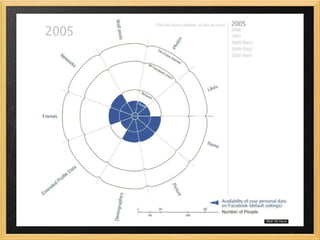
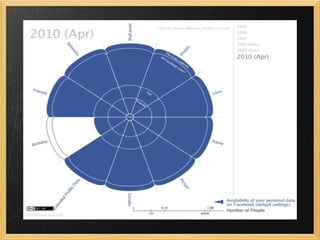
  • #28 Who has their own Facebook page? Settings change, often without any warning We need to understand as much as we can because at the end of the day, we&apos;re the adults Following are two graphs showing how by default Facebook has expanded the information publicly available. Facebook is out there to make money, not to help you. Don ’ t settle for their default privacy settings... Choose what ’ s right for you
  • #32 rename slide
  • #33 You need to create your own profile. Make sure that you add your child as a friend Be aware that your child has not put you on a limited profile, or blocks you from seeing photos. 
  • #36 You need to be 13 to create a page. Also, it ’ s just important to read the TOS Children must remember that there is a record of everything they have said on Facebook Facebook owns everything
  • #38 This is important to know for adults, because they can block you, but they can also block other people!
  • #41 * Interrupt your Kids * Ask them What They ’ re Doing * Keep Computers in Common Areas Make sure the computer is in an open place. This allows you to monitor what your child is accessing on the internet. If every time you walk pass the computer the screen is minimised ask WHY?
  • #42 It is important that you log on and view your child&apos;s profile regularly, through your own profile. Parents should also regularly be sitting down with their child to look at their profile.  Some parents may request their child&apos;s user name and password, depending on the age of the child.
  • #44 Students feel that they can multitask. For example they will have homework, Facebook and MSN open all at the same time and go between them. THEY CAN&apos;T!   It is OK to be checking on what your children are doing.  Don&apos;t allow your child to be on the computer for hours at a time.