NORBERT ELIASCulture / The Social Body TheoryJEFFREY ARNETTSubculture, Norms and ValuesCharlotte ButlerReligion – as Agent of SOCIAL CONTROLPeter BergerSocial ControlDIANE REAYFRANK FUREDI
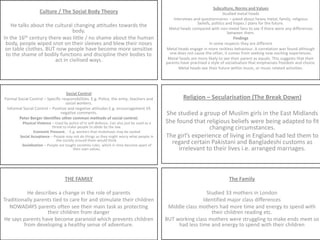
Subculture, Norms and ValuesStudied metal headsInterviews and questionnaires – asked about heavy metal, family, religious beliefs, politics and hopes / plans for the future.Metal heads compared with non-metal fans to see if there were any differences between them.Findings In some respects they are differentMetal heads engage in more reckless behaviour. A correlation was found although one does not cause the other, it comes from seeking new exciting experiences. Metal heads are more likely to see their parent as equals. This suggests that their parents have practised a style of socialisation that emphasises freedom and choice. Metal heads see their future within music, or music related activities.Culture / The Social Body Theory He talks about the cultural changing attitudes towards the body.In the 16th century there was little / no shame about the human body, people wiped snot on their sleeves and blew their noses on table clothes. BUT now people have become more sensitive to the shame of bodily functions and discipline their bodies to act in civilised ways. Social ControlFormal Social Control – Specific responsibilities. E.g. Police, the army, teachers and social workers.Informal Social Control – Positive and negative attitudes E.g. encouragement VS negative comments.Peter Berger identifies other common methods of social control;Physical Violence – Used by police of in self-defence. Can also just be used as a threat to make people to abide by the law.Economic Pressure.  - E.g. workers that misbehave may be sackedSocial Acceptance – People may not do things as they might worry what people in the society around them would think.Socialisation – People are taught societies rules, which in time become apart of their own values.Religion – Secularisation (The Break Down) She studied a group of Muslim girls in the East MidlandsShe found that religious beliefs were being adapted to fit changing circumstances.The girl’s experience of living in England had led them to regard certain Pakistani and Bangladeshi customs as irrelevant to their lives i.e. arranged marriages.  THE FAMILY He describes a change in the role of parents Traditionally parents tied to care for and stimulate their childrenNOWADAYS parents often see their main task as protecting their children from dangerHe says parents have become paranoid which prevents children from developing a healthy sense of adventure. The Family Studied 33 mothers in LondonIdentified major class differences Middle class mothers had more time and energy to spend with their children reading etc.BUT working class mothers were struggling to make ends meet so had less time and energy to spend with their children
ADLER AND ADLERPeer GroupCHRISTINE SKELTONEducation GOLDBERGGender identity – Biologically DeterminedMARGERET MEADGender Identity Socially ConstructedCONNELLGENDER IDENTITYEMMA RENOLDGENDER INDENTIY
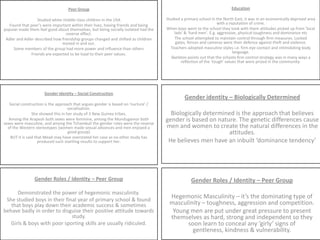
Education Studied a primary school in the North East, it was in an economically deprived area with a reputation of crime.When boys went to the school they took with them attitudes picked up from ‘local lads’ & ‘hard men’. E.g. aggressive, physical toughness and dominance etcThe school attempted to maintain control through firm measures. Locked gates, fences and cameras were their defence against theft and violence.Teachers adopted masculine styles i.e. firm eye contact and intimidating body language.Skeleton points out that the schools firm control strategy was in many ways a reflection of the ‘tough’ values that were prized in the community. Peer Group Studied white middle class children in the USAFound that peer’s were important within their lives, having friends and being popular made them feel good about themselves, but being socially isolated had the reverse effect.Adler and Adler described how friendship groups changed and shifted as children moved in and out.Some members of the group had more power and influence than othersFriends are expected to be loyal to their peer values. Gender Identity – Social Construction Social construction is the approach that argues gender is based on ‘nurture’ / socialisation. She showed this in her study of 3 New Guinea tribes.Among the Arapesh both sexes were feminine, among the Mundugamor both sexes were masculine, and among the Tchambuli the gender roles were the reverse of the Western stereotypes (women made sexual advances and men enjoyed a good gossip)BUT it is said that Mead may have overstated her case as no other study has produced such startling results to support her. Gender identity – Biologically Determined Biologically determined is the approach that believes gender is based on nature. The genetic differences cause men and women to create the natural differences in the attitudes.He believes men have an inbuilt ‘dominance tendency’ Gender Roles / Identity – Peer Group Demonstrated the power of hegemonic masculinity.She studied boys in their final year of primary school & found that boys play down their academic success & sometimes behave badly in order to disguise their positive attitude towards study. Girls & boys with poor sporting skills are usually ridiculed. Gender Roles / Identity – Peer Group Hegemonic Masculinity – it’s the dominating type of masculinity – toughness, aggression and competition. Young men are put under great pressure to present themselves as hard, strong and independent so they soon learn to conceal any ‘girly’ signs of gentleness, kindness & vulnerability.
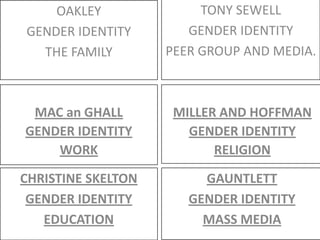
TONY SEWELL GENDER IDENTITY PEER GROUP AND MEDIA. OAKLEYGENDER IDENTITYTHE FAMILYMAC an GHALLGENDER IDENTITYWORKMILLER AND HOFFMANGENDER IDENTITYRELIGIONCHRISTINE SKELTONGENDER IDENTITYEDUCATIONGAUNTLETTGENDER IDENTITYMASS MEDIA
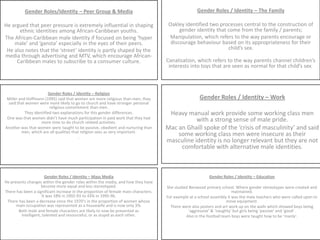
Gender Roles / Identity – The Family Oakley identified two processes central to the construction of gender identity that come from the family / parents;Manipulation, which refers to the way parents encourage or discourage behaviour based on its appropriateness for their child’s sex.Canalisation, which refers to the way parents channel children’s interests into toys that are seen as normal for that child’s sex.Gender Roles/Identity – Peer Group & Media He argued that peer pressure is extremely influential in shaping ethnic identities among African-Caribbean youths.The African-Caribbean male identity if focused on being ‘hyper male’ and ‘gansta’ especially in the eyes of their peers.He also notes that the ‘street’ identity is partly shaped by the media through advertising and MTV, which encourage African-Caribbean males to subscribe to a consumer culture.Gender Roles / Identity – ReligionMiller and Hoffmann (1995) said that women are more religious than men; they said that women were more likely to go to church and have stronger personal religious commitment than men.They identified two explanations for this gender differences.One was that women didn’t have much participation in paid work that they had more time to do church related activities.Another was that women were taught to be passive, obedient and nurturing than men, which are all qualities that religion sees as very important.. Gender Roles / Identity – Work Heavy manual work provide some working class men with a strong sense of male pride. Mac an Ghaill spoke of the ‘crisis of masculinity’ and said some working class men were insecure as their masculine identity is no longer relevant but they are not comfortable with alternative male identities.  Gender Roles / Identity – Mass MediaHe presents changes within the gender roles within the media, and how they have become more equal and less stereotyped.There has been a significant increase in the proportion of female main characters. It was 18% in 1992-93 to 43% in 1995-96. There has been a decrease since the 1970’s in the proportion of women whose main occupation was represented as a housewife and is now only 3%. Both male and female characters are likely to now be presented as intelligent, talented and resourceful, or as stupid as each other. Gender Roles / Identity – Education She studied Benwood primary school. Where gender stereotypes were created and maintained.For example at a school assembly it was the male teachers who were called upon to move equipment.There were also posters and art work up on the walls which showed boys being ‘aggressive’ & ‘naughty’ but girls being ‘passive’ and ‘good’.Also in the football team boys were taught how to be ‘manly’.
. TONY SEWELLETHNIC IDENTITIESPEER GROUPMODOOD ET ALETHNIC IDENTITIES RELIGION
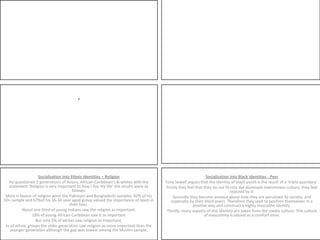
. Socialisation into Ethnic Identities – ReligionHe questioned 2 generations of Asians, African-Caribbean’s & whites with the statement ‘Religion is very important to how I live my life’ the results were as follows:Most in favour of religion were the Pakistani and Bangladeshi samples. 82% of his 50+ sample and 67%of his 16-34 year aged group valued the importance of Islam in their lives.About one third of young Indians saw the religion as important. 18% of young African-Caribbean saw it as important But only 5% of whites saw religion as important. In all ethnic groups the older generation saw religion as more important than the younger generation although the gap was lowest among the Muslim sample.Socialisation into Black Identities - PeerTony Sewell argues that the identity of black youth is the result of a ‘triple quandary’. Firstly they feel that they do not fit into the dominant mainstream culture, they feel rejected by it.Secondly they become anxious about how they are perceived by society, and especially by their black peers. Therefore they seek to position themselves in a positive way and construct a highly masculine identity. Thirdly, many aspects of this identity are taken from the media culture. This culture of masculinity is valued as a comfort zone.
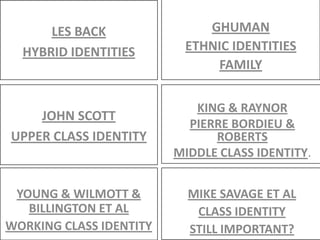
GHUMANETHNIC IDENTITIESFAMILYLES BACKHYBRID IDENTITIESJOHN SCOTTUPPER CLASS IDENTITYKING & RAYNORPIERRE BORDIEU & ROBERTSMIDDLE CLASS IDENTITY.  YOUNG & WILMOTT & BILLINGTON ET ALWORKING CLASS IDENTITYMIKE SAVAGE ET ALCLASS IDENTITYSTILL IMPORTANT?
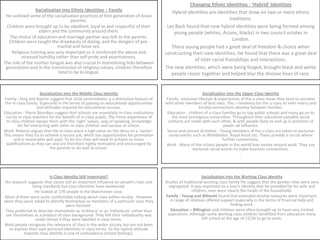
Changing Ethnic Identities - ‘Hybrid’ IdentitiesHybrid identities are identities that draw on two or more ethnic traditions. Les Back found that new hybrid identities were being formed among young people (whites, Asians, blacks) in two council estates in London.These young people had a great deal of freedom & choice when constructing their new identities. He found that there was a great deal of inter-racial friendships and interactions. The new identities, which were being forged, brought black and white people closer together and helped blur the divisive lines of race.Socialisation into Ethnic Identities – FamilyHe outlined some of the socialisation practices of first generation of Asian parents. Children were brought up to be obedient, loyal to and respectful of their elders and the community around them. The choice of education and marriage partner was left to the parents. Children were taught the drawbacks of dating, and the dangers of pre-marital and loose sex.Religious training was very important as it reinforced the above and stressed humility rather than self-pride and assertiveness. The role of the mother tongue was also crucial in maintaining links between generations and in the transmission of religious values, children therefore tend to be bi-lingual..Socialisation into the Middle Class IdentityFamily - King and Raynor suggest that child-centeredness is a distinctive feature of the m-class family. Especially in the terms of passing on educational opportunities and attitudes required for educational success.Education - Pierre Bourdieu suggest that schools are essentially m-class institutions run by m-class teachers for the benefit of m-class pupils. The home experience of m-class children equips them with the ‘right’ values, way of speaking, knowledge etc for interacting with other m-class children and success at school.Work- Roberts argues that the m-class place a high value on the ideas on a ‘career’. This means they try to achieve a secure job, which has opportunities for promotion and is reasonable well paid. To do this they will need to achieve as many qualifications as they can and are therefore highly motivated and encouraged by the parents to do well at school. Socialisation into the Upper Class IdentityFamily - exclusive lifestyle & experiences of the u-class mean they tend to socialise with other members of that class. This = tendency for the u-class to inter-marry and kinship connections develop between families. Education - children of u-class families go to top public schools and many go on to the most prestigious universities. Throughout their education valuable social contacts are made with each other, & with people likely to end up in positions of power ad influence.Social and Leisure Activities - Young members of the u-class are taken to exclusive social events such as Wimbledon, Royal Ascot etc. These provide a circuit where further connections.Work - Many of the richest people in the world lives evolve around work. They use exclusive social events to make business connections..  Is Class Identity Still Important?His research suggests that classis still an important influence on people’s lives and living standards but class identities have weakened. He looked at 178 people in the Manchester area. Most of them were quite comfortable talking about class within society.  However when they were asked to identify themselves as members of a particular class they were hesitant.They preferred to describe themselves as ‘ordinary’ or as ‘individuals’ rather than see themselves as a product of class background. They felt their individuality was under threat if they were labelled in class terms.Most people recognise the relevance of class in the wider society but are not keen to express their own personal identities in class terms. So the typical attitude towards class identity is one of ambivalence (mixed feelings).Socialisation into the Working Class IdentityStudies of traditional working class family life suggest that the gender roles were very segregated. It was important to a man’s identity that he provided for his wife and children, men were clearly the heads of the households. Family - Young and Wilmottfound that extended kinship networks were important. A range of relatives offered support especially in the terms of financial help and finding work. Education – Billingtonsaid children were often brought up to have very limited aspirations. Although some working class children benefited from education many left school at the age of 15/16 to go to work.

SociologyExchange.co.uk Shared Resource

  • 1.
    NORBERT ELIASCulture /The Social Body TheoryJEFFREY ARNETTSubculture, Norms and ValuesCharlotte ButlerReligion – as Agent of SOCIAL CONTROLPeter BergerSocial ControlDIANE REAYFRANK FUREDI
  • 2.
    Subculture, Norms andValuesStudied metal headsInterviews and questionnaires – asked about heavy metal, family, religious beliefs, politics and hopes / plans for the future.Metal heads compared with non-metal fans to see if there were any differences between them.Findings In some respects they are differentMetal heads engage in more reckless behaviour. A correlation was found although one does not cause the other, it comes from seeking new exciting experiences. Metal heads are more likely to see their parent as equals. This suggests that their parents have practised a style of socialisation that emphasises freedom and choice. Metal heads see their future within music, or music related activities.Culture / The Social Body Theory He talks about the cultural changing attitudes towards the body.In the 16th century there was little / no shame about the human body, people wiped snot on their sleeves and blew their noses on table clothes. BUT now people have become more sensitive to the shame of bodily functions and discipline their bodies to act in civilised ways. Social ControlFormal Social Control – Specific responsibilities. E.g. Police, the army, teachers and social workers.Informal Social Control – Positive and negative attitudes E.g. encouragement VS negative comments.Peter Berger identifies other common methods of social control;Physical Violence – Used by police of in self-defence. Can also just be used as a threat to make people to abide by the law.Economic Pressure. - E.g. workers that misbehave may be sackedSocial Acceptance – People may not do things as they might worry what people in the society around them would think.Socialisation – People are taught societies rules, which in time become apart of their own values.Religion – Secularisation (The Break Down) She studied a group of Muslim girls in the East MidlandsShe found that religious beliefs were being adapted to fit changing circumstances.The girl’s experience of living in England had led them to regard certain Pakistani and Bangladeshi customs as irrelevant to their lives i.e. arranged marriages. THE FAMILY He describes a change in the role of parents Traditionally parents tied to care for and stimulate their childrenNOWADAYS parents often see their main task as protecting their children from dangerHe says parents have become paranoid which prevents children from developing a healthy sense of adventure. The Family Studied 33 mothers in LondonIdentified major class differences Middle class mothers had more time and energy to spend with their children reading etc.BUT working class mothers were struggling to make ends meet so had less time and energy to spend with their children
  • 3.
    ADLER AND ADLERPeerGroupCHRISTINE SKELTONEducation GOLDBERGGender identity – Biologically DeterminedMARGERET MEADGender Identity Socially ConstructedCONNELLGENDER IDENTITYEMMA RENOLDGENDER INDENTIY
  • 4.
    Education Studied a primaryschool in the North East, it was in an economically deprived area with a reputation of crime.When boys went to the school they took with them attitudes picked up from ‘local lads’ & ‘hard men’. E.g. aggressive, physical toughness and dominance etcThe school attempted to maintain control through firm measures. Locked gates, fences and cameras were their defence against theft and violence.Teachers adopted masculine styles i.e. firm eye contact and intimidating body language.Skeleton points out that the schools firm control strategy was in many ways a reflection of the ‘tough’ values that were prized in the community. Peer Group Studied white middle class children in the USAFound that peer’s were important within their lives, having friends and being popular made them feel good about themselves, but being socially isolated had the reverse effect.Adler and Adler described how friendship groups changed and shifted as children moved in and out.Some members of the group had more power and influence than othersFriends are expected to be loyal to their peer values. Gender Identity – Social Construction Social construction is the approach that argues gender is based on ‘nurture’ / socialisation. She showed this in her study of 3 New Guinea tribes.Among the Arapesh both sexes were feminine, among the Mundugamor both sexes were masculine, and among the Tchambuli the gender roles were the reverse of the Western stereotypes (women made sexual advances and men enjoyed a good gossip)BUT it is said that Mead may have overstated her case as no other study has produced such startling results to support her. Gender identity – Biologically Determined Biologically determined is the approach that believes gender is based on nature. The genetic differences cause men and women to create the natural differences in the attitudes.He believes men have an inbuilt ‘dominance tendency’ Gender Roles / Identity – Peer Group Demonstrated the power of hegemonic masculinity.She studied boys in their final year of primary school & found that boys play down their academic success & sometimes behave badly in order to disguise their positive attitude towards study. Girls & boys with poor sporting skills are usually ridiculed. Gender Roles / Identity – Peer Group Hegemonic Masculinity – it’s the dominating type of masculinity – toughness, aggression and competition. Young men are put under great pressure to present themselves as hard, strong and independent so they soon learn to conceal any ‘girly’ signs of gentleness, kindness & vulnerability.
  • 5.
    TONY SEWELL GENDERIDENTITY PEER GROUP AND MEDIA. OAKLEYGENDER IDENTITYTHE FAMILYMAC an GHALLGENDER IDENTITYWORKMILLER AND HOFFMANGENDER IDENTITYRELIGIONCHRISTINE SKELTONGENDER IDENTITYEDUCATIONGAUNTLETTGENDER IDENTITYMASS MEDIA
  • 6.
    Gender Roles /Identity – The Family Oakley identified two processes central to the construction of gender identity that come from the family / parents;Manipulation, which refers to the way parents encourage or discourage behaviour based on its appropriateness for their child’s sex.Canalisation, which refers to the way parents channel children’s interests into toys that are seen as normal for that child’s sex.Gender Roles/Identity – Peer Group & Media He argued that peer pressure is extremely influential in shaping ethnic identities among African-Caribbean youths.The African-Caribbean male identity if focused on being ‘hyper male’ and ‘gansta’ especially in the eyes of their peers.He also notes that the ‘street’ identity is partly shaped by the media through advertising and MTV, which encourage African-Caribbean males to subscribe to a consumer culture.Gender Roles / Identity – ReligionMiller and Hoffmann (1995) said that women are more religious than men; they said that women were more likely to go to church and have stronger personal religious commitment than men.They identified two explanations for this gender differences.One was that women didn’t have much participation in paid work that they had more time to do church related activities.Another was that women were taught to be passive, obedient and nurturing than men, which are all qualities that religion sees as very important.. Gender Roles / Identity – Work Heavy manual work provide some working class men with a strong sense of male pride. Mac an Ghaill spoke of the ‘crisis of masculinity’ and said some working class men were insecure as their masculine identity is no longer relevant but they are not comfortable with alternative male identities. Gender Roles / Identity – Mass MediaHe presents changes within the gender roles within the media, and how they have become more equal and less stereotyped.There has been a significant increase in the proportion of female main characters. It was 18% in 1992-93 to 43% in 1995-96. There has been a decrease since the 1970’s in the proportion of women whose main occupation was represented as a housewife and is now only 3%. Both male and female characters are likely to now be presented as intelligent, talented and resourceful, or as stupid as each other. Gender Roles / Identity – Education She studied Benwood primary school. Where gender stereotypes were created and maintained.For example at a school assembly it was the male teachers who were called upon to move equipment.There were also posters and art work up on the walls which showed boys being ‘aggressive’ & ‘naughty’ but girls being ‘passive’ and ‘good’.Also in the football team boys were taught how to be ‘manly’.
  • 7.
    . TONY SEWELLETHNICIDENTITIESPEER GROUPMODOOD ET ALETHNIC IDENTITIES RELIGION
  • 8.
    . Socialisation intoEthnic Identities – ReligionHe questioned 2 generations of Asians, African-Caribbean’s & whites with the statement ‘Religion is very important to how I live my life’ the results were as follows:Most in favour of religion were the Pakistani and Bangladeshi samples. 82% of his 50+ sample and 67%of his 16-34 year aged group valued the importance of Islam in their lives.About one third of young Indians saw the religion as important. 18% of young African-Caribbean saw it as important But only 5% of whites saw religion as important. In all ethnic groups the older generation saw religion as more important than the younger generation although the gap was lowest among the Muslim sample.Socialisation into Black Identities - PeerTony Sewell argues that the identity of black youth is the result of a ‘triple quandary’. Firstly they feel that they do not fit into the dominant mainstream culture, they feel rejected by it.Secondly they become anxious about how they are perceived by society, and especially by their black peers. Therefore they seek to position themselves in a positive way and construct a highly masculine identity. Thirdly, many aspects of this identity are taken from the media culture. This culture of masculinity is valued as a comfort zone.
  • 9.
    GHUMANETHNIC IDENTITIESFAMILYLES BACKHYBRIDIDENTITIESJOHN SCOTTUPPER CLASS IDENTITYKING & RAYNORPIERRE BORDIEU & ROBERTSMIDDLE CLASS IDENTITY. YOUNG & WILMOTT & BILLINGTON ET ALWORKING CLASS IDENTITYMIKE SAVAGE ET ALCLASS IDENTITYSTILL IMPORTANT?
  • 10.
    Changing Ethnic Identities- ‘Hybrid’ IdentitiesHybrid identities are identities that draw on two or more ethnic traditions. Les Back found that new hybrid identities were being formed among young people (whites, Asians, blacks) in two council estates in London.These young people had a great deal of freedom & choice when constructing their new identities. He found that there was a great deal of inter-racial friendships and interactions. The new identities, which were being forged, brought black and white people closer together and helped blur the divisive lines of race.Socialisation into Ethnic Identities – FamilyHe outlined some of the socialisation practices of first generation of Asian parents. Children were brought up to be obedient, loyal to and respectful of their elders and the community around them. The choice of education and marriage partner was left to the parents. Children were taught the drawbacks of dating, and the dangers of pre-marital and loose sex.Religious training was very important as it reinforced the above and stressed humility rather than self-pride and assertiveness. The role of the mother tongue was also crucial in maintaining links between generations and in the transmission of religious values, children therefore tend to be bi-lingual..Socialisation into the Middle Class IdentityFamily - King and Raynor suggest that child-centeredness is a distinctive feature of the m-class family. Especially in the terms of passing on educational opportunities and attitudes required for educational success.Education - Pierre Bourdieu suggest that schools are essentially m-class institutions run by m-class teachers for the benefit of m-class pupils. The home experience of m-class children equips them with the ‘right’ values, way of speaking, knowledge etc for interacting with other m-class children and success at school.Work- Roberts argues that the m-class place a high value on the ideas on a ‘career’. This means they try to achieve a secure job, which has opportunities for promotion and is reasonable well paid. To do this they will need to achieve as many qualifications as they can and are therefore highly motivated and encouraged by the parents to do well at school. Socialisation into the Upper Class IdentityFamily - exclusive lifestyle & experiences of the u-class mean they tend to socialise with other members of that class. This = tendency for the u-class to inter-marry and kinship connections develop between families. Education - children of u-class families go to top public schools and many go on to the most prestigious universities. Throughout their education valuable social contacts are made with each other, & with people likely to end up in positions of power ad influence.Social and Leisure Activities - Young members of the u-class are taken to exclusive social events such as Wimbledon, Royal Ascot etc. These provide a circuit where further connections.Work - Many of the richest people in the world lives evolve around work. They use exclusive social events to make business connections.. Is Class Identity Still Important?His research suggests that classis still an important influence on people’s lives and living standards but class identities have weakened. He looked at 178 people in the Manchester area. Most of them were quite comfortable talking about class within society. However when they were asked to identify themselves as members of a particular class they were hesitant.They preferred to describe themselves as ‘ordinary’ or as ‘individuals’ rather than see themselves as a product of class background. They felt their individuality was under threat if they were labelled in class terms.Most people recognise the relevance of class in the wider society but are not keen to express their own personal identities in class terms. So the typical attitude towards class identity is one of ambivalence (mixed feelings).Socialisation into the Working Class IdentityStudies of traditional working class family life suggest that the gender roles were very segregated. It was important to a man’s identity that he provided for his wife and children, men were clearly the heads of the households. Family - Young and Wilmottfound that extended kinship networks were important. A range of relatives offered support especially in the terms of financial help and finding work. Education – Billingtonsaid children were often brought up to have very limited aspirations. Although some working class children benefited from education many left school at the age of 15/16 to go to work.