 The concept of identity: A sense of self that
develops as a child differentiates from parents
& family.
 This takes place in society.
 It refers to the sense that someone has of who
they are & what is most important about them-
nationality, ethnicity, sexuality, gender & class.
 Although it is individuals who have identities,
identity is related to the social group they
belong to & with which they identify
themselves.
 There is not always a perfect match between
how a person thinks of themselves & how
others see them.
 Personal identity may be different from social
identity. E.g. a person perceived by others to be
male may see himself as a woman trapped in a
man’s body.
 Social identity: our understanding of who we are
& of who other people are & other people’s
understanding of themselves & others.
 Created in the process of human interaction.
 Involves making comparisons between people &
establishing similarities & differences between
them, thus creating groups.
 Social identity is about meanings which are
socially constructed rather than about essential
difference between people. E.g. retirement at 65. A
64 year old and a 65 year old will have different
benefits.
 This is how men & women behave.
 Traditional ideologies about men being
masculine & females feminine- biological
differences.
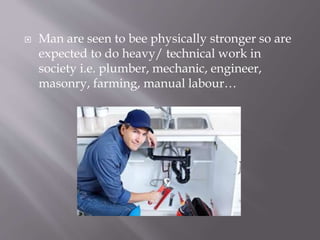
 Man are seen to bee physically stronger so are
expected to do heavy/ technical work in
society i.e. plumber, mechanic, engineer,
masonry, farming, manual labour…
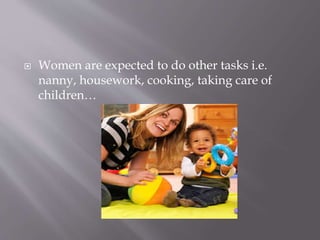
 Women are expected to do other tasks i.e.
nanny, housework, cooking, taking care of
children…
 Men are usually doing the expected jobs like mentioned above-
plumbing, engineering, masonry, farming, fishing…
 Most men occupy the high positioned jobs such as managing or business
ownership.
 Most single-parent families are headed by women.
 Most women work & quite a few have high occupations.
 After following interviews with a few female representatives about the
position of women in our society, it was seen that although women have
been given the chance to work in our modern day, this becomes
somewhat a problem since the women are still expected to cook, do
housework & take care of the children & are therefore tired after work.
 Those in high class families however, may afford nannies, maids & house
takers.
 Some families include women with higher paid jobs than their husbands
& sometimes use this as a sense of power.
 It was also said that opportunities are there for all women but they don’t
work hard enough to achieve- it is surely a world of competition!
 Boys & girls play & interact differently with each other.
Boys may prefer playing with toy cars, trucks, legos… &
girls may prefer to play with dolls.
 Boys carry stationary & school material decorated with
cartoon characters intended for them i.e. Ben 10/
Spiderman… & girls would go for Barbie, High school
musical, Dora, Strawberry shortcake… these objects already
serve a purpose of creating identity. Girls will be girly &
feminine & boys will be… well… boys.
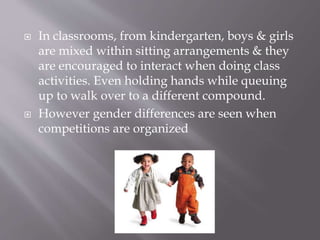
 In classrooms, from kindergarten, boys & girls are mixed
within sitting arrangements & they are encouraged to
interact when doing class activities. Even holding hands
while queuing up to walk over to a different compound.
 However gender differences are seen when competitions are
organized
 In classrooms, from kindergarten, boys & girls
are mixed within sitting arrangements & they
are encouraged to interact when doing class
activities. Even holding hands while queuing
up to walk over to a different compound.
 However gender differences are seen when
competitions are organized
 Back in the day it could be said that girls paid
more attention to fashion than boys but now, they
pay equally as much attention to their appearance
as girls do.
 Girls & boys tend to mix together to organize
activities such as going out to see movies or going
to the beach. However a majority of boys do
prefer engaging in sports when in adolescence.
 When engaging into illegal activities, it has been
seen that there are generally more boys than girls
who are involved in drugs. The reason for this
hasn’t been given.
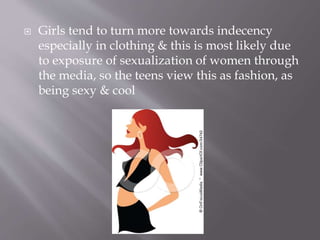
 Girls tend to turn more towards indecency
especially in clothing & this is most likely due
to exposure of sexualization of women through
the media, so the teens view this as fashion, as
being sexy & cool
 At this stage, in education, boys are most likely
to take up subjects such as math, physics,
computing… & are less likely to take up
language subjects & social sciences e.g. our
very own sociology class consisting of only one
boy: EDDY.
 At this stage, in our society, there is great effort put by government to
give opportunities to both genders especially in relation to studies, e.g.
the MTC & SIT would be occupied by mostly boys & girls wouldn’t be
encouraged to join these institutions, but now this is a different case, so
this can be seen as preparation for accommodating future female workers
in these fields of work, since these institutions train for the working field.
 Females & males tend to pay attention to their career when being young
adults. There are few gender differences in some career choices such as
doctors, officers, accountants…
 However it can also be said that there are quite a number of young
females in the tourism sector, so many of then prefer working in tourism.
 At this stage, it is also quite easy to recruit participants for beauty contests
as young women are eager to come forward & participate.
 Most young men would be focusing on other fields or being trained to
take care of family business.
 Women would otherwise be given the task of bearing
children & creating families but with improved literacy,
women tend to also be focused on their jobs & careers just as
well as men.
 Women have mostly the same rights and benefits as men do.
 They drive cars, are allowed to smoke- back in the day,
smoking would be seen as an activity for mostly men,
women couldn’t really smoke in public.
 However like mentioned previously, women would still be
relied upon to take care of the children if they do have
children because some men tend to be a bit neglecting.
When families break up, men are not always so eager to
have full custody of the children.
 Mostly the people who do not contribute anything to society
& can be called drunkards are the men. Some women are
also present in that field.
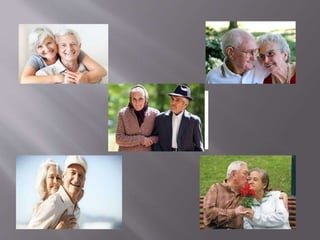
 In our elderly age groups, old people are part of couples. They are
products of older generations & sometimes they tell stories of how
different society was in their time.
 They had more kids in their families. A family could consist of
more than 10 children. The women would look after the kids and
the men would work to provide income for the family.
 Most men had to do manual labour but even if working conditions
were harder, it was easier to take care of such a huge family
because the cost of living was not as high as it is in the present
day.
 Nothing much is expected from the elderly of our society now.
The women stay home & those still capable engage in minor
craftwork & the men enjoy light leisure.
 To conclude, it is safe to say that different roles
are assigned to different genders in society &
identity is socially constructed.
 On the other hand, this is slowly changing in
time. Women are increasingly being given the
same choices as men & they are choosing their
own roles & deciding the path of their own
lives.

Identity & Gender

  • 1.
     The conceptof identity: A sense of self that develops as a child differentiates from parents & family.  This takes place in society.  It refers to the sense that someone has of who they are & what is most important about them- nationality, ethnicity, sexuality, gender & class.
  • 2.
     Although itis individuals who have identities, identity is related to the social group they belong to & with which they identify themselves.
  • 3.
     There isnot always a perfect match between how a person thinks of themselves & how others see them.  Personal identity may be different from social identity. E.g. a person perceived by others to be male may see himself as a woman trapped in a man’s body.
  • 4.
     Social identity:our understanding of who we are & of who other people are & other people’s understanding of themselves & others.  Created in the process of human interaction.  Involves making comparisons between people & establishing similarities & differences between them, thus creating groups.  Social identity is about meanings which are socially constructed rather than about essential difference between people. E.g. retirement at 65. A 64 year old and a 65 year old will have different benefits.
  • 5.
     This ishow men & women behave.  Traditional ideologies about men being masculine & females feminine- biological differences.
  • 6.
     Man areseen to bee physically stronger so are expected to do heavy/ technical work in society i.e. plumber, mechanic, engineer, masonry, farming, manual labour…
  • 7.
     Women areexpected to do other tasks i.e. nanny, housework, cooking, taking care of children…
  • 8.
     Men areusually doing the expected jobs like mentioned above- plumbing, engineering, masonry, farming, fishing…  Most men occupy the high positioned jobs such as managing or business ownership.  Most single-parent families are headed by women.  Most women work & quite a few have high occupations.  After following interviews with a few female representatives about the position of women in our society, it was seen that although women have been given the chance to work in our modern day, this becomes somewhat a problem since the women are still expected to cook, do housework & take care of the children & are therefore tired after work.  Those in high class families however, may afford nannies, maids & house takers.  Some families include women with higher paid jobs than their husbands & sometimes use this as a sense of power.  It was also said that opportunities are there for all women but they don’t work hard enough to achieve- it is surely a world of competition!
  • 9.
     Boys &girls play & interact differently with each other. Boys may prefer playing with toy cars, trucks, legos… & girls may prefer to play with dolls.  Boys carry stationary & school material decorated with cartoon characters intended for them i.e. Ben 10/ Spiderman… & girls would go for Barbie, High school musical, Dora, Strawberry shortcake… these objects already serve a purpose of creating identity. Girls will be girly & feminine & boys will be… well… boys.  In classrooms, from kindergarten, boys & girls are mixed within sitting arrangements & they are encouraged to interact when doing class activities. Even holding hands while queuing up to walk over to a different compound.  However gender differences are seen when competitions are organized
  • 10.
     In classrooms,from kindergarten, boys & girls are mixed within sitting arrangements & they are encouraged to interact when doing class activities. Even holding hands while queuing up to walk over to a different compound.  However gender differences are seen when competitions are organized
  • 11.
     Back inthe day it could be said that girls paid more attention to fashion than boys but now, they pay equally as much attention to their appearance as girls do.  Girls & boys tend to mix together to organize activities such as going out to see movies or going to the beach. However a majority of boys do prefer engaging in sports when in adolescence.  When engaging into illegal activities, it has been seen that there are generally more boys than girls who are involved in drugs. The reason for this hasn’t been given.
  • 12.
     Girls tendto turn more towards indecency especially in clothing & this is most likely due to exposure of sexualization of women through the media, so the teens view this as fashion, as being sexy & cool
  • 13.
     At thisstage, in education, boys are most likely to take up subjects such as math, physics, computing… & are less likely to take up language subjects & social sciences e.g. our very own sociology class consisting of only one boy: EDDY.
  • 14.
     At thisstage, in our society, there is great effort put by government to give opportunities to both genders especially in relation to studies, e.g. the MTC & SIT would be occupied by mostly boys & girls wouldn’t be encouraged to join these institutions, but now this is a different case, so this can be seen as preparation for accommodating future female workers in these fields of work, since these institutions train for the working field.  Females & males tend to pay attention to their career when being young adults. There are few gender differences in some career choices such as doctors, officers, accountants…  However it can also be said that there are quite a number of young females in the tourism sector, so many of then prefer working in tourism.  At this stage, it is also quite easy to recruit participants for beauty contests as young women are eager to come forward & participate.  Most young men would be focusing on other fields or being trained to take care of family business.
  • 16.
     Women wouldotherwise be given the task of bearing children & creating families but with improved literacy, women tend to also be focused on their jobs & careers just as well as men.  Women have mostly the same rights and benefits as men do.  They drive cars, are allowed to smoke- back in the day, smoking would be seen as an activity for mostly men, women couldn’t really smoke in public.  However like mentioned previously, women would still be relied upon to take care of the children if they do have children because some men tend to be a bit neglecting. When families break up, men are not always so eager to have full custody of the children.  Mostly the people who do not contribute anything to society & can be called drunkards are the men. Some women are also present in that field.
  • 17.
     In ourelderly age groups, old people are part of couples. They are products of older generations & sometimes they tell stories of how different society was in their time.  They had more kids in their families. A family could consist of more than 10 children. The women would look after the kids and the men would work to provide income for the family.  Most men had to do manual labour but even if working conditions were harder, it was easier to take care of such a huge family because the cost of living was not as high as it is in the present day.  Nothing much is expected from the elderly of our society now. The women stay home & those still capable engage in minor craftwork & the men enjoy light leisure.
  • 19.
     To conclude,it is safe to say that different roles are assigned to different genders in society & identity is socially constructed.  On the other hand, this is slowly changing in time. Women are increasingly being given the same choices as men & they are choosing their own roles & deciding the path of their own lives.