GCSE Sociology


 Crime and Deviance
                          Looking for patterns


                                       Age
                                   Ethnicity
                                       Gender


                                  Class
                      Location
               Essential Notes and Workbook


     What is the relationship between involvement in crime and age?

HG GCSE Sociology Crime and Deviance
From your notes can you recall….

What connection between age and crime is shown in the official
statistics?


Do self-report studies agree with official statistics?


How do we explain the relationship between age and crime?


              What is the relationship between gender and crime?


HG GCSE Sociology Crime and Deviance
What do the official statistics tell us about women and crime?


What is the most common offence for both men and women?


How can we explain why women are less involved in criminal activity?


How do we explain women’s increasing involvement in crime?


HG GCSE Sociology Crime and Deviance
What is the general pattern of women’s involvement in crime?


What are the explanations for this change?


                          Girl Gangs and Street Violence


HG GCSE Sociology Crime and Deviance
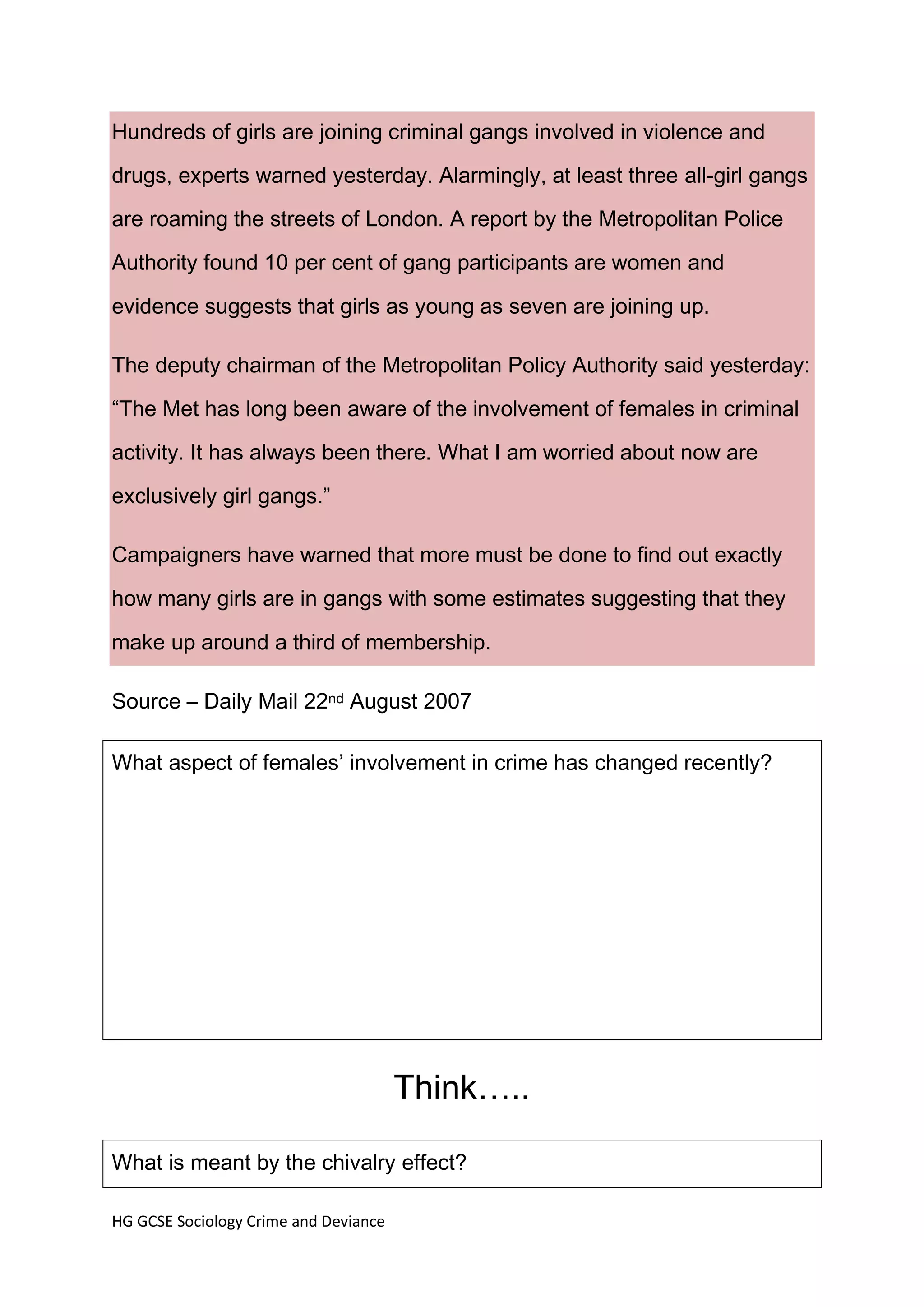
Hundreds of girls are joining criminal gangs involved in violence and
drugs, experts warned yesterday. Alarmingly, at least three all-girl gangs
are roaming the streets of London. A report by the Metropolitan Police

Authority found 10 per cent of gang participants are women and

evidence suggests that girls as young as seven are joining up.

The deputy chairman of the Metropolitan Policy Authority said yesterday:

“The Met has long been aware of the involvement of females in criminal

activity. It has always been there. What I am worried about now are
exclusively girl gangs.”

Campaigners have warned that more must be done to find out exactly
how many girls are in gangs with some estimates suggesting that they

make up around a third of membership.

Source – Daily Mail 22nd August 2007

What aspect of females’ involvement in crime has changed recently?


                                       Think…..

What is meant by the chivalry effect?

HG GCSE Sociology Crime and Deviance
What evidence is there to suggest that the chivalry effect is becoming

less significant?


The newspaper article identifies the emergence of exclusively girl gangs.
Why might this raise more public concern that mixed or exclusively boy
gangs?


            What is the relationship between ethnicity and crime?

Look at these statistics and answer the questions.

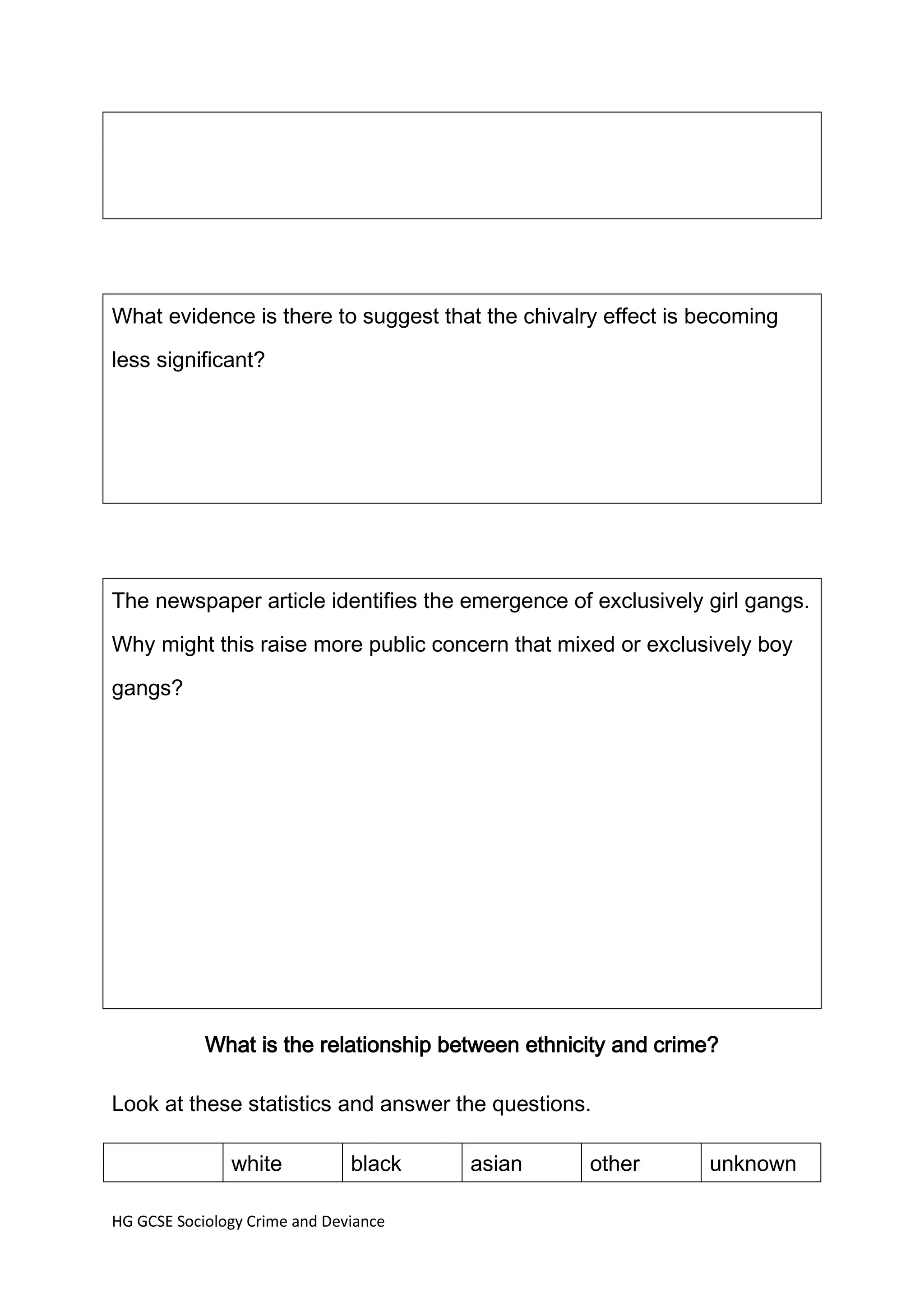
               white           black   asian       other        unknown

HG GCSE Sociology Crime and Deviance
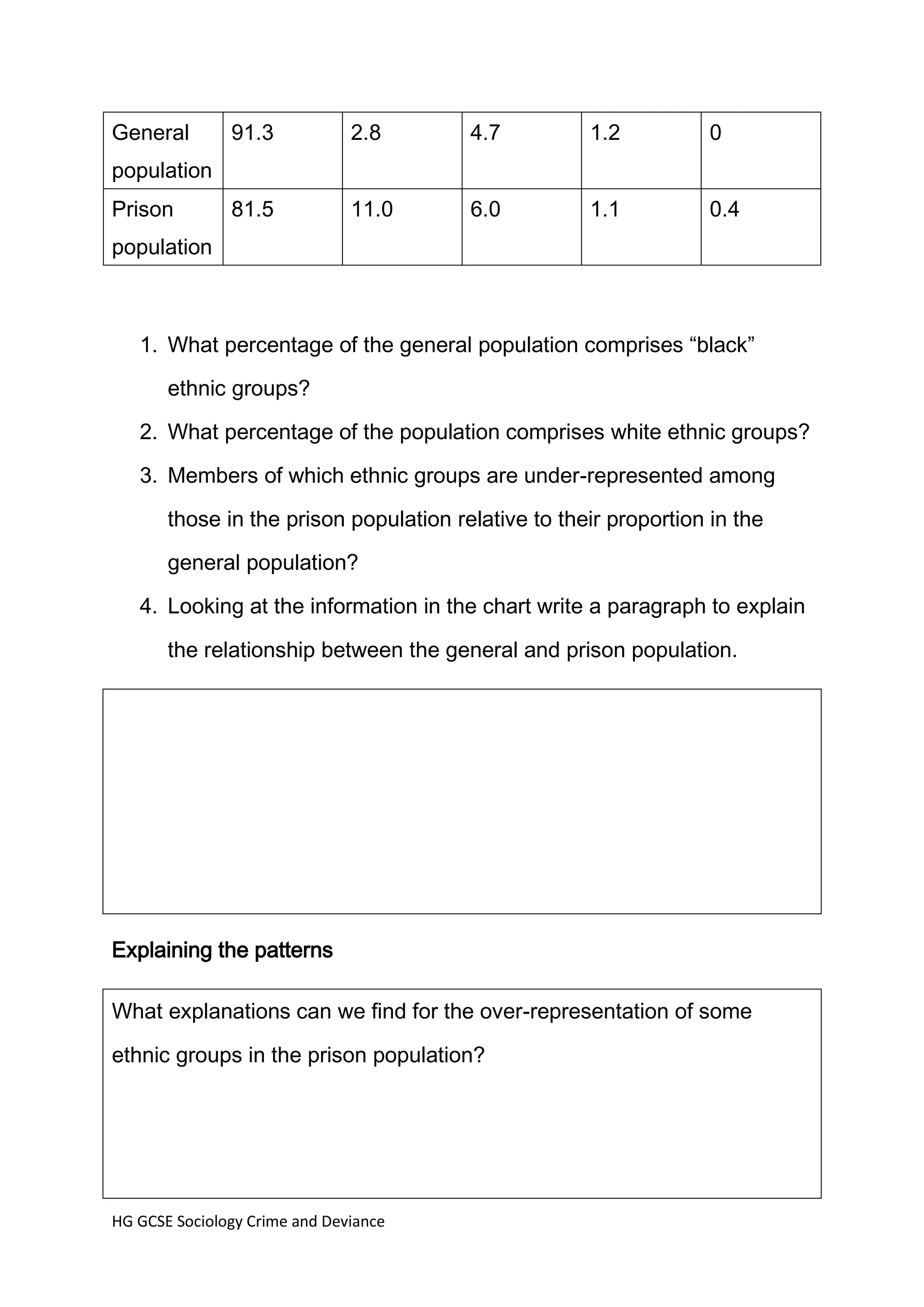
General        91.3            2.8      4.7          1.2           0
population
Prison         81.5            11.0     6.0          1.1           0.4
population


   1. What percentage of the general population comprises “black”
       ethnic groups?

   2. What percentage of the population comprises white ethnic groups?

   3. Members of which ethnic groups are under-represented among
       those in the prison population relative to their proportion in the
       general population?

   4. Looking at the information in the chart write a paragraph to explain

       the relationship between the general and prison population.


Explaining the patterns

What explanations can we find for the over-representation of some

ethnic groups in the prison population?


HG GCSE Sociology Crime and Deviance
Look at this chart

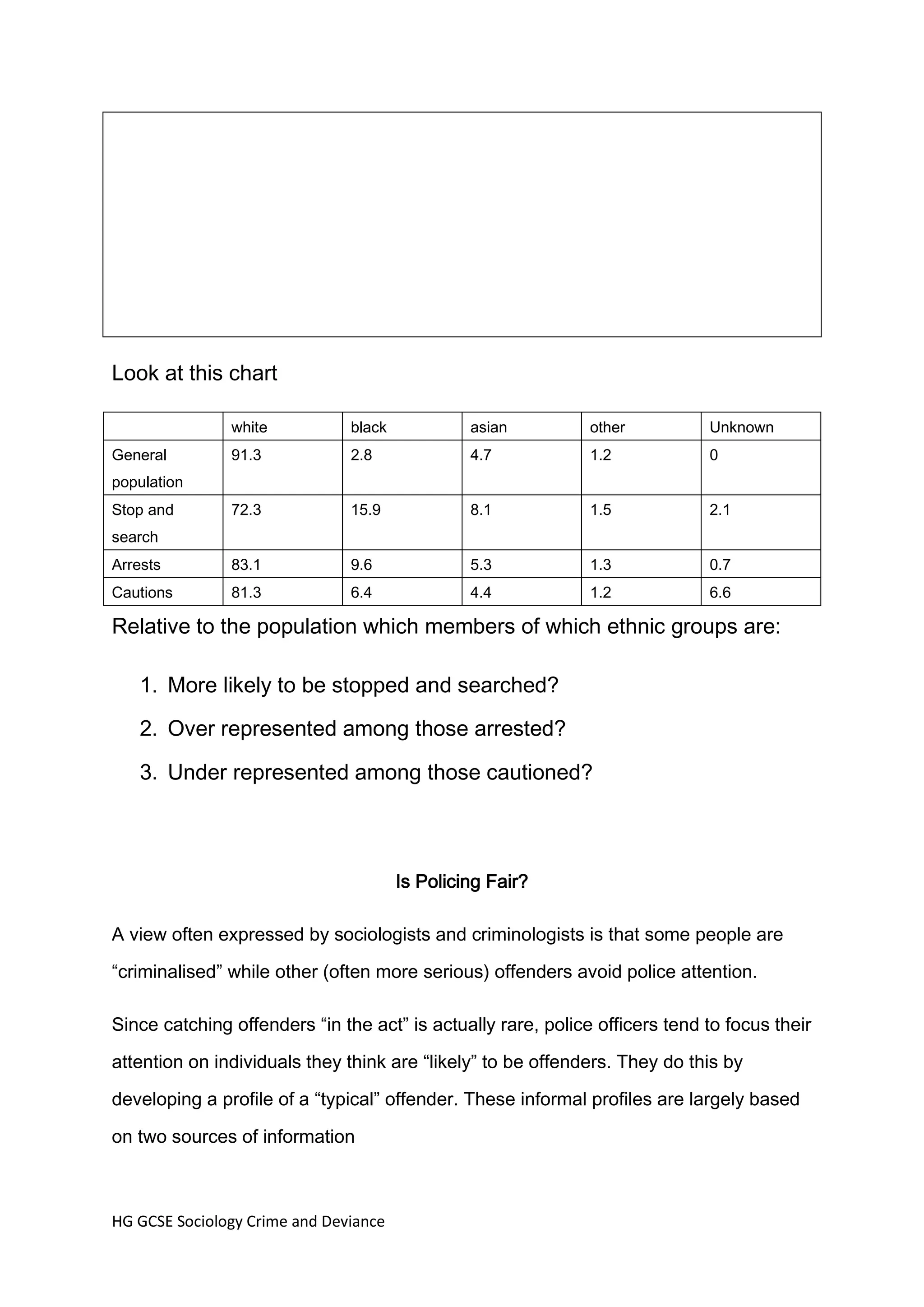
               white           black            asian         other          Unknown
General        91.3            2.8              4.7           1.2            0
population
Stop and       72.3            15.9             8.1           1.5            2.1
search
Arrests        83.1            9.6              5.3           1.3            0.7
Cautions       81.3            6.4              4.4           1.2            6.6

Relative to the population which members of which ethnic groups are:

   1. More likely to be stopped and searched?
   2. Over represented among those arrested?

   3. Under represented among those cautioned?


                                       Is Policing Fair?

A view often expressed by sociologists and criminologists is that some people are

“criminalised” while other (often more serious) offenders avoid police attention.

Since catching offenders “in the act” is actually rare, police officers tend to focus their

attention on individuals they think are “likely” to be offenders. They do this by

developing a profile of a “typical” offender. These informal profiles are largely based

on two sources of information


HG GCSE Sociology Crime and Deviance
First officers’ own views and previous encounters with offenders. However these

encounters are problematic because they are rarely systematic. Most offenders are

never caught and those who are caught are either unlucky or slow (thus not

representative of offenders in general)

Secondly, information from the public. However, accounts of offenders given by

victims or witnesses usually involve no more than descriptions of sex, age and

ethnicity – presumably because they are often the characteristics most obvious to

onlookers.

The central problem therefore, is that police have to operate with profiles that rely on

such characteristics (young, black males etc.) rather than anything that is clearly

linked with potential or undetected offending. If the criteria usually used to select

individuals for police attention are characteristics that people have little or no control

over (age, ethnicity, gender and social class) then only a narrow group of people

becomes subject to police attention, on grounds that are often not justifiable.

Source Townsley and Marshall (2006)


   1. Can you think of crimes that may “avoid police attention”?
   2. According to this article – what are the two main sources of
       information used to base the “typical” offender on?
   3. Looking at this article, write a paragraph to explain why the

       policing of young, black men can seem unfair.


HG GCSE Sociology Crime and Deviance
What is the relationship between crime and class and locality?

What does the evidence show about the number of working class people

in the prison population?


What are the explanations for this?


HG GCSE Sociology Crime and Deviance
White collar crime – a definition.


Why do these crimes go undetected?


HG GCSE Sociology Crime and Deviance
What is the link between locality and crime?


How can we explain the link between locality and crime?


HG GCSE Sociology Crime and Deviance
Homework questions

What do sociologists mean by the terms white collar and corporate

crime?

Explain two reasons why white collar and corporate crime may be under-

represented in crime statistics.

Explain briefly why there appears to be more crime in urban areas than

in rural areas.


HG GCSE Sociology Crime and Deviance

SociologyExchange.co.uk Shared Resource

  • 1.
    GCSE Sociology Crimeand Deviance Looking for patterns Age Ethnicity Gender Class Location Essential Notes and Workbook What is the relationship between involvement in crime and age? HG GCSE Sociology Crime and Deviance
  • 2.
    From your notescan you recall…. What connection between age and crime is shown in the official statistics? Do self-report studies agree with official statistics? How do we explain the relationship between age and crime? What is the relationship between gender and crime? HG GCSE Sociology Crime and Deviance
  • 3.
    What do theofficial statistics tell us about women and crime? What is the most common offence for both men and women? How can we explain why women are less involved in criminal activity? How do we explain women’s increasing involvement in crime? HG GCSE Sociology Crime and Deviance
  • 4.
    What is thegeneral pattern of women’s involvement in crime? What are the explanations for this change? Girl Gangs and Street Violence HG GCSE Sociology Crime and Deviance
  • 5.
    Hundreds of girlsare joining criminal gangs involved in violence and drugs, experts warned yesterday. Alarmingly, at least three all-girl gangs are roaming the streets of London. A report by the Metropolitan Police Authority found 10 per cent of gang participants are women and evidence suggests that girls as young as seven are joining up. The deputy chairman of the Metropolitan Policy Authority said yesterday: “The Met has long been aware of the involvement of females in criminal activity. It has always been there. What I am worried about now are exclusively girl gangs.” Campaigners have warned that more must be done to find out exactly how many girls are in gangs with some estimates suggesting that they make up around a third of membership. Source – Daily Mail 22nd August 2007 What aspect of females’ involvement in crime has changed recently? Think….. What is meant by the chivalry effect? HG GCSE Sociology Crime and Deviance
  • 6.
    What evidence isthere to suggest that the chivalry effect is becoming less significant? The newspaper article identifies the emergence of exclusively girl gangs. Why might this raise more public concern that mixed or exclusively boy gangs? What is the relationship between ethnicity and crime? Look at these statistics and answer the questions. white black asian other unknown HG GCSE Sociology Crime and Deviance
  • 7.
    General 91.3 2.8 4.7 1.2 0 population Prison 81.5 11.0 6.0 1.1 0.4 population 1. What percentage of the general population comprises “black” ethnic groups? 2. What percentage of the population comprises white ethnic groups? 3. Members of which ethnic groups are under-represented among those in the prison population relative to their proportion in the general population? 4. Looking at the information in the chart write a paragraph to explain the relationship between the general and prison population. Explaining the patterns What explanations can we find for the over-representation of some ethnic groups in the prison population? HG GCSE Sociology Crime and Deviance
  • 8.
    Look at thischart white black asian other Unknown General 91.3 2.8 4.7 1.2 0 population Stop and 72.3 15.9 8.1 1.5 2.1 search Arrests 83.1 9.6 5.3 1.3 0.7 Cautions 81.3 6.4 4.4 1.2 6.6 Relative to the population which members of which ethnic groups are: 1. More likely to be stopped and searched? 2. Over represented among those arrested? 3. Under represented among those cautioned? Is Policing Fair? A view often expressed by sociologists and criminologists is that some people are “criminalised” while other (often more serious) offenders avoid police attention. Since catching offenders “in the act” is actually rare, police officers tend to focus their attention on individuals they think are “likely” to be offenders. They do this by developing a profile of a “typical” offender. These informal profiles are largely based on two sources of information HG GCSE Sociology Crime and Deviance
  • 9.
    First officers’ ownviews and previous encounters with offenders. However these encounters are problematic because they are rarely systematic. Most offenders are never caught and those who are caught are either unlucky or slow (thus not representative of offenders in general) Secondly, information from the public. However, accounts of offenders given by victims or witnesses usually involve no more than descriptions of sex, age and ethnicity – presumably because they are often the characteristics most obvious to onlookers. The central problem therefore, is that police have to operate with profiles that rely on such characteristics (young, black males etc.) rather than anything that is clearly linked with potential or undetected offending. If the criteria usually used to select individuals for police attention are characteristics that people have little or no control over (age, ethnicity, gender and social class) then only a narrow group of people becomes subject to police attention, on grounds that are often not justifiable. Source Townsley and Marshall (2006) 1. Can you think of crimes that may “avoid police attention”? 2. According to this article – what are the two main sources of information used to base the “typical” offender on? 3. Looking at this article, write a paragraph to explain why the policing of young, black men can seem unfair. HG GCSE Sociology Crime and Deviance
  • 10.
    What is therelationship between crime and class and locality? What does the evidence show about the number of working class people in the prison population? What are the explanations for this? HG GCSE Sociology Crime and Deviance
  • 11.
    White collar crime– a definition. Why do these crimes go undetected? HG GCSE Sociology Crime and Deviance
  • 12.
    What is thelink between locality and crime? How can we explain the link between locality and crime? HG GCSE Sociology Crime and Deviance
  • 13.
    Homework questions What dosociologists mean by the terms white collar and corporate crime? Explain two reasons why white collar and corporate crime may be under- represented in crime statistics. Explain briefly why there appears to be more crime in urban areas than in rural areas. HG GCSE Sociology Crime and Deviance
  • 14.
    HG GCSE SociologyCrime and Deviance