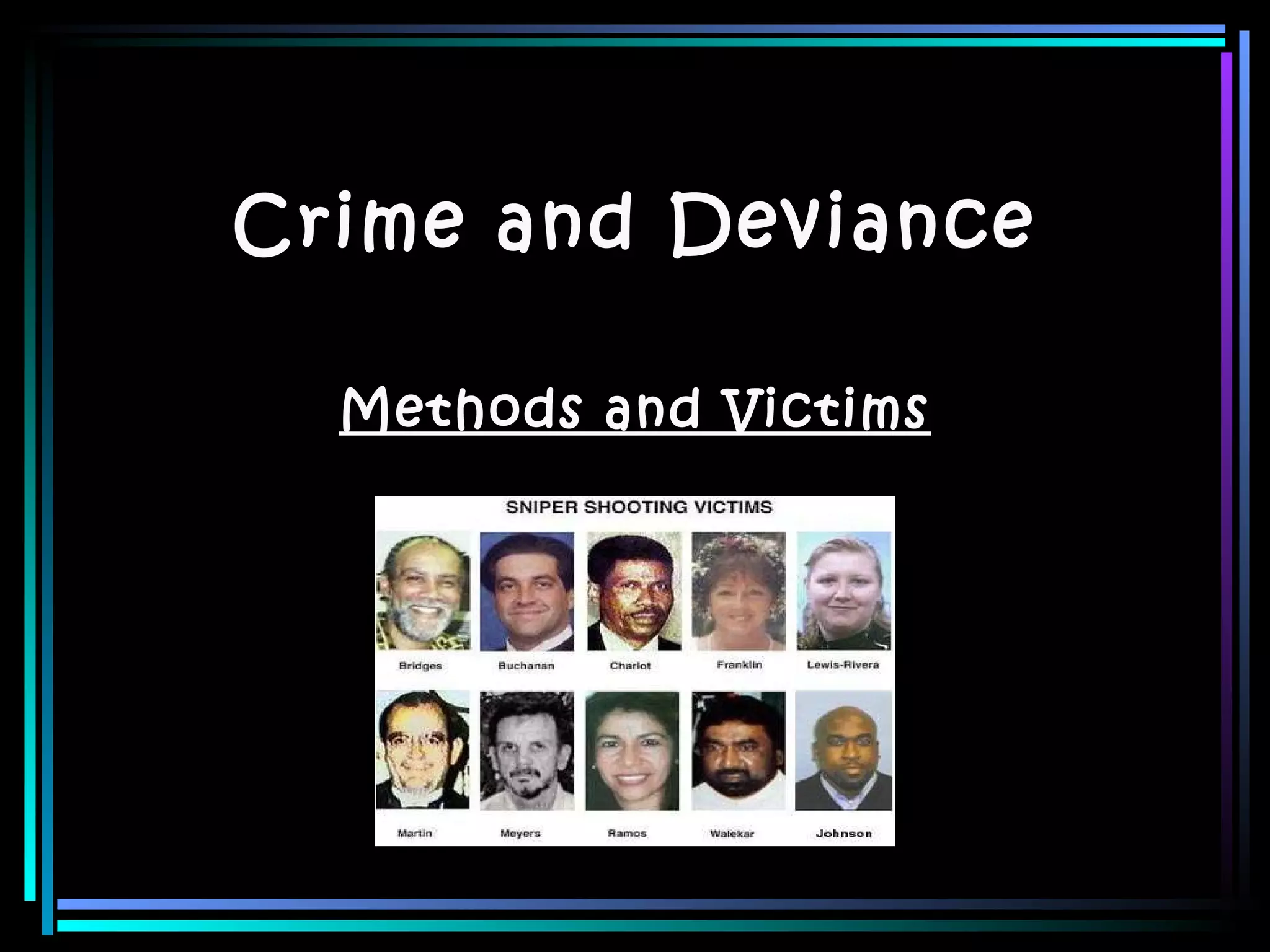
Crime and Deviance Methods and Victims
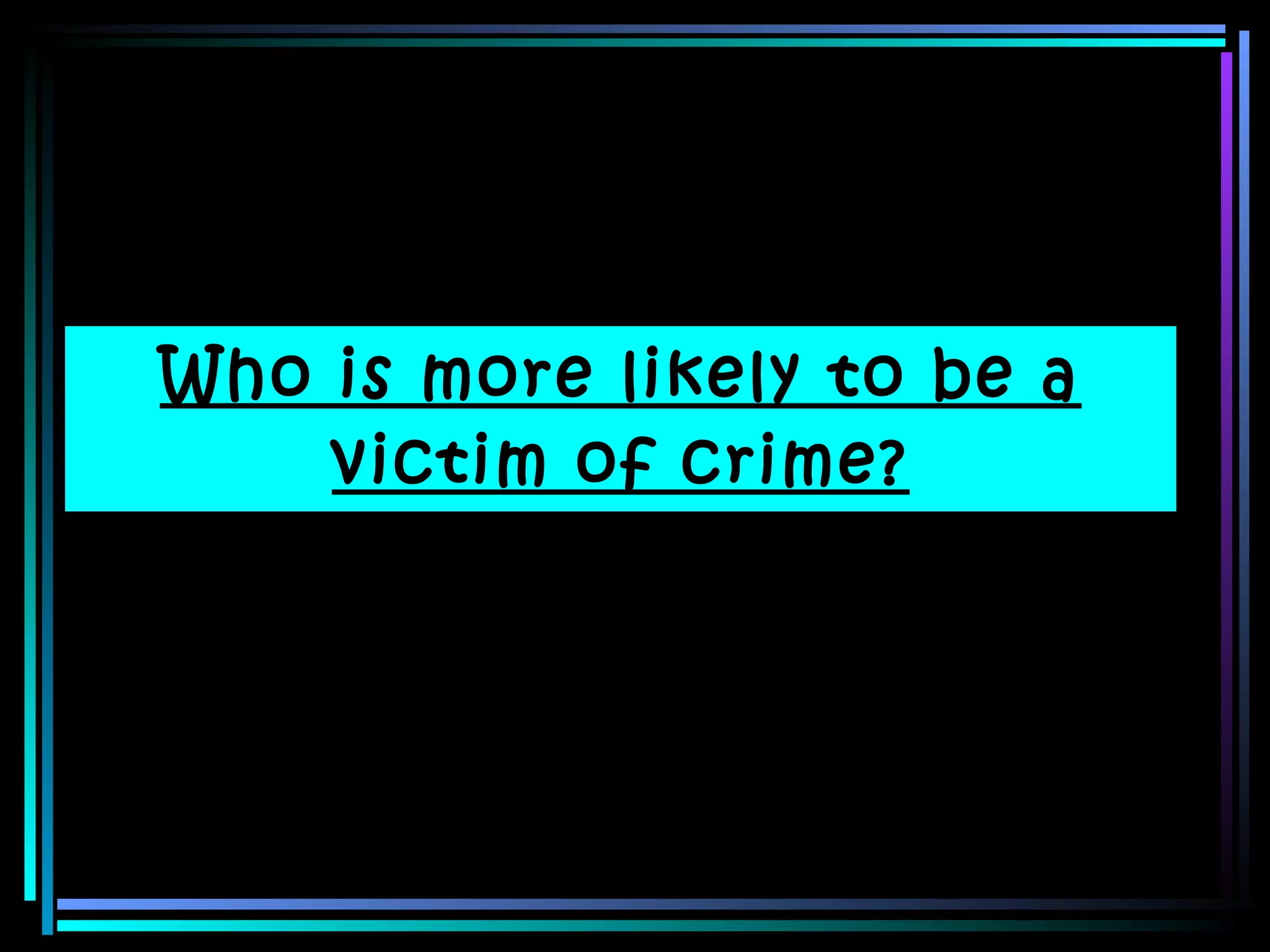
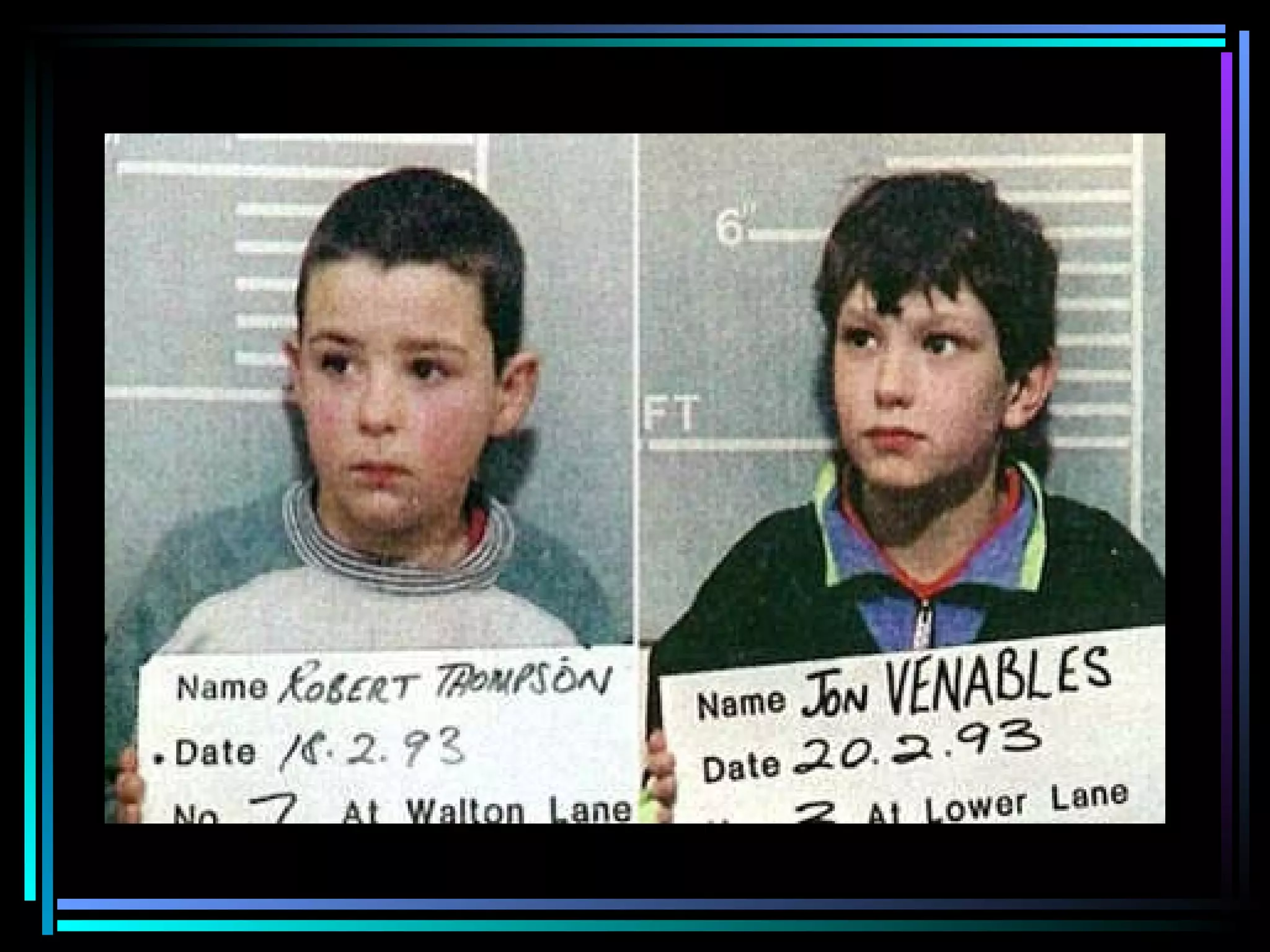
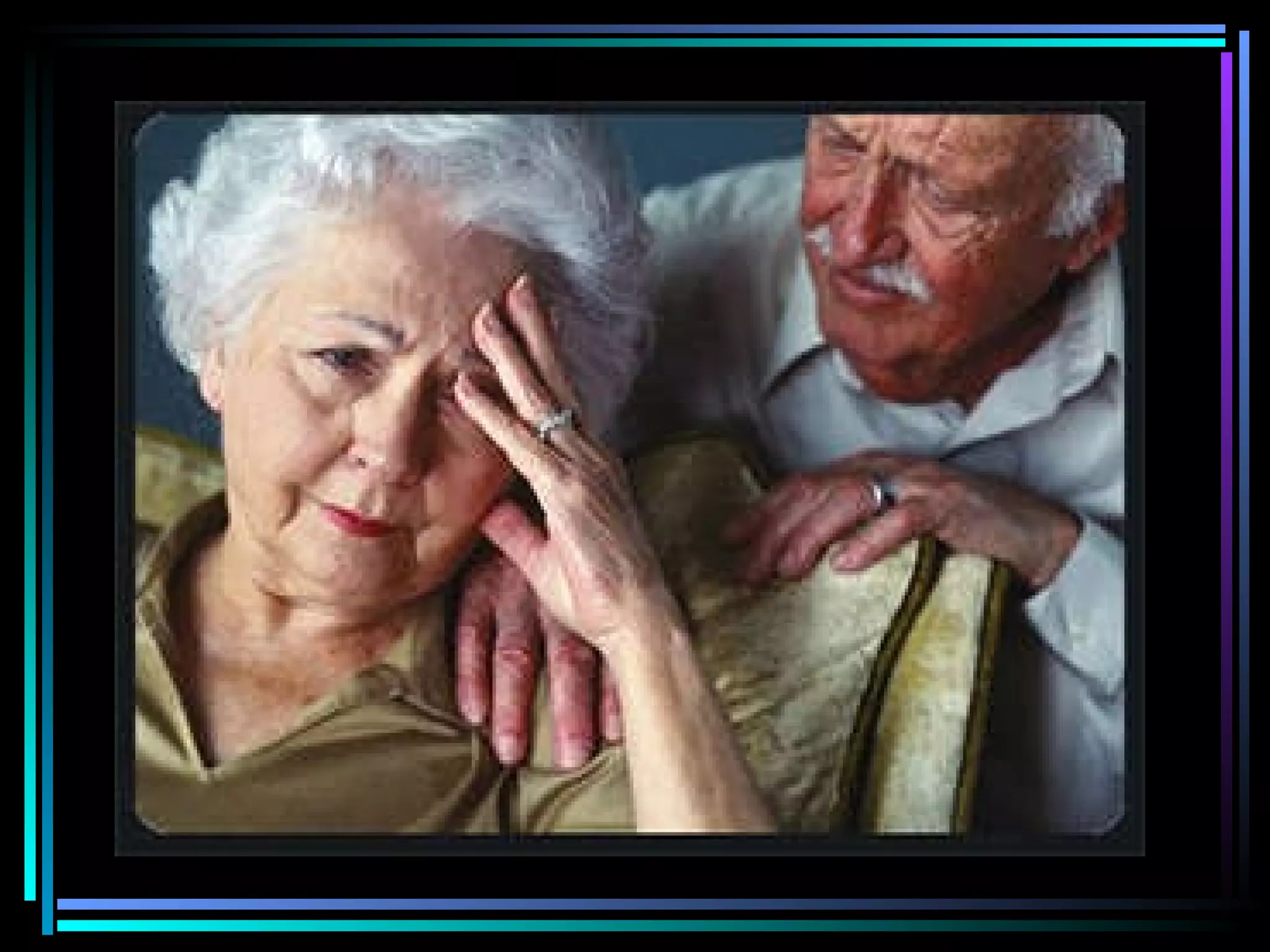
Who is more likely to be a victim of crime?


Measuring crime and deviance What are the practical and theoretical  problems when measuring crime and deviance?
In pairs……. What does this say about how we measure crime and deviance? Interactionist Critique BECKER:  whether an act is counted as deviant  or criminal or not depends not on the act itself, but on the reaction of it to others. CICOUREL : found that WC youths who were arrested were likely to be labelled as deliquent as they fit the police idea of a ‘typical deliquent’, while MC youths were able to negotiate, presenting themselves as remorseful and able to reform. The dominance of WC in statistics is thus the result of processes of negotiation through interaction.
Marxist Law and enforcement reflects interests of the ruling class.  The crimes of the poor are strictly enforced.  Statistics reflect these inequalities. Feminist Do not reflect the amount of crime against women, especially domestic violence.  These often occur in a private domestic setting where the police are reluctant  to get involved.  Women feel they can not report these crimes. Left Realist Crime is a genuine problem, especially poorer groups in society.  Favour detailed victim surveys in local areas.  Can reveal basis for many peoples fear of crime
How do we measure crime and deviance? Official statistics (O.S) are numerical data that have been produced by an official body, usually a Government department, or an organisation associated with the Government.  O.S cover a wide range of behaviour including births, deaths, marriage, crime….. What theoretical perspective would favour O.S? Positivists see them as a valuable source of quantitative data.  They provide measures of behaviour that can be used to investigate possible cause and effect relationships.
In pairs, brainstorm the advantages and disadvantages of O.S.
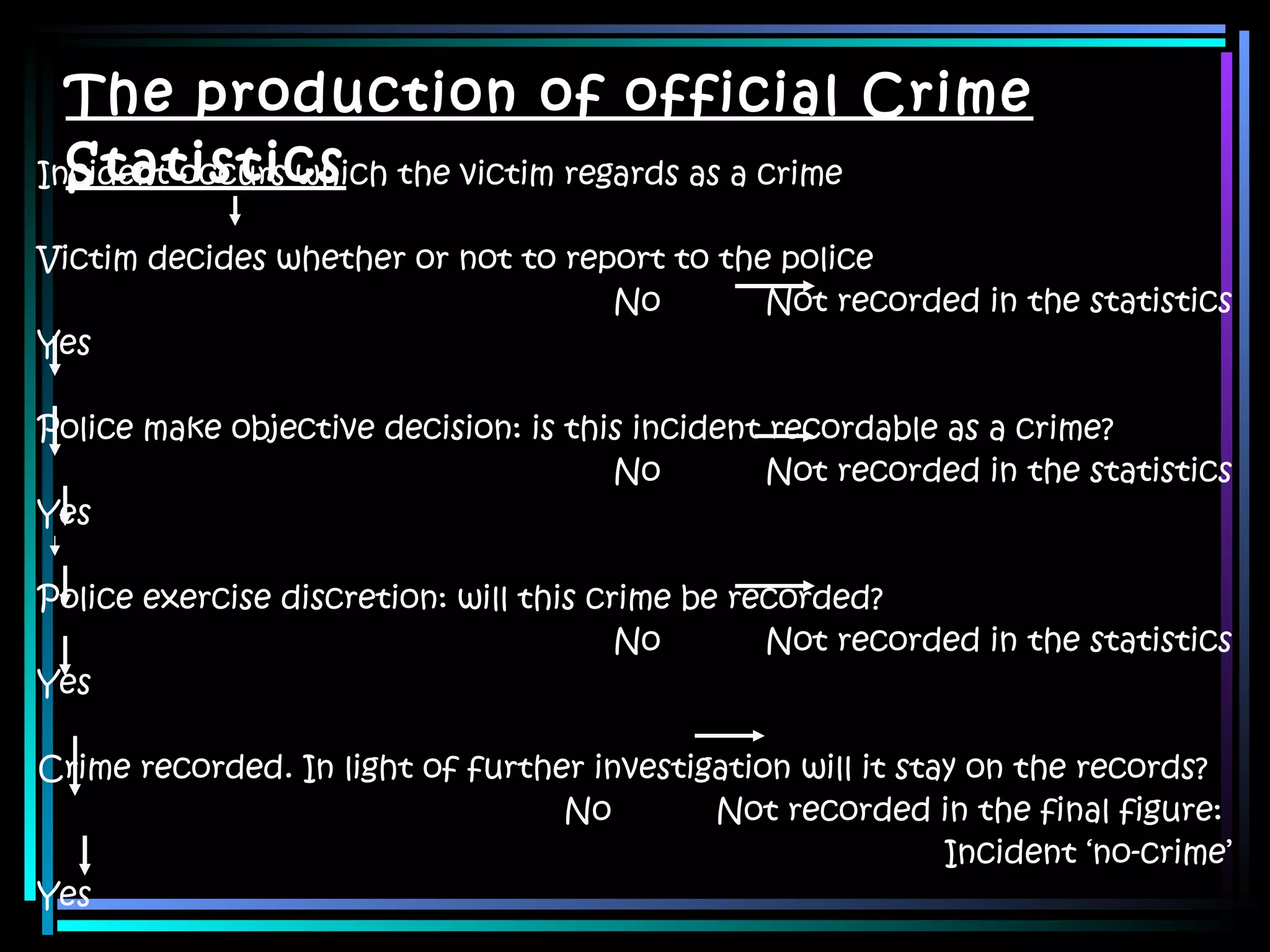
The production of official Crime Statistics Incident occurs which the victim regards as a crime Victim decides whether or not to report to the police No  Not recorded in the statistics Yes Police make objective decision: is this incident recordable as a crime? No  Not recorded in the statistics Yes Police exercise discretion: will this crime be recorded? No  Not recorded in the statistics Yes Crime recorded. In light of further investigation will it stay on the records? No  Not recorded in the final figure:  Incident ‘no-crime’ Yes Home office calculates details. Incident appears as a crime in the final statistics.
Investigating crime and deviance The Public p211 -212 The police p212-215 The judiciary p215-216 Government p242 (A2 Soc Moore et al) Market place
Plenary Summarize each section in no more than 2 words Good Luck with that!!!!
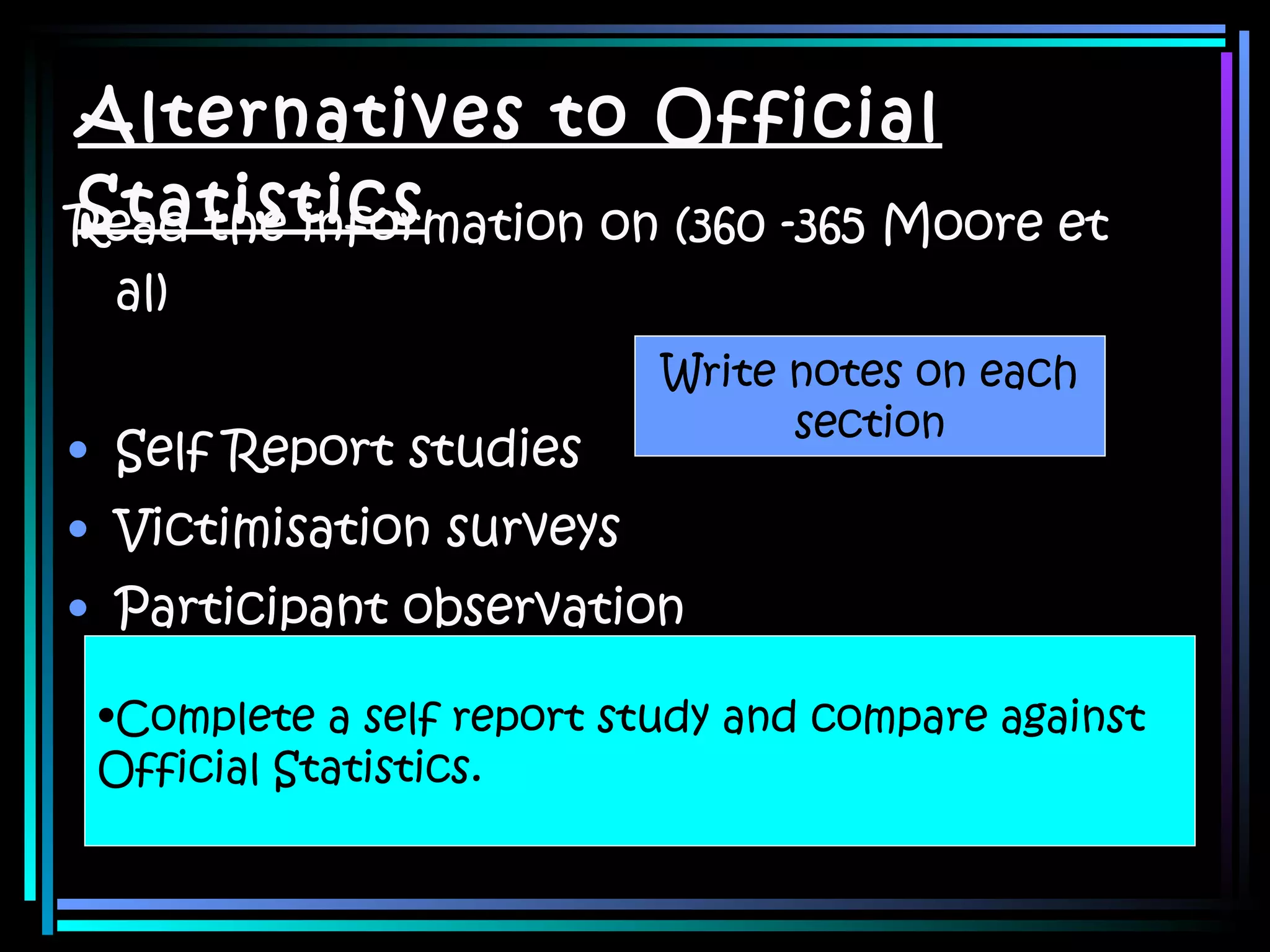
Alternatives to Official Statistics Read the information on (360 -365 Moore et al) Self Report studies Victimisation surveys Participant observation Write notes on each section Complete a self report study and compare against  Official Statistics.
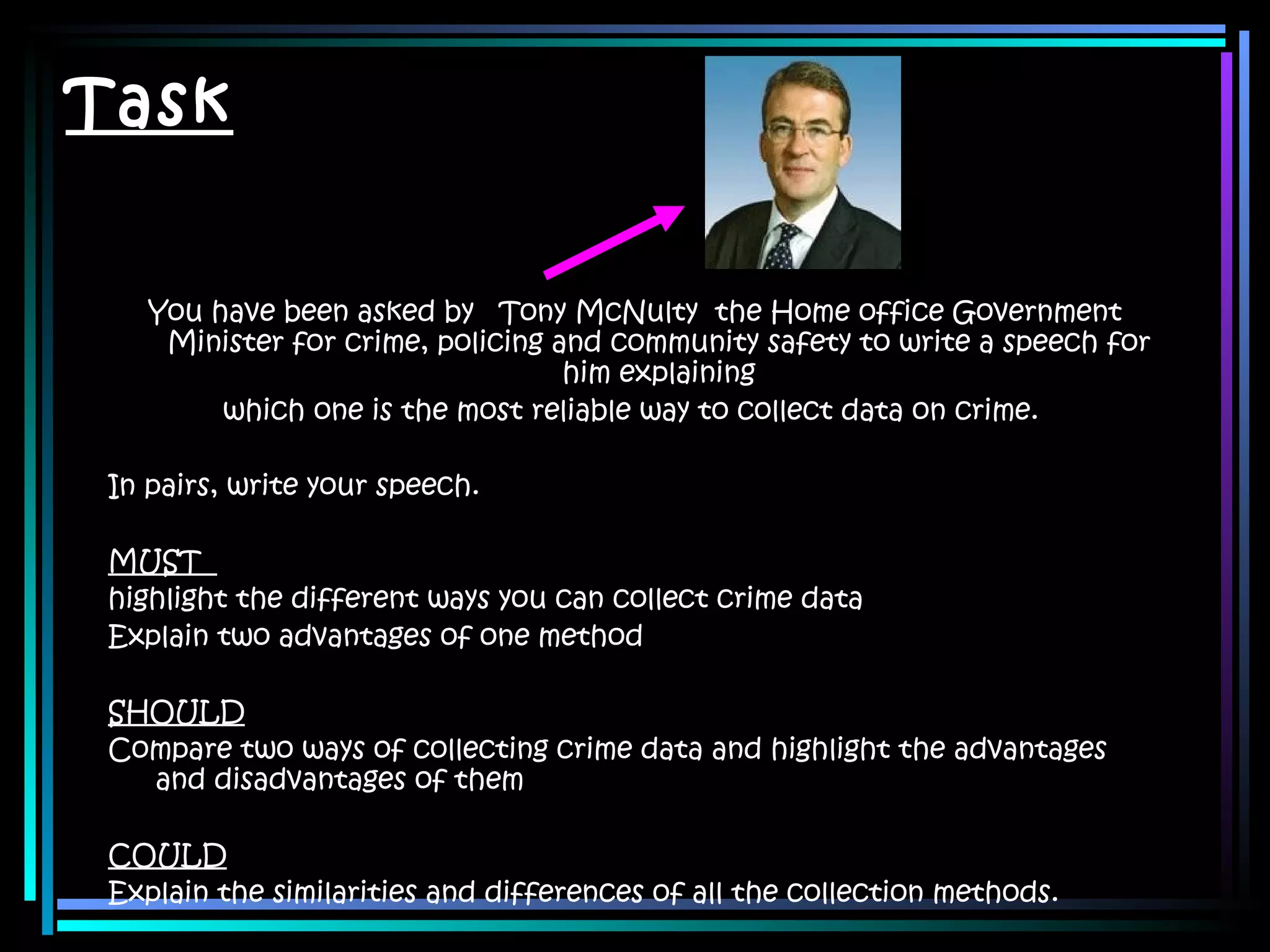
Task You have been asked by  Tony McNulty  the Home office Government Minister for crime, policing and community safety to write a speech for him explaining which one is the most reliable way to collect data on crime.  In pairs, write your speech. MUST  highlight the different ways you can collect crime data Explain two advantages of one method  SHOULD Compare two ways of collecting crime data and highlight the advantages and disadvantages of them COULD Explain the similarities and differences of all the collection methods.
Homework Using material from Item A and elsewhere examine the usefulness of victim surveys for an understanding of crime and deviance. 12 marks (p365 Sociology for A2 for AQA: Moore et al)

SociologyExchange.co.uk Shared Resource

  • 1.
    Crime and DevianceMethods and Victims
  • 2.
    Who is morelikely to be a victim of crime?
  • 3.
  • 4.
  • 5.
  • 6.
  • 7.
  • 8.
  • 9.
    Measuring crime anddeviance What are the practical and theoretical problems when measuring crime and deviance?
  • 10.
    In pairs……. Whatdoes this say about how we measure crime and deviance? Interactionist Critique BECKER: whether an act is counted as deviant or criminal or not depends not on the act itself, but on the reaction of it to others. CICOUREL : found that WC youths who were arrested were likely to be labelled as deliquent as they fit the police idea of a ‘typical deliquent’, while MC youths were able to negotiate, presenting themselves as remorseful and able to reform. The dominance of WC in statistics is thus the result of processes of negotiation through interaction.
  • 11.
    Marxist Law andenforcement reflects interests of the ruling class. The crimes of the poor are strictly enforced. Statistics reflect these inequalities. Feminist Do not reflect the amount of crime against women, especially domestic violence. These often occur in a private domestic setting where the police are reluctant to get involved. Women feel they can not report these crimes. Left Realist Crime is a genuine problem, especially poorer groups in society. Favour detailed victim surveys in local areas. Can reveal basis for many peoples fear of crime
  • 12.
    How do wemeasure crime and deviance? Official statistics (O.S) are numerical data that have been produced by an official body, usually a Government department, or an organisation associated with the Government. O.S cover a wide range of behaviour including births, deaths, marriage, crime….. What theoretical perspective would favour O.S? Positivists see them as a valuable source of quantitative data. They provide measures of behaviour that can be used to investigate possible cause and effect relationships.
  • 13.
    In pairs, brainstormthe advantages and disadvantages of O.S.
  • 14.
    The production ofofficial Crime Statistics Incident occurs which the victim regards as a crime Victim decides whether or not to report to the police No Not recorded in the statistics Yes Police make objective decision: is this incident recordable as a crime? No Not recorded in the statistics Yes Police exercise discretion: will this crime be recorded? No Not recorded in the statistics Yes Crime recorded. In light of further investigation will it stay on the records? No Not recorded in the final figure: Incident ‘no-crime’ Yes Home office calculates details. Incident appears as a crime in the final statistics.
  • 15.
    Investigating crime anddeviance The Public p211 -212 The police p212-215 The judiciary p215-216 Government p242 (A2 Soc Moore et al) Market place
  • 16.
    Plenary Summarize eachsection in no more than 2 words Good Luck with that!!!!
  • 17.
    Alternatives to OfficialStatistics Read the information on (360 -365 Moore et al) Self Report studies Victimisation surveys Participant observation Write notes on each section Complete a self report study and compare against Official Statistics.
  • 18.
    Task You havebeen asked by Tony McNulty the Home office Government Minister for crime, policing and community safety to write a speech for him explaining which one is the most reliable way to collect data on crime. In pairs, write your speech. MUST highlight the different ways you can collect crime data Explain two advantages of one method SHOULD Compare two ways of collecting crime data and highlight the advantages and disadvantages of them COULD Explain the similarities and differences of all the collection methods.
  • 19.
    Homework Using materialfrom Item A and elsewhere examine the usefulness of victim surveys for an understanding of crime and deviance. 12 marks (p365 Sociology for A2 for AQA: Moore et al)