Sociology, 12th Edition by John Macionis
Copyright  2008 Prentice Hall, a division of Pearson Education. All rights reserved.
The Sociological
Perspective
The systematic study of human society
Sociology, 12th Edition by John Macionis
Copyright  2008 Prentice Hall, a division of Pearson Education. All rights reserved.
What Is Sociology?
“...The systematic study of human society ”
– Systematic
• Scientific discipline that focuses attention on patterns of behavior
– Human society
• Group behavior is primary focus; how groups influence individuals
and vice versa
– At the “heart of sociology”
• The sociological perspective which offers a unique view of society
Sociology, 12th Edition by John Macionis
Copyright  2008 Prentice Hall, a division of Pearson Education. All rights reserved.
Why Take Sociology?
• Education and liberal arts
– Well-rounded as a person
– Social expectations
• More appreciation for diversity
– The global village
– Domestic social marginality
• Enhanced life chances
– Micro and macro understanding
– Increase social potentials
Benefits of the Sociological
Perspective
1. Helps us assess the truth of
common sense
2. Helps us assess both
opportunities and constraints in
our lives
Sociology, 12th Edition by John Macionis
Copyright  2008 Prentice Hall, a division of Pearson Education. All rights reserved.
Benefits of the Sociological Perspective
3. Empowers us to be active
participants in our society
4. Helps us live in a diverse
world
Sociology, 12th Edition by John Macionis
Copyright  2008 Prentice Hall, a division of Pearson Education. All rights reserved.
Sociology, 12th Edition by John Macionis
Copyright  2008 Prentice Hall, a division of Pearson Education. All rights reserved.
Importance of Global Perspective
• Where we live makes a great difference in
shaping our lives
• Societies throughout the world are
increasingly interconnected through
technology and economics.
Sociology, 12th Edition by John Macionis
Copyright  2008 Prentice Hall, a division of Pearson Education. All rights reserved.
• Many problems that we face in
Pakistan are more serious
elsewhere.
• Thinking globally is a good way
to learn more about ourselves.
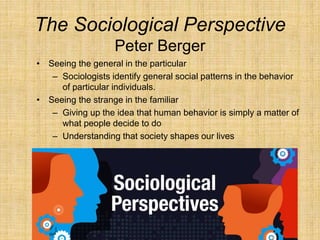
The Sociological Perspective
Peter Berger
• Seeing the general in the particular
– Sociologists identify general social patterns in the behavior
of particular individuals.
• Seeing the strange in the familiar
– Giving up the idea that human behavior is simply a matter of
what people decide to do
– Understanding that society shapes our lives
Durkheim’s Study of Suicide
• Emile Durkheim’s research showed
that society affects even our most
personal choices.
– More likely to commit: male Protestants
who were wealthy and unmarried
– Less likely to commit: male Jews and
Catholics who were poor and married
One of the basic findings: Why?
The differences between these groups had to do with
“social integration.”
Those with strong social ties had less of a chance of
committing suicide.
C. Wright Mills’
Sociological Imagination
• The power of the sociological
perspective lies not just in
changing individual lives but in
transforming society.
• Society, not people’s personal
failings, is the cause of social
problems.
• The sociological imagination
transforms personal problems
into public issues.
The Origins of Sociology
• Social Change
– Industrialization,
urbanization, political
revolution, and a new
awareness of society
One of the youngest of academic disciplines, sociology has
its origins in powerful social forces.
Science
3-Stages: Theological, Metaphysical & Scientific
Positivism–A way of understanding based on science
Sociological Theory
• Theory: a statement of how and why facts
are related
– Explains social behavior to the real world
Structural-functional
Social-conflict
Symbolic-interaction
Theoretical paradigm: A set of fundamental
assumptions that guides thinking.
Structural-Functional Paradigm
• The basics
– A macro-level orientation, concerned with broad patterns
that shape society as a whole
– Views society as a complex system whose parts work
together to promote solidarity and stability
Key elements:
Social structure refers to any relatively stable
patterns of social behavior found in social
institutions.
Social function refers to the consequences for the
operation of society as a whole.
Sociology, 12th Edition by John Macionis
Copyright  2008 Prentice Hall, a division of Pearson Education. All rights reserved.
Who’s Who in the Structural-
Functional Paradigm
• Auguste Comte
– Importance of social integration during times of rapid change
• Emile Durkheim
– Helped establish sociology as a discipline
• Herbert Spencer
– Compared society to the human body
• Robert K. Merton
– Manifest functions are recognized and intended
consequences.
– Latent functions are unrecognized and unintended
consequences.
– Social dysfunctions are undesirable consequences.
Social-Conflict Paradigm
• The basics:
– A macro-oriented
paradigm
– Views society as an arena
of inequality that
generates conflict and
social change
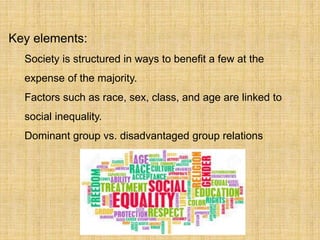
Key elements:
Society is structured in ways to benefit a few at the
expense of the majority.
Factors such as race, sex, class, and age are linked to
social inequality.
Dominant group vs. disadvantaged group relations
Who’s Who in the
Social-Conflict Paradigm
• Karl Marx
– The importance of social class in inequality and
social conflict
• W.E.B. Du Bois
– Race as the major problem facing the United
States in the 20th century
Feminism and the
Gender-Conflict Approach
• A point of view that focuses on inequality
and conflict between women and men
• Closely linked to feminism, the advocacy of
social equality for women and men
Women important to the
development of sociology:
Harriet Martineau and Jane
Addams
The Race-Conflict Approach
• A point of view that focuses on inequality
and conflict between people of different
racial and ethnic categories
• People of color important to the
development of sociology: Ida Wells Barnett
and W.E.B. Du Bois
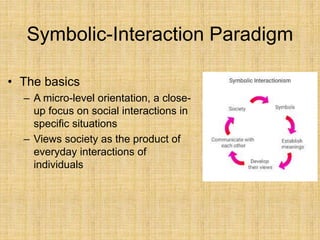
Symbolic-Interaction Paradigm
• The basics
– A micro-level orientation, a close-
up focus on social interactions in
specific situations
– Views society as the product of
everyday interactions of
individuals
Key elements
Society is nothing more than the shared reality that
people construct as they interact with one another.
Society is a complex, ever-changing mosaic of
subjective meanings.
Who’s Who in the
Symbolic-Interaction Paradigm
• Max Weber
– Understanding a setting from the people in it
• George Herbert Mead
– How we build personalities from social
experience
• Erving Goffman
– Dramaturgical analysis
• George Homans & Peter Blau
– Social-exchange analysis
Critical Evaluation
• Structural-Functional
– Too broad, ignores inequalities of social class, race
& gender, focuses on stability at the expense of
conflict
• Social-Conflict
– Too broad, ignores how shared values and mutual
interdependence unify society, pursues political
goals
• Symbolic-Interaction
– Ignores larger social structures, effects of culture,
factors such as class, gender & race
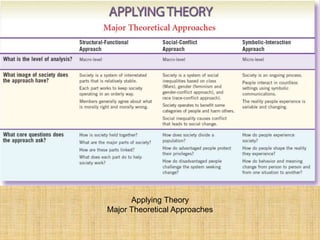
Applying Theory
Major Theoretical Approaches

Ch 1Sociological perspective.ppt

  • 1.
    Sociology, 12th Editionby John Macionis Copyright  2008 Prentice Hall, a division of Pearson Education. All rights reserved. The Sociological Perspective The systematic study of human society
  • 2.
    Sociology, 12th Editionby John Macionis Copyright  2008 Prentice Hall, a division of Pearson Education. All rights reserved. What Is Sociology? “...The systematic study of human society ” – Systematic • Scientific discipline that focuses attention on patterns of behavior – Human society • Group behavior is primary focus; how groups influence individuals and vice versa – At the “heart of sociology” • The sociological perspective which offers a unique view of society
  • 3.
    Sociology, 12th Editionby John Macionis Copyright  2008 Prentice Hall, a division of Pearson Education. All rights reserved. Why Take Sociology? • Education and liberal arts – Well-rounded as a person – Social expectations • More appreciation for diversity – The global village – Domestic social marginality • Enhanced life chances – Micro and macro understanding – Increase social potentials
  • 4.
    Benefits of theSociological Perspective 1. Helps us assess the truth of common sense 2. Helps us assess both opportunities and constraints in our lives Sociology, 12th Edition by John Macionis Copyright  2008 Prentice Hall, a division of Pearson Education. All rights reserved.
  • 5.
    Benefits of theSociological Perspective 3. Empowers us to be active participants in our society 4. Helps us live in a diverse world Sociology, 12th Edition by John Macionis Copyright  2008 Prentice Hall, a division of Pearson Education. All rights reserved.
  • 6.
    Sociology, 12th Editionby John Macionis Copyright  2008 Prentice Hall, a division of Pearson Education. All rights reserved. Importance of Global Perspective • Where we live makes a great difference in shaping our lives • Societies throughout the world are increasingly interconnected through technology and economics.
  • 7.
    Sociology, 12th Editionby John Macionis Copyright  2008 Prentice Hall, a division of Pearson Education. All rights reserved. • Many problems that we face in Pakistan are more serious elsewhere. • Thinking globally is a good way to learn more about ourselves.
  • 8.
    The Sociological Perspective PeterBerger • Seeing the general in the particular – Sociologists identify general social patterns in the behavior of particular individuals. • Seeing the strange in the familiar – Giving up the idea that human behavior is simply a matter of what people decide to do – Understanding that society shapes our lives
  • 9.
    Durkheim’s Study ofSuicide • Emile Durkheim’s research showed that society affects even our most personal choices. – More likely to commit: male Protestants who were wealthy and unmarried – Less likely to commit: male Jews and Catholics who were poor and married
  • 10.
    One of thebasic findings: Why? The differences between these groups had to do with “social integration.” Those with strong social ties had less of a chance of committing suicide.
  • 11.
    C. Wright Mills’ SociologicalImagination • The power of the sociological perspective lies not just in changing individual lives but in transforming society. • Society, not people’s personal failings, is the cause of social problems. • The sociological imagination transforms personal problems into public issues.
  • 12.
    The Origins ofSociology • Social Change – Industrialization, urbanization, political revolution, and a new awareness of society One of the youngest of academic disciplines, sociology has its origins in powerful social forces.
  • 13.
    Science 3-Stages: Theological, Metaphysical& Scientific Positivism–A way of understanding based on science
  • 14.
    Sociological Theory • Theory:a statement of how and why facts are related – Explains social behavior to the real world
  • 15.
  • 16.
    Structural-Functional Paradigm • Thebasics – A macro-level orientation, concerned with broad patterns that shape society as a whole – Views society as a complex system whose parts work together to promote solidarity and stability
  • 17.
    Key elements: Social structurerefers to any relatively stable patterns of social behavior found in social institutions. Social function refers to the consequences for the operation of society as a whole.
  • 18.
    Sociology, 12th Editionby John Macionis Copyright  2008 Prentice Hall, a division of Pearson Education. All rights reserved. Who’s Who in the Structural- Functional Paradigm • Auguste Comte – Importance of social integration during times of rapid change • Emile Durkheim – Helped establish sociology as a discipline • Herbert Spencer – Compared society to the human body • Robert K. Merton – Manifest functions are recognized and intended consequences. – Latent functions are unrecognized and unintended consequences. – Social dysfunctions are undesirable consequences.
  • 19.
    Social-Conflict Paradigm • Thebasics: – A macro-oriented paradigm – Views society as an arena of inequality that generates conflict and social change
  • 20.
    Key elements: Society isstructured in ways to benefit a few at the expense of the majority. Factors such as race, sex, class, and age are linked to social inequality. Dominant group vs. disadvantaged group relations
  • 21.
    Who’s Who inthe Social-Conflict Paradigm • Karl Marx – The importance of social class in inequality and social conflict • W.E.B. Du Bois – Race as the major problem facing the United States in the 20th century
  • 22.
    Feminism and the Gender-ConflictApproach • A point of view that focuses on inequality and conflict between women and men • Closely linked to feminism, the advocacy of social equality for women and men Women important to the development of sociology: Harriet Martineau and Jane Addams
  • 23.
    The Race-Conflict Approach •A point of view that focuses on inequality and conflict between people of different racial and ethnic categories • People of color important to the development of sociology: Ida Wells Barnett and W.E.B. Du Bois
  • 24.
    Symbolic-Interaction Paradigm • Thebasics – A micro-level orientation, a close- up focus on social interactions in specific situations – Views society as the product of everyday interactions of individuals
  • 25.
    Key elements Society isnothing more than the shared reality that people construct as they interact with one another. Society is a complex, ever-changing mosaic of subjective meanings.
  • 26.
    Who’s Who inthe Symbolic-Interaction Paradigm • Max Weber – Understanding a setting from the people in it • George Herbert Mead – How we build personalities from social experience • Erving Goffman – Dramaturgical analysis • George Homans & Peter Blau – Social-exchange analysis
  • 27.
    Critical Evaluation • Structural-Functional –Too broad, ignores inequalities of social class, race & gender, focuses on stability at the expense of conflict • Social-Conflict – Too broad, ignores how shared values and mutual interdependence unify society, pursues political goals • Symbolic-Interaction – Ignores larger social structures, effects of culture, factors such as class, gender & race
  • 28.