Social Development during
Adolescence
Chapter 4
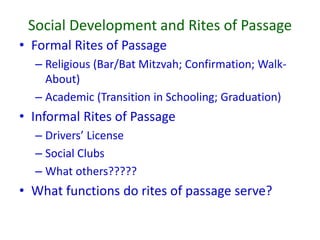
Social Development and Rites of Passage
• Formal Rites of Passage
– Religious (Bar/Bat Mitzvah; Confirmation; Walk-
About)
– Academic (Transition in Schooling; Graduation)
• Informal Rites of Passage
– Drivers’ License
– Social Clubs
– What others?????
• What functions do rites of passage serve?
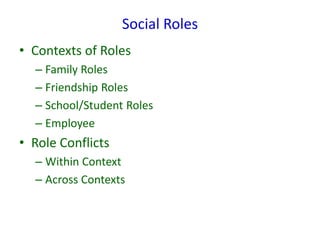
Social Roles
• Contexts of Roles
– Family Roles
– Friendship Roles
– School/Student Roles
– Employee
• Role Conflicts
– Within Context
– Across Contexts
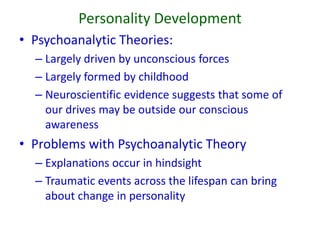
Personality Development
• Psychoanalytic Theories:
– Largely driven by unconscious forces
– Largely formed by childhood
– Neuroscientific evidence suggests that some of
our drives may be outside our conscious
awareness
• Problems with Psychoanalytic Theory
– Explanations occur in hindsight
– Traumatic events across the lifespan can bring
about change in personality
Personality Development
• Trait Theory—The Big Five
– Trait: Relatively stable over time with some
variability
• Openness to experience
• Conscientiousness
• Extraversion
• Agreeableness
• Neuroticism
– Traits tend to be relatively stable across
adolescence
Personality Development
• Trait Theory (cont’d)
– South, Krueger, Johnson & Iacono (2008)
• The contribution of genetic and environmental forces
varied as a result of the adolescent’s personality and
parent interaction;
• The genetic-environment interaction is complex and
varies according to multiple factors
Temperament
• Temperament:
– Patterns of arousal and emotionality that are
consistent and enduring (Feldman, 2008, 122)
• Activity level
• Irritability level
– Strong genetic component
– Frequently observable in neonates
– Impact of temperament can be moderated by
environmental forces (e.g. parental reactions,
peers’ reactions)
Moral Development
• Piaget—Understanding rules & intent
– Heteronomous morality
• Rigid rules with no necessary agreement on rules
• Little or no focus on intent
– Incipient cooperation:
• Rigid rules, but shared understanding
• Some focus on intent based on rules
– Autonomous cooperation:
• Rules exist
• Rules can be changed by participants
• Intent is considered
Moral Development
• Kohlberg’s Theory
– Moral reasoning: Process of making a judgment,
not the judgment itself is the object of study
– Tied to cognitive development and experience
– Assessment is based on moral dilemmas and the
reasoning one uses to resolve them
– Based on Levels and Stages of reasoning
Moral Development
• Kohlberg’s Theory
– Level 1: Preconventional
• Self-serving interests
• Focus is on outcomes for the individual
– Stage 1: Rules followed to avoid punishment;
morality is based on decisions that will avoid
negative outcomes
– Stage 2: Transition from avoiding negative to
seeking benefit or reward
Moral Development
• Kohlberg’s Theory
– Level 2: Conventional
• Moral decisions are based on societal rules and
conventions for being accepted as good members of
society
– Stage 3: Moral decisions are made in order to
manage others’ impressions and maintain their
respect;
– Stage 4: Moral decisions are made to comply with
rule of law and societal rules
Moral Development
• Kohlberg’s Theory
– Level 3: Postconventional
• Moral reasoning at this level transcends specific
societal or personal rationales and moves to a broader
set of principles that transcend time and context
– Stage 5: Reasoning here is based on a sense of
what is right; rules and laws are seen as malleable
based on social contracts
– Stage 6: Decisions are based on universal principles
that transcend time and context; Rules or Laws that
violate these principles are not obeyed
Moral Development
• Gilligan’s Moral Development:
– Kohlberg’s model was based on a masculine/male
perspective of justice
– Feminine approach would be based on
relationships and care (the ethic of care)
– Gender role may be more important than
biological sex
Moral Development
• Gilligan’s Moral Development:
– Stage 1: Self-Care from Need: Orientation toward
individual survival
– Stage 2: Other-Care from Need: Sacrifice self for
others’ needs
– Stage 3: Self-Other Care from Need: Recognize the
value in working to balance costs and benefits for
all concerned
• Research has demonstrated that both
Kohlberg’s ideas and Gilligan’s ideas work for
both sexes
Moral Development
• Social Learning Models of Moral Development
– Modeling moral behavior (e.g. observing a coach
reinforcing winning at any cost; observing a
teacher rewarding one of your friends for helping
a special needs student)
– Model Characteristics:
• Well respected
• Viewed as competent
• Seen as similar to the observer
Moral Development
• Moral reasoning VS Moral Behavior
– Evaluation of moral reasoning takes place out of
context
– Moral behavior is typically contextualized and brings
emotional loading
– Adolescents are vulnerable to peer pressure and
influence hence the context can sway decisions to act
even in the face of high levels of moral reasoning
– Perceived negative outcomes (costs) can be see as
being outweighed by positive outcomes (benefits)
– Personal fable and imaginary audience
Socialdevelopmentduringadolescence

Socialdevelopmentduringadolescence

  • 1.
  • 2.
    Social Development andRites of Passage • Formal Rites of Passage – Religious (Bar/Bat Mitzvah; Confirmation; Walk- About) – Academic (Transition in Schooling; Graduation) • Informal Rites of Passage – Drivers’ License – Social Clubs – What others????? • What functions do rites of passage serve?
  • 3.
    Social Roles • Contextsof Roles – Family Roles – Friendship Roles – School/Student Roles – Employee • Role Conflicts – Within Context – Across Contexts
  • 4.
    Personality Development • PsychoanalyticTheories: – Largely driven by unconscious forces – Largely formed by childhood – Neuroscientific evidence suggests that some of our drives may be outside our conscious awareness • Problems with Psychoanalytic Theory – Explanations occur in hindsight – Traumatic events across the lifespan can bring about change in personality
  • 5.
    Personality Development • TraitTheory—The Big Five – Trait: Relatively stable over time with some variability • Openness to experience • Conscientiousness • Extraversion • Agreeableness • Neuroticism – Traits tend to be relatively stable across adolescence
  • 6.
    Personality Development • TraitTheory (cont’d) – South, Krueger, Johnson & Iacono (2008) • The contribution of genetic and environmental forces varied as a result of the adolescent’s personality and parent interaction; • The genetic-environment interaction is complex and varies according to multiple factors
  • 7.
    Temperament • Temperament: – Patternsof arousal and emotionality that are consistent and enduring (Feldman, 2008, 122) • Activity level • Irritability level – Strong genetic component – Frequently observable in neonates – Impact of temperament can be moderated by environmental forces (e.g. parental reactions, peers’ reactions)
  • 8.
    Moral Development • Piaget—Understandingrules & intent – Heteronomous morality • Rigid rules with no necessary agreement on rules • Little or no focus on intent – Incipient cooperation: • Rigid rules, but shared understanding • Some focus on intent based on rules – Autonomous cooperation: • Rules exist • Rules can be changed by participants • Intent is considered
  • 9.
    Moral Development • Kohlberg’sTheory – Moral reasoning: Process of making a judgment, not the judgment itself is the object of study – Tied to cognitive development and experience – Assessment is based on moral dilemmas and the reasoning one uses to resolve them – Based on Levels and Stages of reasoning
  • 10.
    Moral Development • Kohlberg’sTheory – Level 1: Preconventional • Self-serving interests • Focus is on outcomes for the individual – Stage 1: Rules followed to avoid punishment; morality is based on decisions that will avoid negative outcomes – Stage 2: Transition from avoiding negative to seeking benefit or reward
  • 11.
    Moral Development • Kohlberg’sTheory – Level 2: Conventional • Moral decisions are based on societal rules and conventions for being accepted as good members of society – Stage 3: Moral decisions are made in order to manage others’ impressions and maintain their respect; – Stage 4: Moral decisions are made to comply with rule of law and societal rules
  • 12.
    Moral Development • Kohlberg’sTheory – Level 3: Postconventional • Moral reasoning at this level transcends specific societal or personal rationales and moves to a broader set of principles that transcend time and context – Stage 5: Reasoning here is based on a sense of what is right; rules and laws are seen as malleable based on social contracts – Stage 6: Decisions are based on universal principles that transcend time and context; Rules or Laws that violate these principles are not obeyed
  • 13.
    Moral Development • Gilligan’sMoral Development: – Kohlberg’s model was based on a masculine/male perspective of justice – Feminine approach would be based on relationships and care (the ethic of care) – Gender role may be more important than biological sex
  • 14.
    Moral Development • Gilligan’sMoral Development: – Stage 1: Self-Care from Need: Orientation toward individual survival – Stage 2: Other-Care from Need: Sacrifice self for others’ needs – Stage 3: Self-Other Care from Need: Recognize the value in working to balance costs and benefits for all concerned • Research has demonstrated that both Kohlberg’s ideas and Gilligan’s ideas work for both sexes
  • 15.
    Moral Development • SocialLearning Models of Moral Development – Modeling moral behavior (e.g. observing a coach reinforcing winning at any cost; observing a teacher rewarding one of your friends for helping a special needs student) – Model Characteristics: • Well respected • Viewed as competent • Seen as similar to the observer
  • 16.
    Moral Development • Moralreasoning VS Moral Behavior – Evaluation of moral reasoning takes place out of context – Moral behavior is typically contextualized and brings emotional loading – Adolescents are vulnerable to peer pressure and influence hence the context can sway decisions to act even in the face of high levels of moral reasoning – Perceived negative outcomes (costs) can be see as being outweighed by positive outcomes (benefits) – Personal fable and imaginary audience