Name: Hachi Mae Luba BAFL-2A
Jeremiakenj Cabanizas Group 2
Learning Objectives:
AFTER THE LESSON WE WILL BE ABLE TO:
• Define what is Moral development
• know what are the stages of moral development
• Learn about Kohlberg’s Moral Dilemma,
• Responses to Heinz Dilemma
Introduction:
Developing moral character does not happen overnight. MIZZONI (2010) stated that that " Human beings are not
born with moral virtues."(p.27). However, if we are aware or made aware, we have the potential to choose and
control our actions through repetition until they become habits embedded in our character. If the habit we have
formed are good, they can be regarded as virtues and this will be easier to do and choose when a dilemma arises.
It is essential to realize that though it might be embedded in our character, an intention to choose and act on it
every time is vital. Moreover, once people recognize it to be part of our character, they would expect us to always
do it
MORAL DEVELOPMENT
Is what every person experiences as they mature and change. How individuals come to distinguish between right
and wrong as they age. Social, cultural, and established legal norms all have an impact on moral behavior.
Although it is generally accepted that moral growth starts in childhood and ends when a person reaches adulthood,
other researchers believe that moral development is a continual process.
I. Level 1: Pre - Conventional Morality
A. Stage 1: Obedient and Punishment
Children follow rules because they are instructed to do so by a parent or teacher, and they are afraid of being
punished if they don't. Children cannot see another person's perspective at this age.
B. Stage 2: Individualism and Exchange
Moral reciprocity governs the behavior. If there is a clear advantage to the youngster, they will abide by the
regulations. Children at this age also administer justice using the Golden Rule or the eye-for-an-eye principle. To
put it another way, if a youngster hits another, the victim will strike back. This is seen as just punishment. At this
age, kids are highly interested in fairness.
Even grownups and other children will negotiate deals. For a reward, they will consent to act in a particular
way. Sometimes the reward is in the awareness that the child's own best interests are served by doing
appropriately. They get praise from superiors or admiration from their peers, they stay out of trouble, or they act
in ways that are consistent with how they see themselves. They are only now starting to comprehend that people
have their own wants and motivations.
II. Level 2: Conventional Morality
A. Stage 3: Interpersonal Relationships
Children act morally because it benefits their family, friends, team, school, or church. They are cognizant of
the ideas of loyalty, gratitude, and trust. They follow the Golden Rule in their daily interactions with others. Acting
morally means adhering to what the social group deems to be good and moral.
B. Stage 4: Authority and Maintaining Social Order
At this age, both children and adults follow the laws of the society in which they reside. All good and bad
activities are supported by these laws and regulations. Both kids and grownups are compelled to follow rules and
respect authority. Although the focus has shifted from the social group to society as a whole, this is still moral
behavior grounded in authority.
III. Level 3: Post - Conventional
A. Stage 5: Social Contact and Individual Rights
At this stage, people are aware that social norms are exclusive to their social group. This differs from culture
to culture and within-culture to within-culture. In light of this, a person makes a commitment to treat other people
with fairness and kindness and to accept authority when it is both moral and well-deserved. Additionally, they
consent to abiding by laws and societal customs that uphold respect for persons and the few accepted moral
principles. The greatest good for the largest number informs moral conduct and judgment.
B. Stage 6: Universal Principles
People evaluate the morality of society's rules and conduct themselves according to what they perceive to be
fundamental moral principles, which often involve respect and equal rights. They abide by societal norms and legal
requirements that are consistent with these universal principles, but not those that they view as abnormal. Adults
in this place are driven by personal conscience rather than social, religious, or cultural norms.
References
http://psychology.bout.com.com/od/developmentalpsychology/a/kohlberg/.hmt
http://www.simplypsychology.org/kokohlberg.html
https://sproutsschools.com/kohlbergs-6-stages-of-moral-development/
https://www.britannica.com/science/Lawrence-Kohlbergs-stages-of-moral-development
https://en.m.wikipedia.org/wiki/Lawrence_Kohlberg%27s_stages_of_moral_development
TEST QUESTIONS:
Direction: Encircle the letter of the correct answer.
1. The sense of right and wrong is most highly associated with what?
a. Distributive Justice
b. Morality
c. Emphaty
d. Shame
2. What are the three major aspects of moral development?
a. Preconventional, conventional, and postconventional
b. Unconventional, preconventional, postconventional
c. Imconventional, unconventional, postconventional
d. Imconventional, unconventional,enterconventional
3. Who was the man who stole the drug for his sick wife in the story?
a. Lath
b. Heinz
c. Train
d. Titus
4. At this stage, moral judgment is motivated by one's own conscience.
a. Authority and Maintaining Social Order
b. Universal Principles
c. Social Contact and Individual Rights
d. Individualism and Exchange
5. What stage of reasoning does this answer fall? Heinz should not steal the medicine, because he will
put in jail?
a. Stage 3
b. Stage 5
c. Stage 2
d. Stage 1
6. Which teacher is most clearly promoting moral development in his or her student?
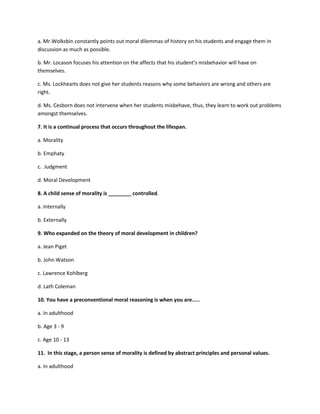
a. Mr.Wolksbin constantly points out moral dilemmas of history on his students and engage them in
discussion as much as possible.
b. Mr. Locason focuses his attention on the affects that his student's misbehavior will have on
themselves.
c. Ms. Lockhearts does not give her students reasons why some behaviors are wrong and others are
right.
d. Ms. Cesborn does not intervene when her students misbehave, thus, they learn to work out problems
amongst themselves.
7. It is a continual process that occurs throughout the lifespan.
a. Morality
b. Emphaty
c. Judgment
d. Moral Development
8. A child sense of morality is ________ controlled.
a. Internally
b. Externally
9. Who expanded on the theory of moral development in children?
a. Jean Piget
b. John Watson
c. Lawrence Kohlberg
d. Lath Coleman
10. You have a preconventional moral reasoning is when you are.....
a. In adulthood
b. Age 3 - 9
c. Age 10 - 13
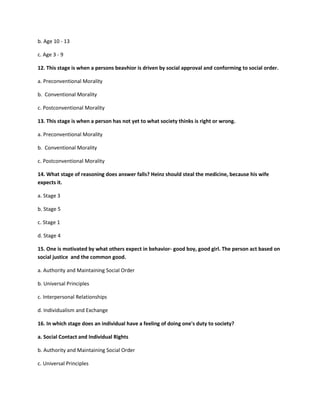
11. In this stage, a person sense of morality is defined by abstract principles and personal values.
a. In adulthood
b. Age 10 - 13
c. Age 3 - 9
12. This stage is when a persons beavhior is driven by social approval and conforming to social order.
a. Preconventional Morality
b. Conventional Morality
c. Postconventional Morality
13. This stage is when a person has not yet to what society thinks is right or wrong.
a. Preconventional Morality
b. Conventional Morality
c. Postconventional Morality
14. What stage of reasoning does answer falls? Heinz should steal the medicine, because his wife
expects it.
a. Stage 3
b. Stage 5
c. Stage 1
d. Stage 4
15. One is motivated by what others expect in behavior- good boy, good girl. The person act based on
social justice and the common good.
a. Authority and Maintaining Social Order
b. Universal Principles
c. Interpersonal Relationships
d. Individualism and Exchange
16. In which stage does an individual have a feeling of doing one's duty to society?
a. Social Contact and Individual Rights
b. Authority and Maintaining Social Order
c. Universal Principles
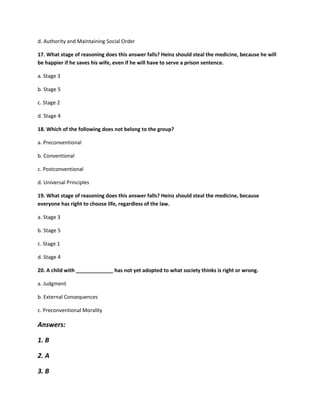
d. Authority and Maintaining Social Order
17. What stage of reasoning does this answer falls? Heinz should steal the medicine, because he will
be happier if he saves his wife, even if he will have to serve a prison sentence.
a. Stage 3
b. Stage 5
c. Stage 2
d. Stage 4
18. Which of the following does not belong to the group?
a. Preconventional
b. Conventional
c. Postconventional
d. Universal Principles
19. What stage of reasoning does this answer falls? Heinz should steal the medicine, because
everyone has right to choose life, regardless of the law.
a. Stage 3
b. Stage 5
c. Stage 1
d. Stage 4
20. A child with _____________ has not yet adopted to what society thinks is right or wrong.
a. Judgment
b. External Consequences
c. Preconventional Morality
Answers:
1. B
2. A
3. B
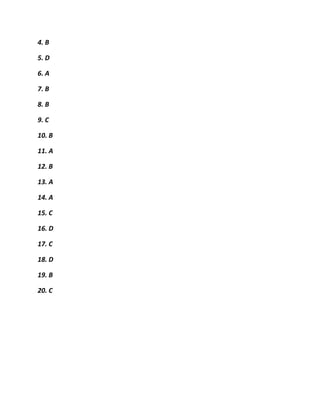
4. B
5. D
6. A
7. B
8. B
9. C
10. B
11. A
12. B
13. A
14. A
15. C
16. D
17. C
18. D
19. B
20. C

ETHICS REPORT.docx

  • 1.
    Name: Hachi MaeLuba BAFL-2A Jeremiakenj Cabanizas Group 2 Learning Objectives: AFTER THE LESSON WE WILL BE ABLE TO: • Define what is Moral development • know what are the stages of moral development • Learn about Kohlberg’s Moral Dilemma, • Responses to Heinz Dilemma Introduction: Developing moral character does not happen overnight. MIZZONI (2010) stated that that " Human beings are not born with moral virtues."(p.27). However, if we are aware or made aware, we have the potential to choose and control our actions through repetition until they become habits embedded in our character. If the habit we have formed are good, they can be regarded as virtues and this will be easier to do and choose when a dilemma arises. It is essential to realize that though it might be embedded in our character, an intention to choose and act on it every time is vital. Moreover, once people recognize it to be part of our character, they would expect us to always do it MORAL DEVELOPMENT Is what every person experiences as they mature and change. How individuals come to distinguish between right and wrong as they age. Social, cultural, and established legal norms all have an impact on moral behavior. Although it is generally accepted that moral growth starts in childhood and ends when a person reaches adulthood, other researchers believe that moral development is a continual process. I. Level 1: Pre - Conventional Morality A. Stage 1: Obedient and Punishment Children follow rules because they are instructed to do so by a parent or teacher, and they are afraid of being punished if they don't. Children cannot see another person's perspective at this age. B. Stage 2: Individualism and Exchange Moral reciprocity governs the behavior. If there is a clear advantage to the youngster, they will abide by the regulations. Children at this age also administer justice using the Golden Rule or the eye-for-an-eye principle. To
  • 2.
    put it anotherway, if a youngster hits another, the victim will strike back. This is seen as just punishment. At this age, kids are highly interested in fairness. Even grownups and other children will negotiate deals. For a reward, they will consent to act in a particular way. Sometimes the reward is in the awareness that the child's own best interests are served by doing appropriately. They get praise from superiors or admiration from their peers, they stay out of trouble, or they act in ways that are consistent with how they see themselves. They are only now starting to comprehend that people have their own wants and motivations. II. Level 2: Conventional Morality A. Stage 3: Interpersonal Relationships Children act morally because it benefits their family, friends, team, school, or church. They are cognizant of the ideas of loyalty, gratitude, and trust. They follow the Golden Rule in their daily interactions with others. Acting morally means adhering to what the social group deems to be good and moral. B. Stage 4: Authority and Maintaining Social Order At this age, both children and adults follow the laws of the society in which they reside. All good and bad activities are supported by these laws and regulations. Both kids and grownups are compelled to follow rules and respect authority. Although the focus has shifted from the social group to society as a whole, this is still moral behavior grounded in authority. III. Level 3: Post - Conventional A. Stage 5: Social Contact and Individual Rights At this stage, people are aware that social norms are exclusive to their social group. This differs from culture to culture and within-culture to within-culture. In light of this, a person makes a commitment to treat other people with fairness and kindness and to accept authority when it is both moral and well-deserved. Additionally, they consent to abiding by laws and societal customs that uphold respect for persons and the few accepted moral principles. The greatest good for the largest number informs moral conduct and judgment. B. Stage 6: Universal Principles People evaluate the morality of society's rules and conduct themselves according to what they perceive to be fundamental moral principles, which often involve respect and equal rights. They abide by societal norms and legal requirements that are consistent with these universal principles, but not those that they view as abnormal. Adults in this place are driven by personal conscience rather than social, religious, or cultural norms. References
  • 3.
  • 4.
    b. Morality c. Emphaty d.Shame 2. What are the three major aspects of moral development? a. Preconventional, conventional, and postconventional b. Unconventional, preconventional, postconventional c. Imconventional, unconventional, postconventional d. Imconventional, unconventional,enterconventional 3. Who was the man who stole the drug for his sick wife in the story? a. Lath b. Heinz c. Train d. Titus 4. At this stage, moral judgment is motivated by one's own conscience. a. Authority and Maintaining Social Order b. Universal Principles c. Social Contact and Individual Rights d. Individualism and Exchange 5. What stage of reasoning does this answer fall? Heinz should not steal the medicine, because he will put in jail? a. Stage 3 b. Stage 5 c. Stage 2 d. Stage 1 6. Which teacher is most clearly promoting moral development in his or her student?
  • 5.
    a. Mr.Wolksbin constantlypoints out moral dilemmas of history on his students and engage them in discussion as much as possible. b. Mr. Locason focuses his attention on the affects that his student's misbehavior will have on themselves. c. Ms. Lockhearts does not give her students reasons why some behaviors are wrong and others are right. d. Ms. Cesborn does not intervene when her students misbehave, thus, they learn to work out problems amongst themselves. 7. It is a continual process that occurs throughout the lifespan. a. Morality b. Emphaty c. Judgment d. Moral Development 8. A child sense of morality is ________ controlled. a. Internally b. Externally 9. Who expanded on the theory of moral development in children? a. Jean Piget b. John Watson c. Lawrence Kohlberg d. Lath Coleman 10. You have a preconventional moral reasoning is when you are..... a. In adulthood b. Age 3 - 9 c. Age 10 - 13 11. In this stage, a person sense of morality is defined by abstract principles and personal values. a. In adulthood
  • 6.
    b. Age 10- 13 c. Age 3 - 9 12. This stage is when a persons beavhior is driven by social approval and conforming to social order. a. Preconventional Morality b. Conventional Morality c. Postconventional Morality 13. This stage is when a person has not yet to what society thinks is right or wrong. a. Preconventional Morality b. Conventional Morality c. Postconventional Morality 14. What stage of reasoning does answer falls? Heinz should steal the medicine, because his wife expects it. a. Stage 3 b. Stage 5 c. Stage 1 d. Stage 4 15. One is motivated by what others expect in behavior- good boy, good girl. The person act based on social justice and the common good. a. Authority and Maintaining Social Order b. Universal Principles c. Interpersonal Relationships d. Individualism and Exchange 16. In which stage does an individual have a feeling of doing one's duty to society? a. Social Contact and Individual Rights b. Authority and Maintaining Social Order c. Universal Principles
  • 7.
    d. Authority andMaintaining Social Order 17. What stage of reasoning does this answer falls? Heinz should steal the medicine, because he will be happier if he saves his wife, even if he will have to serve a prison sentence. a. Stage 3 b. Stage 5 c. Stage 2 d. Stage 4 18. Which of the following does not belong to the group? a. Preconventional b. Conventional c. Postconventional d. Universal Principles 19. What stage of reasoning does this answer falls? Heinz should steal the medicine, because everyone has right to choose life, regardless of the law. a. Stage 3 b. Stage 5 c. Stage 1 d. Stage 4 20. A child with _____________ has not yet adopted to what society thinks is right or wrong. a. Judgment b. External Consequences c. Preconventional Morality Answers: 1. B 2. A 3. B
  • 8.
    4. B 5. D 6.A 7. B 8. B 9. C 10. B 11. A 12. B 13. A 14. A 15. C 16. D 17. C 18. D 19. B 20. C