Beyond Buzz: On measuring a conversation Kate Niederhoffer, Ph.D Marc A. Smith, Ph.D   Dachis Corporation Telligent Systems Web 2.0 4.1.09
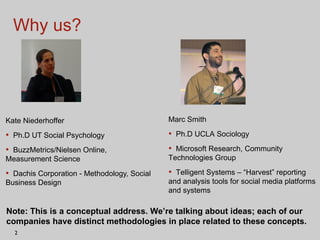
Why us? Kate Niederhoffer Ph.D UT Social Psychology BuzzMetrics/Nielsen Online, Measurement Science Dachis Corporation - Methodology, Social Business Design  Marc Smith Ph.D UCLA Sociology Microsoft Research, Community Technologies Group Telligent Systems – “Harvest” reporting and analysis tools for social media platforms and systems Note: This is a conceptual address. We’re talking about ideas; each of our companies have distinct methodologies in place related to these concepts.
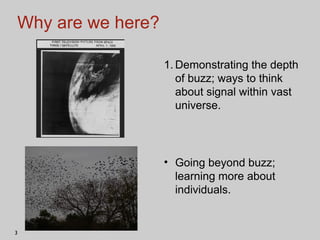
Why are we here? Demonstrating the depth of buzz; ways to think about signal within vast universe. Going beyond buzz; learning more about individuals.
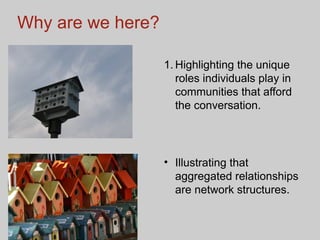
Why are we here? Highlighting the unique roles individuals play in communities that afford the conversation.  Illustrating that aggregated relationships are network structures.
Why now?
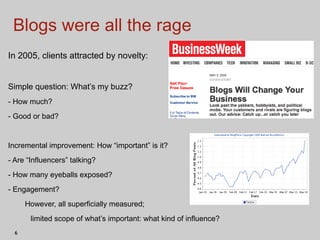
Blogs were all the rage In 2005, clients attracted by novelty: Simple question: What’s my buzz? - How much? - Good or bad? Incremental improvement: How “important” is it? - Are “Influencers” talking? - How many eyeballs exposed? - Engagement? However, all superficially measured; limited scope of what’s important: what kind of influence?
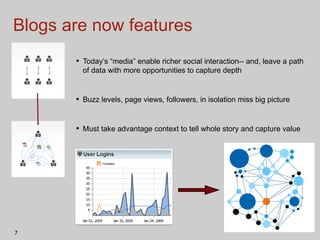
Blogs are now features Today’s “media” enable richer social interaction-- and, leave a path of data with more opportunities to capture depth Buzz levels, page views, followers, in isolation miss big picture Must take advantage context to tell whole story and capture value
Social networks are all the rage, but rarely do we think about  social  metrics We need to stop  blackboxing :  "When a machine runs efficiently, when a matter of fact is settled, one need focus only on its inputs and outputs and not on its internal complexity. Thus, paradoxically, the more science and technology succeed, the more opaque and obscure they become."  - Bruno Latour Even if a conversation is running smoothly, we must figure out what makes it tick.
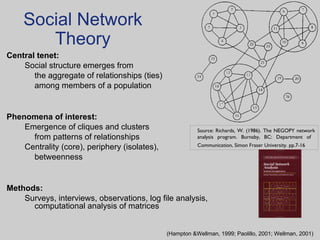
Central tenet: Social structure emerges from  the aggregate of relationships (ties)  among members of a population Phenomena of interest: Emergence of cliques and clusters  from patterns of relationships Centrality (core), periphery (isolates),  betweenness Methods: Surveys, interviews, observations, log file analysis, computational analysis of matrices Source: Richards, W. (1986). The NEGOPY network analysis program. Burnaby, BC: Department of  Communication, Simon Fraser University. pp.7-16   Social Network Theory (Hampton &Wellman, 1999; Paolillo, 2001; Wellman, 2001)
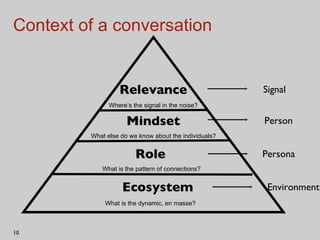
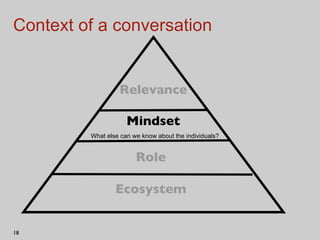
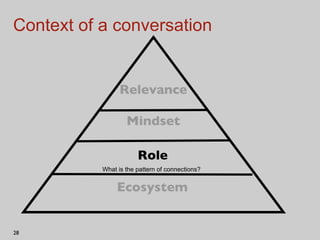
Context of a conversation Relevance Role Mindset Ecosystem What is the pattern of connections?  What is the dynamic, en masse?  What else do we know about the individuals?  Where’s the signal in the noise? Persona Person Environment Signal
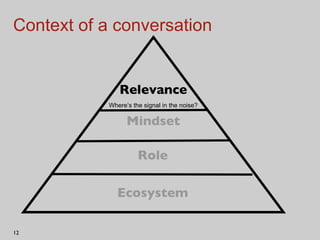
Context of a conversation Relevance Role Mindset Ecosystem Where’s the signal in the noise?
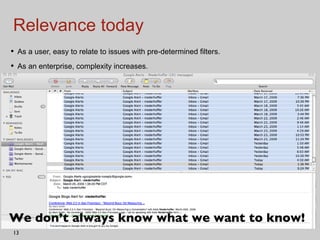
Relevance today As a user, easy to relate to issues with pre-determined filters. As an enterprise, complexity increases.  We don’t always know what we want to know!
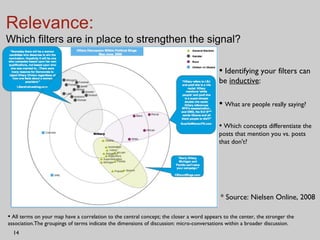
Relevance:  Which filters are in place to strengthen the signal? Identifying your filters can be  inductive : What are people really saying?  Which concepts differentiate the posts that mention you vs. posts that don't? All terms on your map have a correlation to the central concept; the closer a word appears to the center, the stronger the association.The groupings of terms indicate the dimensions of discussion: micro-conversations within a broader discussion.  * Source: Nielsen Online, 2008
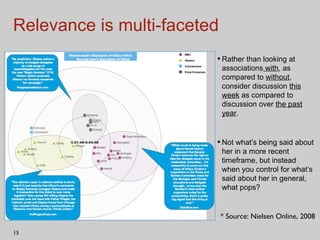
Relevance is multi-faceted Rather than looking at associations  with , as compared to  without , consider discussion  this week  as compared to discussion over  the past year . Not what’s being said about her in a more recent timeframe, but instead when you control for what’s said about her in general, what pops? * Source: Nielsen Online, 2008
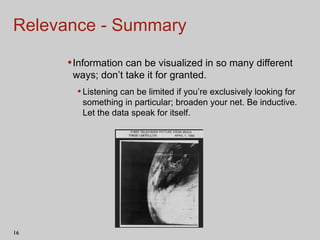
Relevance - Summary Information can be visualized in so many different ways; don’t take it for granted.  Listening can be limited if you’re exclusively looking for something in particular; broaden your net. Be inductive. Let the data speak for itself.
Context of a conversation Relevance Role Mindset Ecosystem What else can we know about the individuals?
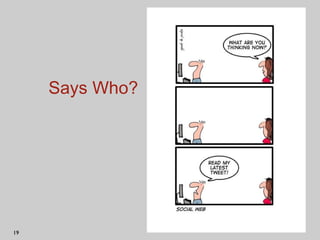
Says Who?
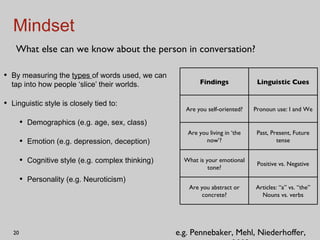
Mindset By measuring the  types  of words used, we can tap into how people ‘slice’ their worlds. Linguistic style is closely tied to: Demographics (e.g. age, sex, class) Emotion (e.g. depression, deception) Cognitive style (e.g. complex thinking) Personality (e.g. Neuroticism) What else can we know about the person in conversation?  e.g. Pennebaker, Mehl, Niederhoffer, 2003 Findings Linguistic Cues Are you self-oriented? Pronoun use: I and We Are you living in ‘the now’? Past, Present, Future tense What is your emotional tone? Positive vs. Negative Are you abstract or concrete? Articles: “a” vs. “the” Nouns vs. verbs
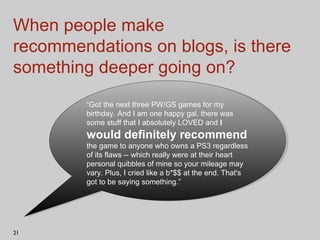
When people make recommendations on blogs, is there something deeper going on? “ Got the next three PW/GS games for my birthday. And I am one happy gal, there was some stuff that I absolutely LOVED and  I  would definitely recommend   the game to anyone who owns a PS3 regardless of its flaws -- which really were at their heart personal quibbles of mine so your mileage may vary. Plus, I cried like a b*$$ at the end. That's got to be saying something.”
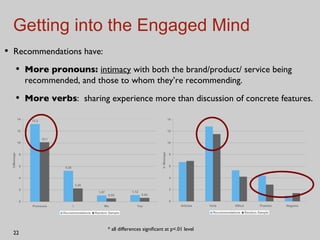
Getting into the Engaged Mind Recommendations have: More pronouns:  intimacy  with both the brand/product/ service being recommended, and those to whom they’re recommending. More verbs :  sharing experience more than discussion of concrete features. * all differences significant at p<.01 level
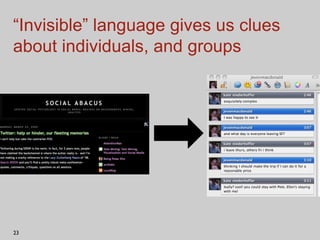
“ Invisible” language gives us clues about individuals, and groups
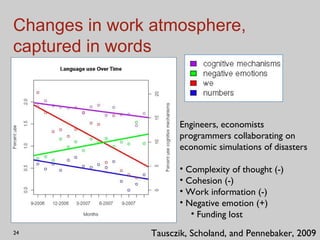
Changes in work atmosphere, captured in words Tausczik, Scholand, and Pennebaker, 2009 Engineers, economists programmers collaborating on economic simulations of disasters Complexity of thought (-)  Cohesion (-) Work information (-) Negative emotion (+) Funding lost
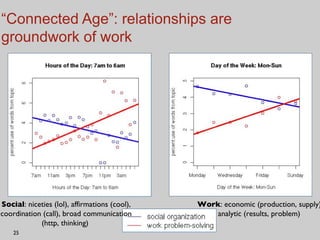
“ Connected Age”: relationships are groundwork of work Social : niceties (lol), affirmations (cool), coordination (call), broad communication (http, thinking)  Work : economic (production, supply), analytic (results, problem)
Mindset- Summary Language is a good way to go beyond the surface and better understand constituents without self- report biases (or effort). Metrics in the hands of users (yourselves) are helpful: know thyself, know how you’re perceived.
Beyond thoughts and feelings, who comes to roost?
Context of a conversation Relevance Role Mindset Ecosystem What is the pattern of connections?
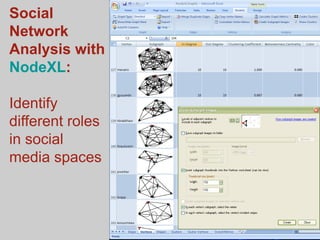
Social Network Analysis with  NodeXL : Identify different roles in social media spaces
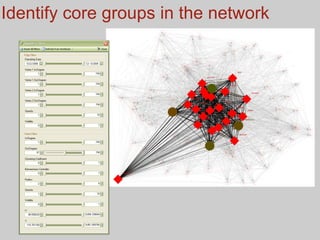
Identify core groups in the network
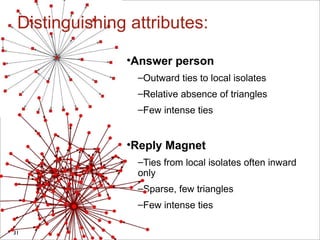
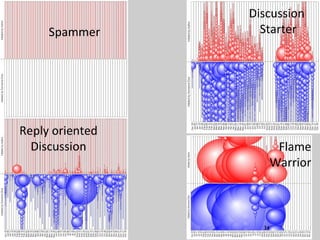
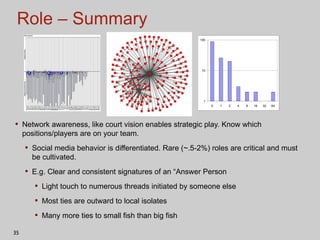
Answer person Outward ties to local isolates Relative absence of triangles Few intense ties Reply Magnet Ties from local isolates often inward only Sparse, few triangles Few intense ties Distinguishing attributes:
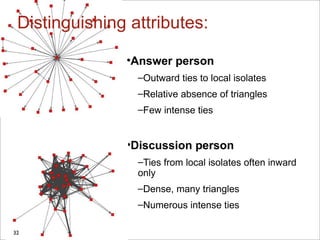
Distinguishing attributes: Answer person Outward ties to local isolates Relative absence of triangles Few intense ties Discussion person Ties from local isolates often inward only Dense, many triangles Numerous intense ties
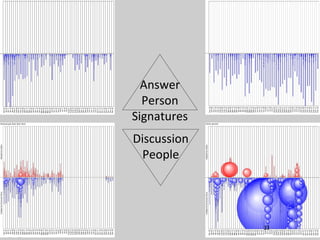
Answer Person Signatures Discussion People
Spammer Discussion  Starter Reply oriented Discussion Flame Warrior
Role – Summary Network awareness, like court vision enables strategic play. Know which positions/players are on your team. Social media behavior is differentiated. Rare (~.5-2%) roles are critical and must be cultivated. E.g. Clear and consistent signatures of an “Answer Person Light touch to numerous threads initiated by someone else Most ties are outward to local isolates Many more ties to small fish than big fish
What is the mix in the neighborhood?
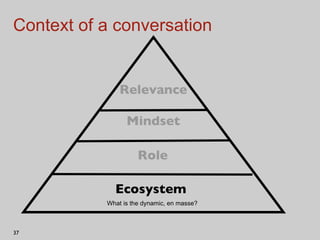
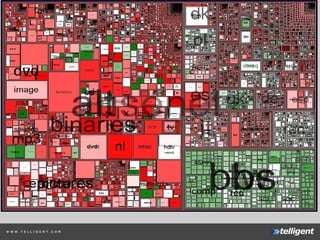
Context of a conversation Relevance Role Mindset Ecosystem What is the dynamic, en masse?
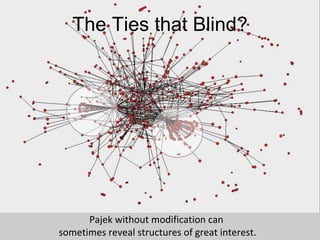
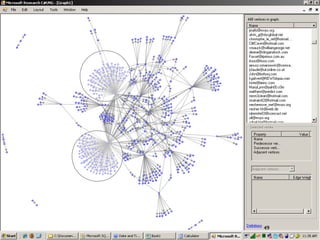
Pajek without modification can  sometimes reveal structures of great interest. The Ties that Blind?
Darwin Bell
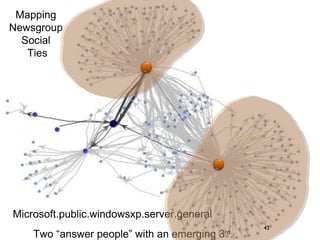
Two “answer people” with an emerging 3 rd . Mapping  Newsgroup  Social  Ties Microsoft.public.windowsxp.server.general
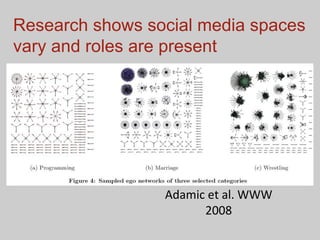
Research shows social media spaces vary and roles are present Adamic et al. WWW 2008
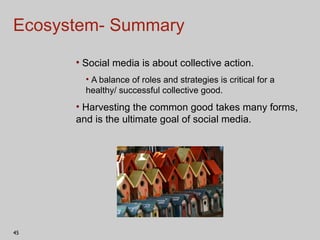
Ecosystem- Summary Social media is about collective action. A balance of roles and strategies is critical for a healthy/ successful collective good. Harvesting the common good takes many forms, and is the ultimate goal of social media.
Why does this matter? This is not measurement for the sake of measurement; we need to measure conversations in order to manage social business.  Measuring conversations is about measuring the context in which those conversations arise. Value is an intermediate step in calculating ROI. Moot to bypass it. Techniques from social science help capture “the immeasurable” in social media and the enterprise. The future of conversations- the enterprise being one-- is about cultivating ecologies of the right balance of relationships.
Thank You [email_address] [email_address] Questions?
Additional Resources
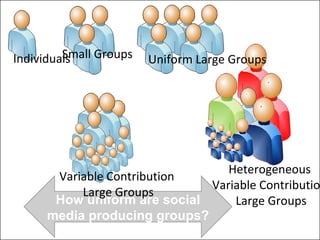
How uniform are social media producing groups? Individuals Small Groups Variable Contribution  Large Groups Uniform Large Groups Heterogeneous  Variable Contribution  Large Groups
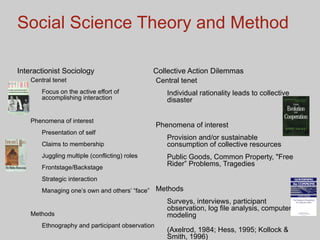
Social Science Theory and Method Interactionist Sociology Central tenet Focus on the active effort of accomplishing interaction Phenomena of interest Presentation of self  Claims to membership Juggling multiple (conflicting) roles Frontstage/Backstage  Strategic interaction Managing one’s own and others’ “face” Methods Ethnography and participant observation (Goffman, 1959; Hall, 1990) Collective Action Dilemmas  Central tenet Individual rationality leads to collective disaster Phenomena of interest Provision and/or sustainable consumption of collective resources Public Goods, Common Property, &quot;Free Rider” Problems, Tragedies Methods Surveys, interviews, participant observation, log file analysis, computer modeling (Axelrod, 1984; Hess, 1995; Kollock & Smith, 1996)

Beyond Buzz - Web 2.0 Expo - K.Niederhoffer & M.Smith

  • 1.
    Beyond Buzz: Onmeasuring a conversation Kate Niederhoffer, Ph.D Marc A. Smith, Ph.D Dachis Corporation Telligent Systems Web 2.0 4.1.09
  • 2.
    Why us? KateNiederhoffer Ph.D UT Social Psychology BuzzMetrics/Nielsen Online, Measurement Science Dachis Corporation - Methodology, Social Business Design Marc Smith Ph.D UCLA Sociology Microsoft Research, Community Technologies Group Telligent Systems – “Harvest” reporting and analysis tools for social media platforms and systems Note: This is a conceptual address. We’re talking about ideas; each of our companies have distinct methodologies in place related to these concepts.
  • 3.
    Why are wehere? Demonstrating the depth of buzz; ways to think about signal within vast universe. Going beyond buzz; learning more about individuals.
  • 4.
    Why are wehere? Highlighting the unique roles individuals play in communities that afford the conversation. Illustrating that aggregated relationships are network structures.
  • 5.
  • 6.
    Blogs were allthe rage In 2005, clients attracted by novelty: Simple question: What’s my buzz? - How much? - Good or bad? Incremental improvement: How “important” is it? - Are “Influencers” talking? - How many eyeballs exposed? - Engagement? However, all superficially measured; limited scope of what’s important: what kind of influence?
  • 7.
    Blogs are nowfeatures Today’s “media” enable richer social interaction-- and, leave a path of data with more opportunities to capture depth Buzz levels, page views, followers, in isolation miss big picture Must take advantage context to tell whole story and capture value
  • 8.
    Social networks areall the rage, but rarely do we think about social metrics We need to stop blackboxing : &quot;When a machine runs efficiently, when a matter of fact is settled, one need focus only on its inputs and outputs and not on its internal complexity. Thus, paradoxically, the more science and technology succeed, the more opaque and obscure they become.&quot; - Bruno Latour Even if a conversation is running smoothly, we must figure out what makes it tick.
  • 9.
    Central tenet: Socialstructure emerges from the aggregate of relationships (ties) among members of a population Phenomena of interest: Emergence of cliques and clusters from patterns of relationships Centrality (core), periphery (isolates), betweenness Methods: Surveys, interviews, observations, log file analysis, computational analysis of matrices Source: Richards, W. (1986). The NEGOPY network analysis program. Burnaby, BC: Department of Communication, Simon Fraser University. pp.7-16 Social Network Theory (Hampton &Wellman, 1999; Paolillo, 2001; Wellman, 2001)
  • 10.
    Context of aconversation Relevance Role Mindset Ecosystem What is the pattern of connections? What is the dynamic, en masse? What else do we know about the individuals? Where’s the signal in the noise? Persona Person Environment Signal
  • 12.
    Context of aconversation Relevance Role Mindset Ecosystem Where’s the signal in the noise?
  • 13.
    Relevance today Asa user, easy to relate to issues with pre-determined filters. As an enterprise, complexity increases. We don’t always know what we want to know!
  • 14.
    Relevance: Whichfilters are in place to strengthen the signal? Identifying your filters can be inductive : What are people really saying? Which concepts differentiate the posts that mention you vs. posts that don't? All terms on your map have a correlation to the central concept; the closer a word appears to the center, the stronger the association.The groupings of terms indicate the dimensions of discussion: micro-conversations within a broader discussion. * Source: Nielsen Online, 2008
  • 15.
    Relevance is multi-facetedRather than looking at associations with , as compared to without , consider discussion this week as compared to discussion over the past year . Not what’s being said about her in a more recent timeframe, but instead when you control for what’s said about her in general, what pops? * Source: Nielsen Online, 2008
  • 16.
    Relevance - SummaryInformation can be visualized in so many different ways; don’t take it for granted. Listening can be limited if you’re exclusively looking for something in particular; broaden your net. Be inductive. Let the data speak for itself.
  • 18.
    Context of aconversation Relevance Role Mindset Ecosystem What else can we know about the individuals?
  • 19.
  • 20.
    Mindset By measuringthe types of words used, we can tap into how people ‘slice’ their worlds. Linguistic style is closely tied to: Demographics (e.g. age, sex, class) Emotion (e.g. depression, deception) Cognitive style (e.g. complex thinking) Personality (e.g. Neuroticism) What else can we know about the person in conversation? e.g. Pennebaker, Mehl, Niederhoffer, 2003 Findings Linguistic Cues Are you self-oriented? Pronoun use: I and We Are you living in ‘the now’? Past, Present, Future tense What is your emotional tone? Positive vs. Negative Are you abstract or concrete? Articles: “a” vs. “the” Nouns vs. verbs
  • 21.
    When people makerecommendations on blogs, is there something deeper going on? “ Got the next three PW/GS games for my birthday. And I am one happy gal, there was some stuff that I absolutely LOVED and I would definitely recommend the game to anyone who owns a PS3 regardless of its flaws -- which really were at their heart personal quibbles of mine so your mileage may vary. Plus, I cried like a b*$$ at the end. That's got to be saying something.”
  • 22.
    Getting into theEngaged Mind Recommendations have: More pronouns: intimacy with both the brand/product/ service being recommended, and those to whom they’re recommending. More verbs : sharing experience more than discussion of concrete features. * all differences significant at p<.01 level
  • 23.
    “ Invisible” languagegives us clues about individuals, and groups
  • 24.
    Changes in workatmosphere, captured in words Tausczik, Scholand, and Pennebaker, 2009 Engineers, economists programmers collaborating on economic simulations of disasters Complexity of thought (-) Cohesion (-) Work information (-) Negative emotion (+) Funding lost
  • 25.
    “ Connected Age”:relationships are groundwork of work Social : niceties (lol), affirmations (cool), coordination (call), broad communication (http, thinking) Work : economic (production, supply), analytic (results, problem)
  • 26.
    Mindset- Summary Languageis a good way to go beyond the surface and better understand constituents without self- report biases (or effort). Metrics in the hands of users (yourselves) are helpful: know thyself, know how you’re perceived.
  • 27.
    Beyond thoughts andfeelings, who comes to roost?
  • 28.
    Context of aconversation Relevance Role Mindset Ecosystem What is the pattern of connections?
  • 29.
    Social Network Analysiswith NodeXL : Identify different roles in social media spaces
  • 30.
    Identify core groupsin the network
  • 31.
    Answer person Outwardties to local isolates Relative absence of triangles Few intense ties Reply Magnet Ties from local isolates often inward only Sparse, few triangles Few intense ties Distinguishing attributes:
  • 32.
    Distinguishing attributes: Answerperson Outward ties to local isolates Relative absence of triangles Few intense ties Discussion person Ties from local isolates often inward only Dense, many triangles Numerous intense ties
  • 33.
    Answer Person SignaturesDiscussion People
  • 34.
    Spammer Discussion Starter Reply oriented Discussion Flame Warrior
  • 35.
    Role – SummaryNetwork awareness, like court vision enables strategic play. Know which positions/players are on your team. Social media behavior is differentiated. Rare (~.5-2%) roles are critical and must be cultivated. E.g. Clear and consistent signatures of an “Answer Person Light touch to numerous threads initiated by someone else Most ties are outward to local isolates Many more ties to small fish than big fish
  • 36.
    What is themix in the neighborhood?
  • 37.
    Context of aconversation Relevance Role Mindset Ecosystem What is the dynamic, en masse?
  • 39.
    Pajek without modificationcan sometimes reveal structures of great interest. The Ties that Blind?
  • 40.
  • 43.
    Two “answer people”with an emerging 3 rd . Mapping Newsgroup Social Ties Microsoft.public.windowsxp.server.general
  • 44.
    Research shows socialmedia spaces vary and roles are present Adamic et al. WWW 2008
  • 45.
    Ecosystem- Summary Socialmedia is about collective action. A balance of roles and strategies is critical for a healthy/ successful collective good. Harvesting the common good takes many forms, and is the ultimate goal of social media.
  • 46.
    Why does thismatter? This is not measurement for the sake of measurement; we need to measure conversations in order to manage social business. Measuring conversations is about measuring the context in which those conversations arise. Value is an intermediate step in calculating ROI. Moot to bypass it. Techniques from social science help capture “the immeasurable” in social media and the enterprise. The future of conversations- the enterprise being one-- is about cultivating ecologies of the right balance of relationships.
  • 47.
    Thank You [email_address][email_address] Questions?
  • 48.
  • 50.
    How uniform aresocial media producing groups? Individuals Small Groups Variable Contribution Large Groups Uniform Large Groups Heterogeneous Variable Contribution Large Groups
  • 51.
    Social Science Theoryand Method Interactionist Sociology Central tenet Focus on the active effort of accomplishing interaction Phenomena of interest Presentation of self Claims to membership Juggling multiple (conflicting) roles Frontstage/Backstage Strategic interaction Managing one’s own and others’ “face” Methods Ethnography and participant observation (Goffman, 1959; Hall, 1990) Collective Action Dilemmas Central tenet Individual rationality leads to collective disaster Phenomena of interest Provision and/or sustainable consumption of collective resources Public Goods, Common Property, &quot;Free Rider” Problems, Tragedies Methods Surveys, interviews, participant observation, log file analysis, computer modeling (Axelrod, 1984; Hess, 1995; Kollock & Smith, 1996)