Social studies Andres Villamil 5B Concept maps
Concept maps  help to answer  focus questions . Concept maps  represent  organized knowledge . Focus questions  are  context dependent . context dependent  for example  personal  and  social organized knowledge  needed to answer  focus questions organized knowledge  is  context dependent organized knowledge  necessary for  effective teaching  and  effective learning organized knowledge  is comprised of  concept  and  propositions Propositions  may be  crosslinks Crosslinks  show  interrelationships Interrelationships  between  different map segments
Propositions  are  units of meaning   units of meaning  constructed in  cognitive structure Propositions  are  hierarchically structured Concepts  connected using  linking words linking words  used to from  Propositions Concepts  are  hierarchically structured hierarchically structured  in  cognitive structure hierarchically structured  especially with  experts hierarchically structured  aids  creativity Creativity  need to see  Interrelationships Creativity  begins with  Infants  Concepts  are  labeled Labeled  with  symbols  and  words
Concepts  are  perceived regularities and patterns. Perceived regularities or patterns  begin with  infants Perceived regularities and patterns  in  events , (happenings) and  objects  ( things). Organized knowledge   associated feelings or affects. Associated feelings or affects  add to  concept.
Concept map:   a diagram showing the relationships among concepts.   Focus questions: a question that will launch the interest of the learners. Organized knowledge: is a way to organized ideas in concepts. Context dependent: a statement that depends of others facts. Personal: directly by yourself, private. Social: concerned with human beings as a group. Effective teaching: to help the students to learn new things. Effective learning: to Improve your learning efficiency, study skills and memorization abilities.   Concept: a thought an idea.
Linking words: help you to connect ideas and sentences, so that people can follow your ideas.  Proposition: a   plan to be considered, sentence that can be true or false. Crossing links: to find the true, we have to united some ideas. Interrelationships: to have a mutual relationship. Different map segments: every part of a conceptual map have different information. Units of meaning: where people can find definitions of something. Cognitive structure: is to see whether differences in memory    Hierarchically structured: an arrangement of items
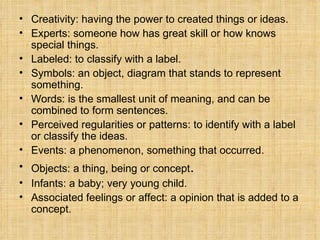
Creativity: having the power to created things or ideas. Experts: someone how has great skill or how knows special things.  Labeled: to classify with a label. Symbols: an object, diagram that stands to represent something. Words: is the smallest unit of meaning, and can be combined to form sentences. Perceived regularities or patterns: to identify with a label or classify the ideas.  Events: a phenomenon, something that occurred. Objects: a thing, being or concept . Infants: a baby; very young child. Associated feelings or affect: a opinion that is added to a concept.

Social Studies

  • 1.
    Social studies AndresVillamil 5B Concept maps
  • 2.
    Concept maps help to answer focus questions . Concept maps represent organized knowledge . Focus questions are context dependent . context dependent for example personal and social organized knowledge needed to answer focus questions organized knowledge is context dependent organized knowledge necessary for effective teaching and effective learning organized knowledge is comprised of concept and propositions Propositions may be crosslinks Crosslinks show interrelationships Interrelationships between different map segments
  • 3.
    Propositions are units of meaning units of meaning constructed in cognitive structure Propositions are hierarchically structured Concepts connected using linking words linking words used to from Propositions Concepts are hierarchically structured hierarchically structured in cognitive structure hierarchically structured especially with experts hierarchically structured aids creativity Creativity need to see Interrelationships Creativity begins with Infants Concepts are labeled Labeled with symbols and words
  • 4.
    Concepts are perceived regularities and patterns. Perceived regularities or patterns begin with infants Perceived regularities and patterns in events , (happenings) and objects ( things). Organized knowledge associated feelings or affects. Associated feelings or affects add to concept.
  • 5.
    Concept map: a diagram showing the relationships among concepts. Focus questions: a question that will launch the interest of the learners. Organized knowledge: is a way to organized ideas in concepts. Context dependent: a statement that depends of others facts. Personal: directly by yourself, private. Social: concerned with human beings as a group. Effective teaching: to help the students to learn new things. Effective learning: to Improve your learning efficiency, study skills and memorization abilities. Concept: a thought an idea.
  • 6.
    Linking words: helpyou to connect ideas and sentences, so that people can follow your ideas. Proposition: a plan to be considered, sentence that can be true or false. Crossing links: to find the true, we have to united some ideas. Interrelationships: to have a mutual relationship. Different map segments: every part of a conceptual map have different information. Units of meaning: where people can find definitions of something. Cognitive structure: is to see whether differences in memory   Hierarchically structured: an arrangement of items
  • 7.
    Creativity: having thepower to created things or ideas. Experts: someone how has great skill or how knows special things. Labeled: to classify with a label. Symbols: an object, diagram that stands to represent something. Words: is the smallest unit of meaning, and can be combined to form sentences. Perceived regularities or patterns: to identify with a label or classify the ideas. Events: a phenomenon, something that occurred. Objects: a thing, being or concept . Infants: a baby; very young child. Associated feelings or affect: a opinion that is added to a concept.