SOCIAL STUDIES PROYECT Colegio Bilingüe Richmond BY: Valentina Morales  TO: Diego Villamizar
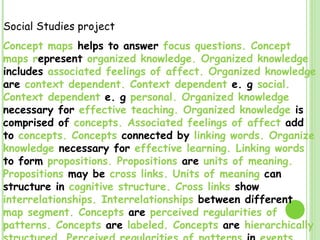
Social Studies project  Concept maps  helps to answer  focus questions. Concept maps r epresent  organized knowledge. Organized knowledge  includes  associated feelings of affect. Organized knowledge  are  context dependent. Context dependent  e. g  social. Context dependent  e. g  personal. Organized knowledge  necessary for  effective teaching. Organized knowledge  is comprised of  concepts. Associated feelings of affect  add to  concepts. Concepts  connected by  linking words. Organize knowledge  necessary for  effective learning. Linking words  to form  propositions. Propositions  are  units of meaning. Propositions  may be  cross links. Units of meaning  can structure in  cognitive structure. Cross links  show  interrelationships. Interrelationships  between different  map segment. Concepts  are  perceived regularities of patterns. Concepts  are  labeled. Concepts  are  hierarchically structured. Perceived regularities of patterns  in  events   peppening. Perceived regularit ies   of  patterns  in   objects things.
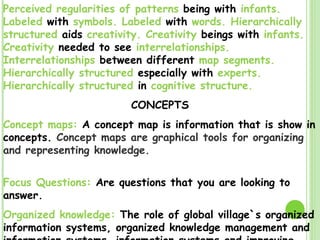
Perceived regularities of patterns  being with   infants. Labeled  with   symbols. Labeled   with   words. Hierarchically structured  aids   creativity. Creativity  beings   with   infants. Creativity  needed to see   interrelationships. Interrelationships   between different   map segments. Hierarchically structured  especially with   experts. Hierarchically structured  in  cognitive structure. CONCEPTS Concept maps:  A concept map is information that is show in concepts.  Concept maps are graphical tools for organizing and representing knowledge.  Focus Questions:  Are questions that you are looking to answer. Organized knowledge:  The role of global village`s organized information systems, organized knowledge management and information systems, information systems and improving working procedures of organizations and various electronic services form electronic trade to electronic citizen will be discussed at the conference.
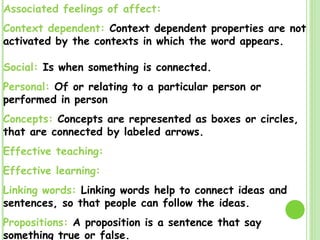
Social:  Is when something is connected. Personal:  Of or relating to a particular person  or performed in person Concepts:  Concepts are represented as boxes or circles, that are connected by labeled arrows. Effective teaching: Effective learning: Linking words:  Linking   words help to connect ideas and sentences, so that people can follow the ideas. Propositions:  A proposition is a sentence that say  something true or false. Associated feelings of affect: Context dependent:  Context dependent properties are not activated by the contexts in which the word appears.
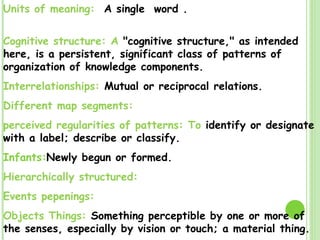
Units of meaning:  A single  word .   Cognitive structure: A  "cognitive structure," as intended here, is a persistent, significant class of patterns of organization of knowledge components. Interrelationships:  Mutual or reciprocal relations. Different map segments: perceived regularities of patterns: To  identify or designate with a label; describe or classify. Infants: Newly begun or formed. Hierarchically structured: Events pepenings: Objects Things:  Something perceptible by one or more of the senses, especially by vision or touch; a material thing.
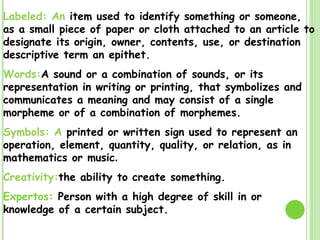
Labeled: An  item used to identify something or someone, as a small piece of paper or cloth attached to an article to designate its origin, owner, contents, use, or destination descriptive term an epithet. Words: A sound or a combination of sounds, or its representation in writing or printing, that symbolizes and communicates a meaning and may consist of a single morpheme or of a combination of morphemes. Symbols: A  printed or written sign used to represent an operation, element, quantity, quality, or relation, as in mathematics or music . Creativity: the ability to create something. Expertos:  Pe rson with a high degree of skill in or knowledge of a certain subject.

Ss

  • 1.
    SOCIAL STUDIES PROYECTColegio Bilingüe Richmond BY: Valentina Morales TO: Diego Villamizar
  • 2.
    Social Studies project Concept maps helps to answer focus questions. Concept maps r epresent organized knowledge. Organized knowledge includes associated feelings of affect. Organized knowledge are context dependent. Context dependent e. g social. Context dependent e. g personal. Organized knowledge necessary for effective teaching. Organized knowledge is comprised of concepts. Associated feelings of affect add to concepts. Concepts connected by linking words. Organize knowledge necessary for effective learning. Linking words to form propositions. Propositions are units of meaning. Propositions may be cross links. Units of meaning can structure in cognitive structure. Cross links show interrelationships. Interrelationships between different map segment. Concepts are perceived regularities of patterns. Concepts are labeled. Concepts are hierarchically structured. Perceived regularities of patterns in events peppening. Perceived regularit ies of patterns in objects things.
  • 3.
    Perceived regularities ofpatterns being with infants. Labeled with symbols. Labeled with words. Hierarchically structured aids creativity. Creativity beings with infants. Creativity needed to see interrelationships. Interrelationships between different map segments. Hierarchically structured especially with experts. Hierarchically structured in cognitive structure. CONCEPTS Concept maps: A concept map is information that is show in concepts. Concept maps are graphical tools for organizing and representing knowledge. Focus Questions: Are questions that you are looking to answer. Organized knowledge: The role of global village`s organized information systems, organized knowledge management and information systems, information systems and improving working procedures of organizations and various electronic services form electronic trade to electronic citizen will be discussed at the conference.
  • 4.
    Social: Iswhen something is connected. Personal: Of or relating to a particular person or performed in person Concepts: Concepts are represented as boxes or circles, that are connected by labeled arrows. Effective teaching: Effective learning: Linking words: Linking words help to connect ideas and sentences, so that people can follow the ideas. Propositions: A proposition is a sentence that say something true or false. Associated feelings of affect: Context dependent: Context dependent properties are not activated by the contexts in which the word appears.
  • 5.
    Units of meaning: A single word . Cognitive structure: A "cognitive structure," as intended here, is a persistent, significant class of patterns of organization of knowledge components. Interrelationships: Mutual or reciprocal relations. Different map segments: perceived regularities of patterns: To identify or designate with a label; describe or classify. Infants: Newly begun or formed. Hierarchically structured: Events pepenings: Objects Things: Something perceptible by one or more of the senses, especially by vision or touch; a material thing.
  • 6.
    Labeled: An item used to identify something or someone, as a small piece of paper or cloth attached to an article to designate its origin, owner, contents, use, or destination descriptive term an epithet. Words: A sound or a combination of sounds, or its representation in writing or printing, that symbolizes and communicates a meaning and may consist of a single morpheme or of a combination of morphemes. Symbols: A printed or written sign used to represent an operation, element, quantity, quality, or relation, as in mathematics or music . Creativity: the ability to create something. Expertos: Pe rson with a high degree of skill in or knowledge of a certain subject.