COMMUNITY
A large numberof people living in a geographical area who have the same
problems and depend on one another and try to find a practical solution to
their problems are known as a community.
A community is a group of individuals residing in a relatively connected
geographic area who share common traits in their way of life, including
customs, traditions, and a general mode of communication
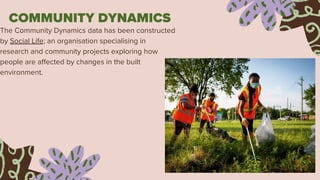
COMMUNITY DYNAMICS
The CommunityDynamics data has been constructed
by Social Life; an organisation specialising in
research and community projects exploring how
people are affected by changes in the built
environment.
7.
Community action refersto a trajectory that is managed by
and benefiting local residents. It includes bottom-up
movements such as collectively governed community
gardens, which can initiate a shift from degraded or function-
designed urban green spaces to novel multifunctional urban
green spaces.
11.
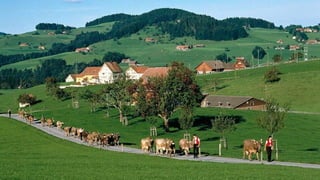
Rural Communities -are often considered
“traditional” in that they typically feature open
spaces, lots of land, small populations, and a slower
pace of life than the average city or town. These
communities typically have a sense of community
identity and pride, as well as organizations like
churches, schools, and volunteer fire departments.
14.
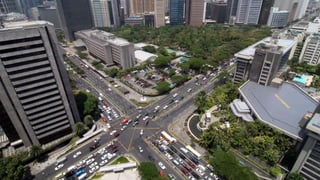
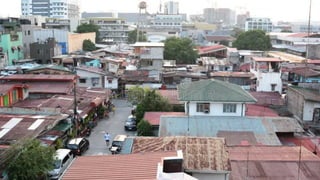
Urban Communities onthe other
hand, are typically associated with
large metropolises where high-rise
buildings are common. These
communities usually have much
higher populations than rural ones
and tend to be more culturally
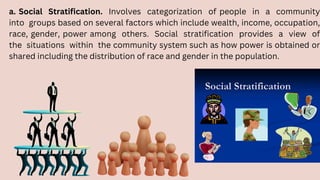
diverse.
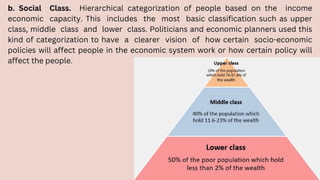
17.
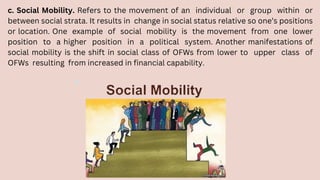
suburban communities -are those that exist
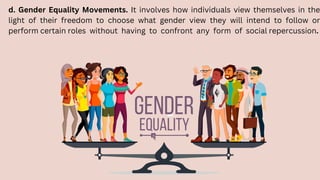
between rural and urban areas. These
communities often have relatively higher
populations than their rural counterparts but
also offer more recreational opportunities and
better access to nearby cities. Suburban
communities tend to be relatively
homogenous and offer organized activities
like community sports leagues and local
festivals.
You can classifyevery type of community by
the purpose that brings them together
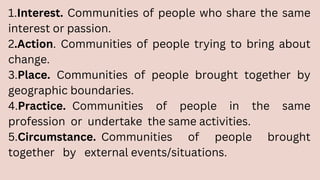
20.
1.Interest. Communities ofpeople who share the same
interest or passion.
2.Action. Communities of people trying to bring about
change.
3.Place. Communities of people brought together by
geographic boundaries.
4.Practice. Communities of people in the same
profession or undertake the same activities.
5.Circumstance. Communities of people brought
together by external events/situations.
21.
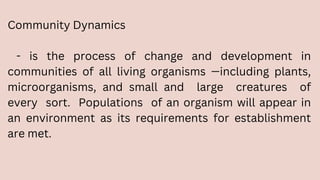
Community Dynamics
- isthe process of change and development in
communities of all living organisms —including plants,
microorganisms, and small and large creatures of
every sort. Populations of an organism will appear in
an environment as its requirements for establishment
are met.
25.
The role thecommunity includes
community consultation, joint
planning, joint design, joint delivery
and community - led activities.
28.
From the wordsof Henrik Ibsen,
“A community is like a ship;
everyone ought to be prepared
to take the helm.”
30.
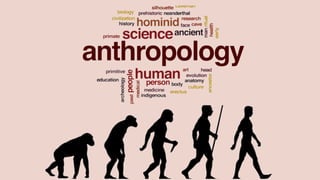
Community being anorganized social
structure serves as the driving force for
civilization. Human development came side
by side with the development of communal
orientation as well as with the evolution of
socio-economic structures
31.
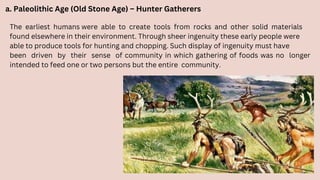
a. Paleolithic Age(Old Stone Age) – Hunter Gatherers
The earliest humans were able to create tools from rocks and other solid materials
found elsewhere in their environment. Through sheer ingenuity these early people were
able to produce tools for hunting and chopping. Such display of ingenuity must have
been driven by their sense of community in which gathering of foods was no longer
intended to feed one or two persons but the entire community.
32.
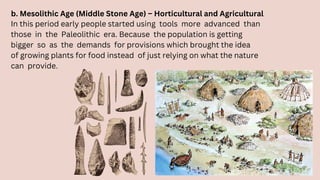
b. Mesolithic Age(Middle Stone Age) – Horticultural and Agricultural
In this period early people started using tools more advanced than
those in the Paleolithic era. Because the population is getting
bigger so as the demands for provisions which brought the idea
of growing plants for food instead of just relying on what the nature
can provide.
33.
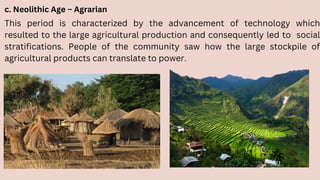
c. Neolithic Age– Agrarian
This period is characterized by the advancement of technology which
resulted to the large agricultural production and consequently led to social
stratifications. People of the community saw how the large stockpile of
agricultural products can translate to power.
35.
2. Sociological Perspective.– Sociology is a branch of Social
Science that analyzes the history, evolution, structure, and
functio ns of societies. Sociologist studied community as a
system and tried to generate empirical data to
established theories on various social phenomena
stemming from inter-human relationships as well as humans
to institutions relationships.
36.
a. Social Stratification.Involves categorization of people in a community
into groups based on several factors which include wealth, income, occupation,
race, gender, power among others. Social stratification provides a view of
the situations within the community system such as how power is obtained or
shared including the distribution of race and gender in the population.
37.
b. Social Class.Hierarchical categorization of people based on the income
economic capacity. This includes the most basic classification such as upper
class, middle class and lower class. Politicians and economic planners used this
kind of categorization to have a clearer vision of how certain socio-economic
policies will affect people in the economic system work or how certain policy will
affect the people.
38.
c. Social Mobility.Refers to the movement of an individual or group within or
between social strata. It results in change in social status relative so one’s positions
or location. One example of social mobility is the movement from one lower
position to a higher position in a political system. Another manifestations of
social mobility is the shift in social class of OFWs from lower to upper class of
OFWs resulting from increased in financial capability.
39.
d. Gender EqualityMovements. It involves how individuals view themselves in the
light of their freedom to choose what gender view they will intend to follow or
perform certain roles without having to confront any form of social repercussion.
40.
e. Deviance. Anyform of action or behavior that undermines social
norms, laws or cultural orientations. Deviance can be a mere
result of a person’s inclination to follow a personal view
of a socially acceptable behavior and not necessarily an affront
to the rules and customary order
43.
B. INSTITUTIONAL PERSPECTIVES’
1.Political Perspectives. Community as a political system composed
of the following elements:
a. Population. Refers to the people who are bestowed with duties, rights and privileges
in order to maximize potentials to the benefits of the community.
b. Territory. A geographical community occupies a physical space within which all
social, economic and political views and activities may be practiced.
c. Sovereignty. At the community level it basically refers to the capacity of the
community to enforce rules within its territory.
d. Government. An institution at the community level that was empowered to
ensure order within its territory.
44.
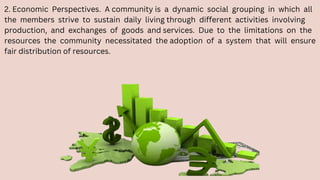
2. Economic Perspectives.A community is a dynamic social grouping in which all
the members strive to sustain daily living through different activities involving
production, and exchanges of goods and services. Due to the limitations on the
resources the community necessitated the adoption of a system that will ensure
fair distribution of resources.
45.
3. Education InstitutionPerspectives. Human survival is tied up to the
different techniques and innovations the people can muster in order to
provide for their needs. Through the advancement of intellect, people learned
how to adapt to their environment and utilize all the resources around them to
produce their daily necessities. As social beings, humans live in a community
that they share with others for which they have to relinquish certain aspect of
their freedom to be able to harmoniously coexist
46.
These are socialscience disciplines,
professions and occupations which seek to
use basic social science research and
theory to improve the daily life of
communities, organizations and persons.
47.
Civil Service Career-The Civil Service delivers public
services according to government policies. There are a
large number of different departments and so a
huge variety of different roles
48.
Human Resources Officer- Human Resources Officers
aim to ensure that organizations have a skilled and
efficient work force. They are involved in recruitment
and selection, training and development, grievance and
discipline and provide advice on employment law.





















![cescpptfinal-220424133321 [Autosaved] [Autosaved].pptx](https://cdn.slidesharecdn.com/ss_thumbnails/cescpptfinal-220424133321autosavedautosaved-230411024854-53f419c6-thumbnail.jpg?width=640&height=640&fit=bounds)
![cescpptfinal-220424133321 [Autosaved].pptx](https://cdn.slidesharecdn.com/ss_thumbnails/cescpptfinal-220424133321autosaved-240319003407-97b0bf7b-thumbnail.jpg?width=640&height=640&fit=bounds)


