CULTURAL DIVERSITY ASSIGNMENT
Topic: Stratification and Caste System
Stratification
* The word is derived from
geology.
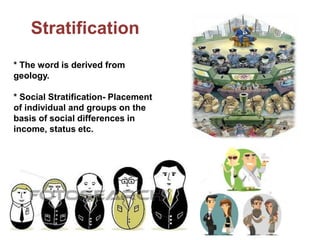
* Social Stratification- Placement
of individual and groups on the
basis of social differences in
income, status etc.
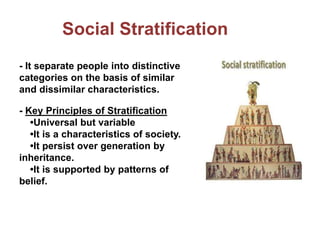
Social Stratification
- It separate people into distinctive
categories on the basis of similar
and dissimilar characteristics.
- Key Principles of Stratification
•Universal but variable
•It is a characteristics of society.
•It persist over generation by
inheritance.
•It is supported by patterns of
belief.
Need of Social Stratification
Duties and Responsibilities.
Limited Resource.
Types of Social Stratification
• Estates System:- Based inland and in
loyalty to an entity that control the Land.
Types
The landed gentry/nobility.
The serfs or peasantry
Clergy
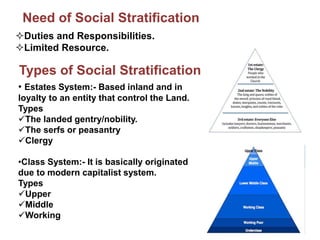
•Class System:- It is basically originated
due to modern capitalist system.
Types
Upper
Middle
Working
Class Awareness and Class
Consciousness
oAmericans are more aware of class today.
oAwareness- Knowing class exist and have
some idea of what class you belong to.
oConsciousness- Aware of not only class
membership, but of corporate interest of
that class vis-à-vis other classes and
society as a whole.
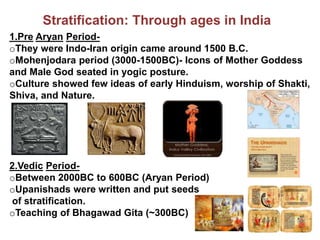
Stratification: Through ages in India
1.Pre Aryan Period-
oThey were Indo-Iran origin came around 1500 B.C.
oMohenjodara period (3000-1500BC)- Icons of Mother Goddess
and Male God seated in yogic posture.
oCulture showed few ideas of early Hinduism, worship of Shakti,
Shiva, and Nature.
2.Vedic Period-
oBetween 2000BC to 600BC (Aryan Period)
oUpanishads were written and put seeds
of stratification.
oTeaching of Bhagawad Gita (~300BC)
Contd….
3.The Pauranic Age-
o300A.D to 1200A.D (Maximum Stratification)
oBrahmas came to dominance.
oBhuddhism and Jainism were on decline.
oSaivism, Vaishnavism, Shaktism, Zorostraianism were
introduced.
oConstruction of large temples.
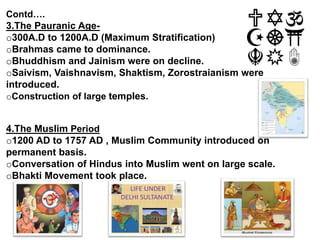
4.The Muslim Period
o1200 AD to 1757 AD , Muslim Community introduced on
permanent basis.
oConversation of Hindus into Muslim went on large scale.
oBhakti Movement took place.
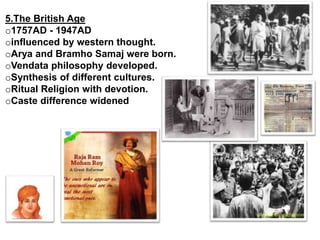
5.The British Age
o1757AD - 1947AD
oinfluenced by western thought.
oArya and Bramho Samaj were born.
oVendata philosophy developed.
oSynthesis of different cultures.
oRitual Religion with devotion.
oCaste difference widened
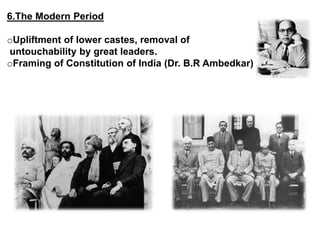
6.The Modern Period
oUpliftment of lower castes, removal of
untouchability by great leaders.
oFraming of Constitution of India (Dr. B.R Ambedkar)
Discrimination in the Modern world
oAs caste continues to the important category, inequality is propagated in
much of the modern world.
oRacial and National discrimination justified exploitation of colonies.
oColonial system create exploitation pattern across vast oceans and
geographical territories ~ Continue to survive in India, Africa and other
colonized Nations.
oColonialism shows up there is no equal work for equal pay across nations.
oBattles for social equality need widespread support and determined by how's
India's economy develops.
oAny social system based on unequal access to economic assets will lead to
some form of social inequality and discrimination.
oStratified India had distinction of Unity in diversity over years.
oVarious details of state craft were recorded in treatises like Arthashastra and
Neetishastra.
Consequences of Stratification
1.Social
•Provisional languages gained importance as Sanskrit was
tough.
•Emergence of rank in the name of god.
•In place of scientific vocational arrangements innumerable
gods evolved.
2.Economic
•Due to highest strata Brahmans and Kshateiyas started
amassing wealth.
•Grab, hate, greed result in intra-religion fights.
•Lower strata economical deprived and oppressed.
3.Political
•Weakening of Integrity and cohesiveness of political.
•Divide and Rule policy of Muslims and European.
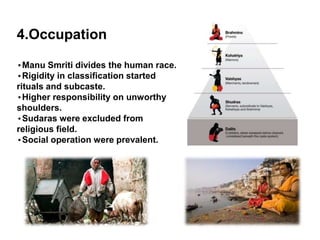
4.Occupation
•Manu Smriti divides the human race.
•Rigidity in classification started
rituals and subcaste.
•Higher responsibility on unworthy
shoulders.
•Sudaras were excluded from
religious field.
•Social operation were prevalent.
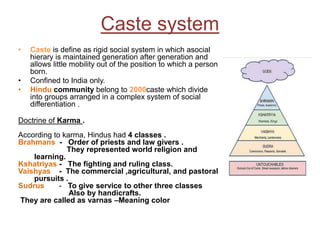
Caste system
• Caste is define as rigid social system in which asocial
hierary is maintained generation after generation and
allows little mobility out of the position to which a person
born.
• Confined to India only.
• Hindu community belong to 2000caste which divide
into groups arranged in a complex system of social
differentiation .
Doctrine of Karma .
According to karma, Hindus had 4 classes .
Brahmans - Order of priests and law givers .
They represented world religion and
learning.
Kshatriyas - The fighting and ruling class.
Vaishyas - The commercial ,agricultural, and pastoral
pursuits .
Sudrus - To give service to other three classes
Also by handicrafts.
They are called as varnas –Meaning color
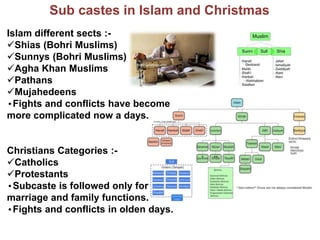
Sub castes in Islam and Christmas
Islam different sects :-
Shias (Bohri Muslims)
Sunnys (Bohri Muslims)
Agha Khan Muslims
Pathans
Mujahedeens
•Fights and conflicts have become
more complicated now a days.
Christians Categories :-
Catholics
Protestants
•Subcaste is followed only for
marriage and family functions.
•Fights and conflicts in olden days.
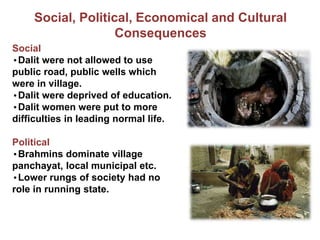
Social, Political, Economical and Cultural
Consequences
Social
•Dalit were not allowed to use
public road, public wells which
were in village.
•Dalit were deprived of education.
•Dalit women were put to more
difficulties in leading normal life.
Political
•Brahmins dominate village
panchayat, local municipal etc.
•Lower rungs of society had no
role in running state.
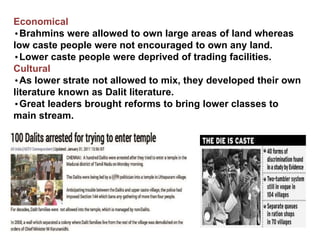
Economical
•Brahmins were allowed to own large areas of land whereas
low caste people were not encouraged to own any land.
•Lower caste people were deprived of trading facilities.
Cultural
•As lower strate not allowed to mix, they developed their own
literature known as Dalit literature.
•Great leaders brought reforms to bring lower classes to
main stream.
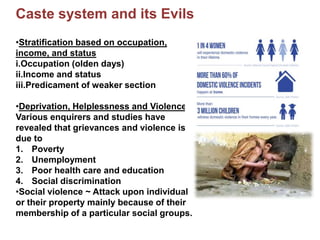
Caste system and its Evils
•Stratification based on occupation,
income, and status
i.Occupation (olden days)
ii.Income and status
iii.Predicament of weaker section
•Deprivation, Helplessness and Violence
Various enquirers and studies have
revealed that grievances and violence is
due to
1. Poverty
2. Unemployment
3. Poor health care and education
4. Social discrimination
•Social violence ~ Attack upon individual
or their property mainly because of their
membership of a particular social groups.
Other Evils of Caste System
• Untouchability.
• Child marriage.
• Restriction in society and social interaction.
• Civil and religious disabilities to some sectionry.
• Restriction in choice of occupations (unworthy workers)
• Casteism (caste feeling)
• Other benefits of various schemes were enjoyed by
higher caste people.
• It started unnecessary rituals and sub cartes.
• Restriction on marriage .
• Deprivation of education .
• Difficulties for women (Dalit).
Special Rights in Constitution
•Equality word in Preamble of Constitution will carry meaning
only if nation as a whole is brought on same level.
•To create equal status for backward and deprived people.
1. Special Rights for Dalits ( SC, ST)
•Cannot be challenged by others in court of law
as discrimination against them.
•State can prohibits others from acquiring their
land and property to protect their interest.
•For various services of them shall be taken
into consideration.
•National commission will be constituted by
President of India.
•Special provisions are laid to care the
educational and economic interests of weaker
section of people.
•Union government will provide grant in aid to
state, for meeting costs of welfare scheme.
2. Special Provisions for Other
Backward Class (OBC)
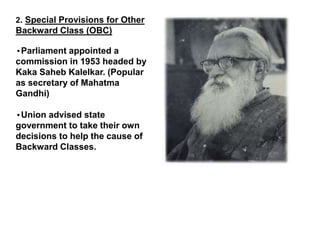
•Parliament appointed a
commission in 1953 headed by
Kaka Saheb Kalelkar. (Popular
as secretary of Mahatma
Gandhi)
•Union advised state
government to take their own
decisions to help the cause of
Backward Classes.
Mandal Commission
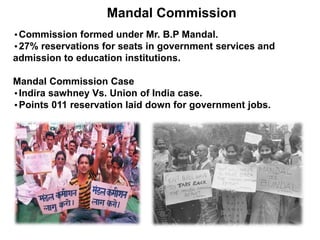
•Commission formed under Mr. B.P Mandal.
•27% reservations for seats in government services and
admission to education institutions.
Mandal Commission Case
•Indira sawhney Vs. Union of India case.
•Points 011 reservation laid down for government jobs.
Abolition of Untouchability
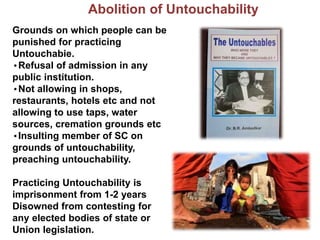
Grounds on which people can be
punished for practicing
Untouchabie.
•Refusal of admission in any
public institution.
•Not allowing in shops,
restaurants, hotels etc and not
allowing to use taps, water
sources, cremation grounds etc
•Insulting member of SC on
grounds of untouchability,
preaching untouchability.
Practicing Untouchability is
imprisonment from 1-2 years
Disowned from contesting for
any elected bodies of state or
Union legislation.
Comments Theory Vs. Practice
•Without provision of Indian Constitution it would
have been very difficult to uplift the weaker section.
•Meritocracy of private sector may continue another
10-20 years by which time the education and talent
level of weaker sections candidate is likely to improve.
•SC/ST and OBC category people prefer government
jobs for security and continuity.

Social stratification and Caste system- its evil

  • 1.
    CULTURAL DIVERSITY ASSIGNMENT Topic:Stratification and Caste System
  • 2.
    Stratification * The wordis derived from geology. * Social Stratification- Placement of individual and groups on the basis of social differences in income, status etc.
  • 3.
    Social Stratification - Itseparate people into distinctive categories on the basis of similar and dissimilar characteristics. - Key Principles of Stratification •Universal but variable •It is a characteristics of society. •It persist over generation by inheritance. •It is supported by patterns of belief.
  • 4.
    Need of SocialStratification Duties and Responsibilities. Limited Resource. Types of Social Stratification • Estates System:- Based inland and in loyalty to an entity that control the Land. Types The landed gentry/nobility. The serfs or peasantry Clergy •Class System:- It is basically originated due to modern capitalist system. Types Upper Middle Working
  • 6.
    Class Awareness andClass Consciousness oAmericans are more aware of class today. oAwareness- Knowing class exist and have some idea of what class you belong to. oConsciousness- Aware of not only class membership, but of corporate interest of that class vis-à-vis other classes and society as a whole.
  • 7.
    Stratification: Through agesin India 1.Pre Aryan Period- oThey were Indo-Iran origin came around 1500 B.C. oMohenjodara period (3000-1500BC)- Icons of Mother Goddess and Male God seated in yogic posture. oCulture showed few ideas of early Hinduism, worship of Shakti, Shiva, and Nature. 2.Vedic Period- oBetween 2000BC to 600BC (Aryan Period) oUpanishads were written and put seeds of stratification. oTeaching of Bhagawad Gita (~300BC)
  • 8.
    Contd…. 3.The Pauranic Age- o300A.Dto 1200A.D (Maximum Stratification) oBrahmas came to dominance. oBhuddhism and Jainism were on decline. oSaivism, Vaishnavism, Shaktism, Zorostraianism were introduced. oConstruction of large temples. 4.The Muslim Period o1200 AD to 1757 AD , Muslim Community introduced on permanent basis. oConversation of Hindus into Muslim went on large scale. oBhakti Movement took place.
  • 9.
    5.The British Age o1757AD- 1947AD oinfluenced by western thought. oArya and Bramho Samaj were born. oVendata philosophy developed. oSynthesis of different cultures. oRitual Religion with devotion. oCaste difference widened
  • 10.
    6.The Modern Period oUpliftmentof lower castes, removal of untouchability by great leaders. oFraming of Constitution of India (Dr. B.R Ambedkar)
  • 11.
    Discrimination in theModern world oAs caste continues to the important category, inequality is propagated in much of the modern world. oRacial and National discrimination justified exploitation of colonies. oColonial system create exploitation pattern across vast oceans and geographical territories ~ Continue to survive in India, Africa and other colonized Nations. oColonialism shows up there is no equal work for equal pay across nations. oBattles for social equality need widespread support and determined by how's India's economy develops. oAny social system based on unequal access to economic assets will lead to some form of social inequality and discrimination. oStratified India had distinction of Unity in diversity over years. oVarious details of state craft were recorded in treatises like Arthashastra and Neetishastra.
  • 12.
    Consequences of Stratification 1.Social •Provisionallanguages gained importance as Sanskrit was tough. •Emergence of rank in the name of god. •In place of scientific vocational arrangements innumerable gods evolved. 2.Economic •Due to highest strata Brahmans and Kshateiyas started amassing wealth. •Grab, hate, greed result in intra-religion fights. •Lower strata economical deprived and oppressed. 3.Political •Weakening of Integrity and cohesiveness of political. •Divide and Rule policy of Muslims and European.
  • 13.
    4.Occupation •Manu Smriti dividesthe human race. •Rigidity in classification started rituals and subcaste. •Higher responsibility on unworthy shoulders. •Sudaras were excluded from religious field. •Social operation were prevalent.
  • 14.
    Caste system • Casteis define as rigid social system in which asocial hierary is maintained generation after generation and allows little mobility out of the position to which a person born. • Confined to India only. • Hindu community belong to 2000caste which divide into groups arranged in a complex system of social differentiation . Doctrine of Karma . According to karma, Hindus had 4 classes . Brahmans - Order of priests and law givers . They represented world religion and learning. Kshatriyas - The fighting and ruling class. Vaishyas - The commercial ,agricultural, and pastoral pursuits . Sudrus - To give service to other three classes Also by handicrafts. They are called as varnas –Meaning color
  • 15.
    Sub castes inIslam and Christmas Islam different sects :- Shias (Bohri Muslims) Sunnys (Bohri Muslims) Agha Khan Muslims Pathans Mujahedeens •Fights and conflicts have become more complicated now a days. Christians Categories :- Catholics Protestants •Subcaste is followed only for marriage and family functions. •Fights and conflicts in olden days.
  • 16.
    Social, Political, Economicaland Cultural Consequences Social •Dalit were not allowed to use public road, public wells which were in village. •Dalit were deprived of education. •Dalit women were put to more difficulties in leading normal life. Political •Brahmins dominate village panchayat, local municipal etc. •Lower rungs of society had no role in running state.
  • 17.
    Economical •Brahmins were allowedto own large areas of land whereas low caste people were not encouraged to own any land. •Lower caste people were deprived of trading facilities. Cultural •As lower strate not allowed to mix, they developed their own literature known as Dalit literature. •Great leaders brought reforms to bring lower classes to main stream.
  • 18.
    Caste system andits Evils •Stratification based on occupation, income, and status i.Occupation (olden days) ii.Income and status iii.Predicament of weaker section •Deprivation, Helplessness and Violence Various enquirers and studies have revealed that grievances and violence is due to 1. Poverty 2. Unemployment 3. Poor health care and education 4. Social discrimination •Social violence ~ Attack upon individual or their property mainly because of their membership of a particular social groups.
  • 19.
    Other Evils ofCaste System • Untouchability. • Child marriage. • Restriction in society and social interaction. • Civil and religious disabilities to some sectionry. • Restriction in choice of occupations (unworthy workers) • Casteism (caste feeling) • Other benefits of various schemes were enjoyed by higher caste people. • It started unnecessary rituals and sub cartes. • Restriction on marriage . • Deprivation of education . • Difficulties for women (Dalit).
  • 20.
    Special Rights inConstitution •Equality word in Preamble of Constitution will carry meaning only if nation as a whole is brought on same level. •To create equal status for backward and deprived people. 1. Special Rights for Dalits ( SC, ST) •Cannot be challenged by others in court of law as discrimination against them. •State can prohibits others from acquiring their land and property to protect their interest. •For various services of them shall be taken into consideration. •National commission will be constituted by President of India. •Special provisions are laid to care the educational and economic interests of weaker section of people. •Union government will provide grant in aid to state, for meeting costs of welfare scheme.
  • 21.
    2. Special Provisionsfor Other Backward Class (OBC) •Parliament appointed a commission in 1953 headed by Kaka Saheb Kalelkar. (Popular as secretary of Mahatma Gandhi) •Union advised state government to take their own decisions to help the cause of Backward Classes.
  • 22.
    Mandal Commission •Commission formedunder Mr. B.P Mandal. •27% reservations for seats in government services and admission to education institutions. Mandal Commission Case •Indira sawhney Vs. Union of India case. •Points 011 reservation laid down for government jobs.
  • 23.
    Abolition of Untouchability Groundson which people can be punished for practicing Untouchabie. •Refusal of admission in any public institution. •Not allowing in shops, restaurants, hotels etc and not allowing to use taps, water sources, cremation grounds etc •Insulting member of SC on grounds of untouchability, preaching untouchability. Practicing Untouchability is imprisonment from 1-2 years Disowned from contesting for any elected bodies of state or Union legislation.
  • 24.
    Comments Theory Vs.Practice •Without provision of Indian Constitution it would have been very difficult to uplift the weaker section. •Meritocracy of private sector may continue another 10-20 years by which time the education and talent level of weaker sections candidate is likely to improve. •SC/ST and OBC category people prefer government jobs for security and continuity.