Presented by – Smriti Bhoray
Course code – B.a , B.ed
Department of education
Lovely school of education
Pedagogy – Social science
Registration – 11810001
Social science
Class – 8th
AFTER EDUCATION REFORMS IMPROVED THE
CONDITION AND SCHOOLS WERE ESTABLISHED IN
INDIA, HOW WILL THIS IMPROVE THE CONDITION
OF THE DALITS AND UNTOUCHABLES?
LET’S DISCUSS…
• 1. awareness will we there due to better education
• 2. less unemployment rates as it will create more job opportunities
• 3. more people will become aware of their right and how to raise a voice
• 4. they can challenge the law made by the court for their betterment.
Story time
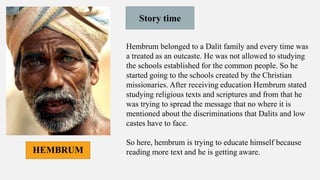
Hembrum belonged to a Dalit family and every time was
a treated as an outcaste. He was not allowed to studying
the schools established for the common people. So he
started going to the schools created by the Christian
missionaries. After receiving education Hembrum stated
studying religious texts and scriptures and from that he
was trying to spread the message that no where it is
mentioned about the discriminations that Dalits and low
castes have to face.
So here, hembrum is trying to educate himself because
reading more text and he is getting aware.
HEMBRUM
Demands for equality and justice
1st half of the nineteenth
century – brought changes
in the education sector.
2nd half of the nineteenth
century – various
movements and reforms
for the demands in
equality and justice.
Satnami movement in Western India Founded for improving the social
status of the leather workers
Haridas thakur mathua sect Founded for chandala cultivators and
supported the Dalit sections of the
society. They also questioned the
spiritual texts and the caste system.
Narayana guru from Kerala Started a movement for the unity of the
people against caste inequality and
argued with people who insulted the
lower castes
Non-brahaman groups in Eastern India Founded for changing the habits and
the practices that provoked the
dominant castes.
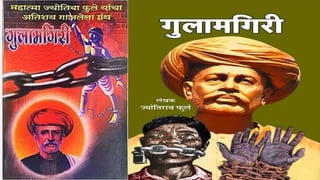
GULAAM GIRI
• Founder of the book and early life - One of the most vocal amongst the “low-caste” leaders was
Jyotirao Phule. Born in 1827, he studied in schools set up by Christian missionaries. On growing up
he developed his own ideas about the injustices of caste society.
• Importance in bringing the revolutionary reform – he argued that the people who are
discriminated are the indigenous people. People who are ruling these days like superior on the
inferiors are the descendants or the Aryans who came from other land setlled here and became
powerful by oppressing the local people.
• Historical importance of the book – this book was written ten years later in 1873 after the American
civil war has been fought in America between the black and the white people. This book was
dedicated to the black slaves in America and also established a link of the caste system in India.
ELABORATE
What is the literal
meaning of this poem?
What message does it
convey?
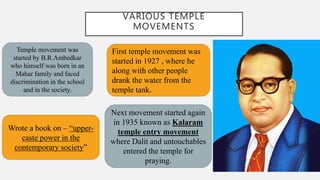
VARIOUS TEMPLE
MOVEMENTS
Temple movement was
started by B.R.Ambedkar
who himself was born in an
Mahar family and faced
discrimination in the school
and in the society.
Wrote a book on – “upper-
caste power in the
contemporary society”
First temple movement was
started in 1927 , where he
along with other people
drank the water from the
temple tank.
Next movement started again
in 1935 known as Kalaram
temple entry movement
where Dalit and untouchables
entered the temple for
praying.
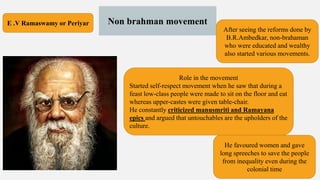
Non brahman movement
After seeing the reforms done by
B.R.Ambedkar, non-brahaman
who were educated and wealthy
also started various movements.
E .V Ramaswamy or Periyar
Role in the movement
Started self-respect movement when he saw that during a
feast low-class people were made to sit on the floor and eat
whereas upper-castes were given table-chair.
He constantly criticized manusmriti and Ramayana
epics and argued that untouchables are the upholders of the
culture.
He favoured women and gave
long spreeches to save the people
from inequality even during the
colonial time
ELABORATE
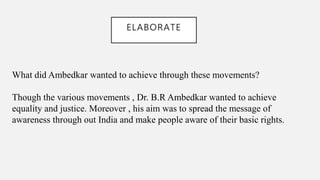
What did Ambedkar wanted to achieve through these movements?
Though the various movements , Dr. B.R Ambedkar wanted to achieve
equality and justice. Moreover , his aim was to spread the message of
awareness through out India and make people aware of their basic rights.
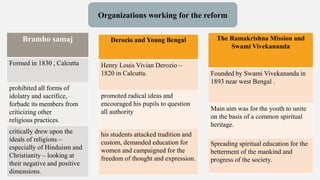
Organizations working for the reform
Bramho samaj
Formed in 1830 , Calcutta
prohibited all forms of
idolatry and sacrifice,
forbade its members from
criticizing other
religious practices.
critically drew upon the
ideals of religions –
especially of Hinduism and
Christianity – looking at
their negative and positive
dimensions.
Derozio and Young Bengal
Henry Louis Vivian Derozio –
1820 in Calcutta.
promoted radical ideas and
encouraged his pupils to question
all authority
his students attacked tradition and
custom, demanded education for
women and campaigned for the
freedom of thought and expression.
The Ramakrishna Mission and
Swami Vivekananda
Founded by Swami Vivekananda in
1893 near west Bengal .
Main aim was for the youth to unite
on the basis of a common spiritual
heritage.
Spreading spiritual education for the
betterment of the mankind and
progress of the society.
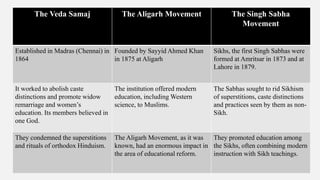
The Veda Samaj The Aligarh Movement The Singh Sabha
Movement
Established in Madras (Chennai) in
1864
Founded by Sayyid Ahmed Khan
in 1875 at Aligarh
Sikhs, the first Singh Sabhas were
formed at Amritsar in 1873 and at
Lahore in 1879.
It worked to abolish caste
distinctions and promote widow
remarriage and women’s
education. Its members believed in
one God.
The institution offered modern
education, including Western
science, to Muslims.
The Sabhas sought to rid Sikhism
of superstitions, caste distinctions
and practices seen by them as non-
Sikh.
They condemned the superstitions
and rituals of orthodox Hinduism.
The Aligarh Movement, as it was
known, had an enormous impact in
the area of educational reform.
They promoted education among
the Sikhs, often combining modern
instruction with Sikh teachings.
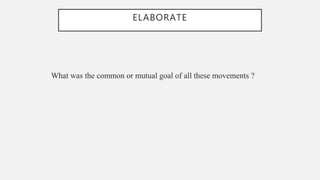
ELABORATE
What was the common or mutual goal of all these movements ?
 women's caste and reforms

women's caste and reforms

  • 1.
    Presented by –Smriti Bhoray Course code – B.a , B.ed Department of education Lovely school of education Pedagogy – Social science Registration – 11810001 Social science Class – 8th
  • 2.
    AFTER EDUCATION REFORMSIMPROVED THE CONDITION AND SCHOOLS WERE ESTABLISHED IN INDIA, HOW WILL THIS IMPROVE THE CONDITION OF THE DALITS AND UNTOUCHABLES? LET’S DISCUSS… • 1. awareness will we there due to better education • 2. less unemployment rates as it will create more job opportunities • 3. more people will become aware of their right and how to raise a voice • 4. they can challenge the law made by the court for their betterment.
  • 3.
    Story time Hembrum belongedto a Dalit family and every time was a treated as an outcaste. He was not allowed to studying the schools established for the common people. So he started going to the schools created by the Christian missionaries. After receiving education Hembrum stated studying religious texts and scriptures and from that he was trying to spread the message that no where it is mentioned about the discriminations that Dalits and low castes have to face. So here, hembrum is trying to educate himself because reading more text and he is getting aware. HEMBRUM
  • 4.
    Demands for equalityand justice 1st half of the nineteenth century – brought changes in the education sector. 2nd half of the nineteenth century – various movements and reforms for the demands in equality and justice. Satnami movement in Western India Founded for improving the social status of the leather workers Haridas thakur mathua sect Founded for chandala cultivators and supported the Dalit sections of the society. They also questioned the spiritual texts and the caste system. Narayana guru from Kerala Started a movement for the unity of the people against caste inequality and argued with people who insulted the lower castes Non-brahaman groups in Eastern India Founded for changing the habits and the practices that provoked the dominant castes.
  • 6.
    GULAAM GIRI • Founderof the book and early life - One of the most vocal amongst the “low-caste” leaders was Jyotirao Phule. Born in 1827, he studied in schools set up by Christian missionaries. On growing up he developed his own ideas about the injustices of caste society. • Importance in bringing the revolutionary reform – he argued that the people who are discriminated are the indigenous people. People who are ruling these days like superior on the inferiors are the descendants or the Aryans who came from other land setlled here and became powerful by oppressing the local people. • Historical importance of the book – this book was written ten years later in 1873 after the American civil war has been fought in America between the black and the white people. This book was dedicated to the black slaves in America and also established a link of the caste system in India.
  • 7.
    ELABORATE What is theliteral meaning of this poem? What message does it convey?
  • 9.
    VARIOUS TEMPLE MOVEMENTS Temple movementwas started by B.R.Ambedkar who himself was born in an Mahar family and faced discrimination in the school and in the society. Wrote a book on – “upper- caste power in the contemporary society” First temple movement was started in 1927 , where he along with other people drank the water from the temple tank. Next movement started again in 1935 known as Kalaram temple entry movement where Dalit and untouchables entered the temple for praying.
  • 10.
    Non brahman movement Afterseeing the reforms done by B.R.Ambedkar, non-brahaman who were educated and wealthy also started various movements. E .V Ramaswamy or Periyar Role in the movement Started self-respect movement when he saw that during a feast low-class people were made to sit on the floor and eat whereas upper-castes were given table-chair. He constantly criticized manusmriti and Ramayana epics and argued that untouchables are the upholders of the culture. He favoured women and gave long spreeches to save the people from inequality even during the colonial time
  • 11.
    ELABORATE What did Ambedkarwanted to achieve through these movements? Though the various movements , Dr. B.R Ambedkar wanted to achieve equality and justice. Moreover , his aim was to spread the message of awareness through out India and make people aware of their basic rights.
  • 12.
    Organizations working forthe reform Bramho samaj Formed in 1830 , Calcutta prohibited all forms of idolatry and sacrifice, forbade its members from criticizing other religious practices. critically drew upon the ideals of religions – especially of Hinduism and Christianity – looking at their negative and positive dimensions. Derozio and Young Bengal Henry Louis Vivian Derozio – 1820 in Calcutta. promoted radical ideas and encouraged his pupils to question all authority his students attacked tradition and custom, demanded education for women and campaigned for the freedom of thought and expression. The Ramakrishna Mission and Swami Vivekananda Founded by Swami Vivekananda in 1893 near west Bengal . Main aim was for the youth to unite on the basis of a common spiritual heritage. Spreading spiritual education for the betterment of the mankind and progress of the society.
  • 13.
    The Veda SamajThe Aligarh Movement The Singh Sabha Movement Established in Madras (Chennai) in 1864 Founded by Sayyid Ahmed Khan in 1875 at Aligarh Sikhs, the first Singh Sabhas were formed at Amritsar in 1873 and at Lahore in 1879. It worked to abolish caste distinctions and promote widow remarriage and women’s education. Its members believed in one God. The institution offered modern education, including Western science, to Muslims. The Sabhas sought to rid Sikhism of superstitions, caste distinctions and practices seen by them as non- Sikh. They condemned the superstitions and rituals of orthodox Hinduism. The Aligarh Movement, as it was known, had an enormous impact in the area of educational reform. They promoted education among the Sikhs, often combining modern instruction with Sikh teachings.
  • 14.
    ELABORATE What was thecommon or mutual goal of all these movements ?