Social Sciences in Dentistry
Contents
• Introduction
• Definition
• Components of social sciences
• Cultural anthropology
• Health behaviour and lifestyle
• Risk Behaviour
• Conclusion
• References 2
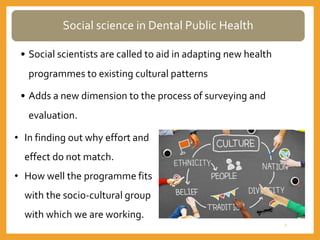
Social science in Dental Public Health
• Social scientists are called to aid in adapting new health
programmes to existing cultural patterns
• Adds a new dimension to the process of surveying and
evaluation.
• In finding out why effort and
effect do not match.
• How well the programme fits
with the socio-cultural group
with which we are working.
3
Introduction
• Behaviour is an action nor observable practice/
practices in an individual, family and community
• Health behaviour is a broad concept implying
actions undertaken by people which have positive
or negative consequences to health
4
Terminologies
• Social Sciences:The branch of science that studies society
and the relationships of individual within a society.
• Medical Sociology: Medical sociology is concerned with the
relationships between social factors and health, and with the
application of sociological theory and research techniques to
questions related to health care system.
5
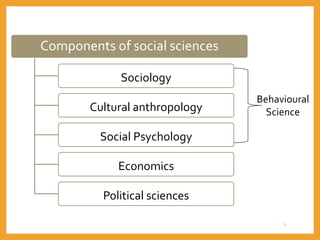
Components of social sciences
Sociology
Cultural anthropology
Social Psychology
Economics
Political sciences
Behavioural
Science
6
Sociology is the science concerned with the
organization or structure of social groups. It is the
science of behavior of man in a society or group of
human beings.
7
Structural aspects of society
• Social institutions - it is a social structure and machinery
through which human society organizes, directs and executes the
multifarious activities required to satisfy human needs.
8
• Community - defined as a group
small or large, living together in
such a way that the members share
not one or more specific interests
but rather the basic conditions of a
common life.
• Associations – they are groups of
people united for a specific purpose
or a limited number of purposes and
are based on utilitarian interest.
9
Functional aspects of society:
A. Social norms
• The specified rules of conduct to be followed by the
members of a society
• There are 4 types of norms:
• Folkways
• Mores
• Taboos
• Laws
10
Examples:
• CoveringYour MouthWhenYou Cough Or Sneeze
• DressingAppropriatelyAtWork
• WearingA School Uniform
• RaisingYour HandTo Speak
• Saying PleaseAndThankYou
• BrushingAnd FlossingYourTeeth Daily
• Waiting In Line
• MakingYour Bed InThe Morning
Folkways – Customary ways of behaviour norms that are not strictly enforced
and not a threat to society
11
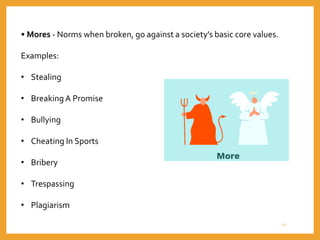
• Mores - Norms when broken, go against a society’s basic core values.
Examples:
• Stealing
• Breaking A Promise
• Bullying
• Cheating In Sports
• Bribery
• Trespassing
• Plagiarism
12
• Taboo – Mores expressed in a negative context socially repulsive
Examples:
• Failure toTip at a Restaurant
• Discussing yourWealth or Income
• Asking aWoman’sAge
• Leaving the Office Before your Boss
• Refusing a Gift
• Putting your Hands in your Pockets
• Eating Before Everyone is at theTable
13
• Laws- Laws are norms that are actually defined as being legal or illegal.The
government has decided these norms are so important that you could get in
trouble for breaking them.
Examples:
• Running red lights
• Speeding
• Theft
14
B. Customs and Habits
• Custom is a broad term involving folkways or mores.
Repeated by generations
• Habits is an acquired tendency to respond in an identical
way to a situation or stimulus.
• A habit is a purely personal affair, not entailing any
obligation.
• E.g. Smoking a cigarette after dinner, bathing daily
15
• Eg ; Shaking hands or taking
your shoes off before you
enter a place of worship in
India.
C. Etiquettes and conventions:
• Etiquettes are concerned with choice of the proper form of
doing something in relation to other people.
• Convention is merely an agreed upon procedure.
16
D. Social values
• Values refer to those standards of
judgement by which things and
actions are evaluated as good or
bad.
• E.g. it is a norm that no man should be differentiated in terms
of gender, caste, color or creed while practicing the art of
medicine. The value behind it is that “ all men are born free and
equal”.
17
Cultural anthropology
• Culture the training and refinement of mind, tastes and
manners, the condition of being thus trained and refined.
18
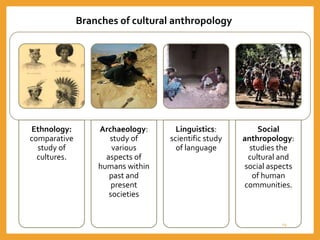
Ethnology:
comparative
study of
cultures.
Archaeology:
study of
various
aspects of
humans within
past and
present
societies
Linguistics:
scientific study
of language
Social
anthropology:
studies the
cultural and
social aspects
of human
communities.
Branches of cultural anthropology
19
Economics
It studies the production, distribution
and consumption of the three basic
essentials for his living namely food,
shelter and clothing.
Social Psychology
Social Psychology studies the effect of
social environment on individual
psychology
20
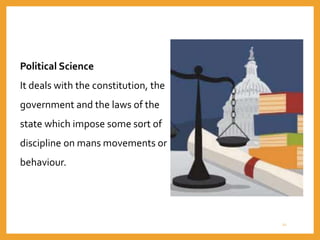
Political Science
It deals with the constitution, the
government and the laws of the
state which impose some sort of
discipline on mans movements or
behaviour.
21
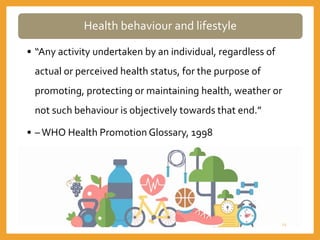
Health behaviour and lifestyle
• “Any activity undertaken by an individual, regardless of
actual or perceived health status, for the purpose of
promoting, protecting or maintaining health, weather or
not such behaviour is objectively towards that end.”
• –WHO Health Promotion Glossary, 1998
22
Harmful dental health behaviours:
Smoking
Alcohol use
Drug misuse
Nutrition
23
Barriers to Achieving Behaviour Change
• Lack of opportunity
• Lack of resources
• Lack of support
• Conflicting motives
• Long term nature of benefit
• Belief that change not possible
24
Behaviour scientists' classification of social class
The upper middle class:
•The professional and business executive group, well educated,
living in well maintained homes.
• Seek out expert advice and follow the advice religiously when it
comes to health care.
•They value their teeth and are interested in preventive dentistry
and actively pursue dental care.
25
The lower middle class
• Includes small business owners, minor executives, teachers,
salesman.
•They are highly moralistic group with at least a high school
education
•They live in a clean pleasant neighborhood.
• Most compulsive in dental care attitudes.
• Dentist is regarded as an authority who fixes teeth.
26
The upper lower class:
•The necessity to be socially presentable makes for a high
standard of dental care among this status level.
• Generally skilled and semiskilled blue-collar workers with
limited education.
•The group which needs to become the objective of major
educational efforts regarding dental care.
•They are most accessible to these attempts and offer best
possibilities of behavioural and attitudinal changes.
•They acquire artificial dentures at an early age and are
reasonably happy with them. 27
The lower class
• They are called underprivileged or disadvantaged class.
• Consists of unskilled laborer's, people who shift from job to job,
limited education, live in slum areas and exhibit no stable
pattern of life.
• Reveal most consistent neglect of teeth.
• They require careful understanding if they are to receive
adequate care in public health facilities.
28
Attitudes of underprivileged towards health:
1. Castration complex
2. Contradiction of common sense
3. Coming in crowd
4. The last-ditch effort
5. If it hurts, you are quack
6. Unclean or dirty feeling
7. The clinic was built there, not here
8. Cold professional attitudes
9. Difference in pain threshold
10. Complications of the unknown
11. The pills don’t work
12. Appointments not important
13. Teeth lost anyhow
14. Traditions
29
Risk Behaviour
• Risk behavior (WHO Health Promotion Glossary, 1998) is the
“specific forms of behavior which are proven to be associated
with increased susceptibility to a specific disease or ill-health”
• Risk factor (WHO Health Promotion Glossary, 1998) is the
“social, economic or biological status, behaviors or
environments which are associated with or cause increased
susceptibility to a specific disease, ill-health, or injury”
30
Utilization of dental services:
• Utilization is the actual attendance by members of the public of
health care facilities to receive care.
• Need for dental care (Types)
• Normative need: It is the requirement for care as
determined by expert opinion
• Felt need: It is the requirement of, or care as determined by
the patient or the public
• Expressed need: It arises out of attempts by members of
the public to seek attention for their perceived needs.
31
Factors affecting utilization:
• Age
• Gender
• Education
• Socio-economic status
• Occupation
• Residence
• Socio-cultural factors
• Organizational factors
• Cost of health services
32
Summary
• Social scientists are called to aid in programme
planning and evaluation problems.
• Social sciences plays a major role in understanding
the individual, his community and his environment.
• Social environment plays an important role in
relation to health and disease in man.
33
• The environment is unique to man and includes
cultural values, customs, habits, attitudes, morals,
religion, education, income occupation, standard of
living, community life, social and political organization.
• Health behaviour has direct and indirect effects on
health.
34
Suggested Reading
• Soben Peter (2018). Essentials of Preventive and
Community Dentistry. 6th Edition, Arya Publishing
House, New Delhi.
• Park K.Textbook of preventive and social medicine;
23rd Edition
35
36

SOCIAL SCIENCE

  • 1.
  • 2.
    Contents • Introduction • Definition •Components of social sciences • Cultural anthropology • Health behaviour and lifestyle • Risk Behaviour • Conclusion • References 2
  • 3.
    Social science inDental Public Health • Social scientists are called to aid in adapting new health programmes to existing cultural patterns • Adds a new dimension to the process of surveying and evaluation. • In finding out why effort and effect do not match. • How well the programme fits with the socio-cultural group with which we are working. 3
  • 4.
    Introduction • Behaviour isan action nor observable practice/ practices in an individual, family and community • Health behaviour is a broad concept implying actions undertaken by people which have positive or negative consequences to health 4
  • 5.
    Terminologies • Social Sciences:Thebranch of science that studies society and the relationships of individual within a society. • Medical Sociology: Medical sociology is concerned with the relationships between social factors and health, and with the application of sociological theory and research techniques to questions related to health care system. 5
  • 6.
    Components of socialsciences Sociology Cultural anthropology Social Psychology Economics Political sciences Behavioural Science 6
  • 7.
    Sociology is thescience concerned with the organization or structure of social groups. It is the science of behavior of man in a society or group of human beings. 7
  • 8.
    Structural aspects ofsociety • Social institutions - it is a social structure and machinery through which human society organizes, directs and executes the multifarious activities required to satisfy human needs. 8
  • 9.
    • Community -defined as a group small or large, living together in such a way that the members share not one or more specific interests but rather the basic conditions of a common life. • Associations – they are groups of people united for a specific purpose or a limited number of purposes and are based on utilitarian interest. 9
  • 10.
    Functional aspects ofsociety: A. Social norms • The specified rules of conduct to be followed by the members of a society • There are 4 types of norms: • Folkways • Mores • Taboos • Laws 10
  • 11.
    Examples: • CoveringYour MouthWhenYouCough Or Sneeze • DressingAppropriatelyAtWork • WearingA School Uniform • RaisingYour HandTo Speak • Saying PleaseAndThankYou • BrushingAnd FlossingYourTeeth Daily • Waiting In Line • MakingYour Bed InThe Morning Folkways – Customary ways of behaviour norms that are not strictly enforced and not a threat to society 11
  • 12.
    • Mores -Norms when broken, go against a society’s basic core values. Examples: • Stealing • Breaking A Promise • Bullying • Cheating In Sports • Bribery • Trespassing • Plagiarism 12
  • 13.
    • Taboo –Mores expressed in a negative context socially repulsive Examples: • Failure toTip at a Restaurant • Discussing yourWealth or Income • Asking aWoman’sAge • Leaving the Office Before your Boss • Refusing a Gift • Putting your Hands in your Pockets • Eating Before Everyone is at theTable 13
  • 14.
    • Laws- Lawsare norms that are actually defined as being legal or illegal.The government has decided these norms are so important that you could get in trouble for breaking them. Examples: • Running red lights • Speeding • Theft 14
  • 15.
    B. Customs andHabits • Custom is a broad term involving folkways or mores. Repeated by generations • Habits is an acquired tendency to respond in an identical way to a situation or stimulus. • A habit is a purely personal affair, not entailing any obligation. • E.g. Smoking a cigarette after dinner, bathing daily 15
  • 16.
    • Eg ;Shaking hands or taking your shoes off before you enter a place of worship in India. C. Etiquettes and conventions: • Etiquettes are concerned with choice of the proper form of doing something in relation to other people. • Convention is merely an agreed upon procedure. 16
  • 17.
    D. Social values •Values refer to those standards of judgement by which things and actions are evaluated as good or bad. • E.g. it is a norm that no man should be differentiated in terms of gender, caste, color or creed while practicing the art of medicine. The value behind it is that “ all men are born free and equal”. 17
  • 18.
    Cultural anthropology • Culturethe training and refinement of mind, tastes and manners, the condition of being thus trained and refined. 18
  • 19.
    Ethnology: comparative study of cultures. Archaeology: study of various aspectsof humans within past and present societies Linguistics: scientific study of language Social anthropology: studies the cultural and social aspects of human communities. Branches of cultural anthropology 19
  • 20.
    Economics It studies theproduction, distribution and consumption of the three basic essentials for his living namely food, shelter and clothing. Social Psychology Social Psychology studies the effect of social environment on individual psychology 20
  • 21.
    Political Science It dealswith the constitution, the government and the laws of the state which impose some sort of discipline on mans movements or behaviour. 21
  • 22.
    Health behaviour andlifestyle • “Any activity undertaken by an individual, regardless of actual or perceived health status, for the purpose of promoting, protecting or maintaining health, weather or not such behaviour is objectively towards that end.” • –WHO Health Promotion Glossary, 1998 22
  • 23.
    Harmful dental healthbehaviours: Smoking Alcohol use Drug misuse Nutrition 23
  • 24.
    Barriers to AchievingBehaviour Change • Lack of opportunity • Lack of resources • Lack of support • Conflicting motives • Long term nature of benefit • Belief that change not possible 24
  • 25.
    Behaviour scientists' classificationof social class The upper middle class: •The professional and business executive group, well educated, living in well maintained homes. • Seek out expert advice and follow the advice religiously when it comes to health care. •They value their teeth and are interested in preventive dentistry and actively pursue dental care. 25
  • 26.
    The lower middleclass • Includes small business owners, minor executives, teachers, salesman. •They are highly moralistic group with at least a high school education •They live in a clean pleasant neighborhood. • Most compulsive in dental care attitudes. • Dentist is regarded as an authority who fixes teeth. 26
  • 27.
    The upper lowerclass: •The necessity to be socially presentable makes for a high standard of dental care among this status level. • Generally skilled and semiskilled blue-collar workers with limited education. •The group which needs to become the objective of major educational efforts regarding dental care. •They are most accessible to these attempts and offer best possibilities of behavioural and attitudinal changes. •They acquire artificial dentures at an early age and are reasonably happy with them. 27
  • 28.
    The lower class •They are called underprivileged or disadvantaged class. • Consists of unskilled laborer's, people who shift from job to job, limited education, live in slum areas and exhibit no stable pattern of life. • Reveal most consistent neglect of teeth. • They require careful understanding if they are to receive adequate care in public health facilities. 28
  • 29.
    Attitudes of underprivilegedtowards health: 1. Castration complex 2. Contradiction of common sense 3. Coming in crowd 4. The last-ditch effort 5. If it hurts, you are quack 6. Unclean or dirty feeling 7. The clinic was built there, not here 8. Cold professional attitudes 9. Difference in pain threshold 10. Complications of the unknown 11. The pills don’t work 12. Appointments not important 13. Teeth lost anyhow 14. Traditions 29
  • 30.
    Risk Behaviour • Riskbehavior (WHO Health Promotion Glossary, 1998) is the “specific forms of behavior which are proven to be associated with increased susceptibility to a specific disease or ill-health” • Risk factor (WHO Health Promotion Glossary, 1998) is the “social, economic or biological status, behaviors or environments which are associated with or cause increased susceptibility to a specific disease, ill-health, or injury” 30
  • 31.
    Utilization of dentalservices: • Utilization is the actual attendance by members of the public of health care facilities to receive care. • Need for dental care (Types) • Normative need: It is the requirement for care as determined by expert opinion • Felt need: It is the requirement of, or care as determined by the patient or the public • Expressed need: It arises out of attempts by members of the public to seek attention for their perceived needs. 31
  • 32.
    Factors affecting utilization: •Age • Gender • Education • Socio-economic status • Occupation • Residence • Socio-cultural factors • Organizational factors • Cost of health services 32
  • 33.
    Summary • Social scientistsare called to aid in programme planning and evaluation problems. • Social sciences plays a major role in understanding the individual, his community and his environment. • Social environment plays an important role in relation to health and disease in man. 33
  • 34.
    • The environmentis unique to man and includes cultural values, customs, habits, attitudes, morals, religion, education, income occupation, standard of living, community life, social and political organization. • Health behaviour has direct and indirect effects on health. 34
  • 35.
    Suggested Reading • SobenPeter (2018). Essentials of Preventive and Community Dentistry. 6th Edition, Arya Publishing House, New Delhi. • Park K.Textbook of preventive and social medicine; 23rd Edition 35
  • 36.

Editor's Notes

  • #4 Social factors represent another important set of influences on consumer behavior. Specifically, these are the effects of people and groups influencing one another through culture and subculture, social class, reference groups, and family.