Research on Humanities and Social Sciences                                                                  www.iiste.org
ISSN 2222-1719 (Paper) ISSN 2222-2863 (Online)
                                   2863
Vol 2, No.10, 2012


Social Safety Nets Programs in Bangladesh: Preparing for Adaption
     to Demographic Change, Disaster, and Poverty Reduction
                 Mohammad Abdul Hannan Pradhan* Saidatulakmal Mohd and Jamalludin Sulaiman
          School of Social Sciences, Universiti Sains Malaysia, 11800 USM, Pulau Pinang, Malaysia
                                   ,                             1800
                            * E-mail of the corresponding author: pradhanhannan@gmail.cam
                                mail
Abstract
From the last two decades, Bangladesh has experienced a rapid decline in birth rate and childhood mortality rate
                                                                                                         mortalit
simultaneously. Due to increase in literacy rate, per capita income, more awareness about life, and better nutrition,
life expectancy has also increased rapidly in Bangladesh. As a result, the increase in population and life expectancy
undeniably has an impact on the demographic profile of the population. As a disaster prone and large populated
                s
country with limited resources, a big share of population is still poor and vulnerable. To tackle the situation a large
scale social safety net (SSN) programs with grants cash, in-kind or both for targeted people have been implementing
                                                             kind
by the government and non-government organization. This paper is an attempt to provide an overview of the current
                              government
SSN program implemented by the government. Considering existing literature and document, this paper identifies
three models of SSN transfers: natural shocked-based, extreme poverty-based and age-based transfers model. It
                                           shocked                             based      age
concludes that coverage and amount of age-based transfer need to increase at priority basis as the number of elderly
                                          age based
increases over the year. It also concludes that for extreme poverty reduction the coverage and amount of benefit as
last resort of other two transfer models can be revised.
Keywords: social safety nets, demographic change, v   vulnerability, elderly, and poverty

1. Introduction
Demographic structure has been changing rapidly not only in developed countries but also in developing countries
(Bloom & McKinnon, 2010). Like other developing countries, Bangladesh is passing the second stage of
demographic transition where population growth rate is higher than birth rate. Due to increase in per capita income,
       graphic
literature rate, health facilities, and consciousness about life, life expectancy also increases (Jesmin & Ingman, 2011).
Thought the per capita income increases to double or more compare to 1990s and 1980s respectively, income
                          a
inequality still exists in the country (BBS, 2010). For the geographical location, Bangladesh is also a disaster prone
                                         ( S,
country. Every year, lots of people are affected by the natural disaster like flood, cyclone, storm, drought, land
erosion, sidre and others (Mirza, 2002). A large share of the rural people are vulnerable especially poor and elderly.
As a result, about 31.6 percent people are poor and more than 17.5 percent are hardcore poor (BBS, 2010).
                                                                                                   (
Social Safety Net (SSN) program is widely used as an effective policy tool to tackle the vulnerable and extreme poor
people in developed and developing countries. In Sub-Saharan countries, SSN programs are very diverge. In South
                                                       Sub Saharan                                                 S
Africa, age-based transfer was appeared as an internal idea. After that South Africa, Mauritius, Namibia and other
              based
African countries introduced this program as non-contributory pension program (Niño-Zarazúa, Barrientos, Hickey,
                                                  non                                         Zarazúa,
& Hulme, 2012). This policy idea was extended in Europe and other part of the world in 1950s. In 1990s, Zambia,
                             licy
Zimbabwe and other countries started vulnerability and poverty based transfers SSN programs. But in 1980s, the
World Bank began to introduce SSN program in Latin American countries when they were suffering from most sever
                                                          American
crises like dropping income and growth, increasing inflation and unemployment rate. During the financial crises in
Asia, SSN programs started to use national and regional level to tackle the macroeconomic crises. In South Asian
                                                                                   macroecono
countries, assistance came from the family and society after the demographic and natural shocks. For example,
private transfers for bottom 20 percent of the people was 13.56, 13.42, and 17.6 percent in 2008 in Pakistan, Sri
Lanka, Bangladesh, respectively. Now it became a national, regional as well as international issue. Due to
        ,
environmental degradation and geographical position, this region is more vulnerable to the natural shocked. From
1990 to 2007 about 682 natural disasters were recorded in this area and about 0.4 million people were killed. In
terms of number of incidents, Bangladesh was the worst affected country (Heltberg, 2007).
Bangladesh is the more populated and vulnerable South Asia country. After getting independence in 1971,
                                                                    Asian                          independen
Bangladesh started its inception with a large number of vulnerable and extreme poor people. Realizing the fact,
government introduced SSN program like Vulnerable Group Feeding (VGF) program for extreme poor households.
For the first time Bangladesh was affected by a famine in 1974. Gratuitous and Test Relief program were
                               desh
commenced for the effected people. Like other developing countries, demographic structure of Bangladesh started
changing rapidly in 1990s. Old age Allowance has come as a policy tool based on protection principle. After that,
multiple programs have come out for protection and promotion as a short run as well as long run based on age

                                                          174
Research on Humanities and Social Sciences                                                                   www.iiste.org
ISSN 2222-1719 (Paper) ISSN 2222-2863 (Online)
                                   2863
Vol 2, No.10, 2012

criterion.
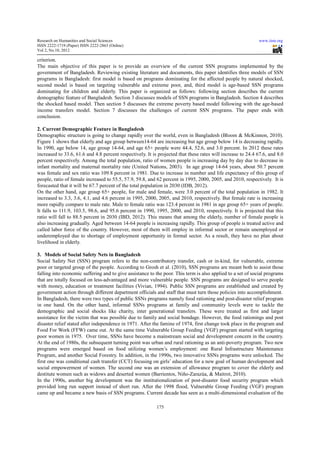
The main objective of this paper is to provide an overview of the current SSN programs implemented by the
                                                                                  program
government of Bangladesh. Reviewing existing literature and documents, this paper identifies three models of SSN
programs in Bangladesh: first model is based on programs dominating for the affected people by natural shocked,
second model is based on targeting vulnerable and extreme poor, and, third model is age-based SSN programs
             l                                                                         age
dominating for children and elderly. This paper is organized as follows: following section describes the current
demographic feature of Bangladesh. Section 3 discusses models of SSN programs in Bangladesh. Section 4 describes
                                             di
the shocked based model. Then section 5 discusses the extreme poverty based model following with the age-based
                                                                                                       age
income transfers model. Section 7 discusses the challenges of current SSN programs. The paper ends with
                                                                               program
conclusion.

2. Current Demographic Feature in Bangladesh
Demographic structure is going to change rapidly over the world, even in Bangladesh (Bloom & McKinnon, 2010).
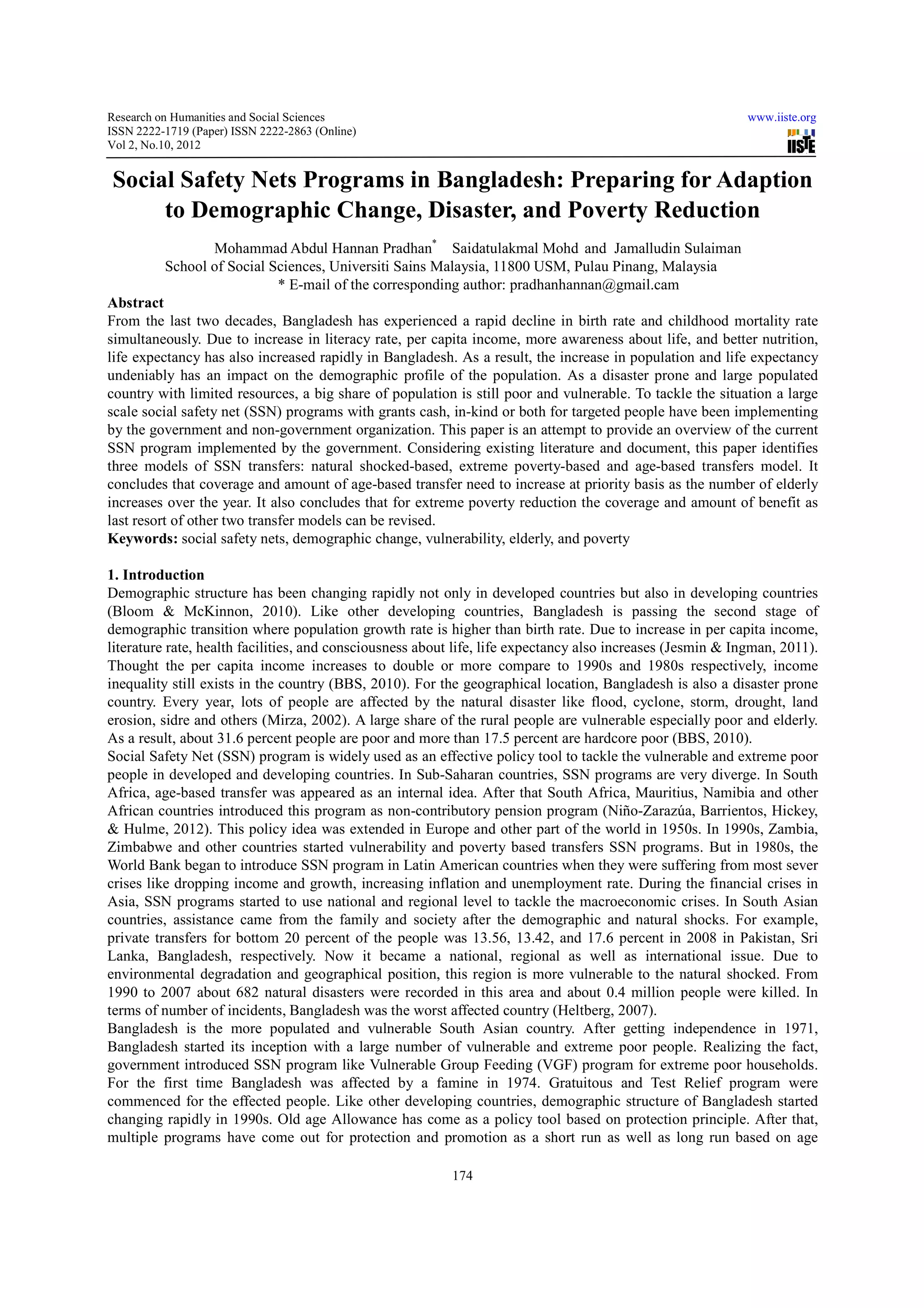
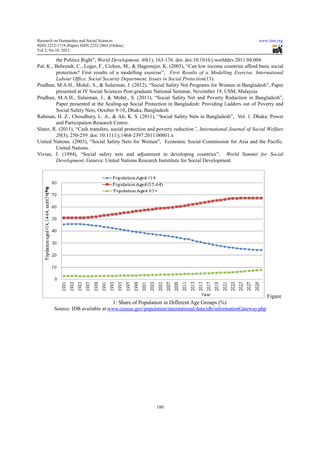
Figure 1 shows that elderly and age group between14-64 are increasing but age group below 14 is decreasing rapidly.
                                             between14              reasing
In 1990, age below 14, age group 14-64, and age 65+ people were 44.4, 52.6, and 3.0 percent. In 2012 these rates
                                     14 64,
increased to 33.6, 61.6 and 4.8 percent respectively. It is projected that these rates will increase to 24.4 67.6, and 8.0
                                                                                       will
percent respectively. Among the total population, ratio of women people is increasing day by day due to decrease in
infant mortality and maternal mortality rate (United Nations, 2003). In age group 14-64 years, about 50.7 percent
                                                                                        14 64
was female and sex ratio was 109.8 percent in 1981. Due to increase in number and life expectancy of this group of
people, ratio of female increased to 55.5, 57.9, 59.8, and 62 percent in 1995, 2000, 2005, and 2010, respectively. It is
forecasted that it will be 67.7 percent of the total population in 2030 (IDB, 2012).
On the other hand, age group 65+ people, for male and female, were 3.0 percent of the total population in 1982. It
increased to 3.3, 3.6, 4.1, and 4.6 percent in 1995, 2000, 2005, and 2010, respectively. But female rate is increasing
                                                                    and
more rapidly compare to male rate. Male to female ratio was 123.4 percent in 1981 in age group 65+ years of people.
It falls to 111.9, 103.5, 98.6, and 95.6 percent in 1990, 1995, 2000, and 2010, respectively. It is projected that this
                                                                                    respectively.
ratio will fall to 88.5 percent in 2030 (IBD, 2012). This means that among the elderly, number of female people is
also increasing gradually. Aged between 14 64 people is increasing rapidly. This group of people is treated active and
                                            14-64
called labor force of the country. However, most of them will employ in informal sector or remain unemployed or
underemployed due to shortage of employment opportunity in formal sector. As a result, they have no plan about
livelihood in elderly.

3. Models of Social Safety Nets in Bangladesh
Social Safety Net (SSN) program refers to the non  non-contributory transfer, cash or in-kind, for vulnerable, extreme
                                                                                          kind,
poor or targeted group of the people. According to Grosh et al. (2010), SSN programs are meant both to assist those
                                                                                                      bo
falling into economic suffering and to give assistance to the poor. This term is also applied to a set of social programs
that are totally focused on less-advantaged and more vulnerable people. SSN programs are designed to serve people
                                  advantaged
with money, education or treatment facilities (Vivian, 1994). Public SSN programs are established and created by
  ith
government action through different department officials and staff that must turn those policies into accomplishment.
In Bangladesh, there were two types of public SSNs programs namely food rationing and post-disaster relief program
                                                                                             post
in one hand. On the other hand, informal SSNs programs at family and community levels were to tackle the
demographic and social shocks like charity, inter generational transfers. These were treated as first and larger
                                                       generational
assistance for the victim that was possible due to family and social bondage. However, the food rationings and post
disaster relief stated after independence in 1971. After the famine of 1974, first change took place in the program and
                                                                                   change
Food For Work (FFW) came out. At the same time Vulnerable Group Feeding (VGF) program started with targeting
poor women in 1975. Over time, SSNs have become a mainstream social and development concern in the country.
At the end of 1980s, the subsequent turning point was urban and rural rationing as an anti-poverty program. Two new
                                                                                        anti-
programs were emerged based on food utilizing women’s employment: one Rural Infrastructure Maintenance
Program, and another Social Forestry. In addition, in the 1990s, two innovative SSNs programs were unlocked. The
                                            addition,
first one was conditional cash transfer (CCT) focusing on girls’ education for a new goal of human development and
social empowerment of women. The second one was an extension of allowance program to cover the elderly and
                                                                           allowance
destitute women such as widows and deserted women (Barrientos, Niño-Zarazúa, & Maitrot, 2010).
                                                                     Niño Zarazúa,
In the 1990s, another big development was the institutionalization of post disaster food security program which
                                                                            post-disaster
provided long run support instead of short run. After the 1998 flood, Vulnerable Group Feeding (VGF) program
came up and became a new basis of SSN programs. Current decade has seen as a multi-dimensional evaluation of the
        p                                   programs                                       dimensional

                                                           175
Research on Humanities and Social Sciences                                                              www.iiste.org
ISSN 2222-1719 (Paper) ISSN 2222-2863 (Online)
                                   2863
Vol 2, No.10, 2012

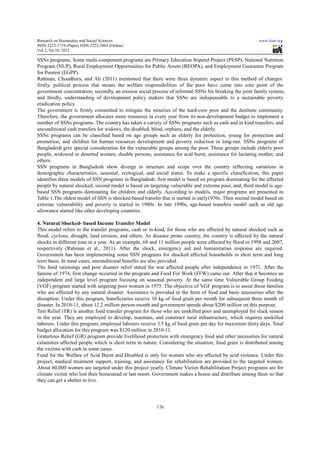
SSNs programs. Some multi-component programs are Primary Education Stipend Project (PESP), National Nutrition
                               component           are
Program (NUP), Rural Employment Opportunities for Public Assets (REOPA), and Employment Guarantee Program
for Poorest (EGPP).
Rahman, Choudhury, and Ali (2011) mentioned that there were three dynamic aspect in this method of changes:
firstly, political process that means the welfare responsibilities of the poor have come into core point of the
government concentration, secondly, an erosion social process of informal SSNs for breaking the joint family system,
and thirdly, understanding of development policy makers that SSNs are indispensable to a sustainable poverty
eradication policy.
The government is firmly committed to mitigate the miseries of the hard-core poor and the destitute community.
                                                                        hard core
Therefore, the government allocates more resources in every year from its non development budget to implement a
  herefore,                                                                  non-development
number of SSNs programs. The country has taken a variety of SSNs programs such as cash and in kind transfers, and
unconditional cash transfers for widows, the disabled, blind, orphans, and the elderly.
                                r
SSNs programs can be classified based on age groups such as elderly for protection, young for protection and
promotion, and children for human resources development and poverty reduction in long-run. SSNs programs of
                                                                                         long
Bangladesh give special consideration for the vulnerable groups among the poor. These groups include elderly poor
people, widowed or deserted women; disable persons, assistance for acid burnt, assistance for lactating mother, and
others.
SSN programs in Bangladesh show diverge in structure and scope over the country reflecting variations in
demographic characteristics, seasonal, ecological, and social status. To make a specific classification, this paper
identifies three models of SSN programs in Bangladesh: first model is based on program dominating for the affected
                                   grams
people by natural shocked, second model is based on targeting vulnerable and extreme poor, and, third model is age
                                                                                                                age-
based SSN programs dominating for children and elderly. According to models, major programs are presented in
                                                              According
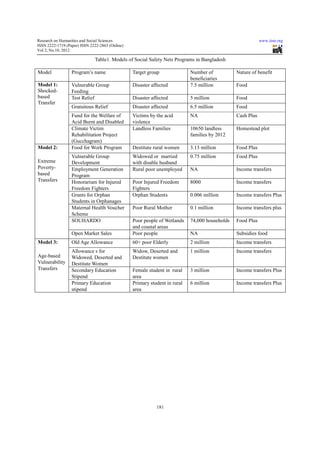
Table 1.The oldest model of SSN is shocked based transfer that is started in early1970s. Then second model based on
                                    shocked-based
extreme vulnerability and poverty is started in 1980s. In late 1990s, age based transfers model such as old age
                                                                         age-based            m
allowance started like other developing countries.

4. Natural Shocked- based Income Transfer Model
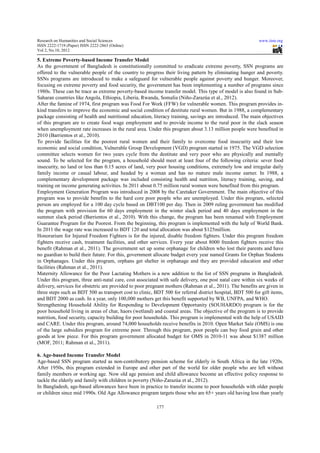
This model refers to the transfer programs, cash or in kind, for those who are affected by natural shocked such as
                                                      in-kind,
flood, cyclone, drought, land erosion, and others. As disaster prone country, the country is affected by the natural
                      ght,
shocks in different time in a year. As an example, 68 and 11 million people were affected by flood in 1998 and 2007,
respectively (Rahman et al., 2011). After the shock, emergency aid and humanitarian response are required.
Government has been implementing some SSN programs for shocked affected households in short term and long
term basis. In most cases, unconditional benefits are also provided.
The food rationings and post disaster relief stated for war affected people after independence in 1971. After the
                  ngs
famine of 1974, first change occurred in the program and Food For Work (FFW) came out. After that it becomes an
                                 curred                           For
independent and large level program focusing on seasonal poverty. At the same time Vulnerable Group Feeding
                                                  on
(VGF) program started with targeting poor women in 1975. The objective of VGF program is to assist those families
who are affected by any natural disaster. Assistance is provided in the form of food and basic necessities after the
disruption. Under this program, beneficiaries receive 10 kg of food grain per month for subsequent three month of
disaster. In 2010-11, about 12.2 million person month and government spends about $200 million on this purpose.
                  11,                    person-month                                                     pu
Test Relief (TR) is another food transfer program for those who are unskilled poor and unemployed for slack season
in the year. They are employed to develop, maintain, and construct rural infrastructure, which requires unskilled
laborers. Under this program, employed laborers receive 3.5 kg of food grain per day for maximum thirty days. Total
                    s
budget allocation for this program was $120 million in 2010
                                                         2010-11.
Gratuitous Relief (GR) program provide livelihood protection with emergency food and other necessities for natural
                                                                                               nec
calamities affected people which is short term in nature. Considering the situation, food grain is distributed among
the victims with cash in some cases.
Fund for the Welfare of Acid Burnt and Disabled is only for women who are affected by acid violence. Under this
                                                                                affected
project, medical treatment support, training, and assistance for rehabilitation are provided to the targeted women.
About 80,000 women are targeted under this project yearly. Climate Victim Rehabilitation Project programs are for
climate victim who lost their homestead or last resort. Government makes a house and distribute among them so that
they can get a shelter to live.


                                                        176
Research on Humanities and Social Sciences                                                                  www.iiste.org
ISSN 2222-1719 (Paper) ISSN 2222-2863 (Online)
                                   2863
Vol 2, No.10, 2012

5. Extreme Poverty-based Income Transfer Model
                       based
As the government of Bangladesh is constitutionally committed to eradicate extreme poverty, SSN programs are
                                                          committed
offered to the vulnerable people of the country to progress their living pattern by eliminating hunger and poverty.
SSNs programs are introduced to make a safeguard for vulnerable people against poverty and hunger. Moreover,
focusing on extreme poverty and food security, the government has been implementing a number of programs since
1980s. These can be trace as extreme poverty based income transfer model. This type of model is also found in Sub-
                                        poverty-based                                                               Sub
Saharan countries like Angola, Ethiopia, Liberia, Rwanda, Somalia (Niño Zarazúa et al., 2012).
            ountries                                                 (Niño-Zarazúa
After the famine of 1974, first program was Food For Work (FFW) for vulnerable women. This program provides in-
                                                      or                                                             in
kind transfers to improve the economic and social condition of destitute rural women. But in 1988, a complementary
package consisting of health and nutritional education, literacy training, savings are introduced. The main objectives
of this program are to create food wage employment and to provide income to the rural poor in the slack season
                                                                                         rural
when unemployment rate increases in the rural area. Under this program about 3.13 million people were benefited in
2010 (Barrientos et al., 2010).
To provide facilities for the poorest rural women and their family to overcome food insecurity and their low
economic and social condition, Vulnerable Group Development (VGD) program started in 1975. The VGD selection
committee selects women for two years cycle from the destitute and very poor who are physically and mentally
sound. To be selected for the program, a household should meet at least four of the following criteria: sever food
          o
insecurity, no land or less than 0.15 acres of land, very poor housing conditions, extremely low and irregular daily
family income or casual labour, and headed by a woman and has no mature male income earner. In 1988, a
complementary development package was included consisting health and nutrition, literacy training, saving, and
training on income generating activities. In 2011 about 0.75 million rural women were benefited from this program.
Employment Generation Program was introduced in 2008 by the Caretaker Government. The main objective of this
program was to provide benefits to the hard core poor people who are unemployed. Under this program, selected  sele
person are employed for a 100 day cycle based on DBT100 per day. Then in 2009 ruling government has modified
the program with provision for 60 days employment in the winter slack period and 40 days employment in the
summer slack period (Barrientos et al., 2010). With this change, the program has been renamed with Employment
Guarantee Program for the Poorest. From the beginning, this program is implemented with the help of World Bank.
In 2011 the wage rate was increased to BDT 120 and total allocation was about $125million.
                                                                       was
Honorarium for Injured Freedom Fighters is for the injured, disable freedom fighters. Under this program freedom
fighters receive cash, treatment facilities, and other services. Every year about 8000 freedom fighters receive this
benefit (Rahman et al., 2011). The government set up some orphanage for children who lost their parents and have
     fit
no guardian to build their future. For this, government allocate budget every year named Grants for Orphan Students
in Orphanages. Under this program, orphans get shelter in orphanage and they are provided education and other
                                    am,
facilities (Rahman et al., 2011).
Maternity Allowance for the Poor Lactating Mothers is a new addition to the list of SSN programs in Bangladesh.
Under this program, three anti-natal care, cost associated with safe delivery, one post natal care within six weeks of
                                  natal
delivery, services for obstetric are provided to poor pregnant mothers (Rahman et al., 2011). The benefits are given in
three steps such as BDT 500 as transport cost to clinic, BDT 500 for referral district hospital, BDT 500 for gift items,
and BDT 2000 as cash. In a year, only 100,000 mothers get this benefit supported by WB, UNFPA, and WHO.
Strengthening Household Ability for Responding to Development Opportunity (SOUHARDO) program is for the
                                                                                    (SOUHARDO)
poor household living in areas of char, haors (wetland) and coastal areas. The objective of the program is to provide
nutrition, food security, capacity building for poor households. This program is implemented with the help of USAID
                                                                                                                USA
and CARE. Under this program, around 74,000 households receive benefits in 2010. Open Market Sale (OMS) is one
of the large subsidies program for extreme poor. Through this program, poor people can buy food grain and other
goods at low piece. For this program government allocated budget for OMS in 2010-11 was about $1387 million
                                 rogram                                              2010 11
(MOF, 2011; Rahman et al., 2011).

6. Age-based Income Transfer Model
        based
Age-based SSN program started as non-contributory pension scheme for elderly in South Africa in the late 1920s.
                                     non contributory                                                      192
After 1950s, this program extended in Europe and other part of the world for older people who are left without
family members or working age. Now old age pension and child allowance become an effective policy response to
tackle the elderly and family with children in poverty (Niño-Zarazúa et al., 2012).
                               ith                     (Niño
In Bangladesh, age-based allowances have been in practice to transfer income to poor households with older people
                     based
or children since mid 1990s. Old Age Allowance program targets those who are 65+ years ol having less than yearly
                                                                                       old

                                                          177
Research on Humanities and Social Sciences                                                                  www.iiste.org
ISSN 2222-1719 (Paper) ISSN 2222-2863 (Online)
                                   2863
Vol 2, No.10, 2012

income of BDT 3000 (below $50) and have no work regularly or in the formal sector. Under this program, ten
elderly people are selected from each Union for the benefit transfer. About 4.8 percent people are elderly of total
population (IDB, 2012). According to this estimation, about 7.5 million are elderly people. Only 2.5 million elderly
        ion
receive Old Age Allowance benefit at BDT 300 per month in 2011( 2011(MOF, 2012). As the beneficiary is selected 50
                                                                                 ).
percent from male and 50 percent from female, only 1.25 million elderly female receive old age allowance which is
40 percent of total old female and 16 percent of total elderly.
Another program is Allowances for the Widowed, Deserted and Destitute Women (AWDDW) which started in 1998.
The widowed, deserted, and destitute women are more helpless in Bangladesh. In social context, a woman’s marital
           wed,
status is important for her survival and safety. Once her husband is died or she is separated from her husband, her
economic condition becomes uncertain in most cases. In fact these groups of women have to readjust the entire basis
                               uncertain
of her life and work. It is estimated that more than 6 million women are widowed in Bangladesh (Iqbal, Khan,
Tahsina, & Dialogue, 2008). Among them, around one million women get this benefit in a year (MOF, 2011).
                                                                                               (
For the poor family with children, there are two programs: Primary Education Stipend Program (PESP) and Female
Secondary School Assistance Program (FSSAP). Previously known as Food for Education project has been replaced
                                                                                                           repl
in 2002 by the cash-based PESP. It is country wide programs covering about 7.8 million students of primary level.
                      based
This is for male and female children who are from poor family. This program provides a cash transfer to families that
keep children in primary education. The households can received benefits Taka 100 for one children and Taka 125
                    imary
for two or more children as long as the children attend 85 percent of school days, and obtain at least 40 percent
marks in the annual examinations(Barrientos et al 2010).
                                                 al.,
Another program for female student is FSSAP. The main object of this program is to increase the number of female
students in the secondary school, to control under age marriage, and to reduce poverty rate through human
development. Every female student get fixed stipend per month and they need not pay any tuition or examination fee.
                              tudent
However, every female student must fulfill some condition to get benefit such as meeting attendance in the school
regularly, up to the marks in the examination and marriage criteria. About 5 million female students receive benefit
                                                      marriage
from this program every year (Barrientos et al., 2010; MOF, 2012).
                                                        MOF

7. Challenges of Current SSN programs
Government of Bangladesh has taken large and various in nature SSNs programs. Rahman et al. (2011) mentioned
that currently government is implementing 84 programs but nearly 97 percent of budget allocation spends on about
30 programs. The government expends on SSNs program 13.32, 15.22, 14.75 and 13.79 as percentage of its budget
in FY 2007-07, 2009-10, 2010-11, 2011 12 and 2.14, 2.52, 2.64, and 2.51 percent of GDP respectively (
                                  11, 2011-12                                                              (MOF, 2012).
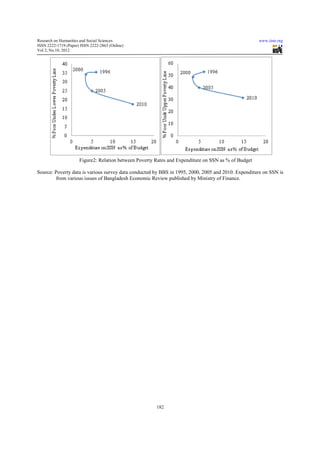
Since expenditure on SSN programs has protection and promotion effect, it is negatively associated with poverty rate
(Devereux, 2002; Pradhan et al., 20  2011; Slater, 2011). Figure 2 shows that poverty rate falls as government spends
                                                  ,
more on SSN as percent of budget in Bangladesh. Therefore, the government gives out resources more every year
from its non-development budget to implement a number of SSNs programs. While continuing with the on-going
               development                                               programs.                              on
programs, the government also adopts new programs that would contribute to the welfare of the poor and also the
deprived community.
As the government is in the main stream of SSN programs, it has to deal with several challenges. Challenges are
balancing on model wise coverag and financing. Demographic projection shows a rapid increase in elderly people.
The growth rate of elderly people from 2000 to 2030 will be more than 200 percent (Jesmin & Ingman, 2011). As the
traditional joint family support for the elderly is deteriorating rapidly, more support for elderly from the government
  aditional
are required. Though the allowance for elderly started in 1990s, coverage and transfers amount is still inaducate.
From every Union, 10 elderly are selected for the old age allowance where male and female is selecte equally. It is
                          lderly
targeted only for those who are extremely poor and destitute older person.
In the national level there is no data base that can provide the actual number of eligible person for SSN benefit. But it
                                                                                  eligible
is estimated that only 10 percent of the poor receive benefits (Morshed, 2009). According to BBS (2010), only 24
                                                                    Morshed,
percent of poor receive at least one SSN program benefit in a year. In some cases, one household receives more than
                                                                                                               mo
one program benefits at a time (Ahmed, 2005). Amount of benefit per beneficiaries lies between BDT300 ($4) to
                                    Ahmed,
BDT350 ($3.5) per month. With this amount, beneficiary can buy six kg of rice or four kg of wheat. It can be
mentioned that mothely benefit covers about 27 to 32 percent of the Food Poverty Line (FPL) and about 70 percent
                                 t
of per capita GDP, yearly (Pradhan et al., 2012).
                                             2012)
The existing SSN program covers only a fraction of vulnerable and poor. Undertaking detailed simulations with
varying fiscal capacity, Pal el al. (2005) show that about 1, 2, and 2 3 percent of GDP could be sufficient to cover
             al                                                         2-3
basic pension, child benefit, and health provision, respectively. But in Bangladesh, only around 2.5 percent of GDP

                                                          178
Research on Humanities and Social Sciences                                                                  www.iiste.org
ISSN 2222-1719 (Paper) ISSN 2222-2863 (Online)
                                   2863
Vol 2, No.10, 2012

spends on all SSN programs. It is still less than the required amount. About 31.5 and 17.6 percent people is poor and
                                      till
hard core poor, respectively. And about 20 percent people are affected by natural shocks yearly. People staying just
above the poverty line are added with poor newly due to inflation. As a result a large part of poor and vulnerable
people remain out of shade of SSN programs.
8. Conclusion
In this paper, three models of SSN have been identified in Bangladesh: age based vulnerability transfers, extreme
                                                                             age-based
poverty-based transfers, and shocked
                                 shocked-based transfer model. Age-based vulnerability transfers model describes a
                                                                       based
group of programs that focuses on children and elderly. Extreme poverty
                                                                   poverty-based transfers present a group of programs
targeting vulnerable and extreme poor. Shocked
                                           Shocked-based transfer model refers those programs that are only for affected
people by natural shocked. Shocked
                                Shocked-based transfer and extreme poverty-based transfer models were in place in
                                                                               based
1970s. Age-based transfer model stared implementing in 1990s.
              based
Three areas are identified as key policy area of SSN program . First, little attention has been paid on aged-based
                       tified                             programs.                                          aged
vulnerability especially elderly. So, more attention should be paid on age based vulnerability to increase the
                                                                               age-based
coverage and financial support. It can be mentioned as an example; government of Maldives has started Old Age
                                               mentioned
Basic Pension Plan replacing Old Age Allowance. Under this plan all people who are 65 or more years will receive
cash thorough the bank account if he/she apply for the benefit. Second, coverage and amount of benefit for extreme
                                                                                     and
poverty and shocked based transfer is limited and very little respectively. In terms of money, it is below $4. Third,
total allocation for SSN programs is below the required amount.
To stabilize aggregate domestic demand after disaster, SSN transfers can play an important role that brings the
                                               after
sustainable economic development for the country. National priority should be to reduce poverty and to provide
resources and services for the targeted people. Providing benefits and services will assist the people who are
                                                                              services
vulnerable, destitute, homeless, and at risk economically or socially. Since high inequality persists in economy,
budget allocation need to increase imposing tax on rich. Through this process, equality can be also achiev
                                                                                                      achieved.
References
Ahmed, S. S. (2005), “Delivery mechanisms of cash transfer programs to the poor in Bangladesh”, World Bank
                           Delivery                                                            Bangladesh
          social protection discussion paper series, No.0520.
                                                series
Bangladesh Bureau of Statistics BBS. (2010), “Primary Report on Household Income & Expenditure Survey 2010”,
          Dhaka, Bangladesh: Bangladesh Bureau of Statistics.
Barrientos, A., Niño-Zarazúa, M., & Maitrot, M. (2010), “Social Assistance in Developing Countries”, Database
                           razúa,                               Social                             Countries
          Version5.0:Chronic Poverty Research Centre. Avalable at SSRN: http://ssrn.com/abstract=1672090 or
                      Chronic                                                         p://ssrn.com/abstract=1672090
          http://dx.doi.org/10.2139/ssrn.1672090
Bloom, D. E., & McKinnon, R. (2010), “Social security and the challenge of demographic change”, International
          Social Security Review 63(3  (3‐4), 3-21
Devereux, S. (2002), “Can social safety nets reduce chronic poverty?”, Development Policy Review 20(5), 657-675
                                       fety                                                            20
Grosh, M. E., Del Ninno, C., Tesliuc, E., & Ouerghi, A. (2010), “For protection and promotion: The design and
          implementation of effective safety nets”, Washington, D.C.: World Bank Publications.
                                                                                  nk
Heltberg, R. (2007), “Helping South Asia cope better with natural disasters: the role of social protection”,
          Development Policy Review 25(6), 681-698.
                                         25
IDB. (2012), “International Data Base (IDB)”, Retrieved on October 15, 2012, from
          http://www.census.gov/population/international/data/idb/informationGateway.php.
               //www.census.gov/population/international/data/idb/informationGateway.php.
Iqbal, M. A., Khan, T. I., Tahsina, T., & Dialogue, C. F. P. (2008), “Macroeconomic Implications of Social Safety
          Nets in the Context of Bangladesh”, Centre for Policy Dialogue.
Jesmin, S. S., & Ingman, S. R. (2011), “Social Supports for Older Adults in Bangladesh”, The Journal of Aging in
 esmin,
          Emerging Economies, 69-79.  79.
Ministry of Finance MOF. (2011) “Bangladesh Economic Review – 2010”, Dhaka: Ministry of Finance,
                                  (2011),
          Government          of      The        People's
                                                 People's    Republic       of       Bangladesh.       Available       at
          http://www.mof.gov.bd/en/index.php?option=com_content&view=article&id=211&Itemid=1
Ministry of Finance MOF. (2012), “Bangladesh Economic Review – 2011”, Dhaka: Ministry of Finance,
          Government          of      The        People's    Republic
                                                             Republic       of       Bangladesh.       Available       at
          http://www.mof.gov.bd/en/index.php?option=com_content&view=article&id=210&Itemid=1
Mirza, M.Q.M. (2002), “Global warming and changes in the probability of occurrence of floods in Bangladesh and
                            Global
          implications”. Global Enviro
                                   Environmental Change 12(2), 127-138.
Morshed, K. A. M. (2009), “Social Safety Net Programmes in Bangladesh”, UNDP, Bangladesh.
                               Social                            Bangladesh
Niño-Zarazúa, M., Barrientos, A., Hickey, S., & Hulme, D. (2012) “Social Protection in Sub-Saharan Africa: Getting
       Zarazúa,                                               (2012), Social                 Sub

                                                          179
Research on Humanities and Social Sciences                                                               www.iiste.org
ISSN 2222-1719 (Paper) ISSN 2222-2863 (Online)
                                   2863
Vol 2, No.10, 2012

         the Politics Right”, World Development, 40(1), 163-176. doi: doi:10.1016/j.worlddev.2011.04.004
                                                    40         176.
Pal, K., Behrendt, C., Leger, F., Cichon, M., & Hagemejer, K. (2005), “Can low income countries afford basic social
                                                                 (2005) Can
         protection? First results of a modelling exercise”, First Results of a Modelling Exercise. International
                                                     exercise            sults
         Labour Office, Social Security Department, Issues in Social Protection(13).
                                                                       Protection
Pradhan, M.A.H., Mohd., S., & Sulaiman, J. (2012), “Social Safety Net Programs for Women in Bangladesh”, Paper
                                                       “Social
         presented at IV Social Sciences Post graduate National Seminar, November 19, USM, Malaysia.
                                  ciences Post-graduate
Pradhan, M.A.H., Sulaiman, J., & Mohd., S. (2011), “Social Safety Net and Poverty Reduction in Bangladesh”,
                                                          “Social
         Paper presented at the Scaling up Social Protection in Bangladesh: Providing Ladders out of Poverty and
                                  Scaling-up                                              La
         Social Safety Nets, October 9 9-10, Dhaka, Bangladesh
Rahman, H. Z., Choudhury, L. A., & Ali, K. S. (2011) “Social Safety Nets in Bangladesh”, Vol. 1. Dhaka: Power
                                                   (2011), Social                 Bangladesh
         and Participation Research Centre.
Slater, R. (2011), “Cash transfers, social protection and poverty reduction”, International Journal of Social Welfare
                                 rs,                               reduction”,
         20(3), 250-259. doi: 10.1111/j.1468
                     259.      10.1111/j.1468-2397.2011.00801.x
United Nations. (2003), “Social Safety Nets for Women”, Economic Social Commission for Asia and the Pacific.
         United Nations.
Vivian, J. (1994), “Social safety nets and adjustment in developing countries
                       Social                                                 countries”, World Summit for Social
         Development. Geneva: United Nations Research Inststitute for Social Development.
                       .


                                                                                                             Figure
                                        1: Share of Population in Different Age Groups (%)
         Source: IDB available at www.census.gov/population/international/data/idb/informationGateway.php


                                                           180
Research on Humanities and Social Sciences                                                                  www.iiste.org
ISSN 2222-1719 (Paper) ISSN 2222-2863 (Online)
                                   2863
Vol 2, No.10, 2012

                              Table1. Models of Social Safety Nets Programs in Bangladesh
                                      Model

Model             Program’s name                 Target group               Number of           Nature of benefit
                                                                            beneficiaries
Model 1:          Vulnerable Group               Disaster affected          7.5 million         Food
Shocked-          Feeding
based             Test Relief                    Disaster affected          5 million           Food
Transfer
                  Gratuitous Relief              Disaster affected          6.5 million         Food
                  Fund for the Welfare of        Victims by the acid        NA                  Cash Plus
                  Acid Burnt and Disabled        violence
                  Climate Victim                 Landless Families          10650 landless      Homestead plot
                  Rehabilitation Project                                    families by 2012
                  (Gucchagram)
Model 2:          Food for Work Program          Destitute rural women      3.13 million        Food Plus
                  Vulnerable Group               Widowed or married         0.75 million        Food Plus
Extreme           Development                    with disable husband
Poverty-          Employment Generation          Rural poor unemployed      NA                  Income transfers
based             Program
Transfers         Honorarium for Injured
                        arium                    Poor Injured Freedom       8000                Income transfers
                  Freedom Fighters               Fighters
                  Grants for Orphan              Orphan Students            0.006 million       Income transfers Plus
                  Students in Orphanages
                  Maternal Health Voucher        Poor Rural Mother          0.1 million         Income transfers plus
                  Scheme
                  SOUHARDO                       Poor people of Wetlands    74,000 households   Food Plus
                                                 and coastal areas
                  Open Market Sales              Poor people                NA                  Subsidies food
Model 3:          Old Age Allowance              60+ poor Elderly           2 million           Income transfers
                  Allowance s for                Widow, Deserted and        1 million           Income transfers
Age-based         Widowed, Deserted and          Destitute women
Vulnerability     Destitute Women
Transfers         Secondary Education            Female student in rural    3 million           Income transfers Plus
                  Stipend                        area
                  Primary Education              Primary student in rural   6 million           Income transfers Plus
                  stipend                        area


                                                            181
Research on Humanities and Social Sciences                                                            www.iiste.org
ISSN 2222-1719 (Paper) ISSN 2222-2863 (Online)
                                   2863
Vol 2, No.10, 2012


                      Figure2: Relation between Poverty R
                             :                          Rates and Expenditure on SSN as % of Budget
                                                                   xpenditure

Source: Poverty data is various survey data conducted by BBS in 1995, 2000, 2005 and 2010. Expenditure on SSN is
                            ous
        from various issues of Bangladesh Economic Review published by Ministry of Finance.


                                                        182
This academic article was published by The International Institute for Science,
Technology and Education (IISTE). The IISTE is a pioneer in the Open Access
Publishing service based in the U.S. and Europe. The aim of the institute is
Accelerating Global Knowledge Sharing.

More information about the publisher can be found in the IISTE’s homepage:
http://www.iiste.org


                               CALL FOR PAPERS

The IISTE is currently hosting more than 30 peer-reviewed academic journals and
collaborating with academic institutions around the world. There’s no deadline for
submission. Prospective authors of IISTE journals can find the submission
instruction on the following page: http://www.iiste.org/Journals/

The IISTE editorial team promises to the review and publish all the qualified
submissions in a fast manner. All the journals articles are available online to the
readers all over the world without financial, legal, or technical barriers other than
those inseparable from gaining access to the internet itself. Printed version of the
journals is also available upon request of readers and authors.

IISTE Knowledge Sharing Partners

EBSCO, Index Copernicus, Ulrich's Periodicals Directory, JournalTOCS, PKP Open
Archives Harvester, Bielefeld Academic Search Engine, Elektronische
Zeitschriftenbibliothek EZB, Open J-Gate, OCLC WorldCat, Universe Digtial
Library , NewJour, Google Scholar

Social safety nets programs in bangladesh

  • 1.
    Research on Humanitiesand Social Sciences www.iiste.org ISSN 2222-1719 (Paper) ISSN 2222-2863 (Online) 2863 Vol 2, No.10, 2012 Social Safety Nets Programs in Bangladesh: Preparing for Adaption to Demographic Change, Disaster, and Poverty Reduction Mohammad Abdul Hannan Pradhan* Saidatulakmal Mohd and Jamalludin Sulaiman School of Social Sciences, Universiti Sains Malaysia, 11800 USM, Pulau Pinang, Malaysia , 1800 * E-mail of the corresponding author: pradhanhannan@gmail.cam mail Abstract From the last two decades, Bangladesh has experienced a rapid decline in birth rate and childhood mortality rate mortalit simultaneously. Due to increase in literacy rate, per capita income, more awareness about life, and better nutrition, life expectancy has also increased rapidly in Bangladesh. As a result, the increase in population and life expectancy undeniably has an impact on the demographic profile of the population. As a disaster prone and large populated s country with limited resources, a big share of population is still poor and vulnerable. To tackle the situation a large scale social safety net (SSN) programs with grants cash, in-kind or both for targeted people have been implementing kind by the government and non-government organization. This paper is an attempt to provide an overview of the current government SSN program implemented by the government. Considering existing literature and document, this paper identifies three models of SSN transfers: natural shocked-based, extreme poverty-based and age-based transfers model. It shocked based age concludes that coverage and amount of age-based transfer need to increase at priority basis as the number of elderly age based increases over the year. It also concludes that for extreme poverty reduction the coverage and amount of benefit as last resort of other two transfer models can be revised. Keywords: social safety nets, demographic change, v vulnerability, elderly, and poverty 1. Introduction Demographic structure has been changing rapidly not only in developed countries but also in developing countries (Bloom & McKinnon, 2010). Like other developing countries, Bangladesh is passing the second stage of demographic transition where population growth rate is higher than birth rate. Due to increase in per capita income, graphic literature rate, health facilities, and consciousness about life, life expectancy also increases (Jesmin & Ingman, 2011). Thought the per capita income increases to double or more compare to 1990s and 1980s respectively, income a inequality still exists in the country (BBS, 2010). For the geographical location, Bangladesh is also a disaster prone ( S, country. Every year, lots of people are affected by the natural disaster like flood, cyclone, storm, drought, land erosion, sidre and others (Mirza, 2002). A large share of the rural people are vulnerable especially poor and elderly. As a result, about 31.6 percent people are poor and more than 17.5 percent are hardcore poor (BBS, 2010). ( Social Safety Net (SSN) program is widely used as an effective policy tool to tackle the vulnerable and extreme poor people in developed and developing countries. In Sub-Saharan countries, SSN programs are very diverge. In South Sub Saharan S Africa, age-based transfer was appeared as an internal idea. After that South Africa, Mauritius, Namibia and other based African countries introduced this program as non-contributory pension program (Niño-Zarazúa, Barrientos, Hickey, non Zarazúa, & Hulme, 2012). This policy idea was extended in Europe and other part of the world in 1950s. In 1990s, Zambia, licy Zimbabwe and other countries started vulnerability and poverty based transfers SSN programs. But in 1980s, the World Bank began to introduce SSN program in Latin American countries when they were suffering from most sever American crises like dropping income and growth, increasing inflation and unemployment rate. During the financial crises in Asia, SSN programs started to use national and regional level to tackle the macroeconomic crises. In South Asian macroecono countries, assistance came from the family and society after the demographic and natural shocks. For example, private transfers for bottom 20 percent of the people was 13.56, 13.42, and 17.6 percent in 2008 in Pakistan, Sri Lanka, Bangladesh, respectively. Now it became a national, regional as well as international issue. Due to , environmental degradation and geographical position, this region is more vulnerable to the natural shocked. From 1990 to 2007 about 682 natural disasters were recorded in this area and about 0.4 million people were killed. In terms of number of incidents, Bangladesh was the worst affected country (Heltberg, 2007). Bangladesh is the more populated and vulnerable South Asia country. After getting independence in 1971, Asian independen Bangladesh started its inception with a large number of vulnerable and extreme poor people. Realizing the fact, government introduced SSN program like Vulnerable Group Feeding (VGF) program for extreme poor households. For the first time Bangladesh was affected by a famine in 1974. Gratuitous and Test Relief program were desh commenced for the effected people. Like other developing countries, demographic structure of Bangladesh started changing rapidly in 1990s. Old age Allowance has come as a policy tool based on protection principle. After that, multiple programs have come out for protection and promotion as a short run as well as long run based on age 174
  • 2.
    Research on Humanitiesand Social Sciences www.iiste.org ISSN 2222-1719 (Paper) ISSN 2222-2863 (Online) 2863 Vol 2, No.10, 2012 criterion. The main objective of this paper is to provide an overview of the current SSN programs implemented by the program government of Bangladesh. Reviewing existing literature and documents, this paper identifies three models of SSN programs in Bangladesh: first model is based on programs dominating for the affected people by natural shocked, second model is based on targeting vulnerable and extreme poor, and, third model is age-based SSN programs l age dominating for children and elderly. This paper is organized as follows: following section describes the current demographic feature of Bangladesh. Section 3 discusses models of SSN programs in Bangladesh. Section 4 describes di the shocked based model. Then section 5 discusses the extreme poverty based model following with the age-based age income transfers model. Section 7 discusses the challenges of current SSN programs. The paper ends with program conclusion. 2. Current Demographic Feature in Bangladesh Demographic structure is going to change rapidly over the world, even in Bangladesh (Bloom & McKinnon, 2010). Figure 1 shows that elderly and age group between14-64 are increasing but age group below 14 is decreasing rapidly. between14 reasing In 1990, age below 14, age group 14-64, and age 65+ people were 44.4, 52.6, and 3.0 percent. In 2012 these rates 14 64, increased to 33.6, 61.6 and 4.8 percent respectively. It is projected that these rates will increase to 24.4 67.6, and 8.0 will percent respectively. Among the total population, ratio of women people is increasing day by day due to decrease in infant mortality and maternal mortality rate (United Nations, 2003). In age group 14-64 years, about 50.7 percent 14 64 was female and sex ratio was 109.8 percent in 1981. Due to increase in number and life expectancy of this group of people, ratio of female increased to 55.5, 57.9, 59.8, and 62 percent in 1995, 2000, 2005, and 2010, respectively. It is forecasted that it will be 67.7 percent of the total population in 2030 (IDB, 2012). On the other hand, age group 65+ people, for male and female, were 3.0 percent of the total population in 1982. It increased to 3.3, 3.6, 4.1, and 4.6 percent in 1995, 2000, 2005, and 2010, respectively. But female rate is increasing and more rapidly compare to male rate. Male to female ratio was 123.4 percent in 1981 in age group 65+ years of people. It falls to 111.9, 103.5, 98.6, and 95.6 percent in 1990, 1995, 2000, and 2010, respectively. It is projected that this respectively. ratio will fall to 88.5 percent in 2030 (IBD, 2012). This means that among the elderly, number of female people is also increasing gradually. Aged between 14 64 people is increasing rapidly. This group of people is treated active and 14-64 called labor force of the country. However, most of them will employ in informal sector or remain unemployed or underemployed due to shortage of employment opportunity in formal sector. As a result, they have no plan about livelihood in elderly. 3. Models of Social Safety Nets in Bangladesh Social Safety Net (SSN) program refers to the non non-contributory transfer, cash or in-kind, for vulnerable, extreme kind, poor or targeted group of the people. According to Grosh et al. (2010), SSN programs are meant both to assist those bo falling into economic suffering and to give assistance to the poor. This term is also applied to a set of social programs that are totally focused on less-advantaged and more vulnerable people. SSN programs are designed to serve people advantaged with money, education or treatment facilities (Vivian, 1994). Public SSN programs are established and created by ith government action through different department officials and staff that must turn those policies into accomplishment. In Bangladesh, there were two types of public SSNs programs namely food rationing and post-disaster relief program post in one hand. On the other hand, informal SSNs programs at family and community levels were to tackle the demographic and social shocks like charity, inter generational transfers. These were treated as first and larger generational assistance for the victim that was possible due to family and social bondage. However, the food rationings and post disaster relief stated after independence in 1971. After the famine of 1974, first change took place in the program and change Food For Work (FFW) came out. At the same time Vulnerable Group Feeding (VGF) program started with targeting poor women in 1975. Over time, SSNs have become a mainstream social and development concern in the country. At the end of 1980s, the subsequent turning point was urban and rural rationing as an anti-poverty program. Two new anti- programs were emerged based on food utilizing women’s employment: one Rural Infrastructure Maintenance Program, and another Social Forestry. In addition, in the 1990s, two innovative SSNs programs were unlocked. The addition, first one was conditional cash transfer (CCT) focusing on girls’ education for a new goal of human development and social empowerment of women. The second one was an extension of allowance program to cover the elderly and allowance destitute women such as widows and deserted women (Barrientos, Niño-Zarazúa, & Maitrot, 2010). Niño Zarazúa, In the 1990s, another big development was the institutionalization of post disaster food security program which post-disaster provided long run support instead of short run. After the 1998 flood, Vulnerable Group Feeding (VGF) program came up and became a new basis of SSN programs. Current decade has seen as a multi-dimensional evaluation of the p programs dimensional 175
  • 3.
    Research on Humanitiesand Social Sciences www.iiste.org ISSN 2222-1719 (Paper) ISSN 2222-2863 (Online) 2863 Vol 2, No.10, 2012 SSNs programs. Some multi-component programs are Primary Education Stipend Project (PESP), National Nutrition component are Program (NUP), Rural Employment Opportunities for Public Assets (REOPA), and Employment Guarantee Program for Poorest (EGPP). Rahman, Choudhury, and Ali (2011) mentioned that there were three dynamic aspect in this method of changes: firstly, political process that means the welfare responsibilities of the poor have come into core point of the government concentration, secondly, an erosion social process of informal SSNs for breaking the joint family system, and thirdly, understanding of development policy makers that SSNs are indispensable to a sustainable poverty eradication policy. The government is firmly committed to mitigate the miseries of the hard-core poor and the destitute community. hard core Therefore, the government allocates more resources in every year from its non development budget to implement a herefore, non-development number of SSNs programs. The country has taken a variety of SSNs programs such as cash and in kind transfers, and unconditional cash transfers for widows, the disabled, blind, orphans, and the elderly. r SSNs programs can be classified based on age groups such as elderly for protection, young for protection and promotion, and children for human resources development and poverty reduction in long-run. SSNs programs of long Bangladesh give special consideration for the vulnerable groups among the poor. These groups include elderly poor people, widowed or deserted women; disable persons, assistance for acid burnt, assistance for lactating mother, and others. SSN programs in Bangladesh show diverge in structure and scope over the country reflecting variations in demographic characteristics, seasonal, ecological, and social status. To make a specific classification, this paper identifies three models of SSN programs in Bangladesh: first model is based on program dominating for the affected grams people by natural shocked, second model is based on targeting vulnerable and extreme poor, and, third model is age age- based SSN programs dominating for children and elderly. According to models, major programs are presented in According Table 1.The oldest model of SSN is shocked based transfer that is started in early1970s. Then second model based on shocked-based extreme vulnerability and poverty is started in 1980s. In late 1990s, age based transfers model such as old age age-based m allowance started like other developing countries. 4. Natural Shocked- based Income Transfer Model This model refers to the transfer programs, cash or in kind, for those who are affected by natural shocked such as in-kind, flood, cyclone, drought, land erosion, and others. As disaster prone country, the country is affected by the natural ght, shocks in different time in a year. As an example, 68 and 11 million people were affected by flood in 1998 and 2007, respectively (Rahman et al., 2011). After the shock, emergency aid and humanitarian response are required. Government has been implementing some SSN programs for shocked affected households in short term and long term basis. In most cases, unconditional benefits are also provided. The food rationings and post disaster relief stated for war affected people after independence in 1971. After the ngs famine of 1974, first change occurred in the program and Food For Work (FFW) came out. After that it becomes an curred For independent and large level program focusing on seasonal poverty. At the same time Vulnerable Group Feeding on (VGF) program started with targeting poor women in 1975. The objective of VGF program is to assist those families who are affected by any natural disaster. Assistance is provided in the form of food and basic necessities after the disruption. Under this program, beneficiaries receive 10 kg of food grain per month for subsequent three month of disaster. In 2010-11, about 12.2 million person month and government spends about $200 million on this purpose. 11, person-month pu Test Relief (TR) is another food transfer program for those who are unskilled poor and unemployed for slack season in the year. They are employed to develop, maintain, and construct rural infrastructure, which requires unskilled laborers. Under this program, employed laborers receive 3.5 kg of food grain per day for maximum thirty days. Total s budget allocation for this program was $120 million in 2010 2010-11. Gratuitous Relief (GR) program provide livelihood protection with emergency food and other necessities for natural nec calamities affected people which is short term in nature. Considering the situation, food grain is distributed among the victims with cash in some cases. Fund for the Welfare of Acid Burnt and Disabled is only for women who are affected by acid violence. Under this affected project, medical treatment support, training, and assistance for rehabilitation are provided to the targeted women. About 80,000 women are targeted under this project yearly. Climate Victim Rehabilitation Project programs are for climate victim who lost their homestead or last resort. Government makes a house and distribute among them so that they can get a shelter to live. 176
  • 4.
    Research on Humanitiesand Social Sciences www.iiste.org ISSN 2222-1719 (Paper) ISSN 2222-2863 (Online) 2863 Vol 2, No.10, 2012 5. Extreme Poverty-based Income Transfer Model based As the government of Bangladesh is constitutionally committed to eradicate extreme poverty, SSN programs are committed offered to the vulnerable people of the country to progress their living pattern by eliminating hunger and poverty. SSNs programs are introduced to make a safeguard for vulnerable people against poverty and hunger. Moreover, focusing on extreme poverty and food security, the government has been implementing a number of programs since 1980s. These can be trace as extreme poverty based income transfer model. This type of model is also found in Sub- poverty-based Sub Saharan countries like Angola, Ethiopia, Liberia, Rwanda, Somalia (Niño Zarazúa et al., 2012). ountries (Niño-Zarazúa After the famine of 1974, first program was Food For Work (FFW) for vulnerable women. This program provides in- or in kind transfers to improve the economic and social condition of destitute rural women. But in 1988, a complementary package consisting of health and nutritional education, literacy training, savings are introduced. The main objectives of this program are to create food wage employment and to provide income to the rural poor in the slack season rural when unemployment rate increases in the rural area. Under this program about 3.13 million people were benefited in 2010 (Barrientos et al., 2010). To provide facilities for the poorest rural women and their family to overcome food insecurity and their low economic and social condition, Vulnerable Group Development (VGD) program started in 1975. The VGD selection committee selects women for two years cycle from the destitute and very poor who are physically and mentally sound. To be selected for the program, a household should meet at least four of the following criteria: sever food o insecurity, no land or less than 0.15 acres of land, very poor housing conditions, extremely low and irregular daily family income or casual labour, and headed by a woman and has no mature male income earner. In 1988, a complementary development package was included consisting health and nutrition, literacy training, saving, and training on income generating activities. In 2011 about 0.75 million rural women were benefited from this program. Employment Generation Program was introduced in 2008 by the Caretaker Government. The main objective of this program was to provide benefits to the hard core poor people who are unemployed. Under this program, selected sele person are employed for a 100 day cycle based on DBT100 per day. Then in 2009 ruling government has modified the program with provision for 60 days employment in the winter slack period and 40 days employment in the summer slack period (Barrientos et al., 2010). With this change, the program has been renamed with Employment Guarantee Program for the Poorest. From the beginning, this program is implemented with the help of World Bank. In 2011 the wage rate was increased to BDT 120 and total allocation was about $125million. was Honorarium for Injured Freedom Fighters is for the injured, disable freedom fighters. Under this program freedom fighters receive cash, treatment facilities, and other services. Every year about 8000 freedom fighters receive this benefit (Rahman et al., 2011). The government set up some orphanage for children who lost their parents and have fit no guardian to build their future. For this, government allocate budget every year named Grants for Orphan Students in Orphanages. Under this program, orphans get shelter in orphanage and they are provided education and other am, facilities (Rahman et al., 2011). Maternity Allowance for the Poor Lactating Mothers is a new addition to the list of SSN programs in Bangladesh. Under this program, three anti-natal care, cost associated with safe delivery, one post natal care within six weeks of natal delivery, services for obstetric are provided to poor pregnant mothers (Rahman et al., 2011). The benefits are given in three steps such as BDT 500 as transport cost to clinic, BDT 500 for referral district hospital, BDT 500 for gift items, and BDT 2000 as cash. In a year, only 100,000 mothers get this benefit supported by WB, UNFPA, and WHO. Strengthening Household Ability for Responding to Development Opportunity (SOUHARDO) program is for the (SOUHARDO) poor household living in areas of char, haors (wetland) and coastal areas. The objective of the program is to provide nutrition, food security, capacity building for poor households. This program is implemented with the help of USAID USA and CARE. Under this program, around 74,000 households receive benefits in 2010. Open Market Sale (OMS) is one of the large subsidies program for extreme poor. Through this program, poor people can buy food grain and other goods at low piece. For this program government allocated budget for OMS in 2010-11 was about $1387 million rogram 2010 11 (MOF, 2011; Rahman et al., 2011). 6. Age-based Income Transfer Model based Age-based SSN program started as non-contributory pension scheme for elderly in South Africa in the late 1920s. non contributory 192 After 1950s, this program extended in Europe and other part of the world for older people who are left without family members or working age. Now old age pension and child allowance become an effective policy response to tackle the elderly and family with children in poverty (Niño-Zarazúa et al., 2012). ith (Niño In Bangladesh, age-based allowances have been in practice to transfer income to poor households with older people based or children since mid 1990s. Old Age Allowance program targets those who are 65+ years ol having less than yearly old 177
  • 5.
    Research on Humanitiesand Social Sciences www.iiste.org ISSN 2222-1719 (Paper) ISSN 2222-2863 (Online) 2863 Vol 2, No.10, 2012 income of BDT 3000 (below $50) and have no work regularly or in the formal sector. Under this program, ten elderly people are selected from each Union for the benefit transfer. About 4.8 percent people are elderly of total population (IDB, 2012). According to this estimation, about 7.5 million are elderly people. Only 2.5 million elderly ion receive Old Age Allowance benefit at BDT 300 per month in 2011( 2011(MOF, 2012). As the beneficiary is selected 50 ). percent from male and 50 percent from female, only 1.25 million elderly female receive old age allowance which is 40 percent of total old female and 16 percent of total elderly. Another program is Allowances for the Widowed, Deserted and Destitute Women (AWDDW) which started in 1998. The widowed, deserted, and destitute women are more helpless in Bangladesh. In social context, a woman’s marital wed, status is important for her survival and safety. Once her husband is died or she is separated from her husband, her economic condition becomes uncertain in most cases. In fact these groups of women have to readjust the entire basis uncertain of her life and work. It is estimated that more than 6 million women are widowed in Bangladesh (Iqbal, Khan, Tahsina, & Dialogue, 2008). Among them, around one million women get this benefit in a year (MOF, 2011). ( For the poor family with children, there are two programs: Primary Education Stipend Program (PESP) and Female Secondary School Assistance Program (FSSAP). Previously known as Food for Education project has been replaced repl in 2002 by the cash-based PESP. It is country wide programs covering about 7.8 million students of primary level. based This is for male and female children who are from poor family. This program provides a cash transfer to families that keep children in primary education. The households can received benefits Taka 100 for one children and Taka 125 imary for two or more children as long as the children attend 85 percent of school days, and obtain at least 40 percent marks in the annual examinations(Barrientos et al 2010). al., Another program for female student is FSSAP. The main object of this program is to increase the number of female students in the secondary school, to control under age marriage, and to reduce poverty rate through human development. Every female student get fixed stipend per month and they need not pay any tuition or examination fee. tudent However, every female student must fulfill some condition to get benefit such as meeting attendance in the school regularly, up to the marks in the examination and marriage criteria. About 5 million female students receive benefit marriage from this program every year (Barrientos et al., 2010; MOF, 2012). MOF 7. Challenges of Current SSN programs Government of Bangladesh has taken large and various in nature SSNs programs. Rahman et al. (2011) mentioned that currently government is implementing 84 programs but nearly 97 percent of budget allocation spends on about 30 programs. The government expends on SSNs program 13.32, 15.22, 14.75 and 13.79 as percentage of its budget in FY 2007-07, 2009-10, 2010-11, 2011 12 and 2.14, 2.52, 2.64, and 2.51 percent of GDP respectively ( 11, 2011-12 (MOF, 2012). Since expenditure on SSN programs has protection and promotion effect, it is negatively associated with poverty rate (Devereux, 2002; Pradhan et al., 20 2011; Slater, 2011). Figure 2 shows that poverty rate falls as government spends , more on SSN as percent of budget in Bangladesh. Therefore, the government gives out resources more every year from its non-development budget to implement a number of SSNs programs. While continuing with the on-going development programs. on programs, the government also adopts new programs that would contribute to the welfare of the poor and also the deprived community. As the government is in the main stream of SSN programs, it has to deal with several challenges. Challenges are balancing on model wise coverag and financing. Demographic projection shows a rapid increase in elderly people. The growth rate of elderly people from 2000 to 2030 will be more than 200 percent (Jesmin & Ingman, 2011). As the traditional joint family support for the elderly is deteriorating rapidly, more support for elderly from the government aditional are required. Though the allowance for elderly started in 1990s, coverage and transfers amount is still inaducate. From every Union, 10 elderly are selected for the old age allowance where male and female is selecte equally. It is lderly targeted only for those who are extremely poor and destitute older person. In the national level there is no data base that can provide the actual number of eligible person for SSN benefit. But it eligible is estimated that only 10 percent of the poor receive benefits (Morshed, 2009). According to BBS (2010), only 24 Morshed, percent of poor receive at least one SSN program benefit in a year. In some cases, one household receives more than mo one program benefits at a time (Ahmed, 2005). Amount of benefit per beneficiaries lies between BDT300 ($4) to Ahmed, BDT350 ($3.5) per month. With this amount, beneficiary can buy six kg of rice or four kg of wheat. It can be mentioned that mothely benefit covers about 27 to 32 percent of the Food Poverty Line (FPL) and about 70 percent t of per capita GDP, yearly (Pradhan et al., 2012). 2012) The existing SSN program covers only a fraction of vulnerable and poor. Undertaking detailed simulations with varying fiscal capacity, Pal el al. (2005) show that about 1, 2, and 2 3 percent of GDP could be sufficient to cover al 2-3 basic pension, child benefit, and health provision, respectively. But in Bangladesh, only around 2.5 percent of GDP 178
  • 6.
    Research on Humanitiesand Social Sciences www.iiste.org ISSN 2222-1719 (Paper) ISSN 2222-2863 (Online) 2863 Vol 2, No.10, 2012 spends on all SSN programs. It is still less than the required amount. About 31.5 and 17.6 percent people is poor and till hard core poor, respectively. And about 20 percent people are affected by natural shocks yearly. People staying just above the poverty line are added with poor newly due to inflation. As a result a large part of poor and vulnerable people remain out of shade of SSN programs. 8. Conclusion In this paper, three models of SSN have been identified in Bangladesh: age based vulnerability transfers, extreme age-based poverty-based transfers, and shocked shocked-based transfer model. Age-based vulnerability transfers model describes a based group of programs that focuses on children and elderly. Extreme poverty poverty-based transfers present a group of programs targeting vulnerable and extreme poor. Shocked Shocked-based transfer model refers those programs that are only for affected people by natural shocked. Shocked Shocked-based transfer and extreme poverty-based transfer models were in place in based 1970s. Age-based transfer model stared implementing in 1990s. based Three areas are identified as key policy area of SSN program . First, little attention has been paid on aged-based tified programs. aged vulnerability especially elderly. So, more attention should be paid on age based vulnerability to increase the age-based coverage and financial support. It can be mentioned as an example; government of Maldives has started Old Age mentioned Basic Pension Plan replacing Old Age Allowance. Under this plan all people who are 65 or more years will receive cash thorough the bank account if he/she apply for the benefit. Second, coverage and amount of benefit for extreme and poverty and shocked based transfer is limited and very little respectively. In terms of money, it is below $4. Third, total allocation for SSN programs is below the required amount. To stabilize aggregate domestic demand after disaster, SSN transfers can play an important role that brings the after sustainable economic development for the country. National priority should be to reduce poverty and to provide resources and services for the targeted people. Providing benefits and services will assist the people who are services vulnerable, destitute, homeless, and at risk economically or socially. Since high inequality persists in economy, budget allocation need to increase imposing tax on rich. Through this process, equality can be also achiev achieved. References Ahmed, S. S. (2005), “Delivery mechanisms of cash transfer programs to the poor in Bangladesh”, World Bank Delivery Bangladesh social protection discussion paper series, No.0520. series Bangladesh Bureau of Statistics BBS. (2010), “Primary Report on Household Income & Expenditure Survey 2010”, Dhaka, Bangladesh: Bangladesh Bureau of Statistics. Barrientos, A., Niño-Zarazúa, M., & Maitrot, M. (2010), “Social Assistance in Developing Countries”, Database razúa, Social Countries Version5.0:Chronic Poverty Research Centre. Avalable at SSRN: http://ssrn.com/abstract=1672090 or Chronic p://ssrn.com/abstract=1672090 http://dx.doi.org/10.2139/ssrn.1672090 Bloom, D. E., & McKinnon, R. (2010), “Social security and the challenge of demographic change”, International Social Security Review 63(3 (3‐4), 3-21 Devereux, S. (2002), “Can social safety nets reduce chronic poverty?”, Development Policy Review 20(5), 657-675 fety 20 Grosh, M. E., Del Ninno, C., Tesliuc, E., & Ouerghi, A. (2010), “For protection and promotion: The design and implementation of effective safety nets”, Washington, D.C.: World Bank Publications. nk Heltberg, R. (2007), “Helping South Asia cope better with natural disasters: the role of social protection”, Development Policy Review 25(6), 681-698. 25 IDB. (2012), “International Data Base (IDB)”, Retrieved on October 15, 2012, from http://www.census.gov/population/international/data/idb/informationGateway.php. //www.census.gov/population/international/data/idb/informationGateway.php. Iqbal, M. A., Khan, T. I., Tahsina, T., & Dialogue, C. F. P. (2008), “Macroeconomic Implications of Social Safety Nets in the Context of Bangladesh”, Centre for Policy Dialogue. Jesmin, S. S., & Ingman, S. R. (2011), “Social Supports for Older Adults in Bangladesh”, The Journal of Aging in esmin, Emerging Economies, 69-79. 79. Ministry of Finance MOF. (2011) “Bangladesh Economic Review – 2010”, Dhaka: Ministry of Finance, (2011), Government of The People's People's Republic of Bangladesh. Available at http://www.mof.gov.bd/en/index.php?option=com_content&view=article&id=211&Itemid=1 Ministry of Finance MOF. (2012), “Bangladesh Economic Review – 2011”, Dhaka: Ministry of Finance, Government of The People's Republic Republic of Bangladesh. Available at http://www.mof.gov.bd/en/index.php?option=com_content&view=article&id=210&Itemid=1 Mirza, M.Q.M. (2002), “Global warming and changes in the probability of occurrence of floods in Bangladesh and Global implications”. Global Enviro Environmental Change 12(2), 127-138. Morshed, K. A. M. (2009), “Social Safety Net Programmes in Bangladesh”, UNDP, Bangladesh. Social Bangladesh Niño-Zarazúa, M., Barrientos, A., Hickey, S., & Hulme, D. (2012) “Social Protection in Sub-Saharan Africa: Getting Zarazúa, (2012), Social Sub 179
  • 7.
    Research on Humanitiesand Social Sciences www.iiste.org ISSN 2222-1719 (Paper) ISSN 2222-2863 (Online) 2863 Vol 2, No.10, 2012 the Politics Right”, World Development, 40(1), 163-176. doi: doi:10.1016/j.worlddev.2011.04.004 40 176. Pal, K., Behrendt, C., Leger, F., Cichon, M., & Hagemejer, K. (2005), “Can low income countries afford basic social (2005) Can protection? First results of a modelling exercise”, First Results of a Modelling Exercise. International exercise sults Labour Office, Social Security Department, Issues in Social Protection(13). Protection Pradhan, M.A.H., Mohd., S., & Sulaiman, J. (2012), “Social Safety Net Programs for Women in Bangladesh”, Paper “Social presented at IV Social Sciences Post graduate National Seminar, November 19, USM, Malaysia. ciences Post-graduate Pradhan, M.A.H., Sulaiman, J., & Mohd., S. (2011), “Social Safety Net and Poverty Reduction in Bangladesh”, “Social Paper presented at the Scaling up Social Protection in Bangladesh: Providing Ladders out of Poverty and Scaling-up La Social Safety Nets, October 9 9-10, Dhaka, Bangladesh Rahman, H. Z., Choudhury, L. A., & Ali, K. S. (2011) “Social Safety Nets in Bangladesh”, Vol. 1. Dhaka: Power (2011), Social Bangladesh and Participation Research Centre. Slater, R. (2011), “Cash transfers, social protection and poverty reduction”, International Journal of Social Welfare rs, reduction”, 20(3), 250-259. doi: 10.1111/j.1468 259. 10.1111/j.1468-2397.2011.00801.x United Nations. (2003), “Social Safety Nets for Women”, Economic Social Commission for Asia and the Pacific. United Nations. Vivian, J. (1994), “Social safety nets and adjustment in developing countries Social countries”, World Summit for Social Development. Geneva: United Nations Research Inststitute for Social Development. . Figure 1: Share of Population in Different Age Groups (%) Source: IDB available at www.census.gov/population/international/data/idb/informationGateway.php 180
  • 8.
    Research on Humanitiesand Social Sciences www.iiste.org ISSN 2222-1719 (Paper) ISSN 2222-2863 (Online) 2863 Vol 2, No.10, 2012 Table1. Models of Social Safety Nets Programs in Bangladesh Model Model Program’s name Target group Number of Nature of benefit beneficiaries Model 1: Vulnerable Group Disaster affected 7.5 million Food Shocked- Feeding based Test Relief Disaster affected 5 million Food Transfer Gratuitous Relief Disaster affected 6.5 million Food Fund for the Welfare of Victims by the acid NA Cash Plus Acid Burnt and Disabled violence Climate Victim Landless Families 10650 landless Homestead plot Rehabilitation Project families by 2012 (Gucchagram) Model 2: Food for Work Program Destitute rural women 3.13 million Food Plus Vulnerable Group Widowed or married 0.75 million Food Plus Extreme Development with disable husband Poverty- Employment Generation Rural poor unemployed NA Income transfers based Program Transfers Honorarium for Injured arium Poor Injured Freedom 8000 Income transfers Freedom Fighters Fighters Grants for Orphan Orphan Students 0.006 million Income transfers Plus Students in Orphanages Maternal Health Voucher Poor Rural Mother 0.1 million Income transfers plus Scheme SOUHARDO Poor people of Wetlands 74,000 households Food Plus and coastal areas Open Market Sales Poor people NA Subsidies food Model 3: Old Age Allowance 60+ poor Elderly 2 million Income transfers Allowance s for Widow, Deserted and 1 million Income transfers Age-based Widowed, Deserted and Destitute women Vulnerability Destitute Women Transfers Secondary Education Female student in rural 3 million Income transfers Plus Stipend area Primary Education Primary student in rural 6 million Income transfers Plus stipend area 181
  • 9.
    Research on Humanitiesand Social Sciences www.iiste.org ISSN 2222-1719 (Paper) ISSN 2222-2863 (Online) 2863 Vol 2, No.10, 2012 Figure2: Relation between Poverty R : Rates and Expenditure on SSN as % of Budget xpenditure Source: Poverty data is various survey data conducted by BBS in 1995, 2000, 2005 and 2010. Expenditure on SSN is ous from various issues of Bangladesh Economic Review published by Ministry of Finance. 182
  • 10.
    This academic articlewas published by The International Institute for Science, Technology and Education (IISTE). The IISTE is a pioneer in the Open Access Publishing service based in the U.S. and Europe. The aim of the institute is Accelerating Global Knowledge Sharing. More information about the publisher can be found in the IISTE’s homepage: http://www.iiste.org CALL FOR PAPERS The IISTE is currently hosting more than 30 peer-reviewed academic journals and collaborating with academic institutions around the world. There’s no deadline for submission. Prospective authors of IISTE journals can find the submission instruction on the following page: http://www.iiste.org/Journals/ The IISTE editorial team promises to the review and publish all the qualified submissions in a fast manner. All the journals articles are available online to the readers all over the world without financial, legal, or technical barriers other than those inseparable from gaining access to the internet itself. Printed version of the journals is also available upon request of readers and authors. IISTE Knowledge Sharing Partners EBSCO, Index Copernicus, Ulrich's Periodicals Directory, JournalTOCS, PKP Open Archives Harvester, Bielefeld Academic Search Engine, Elektronische Zeitschriftenbibliothek EZB, Open J-Gate, OCLC WorldCat, Universe Digtial Library , NewJour, Google Scholar