• Everyman, as is typical of most Morality Plays
(actors don’t play as an actual person ,they paly as
human qualities)
• Everyman is a one-act play (employs one-
dimensional characters to represent people, things,
events, or symbols.)
• Salivation.......
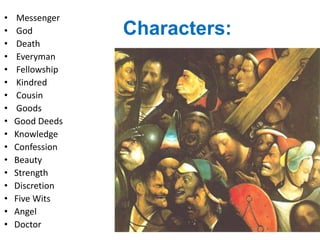
Characters:
• Messenger
• God
• Death
• Everyman
• Fellowship
• Kindred
• Cousin
• Goods
• Good Deeds
• Knowledge
• Confession
• Beauty
• Strength
• Discretion
• Five Wits
• Angel
• Doctor
Themes
• Several closely related themes are presented in Everyman,
which are represented by the words and actions of the
characters.
• Giving to others is more rewarding than acquiring wealth and
possessions.
• · People are responsible for their own actions.
• · The only thing humans can take with them in death is the
virtue they lived with during life.
• · God will forgive those who repent.
• · Virtuous living is the path to salvation.
Messenger
• begins with a Messenger:
A prologue, read by the messenger
asks the audience to give their
attention and announces the purpose
of the play, which will show us our
lives as well as our deaths (“our
ending”) and how we humans are
always changing from one state into
another.
• Messenger.
I pray you all give your audience,
And hear this matter with reverence,
In form a moral play.
The Summoning of Everyman it is called so,
That of our lives and ending maketh show
How transitory we be every day.
This matter is wondrous precious,
But the meaning of it is more gracious
And sweet to bear away.
The story : Man, in the beginning
Watch well, and take good heed of the ending....
• God speaks next, and immediately launches into a criticism of
the way that “all creatures” are not serving Him properly.
People are living without “dread” (fear) in the world without
any thought of heaven or hell. God says. Everyone is living
purely for their own pleasure, but yet they are not at all
secure in their lives. God sees everything so has decided to
have a “reckoning of every man’s person”. Are they guilty or
are they godly – should they be going to heaven or hell?
• God calls in Death, his “messenger
mightly”. People who love wealth
and worldly goods will be sent to
dwell in hell eternally unless that is,
“Alms be his good friend”. “Alms”
means “good deeds”, and it is an
important clue even at this stage that
good deeds can save a sinner from
eternal damnation.
God.
Go thou to Everyman,
And show him in my name
A pilgrimage he must on him take,
Which he in no wise may escape,
And that he bring with him a sure reckoning
Without delay or any tarrying.
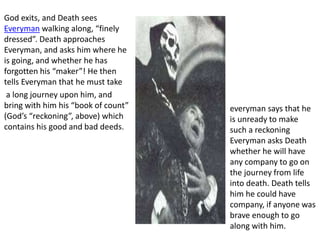
God exits, and Death sees
Everyman walking along, “finely
dressed”. Death approaches
Everyman, and asks him where he
is going, and whether he has
forgotten his “maker”! He then
tells Everyman that he must take
a long journey upon him, and
bring with him his “book of count”
(God’s “reckoning”, above) which
contains his good and bad deeds.
everyman says that he
is unready to make
such a reckoning
Everyman asks Death
whether he will have
any company to go on
the journey from life
into death. Death tells
him he could have
company, if anyone was
brave enough to go
along with him.
• Fellowship
• Kindred&Cousin“
• Goods
(that love of Goods is
opposite to love of God)
More friends:
Discretion, Strength, Beauty & Five Wits
Make promise to accompany Everyman on his journey to
Everyman’s grave
(each of his companions set their hands on the cross).
As Everyman begins to die, Beauty, Strength, Discretion and Five
Wits all forsake him one after another.
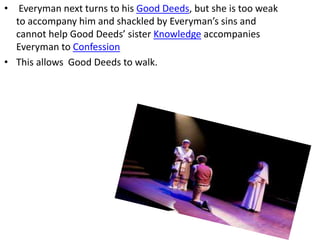
• Everyman next turns to his Good Deeds, but she is too weak
to accompany him and shackled by Everyman’s sins and
cannot help Good Deeds’ sister Knowledge accompanies
Everyman to Confession
• This allows Good Deeds to walk.
• Everyman learns that knowledge of his sins
and his repentance of them is the means to
find salvation
• The audience is learned that the priest is
God’s representative on earth and that man
must turn to priests to help him prepare for
death.
Attheend
Everyman realizes that it is time for him to be gone
to make his reckoning and pay his spiritual debts.
Yet, he says, there is a lesson to be learned, and
speaks the lesson of the play:
(Into thy hands, Lord, my soul I commend
Receive it, Lord, that it be not lost!
As thou didst me buy, so do thou me defend,
And save me from the fiend’s boast
That I may appear with that blessed host(885)
That shall be saved at the day of doom.
In manus tuas, of mights the most,
Forever commendo spiritum meum.)
[Everyman goes into the grave]
a Doctor of Theology appears to remind the audience
that all men must make this journey and that only their
good deeds will speak for them at God’s final reckoning.
• Doctor.
• This moral men may have in mind,—
• Ye hearers, take it as of worth, both young and old,
• And forsake Pride, for he deceiveth you in the end, as ye will find,(905)
• And remember Beauty, Five Wits, Strength, and Discretion, all told,
• They all at the last do Everyman forsake
• Save that his Good Deeds there doth he take.
• But beware, if they be small,(910)
• Before God he hath no help at all,
• None excuse for Everyman may there then be there.
• Alas, how shall he then do and fare!
• For after death amends may no man make,
• For then Mercy and Pity do him forsake.(915)
• If his reckoning be not clear when he doth come,
• God will say, Ite, maledicti, in ignem aeternum.
• And he that hath his account whole and sound,
• High in heaven he shall be crowned,
• Unto which place God bring us all thither(920)
• That we may live, body and soul, together!
• Thereto their aid vouchsafe the Trinity—
• Amen, say ye, for holy Charity!

Everyman

  • 2.
    • Everyman, asis typical of most Morality Plays (actors don’t play as an actual person ,they paly as human qualities) • Everyman is a one-act play (employs one- dimensional characters to represent people, things, events, or symbols.) • Salivation.......
  • 3.
    Characters: • Messenger • God •Death • Everyman • Fellowship • Kindred • Cousin • Goods • Good Deeds • Knowledge • Confession • Beauty • Strength • Discretion • Five Wits • Angel • Doctor
  • 4.
    Themes • Several closelyrelated themes are presented in Everyman, which are represented by the words and actions of the characters. • Giving to others is more rewarding than acquiring wealth and possessions. • · People are responsible for their own actions. • · The only thing humans can take with them in death is the virtue they lived with during life. • · God will forgive those who repent. • · Virtuous living is the path to salvation.
  • 5.
    Messenger • begins witha Messenger: A prologue, read by the messenger asks the audience to give their attention and announces the purpose of the play, which will show us our lives as well as our deaths (“our ending”) and how we humans are always changing from one state into another.
  • 6.
    • Messenger. I prayyou all give your audience, And hear this matter with reverence, In form a moral play. The Summoning of Everyman it is called so, That of our lives and ending maketh show How transitory we be every day. This matter is wondrous precious, But the meaning of it is more gracious And sweet to bear away. The story : Man, in the beginning Watch well, and take good heed of the ending....
  • 7.
    • God speaksnext, and immediately launches into a criticism of the way that “all creatures” are not serving Him properly. People are living without “dread” (fear) in the world without any thought of heaven or hell. God says. Everyone is living purely for their own pleasure, but yet they are not at all secure in their lives. God sees everything so has decided to have a “reckoning of every man’s person”. Are they guilty or are they godly – should they be going to heaven or hell?
  • 8.
    • God callsin Death, his “messenger mightly”. People who love wealth and worldly goods will be sent to dwell in hell eternally unless that is, “Alms be his good friend”. “Alms” means “good deeds”, and it is an important clue even at this stage that good deeds can save a sinner from eternal damnation. God. Go thou to Everyman, And show him in my name A pilgrimage he must on him take, Which he in no wise may escape, And that he bring with him a sure reckoning Without delay or any tarrying.
  • 9.
    God exits, andDeath sees Everyman walking along, “finely dressed”. Death approaches Everyman, and asks him where he is going, and whether he has forgotten his “maker”! He then tells Everyman that he must take a long journey upon him, and bring with him his “book of count” (God’s “reckoning”, above) which contains his good and bad deeds. everyman says that he is unready to make such a reckoning Everyman asks Death whether he will have any company to go on the journey from life into death. Death tells him he could have company, if anyone was brave enough to go along with him.
  • 10.
    • Fellowship • Kindred&Cousin“ •Goods (that love of Goods is opposite to love of God)
  • 11.
    More friends: Discretion, Strength,Beauty & Five Wits Make promise to accompany Everyman on his journey to Everyman’s grave (each of his companions set their hands on the cross). As Everyman begins to die, Beauty, Strength, Discretion and Five Wits all forsake him one after another.
  • 12.
    • Everyman nextturns to his Good Deeds, but she is too weak to accompany him and shackled by Everyman’s sins and cannot help Good Deeds’ sister Knowledge accompanies Everyman to Confession • This allows Good Deeds to walk.
  • 13.
    • Everyman learnsthat knowledge of his sins and his repentance of them is the means to find salvation • The audience is learned that the priest is God’s representative on earth and that man must turn to priests to help him prepare for death.
  • 14.
    Attheend Everyman realizes thatit is time for him to be gone to make his reckoning and pay his spiritual debts. Yet, he says, there is a lesson to be learned, and speaks the lesson of the play: (Into thy hands, Lord, my soul I commend Receive it, Lord, that it be not lost! As thou didst me buy, so do thou me defend, And save me from the fiend’s boast That I may appear with that blessed host(885) That shall be saved at the day of doom. In manus tuas, of mights the most, Forever commendo spiritum meum.) [Everyman goes into the grave]
  • 15.
    a Doctor ofTheology appears to remind the audience that all men must make this journey and that only their good deeds will speak for them at God’s final reckoning.
  • 16.
    • Doctor. • Thismoral men may have in mind,— • Ye hearers, take it as of worth, both young and old, • And forsake Pride, for he deceiveth you in the end, as ye will find,(905) • And remember Beauty, Five Wits, Strength, and Discretion, all told, • They all at the last do Everyman forsake • Save that his Good Deeds there doth he take. • But beware, if they be small,(910) • Before God he hath no help at all, • None excuse for Everyman may there then be there. • Alas, how shall he then do and fare! • For after death amends may no man make, • For then Mercy and Pity do him forsake.(915) • If his reckoning be not clear when he doth come, • God will say, Ite, maledicti, in ignem aeternum. • And he that hath his account whole and sound, • High in heaven he shall be crowned, • Unto which place God bring us all thither(920) • That we may live, body and soul, together! • Thereto their aid vouchsafe the Trinity— • Amen, say ye, for holy Charity!