Social protection and development cooperation  Reflections on the role of international advocacy and civil society   in the developing world Sida Academy Seminar  Stockholm  19 October 2010  Sylvia Beales  Head of Strategic Alliances  HelpAge International   [email_address]
Expectations   in our ageing century National and global investment in people and in decent jobs  Good and affordable health services and disease prevention at all ages Accessible and appropriate health & social care at all stages of life Secure income in old age, in childhood, and at times of disability  Clean water, sanitation, nutritious food and education  Dignity, respect, security and freedom from discrimination  Sylvia Beales September 2010
Approaches to building demand  Engaging with governments Partnerships with regional and international actors  Brokering and supporting  stakeholder dialogue Listening to and learning from our constituency  Supporting civil society  Contributing to and furthering evidence base  Promoting capacity building  Supporting  south south learning
Rationale for Social Protection  Persistent poverty amongst the already poor  Rising inequality in and between countries Inadequate access to basic services including water Growing disenfranchisement and unemployment of youth Growth of employment in informal sector  Only one in five are beneficiaries of right of social security  Intergenerational transfer of poverty Greatest health spend is ‘out of pocket’  for poorest families  Non communicable disease including dementia biggest health burden in developing world Demographic transition from young to old in poorest countries; intergenerational interdependence
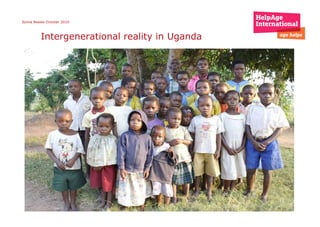
Sylvia Beales October 2010 Intergenerational reality in Uganda
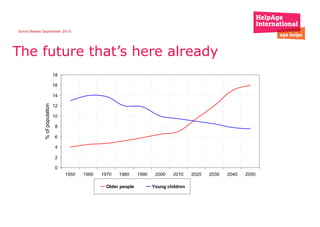
The future that’s here already  Sylvia Beales September 2010
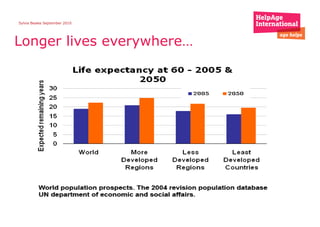
Longer lives everywhere…  Sylvia Beales September 2010
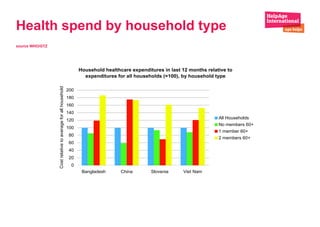
Health spend by household type source WHO/GTZ
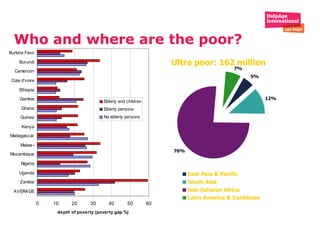
Who and where are the poor?
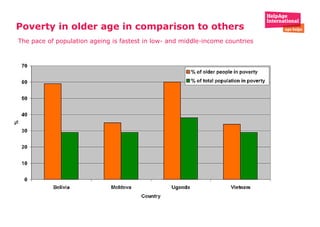
Poverty in older age in comparison to others   The pace of population ageing is fastest in low- and middle-income countries
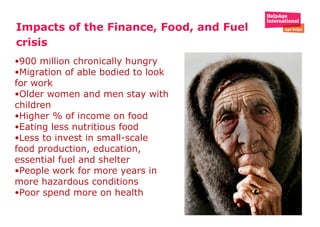
Impacts of the Finance, Food, and Fuel crisis 900 million chronically hungry Migration of able bodied to look for work  Older women and men stay with children  Higher % of income on food Eating less nutritious food Less to invest in small-scale food production, education, essential fuel and shelter People work for more years in more hazardous conditions Poor spend more on health
Social protection dialogue needs mandate,  definitions, evidence and dialogue  Social protection encompasses a range of public actions carried out by the state and others that address risk, vulnerability, discrimination and chronic poverty . (Livingstone 1) The right to social security in childhood, old age and at times of disability is expressed in a range of international Human Rights Declarations and treaties. Social security transfers in the form of, for example, pensions, child benefit and disability allowances are considered to be core elements of a comprehensive social protection system.’ [1]  ( Livingstone 2) [1]   By implementing basic social protection, states and supporting international agencies fulfill international human obligations, as expressed in Article 25 of the Universal Declaration of Human Rights.
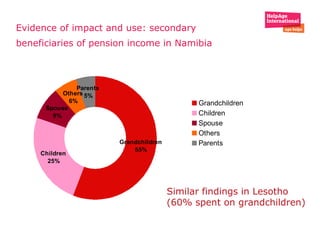
Evidence of impact and use: secondary beneficiaries of pension income in Namibia Similar findings in Lesotho (60% spent on grandchildren)
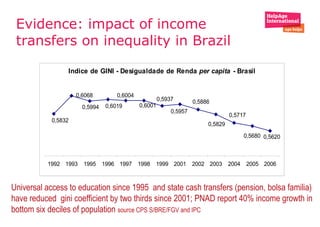
Evidence: impact of income transfers on inequality in Brazil Universal access to education since 1995  and state cash transfers (pension, bolsa familia) have reduced  gini coefficient by two thirds since 2001; PNAD report 40% income growth in bottom six deciles of population  source CPS  S/BRE/FGV and IPC
Evidence of citizen/state impact of cash transfer in Northern Kenya  (source HelpAge International) Links previously unknown communities with governance systems triggering local demand for services Creates incentives for people to get national ID cards which are required to  receive cash, to vote, to register birth of children and to participate in constitutional processes  Incentive for communities to improve record keeping/civic registration systems Incentive for previously insecure communities to provide better security  Excluded people have a voice and channel to express real or perceived grievances  Recognised as a significant first step towards accountability and responsiveness of state to citizen
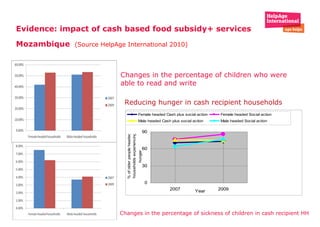
Evidence: impact of cash based food subsidy+ services Mozambique  (Source HelpAge International 2010) Reducing hunger in cash recipient households Changes in the percentage of children who were able to read and write Changes in the percentage of sickness of children in cash recipient HH
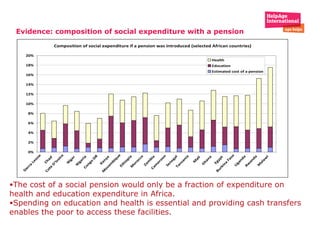
Evidence: composition of social expenditure with a pension The cost of a social pension would only be a fraction of expenditure on health and education expenditure in Africa.  Spending on education and health is essential and providing cash transfers enables the poor to access these facilities.
Process example in Africa:  ‘Transformative Agenda for the 21 st  Century’  2006; Livingstone 1: expert evidence presented to 16 governments including by Brazil; field visit to homes in Kalomo Zambia Call for Action included  ‘costed plans’ for basic transfers and follow up  Govt of Zambia/HelpAge convened with support of African Union  Political will generated by Call for Action fed into international processes and national debates  2008: African Union convened Livingstone 2:  6 National, 3 Regional and Ministerial continental Dialogue  Social Policy Framework with social protection embedded  HelpAge supported process with UN and development partners including DFID GTZ and Sida  ‘  S ocial protection mechanisms reduce poverty and inequality, ensure social sustainability and contribute to economic growth’ (African Union 2008)
Consensus recommendations  Establish high level inter-ministerial committees on social protection (SP) Establish regional social protection ‘observatories’ Review budgetary provisions for SP based on accurate demographic and poverty data Support institutional capacity building  Introduce a global strategy on SP – eg a minimum social security package Partnerships with civil society on SP design, delivery and monitoring  Include SP in PRSPs and put together national SP action plans Ensure social security reforms promote public and private investment and prioritise sustainability, universality and improved quality of services  Extend social security to informal sector workers  Improve health access for all groups
Mission To strengthen civil society engagement with the articulation, formulation and implementation of social protection policies and programmes in Africa. Objective  To support the development of effective national social protection policies and programmes for people in chronic poverty, in particular older people, children and physically/mentally challenged people and thereby contribute to the achievement of the Millennium Development goals (MDGS) and to the goals of Africa Social Policy Framework (SPF).   Focus  Capacity,  Coordination,  Engagement
Building national civil society action  Livingstone 2006 Social Protection “Call for Action” Johannesburg CSO Workshop; March 2007 CSO Consultations 2007/8 “ Investing in social protection in Africa” 2008; national and regional expert meetings Presence in AU Ministerial  Windhoek 2008 Nairobi Conference September 2008 – 90 participants from 23 African countries 2010 - 25 countries, Board and Constitution
Key activities of the Platform  Translation of human rights agreements, including the right to social security, into accountable national programmes Promoting dialogue on covering costs from domestic resources: sustainability for long term programmes requires national financing including from taxation Universalism – build up and expand existing programmes Building up civil society capabilities to be credible & to engage with governments Input to constitutional reform to enshrine rights Consultative meetings in Ghana, Kenya and  Rwanda to develop national platforms and to  feed into AU process on SP
Implementation challenges National implementation issues Robust political will and achieving a shared vision Context specific models and regional differences in emphasis  Inter-ministerial coordination and financing  Creating national fiscal space for long term budgetary provision  Capacity building on systems development including registration  Evidence and monitoring with citizen engagement  Regional and international issues Supporting capacity development in design and implementation  Role for aid and support of donor community for extending social security coverage and agreement on minimum package  Long term support for implementation of SP Floor/minimum package Greater investment in social policy including health  Support for citizen action and its policy engagement
Opportunities:  African Union Social Policy Framework National ,subregional and regional agreements for social protection on  Building political consensus  Design, targeting and implementation  Finance  Building Communication, Capacity and Co-ordination (3Cs) National action and consensus required – No ‘one size fits all’
African Union Social Protection agreement   ‘ A minimum package of essential social protection to cover essential health care, and benefits for children, informal workers, the unemployed, older persons and persons with disabilities. This minimum package provides the platform for broadening and extending social protection as more fiscal space is created’  ‘ Develop and operationalise costed national plans for social protection based on the concept of a “minimum package”’   (extracts from Social Protection segment of African Union Social Policy Framework 2008/9) Ministers in charge of social development to meet on 22-26 November 2010 Khartoum Sudan to review implementation
Opportunities: Social Protection Floor 2009   UN Global Initiative – one of nine to combat the global crisis Promotes universal access to essential social transfers and services Currently 80% of global population lack regular transfers and services Provides for availability, continuity geographical and financial access to essential services  Ensures a basic set of essential social transfers in cash and in kind (entitlements, information and policies) in old age, childhood and at times of disability  MDG progress will be ‘accelerated’ by ‘ promoting universal access to public and social services and providing  social protection floors ’ (MDG outcome document September 2010)
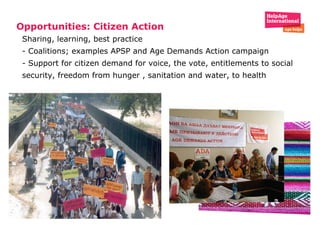
Opportunities: Citizen Action  Sharing, learning, best practice - Coalitions; examples APSP and Age Demands Action campaign - Support for citizen demand for voice, the vote, entitlements to social security, freedom from hunger , sanitation and water, to health
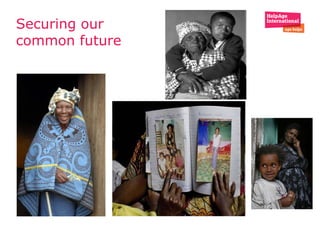
Securing our  common future

Social protection and development cooperation

  • 1.
    Social protection anddevelopment cooperation Reflections on the role of international advocacy and civil society in the developing world Sida Academy Seminar Stockholm 19 October 2010 Sylvia Beales Head of Strategic Alliances HelpAge International [email_address]
  • 2.
    Expectations in our ageing century National and global investment in people and in decent jobs Good and affordable health services and disease prevention at all ages Accessible and appropriate health & social care at all stages of life Secure income in old age, in childhood, and at times of disability Clean water, sanitation, nutritious food and education Dignity, respect, security and freedom from discrimination Sylvia Beales September 2010
  • 3.
    Approaches to buildingdemand Engaging with governments Partnerships with regional and international actors Brokering and supporting stakeholder dialogue Listening to and learning from our constituency Supporting civil society Contributing to and furthering evidence base Promoting capacity building Supporting south south learning
  • 4.
    Rationale for SocialProtection Persistent poverty amongst the already poor Rising inequality in and between countries Inadequate access to basic services including water Growing disenfranchisement and unemployment of youth Growth of employment in informal sector Only one in five are beneficiaries of right of social security Intergenerational transfer of poverty Greatest health spend is ‘out of pocket’ for poorest families Non communicable disease including dementia biggest health burden in developing world Demographic transition from young to old in poorest countries; intergenerational interdependence
  • 5.
    Sylvia Beales October2010 Intergenerational reality in Uganda
  • 6.
    The future that’shere already Sylvia Beales September 2010
  • 7.
    Longer lives everywhere… Sylvia Beales September 2010
  • 8.
    Health spend byhousehold type source WHO/GTZ
  • 9.
    Who and whereare the poor?
  • 10.
    Poverty in olderage in comparison to others The pace of population ageing is fastest in low- and middle-income countries
  • 11.
    Impacts of theFinance, Food, and Fuel crisis 900 million chronically hungry Migration of able bodied to look for work Older women and men stay with children Higher % of income on food Eating less nutritious food Less to invest in small-scale food production, education, essential fuel and shelter People work for more years in more hazardous conditions Poor spend more on health
  • 12.
    Social protection dialogueneeds mandate, definitions, evidence and dialogue Social protection encompasses a range of public actions carried out by the state and others that address risk, vulnerability, discrimination and chronic poverty . (Livingstone 1) The right to social security in childhood, old age and at times of disability is expressed in a range of international Human Rights Declarations and treaties. Social security transfers in the form of, for example, pensions, child benefit and disability allowances are considered to be core elements of a comprehensive social protection system.’ [1] ( Livingstone 2) [1] By implementing basic social protection, states and supporting international agencies fulfill international human obligations, as expressed in Article 25 of the Universal Declaration of Human Rights.
  • 13.
    Evidence of impactand use: secondary beneficiaries of pension income in Namibia Similar findings in Lesotho (60% spent on grandchildren)
  • 14.
    Evidence: impact ofincome transfers on inequality in Brazil Universal access to education since 1995 and state cash transfers (pension, bolsa familia) have reduced gini coefficient by two thirds since 2001; PNAD report 40% income growth in bottom six deciles of population source CPS S/BRE/FGV and IPC
  • 15.
    Evidence of citizen/stateimpact of cash transfer in Northern Kenya (source HelpAge International) Links previously unknown communities with governance systems triggering local demand for services Creates incentives for people to get national ID cards which are required to receive cash, to vote, to register birth of children and to participate in constitutional processes Incentive for communities to improve record keeping/civic registration systems Incentive for previously insecure communities to provide better security Excluded people have a voice and channel to express real or perceived grievances Recognised as a significant first step towards accountability and responsiveness of state to citizen
  • 16.
    Evidence: impact ofcash based food subsidy+ services Mozambique (Source HelpAge International 2010) Reducing hunger in cash recipient households Changes in the percentage of children who were able to read and write Changes in the percentage of sickness of children in cash recipient HH
  • 17.
    Evidence: composition ofsocial expenditure with a pension The cost of a social pension would only be a fraction of expenditure on health and education expenditure in Africa. Spending on education and health is essential and providing cash transfers enables the poor to access these facilities.
  • 18.
    Process example inAfrica: ‘Transformative Agenda for the 21 st Century’ 2006; Livingstone 1: expert evidence presented to 16 governments including by Brazil; field visit to homes in Kalomo Zambia Call for Action included ‘costed plans’ for basic transfers and follow up Govt of Zambia/HelpAge convened with support of African Union Political will generated by Call for Action fed into international processes and national debates 2008: African Union convened Livingstone 2: 6 National, 3 Regional and Ministerial continental Dialogue Social Policy Framework with social protection embedded HelpAge supported process with UN and development partners including DFID GTZ and Sida ‘ S ocial protection mechanisms reduce poverty and inequality, ensure social sustainability and contribute to economic growth’ (African Union 2008)
  • 19.
    Consensus recommendations Establish high level inter-ministerial committees on social protection (SP) Establish regional social protection ‘observatories’ Review budgetary provisions for SP based on accurate demographic and poverty data Support institutional capacity building Introduce a global strategy on SP – eg a minimum social security package Partnerships with civil society on SP design, delivery and monitoring Include SP in PRSPs and put together national SP action plans Ensure social security reforms promote public and private investment and prioritise sustainability, universality and improved quality of services Extend social security to informal sector workers Improve health access for all groups
  • 20.
    Mission To strengthencivil society engagement with the articulation, formulation and implementation of social protection policies and programmes in Africa. Objective To support the development of effective national social protection policies and programmes for people in chronic poverty, in particular older people, children and physically/mentally challenged people and thereby contribute to the achievement of the Millennium Development goals (MDGS) and to the goals of Africa Social Policy Framework (SPF).   Focus Capacity, Coordination, Engagement
  • 21.
    Building national civilsociety action Livingstone 2006 Social Protection “Call for Action” Johannesburg CSO Workshop; March 2007 CSO Consultations 2007/8 “ Investing in social protection in Africa” 2008; national and regional expert meetings Presence in AU Ministerial Windhoek 2008 Nairobi Conference September 2008 – 90 participants from 23 African countries 2010 - 25 countries, Board and Constitution
  • 22.
    Key activities ofthe Platform Translation of human rights agreements, including the right to social security, into accountable national programmes Promoting dialogue on covering costs from domestic resources: sustainability for long term programmes requires national financing including from taxation Universalism – build up and expand existing programmes Building up civil society capabilities to be credible & to engage with governments Input to constitutional reform to enshrine rights Consultative meetings in Ghana, Kenya and Rwanda to develop national platforms and to feed into AU process on SP
  • 23.
    Implementation challenges Nationalimplementation issues Robust political will and achieving a shared vision Context specific models and regional differences in emphasis Inter-ministerial coordination and financing Creating national fiscal space for long term budgetary provision Capacity building on systems development including registration Evidence and monitoring with citizen engagement Regional and international issues Supporting capacity development in design and implementation Role for aid and support of donor community for extending social security coverage and agreement on minimum package Long term support for implementation of SP Floor/minimum package Greater investment in social policy including health Support for citizen action and its policy engagement
  • 24.
    Opportunities: AfricanUnion Social Policy Framework National ,subregional and regional agreements for social protection on Building political consensus Design, targeting and implementation Finance Building Communication, Capacity and Co-ordination (3Cs) National action and consensus required – No ‘one size fits all’
  • 25.
    African Union SocialProtection agreement ‘ A minimum package of essential social protection to cover essential health care, and benefits for children, informal workers, the unemployed, older persons and persons with disabilities. This minimum package provides the platform for broadening and extending social protection as more fiscal space is created’ ‘ Develop and operationalise costed national plans for social protection based on the concept of a “minimum package”’ (extracts from Social Protection segment of African Union Social Policy Framework 2008/9) Ministers in charge of social development to meet on 22-26 November 2010 Khartoum Sudan to review implementation
  • 26.
    Opportunities: Social ProtectionFloor 2009 UN Global Initiative – one of nine to combat the global crisis Promotes universal access to essential social transfers and services Currently 80% of global population lack regular transfers and services Provides for availability, continuity geographical and financial access to essential services Ensures a basic set of essential social transfers in cash and in kind (entitlements, information and policies) in old age, childhood and at times of disability MDG progress will be ‘accelerated’ by ‘ promoting universal access to public and social services and providing social protection floors ’ (MDG outcome document September 2010)
  • 27.
    Opportunities: Citizen Action Sharing, learning, best practice - Coalitions; examples APSP and Age Demands Action campaign - Support for citizen demand for voice, the vote, entitlements to social security, freedom from hunger , sanitation and water, to health
  • 28.
    Securing our common future

Editor's Notes

  • #7 In Kerala primary schools are closing – a commission considering turning them in older people’s centres
  • #14 But pensioners are not the only benefits of pensions. As this report has shown. OP live as part of wider households. Only 30% of the pension spent on older person alone, rest was shared.