
Measuring action on global ageing
Examples from Helpage International
Kings College 23 March 2015
Sylvia Beales HelpAge International sbeales@helpage.org
HelpAge works with 116 Affiliates and 6
regional offices in 74 countries; Global
Network and NGO
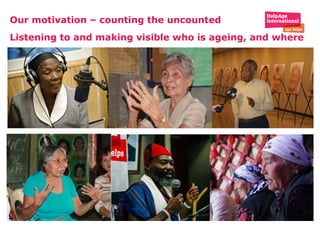
Our motivation – counting the uncounted
Listening to and making visible who is ageing, and where
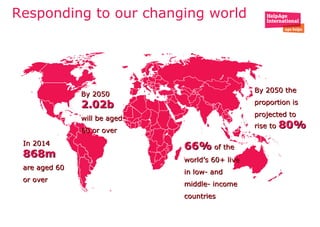
Responding to our changing world
In 2014In 2014
868m868m
are aged 60are aged 60
or overor over
By 2050By 2050
2.02b2.02b
will be agedwill be aged
60 or over60 or over
66%66% of theof the
world’s 60+ liveworld’s 60+ live
in low- andin low- and
middle- incomemiddle- income
countriescountries
By 2050 theBy 2050 the
proportion isproportion is
projected toprojected to
rise torise to 80%80%
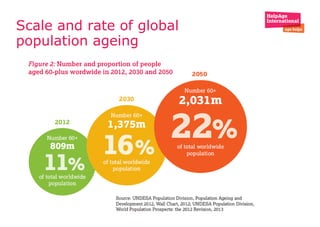
Scale and rate of global
population ageing
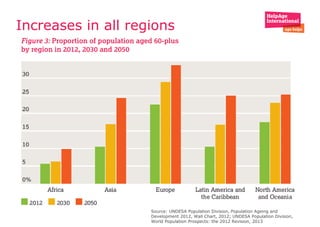
Increases in all regions
Source: UNDESA Population Division, Population Ageing and
Development 2012, Wall Chart, 2012; UNDESA Population Division,
World Population Prospects: the 2012 Revision, 2013
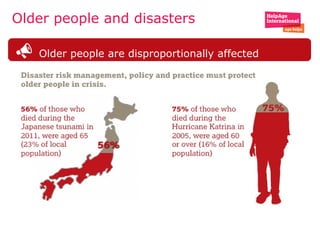
Older people are disproportionally affected
Older people and disasters
Background findings of ‘ Ageing in the 21st
Century – a celebration and a challenge’
Older people play a vital role, giving more than they receive
Investment in basic income security, pensions systems and
health brings returns across generations
Non-communicable diseases (NCDs) on the rise
Dementia care costs fall mainly on the family. Worldwide cost
of dementia in 2010: US$604 billion.
Environmental change and humanitarian disaster affect older
people disproportionately
Age-friendly housing and transport vital to access services
Elder abuse often hidden in families – shame and stigma
Global Agewatch Index – what is it?
• Monitors well-being of older people across the world
• Benchmarks countries and provide insight into areas of policy
intervention
• Provides a guideline framework for governments and
international institutions on key data to collect to develop and
respond to population ageing
• Helps identify, track and monitor key trends on ageing at
country, regional and global levels
• Ensures the Post 2015 framework includes older people and
responds to the UN Secretary General’s call for a ‘data
revolution’.
• Uses the latest cross-national data available from World
Bank, WHO, ILO, and Gallup World View
• Covers 96 countries representing 91% of the world’s older
people interactive website www.globalagewatch.org
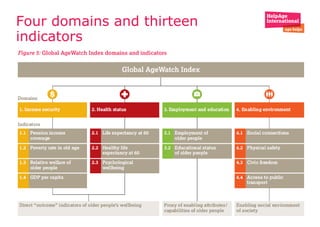
Four domains and thirteen
indicators
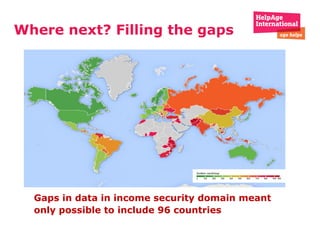
Where next? Filling the gaps
Older people
contribute so much…
it’s time to
invest in them
Gaps in data in income security domain meant
only possible to include 96 countries
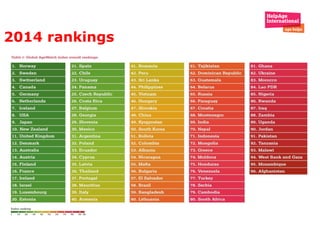
2014 rankings
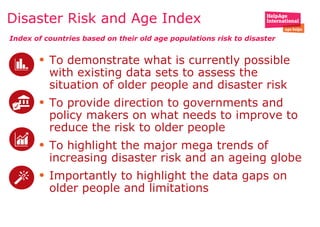
• To demonstrate what is currently possible
with existing data sets to assess the
situation of older people and disaster risk
• To provide direction to governments and
policy makers on what needs to improve to
reduce the risk to older people
• To highlight the major mega trends of
increasing disaster risk and an ageing globe
• Importantly to highlight the data gaps on
older people and limitations
Disaster Risk and Age Index
Index of countries based on their old age populations risk to disaster
Disaster Risk and Age Index
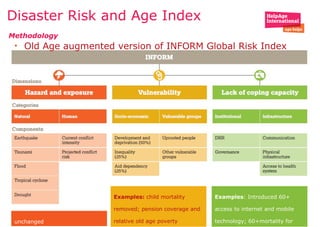
Methodology
• Old Age augmented version of INFORM Global Risk Index
unchanged
Examples: child mortality
removed; pension coverage and
relative old age poverty
Examples: Introduced 60+
access to internet and mobile
technology; 60+mortality for
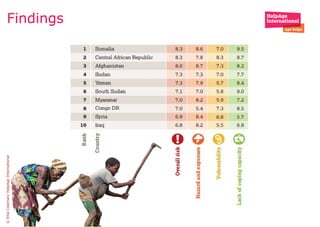
Findings
©EllieColeman/HelpAgeInternational
Ageing and disaster smart
development
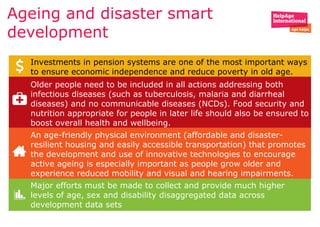
Investments in pension systems are one of the most important ways
to ensure economic independence and reduce poverty in old age.
Older people need to be included in all actions addressing both
infectious diseases (such as tuberculosis, malaria and diarrheal
diseases) and no communicable diseases (NCDs). Food security and
nutrition appropriate for people in later life should also be ensured to
boost overall health and wellbeing.
An age-friendly physical environment (affordable and disaster-
resilient housing and easily accessible transportation) that promotes
the development and use of innovative technologies to encourage
active ageing is especially important as people grow older and
experience reduced mobility and visual and hearing impairments.
Major efforts must be made to collect and provide much higher
levels of age, sex and disability disaggregated data across
development data sets
Cross-national research
challenges: Data
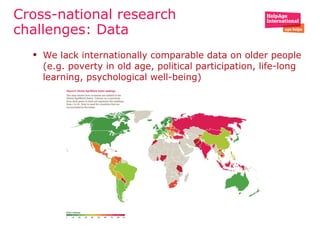
• We lack internationally comparable data on older people
(e.g. poverty in old age, political participation, life-long
learning, psychological well-being)
Cross-national research
challenges: Data
• When data is available it might not reflect the current
situation
• Time lag when national statistics makes it to
international datasets
• No international agreement on methodology of
measuring indicators (e.g. HALE; poverty rate: absolute
vs. relative; equivalence scale; income vs. consumption
based)
• Subjective indicators - better quality data needed
greater sample and age group 60+
• should be part of national datasets (e.g. Eurofound
Quality of life Survey 2012, EU Quality of life
indicators
2014/5 influencing impact examples
• Global - Post-2015; putting age in the new Sustainable Development Goal
Framework: through
 Improving and extending data on ageing - leave no one behind
 Input of findings to Member State and regional body negotiations – age in 7
of the 17 proposed goals of framework
 Highlighting age in November ‘14 data report of UN expert ‘data revolution’
group, and in December ‘14 SG report
 Using Global AgeWatch Index together with Commonwealth Youth Index to
promote better data and visibility of youth and older people
• The Economic and Social Research Council support national research from
January 2015 using the Index framework in 4 Asian countries - China,
Pakistan, India, Bangladesh
• National Index development in Korea, China and Kenya
• United Arab Emirates propose a regional Index to support planning on
ageing and to fill in data gaps for the region
Charter 14
Thank you and spread the word!
www.helpage.org

Measuring action on ageing: Examples from Helpage International

  • 1.
    Measuring action onglobal ageing Examples from Helpage International Kings College 23 March 2015 Sylvia Beales HelpAge International sbeales@helpage.org
  • 2.
    HelpAge works with116 Affiliates and 6 regional offices in 74 countries; Global Network and NGO
  • 3.
    Our motivation –counting the uncounted Listening to and making visible who is ageing, and where
  • 4.
    Responding to ourchanging world In 2014In 2014 868m868m are aged 60are aged 60 or overor over By 2050By 2050 2.02b2.02b will be agedwill be aged 60 or over60 or over 66%66% of theof the world’s 60+ liveworld’s 60+ live in low- andin low- and middle- incomemiddle- income countriescountries By 2050 theBy 2050 the proportion isproportion is projected toprojected to rise torise to 80%80%
  • 5.
    Scale and rateof global population ageing
  • 6.
    Increases in allregions Source: UNDESA Population Division, Population Ageing and Development 2012, Wall Chart, 2012; UNDESA Population Division, World Population Prospects: the 2012 Revision, 2013
  • 7.
    Older people aredisproportionally affected Older people and disasters
  • 8.
    Background findings of‘ Ageing in the 21st Century – a celebration and a challenge’ Older people play a vital role, giving more than they receive Investment in basic income security, pensions systems and health brings returns across generations Non-communicable diseases (NCDs) on the rise Dementia care costs fall mainly on the family. Worldwide cost of dementia in 2010: US$604 billion. Environmental change and humanitarian disaster affect older people disproportionately Age-friendly housing and transport vital to access services Elder abuse often hidden in families – shame and stigma
  • 9.
    Global Agewatch Index– what is it? • Monitors well-being of older people across the world • Benchmarks countries and provide insight into areas of policy intervention • Provides a guideline framework for governments and international institutions on key data to collect to develop and respond to population ageing • Helps identify, track and monitor key trends on ageing at country, regional and global levels • Ensures the Post 2015 framework includes older people and responds to the UN Secretary General’s call for a ‘data revolution’. • Uses the latest cross-national data available from World Bank, WHO, ILO, and Gallup World View • Covers 96 countries representing 91% of the world’s older people interactive website www.globalagewatch.org
  • 10.
    Four domains andthirteen indicators
  • 12.
    Where next? Fillingthe gaps Older people contribute so much… it’s time to invest in them Gaps in data in income security domain meant only possible to include 96 countries
  • 13.
  • 14.
    • To demonstratewhat is currently possible with existing data sets to assess the situation of older people and disaster risk • To provide direction to governments and policy makers on what needs to improve to reduce the risk to older people • To highlight the major mega trends of increasing disaster risk and an ageing globe • Importantly to highlight the data gaps on older people and limitations Disaster Risk and Age Index Index of countries based on their old age populations risk to disaster
  • 15.
    Disaster Risk andAge Index Methodology • Old Age augmented version of INFORM Global Risk Index unchanged Examples: child mortality removed; pension coverage and relative old age poverty Examples: Introduced 60+ access to internet and mobile technology; 60+mortality for
  • 16.
  • 17.
    Ageing and disastersmart development Investments in pension systems are one of the most important ways to ensure economic independence and reduce poverty in old age. Older people need to be included in all actions addressing both infectious diseases (such as tuberculosis, malaria and diarrheal diseases) and no communicable diseases (NCDs). Food security and nutrition appropriate for people in later life should also be ensured to boost overall health and wellbeing. An age-friendly physical environment (affordable and disaster- resilient housing and easily accessible transportation) that promotes the development and use of innovative technologies to encourage active ageing is especially important as people grow older and experience reduced mobility and visual and hearing impairments. Major efforts must be made to collect and provide much higher levels of age, sex and disability disaggregated data across development data sets
  • 18.
    Cross-national research challenges: Data •We lack internationally comparable data on older people (e.g. poverty in old age, political participation, life-long learning, psychological well-being)
  • 19.
    Cross-national research challenges: Data •When data is available it might not reflect the current situation • Time lag when national statistics makes it to international datasets • No international agreement on methodology of measuring indicators (e.g. HALE; poverty rate: absolute vs. relative; equivalence scale; income vs. consumption based) • Subjective indicators - better quality data needed greater sample and age group 60+ • should be part of national datasets (e.g. Eurofound Quality of life Survey 2012, EU Quality of life indicators
  • 20.
    2014/5 influencing impactexamples • Global - Post-2015; putting age in the new Sustainable Development Goal Framework: through  Improving and extending data on ageing - leave no one behind  Input of findings to Member State and regional body negotiations – age in 7 of the 17 proposed goals of framework  Highlighting age in November ‘14 data report of UN expert ‘data revolution’ group, and in December ‘14 SG report  Using Global AgeWatch Index together with Commonwealth Youth Index to promote better data and visibility of youth and older people • The Economic and Social Research Council support national research from January 2015 using the Index framework in 4 Asian countries - China, Pakistan, India, Bangladesh • National Index development in Korea, China and Kenya • United Arab Emirates propose a regional Index to support planning on ageing and to fill in data gaps for the region
  • 21.
  • 22.
    Thank you andspread the word! www.helpage.org

Editor's Notes

  • #3 Describe HelpAge briefly
  • #4 Images of articulate and organized older people - are we listening to them? Women over 60 already 20 % of global total of worlds women No convention for the rights of older people despite evidence of routine age discrimination Do older people have a voice? Are they included, are they counted?
  • #5 It is a sign of the world’s resilience that in 2014 approximately 868 million people or nearly 12 per cent of the world’s population are over the age of 60. By 2050 there will be 2.02 billion people over 60 – nearly as many as children under 15 (2.03billion).An older world with increasing disaster exposure
  • #6 Myth breaking. Make the point world is ageing fast with developing countries ageing fastest. Today there are more people over 60 than under 5, by 2050 those over 60 will out number those under 15.
  • #7 Make the point all regions are ageing although at different speeds note ageing in Asia
  • #9 Some of what we know about experiences of ageing and wellbeing from existing research in the 2012 report including chapter 4 the first time Op issues articulated by older people had been included in a UN report – 1,300 people in a 36 country participatory focal group study
  • #11 All domains are equally weighted, website allows people to vary weighting on line. See Insight (p.14/15) for detailed explanations of indicators. Methodology report expands on reasons and statistical methodology. Draws on statistical and perception data (enabling social environment)
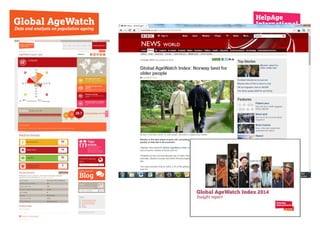
  • #12 Website is a ‘one stop shop’ for data and analysis on population ageing. All the material related to the project is available for download including the Index, the methodology report and data visualisations. The portal also has data by country, referencing key data sources, papers and relevant events. This is in line with HelpAge’s aim of being transparent and accountable to both the people we support and our donors.
  • #13 See page 10 of report Map exposes limitations of existing data in international data sets Gaps in data in income security domain meant only possible to include 96 countries Gaps call into question capacity of governments and others to make informed an appropriate policy decisions affecting older people Gaps highlight the need to improve international data sets to ensure ageing is visible for policy responses When data is available it might not reflect the current situation Time lag when national statistics makes it to international datasets No international agreement on methodology of measuring indicators (e.g. HALE; poverty rate: absolute vs. relative; equivalence scale; income vs. consumption based) (You can also use this map to compare countries within your region) All available data for countries not in index is on the website
  • #14 2014 covers 96 countries representing 91% of the world’s older people 5 new countries - Iraq, Mozambique, Bangladesh Zambia Uganda Norway best, top ten apart from Japan are all in western Europe, long standing pensions, health care and education programmes Worst all regions represented in lowest quarter, Venezuela, 76, Serbia, 78, Turkey 77, Tanzania, Jordan South Africa, Mexico, Brazil doing relatively well, Turkey, Russia, India less well Diverse responses within regions show impact of policy environment e.g. Thailand 36, Indonesia 71 Poland 32, Ukraine 88
  • #16 This pilot Index is based on the INFORM 2015 Index, a global, open-source risk assessment for humanitarian crises and disasters, which was developed through a collaboration between the Inter-Agency Standing Committee Task Team for Preparedness and Resilience and the European Commission. (Introduce Tom if he joins you) a hazard and exposure dimension, which outlines both natural and human hazards in the environment • a vulnerability dimension comprising development and deprivation data, inequality, aid dependency, uprooted people and vulnerable group data • a capacity dimension that includes disaster risk reduction (DRR), governance, communication, infrastructure and access to healthcare capacity data. All three dimensions are equally weighted to determine risk. HelpAge International has augmented this methodology to create a pilot Disaster Risk and Age Index, including additional indicators within the vulnerability and capacity components that reflect more accurately the specific situation and condition of the older population, rather than the population as a whole. For example, within the vulnerability dimension, child mortality rates were removed, while pension coverage and relative old-age poverty were included. In some of the indicators, data on the 60-plus or 65-plus cohort was disaggregated, such as UNHCR’s “People of Concern” which was already age-disaggregated. Other indicators were adjusted to data sets which included age-disaggregated components, but were similar to the original indicators, such as malaria mortality in older age, as opposed to the original prevalence data which was not available age-disaggregated.
  • #18 Income and social protection: Among the most urgent concerns of older people worldwide is income security, which is a significant factor in the vulnerability indicators of the Disaster Risk and Age Index. These issues are also among the greatest challenges for governments faced with ageing populations. Investments in pension systems are one of the most important ways to ensure economic independence and reduce poverty in old age. Health and nutrition:Health and social care services should work together with a focus on maintaining independence, aiming to mitigate the impacts of disease and disability and, where appropriate, provide treatment. Older people need to be included in all actions addressing both infectious diseases (such as tuberculosis, malaria and diarrhoeal diseases) and no communicable diseases (NCDs). Food security and nutrition appropriate for people in later life should also be ensured to boost overall health and wellbeing. Infrastructure: An age-friendly physical environment that promotes the development and use of innovative technologies to encourage active ageing is especially important as people grow older and experience reduced mobility and visual and hearing impairments. Affordable and disaster-resilient housing and easily accessible transportation that encourage ageing “in place” are essential to maintain independence, facilitate social contacts and permit older people to remain active members of society. Data: Lack of data on the situation of older people – before, during and after a disaster – is a major barrier to gathering reliable evidence and taking action. Major efforts must be made to collect and provide much higher levels of age, sex and disability disaggregated data, not only in the hazard and disaster statistics but across development data sets
  • #19 In the narrative you could mention how the index construction also helped us identify and the data and knowledge gap
  • #21 Age in the data revolution - ‘leave no-one behind’ End age discrimination and violence Tackle income poverty with ‘social protection floor’ Extend healthy life expectancy and well being for all Gender equality and women's empowerment for all at all ages Employment and decent work for all who have to work Lifelong learning and reskilling opportunities End to hunger, malnutrition and food insecurity Inclusion, visibility and recognition of ageing through age disaggregated data
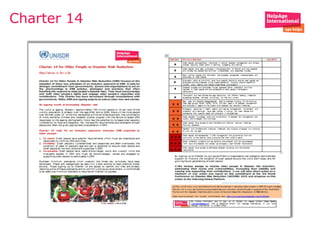
  • #22 HelpAge International and UNISDR ask all government ministries responsible for DRR to sign up All agencies implementing DRR/CCA and Humanitarian response Sign up to address the principals of older people in need, in visible (due to lack of SADD) and invaluable in DRR Signees asked to commit to a minimum of one of the 14 actions Can be used as one of your voluntary commitments or government announcements towards Sendai World conferene next year.