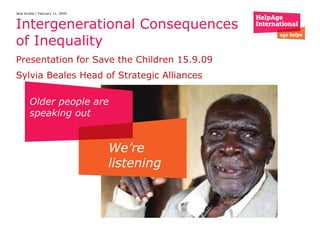
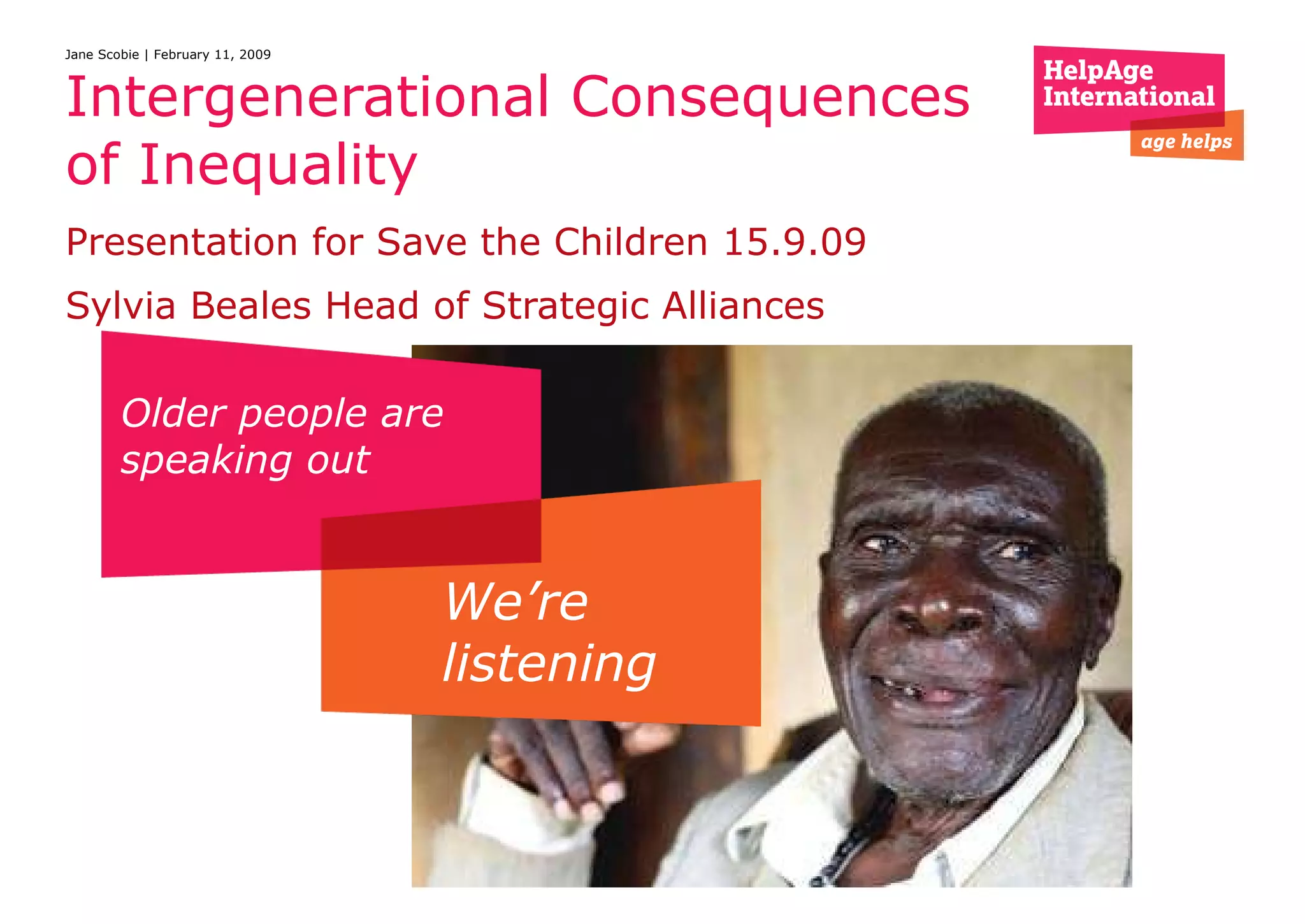
Intergenerational Consequences of Inequality  Presentation for Save the Children 15.9.09 Sylvia Beales Head of Strategic Alliances Jane Scobie | February 11, 2009 Older people are speaking out We’re listening
Definition of inequality The quality of being unequal; difference, or want of equality, in any respect; lack of uniformity; disproportion; uneveness; disparity; diversity;  Inequality in size, stature, numbers, power, distances, motions, rank, property; changeableness Inequality of opportunity (ie to school, health, employment, amenities, land, state benefit) If a single person holds all of a given resource, inequality is at a maximum.  If all persons hold the same percentage of a resource, inequality is at a minimum.  Inequality studies explore the levels of resource disparity and their practical and political implications
Inequalities – and human rights Universal Declaration of Human Rights Articles 1 -3 All human beings are born free and equal in dignity and rights. They are endowed with reason and conscience and should act towards one another in a spirit of brotherhood. Article 2. Everyone is entitled to all the rights and freedoms set forth in this Declaration, without distinction of any kind, such as race, colour, sex, language, religion, political or other opinion, national or social origin, property, birth or other status.. Article 3. Everyone has the right to life, liberty and security of person.
Right to ‘adequate standard of living  Universal Declaration of Human rights Article 25 (1) Everyone has the right to a standard of living adequate for the health and well-being of himself and of his family, including food, clothing, housing and medical care and necessary social services, and the right to security in the event of unemployment, sickness, disability, widowhood, old age or other lack of livelihood in circumstances beyond his control. (2) Motherhood and childhood are entitled to special care and assistance. All children, whether born in or out of wedlock, shall enjoy the same social protection. 342 million older people currently lack any form of income security; this could rise to 1.6 billion people by 2050 if no action is taken on income security
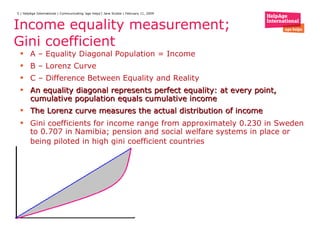
Income equality measurement; Gini coefficient A – Equality Diagonal Population = Income B – Lorenz Curve  C – Difference Between Equality and Reality  An equality diagonal represents perfect equality: at every point, cumulative population equals cumulative income The Lorenz curve measures the actual distribution of income Gini coefficients for income range from approximately 0.230 in Sweden to 0.707 in Namibia; pension and social welfare systems in place or being piloted in high gini coefficient countries
Other inequality measurements; Human Development  Indicators HDI – human development index; shift from income to human development - ie  A long and healthy life  Access to knowledge  A decent standard of living Measured by  Life expectancy at birth  Adult literacy rate and the combined primary, secondary, and tertiary gross enrolment ratio; GDP  per capita (PPP US$) How do we measure these indicators?
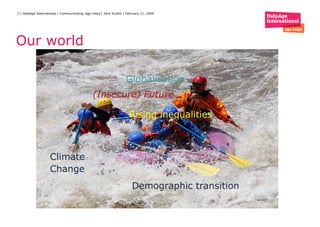
Our world Climate Change Globalisation Demographic transition (Insecure) Future Rising inequalities
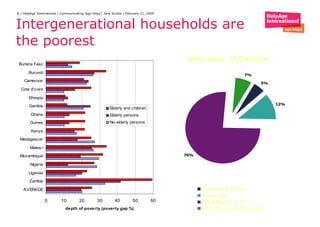
Intergenerational households are the poorest
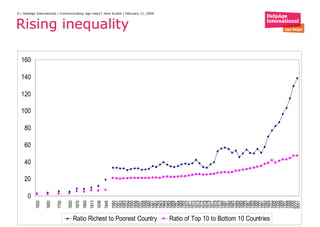
Rising inequality
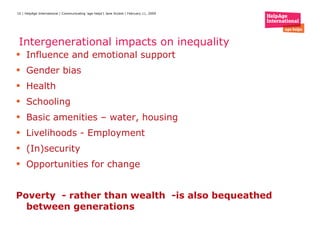
Intergenerational impacts on inequality Influence and emotional support Gender bias  Health Schooling Basic amenities – water, housing  Livelihoods - Employment (In)security Opportunities for change Poverty  - rather than wealth  -is also bequeathed between generations
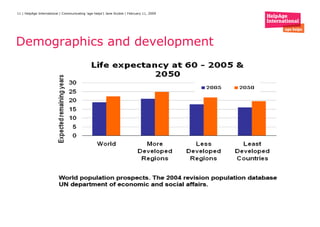
Demographics and development
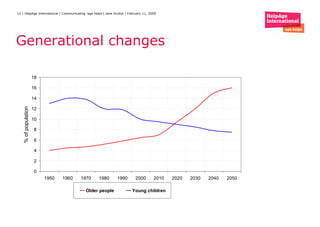
Generational changes
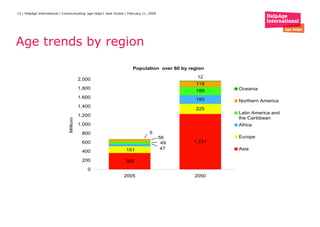
Age trends by region
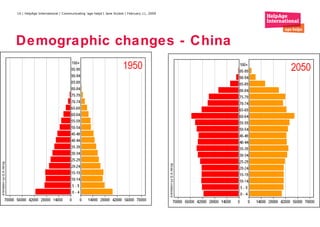
Demographic changes - China
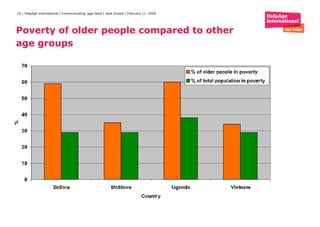
Poverty of older people compared to other age groups
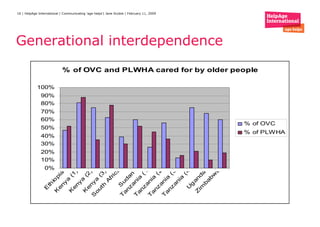
Generational interdependence
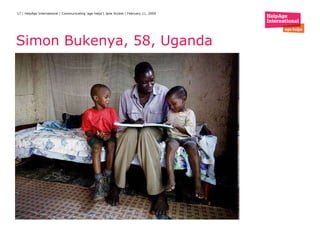
Simon Bukenya, 58, Uganda
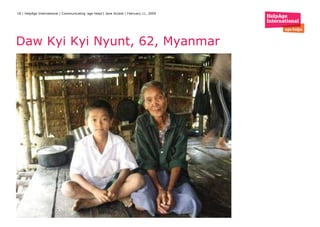
Daw Kyi Kyi Nyunt, 62, Myanmar
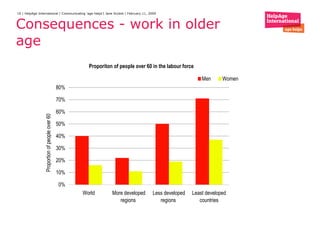
Consequences - work in older age
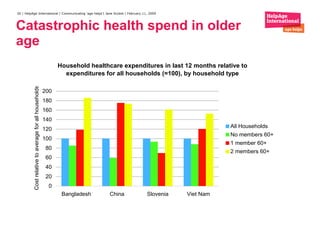
Catastrophic health spend in older age
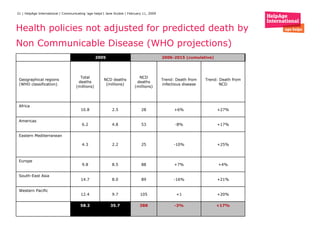
Health policies not adjusted for predicted death by Non Communicable Disease (WHO projections) 2005 2006-2015 (cumulative) Geographical regions (WHO classification) Total deaths (millions) NCD deaths (millions) NCD deaths (millions) Trend: Death from infectious disease Trend: Death from NCD Africa 10.8 2.5 28 +6% +27% Americas 6.2 4.8 53 -8% +17% Eastern Mediterranean 4.3 2.2 25 -10% +25% Europe 9.8 8.5 88 +7% +4% South-East Asia 14.7 8.0 89 -16% +21% Western Pacific 12.4 9.7 105 +1 +20% Total 58.2 35.7 388 -3% +17%
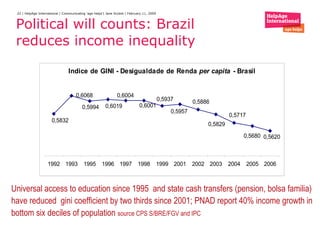
Political will counts: Brazil reduces income inequality  Universal access to education since 1995  and state cash transfers (pension, bolsa familia) have reduced  gini coefficient by two thirds since 2001; PNAD report 40% income growth in bottom six deciles of population  source CPS  S/BRE/FGV and IPC
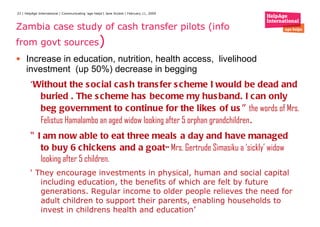
Zambia case study of cash transfer pilots (info from govt sources ) Increase in education, nutrition, health access,  livelihood investment  (up 50%) decrease in begging ‘ Without the social cash transfer scheme I would be dead and buried . The scheme has become my husband. I can only beg government to continue for the likes of us ”  the words of Mrs. Felistus Hamalambo an aged widow looking after 5 orphan grandchildren . “  I am now able to eat three meals a day and have managed to buy 6 chickens and a goat ”  Mrs. Gertrude Simasiku a ‘sickly’ widow looking after 5 children.  ‘  They encourage investments in physical, human and social capital including education, the benefits of which are felt by future generations. Regular income to older people relieves the need for adult children to support their parents, enabling households to invest in childrens health and education’
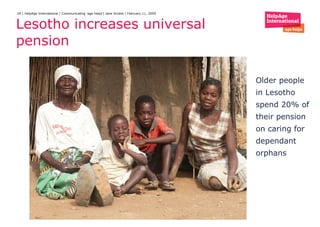
Lesotho increases universal pension  Older people in Lesotho spend 20% of their pension on caring for dependant orphans
Moving to reduce inequalities in Africa   Social Policy Framework for Africa 2008: 2.3.3.para 32 and 33  Member States are encouraged to choose the coverage extension strategy and combination of tools most appropriate to their circumstances. There is an emerging consensus that  a minimum package of essential social protection should cover: essential health care, and benefits for children, informal workers, the unemployed, older persons and persons with disabilities . This minimum package provides the platform for broadening and extending social protection as more fiscal space is created’. A minimum package can have a significant impact on poverty alleviation, improvement of living standards, reduction of inequalities and promotion of  economic growth and has been shown to be affordable, even in low-income countries, within existing resources, if properly managed
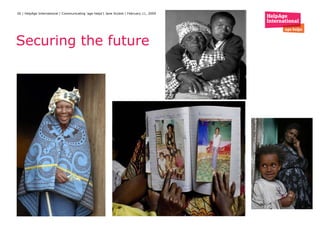
Securing the future

Intergenerational consequences of inequality

  • 1.
    Intergenerational Consequences ofInequality Presentation for Save the Children 15.9.09 Sylvia Beales Head of Strategic Alliances Jane Scobie | February 11, 2009 Older people are speaking out We’re listening
  • 2.
    Definition of inequalityThe quality of being unequal; difference, or want of equality, in any respect; lack of uniformity; disproportion; uneveness; disparity; diversity; Inequality in size, stature, numbers, power, distances, motions, rank, property; changeableness Inequality of opportunity (ie to school, health, employment, amenities, land, state benefit) If a single person holds all of a given resource, inequality is at a maximum. If all persons hold the same percentage of a resource, inequality is at a minimum. Inequality studies explore the levels of resource disparity and their practical and political implications
  • 3.
    Inequalities – andhuman rights Universal Declaration of Human Rights Articles 1 -3 All human beings are born free and equal in dignity and rights. They are endowed with reason and conscience and should act towards one another in a spirit of brotherhood. Article 2. Everyone is entitled to all the rights and freedoms set forth in this Declaration, without distinction of any kind, such as race, colour, sex, language, religion, political or other opinion, national or social origin, property, birth or other status.. Article 3. Everyone has the right to life, liberty and security of person.
  • 4.
    Right to ‘adequatestandard of living Universal Declaration of Human rights Article 25 (1) Everyone has the right to a standard of living adequate for the health and well-being of himself and of his family, including food, clothing, housing and medical care and necessary social services, and the right to security in the event of unemployment, sickness, disability, widowhood, old age or other lack of livelihood in circumstances beyond his control. (2) Motherhood and childhood are entitled to special care and assistance. All children, whether born in or out of wedlock, shall enjoy the same social protection. 342 million older people currently lack any form of income security; this could rise to 1.6 billion people by 2050 if no action is taken on income security
  • 5.
    Income equality measurement;Gini coefficient A – Equality Diagonal Population = Income B – Lorenz Curve C – Difference Between Equality and Reality An equality diagonal represents perfect equality: at every point, cumulative population equals cumulative income The Lorenz curve measures the actual distribution of income Gini coefficients for income range from approximately 0.230 in Sweden to 0.707 in Namibia; pension and social welfare systems in place or being piloted in high gini coefficient countries
  • 6.
    Other inequality measurements;Human Development Indicators HDI – human development index; shift from income to human development - ie A long and healthy life Access to knowledge A decent standard of living Measured by Life expectancy at birth Adult literacy rate and the combined primary, secondary, and tertiary gross enrolment ratio; GDP per capita (PPP US$) How do we measure these indicators?
  • 7.
    Our world ClimateChange Globalisation Demographic transition (Insecure) Future Rising inequalities
  • 8.
  • 9.
  • 10.
    Intergenerational impacts oninequality Influence and emotional support Gender bias Health Schooling Basic amenities – water, housing Livelihoods - Employment (In)security Opportunities for change Poverty - rather than wealth -is also bequeathed between generations
  • 11.
  • 12.
  • 13.
  • 14.
  • 15.
    Poverty of olderpeople compared to other age groups
  • 16.
  • 17.
  • 18.
    Daw Kyi KyiNyunt, 62, Myanmar
  • 19.
    Consequences - workin older age
  • 20.
  • 21.
    Health policies notadjusted for predicted death by Non Communicable Disease (WHO projections) 2005 2006-2015 (cumulative) Geographical regions (WHO classification) Total deaths (millions) NCD deaths (millions) NCD deaths (millions) Trend: Death from infectious disease Trend: Death from NCD Africa 10.8 2.5 28 +6% +27% Americas 6.2 4.8 53 -8% +17% Eastern Mediterranean 4.3 2.2 25 -10% +25% Europe 9.8 8.5 88 +7% +4% South-East Asia 14.7 8.0 89 -16% +21% Western Pacific 12.4 9.7 105 +1 +20% Total 58.2 35.7 388 -3% +17%
  • 22.
    Political will counts:Brazil reduces income inequality Universal access to education since 1995 and state cash transfers (pension, bolsa familia) have reduced gini coefficient by two thirds since 2001; PNAD report 40% income growth in bottom six deciles of population source CPS S/BRE/FGV and IPC
  • 23.
    Zambia case studyof cash transfer pilots (info from govt sources ) Increase in education, nutrition, health access, livelihood investment (up 50%) decrease in begging ‘ Without the social cash transfer scheme I would be dead and buried . The scheme has become my husband. I can only beg government to continue for the likes of us ” the words of Mrs. Felistus Hamalambo an aged widow looking after 5 orphan grandchildren . “ I am now able to eat three meals a day and have managed to buy 6 chickens and a goat ” Mrs. Gertrude Simasiku a ‘sickly’ widow looking after 5 children. ‘ They encourage investments in physical, human and social capital including education, the benefits of which are felt by future generations. Regular income to older people relieves the need for adult children to support their parents, enabling households to invest in childrens health and education’
  • 24.
    Lesotho increases universalpension Older people in Lesotho spend 20% of their pension on caring for dependant orphans
  • 25.
    Moving to reduceinequalities in Africa Social Policy Framework for Africa 2008: 2.3.3.para 32 and 33 Member States are encouraged to choose the coverage extension strategy and combination of tools most appropriate to their circumstances. There is an emerging consensus that a minimum package of essential social protection should cover: essential health care, and benefits for children, informal workers, the unemployed, older persons and persons with disabilities . This minimum package provides the platform for broadening and extending social protection as more fiscal space is created’. A minimum package can have a significant impact on poverty alleviation, improvement of living standards, reduction of inequalities and promotion of economic growth and has been shown to be affordable, even in low-income countries, within existing resources, if properly managed
  • 26.