Social protection in sub-Saharan Africa 
Lessons and Challenges 
Armando Barrientos, David Hulme, and Miguel Nino-Zarazua 
Brooks World Poverty Institute 
The University of Manchester 
www.bwpi.manchester.ac.uk www.chronicpoverty.org
The global rise of social protection 
• Global rise of social protection programmes in developing 
countries (Mexico’s Oportunidades, Brazil’s Bolsa Familia, India’s 
Employment Guarantee Scheme, China’s Minimum Living 
Subsidy Scheme and many more, South Africa’s grants) 
• What is Social Protection? 
– “public actions taken in response to levels of vulnerability, risks, and 
deprivation, which are deemed socially unacceptable within a given polity 
and society” (Conway, de Haan and Norton 2000). 
• Social Insurance, labour market regulation, social assistance 
– Social assistance includes tax-financed, government provided, instruments 
focused on poverty
Social assistance and poverty analysis 
• Informed by new perspectives on poverty: 
– depth and severity of poverty, not just headcount 
– poverty is multidimensional, 
– duration is extremely important (poverty traps) 
• Household agency and productive capacity 
• Reducing poverty in the future by reducing vulnerability 
(…to poverty) 
• Transfers must be regular and reliable, and over an 
appropriate period of time, to enable investment
In Sub-Saharan Africa? 
• Social pensions in Southern cone (South Africa, Namibia, 
Botswana, Lesotho, Swaziland) 
• ‘Older’ schemes Zambia’s PWAS, Mozambique FSB; and 
pilot transfer programmes (Zambia, Tanzania, Malawi, Nigeria, 
Ghana…), Ethiopia’s PSNP 
• West and Central Africa – UNICEF Report 
• Second-generation PRSs. National Social Protection 
Strategies in Ghana, Mozambique, Rwanda and Uganda - 
Livingstone Process – African Union, ministerial level 
• Shift in aid modalities: from emergency aid to predictable 
budget support
Main Lessons I 
• Importance of knowledge base 
– Poverty and vulnerability profiles are essential 
• Political and public support for social protection 
is key to its sustainability 
– Weak ‘demand’ for social protection 
– Political systems fail to aggregate preferences 
– ‘Poverty reduction is a problem for donors’ 
• Delivery Ministries are weak and have limited 
policy formulation and delivery capacity
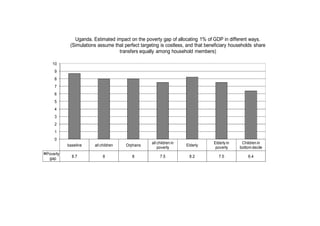
Uganda. Estimated impact on the poverty gap of allocating 1% of GDP in different ways. 
(Simulations assume that perfect targeting is costless, and that beneficiary households share 
transfers equally among household members) 
baseline all children Orphans all children in 
poverty Elderly Elderly in 
poverty 
Children in 
bottom decile 
10 
9 
8 
7 
6 
5 
4 
3 
2 
1 
0 
Poverty 
gap 8.7 8 8 7.5 8.2 7.5 6.4
Main Lessons II 
• Diversity in design of current programmes 
– Programme design involves adaptation 
• Scale and scope are most important 
• ‘social protection is not enough’, we also 
need growth and public services 
• tackle both ‘current’ and ‘future’ poverty
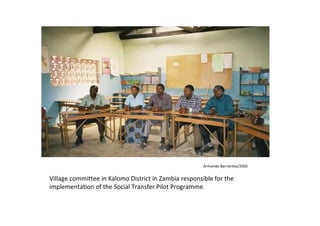
Armando Barrientos/2005 
Village committee in Kalomo District in Zambia responsible for the 
implementation of the Social Transfer Pilot Programme
Key Challenges 
• Learning from past efforts 
• Finance: 
– Resources required are less than 1% GDP 
– Domestic financing in the medium run 
– ‘Socialisation’ of costs of poverty versus ‘resource mobilisation’ 
• Capacity building 
• Coordination and integration of social assistance 
with social policy and labour market policy 
• Institution building not emergency safety nets 
• Reaching all those in poverty

Armando Barrientos, David Hulme and Miguel Niño-Zarazúa: Social Protection in Sub-Saharan Africa - Lessons and Challenges

  • 1.
    Social protection insub-Saharan Africa Lessons and Challenges Armando Barrientos, David Hulme, and Miguel Nino-Zarazua Brooks World Poverty Institute The University of Manchester www.bwpi.manchester.ac.uk www.chronicpoverty.org
  • 2.
    The global riseof social protection • Global rise of social protection programmes in developing countries (Mexico’s Oportunidades, Brazil’s Bolsa Familia, India’s Employment Guarantee Scheme, China’s Minimum Living Subsidy Scheme and many more, South Africa’s grants) • What is Social Protection? – “public actions taken in response to levels of vulnerability, risks, and deprivation, which are deemed socially unacceptable within a given polity and society” (Conway, de Haan and Norton 2000). • Social Insurance, labour market regulation, social assistance – Social assistance includes tax-financed, government provided, instruments focused on poverty
  • 3.
    Social assistance andpoverty analysis • Informed by new perspectives on poverty: – depth and severity of poverty, not just headcount – poverty is multidimensional, – duration is extremely important (poverty traps) • Household agency and productive capacity • Reducing poverty in the future by reducing vulnerability (…to poverty) • Transfers must be regular and reliable, and over an appropriate period of time, to enable investment
  • 4.
    In Sub-Saharan Africa? • Social pensions in Southern cone (South Africa, Namibia, Botswana, Lesotho, Swaziland) • ‘Older’ schemes Zambia’s PWAS, Mozambique FSB; and pilot transfer programmes (Zambia, Tanzania, Malawi, Nigeria, Ghana…), Ethiopia’s PSNP • West and Central Africa – UNICEF Report • Second-generation PRSs. National Social Protection Strategies in Ghana, Mozambique, Rwanda and Uganda - Livingstone Process – African Union, ministerial level • Shift in aid modalities: from emergency aid to predictable budget support
  • 5.
    Main Lessons I • Importance of knowledge base – Poverty and vulnerability profiles are essential • Political and public support for social protection is key to its sustainability – Weak ‘demand’ for social protection – Political systems fail to aggregate preferences – ‘Poverty reduction is a problem for donors’ • Delivery Ministries are weak and have limited policy formulation and delivery capacity
  • 6.
    Uganda. Estimated impacton the poverty gap of allocating 1% of GDP in different ways. (Simulations assume that perfect targeting is costless, and that beneficiary households share transfers equally among household members) baseline all children Orphans all children in poverty Elderly Elderly in poverty Children in bottom decile 10 9 8 7 6 5 4 3 2 1 0 Poverty gap 8.7 8 8 7.5 8.2 7.5 6.4
  • 7.
    Main Lessons II • Diversity in design of current programmes – Programme design involves adaptation • Scale and scope are most important • ‘social protection is not enough’, we also need growth and public services • tackle both ‘current’ and ‘future’ poverty
  • 8.
    Armando Barrientos/2005 Villagecommittee in Kalomo District in Zambia responsible for the implementation of the Social Transfer Pilot Programme
  • 9.
    Key Challenges •Learning from past efforts • Finance: – Resources required are less than 1% GDP – Domestic financing in the medium run – ‘Socialisation’ of costs of poverty versus ‘resource mobilisation’ • Capacity building • Coordination and integration of social assistance with social policy and labour market policy • Institution building not emergency safety nets • Reaching all those in poverty