# D ATA 2 0 1 5
# A L L A G E S
Wifi
Username: Casa1537
Password: Venue1537
Older people count: Making data fit
for purpose in a rapidly ageing world
Session 1: Global data, demographic change
and inequality
Chair: Danny Sriskandarajah, CIVICUS
Panellists:
Sabina Alkire, OPHI
Edilberto Loaiza, UNFPA
Jane Scobie, HelpAge International
#DATA2015
#ALLAGES
Wifi
Username: Casa1537
Password: Venue1537
Session 1: Global data, demographic change
and inequality
Chair: Danny Sriskandarajah, CIVICUS
Opening comments on importance of use of data by citizens of
all ages. Introduction to first session and panellists.
#DATA2015
#ALLAGES
Wifi
Username: Casa1537
Password: Venue1537
Session 1: Global data, demographic change
and inequality
Speaker:
Sabina Alkire, OPHI
Multi-dimensional poverty measurement: What lessons can be
drawn to improve age-disaggregated data?
#DATA2015
#ALLAGES
Wifi
Username: Casa1537
Password: Venue1537
Multidimensional Poverty
and Age-Disaggregated data
Sabina Alkire, University of Oxford
HelpAge side event: Older People Count
Cartagena, 20 April 2015
Measuring Elder Poverty:
Options and Challenges
1. A measure such as the global MPI can be age-
disaggregated.
2. A uniform individual MPI can be built, that allows
comparison across age groups.
3. Specific measure(s) of Elder poverty can be designed
(not discussed here)
Cross-cutting data challenges (will start by naming)
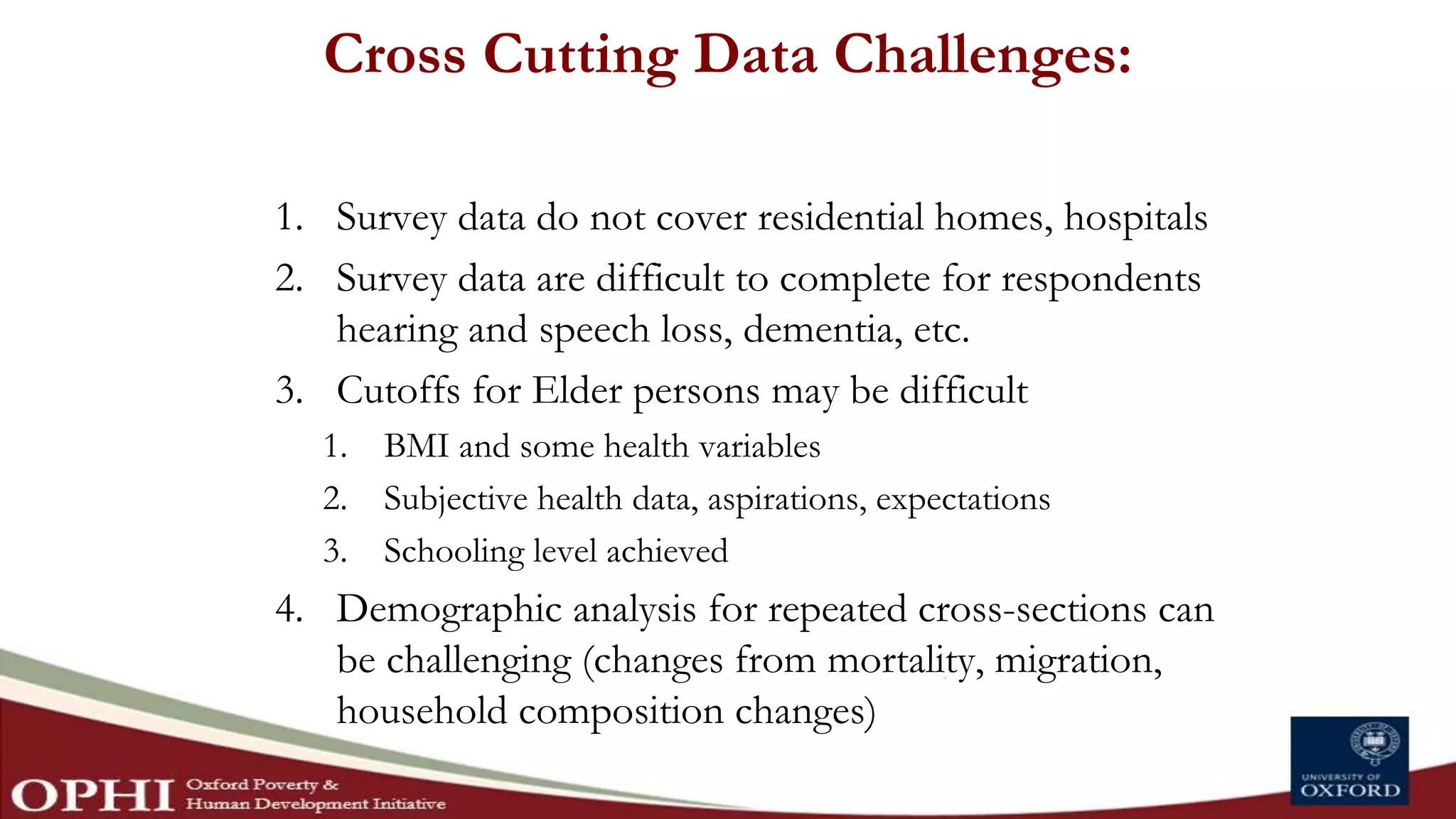
Cross Cutting Data Challenges:
1. Survey data do not cover residential homes, hospitals
2. Survey data are difficult to complete for respondents
hearing and speech loss, dementia, etc.
3. Cutoffs for Elder persons may be difficult
1. BMI and some health variables
2. Subjective health data, aspirations, expectations
3. Schooling level achieved
4. Demographic analysis for repeated cross-sections can
be challenging (changes from mortality, migration,
household composition changes)
Option 1
Age-disaggregated
Global (or national) MPI
The Global MPI
• The global MPI is an internationally comparable index
of acute poverty for 100+ developing countries.
• It was launched in 2010 in UNDP’s Human Development
Report, and updated in 2011, 2013, 2014 and 2015.
• It covers 110 countries at present, using primarily DHS
(52), MICS (34) and WHS (16) data.
• A revised MPI 2015+ is under discussion to monitor
extreme poverty in the SDGs
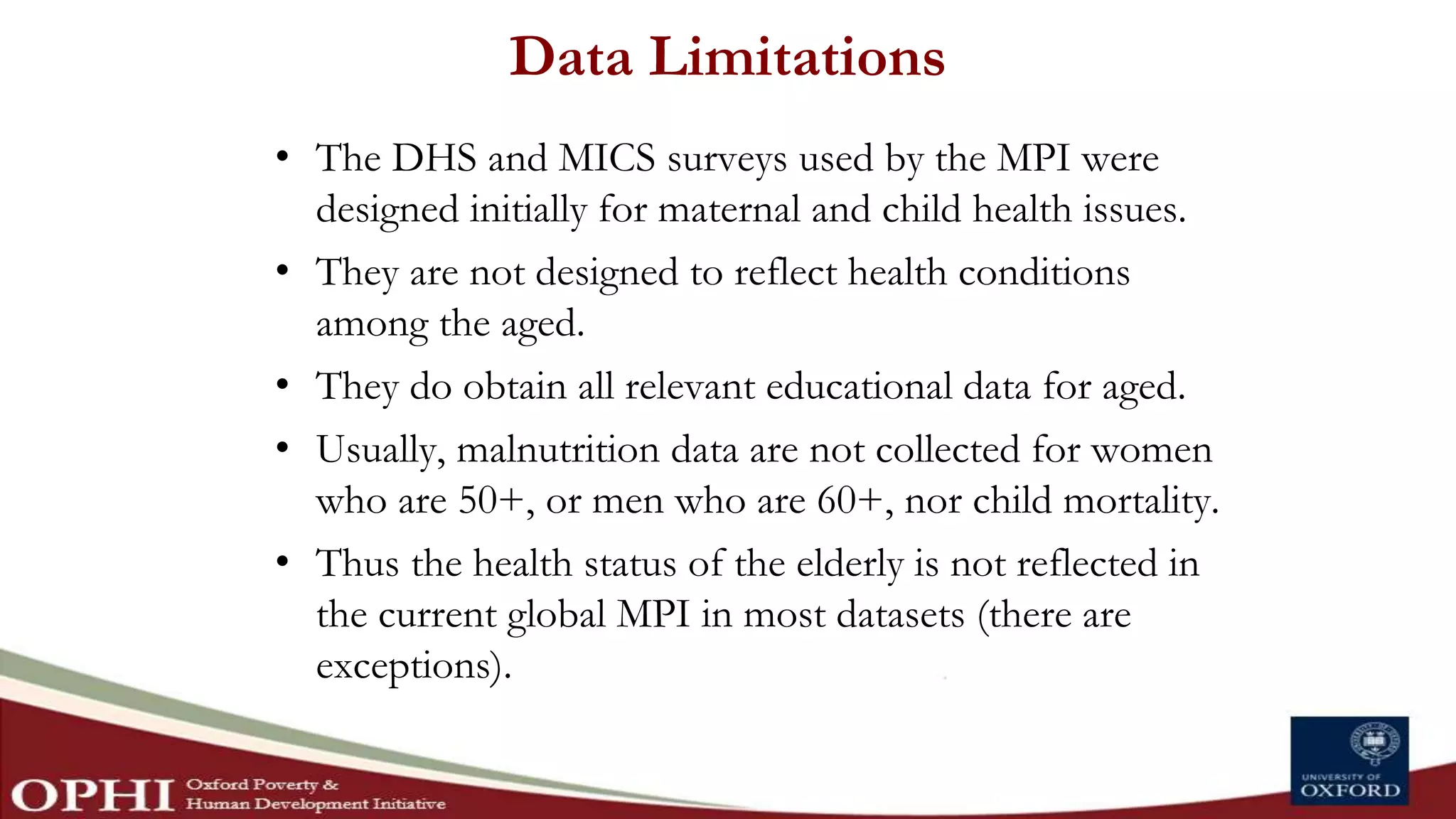
Data Limitations
• The DHS and MICS surveys used by the MPI were
designed initially for maternal and child health issues.
• They are not designed to reflect health conditions
among the aged.
• They do obtain all relevant educational data for aged.
• Usually, malnutrition data are not collected for women
who are 50+, or men who are 60+, nor child mortality.
• Thus the health status of the elderly is not reflected in
the current global MPI in most datasets (there are
exceptions).
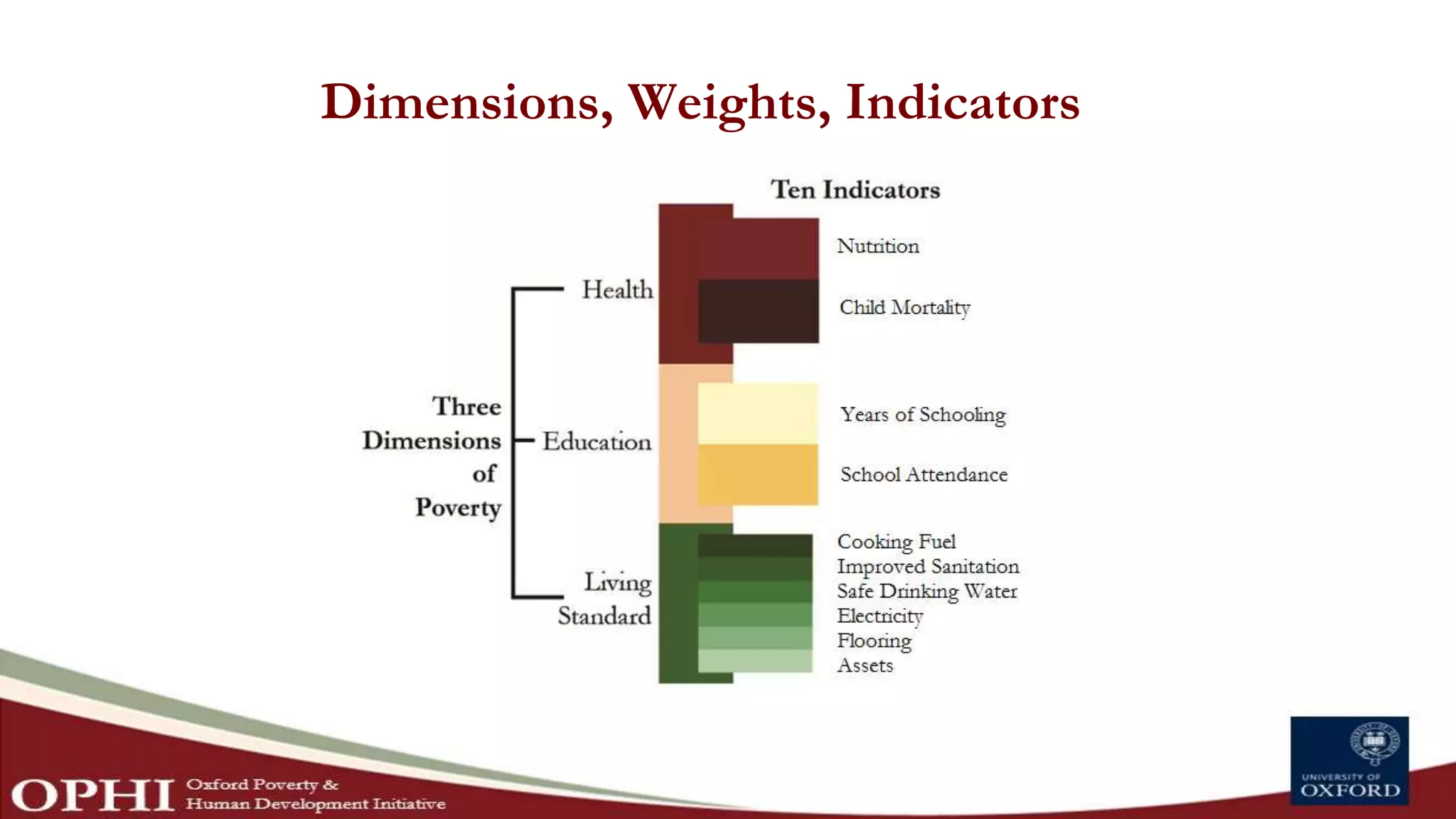
Dimensions, Weights, Indicators
Build a deprivation score for each person,
based on household members
Basic idea – start from people
See what they experience at the same time
Jiyem’s Profile – 77%
Set poverty cutoffs – to see the poorest & less deprived
Show how poverty changes over time.
2. Identify who is poor
Global MPI: A person is multidimensionally poor if
they are deprived in 33% or more of the dimensions.
Phuba’s deprivation score is 67%, so she is poor
3. Compute the MPI (Alkire-Foster)
The MPI is the product of two components:
1) Incidence ~ the percentage of people who
are poor, H.
2) Intensity ~ the average percentage of
dimensions in which poor people are
deprived A.
MPI = H × A
Alkire and Foster Journal of Public Economics 2011
AF
Metodología
Método de
conteo
(NBI)
Método
axiomático
(FGT)
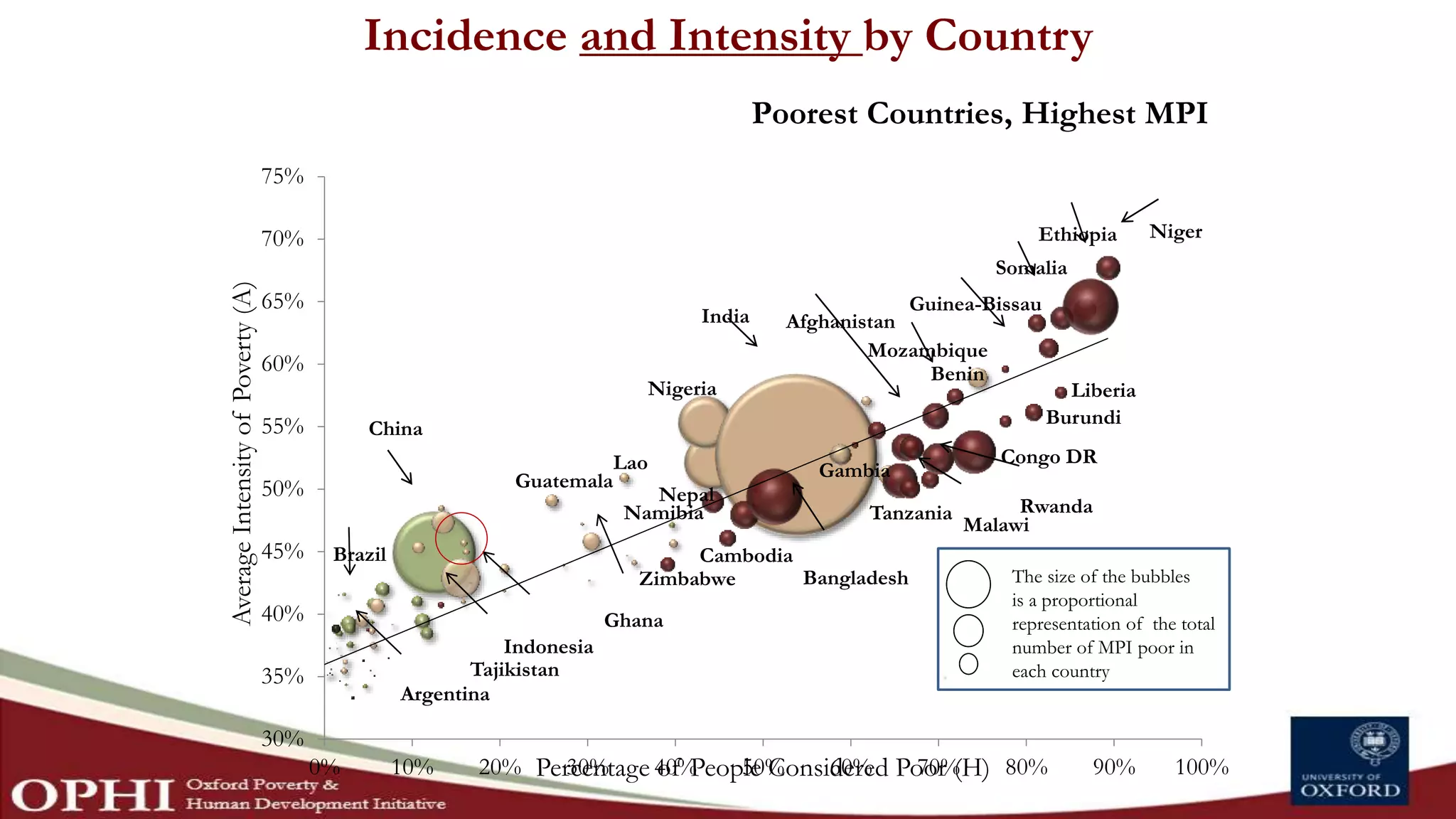
Incidence and Intensity by Country
Namibia
Brazil
Argentina
Indonesia
Guatemala
Ghana
Lao
Nigeria
Tajikistan
Zimbabwe
Cambodia
Nepal
Bangladesh
Gambia
Tanzania
Malawi
Rwanda
Afghanistan
Mozambique
Congo DR
Benin
Burundi
Guinea-Bissau
Liberia
Somalia
Ethiopia Niger
30%
35%
40%
45%
50%
55%
60%
65%
70%
75%
0% 10% 20% 30% 40% 50% 60% 70% 80% 90% 100%
AverageIntensityofPoverty(A)
Percentage of People Considered Poor (H)
Poorest Countries, Highest MPI
China
India
The size of the bubbles
is a proportional
representation of the total
number of MPI poor in
each country
Age decompositions:
Illustrated for 25 countries (Vaz 2014)
Figure 2: Demographic distribution of MPI poor by age categories
[0,9]
[10,18]
[19,64]
65 and older
Figure 1: Age structure of population
[0,9]
[10,18]
[19,64]
65 and older
Age decompositions:
Illustrated for 25 countries
Figure 2: Demographic distribution of MPI poor by age categories
[0,9]
[10,18]
[19,64]
65 and older
Figure 1: Age structure of population
[0,9]
[10,18]
[19,64]
65 and older
The Global MPI shows that the percentage of people who are
MPI poor and 65 higher is:
- The same as the population in 7 countries
- Lower than the population in 8 countries (less elder MPI)
- Higher than the population in 10 (more elder MPI)
- Congo is highest: 2.6% of pop; but 3.8% of poor are 65+
Would this change with nutritional
data for elders?
We have such data in Bangladesh and Ethiopia.
However, malnutrition rates are lower for the elders
• Conclusion: merely adding anthropometric data
for elders is not sufficient.
Bangladesh Ethiopia
Aged 0to14 40.5% 56.6%
Aged 15to49 34.5% 55.9%
Aged 50to64 24.6% 40.2%
Aged 65onwards 27.4% 27.6%
Measuring Elder Poverty:
Options and Challenges
1. A measure such as the global MPI (as improved for
the SDGs) can be age-disaggregated.
• Ideally, requires data for Elder household members.
• May require age-appropriate thresholds
• May require supplementary or different indicators
• Consider incentives: for caring families; for policy makers
• NB: residential care is not visible in standard hh surveys.
Option 2
MPI based on individual’s
attainments
0.5
0.55
0.6
0.65
0.7
0.75
0.8
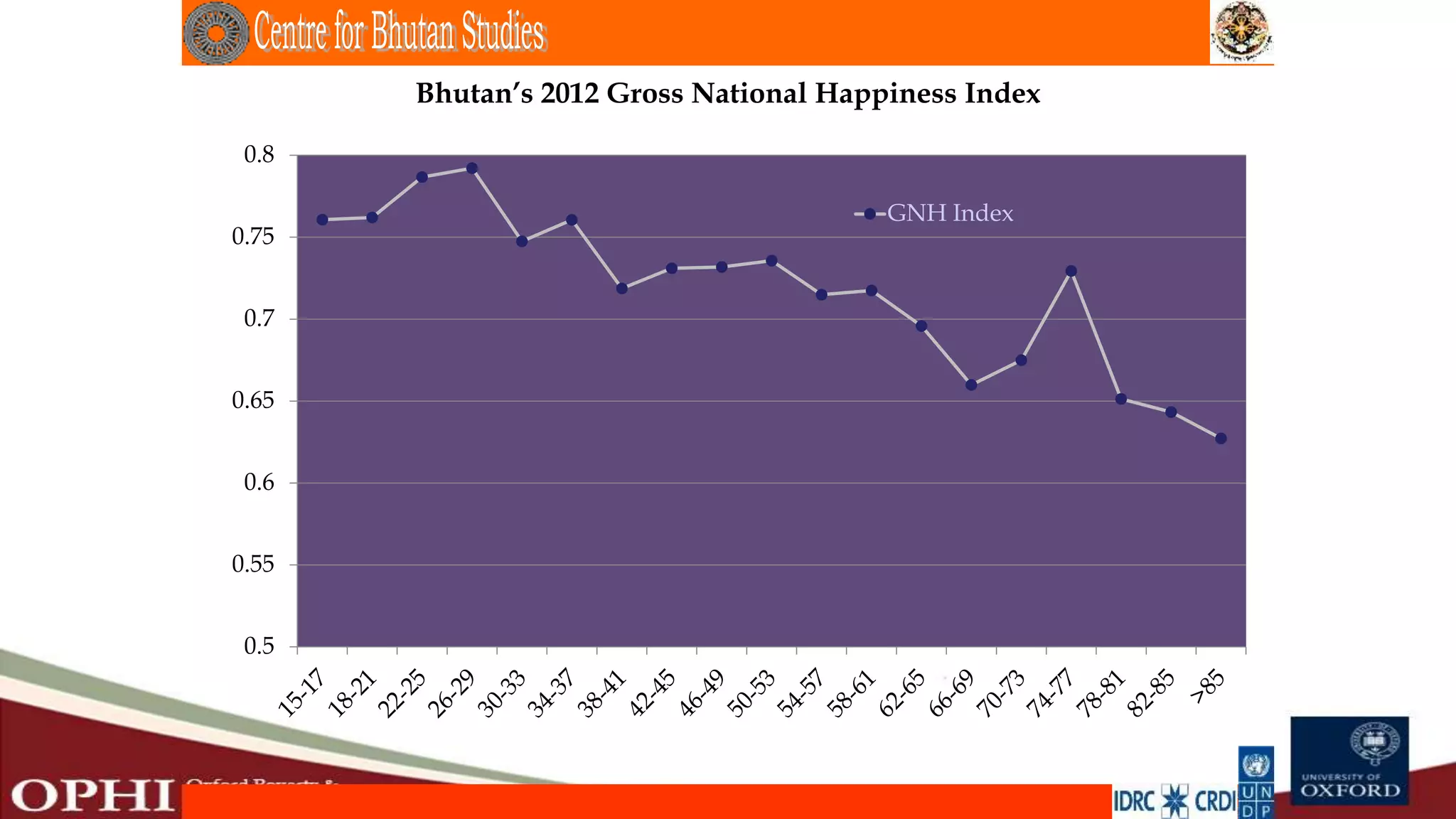
Bhutan’s 2012 Gross National Happiness Index
GNH Index
But in some cases, data are available for all persons,
including the elderly, AND individual-level MPIs
are constructed, in a similar manner to child
poverty.
Example:
Multidimensional poverty measurement for
EU-SILC countries
Sabina Alkire, Mauricio Apablaza
OPHI Working paper and study within NET-SILC2 project.
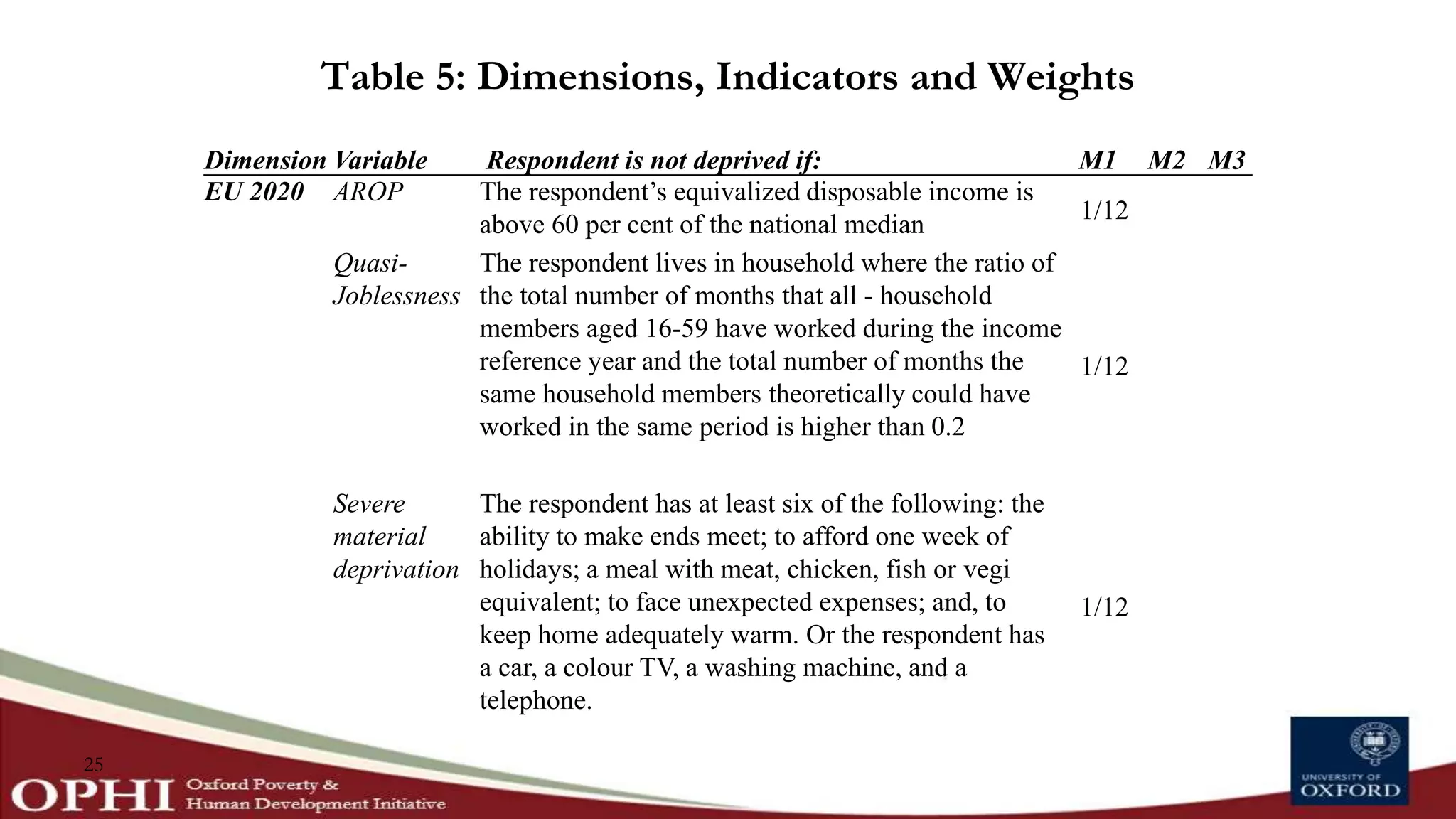
Table 5: Dimensions, Indicators and Weights
25
Dimension Variable Respondent is not deprived if: M1 M2 M3
EU 2020 AROP The respondent’s equivalized disposable income is
above 60 per cent of the national median
1/12
Quasi-
Joblessness
The respondent lives in household where the ratio of
the total number of months that all - household
members aged 16-59 have worked during the income
reference year and the total number of months the
same household members theoretically could have
worked in the same period is higher than 0.2
1/12
Severe
material
deprivation
The respondent has at least six of the following: the
ability to make ends meet; to afford one week of
holidays; a meal with meat, chicken, fish or vegi
equivalent; to face unexpected expenses; and, to
keep home adequately warm. Or the respondent has
a car, a colour TV, a washing machine, and a
telephone.
1/12
26
Dimension Variable Respondent is not deprived if: M1
Education Education The respondent has completed primary
education
1/4
Environment Noise The respondent lives in a household with low
noise from neighbourhood or from the street 1/16
Pollution The respondent lives in a household with low
pollution, grime or other environmental
problems
1/16
Crime The respondent lives in a household with low
crime, violence or vandalism in the area 1/16
Housing The respondent lives in a household with no
leaking roof, damp walls, rot in window frames
or floor
1/16
Health Health The respondent considers her own health as fair
or above
1/16
Chronic
Illness
The respondent has no chronic illness or long-
term condition
1/16
Morbidity The respondent has no limitations due to health
problems
1/16
Unmet Med.
Needs
The respondent does not report unmet medical
needs
1/16
30 EU-SILC countries, poor if k=26% (2009)
Health variables are right most (greenish).
27
MPI for EU-SILC countries for each year (2006-2012)
28
0.00
0.02
0.04
0.06
0.08
0.10
0.12
0.14
0.16
0.18
2006 2007 2008 2009 2010 2011 2012
AT BE BG CH CY CZ DE DK EE EL ES FI FR HR HU IE
IS IT LT LU LV MT NL NO PL PT RO SE SI SK UK
k=26%
We can study the evolution
of poverty for each country
using annual data, and
decompose this by gender
and age.
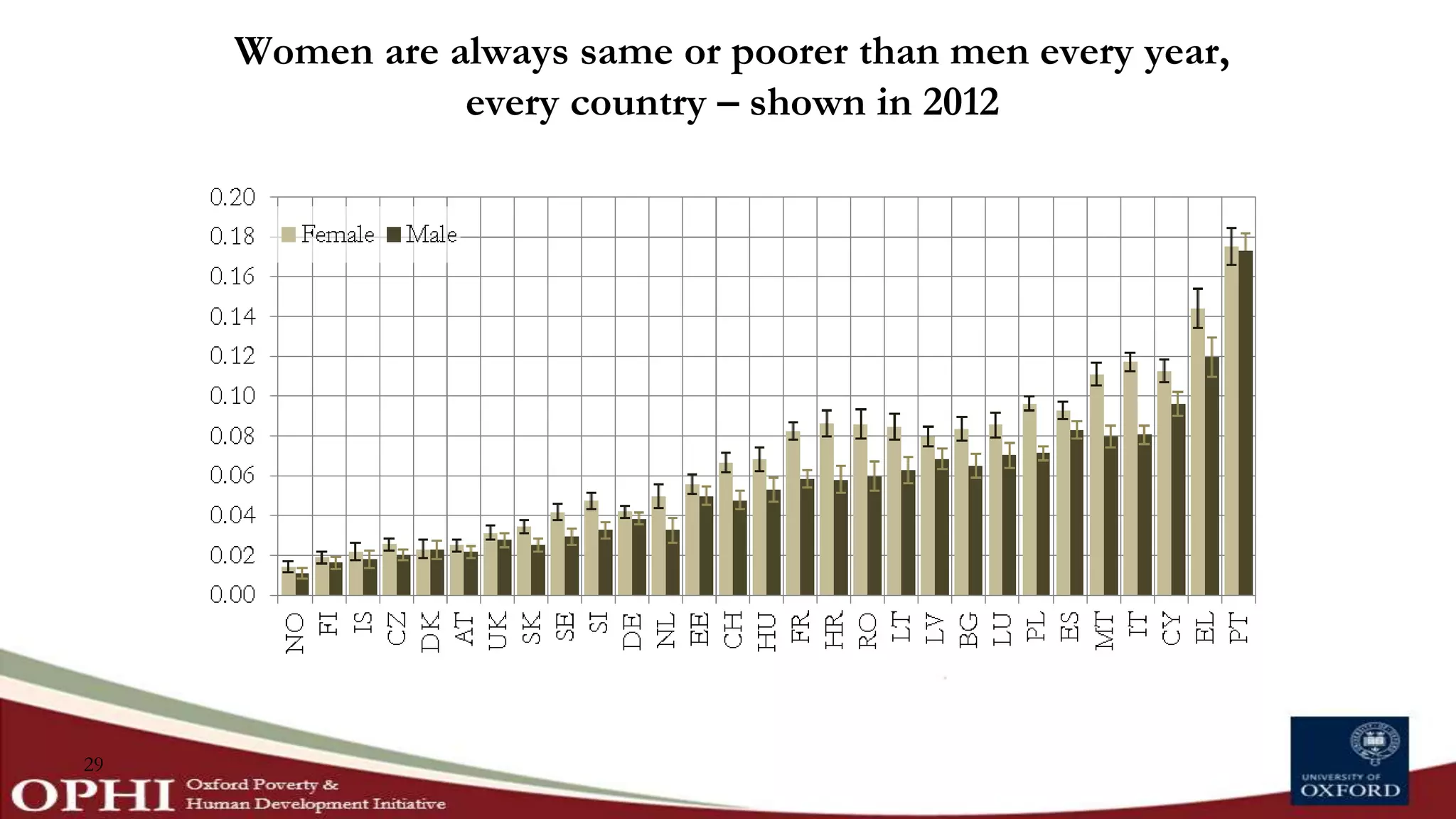
Women are always same or poorer than men every year,
every country – shown in 2012
29
The % of poor by age – high contributions from 65+
30 Elder contribution ot poverty – dark bars on right – usually v hi
Continued
31 France has distinctively high elder poverty – half of poor people!
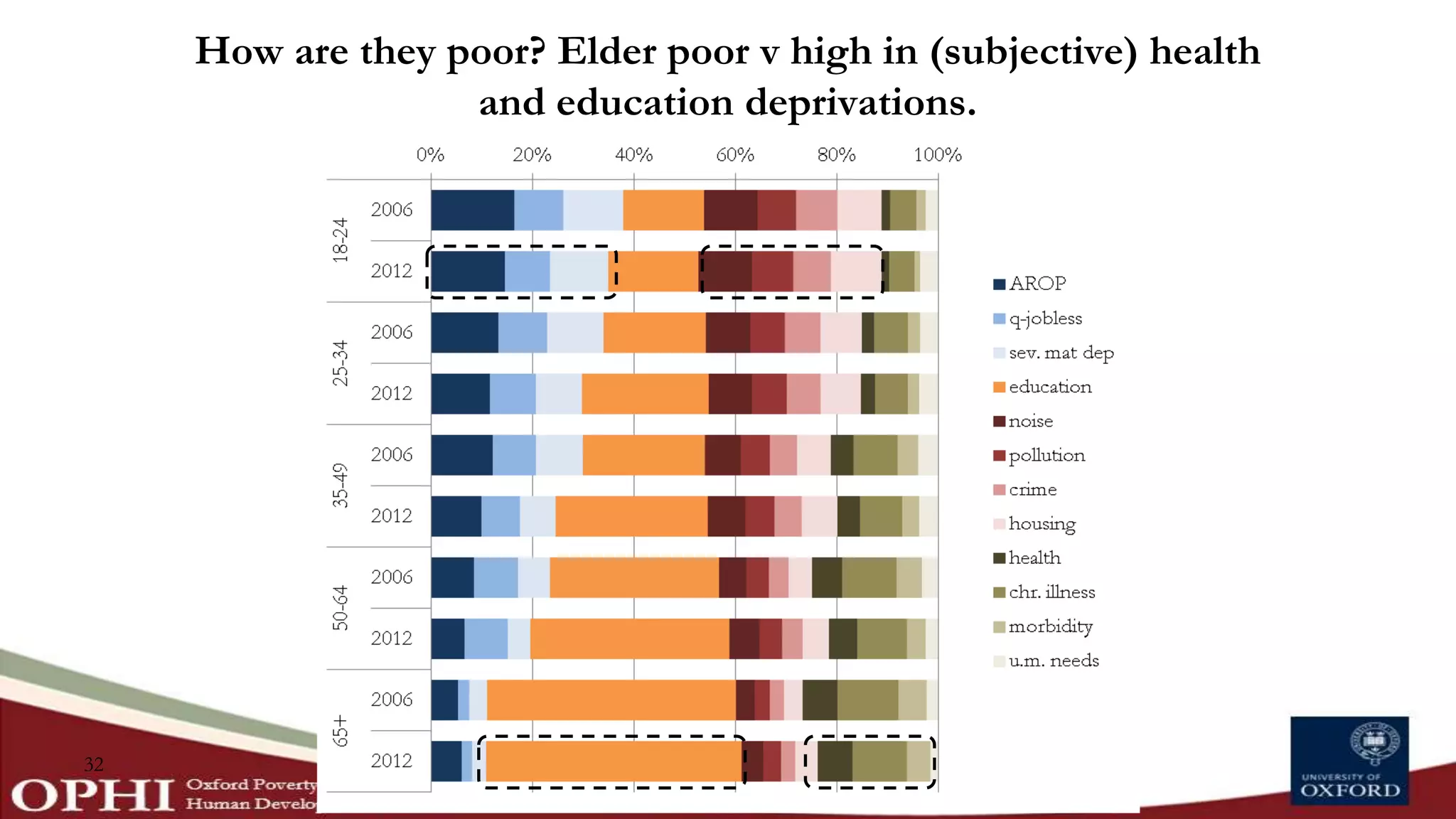
How are they poor? Elder poor v high in (subjective) health
and education deprivations.
32
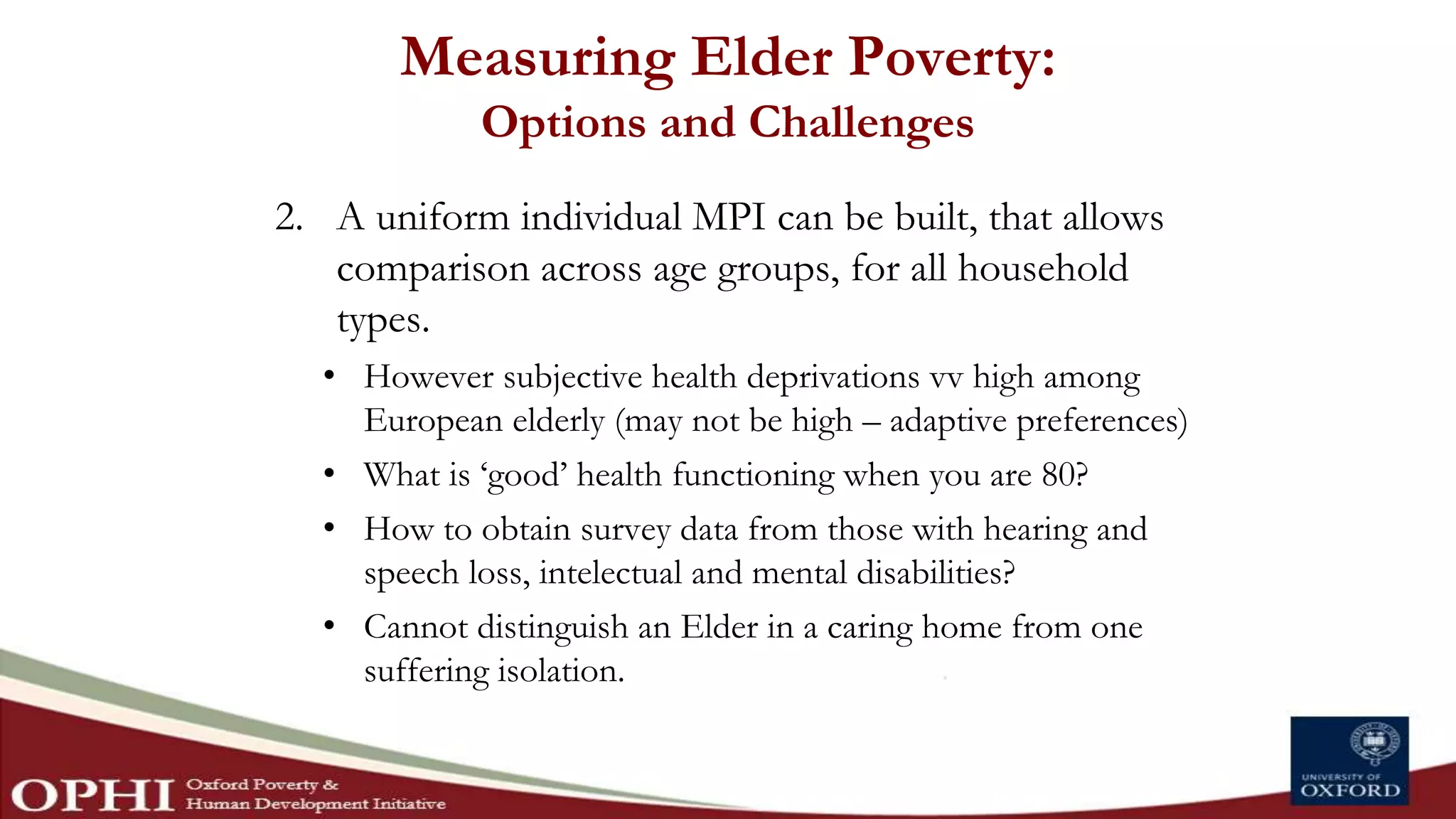
Measuring Elder Poverty:
Options and Challenges
2. A uniform individual MPI can be built, that allows
comparison across age groups, for all household
types.
• However subjective health deprivations vv high among
European elderly (may not be high – adaptive preferences)
• What is ‘good’ health functioning when you are 80?
• How to obtain survey data from those with hearing and
speech loss, intelectual and mental disabilities?
• Cannot distinguish an Elder in a caring home from one
suffering isolation.
Conclusion:
There are 3 immediately feasible options for measuring
multidimensional poverty among the aged:
1. Disaggregating a household-level MPI by age
2. Disaggregating an indvidual-level MPI by age
3. Designing an MPI specifically for Elder poverty
The techniques exist! The challenges lie in data and
standard-setting.
www.ophi.org.uk
Session 1: Global data, demographic change
and inequality
Speaker: Edilberto Loaiza, UNFPA
Population dynamics and SDGs in the context of the
"data revolution".
#DATA2015
#ALLAGES
Wifi
Username: Casa1537
Password: Venue1537
Population Dynamics and SDGs in the
Context of the Data Revolution
Edilberto Loaiza, Ph.D.
UNFPA, New York
Global Data, Demographic Change and Inequality
20th April 2015 , Cartagena
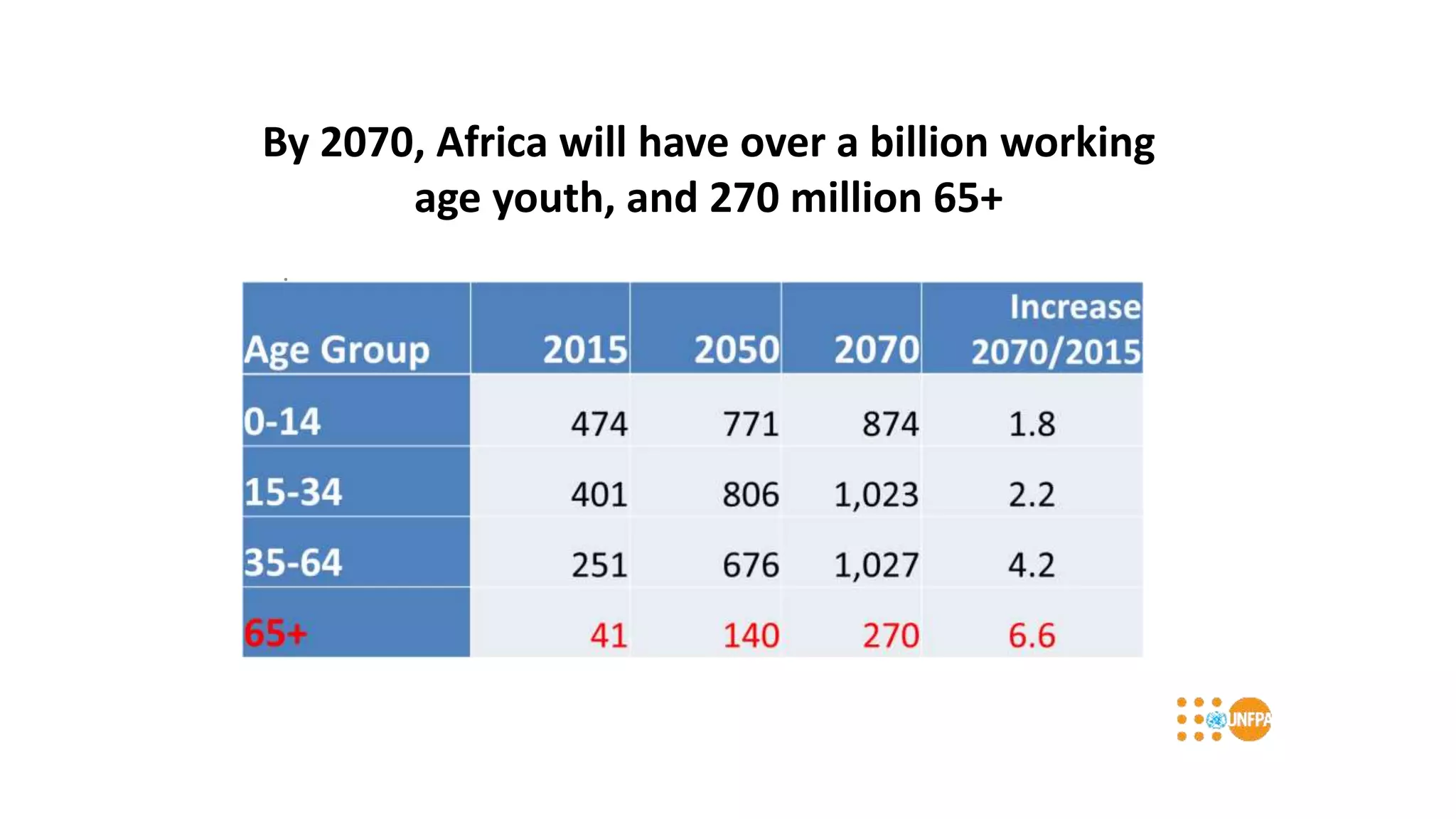
By 2070, Africa will have over a billion working
age youth, and 270 million 65+
j
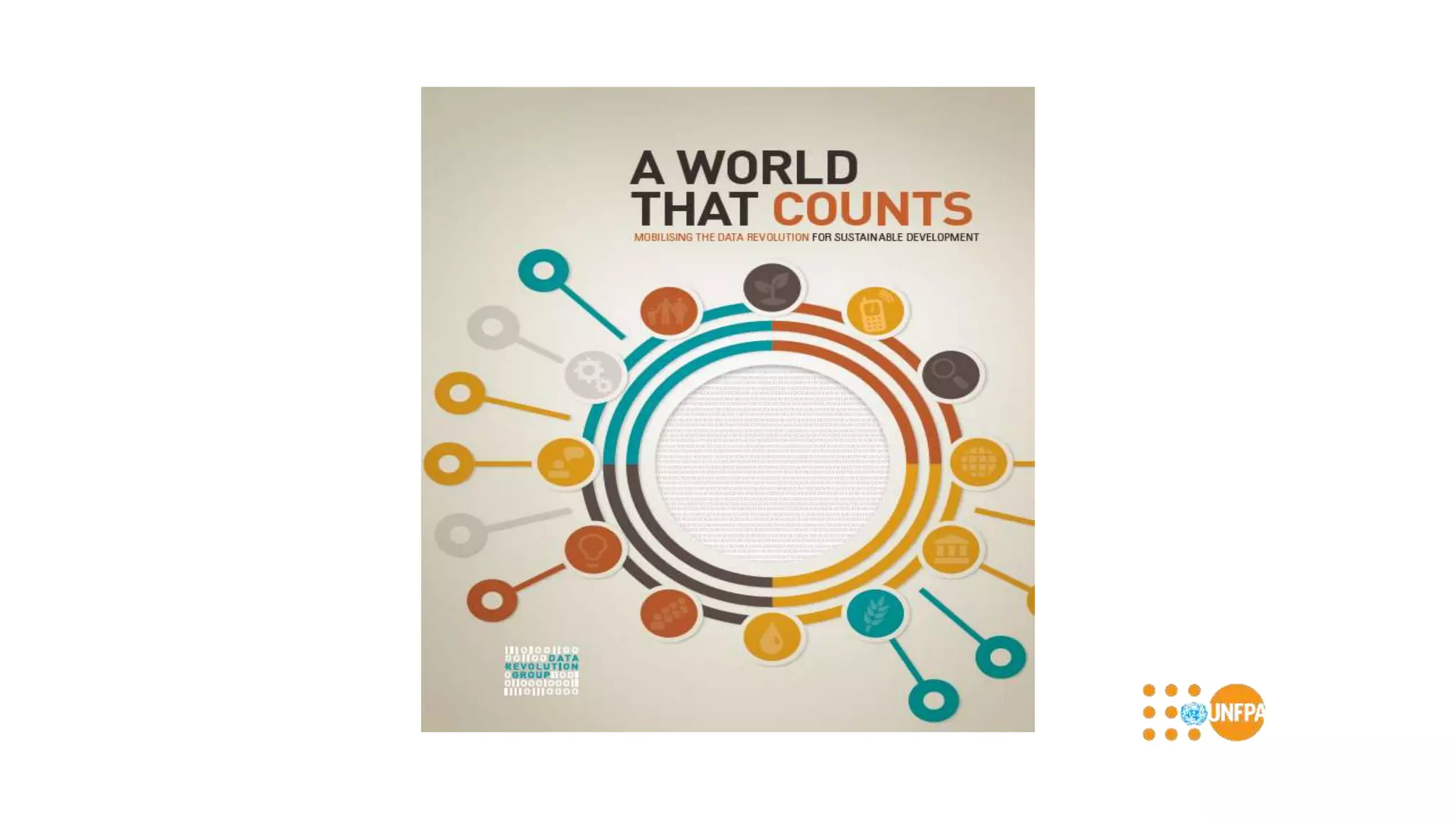
Data Revolution Group, 2014. A World that Counts:
Mobilizing the Data revolution for Sustainable
Development. www.undatarevolution.org.
“Data are the lifeblood of decision-making and the raw
material for accountability. Without high- quality data
providing the right information on the right things at the
right time, designing, monitoring and evaluation effective
policies becomes almost impossible”
What is the data revolution?
• An explosion in the volume of data, the speed with which data are
produced, the number of producers of data, the dissemination of
data, and the range of things on which there is data, coming from
new technologies such as mobile phones and the “internet of
things”, and from other sources, such as qualitative data, citizen-
generated data and perceptions data;
• A growing demand for data from all parts of society
What is the DR for Sustainable Development?
• The integration of these new data with traditional data to produce high-
quality information that is more detailed, timely and relevant for many
purposes and users, especially to foster and monitor sustainable
development;
• The increase in the usefulness of data through a much greater degree of
openness and transparency, avoiding invasion of privacy and abuse of
human rights from misuse of data on individuals and groups, and
minimising inequality in production, access to and use of data;
• Ultimately, more empowered people, better policies, better decisions and
greater participation and accountability, leading to better outcomes for
people and the planet.
Challenges
• MDG and SDG processes  data and knowledge gaps;
• Not having enough high-quality data ;
• Data are not used or usable ;
• Capacity of agencies with a mandate to collect public
information;
• Human and financial resources
Opportunities (1)
 SDGs addressing these challenges
 Particularly on Goals: 1, 2, 3, 4, 5, 8, 16 and 17.
 SDGs are broader in scope and and universal.
 SDGs addresses economic, social and environment
 Emphasis: inclusion, participation: no one behind.
 Accountability = additional data will be needed
 NSSs and needed resources (human and financial)
 The data revolution is an opportunity
Opportunities (2)
• To minimize the disparities in access and use of data;
• To address data access and utilization issues
(privacy, minority rights, institutional trust, quality
assurance, inequality, private sector participation).
• The data revolution is already happening and we
need to act deliberately to minimize the risks of not
responding as needed and therefore increasing
inequalities
A programme of action!
Session 1: Global data, demographic change
and inequality
Speaker: Jane Scobie, HelpAge International
Global AgeWatch Index and the invisibility of data on
older people.
#DATA2015
#ALLAGES
Wifi
Username: Casa1537
Password: Venue1537
Global AgeWatch Index
Invisibility of data on older people
Jane Scobie, HelpAge International jscobie@helpage.org
HelpAge: working globally to realise the rights
and potential of all older people
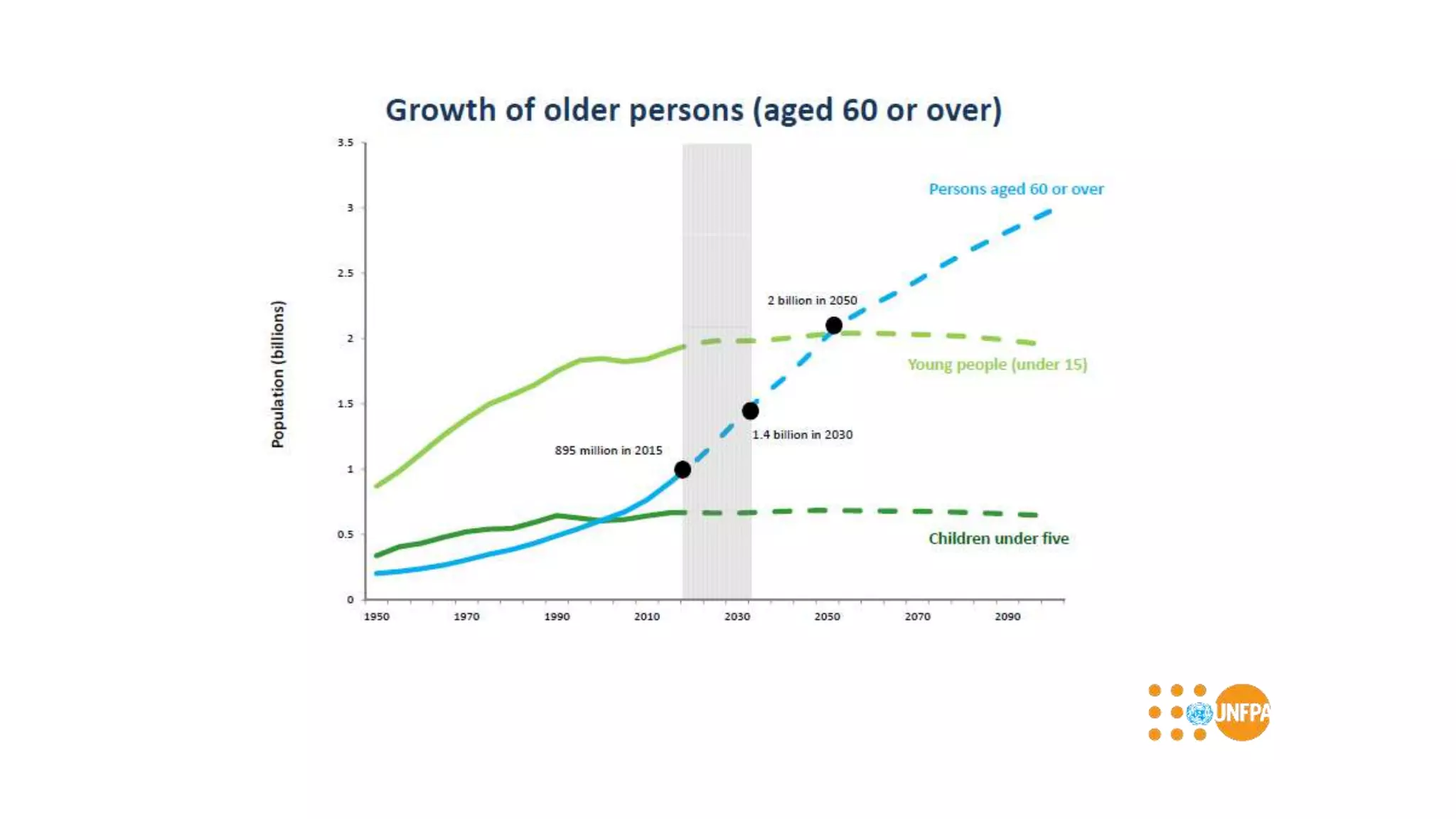
Scale and rate of global population ageing
Today 66% people 60+ live in low and mid income countries
By 2030 > 60+ than children under 10
Time taken to increase the proportion
of older people from 7% to 20%
Rapid ageing
40
23
18
32
38
23
40
10
11
22
21
14
0
5
10
15
20
25
30
35
40
45
United Kingdom Bangladesh Mexico Kenya South Africa Ethiopia
7-14% 14-20%
Source: United Nations, Department of Economic and Social Affairs, Population Division (2013). World Population Prospects: The
2012 Revision, DVD Edition. For UK increase of share of older people from 8-16% and 16-21%, based on ONS data published on
http://www.bbc.co.uk/news/uk-18854073
Longer lives
Source:
http://www.ons.gov.uk/ons/rel/lifetables/historic-and-
projected-data-from-the-period-and-cohort-life-
tables/2012-based/info-surviving-to-age-100.html
1 in 3
babies born today in the UK will
survive to age 100
Japan: LE @ 60 = 21 yrs
Turkey: LE @ 60 = 26 yrs
Afghanistan: LE @ 60 = 16 yrs
What we measure matters –
lets not sleepwalk into ageing
Older women and men are routinely missed out of data
collection and analyses in many countries. Invisibility
reinforces inequalities and masks contribution.
Gaps in global data: some examples
• COLLECTION: DHS people 15-49
• REPORTING: Global reporting HIV focusses on people 15-
49. Yet 14% of people in Africa living with HIV
• ANALYSIS: labour force participation data for people 65+
rarely analysed.
• UTILISATION: Agricultural census: data on older farmers
collected but not acted upon. Older farmers miss out on
agricultural subsidies and training.
Age limits in SDG’s
Freezing older people out? e.g:
• Sex and violence 15-49
• Life learning stops at 64
• NCD stops at 70
• SDG Goal 2 on hunger refers to
addressing nutritional needs of older
persons but has indicators focused
solely on under 5’s
(c) Glyn Riley/ HelpAge International
Global AgeWatch Index
Four domains and thirteen indicators
Challenges : multidimensional
framework of well-being
• How to capture well-being?
• The Index framework was developed based on
• Human Development Index
• Recommendations of the Stiglitz Commission, Madrid
International Plan of Actions on Ageing, UNFPA/HelpAge
International report ‘Ageing in the XXI century’
• Consultations with more than 30 International experts
• Ongoing process
Challenges: Data
We lack internationally comparable data on older people
(e.g. poverty in old age, political participation, life-long
learning, psychological well-being)
Challenges: Data
• Data available for only 96 countries
• Some indicators not available by gender
• Time lag when national statistics makes it to
international datasets
• No international agreement on methodology of
measuring indicators (e.g. poverty rate: absolute vs.
relative)
• Quality of subjective indicators
Profile map
Triangulate global national and local
data on ageing
Global
AgeWatch Index
National data
using framework
of Index
Local citizen
generated data
Tanzania:Older Citizen Monitoring Groups
• Collect data to influence local planning and budgeting
• 1309 monitoring groups collected data from over 200,000
older women and men over 2 years
• QUESTIONS: Did you have to pay for drugs? Where the drugs
you need available? Did you have access to HIV services?
• RESULTS: disaggregation by age in clinics up from
1-60%, more tailored services,
increased budget,
access to AV drugs.
(c) Judith Escribano/ Age International
Recommendations
• Disaggregate all data by age and gender in 5 year
segments from birth to death in SDG and inclusion of
older men and women in indicators
• Standardized set of national indicators on well being in
older age – use Index as a starting point – that can be
compared globally.
• Internationally held and managed Global data sets,
surveys and collection mechanisms including DHS include
older women and men
• Prioritise efforts to enable older women and men to use
existing data
Thank you and spread the word!
HelpAgeInternational
@helpage
#AgeingIndex
info@helpage.org
www.helpage.org
©JonasWresch/HelpAgeInternational
Session 1: Global data, demographic change
and inequality
Comments, questions, responses.
Wrap up: Danny Sriskandarajah.
#DATA2015
#ALLAGES
Wifi
Username: Casa1537
Password: Venue1537

Cartagena Data Festival 2015: Making older people count Pt 1

  • 1.
    # D ATA2 0 1 5 # A L L A G E S Wifi Username: Casa1537 Password: Venue1537 Older people count: Making data fit for purpose in a rapidly ageing world
  • 2.
    Session 1: Globaldata, demographic change and inequality Chair: Danny Sriskandarajah, CIVICUS Panellists: Sabina Alkire, OPHI Edilberto Loaiza, UNFPA Jane Scobie, HelpAge International #DATA2015 #ALLAGES Wifi Username: Casa1537 Password: Venue1537
  • 4.
    Session 1: Globaldata, demographic change and inequality Chair: Danny Sriskandarajah, CIVICUS Opening comments on importance of use of data by citizens of all ages. Introduction to first session and panellists. #DATA2015 #ALLAGES Wifi Username: Casa1537 Password: Venue1537
  • 5.
    Session 1: Globaldata, demographic change and inequality Speaker: Sabina Alkire, OPHI Multi-dimensional poverty measurement: What lessons can be drawn to improve age-disaggregated data? #DATA2015 #ALLAGES Wifi Username: Casa1537 Password: Venue1537
  • 6.
    Multidimensional Poverty and Age-Disaggregateddata Sabina Alkire, University of Oxford HelpAge side event: Older People Count Cartagena, 20 April 2015
  • 7.
    Measuring Elder Poverty: Optionsand Challenges 1. A measure such as the global MPI can be age- disaggregated. 2. A uniform individual MPI can be built, that allows comparison across age groups. 3. Specific measure(s) of Elder poverty can be designed (not discussed here) Cross-cutting data challenges (will start by naming)
  • 8.
    Cross Cutting DataChallenges: 1. Survey data do not cover residential homes, hospitals 2. Survey data are difficult to complete for respondents hearing and speech loss, dementia, etc. 3. Cutoffs for Elder persons may be difficult 1. BMI and some health variables 2. Subjective health data, aspirations, expectations 3. Schooling level achieved 4. Demographic analysis for repeated cross-sections can be challenging (changes from mortality, migration, household composition changes)
  • 9.
  • 10.
    The Global MPI •The global MPI is an internationally comparable index of acute poverty for 100+ developing countries. • It was launched in 2010 in UNDP’s Human Development Report, and updated in 2011, 2013, 2014 and 2015. • It covers 110 countries at present, using primarily DHS (52), MICS (34) and WHS (16) data. • A revised MPI 2015+ is under discussion to monitor extreme poverty in the SDGs
  • 11.
    Data Limitations • TheDHS and MICS surveys used by the MPI were designed initially for maternal and child health issues. • They are not designed to reflect health conditions among the aged. • They do obtain all relevant educational data for aged. • Usually, malnutrition data are not collected for women who are 50+, or men who are 60+, nor child mortality. • Thus the health status of the elderly is not reflected in the current global MPI in most datasets (there are exceptions).
  • 12.
  • 13.
    Build a deprivationscore for each person, based on household members Basic idea – start from people See what they experience at the same time Jiyem’s Profile – 77% Set poverty cutoffs – to see the poorest & less deprived Show how poverty changes over time.
  • 14.
    2. Identify whois poor Global MPI: A person is multidimensionally poor if they are deprived in 33% or more of the dimensions. Phuba’s deprivation score is 67%, so she is poor
  • 15.
    3. Compute theMPI (Alkire-Foster) The MPI is the product of two components: 1) Incidence ~ the percentage of people who are poor, H. 2) Intensity ~ the average percentage of dimensions in which poor people are deprived A. MPI = H × A Alkire and Foster Journal of Public Economics 2011
  • 16.
  • 17.
    Incidence and Intensityby Country Namibia Brazil Argentina Indonesia Guatemala Ghana Lao Nigeria Tajikistan Zimbabwe Cambodia Nepal Bangladesh Gambia Tanzania Malawi Rwanda Afghanistan Mozambique Congo DR Benin Burundi Guinea-Bissau Liberia Somalia Ethiopia Niger 30% 35% 40% 45% 50% 55% 60% 65% 70% 75% 0% 10% 20% 30% 40% 50% 60% 70% 80% 90% 100% AverageIntensityofPoverty(A) Percentage of People Considered Poor (H) Poorest Countries, Highest MPI China India The size of the bubbles is a proportional representation of the total number of MPI poor in each country
  • 18.
    Age decompositions: Illustrated for25 countries (Vaz 2014) Figure 2: Demographic distribution of MPI poor by age categories [0,9] [10,18] [19,64] 65 and older Figure 1: Age structure of population [0,9] [10,18] [19,64] 65 and older
  • 19.
    Age decompositions: Illustrated for25 countries Figure 2: Demographic distribution of MPI poor by age categories [0,9] [10,18] [19,64] 65 and older Figure 1: Age structure of population [0,9] [10,18] [19,64] 65 and older The Global MPI shows that the percentage of people who are MPI poor and 65 higher is: - The same as the population in 7 countries - Lower than the population in 8 countries (less elder MPI) - Higher than the population in 10 (more elder MPI) - Congo is highest: 2.6% of pop; but 3.8% of poor are 65+
  • 20.
    Would this changewith nutritional data for elders? We have such data in Bangladesh and Ethiopia. However, malnutrition rates are lower for the elders • Conclusion: merely adding anthropometric data for elders is not sufficient. Bangladesh Ethiopia Aged 0to14 40.5% 56.6% Aged 15to49 34.5% 55.9% Aged 50to64 24.6% 40.2% Aged 65onwards 27.4% 27.6%
  • 21.
    Measuring Elder Poverty: Optionsand Challenges 1. A measure such as the global MPI (as improved for the SDGs) can be age-disaggregated. • Ideally, requires data for Elder household members. • May require age-appropriate thresholds • May require supplementary or different indicators • Consider incentives: for caring families; for policy makers • NB: residential care is not visible in standard hh surveys.
  • 22.
    Option 2 MPI basedon individual’s attainments
  • 23.
    0.5 0.55 0.6 0.65 0.7 0.75 0.8 Bhutan’s 2012 GrossNational Happiness Index GNH Index
  • 24.
    But in somecases, data are available for all persons, including the elderly, AND individual-level MPIs are constructed, in a similar manner to child poverty. Example: Multidimensional poverty measurement for EU-SILC countries Sabina Alkire, Mauricio Apablaza OPHI Working paper and study within NET-SILC2 project.
  • 25.
    Table 5: Dimensions,Indicators and Weights 25 Dimension Variable Respondent is not deprived if: M1 M2 M3 EU 2020 AROP The respondent’s equivalized disposable income is above 60 per cent of the national median 1/12 Quasi- Joblessness The respondent lives in household where the ratio of the total number of months that all - household members aged 16-59 have worked during the income reference year and the total number of months the same household members theoretically could have worked in the same period is higher than 0.2 1/12 Severe material deprivation The respondent has at least six of the following: the ability to make ends meet; to afford one week of holidays; a meal with meat, chicken, fish or vegi equivalent; to face unexpected expenses; and, to keep home adequately warm. Or the respondent has a car, a colour TV, a washing machine, and a telephone. 1/12
  • 26.
    26 Dimension Variable Respondentis not deprived if: M1 Education Education The respondent has completed primary education 1/4 Environment Noise The respondent lives in a household with low noise from neighbourhood or from the street 1/16 Pollution The respondent lives in a household with low pollution, grime or other environmental problems 1/16 Crime The respondent lives in a household with low crime, violence or vandalism in the area 1/16 Housing The respondent lives in a household with no leaking roof, damp walls, rot in window frames or floor 1/16 Health Health The respondent considers her own health as fair or above 1/16 Chronic Illness The respondent has no chronic illness or long- term condition 1/16 Morbidity The respondent has no limitations due to health problems 1/16 Unmet Med. Needs The respondent does not report unmet medical needs 1/16
  • 27.
    30 EU-SILC countries,poor if k=26% (2009) Health variables are right most (greenish). 27
  • 28.
    MPI for EU-SILCcountries for each year (2006-2012) 28 0.00 0.02 0.04 0.06 0.08 0.10 0.12 0.14 0.16 0.18 2006 2007 2008 2009 2010 2011 2012 AT BE BG CH CY CZ DE DK EE EL ES FI FR HR HU IE IS IT LT LU LV MT NL NO PL PT RO SE SI SK UK k=26% We can study the evolution of poverty for each country using annual data, and decompose this by gender and age.
  • 29.
    Women are alwayssame or poorer than men every year, every country – shown in 2012 29
  • 30.
    The % ofpoor by age – high contributions from 65+ 30 Elder contribution ot poverty – dark bars on right – usually v hi
  • 31.
    Continued 31 France hasdistinctively high elder poverty – half of poor people!
  • 32.
    How are theypoor? Elder poor v high in (subjective) health and education deprivations. 32
  • 33.
    Measuring Elder Poverty: Optionsand Challenges 2. A uniform individual MPI can be built, that allows comparison across age groups, for all household types. • However subjective health deprivations vv high among European elderly (may not be high – adaptive preferences) • What is ‘good’ health functioning when you are 80? • How to obtain survey data from those with hearing and speech loss, intelectual and mental disabilities? • Cannot distinguish an Elder in a caring home from one suffering isolation.
  • 34.
    Conclusion: There are 3immediately feasible options for measuring multidimensional poverty among the aged: 1. Disaggregating a household-level MPI by age 2. Disaggregating an indvidual-level MPI by age 3. Designing an MPI specifically for Elder poverty The techniques exist! The challenges lie in data and standard-setting.
  • 35.
  • 36.
    Session 1: Globaldata, demographic change and inequality Speaker: Edilberto Loaiza, UNFPA Population dynamics and SDGs in the context of the "data revolution". #DATA2015 #ALLAGES Wifi Username: Casa1537 Password: Venue1537
  • 37.
    Population Dynamics andSDGs in the Context of the Data Revolution Edilberto Loaiza, Ph.D. UNFPA, New York Global Data, Demographic Change and Inequality 20th April 2015 , Cartagena
  • 42.
    By 2070, Africawill have over a billion working age youth, and 270 million 65+ j
  • 46.
    Data Revolution Group,2014. A World that Counts: Mobilizing the Data revolution for Sustainable Development. www.undatarevolution.org. “Data are the lifeblood of decision-making and the raw material for accountability. Without high- quality data providing the right information on the right things at the right time, designing, monitoring and evaluation effective policies becomes almost impossible”
  • 47.
    What is thedata revolution? • An explosion in the volume of data, the speed with which data are produced, the number of producers of data, the dissemination of data, and the range of things on which there is data, coming from new technologies such as mobile phones and the “internet of things”, and from other sources, such as qualitative data, citizen- generated data and perceptions data; • A growing demand for data from all parts of society
  • 48.
    What is theDR for Sustainable Development? • The integration of these new data with traditional data to produce high- quality information that is more detailed, timely and relevant for many purposes and users, especially to foster and monitor sustainable development; • The increase in the usefulness of data through a much greater degree of openness and transparency, avoiding invasion of privacy and abuse of human rights from misuse of data on individuals and groups, and minimising inequality in production, access to and use of data; • Ultimately, more empowered people, better policies, better decisions and greater participation and accountability, leading to better outcomes for people and the planet.
  • 49.
    Challenges • MDG andSDG processes  data and knowledge gaps; • Not having enough high-quality data ; • Data are not used or usable ; • Capacity of agencies with a mandate to collect public information; • Human and financial resources
  • 50.
    Opportunities (1)  SDGsaddressing these challenges  Particularly on Goals: 1, 2, 3, 4, 5, 8, 16 and 17.  SDGs are broader in scope and and universal.  SDGs addresses economic, social and environment  Emphasis: inclusion, participation: no one behind.  Accountability = additional data will be needed  NSSs and needed resources (human and financial)  The data revolution is an opportunity
  • 51.
    Opportunities (2) • Tominimize the disparities in access and use of data; • To address data access and utilization issues (privacy, minority rights, institutional trust, quality assurance, inequality, private sector participation). • The data revolution is already happening and we need to act deliberately to minimize the risks of not responding as needed and therefore increasing inequalities
  • 52.
  • 53.
    Session 1: Globaldata, demographic change and inequality Speaker: Jane Scobie, HelpAge International Global AgeWatch Index and the invisibility of data on older people. #DATA2015 #ALLAGES Wifi Username: Casa1537 Password: Venue1537
  • 54.
    Global AgeWatch Index Invisibilityof data on older people Jane Scobie, HelpAge International jscobie@helpage.org
  • 55.
    HelpAge: working globallyto realise the rights and potential of all older people
  • 56.
    Scale and rateof global population ageing Today 66% people 60+ live in low and mid income countries By 2030 > 60+ than children under 10
  • 57.
    Time taken toincrease the proportion of older people from 7% to 20% Rapid ageing 40 23 18 32 38 23 40 10 11 22 21 14 0 5 10 15 20 25 30 35 40 45 United Kingdom Bangladesh Mexico Kenya South Africa Ethiopia 7-14% 14-20% Source: United Nations, Department of Economic and Social Affairs, Population Division (2013). World Population Prospects: The 2012 Revision, DVD Edition. For UK increase of share of older people from 8-16% and 16-21%, based on ONS data published on http://www.bbc.co.uk/news/uk-18854073
  • 58.
    Longer lives Source: http://www.ons.gov.uk/ons/rel/lifetables/historic-and- projected-data-from-the-period-and-cohort-life- tables/2012-based/info-surviving-to-age-100.html 1 in3 babies born today in the UK will survive to age 100 Japan: LE @ 60 = 21 yrs Turkey: LE @ 60 = 26 yrs Afghanistan: LE @ 60 = 16 yrs
  • 60.
    What we measurematters – lets not sleepwalk into ageing Older women and men are routinely missed out of data collection and analyses in many countries. Invisibility reinforces inequalities and masks contribution.
  • 61.
    Gaps in globaldata: some examples • COLLECTION: DHS people 15-49 • REPORTING: Global reporting HIV focusses on people 15- 49. Yet 14% of people in Africa living with HIV • ANALYSIS: labour force participation data for people 65+ rarely analysed. • UTILISATION: Agricultural census: data on older farmers collected but not acted upon. Older farmers miss out on agricultural subsidies and training.
  • 62.
    Age limits inSDG’s Freezing older people out? e.g: • Sex and violence 15-49 • Life learning stops at 64 • NCD stops at 70 • SDG Goal 2 on hunger refers to addressing nutritional needs of older persons but has indicators focused solely on under 5’s (c) Glyn Riley/ HelpAge International
  • 63.
    Global AgeWatch Index Fourdomains and thirteen indicators
  • 64.
    Challenges : multidimensional frameworkof well-being • How to capture well-being? • The Index framework was developed based on • Human Development Index • Recommendations of the Stiglitz Commission, Madrid International Plan of Actions on Ageing, UNFPA/HelpAge International report ‘Ageing in the XXI century’ • Consultations with more than 30 International experts • Ongoing process
  • 65.
    Challenges: Data We lackinternationally comparable data on older people (e.g. poverty in old age, political participation, life-long learning, psychological well-being)
  • 66.
    Challenges: Data • Dataavailable for only 96 countries • Some indicators not available by gender • Time lag when national statistics makes it to international datasets • No international agreement on methodology of measuring indicators (e.g. poverty rate: absolute vs. relative) • Quality of subjective indicators
  • 67.
  • 68.
    Triangulate global nationaland local data on ageing Global AgeWatch Index National data using framework of Index Local citizen generated data
  • 69.
    Tanzania:Older Citizen MonitoringGroups • Collect data to influence local planning and budgeting • 1309 monitoring groups collected data from over 200,000 older women and men over 2 years • QUESTIONS: Did you have to pay for drugs? Where the drugs you need available? Did you have access to HIV services? • RESULTS: disaggregation by age in clinics up from 1-60%, more tailored services, increased budget, access to AV drugs. (c) Judith Escribano/ Age International
  • 70.
    Recommendations • Disaggregate alldata by age and gender in 5 year segments from birth to death in SDG and inclusion of older men and women in indicators • Standardized set of national indicators on well being in older age – use Index as a starting point – that can be compared globally. • Internationally held and managed Global data sets, surveys and collection mechanisms including DHS include older women and men • Prioritise efforts to enable older women and men to use existing data
  • 71.
    Thank you andspread the word! HelpAgeInternational @helpage #AgeingIndex info@helpage.org www.helpage.org ©JonasWresch/HelpAgeInternational
  • 72.
    Session 1: Globaldata, demographic change and inequality Comments, questions, responses. Wrap up: Danny Sriskandarajah. #DATA2015 #ALLAGES Wifi Username: Casa1537 Password: Venue1537

Editor's Notes

  • #13 New labels for Living Standard variables, old picture is behind
  • #38 HIV Project Consultative Meeting Draft Presentation
  • #39 HIV Project Consultative Meeting Draft Presentation
  • #40 HIV Project Consultative Meeting Draft Presentation
  • #41 HIV Project Consultative Meeting Draft Presentation
  • #42 HIV Project Consultative Meeting Draft Presentation
  • #43 HIV Project Consultative Meeting Draft Presentation
  • #44 HIV Project Consultative Meeting Draft Presentation
  • #45 HIV Project Consultative Meeting Draft Presentation
  • #46 HIV Project Consultative Meeting Draft Presentation
  • #47 HIV Project Consultative Meeting Draft Presentation
  • #50 • The MDG and SDG processes have made more visible the data and knowledge gaps existing at country level, particularly regarding uncounted populations, limiting the capacity by governments to act and to communicate with the respective constituencies. • Not having enough high-quality data: data is of poor quality, data arrives too late and too many issues are still not properly covered; (employment, older people, disability, violence against women). • Data are not used or usable (data that are not transferred to statistical offices, or generated by the private sector or academic researchers that are not released); • Agencies with a mandate to collect public information, NSSs, are not always well suited to ensuring their data and information are used by stakeholders and therefore the possible facilitating role of civil society and the private sector; • Monitoring needs (SDGs) for existing and emerging issues will require substantial additional investments;
  • #51 Fortunately many of these challenges are now been addressed under the post 2015 development agenda and included in the Sustainable Development Goals (SDGs) as challenges for countries, civil society, private sector, international organizations and the global community at large. The opportunities to make possible the visibility of older people can be seen under at least eight of the seventeen SDGs: 1, 2, 3, 4, 5, 8, 16 and 17. The initiatives included now under the SDGs are broader in scope and therefore much more ambitious and universal. It is also clearly established now that the development, implementation and monitoring of the SDGs will require actions at the levels at which the challenges reside (economic, social and environment) and with precise emphasis on inclusion, participation and to live no one behind. For the accountability of the actors involved, additional data will be needed and the NSSs (in particular the NSOs) should be equipped with the needed resources (human and financial) to deliver in the production and use of the required data. The data revolution provides a set of opportunities to address these data challenges to maximize the benefits of the needed data to develop policies and interventions, to monitor its implementation and to provide evidence for accountability at the desired levels.
  • #52 Governments and its NSSs, have a concrete responsibility to minimize the disparities in access and use of data: between developed and developing countries, between nformation-rich and information-poor people, and between the private and the public sector. NSSs should be able to respond to issues related to data access/utilization (privacy, minority rights, institutional trust, quality assurance, data inequality, private sector participation). The data revolution is already happening and we need to act deliberately to minimize the risks of not responding as needed and therefore increasing inequalities
  • #57 Myth breaking. Make the point world is ageing fast with developing countries ageing fastest. Today there are more people over 60 than under 5, by 2050 those over 60 will out number those under 15.
  • #58 Speed of ageing in low and middle income countries is happening much faster. E.g. it took 80 years for population of United Kingdom to rise from 7% to 20%. It will take just 29years in Mexico and 54 years in Kenya
  • #60 Too often… Older people face discrimination, older people frequently report this attitude among health staff Older people are seen as a problem: economic pressures are challenging traditional caregiving Older people are seen as a threat: destabilising economies and societies This is not the complete picture, older people are key contributors to family and society, there are many ways we can support increasing frailty that comes with age, people have same rights at all ages.
  • #61 But older people are missed out for data collection and analyses, leading to neglect of older people in social and economic policies and programmes. For example: Demographic and Health Surveys (DHS)only collect data on people between the ages of 15-49 leading to a lack of data on issues fundamental to older people’s wellbeing. Reporting of data at international level by UN agencies: where global indicators are restricted to a specific age group, international reporting focuses on this group, excluding additional data that may be collected and available at the country level. For example: data available at the country level on older women and men and HIV is often not included in global reports on the HIV epidemic . Utilisation of data by governments and other actors: when data is available on older women and men it is not always utilised or acted upon in policies and programmes. For example: Agricultural Censuses collect and disaggregate data by age but very few census reports have included any detailed analysis on the situation of ageing rural populations or addressed their contributions and needs in rural development, food security or social protection policies. Older people want to be seen heard and undersood – resourceful, connect to younger generations, reconfigure not return, volunteer
  • #62 Estimated 50% people in US and 14% people in Africa living with HIV will be over 50 by end of 2015 Cambodia 80% carers of adults with AIDS are older people Older women and men care for up to 40-60% children orphaned by AIDS in East and Southern Africa HIV source Negin J and Cumming R 2010 HIV infection in older adults in sub-Saharan Africa: extrapolating prevalence from existing data, Bulletin of the World Health Organisation, 2010;88:847-853
  • #64 All domains are equally weighted, website allows people to vary weighting on line. See Insight (p.14/15) for detailed explanations of indicators. Methodology report expands on reasons and statistical methodology. Draws on statistical and perception data (enabling social environment)
  • #66 In the narrative you could mention how the index construction also helped us identify and the data and knowledge gap