Population Ageing & Longer Lives – 
Global triumph, global challenge 
Toby Porter 
Chief Executive, HelpAge International
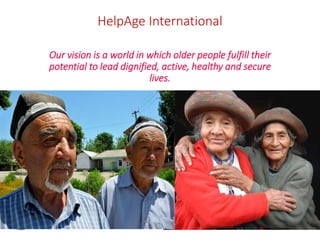
HelpAge International 
Our vision is a world in which older people fulfill their 
potential to lead dignified, active, healthy and secure 
lives. 
-
Global ageing is a triumph of human development 
Twentieth Century advances... 
Health and sanitation 
Education 
Poverty reduction
Development progress... 
more people are surviving childhood 
more women are surviving childbirth 
fewer children are being born... 
...and people are living longer
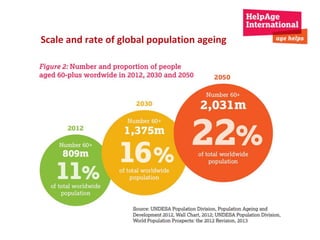
Scale and rate of global population ageing
1209012349035
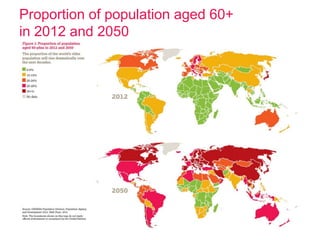
Proportion of population aged 60+ 
in 2012 and 2050
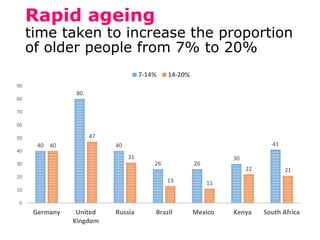
Rapid ageing 
time taken to increase the proportion 
of older people from 7% to 20% 
40 
80 
7-14% 14-20% 
40 40 
41 
26 26 
30 
47 
31 
13 11 
22 21 
90 
80 
70 
60 
50 
40 
30 
20 
10 
0 
Germany United 
Kingdom 
Russia Brazil Mexico Kenya South Africa
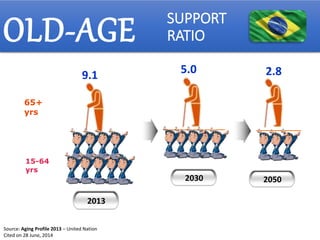
OLD-AGE SUPPORT 
RATIO 
9.1 
2013 
65+ 
yrs 
15-64 
yrs 
Source: Aging Profile 2013 – United Nation 
Cited on 28 June, 2014 
5.0 
2030 
2.8 
2050
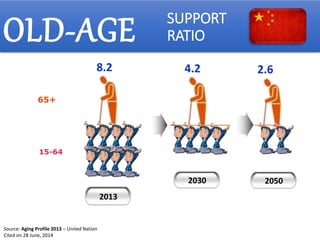
OLD-AGE SUPPORT 
RATIO 
65+ 
Source: Aging Profile 2013 – United Nation 
Cited on 28 June, 2014 
4.2 
2030 
2013 
15-64 
8.2 
2.6 
2050
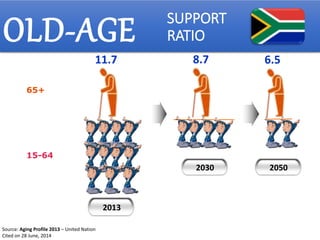
OLD-AGE SUPPORT 
RATIO 
11.7 6.5 
65+ 
Source: Aging Profile 2013 – United Nation 
Cited on 28 June, 2014 
8.7 
2030 
2050 
2013 
15-64
The 21st century is the century of ageing 
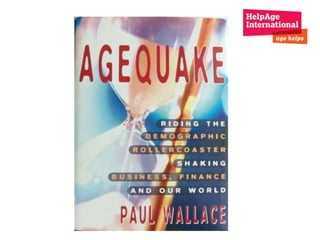
“The new millennium closes the first chapter in human 
history: when we were young” (Paul Wallace: “Agequake”) 
Life expectancy is extending worldwide, fertility rates are 
falling, and demographic ageing is accelerating - 
“The ageing of humanity across the world is a defining stage 
in history. It will change everything from business and finance 
to society and culture”
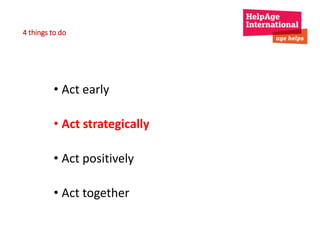
4 things to do 
• Act early 
• Act strategically 
• Act positively 
• Act together
4 things to do 
• Act early 
• Act strategically 
• Act positively 
• Act together
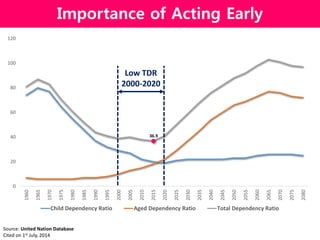
120 
100 
80 
60 
40 
20 
0 
1960 
1965 
1970 
Importance of Acting Early 
1975 
1980 
1985 
1990 
1995 
Low TDR 
2000-2020 
2000 
2005 
2010 
36.9 
2015 
2020 
2025 
2030 
2035 
2040 
2045 
2050 
2055 
2060 
2065 
2070 
2075 
2080 
Child Dependency Ratio Aged Dependency Ratio Total Dependency Ratio 
Source: United Nation Database 
Cited on 1st July, 2014
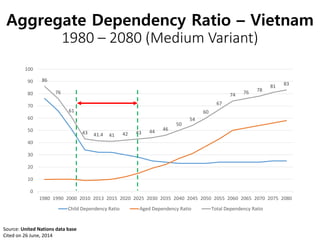
Aggregate Dependency Ratio – Vietnam 
86 
76 
1980 – 2080 (Medium Variant) 
61 
43 41.4 41 42 43 44 46 
50 
54 
60 
67 
74 76 78 
81 83 
100 
90 
80 
70 
60 
50 
40 
30 
20 
10 
0 
1980 1990 2000 2010 2013 2015 2020 2025 2030 2035 2040 2045 2050 2055 2060 2065 2070 2075 2080 
Child Dependency Ratio Aged Dependency Ratio Total Dependency Ratio 
Source: United Nations data base 
Cited on 26 June, 2014
4 things to do 
• Act early 
• Act strategically 
• Act positively 
• Act together
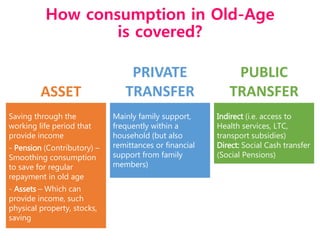
How consumption in Old-Age 
is covered? 
Saving through the 
working life period that 
provide income 
- Pension (Contributory) – 
Smoothing consumption 
to save for regular 
repayment in old age 
- Assets – Which can 
provide income, such 
physical property, stocks, 
saving 
Mainly family support, 
frequently within a 
household (but also 
remittances or financial 
support from family 
members) 
Indirect (i.e. access to 
Health services, LTC, 
transport subsidies) 
Direct: Social Cash transfer 
(Social Pensions) 
ASSET 
PRIVATE 
TRANSFER 
PUBLIC 
TRANSFER
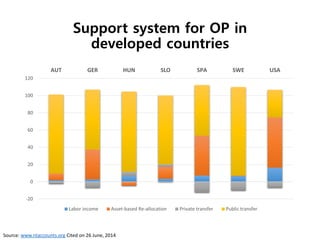
Support system for OP in 
developed countries 
120 
100 
80 
60 
40 
20 
0 
-20 
AUT GER HUN SLO SPA SWE USA 
Labor income Asset-based Re-allocation Private transfer Public transfer 
Source: www.ntaccounts.org Cited on 26 June, 2014
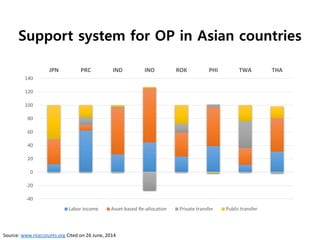
Support system for OP in Asian countries 
140 
120 
100 
80 
60 
40 
20 
0 
-20 
-40 
JPN PRC IND INO ROK PHI TWA THA 
Labor income Asset-based Re-allocation Private transfer Public transfer 
Source: www.ntaccounts.org Cited on 26 June, 2014
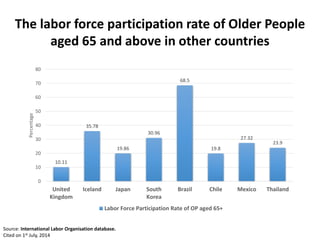
The labor force participation rate of Older People 
aged 65 and above in other countries 
10.11 
35.78 
19.86 
30.96 
68.5 
19.8 
27.32 
23.9 
80 
70 
60 
50 
40 
30 
20 
10 
0 
United 
Kingdom 
Iceland Japan South 
Korea 
Brazil Chile Mexico Thailand 
Percentage 
Labor Force Participation Rate of OP aged 65+ 
Source: International Labor Organisation database. 
Cited on 1st July, 2014
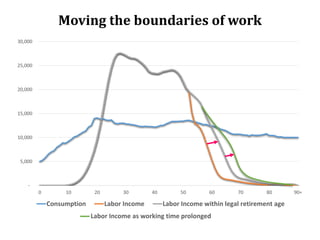
Moving the boundaries of work 
30,000 
25,000 
20,000 
15,000 
10,000 
5,000 
- 
0 10 20 30 40 50 60 70 80 90+ 
Consumption Labor Income Labor Income within legal retirement age 
Labor Income as working time prolonged
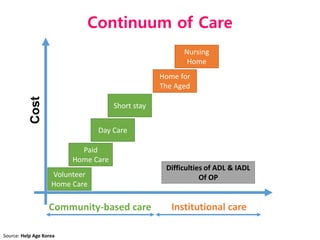
Continuum of Care 
Paid 
Home Care 
Volunteer 
Home Care 
Day Care 
Home for 
The Aged 
Short stay 
Nursing 
Home 
Difficulties of ADL & IADL 
Of OP 
Community-based care Institutional care 
Cost 
Source: Help Age Korea
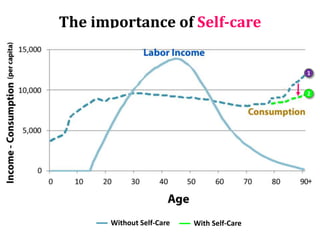
The importance of Self-care 
1 
2 
Without Self-Care With Self-Care
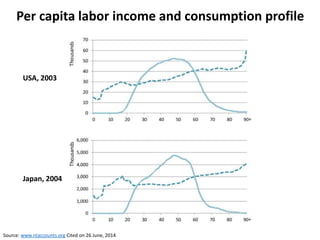
Per capita labor income and consumption profile 
USA, 2003 
Japan, 2004 
Source: www.ntaccounts.org Cited on 26 June, 2014
4 things to do 
• Act early 
• Act strategically 
• Act positively 
• Act together
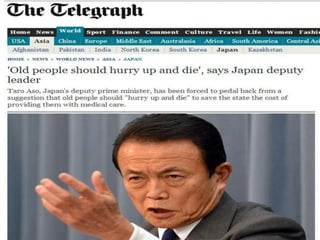
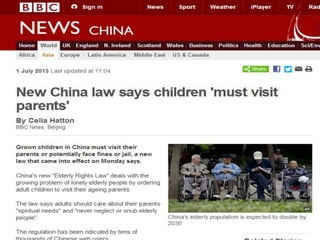
A triumph seen as a crisis 
Many low- and middle-income countries are said to 
be “growing old before they grow rich” 
Media headlines on aging... 
“Aging population may explode global economy by 
2050” 
“Silver Tsunami” 
“World faces ageing population time bomb says UN”
Negative attitudes toward ageing create: 
a lack of preparedness (governments and societies) 
fear of old age & a wish to avoid it 
a reaction against older people (generational competition) 
fear-mongering today reinforces a fatalist approach to the 
future
Old age is seen as a disease 
older people frequently report this attitude among health staff 
Older people are seen as a problem 
economic pressures are challenging traditional caregiving 
Older people are seen as a threat 
destabilising economies and societies
4 things to do 
• Act early 
• Act strategically 
• Act positively 
• Act together
ACTING TOGETHER At Family level 
Problem 
Compartmentalisation of different age groups 
Excluding older people, their needs, vulnerabilities, contributions 
and capabilities runs counter to the reality of the fabric and 
economy of households across the world
ACTING TOGETHER: at Community level 
Problem 
Increasing isolation, family separation due to migration, work 
requirements 
Lack of community-based facilities – health and community 
centres
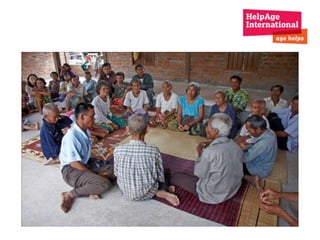
Response 
Village-based older people's associations - foster social bonds and 
help older people to support each other 
training on older people's health 
“age-friendly” health consultations 
training on home-based care 
home care volunteers for frail older people
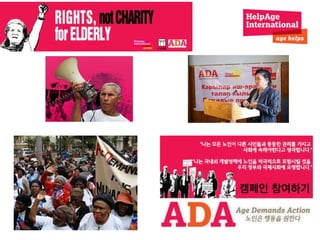
ACTING TOGETHER: At National Level 
Problem: 
Political voice and power of older people is not sufficiently 
organised or heard
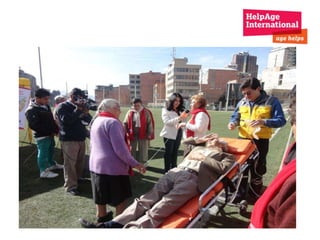
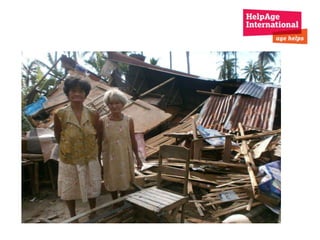
ACTING TOGETHER: At times of Crisis 
Problem 
Older people are especially vulnerable to 
natural disasters 
conflict 
long-term crisis – drought, food shortages
ACTING TOGETHER: Around the World 
As a global community of older people, and advocates for their 
rights 
• Exchanging information, ideas and best practice 
• Coming together as a moral community at times of crisis 
• Combatting ageism, exclusion and discrimination 
• Joining forces for political and advocacy priorities
Ageing in the “post-2015” agenda 
a forward-looking global agenda on health, poverty, rights, the 
environment - 
must recognize demographic change and global ageing 
needs a life-course based, inclusive approach
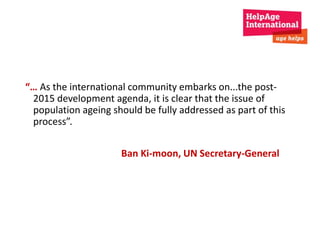
“… As the international community embarks on...the post- 
2015 development agenda, it is clear that the issue of 
population ageing should be fully addressed as part of this 
process”. 
Ban Ki-moon, UN Secretary-General
A UN Convention on the rights of older people 
Growing concern over challenges to older people’s rights… 
…and abuses – physical, social, financial 
UN review of the Madrid International Plan of Action on Ageing - 
major obstacles to older people’s “participation, inclusion & social 
integration”, including discrimination and abuse
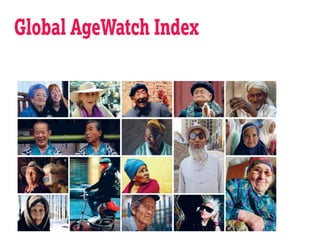
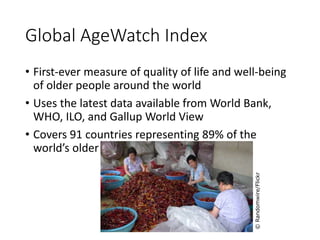
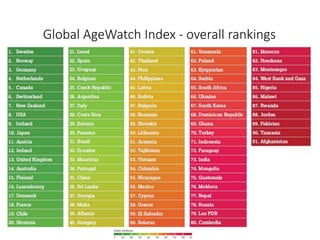
Global AgeWatch Index 
• First-ever measure of quality of life and well-being 
of older people around the world 
• Uses the latest data available from World Bank, 
WHO, ILO, and Gallup World View 
• Covers 91 countries representing 89% of the 
world’s older people 
© Randomwire/Flickr
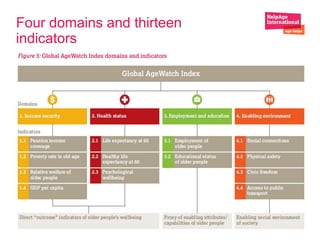
Four domains and thirteen 
indicators
Global AgeWatch Index - overall rankings
A new view of old age 
Focus on the individual and not the age – her/his capabilities and 
assets, not deficits 
Old age is not the problem... 
...Societies need to adjust– social structures, physical environments, 
attitudes
Thank you

Population ageing and longer lives: Global triumph, global challenge

  • 1.
    Population Ageing &Longer Lives – Global triumph, global challenge Toby Porter Chief Executive, HelpAge International
  • 2.
    HelpAge International Ourvision is a world in which older people fulfill their potential to lead dignified, active, healthy and secure lives. -
  • 3.
    Global ageing isa triumph of human development Twentieth Century advances... Health and sanitation Education Poverty reduction
  • 4.
    Development progress... morepeople are surviving childhood more women are surviving childbirth fewer children are being born... ...and people are living longer
  • 5.
    Scale and rateof global population ageing
  • 6.
  • 7.
    Proportion of populationaged 60+ in 2012 and 2050
  • 8.
    Rapid ageing timetaken to increase the proportion of older people from 7% to 20% 40 80 7-14% 14-20% 40 40 41 26 26 30 47 31 13 11 22 21 90 80 70 60 50 40 30 20 10 0 Germany United Kingdom Russia Brazil Mexico Kenya South Africa
  • 9.
    OLD-AGE SUPPORT RATIO 9.1 2013 65+ yrs 15-64 yrs Source: Aging Profile 2013 – United Nation Cited on 28 June, 2014 5.0 2030 2.8 2050
  • 10.
    OLD-AGE SUPPORT RATIO 65+ Source: Aging Profile 2013 – United Nation Cited on 28 June, 2014 4.2 2030 2013 15-64 8.2 2.6 2050
  • 11.
    OLD-AGE SUPPORT RATIO 11.7 6.5 65+ Source: Aging Profile 2013 – United Nation Cited on 28 June, 2014 8.7 2030 2050 2013 15-64
  • 12.
    The 21st centuryis the century of ageing “The new millennium closes the first chapter in human history: when we were young” (Paul Wallace: “Agequake”) Life expectancy is extending worldwide, fertility rates are falling, and demographic ageing is accelerating - “The ageing of humanity across the world is a defining stage in history. It will change everything from business and finance to society and culture”
  • 18.
    4 things todo • Act early • Act strategically • Act positively • Act together
  • 19.
    4 things todo • Act early • Act strategically • Act positively • Act together
  • 20.
    120 100 80 60 40 20 0 1960 1965 1970 Importance of Acting Early 1975 1980 1985 1990 1995 Low TDR 2000-2020 2000 2005 2010 36.9 2015 2020 2025 2030 2035 2040 2045 2050 2055 2060 2065 2070 2075 2080 Child Dependency Ratio Aged Dependency Ratio Total Dependency Ratio Source: United Nation Database Cited on 1st July, 2014
  • 21.
    Aggregate Dependency Ratio– Vietnam 86 76 1980 – 2080 (Medium Variant) 61 43 41.4 41 42 43 44 46 50 54 60 67 74 76 78 81 83 100 90 80 70 60 50 40 30 20 10 0 1980 1990 2000 2010 2013 2015 2020 2025 2030 2035 2040 2045 2050 2055 2060 2065 2070 2075 2080 Child Dependency Ratio Aged Dependency Ratio Total Dependency Ratio Source: United Nations data base Cited on 26 June, 2014
  • 22.
    4 things todo • Act early • Act strategically • Act positively • Act together
  • 23.
    How consumption inOld-Age is covered? Saving through the working life period that provide income - Pension (Contributory) – Smoothing consumption to save for regular repayment in old age - Assets – Which can provide income, such physical property, stocks, saving Mainly family support, frequently within a household (but also remittances or financial support from family members) Indirect (i.e. access to Health services, LTC, transport subsidies) Direct: Social Cash transfer (Social Pensions) ASSET PRIVATE TRANSFER PUBLIC TRANSFER
  • 24.
    Support system forOP in developed countries 120 100 80 60 40 20 0 -20 AUT GER HUN SLO SPA SWE USA Labor income Asset-based Re-allocation Private transfer Public transfer Source: www.ntaccounts.org Cited on 26 June, 2014
  • 25.
    Support system forOP in Asian countries 140 120 100 80 60 40 20 0 -20 -40 JPN PRC IND INO ROK PHI TWA THA Labor income Asset-based Re-allocation Private transfer Public transfer Source: www.ntaccounts.org Cited on 26 June, 2014
  • 27.
    The labor forceparticipation rate of Older People aged 65 and above in other countries 10.11 35.78 19.86 30.96 68.5 19.8 27.32 23.9 80 70 60 50 40 30 20 10 0 United Kingdom Iceland Japan South Korea Brazil Chile Mexico Thailand Percentage Labor Force Participation Rate of OP aged 65+ Source: International Labor Organisation database. Cited on 1st July, 2014
  • 28.
    Moving the boundariesof work 30,000 25,000 20,000 15,000 10,000 5,000 - 0 10 20 30 40 50 60 70 80 90+ Consumption Labor Income Labor Income within legal retirement age Labor Income as working time prolonged
  • 29.
    Continuum of Care Paid Home Care Volunteer Home Care Day Care Home for The Aged Short stay Nursing Home Difficulties of ADL & IADL Of OP Community-based care Institutional care Cost Source: Help Age Korea
  • 30.
    The importance ofSelf-care 1 2 Without Self-Care With Self-Care
  • 31.
    Per capita laborincome and consumption profile USA, 2003 Japan, 2004 Source: www.ntaccounts.org Cited on 26 June, 2014
  • 32.
    4 things todo • Act early • Act strategically • Act positively • Act together
  • 33.
    A triumph seenas a crisis Many low- and middle-income countries are said to be “growing old before they grow rich” Media headlines on aging... “Aging population may explode global economy by 2050” “Silver Tsunami” “World faces ageing population time bomb says UN”
  • 35.
    Negative attitudes towardageing create: a lack of preparedness (governments and societies) fear of old age & a wish to avoid it a reaction against older people (generational competition) fear-mongering today reinforces a fatalist approach to the future
  • 36.
    Old age isseen as a disease older people frequently report this attitude among health staff Older people are seen as a problem economic pressures are challenging traditional caregiving Older people are seen as a threat destabilising economies and societies
  • 38.
    4 things todo • Act early • Act strategically • Act positively • Act together
  • 40.
    ACTING TOGETHER AtFamily level Problem Compartmentalisation of different age groups Excluding older people, their needs, vulnerabilities, contributions and capabilities runs counter to the reality of the fabric and economy of households across the world
  • 41.
    ACTING TOGETHER: atCommunity level Problem Increasing isolation, family separation due to migration, work requirements Lack of community-based facilities – health and community centres
  • 42.
    Response Village-based olderpeople's associations - foster social bonds and help older people to support each other training on older people's health “age-friendly” health consultations training on home-based care home care volunteers for frail older people
  • 44.
    ACTING TOGETHER: AtNational Level Problem: Political voice and power of older people is not sufficiently organised or heard
  • 46.
    ACTING TOGETHER: Attimes of Crisis Problem Older people are especially vulnerable to natural disasters conflict long-term crisis – drought, food shortages
  • 49.
    ACTING TOGETHER: Aroundthe World As a global community of older people, and advocates for their rights • Exchanging information, ideas and best practice • Coming together as a moral community at times of crisis • Combatting ageism, exclusion and discrimination • Joining forces for political and advocacy priorities
  • 51.
    Ageing in the“post-2015” agenda a forward-looking global agenda on health, poverty, rights, the environment - must recognize demographic change and global ageing needs a life-course based, inclusive approach
  • 52.
    “… As theinternational community embarks on...the post- 2015 development agenda, it is clear that the issue of population ageing should be fully addressed as part of this process”. Ban Ki-moon, UN Secretary-General
  • 54.
    A UN Conventionon the rights of older people Growing concern over challenges to older people’s rights… …and abuses – physical, social, financial UN review of the Madrid International Plan of Action on Ageing - major obstacles to older people’s “participation, inclusion & social integration”, including discrimination and abuse
  • 56.
    Global AgeWatch Index • First-ever measure of quality of life and well-being of older people around the world • Uses the latest data available from World Bank, WHO, ILO, and Gallup World View • Covers 91 countries representing 89% of the world’s older people © Randomwire/Flickr
  • 57.
    Four domains andthirteen indicators
  • 58.
    Global AgeWatch Index- overall rankings
  • 59.
    A new viewof old age Focus on the individual and not the age – her/his capabilities and assets, not deficits Old age is not the problem... ...Societies need to adjust– social structures, physical environments, attitudes
  • 60.