Social Media Trends & Innovations
Hamutal Schieber | Feb. 2016
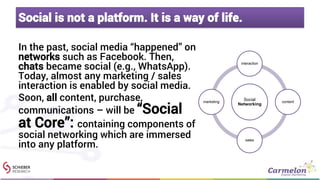
Social is not a platform. It is a way of life.
In the past, social media “happened” on
networks such as Facebook. Then,
chats became social (e.g., WhatsApp).
Today, almost any marketing / sales
interaction is enabled by social media.
Soon, all content, purchase,
communications – will be “Social
at Core”: containing components of
social networking which are immersed
into any platform.
Social
Networking
interaction
content
sales
marketing
Introduction
• Social Media platforms have been changing the way we interact, network, and
collaborate, for years now. More recently, they began to change the way we shop and
work.
• This presentation examines main platforms and behaviors in the “social media” sphere,
as well as best practice in addressing each trend:
WHO WHERE WHEN HOW WHY WHAT
Demographics Geographies /
locations
Social media & the
path to purchase
Device trends What consumers are
looking for
Content and
behavior trends
WHO WHERE WHEN HOW WHY WHAT
Demographics Geographies /
locations
Social media & the path to
purchase
Device trends What consumers are
looking for
Content and behavior
trends
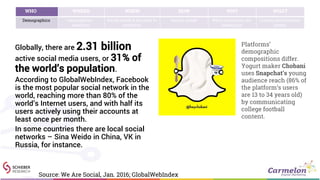
Globally, there are 2.31 billion
active social media users, or 31% of
the world’s population.
According to GlobalWebIndex, Facebook
is the most popular social network in the
world, reaching more than 80% of the
world’s Internet users, and with half its
users actively using their accounts at
least once per month.
In some countries there are local social
networks – Sina Weido in China, VK in
Russia, for instance.
Source: We Are Social, Jan. 2016; GlobalWebIndex
Platforms’
demographic
compositions differ.
Yogurt maker Chobani
uses Snapchat’s young
audience reach (86% of
the platform’s users
are 13 to 34 years old)
by communicating
college football
content.
1550
900 860
700
653 650
400
316 300 300
249 230 212 211 200
105 100 100 100 97
0
200
400
600
800
1000
1200
1400
1600
1800
Source: Statista, 2016
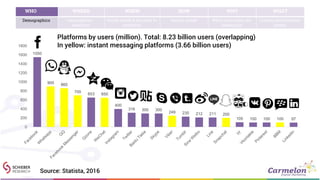
Platforms by users (million). Total: 8.23 billion users (overlapping)
In yellow: instant messaging platforms (3.66 billion users)
WHO WHERE WHEN HOW WHY WHAT
Demographics Geographies /
locations
Social media & the path to
purchase
Device trends What consumers are
looking for
Content and behavior
trends
WHO WHERE WHEN HOW WHY WHAT
Demographics Geographies /
locations
Social media & the path to
purchase
Device trends What consumers are
looking for
Content and behavior
trends
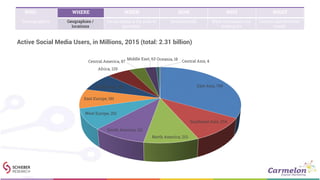
East Asia, 769
Southeast Asis, 234
North America, 213
South America, 211
West Europe, 201
East Europe, 191
South Asia, 186
Africa, 129
Central America, 87
Middle East, 63 Oceania, 18
Central Asis, 4
Active Social Media Users, in Millions, 2015 (total: 2.31 billion)
WHO WHERE WHEN HOW WHY WHAT
Demographics Geographies /
locations
Social media & the path to
purchase
Device trends What consumers are
looking for
Content and behavior
trends
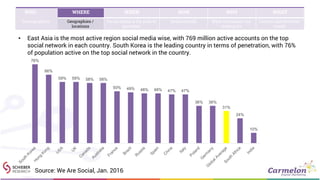
• East Asia is the most active region social media wise, with 769 million active accounts on the top
social network in each country. South Korea is the leading country in terms of penetration, with 76%
of population active on the top social network in the country.
76%
66%
59% 59% 58% 58%
50% 49% 48% 48% 47% 47%
36% 36%
31%
24%
10%
Source: We Are Social, Jan. 2016
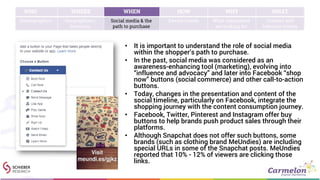
• It is important to understand the role of social media
within the shopper’s path to purchase.
• In the past, social media was considered as an
awareness-enhancing tool (marketing), evolving into
“influence and advocacy” and later into Facebook “shop
now” buttons (social commerce) and other call-to-action
buttons.
• Today, changes in the presentation and content of the
social timeline, particularly on Facebook, integrate the
shopping journey with the content consumption journey.
• Facebook, Twitter, Pinterest and Instagram offer buy
buttons to help brands push product sales through their
platforms.
• Although Snapchat does not offer such buttons, some
brands (such as clothing brand MeUndies) are including
special URLs in some of the Snapchat posts. MeUndies
reported that 10% - 12% of viewers are clicking those
links.
WHO WHERE WHEN HOW WHY WHAT
Demographics Geographies /
locations
Social media & the
path to purchase
Device trends What consumers
are looking for
Content and
behavior trends
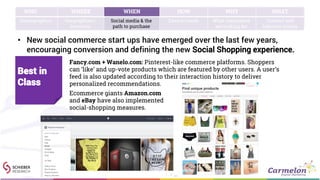
• New social commerce start ups have emerged over the last few years,
encouraging conversion and defining the new Social Shopping experience.
WHO WHERE WHEN HOW WHY WHAT
Demographics Geographies /
locations
Social media & the
path to purchase
Device trends What consumers
are looking for
Content and
behavior trends
Fancy.com + Wanelo.com: Pinterest-like commerce platforms. Shoppers
can ‘like’ and up-vote products which are featured by other users. A user’s
feed is also updated according to their interaction history to deliver
personalized recommendations.
Best in
Class
Ecommerce giants Amazon.com
and eBay have also implemented
social-shopping measures.
• Real Time is a powerful marketing tool: relevant content delivered as-it-
happens to consumers, can create a new “tribal fire” and drive engagement
with the brand.
WHO WHERE WHEN HOW WHY WHAT
Demographics Geographies /
locations
Social media & the
path to purchase
Device trends What consumers
are looking for
Content and
behavior trends
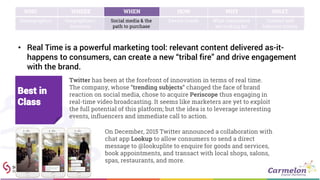
Twitter has been at the forefront of innovation in terms of real time.
The company, whose “trending subjects” changed the face of brand
reaction on social media, chose to acquire Periscope thus engaging in
real-time video broadcasting. It seems like marketers are yet to exploit
the full potential of this platform; but the idea is to leverage interesting
events, influencers and immediate call to action.
Best in
Class
On December, 2015 Twitter announced a collaboration with
chat app Lookup to allow consumers to send a direct
message to @lookuplite to enquire for goods and services,
book appointments, and transact with local shops, salons,
spas, restaurants, and more.
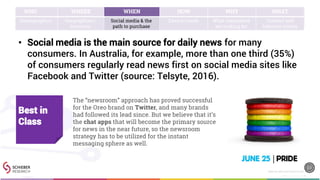
• Social media is the main source for daily news for many
consumers. In Australia, for example, more than one third (35%)
of consumers regularly read news first on social media sites like
Facebook and Twitter (source: Telsyte, 2016).
Best in
Class
WHO WHERE WHEN HOW WHY WHAT
Demographics Geographies /
locations
Social media & the
path to purchase
Device trends What consumers
are looking for
Content and
behavior trends
The “newsroom” approach has proved successful
for the Oreo brand on Twitter, and many brands
had followed its lead since. But we believe that it’s
the chat apps that will become the primary source
for news in the near future, so the newsroom
strategy has to be utilized for the instant
messaging sphere as well.
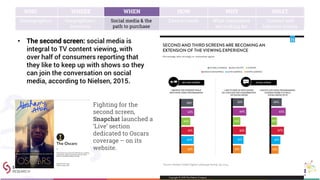
• The second screen: social media is
integral to TV content viewing, with
over half of consumers reporting that
they like to keep up with shows so they
can join the conversation on social
media, according to Nielsen, 2015.
WHO WHERE WHEN HOW WHY WHAT
Demographics Geographies /
locations
Social media & the
path to purchase
Device trends What consumers
are looking for
Content and
behavior trends
Fighting for the
second screen,
Snapchat launched a
‘Live’ section
dedicated to Oscars
coverage – on its
website.
WHO WHERE WHEN HOW WHY WHAT
Demographics Geographies /
locations
Social media & the
path to purchase
Device trends What consumers
are looking for
Content and
behavior trends
27% of the population access social media from
mobile devices – 1.97 billion people.
As chatting apps experience growth, we believe
that this figure will increase significantly over in
the next year.
Sources: We Are Social, Jan. 2016; Adage, Nov. 2015
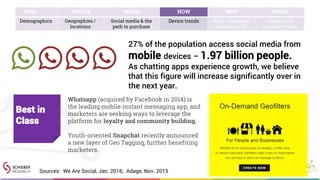
Whatsapp (acquired by Facebook in 2014) is
the leading mobile instant messaging app, and
marketers are seeking ways to leverage the
platform for loyalty and community building.
Youth-oriented Snapchat recently announced
a new layer of Geo Tagging, further benefiting
marketers.
Best in
Class
WHO WHERE WHEN HOW WHY WHAT
Demographics Geographies /
locations
Social media & the
path to purchase
Device trends What consumers
are looking for
Content and
behavior trends
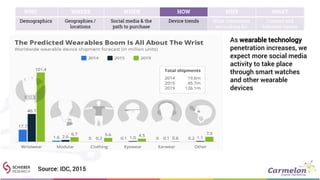
As wearable technology
penetration increases, we
expect more social media
activity to take place
through smart watches
and other wearable
devices
Source: IDC, 2015
WHO WHERE WHEN HOW WHY WHAT
Demographics Geographies /
locations
Social media & the
path to purchase
Device trends What consumers
are looking for
Content and
behavior trends
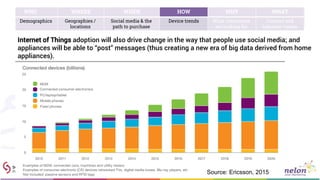
Internet of Things adoption will also drive change in the way that people use social media; and
appliances will be able to “post” messages (thus creating a new era of big data derived from home
appliances).
Source: Ericsson, 2015
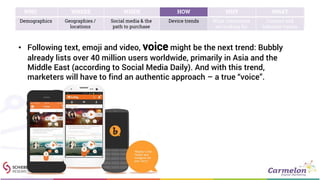
• Following text, emoji and video, voice might be the next trend: Bubbly
already lists over 40 million users worldwide, primarily in Asia and the
Middle East (according to Social Media Daily). And with this trend,
marketers will have to find an authentic approach – a true “voice”.
WHO WHERE WHEN HOW WHY WHAT
Demographics Geographies /
locations
Social media & the
path to purchase
Device trends What consumers
are looking for
Content and
behavior trends
WHO WHERE WHEN HOW WHY WHAT
Demographics Geographies /
locations
Social media & the
path to purchase
Device trends What consumers
are looking for
Content and
behavior trends
• Social media is considered as an addiction by many experts, with
consumers reporting that they want to, but can’t unplug from social
media platforms. Main reasons: Fear of Missing Out (FOMO) and
business demands.
– high rates of social media email opt-out found by Unroll.me, , a Web-based
and mobile application that allows consumers to unroll from any email list
they have subscribed to (Feb. 2016),
– A new US survey by Harris found that 67% of US adults decided to make a
conscious effort to unplug from digital media with over 70% of them citing
social media as the main need.
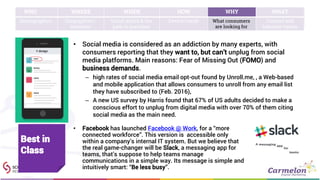
• Facebook has launched Facebook @ Work, for a “more
connected workforce”. This version is accessible only
within a company’s internal IT system. But we believe that
the real game-changer will be Slack, a messaging app for
teams, that’s suppose to help teams manage
communications in a simple way. Its message is simple and
intuitively smart: “Be less busy”.
Best in
Class
WHO WHERE WHEN HOW WHY WHAT
Demographics Geographies /
locations
Social media & the
path to purchase
Device trends What consumers
are looking for
Content and
behavior trends
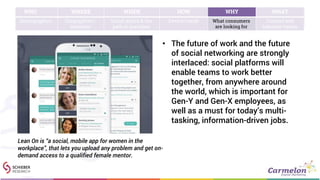
• The future of work and the future
of social networking are strongly
interlaced: social platforms will
enable teams to work better
together, from anywhere around
the world, which is important for
Gen-Y and Gen-X employees, as
well as a must for today’s multi-
tasking, information-driven jobs.
Lean On is “a social, mobile app for women in the
workplace”, that lets you upload any problem and get on-
demand access to a qualified female mentor.
• Our conclusion is this: communication through social media has to be extremely relevant
and consumer-focused, otherwise it will be considered as another disruption – and might
alienate consumers instead of creating loyalty.
WHO WHERE WHEN HOW WHY WHAT
Demographics Geographies /
locations
Social media & the
path to purchase
Device trends What consumers
are looking for
Content and
behavior trends
Vine [https://vine.co/] is a micro-video sharing platform with
over 40 million registered users (57% are female). The largest
age group is 18 – 20 years old users.
Vine refuses to run ads – demonstrating that it understands
its users – but lets brands introduce branded content
(accounting for 4% of top 100 vines). It also curates a
personalized homepage.
Best in Class brands use this platform to create share-worthy
content, using influencers and Vine stars, like this Coca Cola
Freestyle / Lucas & Marcus example. Lowe’s vines garner
many “loops”. The company has managed to turn DIY into a
hot issue through great content.
Best in
Class
• According to surveys, people go to social media platforms to see what their friends are
doing, as well as to post pictures: they don’t go to social media to get in touch with brands.
This means that brands should address consumers’ motivations such as entertainment,
curation of content, and information seeking, in order to take part in the social media
sphere.
WHO WHERE WHEN HOW WHY WHAT
Demographics Geographies /
locations
Social media & the
path to purchase
Device trends What consumers
are looking for
Content and
behavior trends
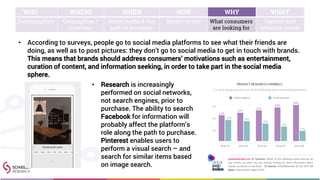
• Research is increasingly
performed on social networks,
not search engines, prior to
purchase. The ability to search
Facebook for information will
probably affect the platform’s
role along the path to purchase.
Pinterest enables users to
perform a visual search – and
search for similar items based
on image search.
• Content and ideas are the most important levers for brand on Social Media.
According to Warc analysis, 55% (11 out of 20) of the top 20 ranked
campaigns in 2015 were digitally led, with social media and online video in
particular delivering business results.
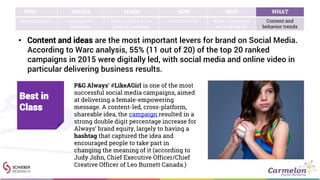
P&G Always’ #LikeAGirl is one of the most
successful social media campaigns, aimed
at delivering a female-empowering
message. A content-led, cross-platform,
shareable idea, the campaign resulted in a
strong double digit percentage increase for
Always’ brand equity, largely to having a
hashtag that captured the idea and
encouraged people to take part in
changing the meaning of it (according to
Judy John, Chief Executive Officer/Chief
Creative Officer of Leo Burnett Canada.)
Best in
Class
WHO WHERE WHEN HOW WHY WHAT
Demographics Geographies /
locations
Social media & the
path to purchase
Device trends What consumers
are looking for
Content and
behavior trends
• Communities are what separates social media from any other means of
media – and brands now turn to build communities on new social media
platforms, such as chatting apps.
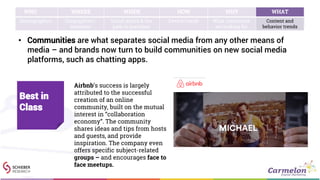
Airbnb’s success is largely
attributed to the successful
creation of an online
community, built on the mutual
interest in “collaboration
economy”. The community
shares ideas and tips from hosts
and guests, and provide
inspiration. The company even
offers specific subject-related
groups – and encourages face to
face meetups.
Best in
Class
WHO WHERE WHEN HOW WHY WHAT
Demographics Geographies /
locations
Social media & the
path to purchase
Device trends What consumers
are looking for
Content and
behavior trends
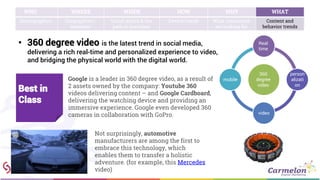
• 360 degree video is the latest trend in social media,
delivering a rich real-time and personalized experience to video,
and bridging the physical world with the digital world.
WHO WHERE WHEN HOW WHY WHAT
Demographics Geographies /
locations
Social media & the
path to purchase
Device trends What consumers
are looking for
Content and
behavior trends
360
degree
video
Real
time
person
alizati
on
video
mobileGoogle is a leader in 360 degree video, as a result of
2 assets owned by the company: Youtube 360
videos delivering content – and Google Cardboard,
delivering the watching device and providing an
immersive experience. Google even developed 360
cameras in collaboration with GoPro.
Best in
Class
Not surprisingly, automotive
manufacturers are among the first to
embrace this technology, which
enables them to transfer a holistic
adventure. (for example, this Mercedes
video)
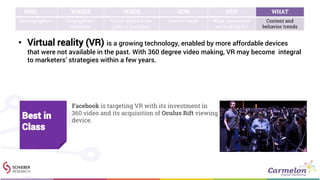
• Virtual reality (VR) is a growing technology, enabled by more affordable devices
that were not available in the past. With 360 degree video making, VR may become integral
to marketers’ strategies within a few years.
WHO WHERE WHEN HOW WHY WHAT
Demographics Geographies /
locations
Social media & the
path to purchase
Device trends What consumers
are looking for
Content and
behavior trends
Facebook is targeting VR with its investment in
360 video and its acquisition of Oculus Rift viewing
device.
Best in
Class
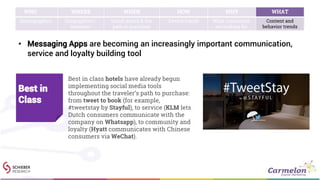
• Messaging Apps are becoming an increasingly important communication,
service and loyalty building tool
WHO WHERE WHEN HOW WHY WHAT
Demographics Geographies /
locations
Social media & the
path to purchase
Device trends What consumers
are looking for
Content and
behavior trends
Best in class hotels have already begun
implementing social media tools
throughout the traveler’s path to purchase:
from tweet to book (for example,
#tweetstay by Stayful), to service (KLM lets
Dutch consumers communicate with the
company on Whatsapp), to community and
loyalty (Hyatt communicates with Chinese
consumers via WeChat).
Best in
Class
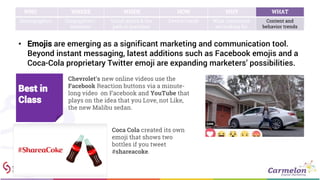
• Emojis are emerging as a significant marketing and communication tool.
Beyond instant messaging, latest additions such as Facebook emojis and a
Coca-Cola proprietary Twitter emoji are expanding marketers’ possibilities.
WHO WHERE WHEN HOW WHY WHAT
Demographics Geographies /
locations
Social media & the
path to purchase
Device trends What consumers
are looking for
Content and
behavior trends
Chevrolet’s new online videos use the
Facebook Reaction buttons via a minute-
long video on Facebook and YouTube that
plays on the idea that you Love, not Like,
the new Malibu sedan.
Best in
Class
Coca Cola created its own
emoji that shows two
bottles if you tweet
#shareacoke.
Social Media as a Facilitator of Real Life…
• Social media has stirred a major transformation in our daily lives, and is probably the
number one reason for the emergence of the Collaboration Economy as well.
• Today, people turn to social media platforms for much more than just information: they
look for apartment-swapping, buying / selling their own household items and much more.
And today, social media platforms are also used for business purposes beyond networking,
with social-media based internal communications.
• The next stage is the immersion of social media into shopping, with social shopping finally
leveraging immediacy, community and crowd-recommendation attributes of social media
instead of merely imitating e-commerce platforms.
Remember - It is important for marketers to adapt to the different
characteristics and main user motivations of each platform, so as not to be
considered as a distraction.
Thank You
The research was conducted by:
Hamutal Schieber
Schieber Research | Market Research & Competitive Intelligence
www.researchci.com | hamutal@researchci.com
Executive Summary. For the full research - please contact
Carmelon Digital Marketing
http://www.carmelon-digital.com

Social Media Trends & Innovations

  • 1.
    Social Media Trends& Innovations Hamutal Schieber | Feb. 2016
  • 2.
    Social is nota platform. It is a way of life. In the past, social media “happened” on networks such as Facebook. Then, chats became social (e.g., WhatsApp). Today, almost any marketing / sales interaction is enabled by social media. Soon, all content, purchase, communications – will be “Social at Core”: containing components of social networking which are immersed into any platform. Social Networking interaction content sales marketing
  • 3.
    Introduction • Social Mediaplatforms have been changing the way we interact, network, and collaborate, for years now. More recently, they began to change the way we shop and work. • This presentation examines main platforms and behaviors in the “social media” sphere, as well as best practice in addressing each trend: WHO WHERE WHEN HOW WHY WHAT Demographics Geographies / locations Social media & the path to purchase Device trends What consumers are looking for Content and behavior trends
  • 4.
    WHO WHERE WHENHOW WHY WHAT Demographics Geographies / locations Social media & the path to purchase Device trends What consumers are looking for Content and behavior trends Globally, there are 2.31 billion active social media users, or 31% of the world’s population. According to GlobalWebIndex, Facebook is the most popular social network in the world, reaching more than 80% of the world’s Internet users, and with half its users actively using their accounts at least once per month. In some countries there are local social networks – Sina Weido in China, VK in Russia, for instance. Source: We Are Social, Jan. 2016; GlobalWebIndex Platforms’ demographic compositions differ. Yogurt maker Chobani uses Snapchat’s young audience reach (86% of the platform’s users are 13 to 34 years old) by communicating college football content.
  • 5.
    1550 900 860 700 653 650 400 316300 300 249 230 212 211 200 105 100 100 100 97 0 200 400 600 800 1000 1200 1400 1600 1800 Source: Statista, 2016 Platforms by users (million). Total: 8.23 billion users (overlapping) In yellow: instant messaging platforms (3.66 billion users) WHO WHERE WHEN HOW WHY WHAT Demographics Geographies / locations Social media & the path to purchase Device trends What consumers are looking for Content and behavior trends
  • 6.
    WHO WHERE WHENHOW WHY WHAT Demographics Geographies / locations Social media & the path to purchase Device trends What consumers are looking for Content and behavior trends East Asia, 769 Southeast Asis, 234 North America, 213 South America, 211 West Europe, 201 East Europe, 191 South Asia, 186 Africa, 129 Central America, 87 Middle East, 63 Oceania, 18 Central Asis, 4 Active Social Media Users, in Millions, 2015 (total: 2.31 billion)
  • 7.
    WHO WHERE WHENHOW WHY WHAT Demographics Geographies / locations Social media & the path to purchase Device trends What consumers are looking for Content and behavior trends • East Asia is the most active region social media wise, with 769 million active accounts on the top social network in each country. South Korea is the leading country in terms of penetration, with 76% of population active on the top social network in the country. 76% 66% 59% 59% 58% 58% 50% 49% 48% 48% 47% 47% 36% 36% 31% 24% 10% Source: We Are Social, Jan. 2016
  • 8.
    • It isimportant to understand the role of social media within the shopper’s path to purchase. • In the past, social media was considered as an awareness-enhancing tool (marketing), evolving into “influence and advocacy” and later into Facebook “shop now” buttons (social commerce) and other call-to-action buttons. • Today, changes in the presentation and content of the social timeline, particularly on Facebook, integrate the shopping journey with the content consumption journey. • Facebook, Twitter, Pinterest and Instagram offer buy buttons to help brands push product sales through their platforms. • Although Snapchat does not offer such buttons, some brands (such as clothing brand MeUndies) are including special URLs in some of the Snapchat posts. MeUndies reported that 10% - 12% of viewers are clicking those links. WHO WHERE WHEN HOW WHY WHAT Demographics Geographies / locations Social media & the path to purchase Device trends What consumers are looking for Content and behavior trends
  • 9.
    • New socialcommerce start ups have emerged over the last few years, encouraging conversion and defining the new Social Shopping experience. WHO WHERE WHEN HOW WHY WHAT Demographics Geographies / locations Social media & the path to purchase Device trends What consumers are looking for Content and behavior trends Fancy.com + Wanelo.com: Pinterest-like commerce platforms. Shoppers can ‘like’ and up-vote products which are featured by other users. A user’s feed is also updated according to their interaction history to deliver personalized recommendations. Best in Class Ecommerce giants Amazon.com and eBay have also implemented social-shopping measures.
  • 10.
    • Real Timeis a powerful marketing tool: relevant content delivered as-it- happens to consumers, can create a new “tribal fire” and drive engagement with the brand. WHO WHERE WHEN HOW WHY WHAT Demographics Geographies / locations Social media & the path to purchase Device trends What consumers are looking for Content and behavior trends Twitter has been at the forefront of innovation in terms of real time. The company, whose “trending subjects” changed the face of brand reaction on social media, chose to acquire Periscope thus engaging in real-time video broadcasting. It seems like marketers are yet to exploit the full potential of this platform; but the idea is to leverage interesting events, influencers and immediate call to action. Best in Class On December, 2015 Twitter announced a collaboration with chat app Lookup to allow consumers to send a direct message to @lookuplite to enquire for goods and services, book appointments, and transact with local shops, salons, spas, restaurants, and more.
  • 11.
    • Social mediais the main source for daily news for many consumers. In Australia, for example, more than one third (35%) of consumers regularly read news first on social media sites like Facebook and Twitter (source: Telsyte, 2016). Best in Class WHO WHERE WHEN HOW WHY WHAT Demographics Geographies / locations Social media & the path to purchase Device trends What consumers are looking for Content and behavior trends The “newsroom” approach has proved successful for the Oreo brand on Twitter, and many brands had followed its lead since. But we believe that it’s the chat apps that will become the primary source for news in the near future, so the newsroom strategy has to be utilized for the instant messaging sphere as well.
  • 12.
    • The secondscreen: social media is integral to TV content viewing, with over half of consumers reporting that they like to keep up with shows so they can join the conversation on social media, according to Nielsen, 2015. WHO WHERE WHEN HOW WHY WHAT Demographics Geographies / locations Social media & the path to purchase Device trends What consumers are looking for Content and behavior trends Fighting for the second screen, Snapchat launched a ‘Live’ section dedicated to Oscars coverage – on its website.
  • 13.
    WHO WHERE WHENHOW WHY WHAT Demographics Geographies / locations Social media & the path to purchase Device trends What consumers are looking for Content and behavior trends 27% of the population access social media from mobile devices – 1.97 billion people. As chatting apps experience growth, we believe that this figure will increase significantly over in the next year. Sources: We Are Social, Jan. 2016; Adage, Nov. 2015 Whatsapp (acquired by Facebook in 2014) is the leading mobile instant messaging app, and marketers are seeking ways to leverage the platform for loyalty and community building. Youth-oriented Snapchat recently announced a new layer of Geo Tagging, further benefiting marketers. Best in Class
  • 14.
    WHO WHERE WHENHOW WHY WHAT Demographics Geographies / locations Social media & the path to purchase Device trends What consumers are looking for Content and behavior trends As wearable technology penetration increases, we expect more social media activity to take place through smart watches and other wearable devices Source: IDC, 2015
  • 15.
    WHO WHERE WHENHOW WHY WHAT Demographics Geographies / locations Social media & the path to purchase Device trends What consumers are looking for Content and behavior trends Internet of Things adoption will also drive change in the way that people use social media; and appliances will be able to “post” messages (thus creating a new era of big data derived from home appliances). Source: Ericsson, 2015
  • 16.
    • Following text,emoji and video, voice might be the next trend: Bubbly already lists over 40 million users worldwide, primarily in Asia and the Middle East (according to Social Media Daily). And with this trend, marketers will have to find an authentic approach – a true “voice”. WHO WHERE WHEN HOW WHY WHAT Demographics Geographies / locations Social media & the path to purchase Device trends What consumers are looking for Content and behavior trends
  • 17.
    WHO WHERE WHENHOW WHY WHAT Demographics Geographies / locations Social media & the path to purchase Device trends What consumers are looking for Content and behavior trends • Social media is considered as an addiction by many experts, with consumers reporting that they want to, but can’t unplug from social media platforms. Main reasons: Fear of Missing Out (FOMO) and business demands. – high rates of social media email opt-out found by Unroll.me, , a Web-based and mobile application that allows consumers to unroll from any email list they have subscribed to (Feb. 2016), – A new US survey by Harris found that 67% of US adults decided to make a conscious effort to unplug from digital media with over 70% of them citing social media as the main need. • Facebook has launched Facebook @ Work, for a “more connected workforce”. This version is accessible only within a company’s internal IT system. But we believe that the real game-changer will be Slack, a messaging app for teams, that’s suppose to help teams manage communications in a simple way. Its message is simple and intuitively smart: “Be less busy”. Best in Class
  • 18.
    WHO WHERE WHENHOW WHY WHAT Demographics Geographies / locations Social media & the path to purchase Device trends What consumers are looking for Content and behavior trends • The future of work and the future of social networking are strongly interlaced: social platforms will enable teams to work better together, from anywhere around the world, which is important for Gen-Y and Gen-X employees, as well as a must for today’s multi- tasking, information-driven jobs. Lean On is “a social, mobile app for women in the workplace”, that lets you upload any problem and get on- demand access to a qualified female mentor.
  • 19.
    • Our conclusionis this: communication through social media has to be extremely relevant and consumer-focused, otherwise it will be considered as another disruption – and might alienate consumers instead of creating loyalty. WHO WHERE WHEN HOW WHY WHAT Demographics Geographies / locations Social media & the path to purchase Device trends What consumers are looking for Content and behavior trends Vine [https://vine.co/] is a micro-video sharing platform with over 40 million registered users (57% are female). The largest age group is 18 – 20 years old users. Vine refuses to run ads – demonstrating that it understands its users – but lets brands introduce branded content (accounting for 4% of top 100 vines). It also curates a personalized homepage. Best in Class brands use this platform to create share-worthy content, using influencers and Vine stars, like this Coca Cola Freestyle / Lucas & Marcus example. Lowe’s vines garner many “loops”. The company has managed to turn DIY into a hot issue through great content. Best in Class
  • 20.
    • According tosurveys, people go to social media platforms to see what their friends are doing, as well as to post pictures: they don’t go to social media to get in touch with brands. This means that brands should address consumers’ motivations such as entertainment, curation of content, and information seeking, in order to take part in the social media sphere. WHO WHERE WHEN HOW WHY WHAT Demographics Geographies / locations Social media & the path to purchase Device trends What consumers are looking for Content and behavior trends • Research is increasingly performed on social networks, not search engines, prior to purchase. The ability to search Facebook for information will probably affect the platform’s role along the path to purchase. Pinterest enables users to perform a visual search – and search for similar items based on image search.
  • 21.
    • Content andideas are the most important levers for brand on Social Media. According to Warc analysis, 55% (11 out of 20) of the top 20 ranked campaigns in 2015 were digitally led, with social media and online video in particular delivering business results. P&G Always’ #LikeAGirl is one of the most successful social media campaigns, aimed at delivering a female-empowering message. A content-led, cross-platform, shareable idea, the campaign resulted in a strong double digit percentage increase for Always’ brand equity, largely to having a hashtag that captured the idea and encouraged people to take part in changing the meaning of it (according to Judy John, Chief Executive Officer/Chief Creative Officer of Leo Burnett Canada.) Best in Class WHO WHERE WHEN HOW WHY WHAT Demographics Geographies / locations Social media & the path to purchase Device trends What consumers are looking for Content and behavior trends
  • 22.
    • Communities arewhat separates social media from any other means of media – and brands now turn to build communities on new social media platforms, such as chatting apps. Airbnb’s success is largely attributed to the successful creation of an online community, built on the mutual interest in “collaboration economy”. The community shares ideas and tips from hosts and guests, and provide inspiration. The company even offers specific subject-related groups – and encourages face to face meetups. Best in Class WHO WHERE WHEN HOW WHY WHAT Demographics Geographies / locations Social media & the path to purchase Device trends What consumers are looking for Content and behavior trends
  • 23.
    • 360 degreevideo is the latest trend in social media, delivering a rich real-time and personalized experience to video, and bridging the physical world with the digital world. WHO WHERE WHEN HOW WHY WHAT Demographics Geographies / locations Social media & the path to purchase Device trends What consumers are looking for Content and behavior trends 360 degree video Real time person alizati on video mobileGoogle is a leader in 360 degree video, as a result of 2 assets owned by the company: Youtube 360 videos delivering content – and Google Cardboard, delivering the watching device and providing an immersive experience. Google even developed 360 cameras in collaboration with GoPro. Best in Class Not surprisingly, automotive manufacturers are among the first to embrace this technology, which enables them to transfer a holistic adventure. (for example, this Mercedes video)
  • 24.
    • Virtual reality(VR) is a growing technology, enabled by more affordable devices that were not available in the past. With 360 degree video making, VR may become integral to marketers’ strategies within a few years. WHO WHERE WHEN HOW WHY WHAT Demographics Geographies / locations Social media & the path to purchase Device trends What consumers are looking for Content and behavior trends Facebook is targeting VR with its investment in 360 video and its acquisition of Oculus Rift viewing device. Best in Class
  • 25.
    • Messaging Appsare becoming an increasingly important communication, service and loyalty building tool WHO WHERE WHEN HOW WHY WHAT Demographics Geographies / locations Social media & the path to purchase Device trends What consumers are looking for Content and behavior trends Best in class hotels have already begun implementing social media tools throughout the traveler’s path to purchase: from tweet to book (for example, #tweetstay by Stayful), to service (KLM lets Dutch consumers communicate with the company on Whatsapp), to community and loyalty (Hyatt communicates with Chinese consumers via WeChat). Best in Class
  • 26.
    • Emojis areemerging as a significant marketing and communication tool. Beyond instant messaging, latest additions such as Facebook emojis and a Coca-Cola proprietary Twitter emoji are expanding marketers’ possibilities. WHO WHERE WHEN HOW WHY WHAT Demographics Geographies / locations Social media & the path to purchase Device trends What consumers are looking for Content and behavior trends Chevrolet’s new online videos use the Facebook Reaction buttons via a minute- long video on Facebook and YouTube that plays on the idea that you Love, not Like, the new Malibu sedan. Best in Class Coca Cola created its own emoji that shows two bottles if you tweet #shareacoke.
  • 27.
    Social Media asa Facilitator of Real Life… • Social media has stirred a major transformation in our daily lives, and is probably the number one reason for the emergence of the Collaboration Economy as well. • Today, people turn to social media platforms for much more than just information: they look for apartment-swapping, buying / selling their own household items and much more. And today, social media platforms are also used for business purposes beyond networking, with social-media based internal communications. • The next stage is the immersion of social media into shopping, with social shopping finally leveraging immediacy, community and crowd-recommendation attributes of social media instead of merely imitating e-commerce platforms. Remember - It is important for marketers to adapt to the different characteristics and main user motivations of each platform, so as not to be considered as a distraction.
  • 28.
    Thank You The researchwas conducted by: Hamutal Schieber Schieber Research | Market Research & Competitive Intelligence www.researchci.com | hamutal@researchci.com Executive Summary. For the full research - please contact Carmelon Digital Marketing http://www.carmelon-digital.com

Editor's Notes

  • #12 http://www.bandt.com.au/media/one-three-australians-turn-social-media-first-news-source
  • #13 http://www.bandt.com.au/media/one-three-australians-turn-social-media-first-news-source
  • #28 http://epceurope.eu/wp-content/uploads/2015/09/epc-trends-social-media.pdf