HUMAN INTERACTION HAS NOT CHANGED.
IT’S WHERE IT HAPPENS THAT’S CHANGED.
Social Media and Networking:
What it is & why it’s important
Kevin Woodward
kwoodward@yahoo.com
Defining Social Media and Networking
Social Media is the content, tools and services
created and used by people online … such as
Facebook, Twitter, LinkedIn, YouTube, blogs,
groups, wikis and others.*
Social Networking is the act of building
interactive online communities of people with
shared interests through communication and
sharing of information.*
* Wikipedia
What it’s about: The bottom line
It’s not about the tools, it’s about the relationships.
Somewhere, someone has something important to tell
you. Listening isn’t a choice, it’s a strategy.
A recent study found that not only can you quantify and
measure social media engagement for the business, there
is a direct correlation with the bottom line. The most
actively engaged companies reported revenue gains of 18
percent on average in the last year, while those who
didn’t reported average losses of 6 percent.*
* ENGAGEMENTdb: Ranking the Top 100 Global Brands | July 21, 2009
U.S. monthly online activity usage
Social media
and
networking
sites have
more overall
usage now
than text
messaging …
and growing
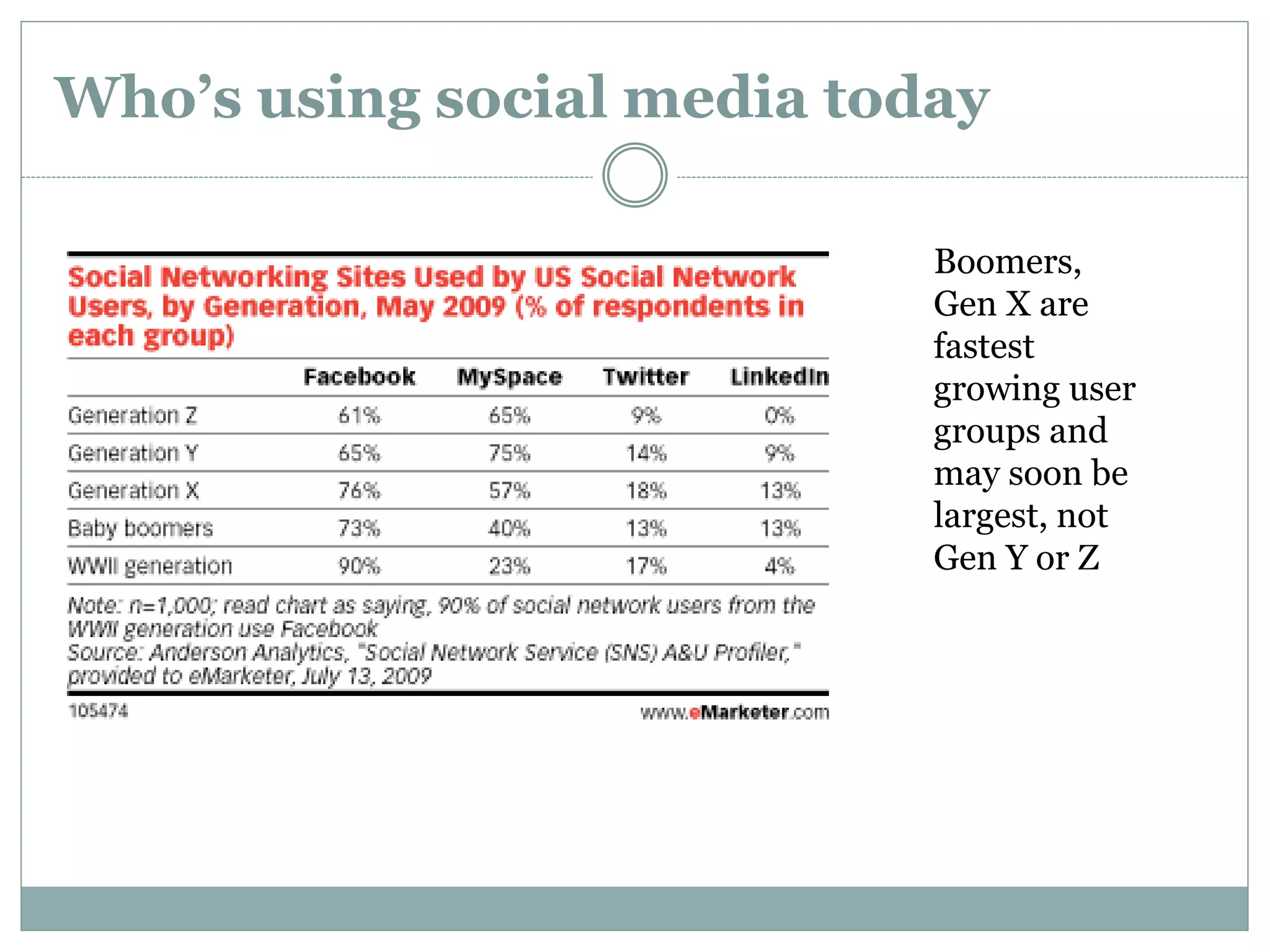
Who’s using social media today
Boomers,
Gen X are
fastest
growing user
groups and
may soon be
largest, not
Gen Y or Z
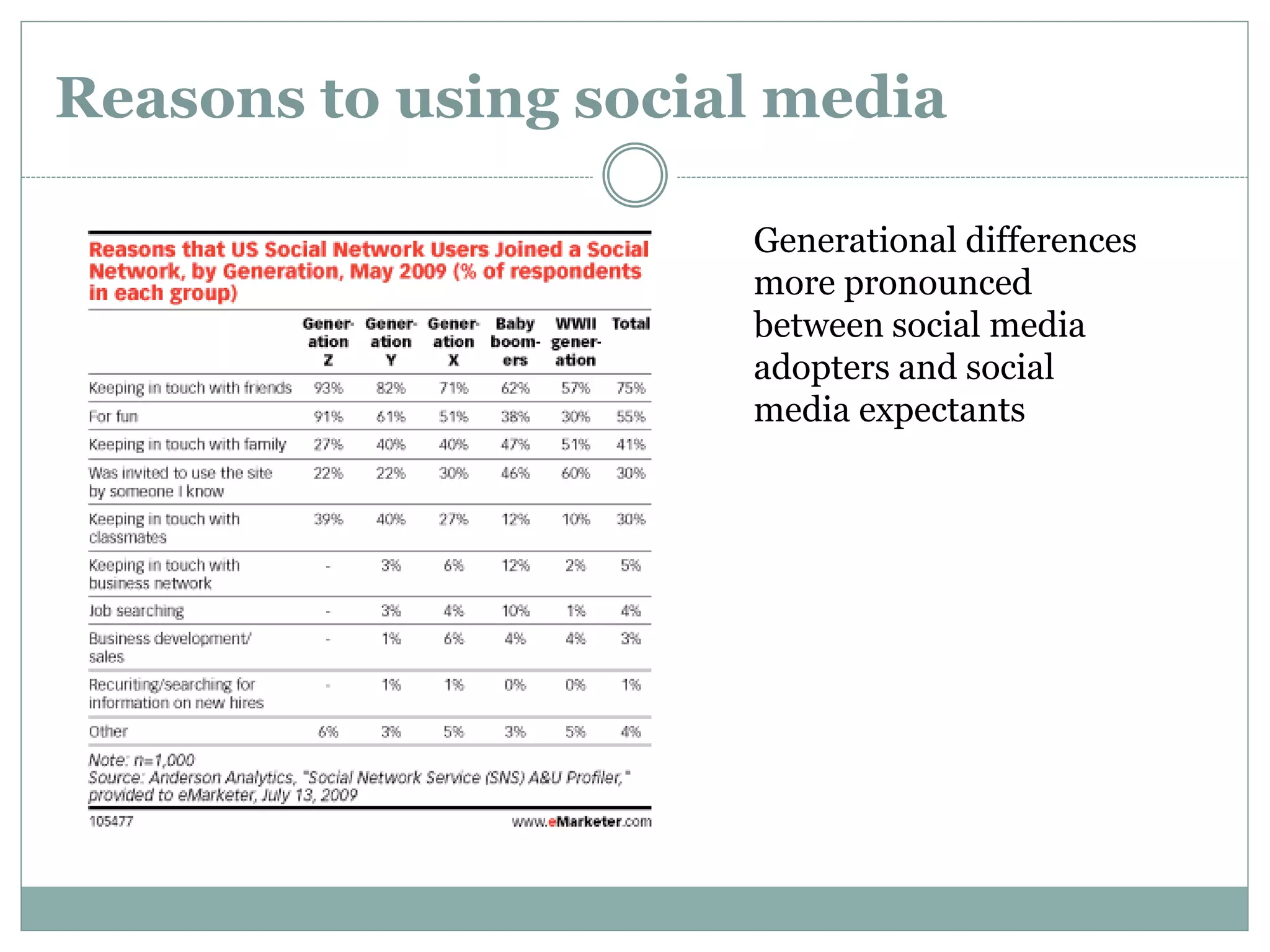
Reasons to using social media
Generational differences
more pronounced
between social media
adopters and social
media expectants
The Big 3 social media for business
 Facebook – Biggest player with 250 million users,
added 50 million in Q209. No. 1 for stickiness with
average 4.5 hours time spent per user in June. Best
for: Connecting with friends, public face for fans.
 Twitter – Micro-blogging in real time. Fastest
growing, reported 19% growth in July over June,
nearly 2000% YOY. World’s biggest focus group. Best
for: Consumer services and interaction.
 LinkedIn – Grow your network exponentially. Not
just for job seekers, 57% of employers registered and
using. Identify key customer contacts, establish
expertise and trust. Best for: Business services, brand.
Pros & cons: Facebook
PROS
 Huge user base
 Search tools
 Mashup apps
 “True” friends, fans
 Stickiness
 Simple business model
 Easy to create and
manage targeted ads
CONS
 Difficult to navigate
 Time intensive
 Opt-in requirement
 Must log in, less
immediate
 “Thick” apps
 Somewhat limited
capabilities for business
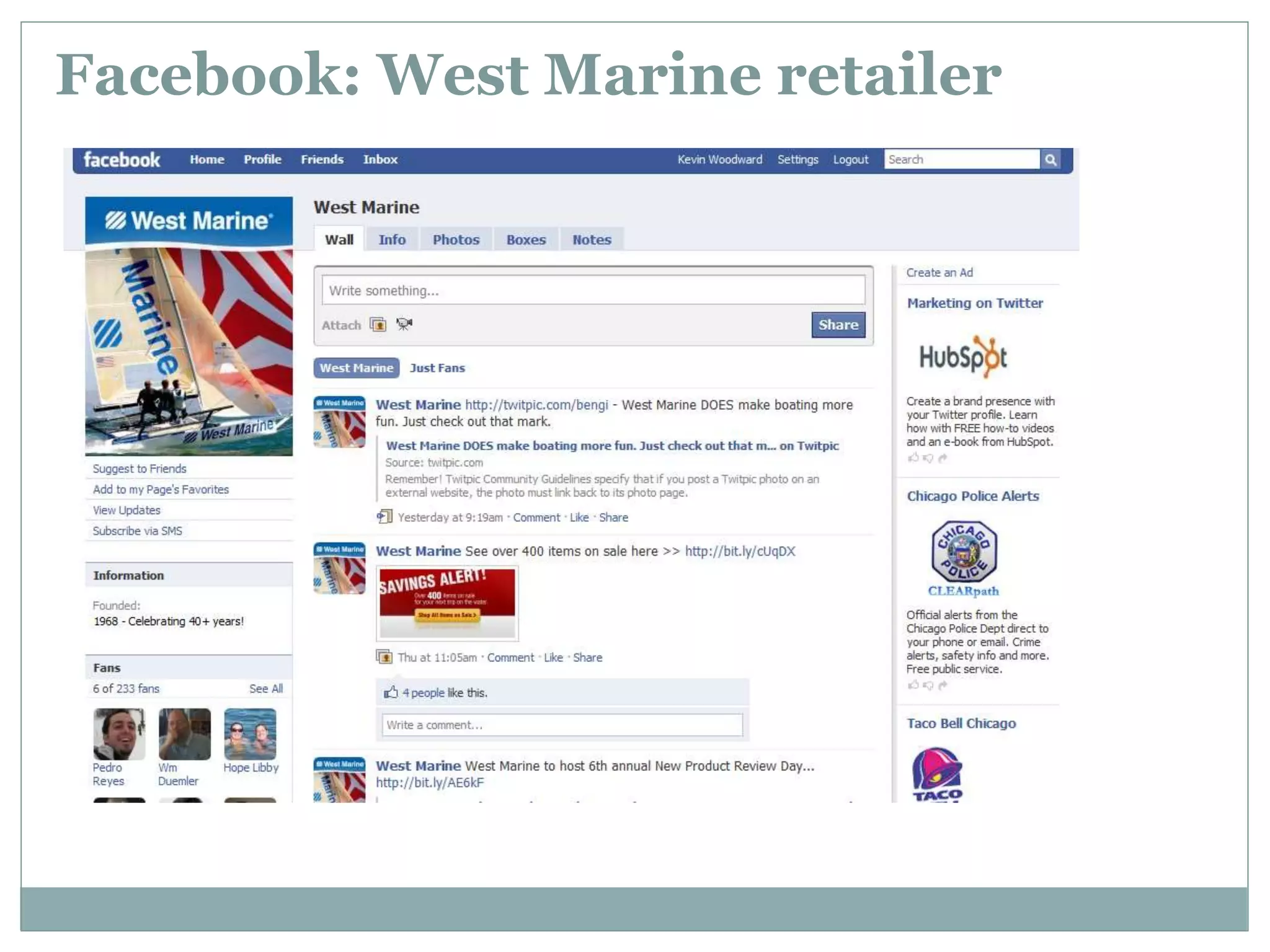
Facebook: West Marine retailer
Facebook: Girl Geek organization
Pros & cons: Twitter
PROS
 Broad reach
 Research, prospecting
capabilities
 Immediate connection,
direct engagement
 “Thin” overhead
 Hotness factor
 Flexibility
 Mobile phone options
CONS
 Easy to abuse, spam
 Smaller, but dedicated
user base
 140-char message
limitation
 Early stage of adoption
 More business services
coming, but undefined
Twitter: West Marine retailer
Twitter: Politician
Pros & cons: LinkedIn
PROS
 Considered “must have” in
business today
 Increase visibility and
connectability
 Research clients, prospect
for new ones, insight into
competition
 Use your contacts for
ecommendations and
introductions
 Search engine optimization
 Controls, privacy features
 Groups
CONS
 Controls, privacy features
 Must be savvy and use
strategically
 Some slow to recognize
business value
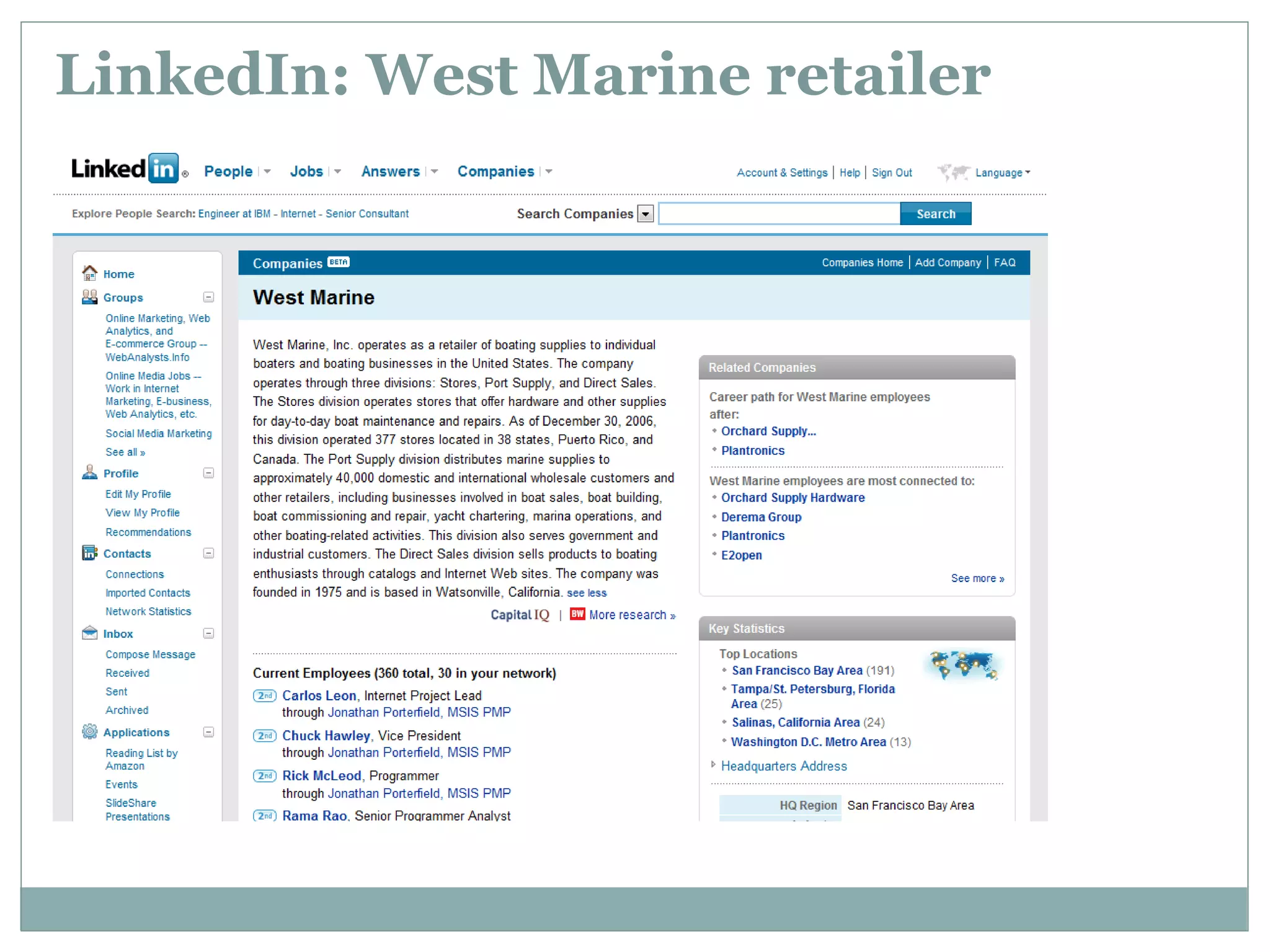
LinkedIn: West Marine retailer
LinkedIn: Company search
Blog: Engage with a purpose
What is the message you
want to communicate?
Best practice is to avoid
hard sell, focus on
helping, sharing.
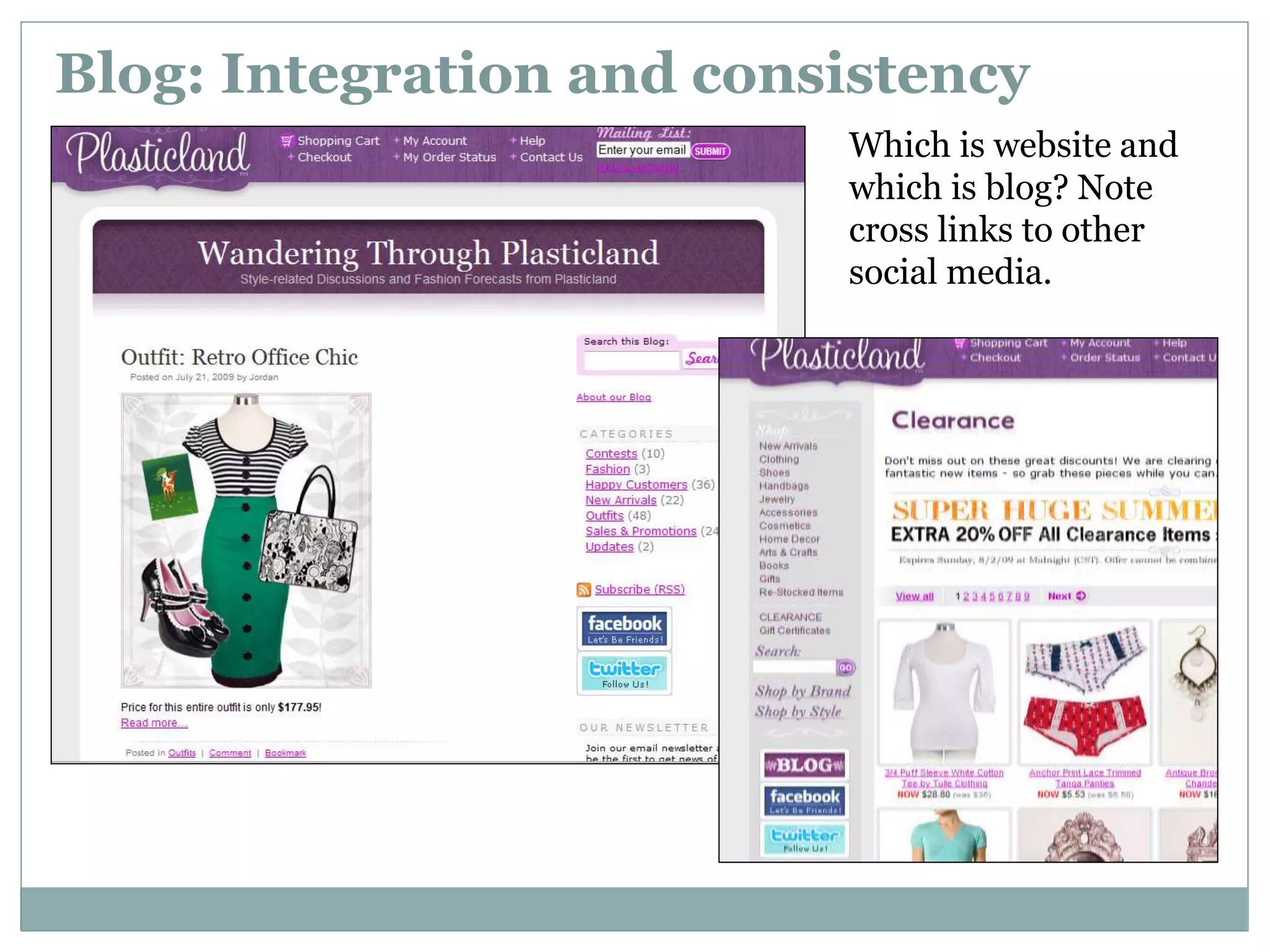
Blog: Integration and consistency
Which is website and
which is blog? Note
cross links to other
social media.
Other: YouTube, multimedia
Video
presence and
hosting
expands
reach. New
tools enable
anyone to tell
a story with
sound and
pictures.
Other sites:
Vimeo,
12seconds.
Social Networking Rules of Engagement
1. A plan that includes measureable success criteria
2. Listen to your audience and what it is telling you
3. Define your brand and align with profiles
4. If you don’t know, ask (or tweet) someone
5. Focus and connect first with who you know best
6. Actively engage with your customers
7. Track and report on usage and results
8. Review , analyze, update … and repeat
9. Manage your time effectively
10. Don’t be afraid to get your feet wet
Points to remember
 Everybody wants to be popular. While popularity
can build share, you have to reach and engage the
right customers to be successful.
 Control your emotions and focus on persuasion,
empathy, trust (PET).
 Help don’t sell. Reach out and others will reach
back.
 Be authentic … be consistent … and have fun.
 At the end of the day it’s better to have a great
product than to be great in social media
Thank you … and stay connected
KEVIN WOODWARD
Email: kwoodward@yahoo.com
Phone: 831-359-5419 (mobile, text), 831-662-3987 (landline)
Social MediYeah! blog:
http://kevinwoodward.wordpress.com
LinkedIn:
http://www.linkedin.com/in/kevincwoodward
Facebook:
http://www.facebook.com/kwoodward
Twitter:
http://twitter.com/kevinwoodward

Social Media And Networking

  • 1.
    HUMAN INTERACTION HASNOT CHANGED. IT’S WHERE IT HAPPENS THAT’S CHANGED. Social Media and Networking: What it is & why it’s important Kevin Woodward kwoodward@yahoo.com
  • 2.
    Defining Social Mediaand Networking Social Media is the content, tools and services created and used by people online … such as Facebook, Twitter, LinkedIn, YouTube, blogs, groups, wikis and others.* Social Networking is the act of building interactive online communities of people with shared interests through communication and sharing of information.* * Wikipedia
  • 3.
    What it’s about:The bottom line It’s not about the tools, it’s about the relationships. Somewhere, someone has something important to tell you. Listening isn’t a choice, it’s a strategy. A recent study found that not only can you quantify and measure social media engagement for the business, there is a direct correlation with the bottom line. The most actively engaged companies reported revenue gains of 18 percent on average in the last year, while those who didn’t reported average losses of 6 percent.* * ENGAGEMENTdb: Ranking the Top 100 Global Brands | July 21, 2009
  • 4.
    U.S. monthly onlineactivity usage Social media and networking sites have more overall usage now than text messaging … and growing
  • 5.
    Who’s using socialmedia today Boomers, Gen X are fastest growing user groups and may soon be largest, not Gen Y or Z
  • 6.
    Reasons to usingsocial media Generational differences more pronounced between social media adopters and social media expectants
  • 7.
    The Big 3social media for business  Facebook – Biggest player with 250 million users, added 50 million in Q209. No. 1 for stickiness with average 4.5 hours time spent per user in June. Best for: Connecting with friends, public face for fans.  Twitter – Micro-blogging in real time. Fastest growing, reported 19% growth in July over June, nearly 2000% YOY. World’s biggest focus group. Best for: Consumer services and interaction.  LinkedIn – Grow your network exponentially. Not just for job seekers, 57% of employers registered and using. Identify key customer contacts, establish expertise and trust. Best for: Business services, brand.
  • 8.
    Pros & cons:Facebook PROS  Huge user base  Search tools  Mashup apps  “True” friends, fans  Stickiness  Simple business model  Easy to create and manage targeted ads CONS  Difficult to navigate  Time intensive  Opt-in requirement  Must log in, less immediate  “Thick” apps  Somewhat limited capabilities for business
  • 9.
  • 10.
    Facebook: Girl Geekorganization
  • 11.
    Pros & cons:Twitter PROS  Broad reach  Research, prospecting capabilities  Immediate connection, direct engagement  “Thin” overhead  Hotness factor  Flexibility  Mobile phone options CONS  Easy to abuse, spam  Smaller, but dedicated user base  140-char message limitation  Early stage of adoption  More business services coming, but undefined
  • 12.
  • 13.
  • 14.
    Pros & cons:LinkedIn PROS  Considered “must have” in business today  Increase visibility and connectability  Research clients, prospect for new ones, insight into competition  Use your contacts for ecommendations and introductions  Search engine optimization  Controls, privacy features  Groups CONS  Controls, privacy features  Must be savvy and use strategically  Some slow to recognize business value
  • 15.
  • 16.
  • 17.
    Blog: Engage witha purpose What is the message you want to communicate? Best practice is to avoid hard sell, focus on helping, sharing.
  • 18.
    Blog: Integration andconsistency Which is website and which is blog? Note cross links to other social media.
  • 19.
    Other: YouTube, multimedia Video presenceand hosting expands reach. New tools enable anyone to tell a story with sound and pictures. Other sites: Vimeo, 12seconds.
  • 20.
    Social Networking Rulesof Engagement 1. A plan that includes measureable success criteria 2. Listen to your audience and what it is telling you 3. Define your brand and align with profiles 4. If you don’t know, ask (or tweet) someone 5. Focus and connect first with who you know best 6. Actively engage with your customers 7. Track and report on usage and results 8. Review , analyze, update … and repeat 9. Manage your time effectively 10. Don’t be afraid to get your feet wet
  • 21.
    Points to remember Everybody wants to be popular. While popularity can build share, you have to reach and engage the right customers to be successful.  Control your emotions and focus on persuasion, empathy, trust (PET).  Help don’t sell. Reach out and others will reach back.  Be authentic … be consistent … and have fun.  At the end of the day it’s better to have a great product than to be great in social media
  • 22.
    Thank you …and stay connected KEVIN WOODWARD Email: kwoodward@yahoo.com Phone: 831-359-5419 (mobile, text), 831-662-3987 (landline) Social MediYeah! blog: http://kevinwoodward.wordpress.com LinkedIn: http://www.linkedin.com/in/kevincwoodward Facebook: http://www.facebook.com/kwoodward Twitter: http://twitter.com/kevinwoodward